You paid a premium for water-repellent fabric. The supplier’s spec sheet said "DWR finish, waterproof." Your marketing team wrote "rain-ready" on the product page. Three weeks after launch, a customer posts a photo of your jacket soaked through after a light drizzle, the fabric dark with absorbed water, the wearer visibly miserable. The comments pile up. You pull the inventory and spray a sample yourself, and the water does not bead. It sinks in. You trusted the spec sheet, and the spec sheet was either wrong about the current lot or the finish washed out after three wears. Now you have a return wave and a credibility gap.
Genuine water repellency is not a permanent property. It is a measurable performance characteristic that must be tested on the actual bulk fabric, not just the development sample, and re-tested after laundering to confirm durability. A fabric can pass a spray test fresh off the finishing line and fail the same test after five home washes. At Shanghai Fumao, I test water repellency on every C0 DWR or C6 DWR lot before shipment, and I test it again after accelerated laundering to confirm the finish is durable. I am going to show you three simple tests you can do at home or in your office to verify water repellency yourself, explain how the industry-standard spray test works, and teach you how to write a DWR specification that guarantees performance through the wash cycles your customer expects.
What Is the Difference Between Water-Repellent, Water-Resistant, and Waterproof?
These three terms are used interchangeably in marketing copy, but they describe fundamentally different levels of water protection, measured by different tests, and appropriate for different end-uses. Getting the terminology right is not pedantry. It determines which test you specify in your purchase order and whether a failed test is a legitimate quality complaint or a misunderstanding of the product’s capability.
Water-repellent is the lowest level of water protection. The fabric resists wetting—water beads up and rolls off the surface—but it is not impervious to water penetration under pressure. Water repellency is achieved by a durable water repellent (DWR) chemical finish applied to the fabric surface, which lowers the surface energy so water cannot spread out and wet the fibers. The test for water repellency is the spray test, which evaluates how much of the fabric surface remains unwetted after a standardized water spray.
Water-resistant is a middle level. The fabric resists water penetration to some degree, usually due to a tight weave, a coating, or a membrane combined with a DWR finish. Water-resistant fabrics can keep the wearer dry in light rain for a short period, but they will eventually wet through under sustained exposure or pressure. There is no single standardized test for water resistance; it is a general performance claim.
Waterproof is the highest level. The fabric prevents water penetration entirely, even under pressure. Waterproofness is measured by the hydrostatic head test, which determines how tall a column of water the fabric can support before a single drop penetrates. A fabric with a 5,000mm hydrostatic head rating is waterproof for light rain. A fabric with a 20,000mm rating is waterproof for heavy rain and pressure from sitting or kneeling. Waterproofness requires a membrane, a coating, or a very dense weave combined with a high-performance DWR.

How Does the "Spray Test" Measure True Water Repellency?
The spray test, standardized as AATCC TM22 or ISO 4920, is the industry standard for measuring water repellency. A fabric sample is mounted on a ring at a 45-degree angle. A specified volume of water—250 milliliters—is sprayed from a standardized nozzle at a fixed height onto the fabric surface for 25 to 30 seconds. After the spray, the fabric is tapped to remove excess droplets, and the wetted surface is visually compared against a photographic rating scale.
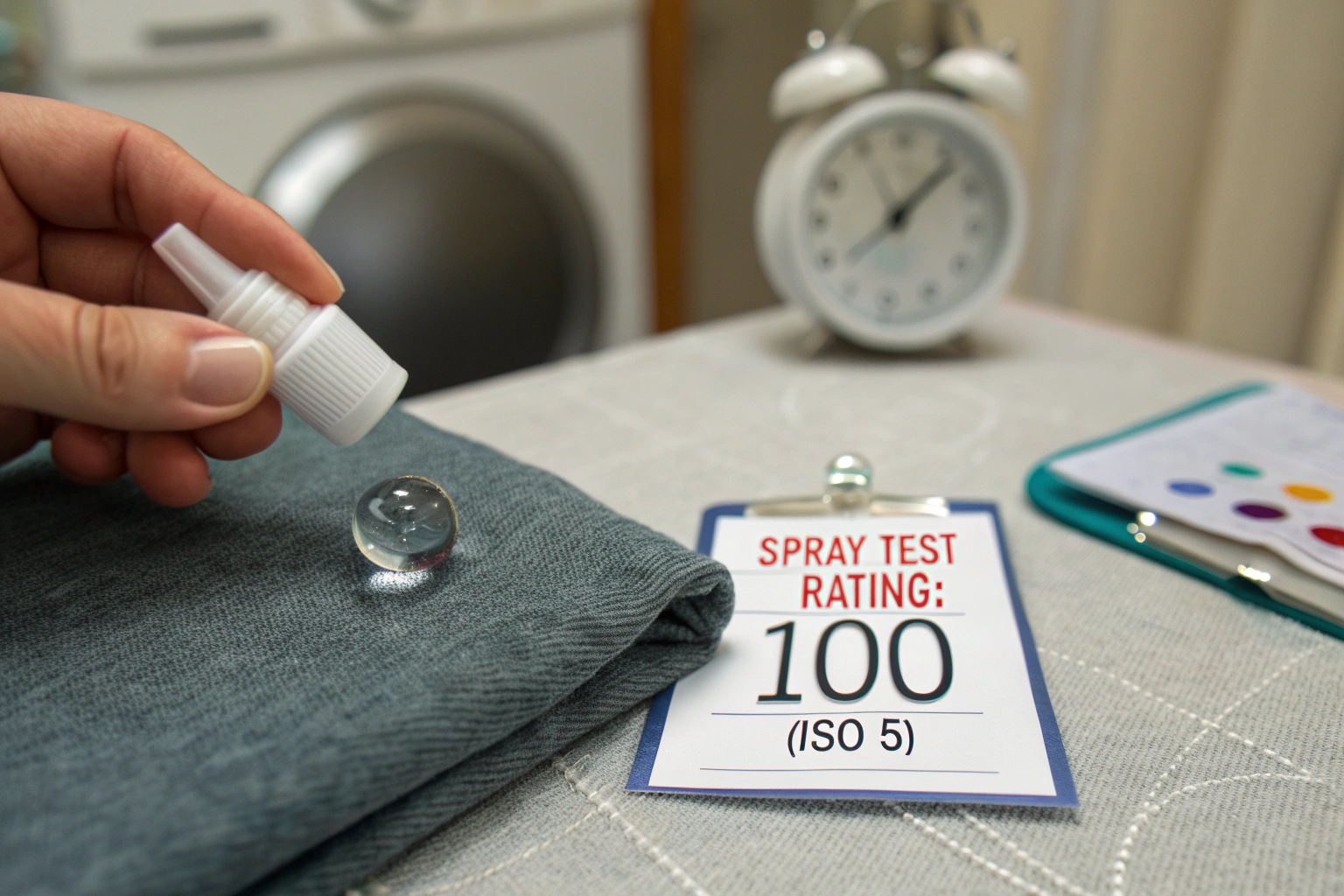
The rating scale ranges from 0 to 100, or ISO 0 to ISO 5, depending on the standard used. A rating of 100 (ISO 5) means no wetting—every water droplet beaded up and rolled off, and the fabric surface is completely dry. A rating of 90 (ISO 4) means slight, random sticking of droplets with small wet patches. A rating of 80 (ISO 3) means wetting at the spray points. A rating of 70 (ISO 2) means partial wetting of the entire sprayed area. A rating of 50 (ISO 1) means complete wetting of the entire sprayed area. A rating of 0 means the fabric absorbed water like a sponge, with wetting on both the face and the back. A genuine water-repellent fabric for outdoor apparel should achieve a minimum spray rating of 90 (ISO 4) before washing and 80 (ISO 3) after the specified number of washes.
Why Does a "Hydrostatic Head" Test Measure Waterproofness, Not Repellency?
The hydrostatic head test, standardized as AATCC TM127 or ISO 811, measures the pressure required to force water through the fabric. The fabric is clamped under a column of water, and the water pressure is increased until the third droplet penetrates the fabric. The height of the water column at that moment, measured in millimeters, is the hydrostatic head rating.
The hydrostatic head test measures water penetration under pressure, not surface beading. A fabric can have a high hydrostatic head rating and still wet out on the surface, losing its breathability even if no water penetrates through. A fabric can have a high spray rating and a low hydrostatic head rating—water beads on the surface but soaks through under pressure. The two tests measure different things and are not interchangeable. For a rain jacket, you need both: a high spray rating for surface beading and a high hydrostatic head rating for penetration resistance. If you are specifying water repellency specifically, you need the spray test, not the hydrostatic head test.
How to Do a "Spray Test" at Home with a Spray Bottle?
You do not need a lab spray tester to evaluate whether your fabric repels water. A standard household spray bottle, a protractor or angle-measuring app on your phone, and a printed spray test rating chart downloaded from the internet are enough to catch a DWR failure. The home spray test is qualitative, not quantitative, but it will tell you whether the fabric beads water or absorbs it instantly.

What Household Items Can Mimic the AATCC Spray Test?
You need a spray bottle with a fine mist setting, not a jet stream. A standard, new, clean household spray bottle is acceptable. Fill it with room-temperature tap water. You need a way to hold the fabric at a 45-degree angle—a cutting board propped against a wall or a stack of books, with the fabric taped or clipped to it. You need a measuring cup to pour exactly 250 milliliters of water if you want to be precise, but for a screening test, a full spray bottle is sufficient. You need a printed AATCC spray test rating chart, which is available for free from several textile testing websites.
Spray the fabric from a distance of about 15 centimeters, moving the spray across the surface for roughly 25 seconds. Tap the fabric once or twice to remove large droplets, and immediately compare the wetted surface to the rating chart. A fabric that shows no wetting—only perfectly beaded droplets—is equivalent to a 100 or ISO 5 rating. A fabric that shows distinct wet patches is below 80 or ISO 3, and it is not adequately water-repellent for outdoor apparel. If you want to follow the protocol more rigorously, there are guides on how to perform a water repellency spray test at home that provide step-by-step instructions with photos.
How to Test the "Contact Angle" of a Water Droplet with Your Phone?
The contact angle is the angle at which a water droplet meets the fabric surface. A high contact angle—above 120 degrees—means the droplet is nearly spherical and the fabric is highly repellent. A low contact angle—below 90 degrees—means the droplet is spreading out and the fabric is wetting. You can estimate the contact angle by placing a single droplet on the fabric surface using an eyedropper or a straw, then photographing it from the side with your smartphone.
Zoom in on the droplet in the photo. Draw an imaginary line along the fabric surface and another line tangent to the droplet where it meets the surface. The angle between these two lines is the contact angle. A spherical droplet that sits on top of the fabric with minimal surface contact has a contact angle above 150 degrees, indicating exceptional repellency. A droplet that has flattened into a dome shape has a contact angle between 90 and 120 degrees, indicating moderate repellency. A droplet that has spread into a flat puddle has a contact angle below 90 degrees, indicating the DWR has failed. This test takes seconds and gives you a visual, intuitive measure of water repellency.
How to Test If the DWR Finish Survives Washing?
A DWR finish that disappears after three washes is not a durable water repellent. It is a temporary fabric treatment that should have been marketed as "needs re-proofing after every wash." Many budget DWR finishes, particularly older C8 fluorocarbon chemistries applied with minimal curing, wash out rapidly. Newer C0 non-fluorinated DWR finishes can also have poor durability if not properly cured during finishing. The only way to know if your DWR is genuinely durable is to wash the fabric and re-test water repellency.

What Is the "5-Wash DWR Retention" Test and How Can You Do It?
The standard durability test for DWR is to wash the fabric five times according to a specified protocol—typically AATCC 135 or ISO 6330, using a standardized detergent and a specified water temperature and drying method—and then re-test the spray rating after the fifth wash. A quality C6 or C0 DWR finish should maintain a spray rating of 80 or above after five washes. A premium DWR finish will maintain a rating of 90 or above.
You can perform this test at home. Cut enough fabric swatches for before-wash and after-wash testing. Machine wash the fabric five times using a standard laundry detergent—not a specialty technical wash—at 40°C, and tumble dry on medium heat. After the fifth wash and dry cycle, perform your home spray test and compare the result to the unwashed swatch. If the spray rating drops by more than 10 points or the water stops beading entirely, the DWR is not adequately durable for a garment that requires regular washing.
Why Does Tumble Drying Sometimes "Reactivate" a DWR?
Many DWR finishes, particularly older C6 fluorocarbon chemistries, are heat-activated. The DWR molecules are aligned on the fiber surface during the heat-curing step in the finishing process, but washing can disrupt this alignment—molecules get flipped, buried, or removed. Tumble drying applies heat to the fabric, which can re-orient the remaining DWR molecules on the fiber surface, partially restoring water repellency.
This is why a garment that wets out after air drying may bead water again after a cycle in the tumble dryer. The DWR was not completely washed away; it was just disorganized. The heat re-organizes it. If tumble drying does not restore the beading, the DWR has been physically removed from the fiber surface and the garment needs re-proofing with a wash-in or spray-on DWR product. I recommend tumble drying as the first troubleshooting step when a water-repellent garment starts wetting out. At Shanghai Fumao, I include a care label instruction for tumble drying specifically to help the consumer maintain the DWR performance.
How to Write a DWR Specification That Guarantees Performance?
A purchase order that says "water-repellent finish" is a wish. A purchase order that specifies the spray test method, the minimum rating before and after washing, the number of wash cycles, and the DWR chemistry is an enforceable quality standard. You must write the specification in terms the mill can test against and a third-party lab can verify.

What DWR Chemistry Should You Specify in 2026?
The regulatory landscape for DWR chemistry has shifted decisively away from fluorocarbons. C8 fluorocarbon DWRs, which used perfluorooctanoic acid (PFOA), are banned in most major markets. C6 fluorocarbon DWRs are being phased out under REACH and other regulatory frameworks, with increasing restrictions expected through 2026 and beyond. The current industry direction is toward C0 non-fluorinated DWR chemistries, which use hydrocarbon, silicone, or dendrimer-based technologies.
C0 DWRs have historically had lower durability than C6 DWRs, but the latest generation—products like Zelan R3 from HeiQ, or Eco-Repel from Rudolf—have closed much of the performance gap. I recommend specifying a C0 DWR chemistry and naming a specific, proven product or requiring that the performance specification be met regardless of chemistry. If you are marketing to the European outdoor market, C0 is effectively mandatory for brand acceptance. If your market does not require it, C6 DWR still offers slightly better durability at a slightly lower cost, but the regulatory window is closing.
What Is the "After-Wash Spray Rating" Clause You Must Include?
The after-wash requirement is the most important line in the specification and the one most buyers omit. Write this: "Water Repellency per AATCC TM22: Initial spray rating minimum 90 (ISO 4). After 10 home launderings per AATCC 135, 40°C wash, tumble dry medium, spray rating minimum 80 (ISO 3)." The ten-wash requirement pushes the DWR supplier to provide a durable chemistry and the mill to cure it properly. A five-wash requirement is a minimum. A ten-wash requirement separates a quality DWR from a budget temporary treatment.
Include a remedy clause: if the after-wash spray rating falls below the specified minimum, the supplier must re-process the fabric with a fresh DWR application at their cost, or provide a price reduction if the fabric is accepted with the lower rating. The remedy clause makes the specification enforceable.
Conclusion
Genuine water repellency is not a yes-or-no property. It is a measurable spray rating that must be verified on the bulk fabric and re-verified after laundering to confirm durability. Water-repellent fabrics bead water on the surface but are not waterproof under pressure. The spray test under AATCC TM22 rates repellency on a 0-to-100 scale, and a rating of 90 or above is the standard for outdoor apparel. You can screen for repellency at home with a spray bottle and a printed rating chart. You can test DWR durability by washing the fabric five or ten times and re-testing. Tumble drying can reactivate a disrupted DWR, but a fully washed-out DWR requires re-proofing. The specification in your purchase order must name the test method, the minimum initial rating, the minimum after-wash rating, the number of wash cycles, and the remedy for a failed test.
At Shanghai Fumao, I test water repellency on every DWR lot before shipment and provide the initial and after-wash spray ratings on the mill test report. If you are developing a water-repellent product and want a fabric supplier who provides verified DWR performance data, please contact our Business Director, Elaine. She can send you a DWR swatch pack with spray test results and a durability test protocol you can run yourself. Email her at strong>elaine@fumaoclothing.com. Let us make sure your fabric beads water when your customer walks out into the rain.