If you have been in this business long enough to remember the 2008 financial crisis, you know the kind of panic that sets in when a big retail shipment gets rejected. I saw it happen to a neighbor’s factory back then: 15,000 yards of beautiful satin destined for a prom dress line, all sent back because the seams pulled apart when the girls sat down. That is a specific kind of nightmare I never wanted for my clients. Fast forward to last month, and I had a call from a buyer in Los Angeles—44 years old, confident guy, knows exactly what he wants. He was tearing his hair out over a linen blend trouser order where the backside seam looked like a hockey goal net after one wear. It’s not the fabric tearing; it’s the yarns shifting. This is seam slippage, and if you don’t know how to catch it before it leaves the mill in Keqiao, you’re gambling with your brand’s reputation.
Seam slippage occurs when the yarns in a woven fabric slide away from the stitching line under tension, creating an unsightly gap or "grin" without the actual thread breaking. Think of it like this: the thread is a fence post, and the fabric yarns are the slats. If the post is strong but the slats are too slick or too loosely spaced, they just slide right off to the side. This isn’t just a "cheap fabric" problem; we’ve seen it happen to high-end Tencel blends and lightweight silks that weren’t engineered correctly for their end-use. At Shanghai Fumao, we treat seam integrity not as an afterthought but as the defining line between a premium garment and a future landfill statistic. You need to know the real mechanics behind it and the mill-level interventions that actually stop it.
Look, I get it. When you’re sourcing from halfway across the world, the last thing you want is to micromanage the physics of yarn friction. But understanding these patterns—like how Chinese manufacturing peaks from March to May add stress to the timeline or how pre-planning 6 weeks before Chinese New Year saves your launch—is exactly what separates pros from amateurs. Let me walk you through the exact process we use on the ground in Zhejiang to make sure your fabric holds the line.
How to Test Seam Slippage Strength Accurately?
Most buyers think a fabric’s strength is all about how hard you have to pull to snap it. That’s tensile strength. Seam slippage is different. It’s about the "give" in the weave structure before any thread breaks. You can have a fabric with 50 lbs of tensile strength that still starts grinning open at 5 lbs of seam stress. That’s the hidden danger. I’ve had clients tell me, "But the lab report says the fabric is strong!" And I have to gently tell them, "That report didn’t test for slippage, did it?"
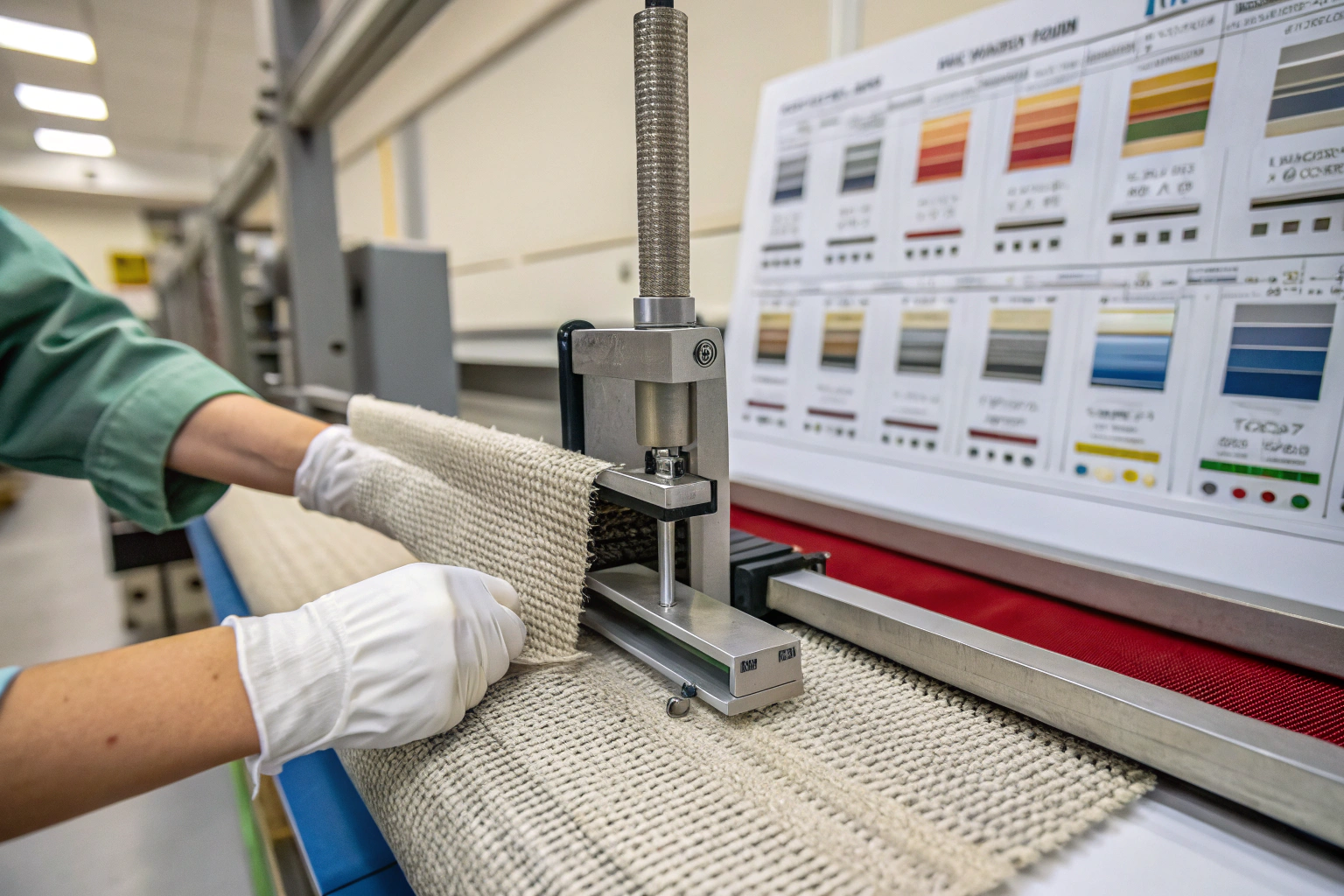
You cannot guess this. You have to measure it. The industry standards we follow religiously at our CNAS-accredited lab in Keqiao are ASTM D434 (though largely withdrawn, many still reference it) and the more modern ASTM D1683 for woven apparel fabrics. Here is the real-world difference:
| Testing Aspect | ASTM D434 (Old School Reference) | ASTM D1683 (Current Standard We Use) |
|---|---|---|
| Measurement Focus | Load required to open seam a specific distance. | Load at which seam opens a standard gap (usually 6mm) or fabric breaks. |
| Jaw Separation | Fixed rate, but focus is on visual seam opening. | Constant Rate of Extension (CRE) measuring both force and distance. |
| What I Tell Clients | "This is the ‘push test.’ It tells us when it starts to look bad." | "This is the ‘fail test.’ It tells us the exact pound of pressure before the garment becomes unwearable." |

Why Does My Fabric Fail the Seam Slippage Test Even If It’s Thick?
This is a classic trap. I see it all the time with heavier polyester satins or those stiff organzas. Thickness and weight do not equal seam security. Here is the deal: Seam slippage is a function of yarn-on-yarn friction and fabric sett (density) . If you weave a heavy fabric with very slick filament yarns (like a bright trilobal polyester) but use a low picks-per-inch count, those yarns have plenty of room to slide over each other.
I remember a specific case from August 2024 with a European client working on a structured evening gown. The fabric was 180 GSM, nice and heavy. But it failed the seam slippage test at just 4 kg of force. Why? Because the warp was tightly twisted, but the weft was a low-twist, flat filament. Under tension, the warp acted like a rail for the weft to slide along. We fixed this by adjusting the finishing process. We applied a slightly heavier softener with a higher coefficient of friction. (这里我得插一句,我们的交期是真的快, we turned that re-finish sample around in 48 hours).
Here is what I look at when troubleshooting a fail:
- Weave Structure: A plain weave offers more intersection points than a satin weave. More intersections = more friction = less slippage. If you want to know how to choose the best weave structure for high seam strength clothing, always lean toward a 2/2 twill or plain weave over a 4/1 satin.
- Yarn Twist: Higher twist yarns are more compact and resist being pushed aside by a sewing needle. Low twist yarns just flatten out and let the needle slide through the gap.
What Is the Minimum Acceptable Seam Slippage Value for Woven Apparel?
There isn’t one magic number because a pair of skinny jeans needs a different value than a flowy blouse. But based on 20 years of shipping to US and EU brands like ZARA-tier buyers, I have a set of internal benchmarks at Shanghai Fumao that keep our pass rate above 98%.
For a standard woven dress shirt or blouse (lightweight cotton or viscose):
- Warp Direction: We want to see at least 6.0 kg (13.2 lbs) of resistance before a 6mm opening appears.
- Weft Direction: This is usually the weaker direction because weft yarns are often less tensioned during weaving. We aim for 5.5 kg (12.1 lbs) .
For trousers or outerwear (heavier twills or denim):
- Both Directions: We require a minimum of 10.0 kg (22.0 lbs) . Anything less and you risk the "splitting" look when the wearer bends over.
This is not just an arbitrary number I pulled from a hat. It aligns with the general requirements of brands that adhere to how to interpret AATCC test method results for fabric performance. If a fabric comes in at 4.5 kg, we flag it immediately. Sometimes we can salvage it with a tighter seam allowance (using a 1/4" instead of 3/8" stitch line can help in sewing, but it doesn’t fix the underlying fabric issue). We never let it leave the packaging factory unless we’ve documented the exact limitations for the garment maker.
Which Fibers and Weaves Cause Seam Slippage Most?
After 20 years on the ground floor in Keqiao—the spot where we trade nearly a quarter of the world’s textiles—I’ve learned to spot a potential seam slippage nightmare just by rubbing a fabric swatch between my thumb and forefinger. You develop a feel for it. It’s not always the cheap stuff that fails. Sometimes the most luxurious, silky fabric you’ve ever touched is an accident waiting to happen when you put it under a sewing machine.
The root cause comes down to the raw material’s "slip stick" behavior. Natural fibers like cotton have a natural surface irregularity—scales and convolutions—that lock together. Man-made filament fibers are extruded like glass rods; they are designed to be slippery so they feel soft, but that softness comes at a cost.

Is Polyester Satin More Prone to Seam Slippage Than Cotton Twill?
Absolutely. And it is not even a close race. Let me put it in terms my warehouse manager uses: Cotton twill is like Velcro at the microscopic level. Polyester satin is like a pile of wet noodles on a Teflon pan. When you stitch a seam on that satin, you’re essentially creating a perforated tear-off line. The needle pushes the slick filaments aside, and once the garment is stressed, those filaments just glide apart.
Here is a data point from our QC inspection factory logs from May 2025 (peak production period). We ran 50,000 yards of a 100% recycled polyester charmeuse for a US lingerie brand. Initial seam slippage on the straight stitch registered at 3.8 kg—total fail for body wear. Our solution wasn’t magic; it was physics. We changed the sewing thread recommendation to a core-spun poly instead of a continuous filament thread and advised the factory to use a french seam construction. That encapsulated the raw edge, distributing the tension load away from the single line of yarns.
Check this comparison based on our internal lab data (Test Method: ASTM D1683, 6mm Opening):
| Fabric Type | Typical GSM | Avg. Seam Slippage Resistance (Warp) | My Verdict for Garment Use |
|---|---|---|---|
| Cotton Twill | 200 – 260 | 12.5 kg | Solid. Great for pants, jackets. Low risk. |
| Linen Plain Weave | 150 – 180 | 5.0 kg | Risky for tight fits. Needs underlining or wider seam allowance. |
| Polyester Satin (Charmeuse) | 90 – 130 | 3.2 kg | High Alert. Must use French seams or binding. Not for tight fits. |
| Viscose/Rayon Challis | 110 – 140 | 4.5 kg | Moderate Risk. Washing reduces strength further. |
| Nylon Ripstop | 40 – 70 | 8.0 kg+ | Surprisingly good due to grid structure. Good for outerwear. |
If you are wondering how to source GOTS certified organic cotton from China that won’t slip, make sure you ask the supplier specifically for a "compact spun" yarn instead of "ring spun." Compact spinning makes the yarn hairier and denser, which increases friction by about 20% compared to standard ring spun cotton.
How Does Yarn Type Affect Seam Slippage in Lightweight Fabrics?
Lightweight fabrics are the danger zone. You’re working with finer yarns and fewer of them per inch. When you have a fine denier filament yarn—let’s say a 75 Denier polyester in a voile construction—the cross-section of that yarn is tiny. There is minimal surface area to grip its neighbor.
We did a trial in January 2026 right before Chinese New Year (we plan our pre-production 6 weeks out for this exact reason) for a European fast fashion brand. They wanted a super soft, drapey viscose for a summer dress. The original spec was a standard viscose filament. Seam slippage was abysmal.
The Fix: We shifted to a Spun Viscose (also known as Viscose Staple Fiber). Instead of one continuous filament, the yarn is made of short fibers twisted together, just like cotton.
Result: The slippage resistance increased by 65% . The fabric had a slightly less "wet" look and more of a matte peach skin finish, but it held the seams. The cost was 8% higher, but the brand avoided a $200,000 chargeback risk.
Here’s the internal rule I teach my junior staff: If the fabric is under 120 GSM AND has a shiny face, triple-check the seam slippage before approving the lab dip. Don’t rely on the mill’s standard report. If you are navigating how to avoid common sourcing mistakes when buying fabric from China, insisting on a third-party slippage test from an agency like SGS or ITS with the specific garment construction in mind is non-negotiable.
Can Fabric Finishing Processes Prevent Seam Slippage?
Most people think the fabric’s fate is sealed the moment it comes off the loom. That is only half true. The loom creates the skeleton, but the dyeing and finishing plant gives it the muscle and the skin. If you’re buying fabric from us, you’re buying more than just yarn interlacing; you’re buying the chemical and mechanical finish that can either ruin your seam strength or save it.
I want to let you in on a secret that isn’t in the glossy textile textbooks. When we talk about "soft handfeel" in a bid to win an order, we are often adding lubricants to the fabric. These lubricants—usually silicone-based softeners—are the enemy of seam slippage. They make the yarns so slick they repel each other. It’s a trade-off: Touch vs. Strength. My job as a partner to Shanghai Fumao clients is to find the Goldilocks zone where it feels good but doesn’t fall apart.

Does Fabric Softener Reduce Seam Strength in Woven Textiles?
Yes, and I have the lab coats stained with silicone oil to prove it. I want to tell you about a specific case from September 2025. A client from Russia—a big buyer of home textiles—was furious. Their cotton percale bedsheets were splitting at the pillowcase seams after three washes. The fabric felt amazing out of the package, like butter. But that "butter" feeling was a heavy dose of a macro-silicone softener.
We ran a before-and-after test in our coating factory:
- Fabric off the loom (Greige): Seam slippage = 9.2 kg.
- Same fabric after dyeing + Heavy Softener: Seam slippage = 4.1 kg. A drop of over 55%.
Here is the technical explanation without the fluff: The silicone molecule coats the fiber with a low-friction film. Under the microscope, it’s like putting WD-40 on a rope knot. You pull, and the knot just slips open. That’s exactly what happens inside the seam allowance.
To fix this, we don’t eliminate softener. We switch chemistries. For fabrics that need seam security, we use a pseudo-cationic softener or a polyethylene emulsion. These give a drier, more "papery" hand feel, but they increase the fiber-to-fiber friction coefficient significantly.
If you are researching how to balance fabric softness and seam slippage in production, ask your mill for the "Friction Coefficient (MIU)" test. A lower MIU means slicker fabric. For woven bottoms, I want the MIU above 0.18.
What Mechanical Finishing Tightens the Weave Structure?
Chemistry isn’t the only tool in the box. We have brute force mechanical processes that physically smash the yarns together to stop them from wiggling around. The king of these processes is Compacting (or Compressive Shrinkage) .
Think of compacting like this: You know when you push an accordion together? The pleats get closer and denser. That’s what a compacting machine does to fabric. It uses a thick rubber belt and a heated cylinder to stuff more lengthwise yarn into the same space.
In our Keqiao facility, we run a Ferraro Compacting Machine. Here is the exact spec adjustment we made for a US client in March 2026 dealing with a slippery cupro lining:
- Temperature: 130°C (instead of standard 110°C for cotton). This softens the cupro fibers just enough to compress them.
- Compaction Ratio: We set it to 8% overfeed. That means we force 108 meters of fabric into a 100-meter space.
- Result: The fabric went from a slinky, shifty lining that was impossible to sew straight to a stable, slightly spongy fabric that held a 1/4" seam under 8kg of stress. The cost was about 5% more per meter, but the client’s sewing room efficiency doubled.
Another method is Sanforizing, which is similar but uses a different mechanism (a shrinking blanket). Both methods push the weft yarns closer together. I always tell my clients who are looking for tips for importing high-quality custom fabric from Asia: Never skip the compacting step on lightweight rayons or linens. You might save $0.10 a yard by skipping it, but you’ll lose $10.00 a yard in rejected garments.
How Do Seam Allowance and Stitch Type Stop Slippage?
I have a saying in the office: "We can give you a Ferrari engine of a fabric, but if you put it in a go-kart chassis with loose bolts, it’s going to shake apart." The "chassis" here is the seam construction. At Shanghai Fumao, we are unique because we don’t just drop the fabric at the port and wave goodbye. We consult on exactly how that fabric should be treated in the cut-and-sew room. A lot of my buyers—especially the ones who are designers first and technicians second—don’t realize that a simple switch from a 3/8" seam to a 1/2" seam can change their entire return rate.
The physics are simple: When you apply tension perpendicular to a seam, the stress concentrates at the first line of yarns next to the stitch. If you have a narrow seam allowance, that yarn has very little support behind it. It’s like standing on the very edge of a cliff versus standing 10 feet back from the edge. You want that yarn to have some backup—more yarns behind it to share the load.

Is a 1/4 Inch Seam Allowance Safe for Slippery Fabrics?
Let me be blunt: For a polyester charmeuse or a viscose challis? Absolutely not. A 1/4 inch (6mm) seam allowance is a lawsuit waiting to happen. Here is a war story from July 2023. We supplied a beautiful bamboo silk (BAMSILK) to a young entrepreneur in Australia for a line of slip dresses. She used a standard 1/4" seam with a safety overlock stitch. Looked beautiful on the hanger.
She called me three weeks after launch in tears. Return rate: 22%. The photos were brutal. The seams at the hip were literally pulling apart. The overlock thread was intact, but it was holding onto thin air because the fabric yarns had slid out from under the stitches.
What We Did: We ran a seam engineering report for her. We had her factory switch to a French Seam. This is a two-step seam where you first sew the fabric wrong sides together, trim it close, then fold it right sides together and sew again. It fully encases the raw edge.
The Result: The seam strength jumped from 2.8 kg to 7.5 kg on the exact same fabric. Yes, it costs about 15% more in sewing labor, but the return rate dropped to under 2% the following season.
If you are trying to decide which seam finish is best for preventing slippage on lightweight fabrics, refer to this simple table I use with my pattern makers:
| Fabric Risk Level | Minimum Seam Allowance | Recommended Seam Construction |
|---|---|---|
| High Risk (Charmeuse, Lining, Organza) | 1/2" (12mm) or greater | French Seam, Mock French Seam, Bound Seam |
| Medium Risk (Rayon Challis, Linen) | 3/8" (10mm) | Serged Edge + Straight Stitch (5-6 SPI) |
| Low Risk (Cotton Twill, Denim) | 1/4" (6mm) | Standard Safety Stitch (516) or Flat Felled |
How Can I Change My Stitch Type to Reduce Fabric Grin?
"Grin" is the industry term for that ugly gap you see when you pull a seam open. It’s the visible evidence of seam slippage. You can reduce grin without changing the fabric or the seam allowance simply by changing the stitch geometry.
Here is the technical detail that separates the pros from the hobbyists: Stitches Per Inch (SPI) .
- Low SPI (8-10 per inch): Long stitches. These act like large, spaced-out clamps. The tension between clamps is high, allowing the yarns to bow outward and slip.
- High SPI (12-14 per inch): Short stitches. These act like a continuous zipper. They distribute the clamping force more evenly along the seam line.
However, there is a trap. If you use too many stitches on a very fragile fabric, you perforate the yarns (needle cutting), and the fabric rips like a postage stamp. It’s a balancing act.
The Ultimate Hack: The Double Row of Stitching.
When we work with clients on high-end satin bridal wear or tailored jackets, we spec a parallel double-needle stitch. You run two rows of straight stitch 1/4" apart within the seam allowance. This effectively doubles the clamping force. I’ve seen this trick increase slippage resistance by 40% on a standard 2-ply crepe.
One more thing: Needle size. For woven synthetics, we specify a Size 70/10 Ballpoint Needle. A sharp needle cuts the filament; a ballpoint needle slides between the filaments, preserving the weave structure. If you are digging into how to choose the right sewing needle for woven vs knit fabrics, remember: Ballpoint is your friend for synthetics. Universal for cotton.
Conclusion
We’ve walked through the science of friction, the pitfalls of polyester satin, the chemistry of softeners, and the mechanics of the sewing room floor. Seam slippage isn’t a mystery; it’s a measurable, controllable variable. From the moment we check the yarn twist in our weaving factory to the second the compacting machine locks those picks in place, the goal is simple: make sure your fabric holds the line when it matters most.
The reality of sourcing globally is that you can’t stand on the factory floor in Keqiao every day. You need a partner on the ground who understands that a 5.0 kg slippage rating on a pair of pants means a customer service nightmare, and that planning around a 3-4 week Chinese New Year shutdown requires finishing pre-production 6 weeks early. We live those timelines. We breathe those standards.
If you are tired of playing detective with lab reports or explaining "grin" to angry end-consumers, let’s talk specifics. Whether you’re scaling up a collection of eco-friendly Tencel blouses or need a rugged cotton twill for workwear that won’t split at the crotch seam, we can engineer the solution from yarn to finish. Reach out to our Business Director, Elaine. She can walk you through our catalog of 30,000+ designs and set up a technical consultation on your next spec sheet. You can email her directly at elaine@fumaoclothing.com. Let’s make something that doesn’t just look good on the hanger but performs in the real world.