
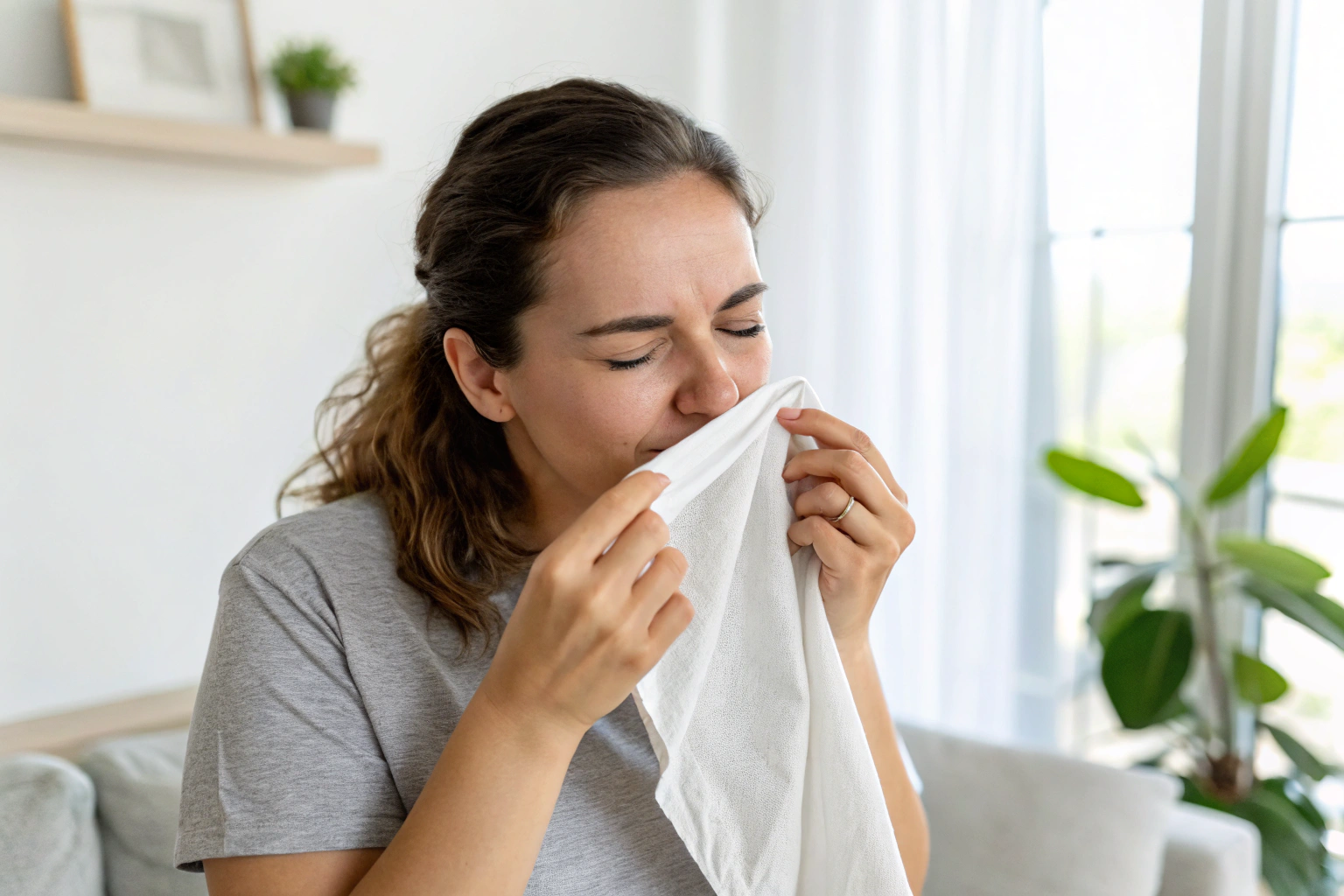
Last month I unboxed a shipment from a new supplier. It was a black polyester spandex knit. The price was great. The handfeel was decent. But the moment I opened that poly bag, a wave of chemical odor hit me like a punch in the face. It smelled like a combination of burnt plastic, gasoline, and mothballs. I had to put the box outside on the loading dock just to air out my office. I knew immediately that this fabric was unsellable. No amount of fabric softener was going to fix that smell. And if I could smell it, imagine what the end customer would think when they opened their online order.
This is the hidden nightmare of fabric sourcing. You can check the weight. You can check the color. You can check the stretch. But smell? That is the sense that online samples and spec sheets cannot transmit. And it is the sense that triggers the most visceral, negative reaction from customers. A smelly garment screams "CHEAP" and "TOXIC" louder than any loose thread ever could.
At Shanghai Fumao, we have dealt with this issue across every fiber type and every finishing process. Chemical odor in fabric is not a mystery. It is a measurable, preventable result of specific manufacturing shortcuts. Let me explain exactly where these smells come from, how we test for them in our CNAS lab, and what you should demand from your supplier to guarantee that the fabric you receive smells like nothing at all.
This is especially critical when you are rushing production during peak periods in March-May or August-October. The temptation for a dye house under pressure is to skip a wash cycle or shorten the curing time. Those are exactly the shortcuts that leave the smell behind. Planning ahead and understanding the chemistry buys you the time to do it right.
What Causes Strong Chemical Odors in Imported Fabrics?
The smell doesn’t come from the fiber itself. Cotton doesn’t smell bad. Polyester chips don’t smell bad. The odor comes from the chemicals used in processing and, more specifically, from the incomplete removal of those chemicals before the fabric is rolled up and shipped.
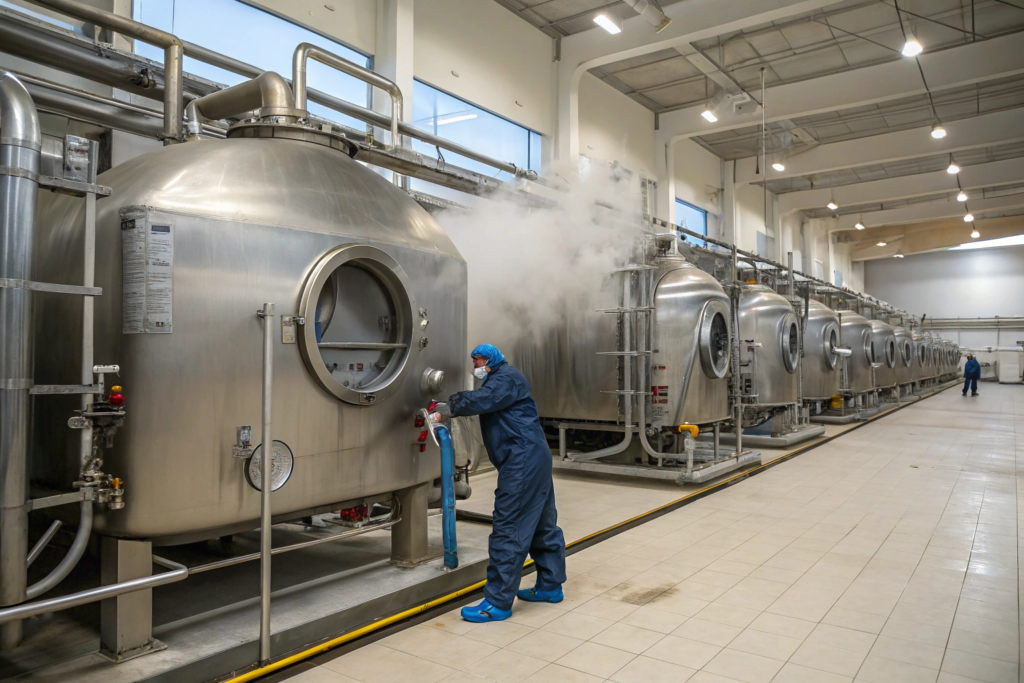
Think of the textile finishing process as a long chemistry experiment. We use dyes to add color. We use softeners to add handfeel. We use leveling agents to make the dye go on evenly. We use defoamers to stop bubbles in the dye bath. We use anti-static agents. We use preservatives to stop mold growth during shipping. Each of these chemicals has a job to do. But if they are not properly washed out or if they are not allowed to fully cure, they remain trapped in the fibers.
When that fabric is sealed in a poly bag and loaded into a hot shipping container for 28 days at sea, those residual chemicals off-gas. They build up in the confined space. By the time the box is opened in a warehouse in Los Angeles or Rotterdam, the concentration of volatile organic compounds is at its peak. That’s the smell that knocks you back.
The most common culprits I encounter in my daily work are specific chemical classes. Let me break them down for you.
Which Finishing Chemicals Are Most Responsible for Residual Smell?
Here is a technical but practical list of the usual suspects. If you can ask your supplier about these specific items, you will sound like a pro and they will know you can’t be fooled.
- Formaldehyde: This is the big one. Formaldehyde-based resins are used as anti-wrinkle finishes and fixatives for certain dyes, especially on cotton and rayon. It smells sharp, pungent, and irritating. It’s what people describe as a "chemical" or "hospital" smell. High levels of formaldehyde are also a skin irritant and a regulated substance.
- Phenolic Compounds: These are used as preservatives and in some carriers for disperse dyes (used for polyester). They smell like tar, creosote, or mothballs. It’s a heavy, oily, industrial odor that is very difficult to remove once it’s in the fiber.
- Amine Compounds: These come from certain azo dyes or from softeners. They often smell fishy or ammonia-like. This is a common complaint with cheap, dark-colored leggings and activewear. The smell gets worse when the fabric gets warm or damp.
- Solvents (VOCs): Used in some printing pastes and coating solutions. These smell like paint thinner, gasoline, or sharp alcohol. They usually dissipate with airing out, but if they are trapped under a coating, they can linger for months.
- Sulfur Compounds: Used in some black dyes (Sulfur Black is a very common, cheap dye for cotton). It smells like rotten eggs. If you ever open a box of black denim and it smells like a sewer, that’s residual sulfur from the dye not being properly washed and oxidized.
I had a situation in October 2025 with a US activewear brand. Their black leggings were getting returned because of a "fishy" smell that appeared when the customer sweated. We traced it back to a cheap amine-based softener the dye house used to get a slick, oily handfeel. The softener wasn’t heat-set properly. Body heat and moisture reactivated the amine smell. We switched the dye house to a cationic softener that bonds permanently to the fiber. The fish smell disappeared. The lesson? Cheap softeners are a false economy. If you are researching how to identify and avoid formaldehyde smells in imported cotton fabrics, always ask for the OEKO-TEX Standard 100 certificate. It sets strict limits on formaldehyde and other extractable chemicals.
Why Does Polyester Packaging Often Trap Unpleasant Odors?
Polyester is a special case. It’s a thermoplastic fiber. When it is heated during dyeing (and polyester must be dyed at very high temperatures, around 130°C), the fiber structure opens up. The disperse dye molecules go inside. Then the fiber cools and closes, trapping the dye.
But it also traps carrier chemicals. Some low-quality dye houses use carriers to help the dye penetrate the polyester faster. These carriers are often chlorinated benzenes or phenols. They smell awful. And because they are trapped inside the fiber, not just on the surface, they are incredibly hard to remove. Airing out the fabric doesn’t work because the smell is coming from inside the yarn.
Then there is the poly bag problem. Polyester fabric is almost always shipped in polyethylene bags to keep it clean. Poly bags do not breathe. They create a perfect sealed environment for off-gassing. Even a low level of residual odor becomes concentrated inside that bag. When you open it, you get the full force.
The fix for polyester is reduction clearing. This is a specific wash process after dyeing. The fabric is washed in a bath of sodium hydrosulfite and caustic soda at high temperature. This chemically breaks down and removes the unfixed, smelly dye and carrier molecules from the surface and the subsurface of the fiber. It adds cost and time to the process. Unscrupulous dye houses skip it or shorten it to save money. That’s when you get the smelly polyester. At Shanghai Fumao, we mandate reduction clearing for all our dark-shade polyester dyeing. It’s non-negotiable. If you are dealing with how to remove chemical smell from new polyester fabric shipments, the answer is: You can’t easily. It has to be done at the dye house. Airing out might help surface smells, but internal smells require industrial washing.
How to Test Fabric for Chemical Odors Before Bulk Production?
You cannot rely on the mill to tell you the fabric smells bad. They work in that environment every day. They are nose-blind to it. And honestly, some suppliers just don’t care. You need a systematic way to test for odor yourself, or you need to demand that a specific test be performed by a third-party lab.
The good news is that odor testing has become much more standardized in the last few years, driven largely by the automotive industry (nobody wants a new car that smells like chemicals) and by brands like IKEA and H&M who have strict VOC limits. We have adopted these methods in our CNAS lab for apparel fabrics.
There are two main approaches: Sensory Testing (using human noses) and Instrumental Testing (using machines). For distributors and brands, a combination of both is ideal. You need the human element to know if it "smells bad" and the machine data to prove there is a chemical problem.
What Is the "Jar Test" and How Do I Perform It Remotely?
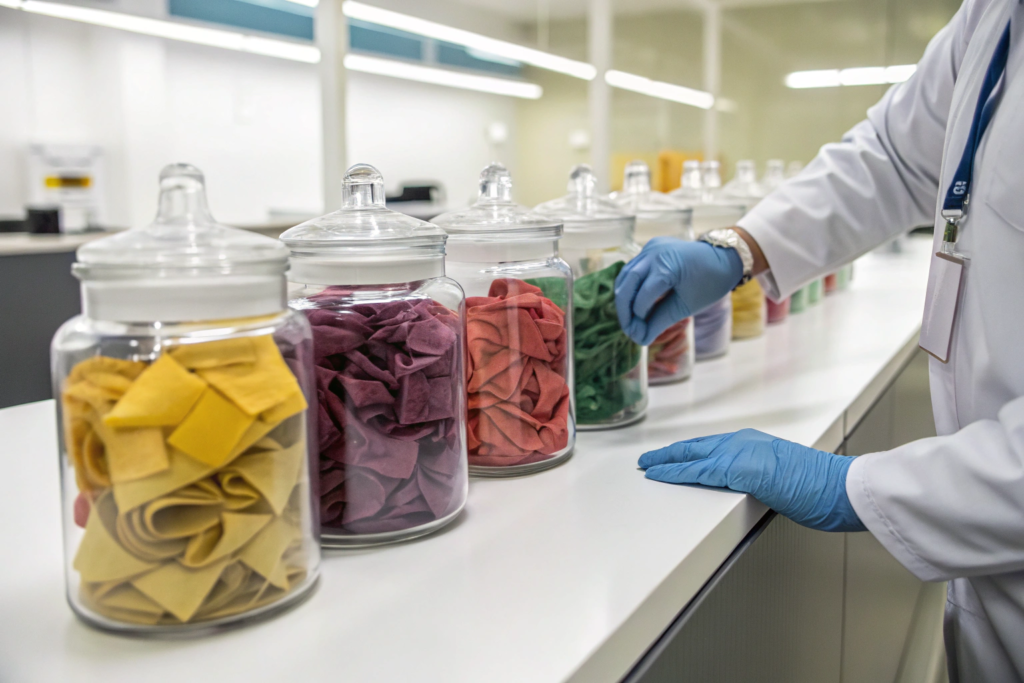
This is the low-tech, high-value test that every single one of my clients should know about. It simulates the shipping container environment. It’s simple, cheap, and incredibly effective at detecting trapped odors.
The Remote Jar Test Protocol:
- Sample: Ask your supplier to send you a 8" x 8" swatch of the bulk production fabric. Do not accept a lab dip swatch. You need the exact fabric with the exact finishing chemicals applied.
- Container: Get a clean glass jar with an airtight lid. A mason jar or a clean pasta sauce jar works perfectly. Wash it with unscented soap and let it dry completely.
- Conditioning: Place the fabric swatch in the jar. Seal the lid tightly.
- Incubation: Put the jar in a warm place for 24 to 48 hours. I tell my clients to put it on a sunny windowsill or on top of their internet router. The heat accelerates the off-gassing.
- Evaluation: Open the jar. Stick your nose right in and take a deep sniff. Before you smell the jar, sniff your own clean shirt sleeve to "zero out" your nose.
What to sniff for:
- Nothing / Neutral: A clean, slightly starchy scent is fine. That’s normal textile.
- Sharp / Pungent: Formaldehyde. Fail.
- Fishy / Ammonia: Amines. Fail.
- Oily / Mothballs: Phenols. Fail.
- Sour / Musty: Mold or bacteria from sitting wet. Fail.
I taught this method to a small distributor in the UK in February 2026. He was about to place a 10,000 yard order for printed viscose. He did the jar test on the pre-production sample. The jar smelled like a paint factory. The printer had used a cheap binder in the pigment print paste. We rejected the sample. The printer re-ran the fabric with a low-VOC binder. The next jar test was clean. He saved himself a container of unsellable, smelly fabric. If you are looking for how to perform a simple odor test on fabric samples before importing, the Jar Test is your first line of defense. It’s free and it works.
How Can OEKO-TEX Certification Guarantee Low Chemical Residues?
The Jar Test tells you if there is a smell. OEKO-TEX Standard 100 tells you what chemicals are present and at what levels. This certification is the global gold standard for textile chemical safety.
Here is what OEKO-TEX actually tests for that relates to smell:
- Formaldehyde: Strict limits based on product class (baby clothes have the lowest limit).
- Heavy Metals: Like lead and cadmium (not smelly, but toxic).
- Pesticides: Residuals from cotton farming.
- Chlorinated Phenols: The mothball-smelling preservatives.
- Phthalates: Plasticizers used in some prints.
- Organotin Compounds: Used in some anti-microbial finishes.
The certification process involves sending fabric samples to an independent, OEKO-TEX accredited lab. They perform chemical extraction tests. They literally measure the parts per million of these substances. If the fabric passes, it gets a certificate number.
Critical Warning: A supplier might show you an OEKO-TEX certificate. That’s good. But you must check two things:
- Is the certificate valid? Go to the OEKO-TEX website and verify the certificate number. Certificates expire annually. I have caught suppliers using expired or fake certificates.
- Does the certificate cover the specific fabric you are buying? The certificate lists the specific fiber composition and construction it applies to. A certificate for 100% cotton poplin does not cover a polyester spandex knit.
At Shanghai Fumao, a significant portion of our stock inventory and all of our eco-friendly lines are OEKO-TEX Standard 100 certified. We provide the valid certificate number with every shipment. For distributors selling to brands that have chemical compliance requirements, this certification is not optional. It’s the ticket to entry. If you are researching how to verify OEKO-TEX certification for imported fabrics from China, always check the issuing body’s online database. Don’t just trust the PDF.
What Washing and Finishing Processes Remove Chemical Smells?
Okay, so we know where the smell comes from. Now let’s talk about how we, at the mill level, actually get rid of it. This is the part of the process that happens after dyeing and before final drying. It’s called Washing Off or Soaping. And it is where the cheap mills cut corners and the good mills invest time and resources.
The principle is simple: Solubilize and Rinse. We use hot water and specific chemicals to dissolve the unfixed dyes and finishing residues, then we rinse them down the drain. But the execution is complex. It requires the right temperature, the right amount of water flow, and the right chemistry.
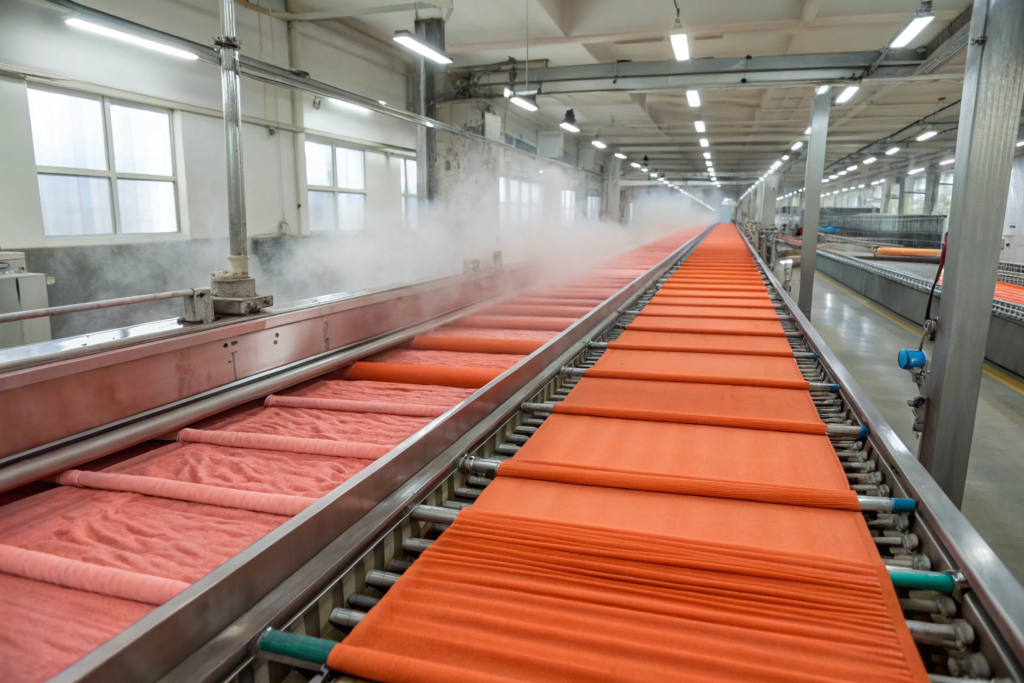
For cotton and rayon, we use a process called Soaping. We run the fabric through a series of wash boxes filled with hot water and a soaping agent (a mild detergent). The soaping agent surrounds the unfixed dye molecules and lifts them off the fiber. We follow this with multiple fresh water rinses. At the end, we often add a small amount of acetic acid (vinegar) to neutralize any residual alkalinity, which can also cause odor.
For polyester, as I mentioned, we use Reduction Clearing. This is a more aggressive chemical wash specifically designed to attack the carriers and unfixed disperse dyes.
Does Enzyme Washing Help Eliminate Odors in Natural Fibers?
Enzyme washing is primarily used to change the handfeel and appearance of fabric. For example, cellulase enzymes eat the tiny fuzz on the surface of cotton, making it smoother and softer. This is called bio-polishing. It reduces pilling.
But here is a secondary benefit: Enzyme washing also cleans. The enzyme treatment is essentially a long, warm bath with mild agitation. This process helps remove residual spin finishes, waxes, and loose dye particles from the fiber surface. A fabric that has been bio-polished is generally cleaner and has less surface chemistry to off-gas.
I have noticed a clear correlation in our production. Our standard cotton jersey that goes through bio-polishing has a much more neutral, "clean laundry" scent compared to a fabric that skips this step. The enzyme bath acts as an extra wash cycle.
We had a client in June 2025 who was selling premium baby blankets made from organic cotton. They were hyper-sensitive to any smell. We ran their fabric through a dual process: A gentle hydrogen peroxide bleach (for whitening and disinfecting) followed by a cellulase enzyme wash (for softness and cleaning). The final fabric had zero detectable odor. It was as clean as a fabric could be. The parents loved it. The return rate for "smell" was zero. If you are looking for how enzyme washing improves fabric cleanliness and reduces odors, it’s a valuable add-on for natural fibers. It costs about $0.20 – $0.30 per yard, but for premium baby or sensitive skin products, it’s worth every penny.
How Does Proper Curing Prevent Odor in Printed and Coated Fabrics?
This is a different category of smell. With prints and coatings, the smell comes from the uncured binder or resin. Pigment prints use a chemical binder to glue the pigment particles to the fabric surface. Coatings use polyurethane (PU) or acrylic resins.
These chemicals are designed to cross-link and form a solid, stable film when heated to a specific temperature for a specific time. This is called curing. If the fabric moves through the curing oven too fast, or if the temperature is too low, the cross-linking reaction is incomplete. The binder is still "wet" chemically. It’s like paint that hasn’t dried.
This uncured resin off-gasses solvents and monomers. It smells like ammonia (from the thickener) or like sharp acrylic. It also performs poorly. An uncured print will crack and wash off.
At Shanghai Fumao, our coating factory and printing factories use stenter frames with precise temperature control and dwell time monitoring. For a standard pigment print, the fabric must reach 150°C – 160°C and stay at that temperature for 2-3 minutes. We have temperature probes and strip charts that record this data for every lot. If the oven temperature drops below the set point, the line slows down automatically to ensure proper curing.
I remember a problem from November 2025. A European distributor complained that a shipment of coated nylon had a "solventy" smell. We pulled the curing records from that day. The oven temperature had a dip for about 20 minutes due to a gas pressure issue. We identified the specific rolls that went through during that window. We had them returned and re-cured them at our cost. The smell was gone. That’s the level of control required. If you are sourcing how to ensure proper curing of pigment prints to avoid chemical smells, ask your supplier: "Do you have time and temperature records for the curing oven?" If they look confused, they are guessing.
How to Specify "Odor-Free" Fabric in Your Purchase Order?
You can have all the technical knowledge in the world, but if you don’t put it in writing, it doesn’t exist. A verbal agreement that "the fabric should smell good" is worthless. You need to translate your odor requirements into clear, enforceable specifications in your Purchase Order and Tech Pack.
This is where I see too many buyers make a critical mistake. They rely on generic quality clauses that are easy for a supplier to ignore. "Good merchantable quality" is a legal term that doesn’t cover smell. You have to be specific. You have to define what "odor-free" means in measurable terms.
At Shanghai Fumao, we welcome these specifications. A clear spec makes our job easier because there is no ambiguity. We know exactly what standard we are being held to. When a buyer sends us a PO with a detailed odor spec, I know they are a professional. I assign that order to my most experienced QC supervisor.
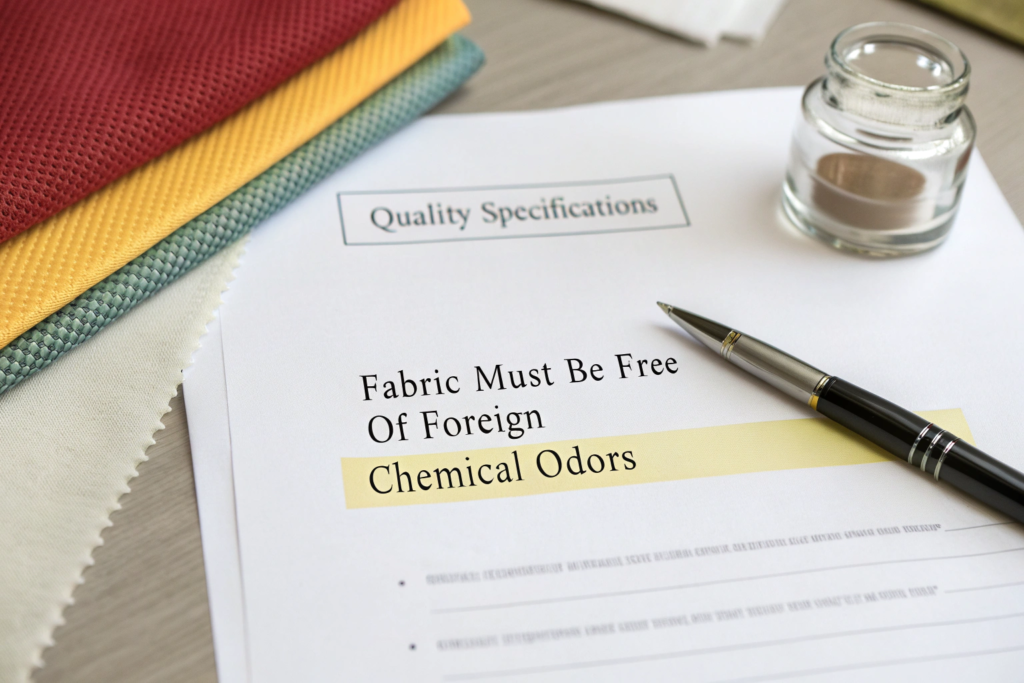
What Language Should I Use in My Tech Pack to Prevent Smelly Fabric?
Here is the exact clause I recommend my clients copy and paste into their tech packs and POs. I’ve developed this language over years of dealing with disputes and returns.
Suggested PO/Tech Pack Clause:
4.7 Chemical Odor Specification:
- Sensory Requirement: Finished fabric must be free of any foreign, objectionable, or pungent odors when evaluated according to the "Jar Test" method (sealed glass container, 35°C for 24 hours). Acceptable odor profile is "neutral" or "faint clean textile scent." Odors defined as objectionable include, but are not limited to: fishy, ammoniacal, phenolic (mothball), sulfurous (rotten egg), solvent-like, or sharp formaldehyde.
- Chemical Compliance: Fabric must comply with OEKO-TEX Standard 100, Appendix 4 limits for Formaldehyde and Chlorinated Phenols for Product Class I (Baby) or Class II (Direct Skin Contact), as specified in the attached Bill of Materials.
- Process Requirement: All polyester dyeing must include a Reduction Clearing step. All pigment printing must include verification of full cure (no tackiness, no residual ammonia odor).
- Rejection Right: Any shipment found to contain residual chemical odor as defined above, either upon arrival or after home laundering simulation, is subject to rejection at supplier’s cost, including return freight and re-procurement costs.
This language is specific. It references a test method (Jar Test). It references a third-party standard (OEKO-TEX). It specifies a process requirement (Reduction Clearing). It defines the remedy (Rejection at supplier’s cost).
I had a US buyer use this clause in September 2025 with a new supplier. The fabric arrived smelling like kerosene. The supplier tried to claim it was "normal." The buyer pointed to Section 4.7 in the signed PO. The supplier had no defense. They covered the cost of re-running the order with proper washing. That clause saved the buyer about $15,000 in loss. If you are drafting how to write a fabric quality specification to prevent odor issues, be this specific. Vagueness is the enemy of enforcement.
What Third-Party Lab Tests Verify "No Odor" Compliance?
For high-value orders or for products going to sensitive markets (baby, medical, luxury), I recommend going beyond the Jar Test and OEKO-TEX. I recommend specific VOC (Volatile Organic Compound) testing by an independent lab like SGS, Intertek, or Bureau Veritas.
There are two main test methods I specify:
- VOC Headspace Analysis (GC/MS): This is the gold standard. A sample of fabric is sealed in a vial and heated. The air in the vial (the headspace) is then injected into a Gas Chromatograph / Mass Spectrometer. This machine identifies and quantifies every single volatile chemical that off-gasses from the fabric. It gives you a printout of exactly what is causing the smell (e.g., "Phenol: 2.3 µg/m³", "Formaldehyde: 15 ppm").
- Odor Panel (VDA 270): This test, developed by the German automotive industry, uses a panel of trained human sniffers. They evaluate the odor intensity on a scale of 1 (not perceptible) to 6 (unbearable). A rating of Grade 3 or better is typically required for automotive interiors, which is a very strict standard. If your fabric passes VDA 270 Grade 3, it will pass any apparel customer’s sniff test.
I used GC/MS Headspace testing in January 2026 to resolve a dispute. A client said the fabric smelled. The supplier said it didn’t. We sent a sample to SGS. The GC/MS report showed a significant peak for Chlorinated Benzene, a known carrier chemical. The supplier had skipped reduction clearing. The data was irrefutable. They took the fabric back. If you are dealing with how to use third-party lab testing to verify fabric odor complaints, GC/MS Headspace is the definitive answer. It costs about $300-$500 per test, but for a container-load order, it’s cheap insurance.
Conclusion
A chemical smell in fabric is more than just an unpleasant surprise. It is a failure of process control. It is evidence of skipped wash cycles, incomplete curing, or cheap, unregulated chemistry. For a brand or a distributor, that smell is a direct hit to customer trust and a guaranteed spike in return rates. Nobody wants to wear a shirt that smells like a chemical plant.
The solution is not to hope for the best. The solution is to build odor prevention into your sourcing process from the very beginning. Use the Jar Test on every sample. Demand valid OEKO-TEX certifications. Specify reduction clearing for polyester and proper curing for prints. Write clear, enforceable odor specifications into your purchase orders. And for critical programs, verify compliance with GC/MS headspace testing.
At Shanghai Fumao, we treat odor control as a core quality metric, right up there with colorfastness and shrinkage. Our washing ranges run at full capacity. Our curing ovens are monitored and logged. Our CNAS lab is equipped to catch problems before the fabric ever sees the inside of a shipping container. We know that the best smelling fabric is the one that smells like nothing at all.
If you have been burned by smelly fabric in the past or if you are developing a product line for a sensitive market, let’s make sure it doesn’t happen again. We can walk you through our odor control protocols and provide the documentation you need to sleep soundly at night.
Reach out to our Business Director, Elaine. She can arrange for Jar Test samples to be sent to you from our current production lots so you can experience the difference a clean process makes. You can email her directly at elaine@fumaoclothing.com. Let’s make sure your next unboxing is a breath of fresh air.








