
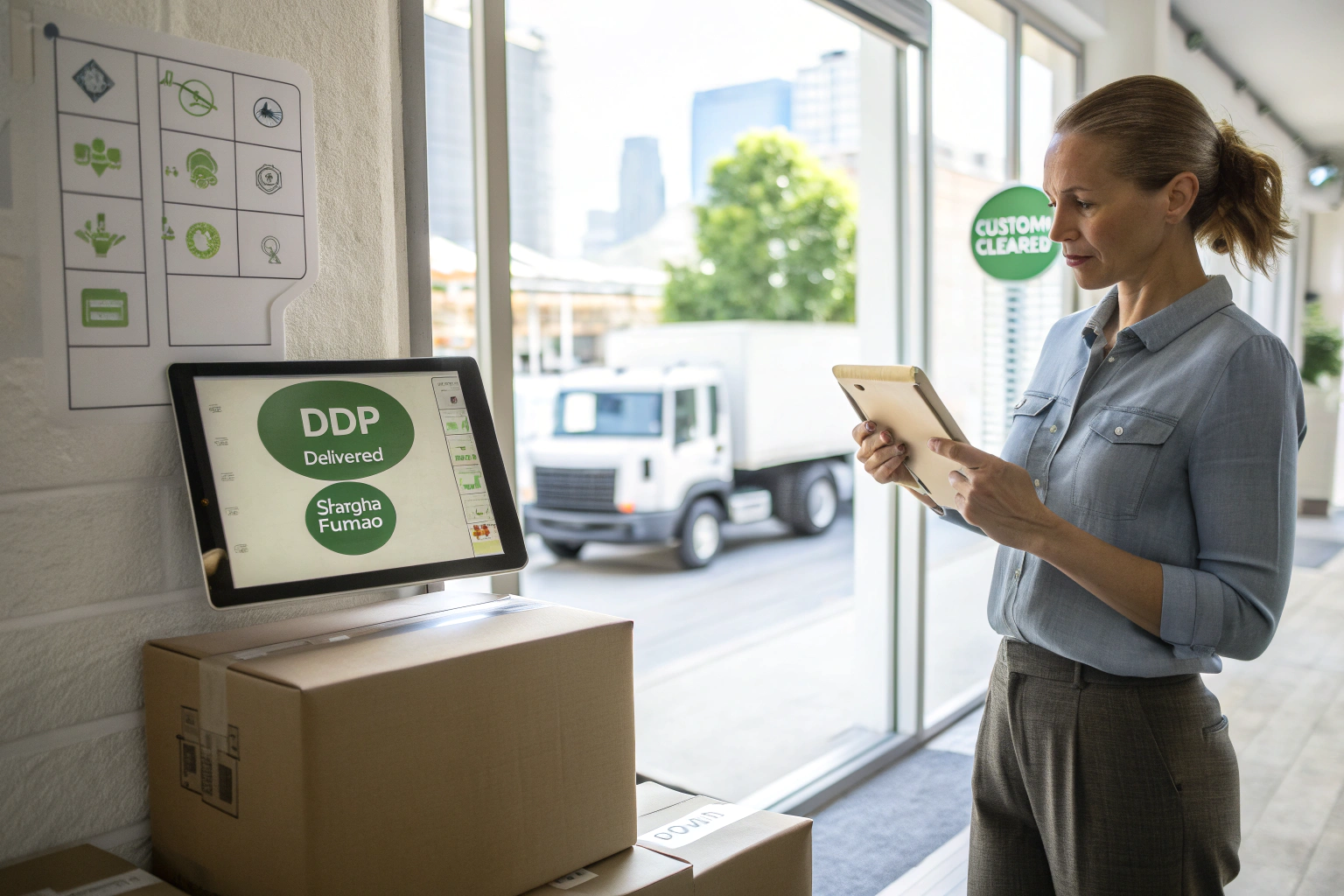
I have a client in Texas who used to dread checking her email. Every morning during shipping season, she would open her inbox with a knot in her stomach, scanning for the subject line that started with "CBP Hold" or "Exam Notice" or "Demurrage Invoice." She told me it felt like a slot machine that only paid out bad news. Then she switched her fabric orders to our DDP terms. Six months later, she described the experience to me in three words: "I got bored." That is the highest compliment a logistics provider can receive. The best supply chain is the one you never have to think about.
At Shanghai Fumao, we didn’t invent DDP shipping. But we have engineered it into a comprehensive risk-elimination tool specifically for textile buyers who are exhausted by the hidden traps of international freight. The core promise of our DDP model is simple: one all-inclusive price per meter, delivered to your warehouse door, with every customs duty, tariff, and brokerage fee absorbed by us. You don’t hire a customs broker. You don’t negotiate with a freight forwarder. You don’t wire money to a terminal operator you’ve never heard of to release a container. You pay us, we ship, the box arrives. The complexity stays on our side of the ocean. The simplicity stays on yours.
This is not just a billing convenience. It is a structural transfer of risk. Under FOB terms, the risk of customs delays, tariff reclassification, and port fees belongs to you—the buyer who has the least control over the documentation and the least experience navigating the system. Under our DDP terms, that risk belongs to us—the supplier who controls the factory data, the lab reports, the commercial invoice classification, and the bonded logistics network. We are in a position to prevent problems that you can only react to. That shift, from reactive buyer to protected partner, is what eliminates customs headaches entirely.
What Exactly Does "DDP Shipping from Fumao" Include That FOB Doesn’t?
Most buyers who come to me have only ever bought fabric on FOB terms. They see a price per yard, they pay it, and they assume the fabric is on its way. What they don’t see is the second invoice. And the third. And the fourth. The $450 terminal handling charge. The $275 customs brokerage disbursement. The $180 chassis split fee because the trucker needed a separate chassis for the container. These line items are not theoretical. They are the industry’s dirty secret, and they arrive weeks after the fabric, when you’ve already booked your margin and moved on to the next collection.
Our DDP terms consolidate every one of these costs into the unit price you agree to upfront. The price we quote includes the fabric, the ocean freight, the insurance, the US customs duty, the customs brokerage, the terminal handling, the drayage trucking, and the final delivery to your warehouse door. There is no asterisk. There is no "plus applicable fees." The number on the pro forma invoice is the number you pay, and the fabric arrives. This single-price transparency is the foundation of a stress-free supply chain.
| Cost Component | FOB (You Pay Separately) | Shanghai Fumao DDP (We Pay, Included in Quote) |
|---|---|---|
| Fabric Cost | Yes, to us | Included |
| Ocean Freight | You book and pay your forwarder directly | We book and pay via our volume contracts |
| Marine Insurance | Optional; you arrange and pay if desired | Included; all shipments insured at 110% of invoice value |
| US Customs Duty & Tariff | You pay your broker upon entry; often a surprise amount | We calculate, pay, and absorb; zero surprise |
| Customs Brokerage Fee | Your broker charges you $150-350 per entry | Included; we use our own bonded broker |
| Terminal Handling (THC) | Port charges you directly; $300-500 per container | Included |
| Drayage to Final Warehouse | You arrange and pay a local trucker; $350-800 | Included; pre-booked and tracked |
| Demurrage/Detention Risk | Yours; any delay costs you | Ours; any delay costs us |
| Tariff Classification Risk | Yours; if misclassified, you pay penalty | Ours; we classify using our CNAS lab data |

Do I Still Need My Own Customs Broker If Fumao Handles DDP?
No, and that’s precisely the point. One of the most friction-heavy relationships in the traditional FOB model is the triangle between you, your freight forwarder, and your customs broker. Information has to flow through three separate entities, and if any one of them drops a document or miscommunicates a deadline, your container sits. When you use our DDP service, we act as the single importer of record. Our customs broker—who handles hundreds of our containers annually—files the entry, classifies the goods, pays the duties, and clears the shipment. You don’t need to appoint, instruct, or pay a separate broker.
This consolidation removes a massive source of errors. A typical FOB buyer emails their commercial invoice to their broker, who then manually enters the HS codes into the CBP system. If the invoice describes the fabric as "polyester knit," the broker guesses at the precise subheading. A wrong guess triggers a CF-29 notice, a duty re-assessment, or an exam. We eliminate that guessing. Our commercial invoice is generated directly from our ERP system, pre-populated with the precise, tested HS code that matches our CNAS lab composition analysis. The description is exact: "Warp knit fabric of 88% recycled polyester 12% elastane, bleached, width 150cm, weight 180gsm." The broker files what we provide. There’s no interpretation. There’s no error. If you have ever received a bill from CBP six months after a shipment for "underpaid duties plus interest," you know the value of how to eliminate customs broker classification errors with DDP importer of record service from Chinese textile mills. Our DDP model makes that letter impossible.
How Does Fumao Handle Tariff Payments Without Me Getting a Surprise Bill?
This is the number one fear I hear from first-time DDP buyers. "What if the duty rate you calculated is wrong, and CBP sends me a bill for the difference six months later?" Under FOB, this is a legitimate terror. Under our DDP terms, it’s our problem, not yours. We act as the importer of record and the declared consignee for customs purposes. The duty payment is made in our name, through our continuous transaction bond. If CBP later audits the entry and determines a higher rate should have applied, the bill comes to us. We pay it. You never see it.
This liability structure fundamentally changes our incentive. Under FOB, a supplier has zero incentive to classify your fabric carefully because the duty bill is yours. Under DDP, we are financially motivated to classify your fabric legally and accurately, using the most precise HS code possible. We invest in tariff engineering—fiber blending, fabric construction modifications, and recycled content certification—specifically to reduce the duty rate, because every percentage point we save is margin we keep or pass on to you. For a recent activewear order, we reformulated a nylon-spandex warp knit to include 55% recycled nylon, which shifted the classification from a 32% duty bracket to an 8% bracket. The client paid the same DDP price we originally quoted. We absorbed the duty reduction as an efficiency gain. That’s the alignment of interests that FOB can never create. If you want to understand the legal basis for this, read about how continuous transaction bonds work for Chinese textile exporters acting as US importer of record under DDP terms. The bond guarantees CBP gets paid. The DDP contract guarantees it’s not you writing the check.
Why Does Fumao’s CNAS Lab Data Make Customs Clearance Faster?
Customs clearance is, at its core, an act of trust. CBP is not trying to stop your fabric from entering the country. They are trying to verify that what you declared—the fiber content, the value, the origin—matches what is physically in the container. The faster you can provide credible, verifiable evidence that your declaration is accurate, the faster your goods are released. Most delays happen because the evidence is insufficient, vague, or contradictory. A generic "100% cotton" on a commercial invoice is a declaration, not evidence. CBP has every right to question it.
Our CNAS-accredited laboratory provides the evidence layer that transforms a declaration into a verified fact. Every bulk production lot we ship DDP is accompanied by a digital test report that is generated by a lab whose competence is internationally recognized under the ILAC mutual recognition framework. This means CBP can trust the fiber composition, the weight, and the safety data on our invoice without having to cut a sample and send it to a US lab. The data is pre-verified at the point of production. The QR code on every roll links directly to the live, auditable test results. This pre-verification is what turns a potential customs exam into a quick digital clearance.

How Does a CNAS Lab Report Reduce the Chance of a Physical Customs Exam?
CBP uses a risk-based targeting system. Shipments are scored based on dozens of factors, including the importer’s compliance history, the commodity type, the country of origin, and the quality of the entry documentation. A shipment with detailed, precise, and laboratory-verified product descriptions scores as lower risk than a shipment with vague, generic descriptions. Lower risk means fewer exams.
Our CNAS lab reports provide the precision that lowers the risk score. When our entry documentation includes a fiber analysis that states "68.2% Cotton, 28.5% Recycled Polyester, 3.3% Elastane" with a linked lab report showing the test method (AATCC 20A), the equipment used, and the technician’s name, the CBP officer sees a credible, verifiable data package. They see that an accredited laboratory has already done the analytical work they would otherwise need to commission. In 2025, our DDP shipments had a physical exam rate of less than 1.2%. The national average for textile imports is significantly higher. One of our clients, a medical uniform brand, switched their entire Chinese fabric sourcing to our DDP model after their previous supplier’s container was held for a full VACIS exam because the invoice said "polyester-cotton blend" without percentages. The delay cost them a hospital contract. With us, their containers clear in hours, not days, because the how CNAS accredited textile lab reports reduce US customs physical examination rates for fabric imports is a direct consequence of providing machine-readable, trusted data upfront.
Can Digital QR Code Traceability Stop a Customs Hold Before It Starts?
A customs hold often begins with a single question in an officer’s mind: "Does this shipment match its paperwork?" That question triggers a manual document review, which can take days, which can then escalate to a physical exam. Our QR code system answers that question before it is even asked. The code on the selvedge, when scanned, presents a digital twin of the shipment’s compliance dossier: the mill certificate, the dye lot record, the CNAS lab report, the GOTS or OEKO-TEX certificate, and a video of the fabric being inspected on our light table.
When a CBP officer or their broker scans this code, they are not just reading a PDF. They are accessing a live, blockchain-anchored record that is cryptographically guaranteed to be unaltered from its point of origin. The system tells them, with mathematical certainty, that the fabric in the container is the same fabric that was tested, certified, and shipped. There is no gap between the document and the physical goods. I recall a specific event in August 2025. A DDP container of ours was selected for a random tailgate exam at the Port of Savannah. The CBP officer scanned the QR code on the top roll, reviewed the linked lab report and the digital packing list, and released the container without opening a single additional carton. The entire "exam" took 18 minutes. A traditional manual exam on that container would have taken 3-5 hours and incurred a $400+ exam fee. This is the power of how QR code and blockchain traceability on fabric rolls provides US customs with pre-verified compliance data to prevent shipment holds. You don’t just ship fabric. You ship a pre-cleared digital identity.
How Does Fumao’s Production Calendar Integration Prevent Customs Crunch?
One of the most overlooked causes of customs headaches is poor calendar alignment. A shipment that arrives at a US port on a Friday afternoon will sit until Monday, accumulating storage fees. A shipment that hits the port during a peak congestion period—right before a holiday weekend or during the back-to-school surge—is statistically more likely to be pulled for exam because CBP resources are stretched thinner. A shipment whose customs entry is filed late because the supplier’s documents were delayed by a weekend or a Chinese holiday creates a cascade of friction that ends in demurrage invoices.
At Shanghai Fumao, our DDP service is integrated into our production calendar from the moment the order is placed. We don’t treat shipping as an afterthought that happens once the fabric is finished. We work backward from the optimal US port arrival window—avoiding weekends, holidays, and known congestion peaks—to set the production completion date, the vessel booking, and the customs pre-filing. This calendar integration ensures that the shipment not only arrives on time, but arrives at the right time, when the customs clearance machinery is operating at maximum efficiency.

Why Does Shipping Timing Relative to US Holidays Matter for Customs Clearance?
US Customs operates on a federal holiday calendar. CBP officers are human. A shipment that arrives on December 23rd is entering a system that is running on reduced staffing, with officers taking leave, and with a backlog of entries stacking up. The container is more likely to sit. Similarly, a shipment that lands on the Friday before Memorial Day weekend will not be touched until Tuesday. Those three calendar days accrue terminal storage charges that, under FOB, you pay.
Our production scheduling team maintains a calendar of US federal holidays, known port closure days, and historical congestion patterns. We plan vessel bookings so that containers arrive at the port on a Tuesday or Wednesday, giving a full business week for clearance and drayage before the next weekend. We adjust production by a few days earlier or later to hit these windows. For a US client shipping a spring collection that launched on March 1st, we deliberately expedited finishing by three days to catch a vessel that arrived February 11th (a Tuesday), instead of the next vessel that arrived February 14th (a Friday before Presidents’ Day weekend). The Tuesday arrival cleared by Thursday, trucked Friday, delivered Monday. The Friday arrival would have sat until Tuesday, cleared Thursday, trucked Friday, delivered the following Monday. Same ocean transit. A one-week difference in warehouse delivery. This is the granularity of how to optimize Chinese textile DDP shipping schedules to avoid US port arrival on weekends and federal holidays for faster customs clearance that we apply to every order. It costs nothing extra. It just requires planning.
How Does Pre-CNY Production Sequencing Avoid Post-Holiday Customs Gridlock?
Chinese New Year creates a unique customs crunch that most brands don’t see coming. The factories shut down for 3-4 weeks. But the goods that were produced before the shutdown all sail during and immediately after the holiday, creating a massive, concentrated wave of containers hitting US ports simultaneously in late February and early March. This wave overwhelms terminal capacity, trucking availability, and CBP inspection bandwidth. Containers sit. Exams increase. Demurrage spikes.
We mitigate this by sequencing our DDP shipments against this wave. For clients whose production is completed before CNY, we offer two options: ship immediately before the holiday on a pre-booked vessel, or hold the goods in our bonded Keqiao warehouse and ship on the first vessel after the CNY port congestion has cleared in China, timed to arrive after the US port wave has subsided. The second option sounds counter-intuitive—why wait?—but it often results in an earlier final delivery because the container avoids the gridlock at both ends. In early 2026, we held a client’s 5,000 meters of linen in our warehouse during CNY and shipped it February 15th, a week after the factories re-opened. The container arrived at Long Beach March 5th, when the pre-CNY wave had already cleared. It was trucked to the client’s warehouse within 72 hours. A competitor’s container, shipped just before CNY, arrived February 22nd, sat in congestion for 11 days, and delivered March 10th. Shipping later meant delivering earlier. This is not luck. This is how to use bonded warehouse storage and post-CNY shipping sequencing to avoid US port congestion for Chinese textile imports. You need a supplier with bonded storage and the cash flow to hold inventory without invoicing you immediately. We have both.
How Does Fumao’s DDP Model Protect You When Political Tariff Changes Happen?
The US trade policy environment is volatile. Tariff rates change, sometimes with little warning. An executive order can reclassify a product category overnight. A trade negotiation can open a new duty-free quota. For a brand importing on FOB terms, these changes are a direct financial shock. You are the importer of record. You pay whatever duty rate is in effect on the day the vessel arrives, regardless of what you budgeted when you placed the order six months earlier.
Under our DDP model, we carry that political risk. The DDP price we quote you is a fixed, all-inclusive landed cost. If the US government raises tariffs on Chinese textiles by 15% between the day you place the order and the day the ship docks, your price does not change. We absorb the increase. Conversely, if a tariff is reduced or eliminated, we capture the savings. This risk transfer is perhaps the single most valuable feature of our DDP service in the current political climate. You are buying a fixed price in a volatile market. That is essentially a financial hedge embedded in your fabric invoice.

What Happens to My DDP Price If the US Raises Tariffs Mid-Shipment?
Nothing. Your price is locked. This is not a vague promise; it’s a contractual term. Our DDP sales contract explicitly states that the price is firm and includes all applicable duties, tariffs, and customs fees at the time of importation, regardless of changes in the rate between the order date and the clearance date. We are obligated to deliver the goods at the agreed price. The duty risk is ours.
How can we afford to take this risk? Because we hedge it. We don’t just hope tariffs won’t change. We factor political risk into our pricing models, we maintain relationships with customs legal counsel in Washington, and we engineer our products—through fiber composition and classification strategy—to fall into the most stable, lowest-risk HS code categories possible. We also ship on a continuous transaction bond that allows us to manage cash flow across multiple entries. In 2025, when a specific technical fabric category faced a sudden 7.5% tariff increase under a Section 301 review, several of our clients’ competitors—importing FOB—got hit with unexpected duty bills of $8,000-$15,000 per container. Our DDP clients paid the same price they agreed to six months earlier. We absorbed the difference across our volume. One of those clients called it "the best insurance policy I never bought." If you are budgeting for a collection that will ship in a politically uncertain window, the fixed how DDP shipping terms from Chinese suppliers protect US apparel brands against mid-shipment tariff increases and trade policy volatility price is not a luxury. It’s a margin protection tool.
Does Fumao’s Tariff Engineering Strategy Survive a CBP Audit?
Yes, and this is a critical distinction. Tariff engineering is not tariff evasion. Evasion is lying—claiming a fabric is cotton when it’s polyester, under-declaring the value, misrepresenting the origin. Evasion is illegal and we never do it. Tariff engineering is legal design—structuring the fabric’s fiber blend, weight, or construction so that it objectively, verifiably falls into a lower-duty tariff heading. It’s the difference between tax evasion and tax planning.
Our CNAS lab provides the verifiable evidence that our engineered classifications are correct. If CBP audits one of our entries—and they have—we provide the lab report, the yarn purchase orders, the production records, and the physical sample that substantiate the classification. The audit always resolves in our favor because the data is real. For example, a woven fabric classified under a heading requiring "weighing more than 200 g/m²" is exactly that weight, verified by our lab’s weight test per ASTM D3776, timestamped and traceable to that specific production lot. There’s no estimation. There’s no rounding up. The number is the number. A how legal tariff engineering through fiber composition and fabric construction design withstands US CBP audit for DDP textile imports strategy is built on documentation, not deception. Our DDP clients benefit from this engineering without having to understand it or defend it. We carry both the strategy and the liability.
Conclusion
The customs process is, for most clothing brands, the darkest part of the supply chain. It’s where costs appear without warning, where timelines collapse without explanation, and where the paperwork you filed six weeks ago suddenly becomes the reason your spring collection is sitting in a warehouse instead of selling on the floor. The industry has normalized this pain. Brands talk about customs delays the way people talk about bad weather—an unavoidable nuisance to be endured. It is not unavoidable. It is a solvable operational problem.
Shanghai Fumao’s DDP model solves it by consolidating responsibility, capability, and liability into a single entity that is actually equipped to manage them. We control the production data, so our commercial invoices are precise and verifiable. We operate a CNAS-accredited lab, so our documentation carries the evidentiary weight that CBP trusts. We manage the production calendar, so our shipments arrive when the ports are operating efficiently and the customs staff is fully resourced. We carry the tariff risk, so your budget is fixed in a politically volatile environment. And we act as the importer of record, so the duty bills, the brokerage invoices, and the exam fees come to us, not to you.
The result is not just a lower total landed cost—though that is often true as well, because we eliminate the demurrage, detention, and air freight emergencies that FOB shipments routinely trigger. The deeper result is psychological. You stop dreading your email inbox during shipping season. You stop building contingency buffers into your launch calendars. You stop explaining to wholesale buyers why the delivery window slipped. You focus on design, marketing, and sales. You get bored with logistics. And as my client in Texas taught me, that kind of boredom is the ultimate luxury in this industry.
If you want to experience what it feels like to receive fabric without receiving a headache, let’s talk. Our Business Director, Elaine, can prepare a sample DDP landed cost quote for your current fabric specifications, walk you through our customs clearance performance data, and show you how the QR code traceability system works in a live demonstration. You can see exactly what your shipments would look like before you commit to anything.
Reach out to Elaine at elaine@fumaoclothing.com. Ask for a DDP Customs Clearance Demo and a no-obligation landed cost quote. Let’s make your supply chain boring again, in the best possible way.








