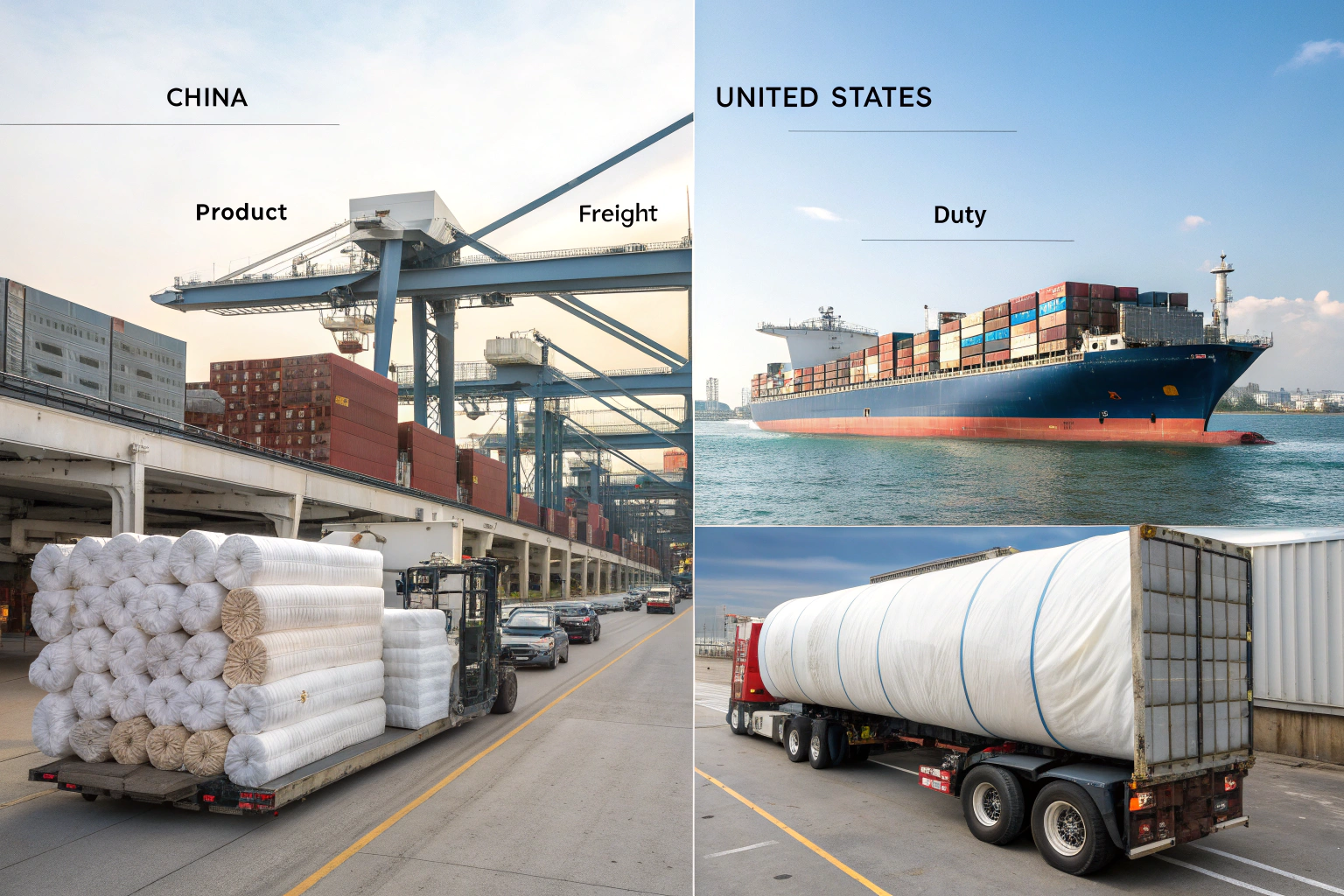
As a fabric supplier dealing with international clients daily, I understand that the initial FOB price represents just the beginning of your cost calculation. Many importers discover too late that overlooking additional expenses leads to significant financial losses. Consequently, mastering landed cost calculation becomes crucial for maintaining profitable operations when sourcing textiles from Asia.
The landed cost constitutes the total price of your fabric shipment, encompassing product cost, shipping, insurance, import duties, and all related fees until goods reach your warehouse. This comprehensive figure represents the true cost of imported goods. For American importers like Ron, accurately determining this amount ensures proper pricing strategies and prevents unexpected expenses from undermining supply chain budgets.
To systematically address this complex topic, we will first examine the core components of landed cost. Following that, we’ll provide a step-by-step calculation methodology. Subsequently, we’ll analyze common pitfalls importers encounter. Finally, we’ll demonstrate how partnering with the right supplier can streamline this entire process.
What exactly is included in landed cost?
Many importers concentrate exclusively on FOB prices, only to encounter numerous unexpected charges later. Landed cost provides complete financial transparency because it aggregates all expenses associated with moving goods from the supplier’s facility to your final destination.
The fundamental components include product costs, shipping and logistics fees, insurance, import duties and taxes, plus brokerage or handling charges. For fabrics, the product cost typically represents the FOB (Free On Board) price, covering expenses until goods are loaded onto vessels at origin ports, including materials, packaging, and port delivery. However, this excludes international freight, insurance, and destination country charges.
Beyond product costs, you must account for transportation expenses. Freight costs fluctuate considerably based on transportation mode (air versus sea), fuel prices, and market demand. Additionally, insurance protection remains essential to safeguard your investment against transit damage or loss. Subsequently, government-imposed charges apply: Import duties reflect taxes levied by customs authorities, with U.S. rates determined by the fabric’s Harmonized System (HS) code and country of origin. You must also anticipate charges like Merchandise Processing Fees (MPF). Finally, brokerage fees compensate customs brokers for managing complex clearance documentation.

Why does accurate landed cost calculation critically impact profit margins?
Relying solely on FOB prices for cost calculations dangerously underestimates true expenses, since landed cost represents the actual Cost of Goods Sold (COGS). For example, if you purchase fabric for $10,000 FOB but incur $3,000 in additional landed costs, your true expense becomes $13,000. Consequently, basing retail pricing on the $10,000 figure would eliminate your profit margin. Therefore, precise landed cost calculation forms the foundation for effective pricing strategy and sustainable financial planning.
Moreover, understanding landed cost enables smarter sourcing decisions. Frequently, suppliers with slightly higher FOB prices but more efficient logistics arrangements deliver lower overall landed costs. This knowledge also facilitates better evaluation of transportation options; for instance, determining whether air freight justifiably costs more for urgent high-performance fabrics shipments requires comprehensive landed cost analysis.
How can importers systematically prevent unexpected charges?
Implementing thorough, systematic approaches prevents cost surprises. First, develop detailed checklists covering all cost components. For duties, always verify correct HS codes for specific fabric types, since misclassification causes overpayment or penalties. Utilize official resources like the U.S. International Trade Commission’s HS Code database for verification.
Second, incorporate contingency buffers into calculations. Standard practice adds 2-5% to estimated landed costs, covering unexpected charges like port congestion surcharges, currency fluctuations, or storage demurrage fees. Third, partnering with experienced freight forwarders and customs brokers proves invaluable because they provide accurate, current estimates for all logistical and regulatory fees specific to your shipments.
How should importers calculate landed cost systematically?
Structured methodologies provide the strongest defense against budget overruns. Rather than mental calculations, utilize spreadsheets or specialized software to ensure consistent inclusion of all variables.
Begin with base costs: the FOB price from your supplier. Next, compute international freight expenses by obtaining forwarder quotes for sea and air options. Then, add insurance, typically 0.3%-0.5% of CIF (Cost, Insurance, and Freight) value. Subsequently, calculate duties and taxes by multiplying the customs value (usually CIF) by the HS code duty rate. Finally, incorporate additional fees: customs brokerage, port-to-warehouse trucking (drayage), and harbor maintenance charges.

Which tools effectively simplify landed cost calculations?
Sophisticated mathematical skills aren’t necessary when using appropriate tools. Excel or Google Sheets templates offer the most accessible solution; create columns for each cost component with formulas automatically calculating totals, providing full control and transparency. We supply clients with basic templates including common HS codes for fabrics like cotton and polyester to facilitate this process.
For larger import operations, dedicated landed cost software justifies investment. These platforms integrate supplier data, forwarder quotes, and customs databases to generate real-time calculations. Since they automatically update duty rates and currency fluctuations, they save significant time while reducing human error, thereby supporting scalable, sophisticated import operations.
Can you demonstrate a practical landed cost calculation?
Consider this scenario: Ron imports organic cotton knit fabric from our Keqiao facility.
| Cost Component | Calculation | Amount |
|---|---|---|
| FOB Price (Ningbo) | 10,000 yards @ $2.80/yard | $28,000 |
| Ocean Freight | One 40′ container from Ningbo to LA | $4,200 |
| Insurance | 0.4% of ($28,000 + $4,200) | $129 |
| CIF Value | Sum of above | $32,329 |
| Duty Rate | HS Code 6002.10 (Knit Cotton Fabric) @ 10.2% | $3,298 |
| MPF (US) | 0.3464% of CIF Value (Min $27, Max $539) | $112 |
| Customs Brokerage | Estimated Fee | $350 |
| Drayage (LA to Warehouse) | Trucking Fee | $600 |
| Total Landed Cost | Sum of All | $36,689 |
This example demonstrates how a $28,000 FOB price escalates to a $36,689 landed cost. Consequently, the actual cost per yard becomes approximately $3.67 instead of $2.80—a 31% increase that must inform financial planning decisions.
What common mistakes undermine landed cost analysis?
Even experienced importers make costly errors in landed cost calculations. The most frequent mistake involves incorrect HS code application, which proves particularly problematic because different fabrics carry substantially different duty rates. For instance, woven linen features different classification and duty rates than woven polyester, so code errors lead to underpayment penalties or overpayment.
Another prevalent error stems from Incoterms misunderstandings. While FOB provides clear cost divisions, EXW (Ex-Works) agreements make importers responsible for all costs from the supplier’s factory gate, including Chinese domestic trucking and port fees. Additionally, many importers neglect internal costs like staff management time or capital costs during 30-45 day shipping cycles.

How do tariff codes directly influence final costs?
Tariff codes (HS codes) function as the universal language of international trade, providing the global product classification system. Customs authorities utilize these codes to identify goods, apply correct import duty rates, track trade statistics, and ensure regulatory compliance. Therefore, accurate HS code application represents a legal requirement rather than a suggestion.
The financial impact is direct and substantial. For example, "Woven fabrics of synthetic filament yarn" (HS code 5407) carries different duty rates than "Woven fabrics of artificial filament yarn" (HS code 5408). Misclassifying viscose fabric (artificial) as polyester (synthetic) results in incorrect duty payments. While the U.S. Customs and Border Protection (CBP) website offers guidance, complex items warrant consultation with licensed customs brokers for accurate classification.
Why do Incoterms misunderstandings generate cost overruns?
Incoterms establish precise responsibility divisions between sellers and buyers, so misinterpretations create unanticipated cost liabilities. For instance, under FOB terms, buyer risk commences once goods board vessels. However, if you believe you have FOB terms while the supplier operates under EXW, you suddenly become responsible for local logistics and Chinese port fees excluded from your budget.
The solution involves explicit clarity and confirmation. Always document agreed Incoterms explicitly on proforma invoices and purchase orders, ensuring mutual understanding between parties. For most clients, we recommend FOB terms because they establish clear cost divisions: we manage everything until goods ship, while clients assume responsibility thereafter, simplifying cost calculations.
How can strategic supplier partnerships reduce landed costs?
Knowledgeable suppliers extend beyond quality fabric production to become supply chain efficiency partners. At Fumao, we recognize that our value measurement extends beyond FOB prices to encompass your total cost optimization.
We actively help clients optimize landed costs through several methods. Supply chain consolidation represents one key approach; sourcing multiple fabric types from different suppliers necessitates multiple smaller shipments with higher per-unit costs. By leveraging our diverse portfolio—spanning natural fibers like wool and hemp to synthetic fibers like nylon and spandex—clients consolidate orders into single, cost-effective container loads, dramatically reducing per-unit freight expenses.

How does integrated sourcing and logistics management create advantages?
Suppliers with integrated capabilities streamline entire import processes. Our established relationships with major shipping lines and freight forwarders frequently secure more competitive freight rates for clients than they could obtain individually. Furthermore, we provide accurately pre-filled documentation, accelerating customs clearance to prevent costly delays and storage fees.
Our strategic location within the Keqiao textile cluster provides inherent logistics advantages. Positioned at the industry’s heart, we ensure shorter trucking lead times to Ningbo or Shanghai ports. This production and logistics agility translates to more reliable sailing schedules, minimizing missed vessel risks and associated extra costs.
Why does supplier reliability significantly impact hidden costs?
Unreliable suppliers generate hidden expenses that never appear on invoices yet steadily erode profits. Production delays cause missed vessel schedules, forcing expensive air freight alternatives or creating stockouts that lose sales. Similarly, inconsistent quality control produces rejected shipments, chargebacks, and wasted duty payments on defective goods.
Our commitment to end-to-end quality control and financial stability ensures promise fulfillment. Our CNAS-accredited laboratory tests every fabric meter, achieving 98% client pass rates and avoiding hidden costs of faulty materials. Meanwhile, agile R&D and sample development capabilities meet tight deadlines without quality compromises, maintaining predictable supply chains and controllable landed costs.
Conclusion
Calculating fabric import landed costs represents an essential discipline for sustainable business operations. This practice transforms cost estimation from guessing to precise knowledge, protecting profit margins while ensuring long-term viability. Remember that landed cost aggregates FOB prices, freight, insurance, duties, taxes, and brokerage fees—all requiring meticulous verification of HS codes and Incoterms to prevent expensive mistakes.
The most strategic import decision involves partnering with fabric suppliers who comprehend your complete cost structure. Suppliers offering consistent quality, diverse product ranges for consolidation, and reliable logistics support become invaluable assets for managing and reducing total landed costs.
If unpredictable import expenses challenge your operations, and you seek partners bringing transparency and efficiency to fabric sourcing, we should connect. We provide detailed FOB quotes while coordinating with logistics partners for accurate freight and duty estimates. Contact our Business Director, Elaine, at elaine@fumaoclothing.com to discuss optimizing your next clothing order from conception to delivery.