A fast fashion giant can copy your silhouette, undercut your price by 60%, and flood the market with a cheaper version of your design before your first production run even lands. You cannot beat them on speed. You cannot beat them on price. But there is one battlefield where they are structurally, institutionally vulnerable, and where a small, focused startup can absolutely destroy them. Quality. Real quality. The kind of quality that makes a customer keep a garment for five years instead of five washes. The kind of quality that turns a first-time buyer into a brand evangelist who posts unboxing videos because the fabric feels so good they need to tell someone about it.
Fast fashion giants are optimized for cost and speed, and that optimization necessarily sacrifices every dimension of quality that requires time, attention, or expensive inputs. Their fabric is engineered to a price point, not a performance standard. Their quality control is statistical, accepting a certain defect rate as mathematically cheaper than prevention. Their relationship with their supply chain is transactional and price-driven, so mills give them the cheapest version of whatever spec they asked for. A startup that understands this structural weakness can build a quality-first sourcing and production strategy that delivers a garment so noticeably superior that the price difference becomes a value proposition, not an objection. At Shanghai Fumao, we supply both ends of the market, and I can tell you with absolute certainty that the mills that produce for startups who prioritize quality are delivering fabric that costs $2 more per meter and lasts five times as long. In this article, I’m going to show you exactly how to weaponize quality as a competitive moat.
Why Should US Startups Use Quality as Their Primary Competitive Moat?
Price competition is a race to the bottom that a startup cannot win. The fast fashion giant buys fabric in million-meter quantities and negotiates per-meter prices that are structurally impossible for a startup ordering 500 meters to match. If a startup competes on price, they compete on the giant’s home turf, with the giant’s advantages, and they lose. Quality competition inverts the battlefield. The giant’s volume advantage becomes a constraint—they cannot switch to a higher-quality yarn or a tighter quality tolerance because the per-unit cost increase multiplied across millions of meters would erase their margin. The startup’s small volume becomes an advantage: they can afford to spend an extra $1.50 per meter on a better yarn, a better finish, a tighter inspection, because that $1.50 multiplied by 500 meters is $750, not $1.5 million.
The startup that competes on quality is not playing the same game as the fast fashion giant. They are selling a different product proposition entirely. The customer who buys a $68 startup hoodie instead of a $24 fast fashion hoodie is not paying a $44 premium for the same thing. They are paying for a fabric that won’t pill after three washes, a color that won’t fade to a sad pastel after a month, a seam that won’t unravel, and a silhouette that won’t twist and bag out. The startup’s marketing doesn’t say "we’re almost as good as Zara but more expensive." It says "this hoodie will look good in three years. That one won’t last the season." That’s a winnable argument because it’s true, it’s demonstrable, and it speaks to a growing consumer segment that is exhausted by disposable clothing. The consumer willingness to pay premium pricing for verifiable garment durability and fabric quality in US apparel market surveys 2025 shows that quality-claims backed by specific performance data command a 25-40% price premium, and the premium increases when brands provide technical evidence rather than marketing language.

What Specific Fabric Upgrades Create a Noticeable Quality Difference?
Not all fabric upgrades are perceptible to the consumer. A 2% improvement in yarn evenness is measurable in the lab but invisible in the garment. The upgrades that create a noticeable, "wow, this feels expensive" consumer response are specific and well-understood. For knits: upgrading from carded cotton to combed compact-spun cotton eliminates the surface fuzz that causes pilling and creates a visibly cleaner, smoother fabric face. The consumer sees it immediately when they hold the garment next to a fast fashion equivalent. For wovens: upgrading from a standard 30S single-ply yarn to a 60/2 double-ply yarn in the warp doubles the seam strength and creates a fabric that holds a crease and resists tearing. For fleece: upgrading from an unbrushed back to a properly brushed back with filament polyester face yarn creates a hoodie that feels plush inside and stays smooth outside after multiple washes.
The upgrade that produces the single largest consumer-perceptible quality improvement is fiber length. Short-staple cotton fibers (under 22mm) produce fabric that fuzzes, pills, and sheds microfibers from day one. Long-staple cotton fibers (over 28mm, like Supima or long-staple Egyptian) produce fabric with dramatically fewer exposed fiber ends, which means less pilling, less shedding, and a smoother hand feel that actually improves with washing rather than degrading. The raw material cost difference between short-staple carded cotton and long-staple combed compact-spun cotton is significant—roughly $0.80 to $1.50 per meter depending on the fabric weight—but the consumer can feel the difference with their eyes closed. A startup that communicates the specific fiber upgrade in their product description ("Made with 38mm long-staple combed cotton, not the 20mm carded cotton used in standard tees") gives the consumer a technical reason to believe the quality claim. The comparative fiber property analysis of long-staple versus short-staple cotton in knitted apparel durability and consumer hand feel perception provides the technical data to support these claims.
How Do I Translate Fabric Quality into a Marketing Claim That Converts?
"Do not make a generic quality claim that any brand can copy. "Premium quality fabric" means nothing because every brand says it, including the fast fashion giants whose fabric is demonstrably not premium. The marketing claim must be specific, verifiable, and comparative. Instead of "high-quality cotton," write "38mm long-staple Supima cotton, combed and compact-spun for a pill-resistant finish." Instead of "durable construction," write "double-ply 60/2 yarn in the warp, tested to 40,000 Martindale rubs for abrasion resistance." The specificity does two things. It gives the consumer a concrete reason to believe the quality claim. And it signals to the consumer that the brand knows enough about textile manufacturing to make the claim in the first place, which builds credibility through demonstrated expertise.
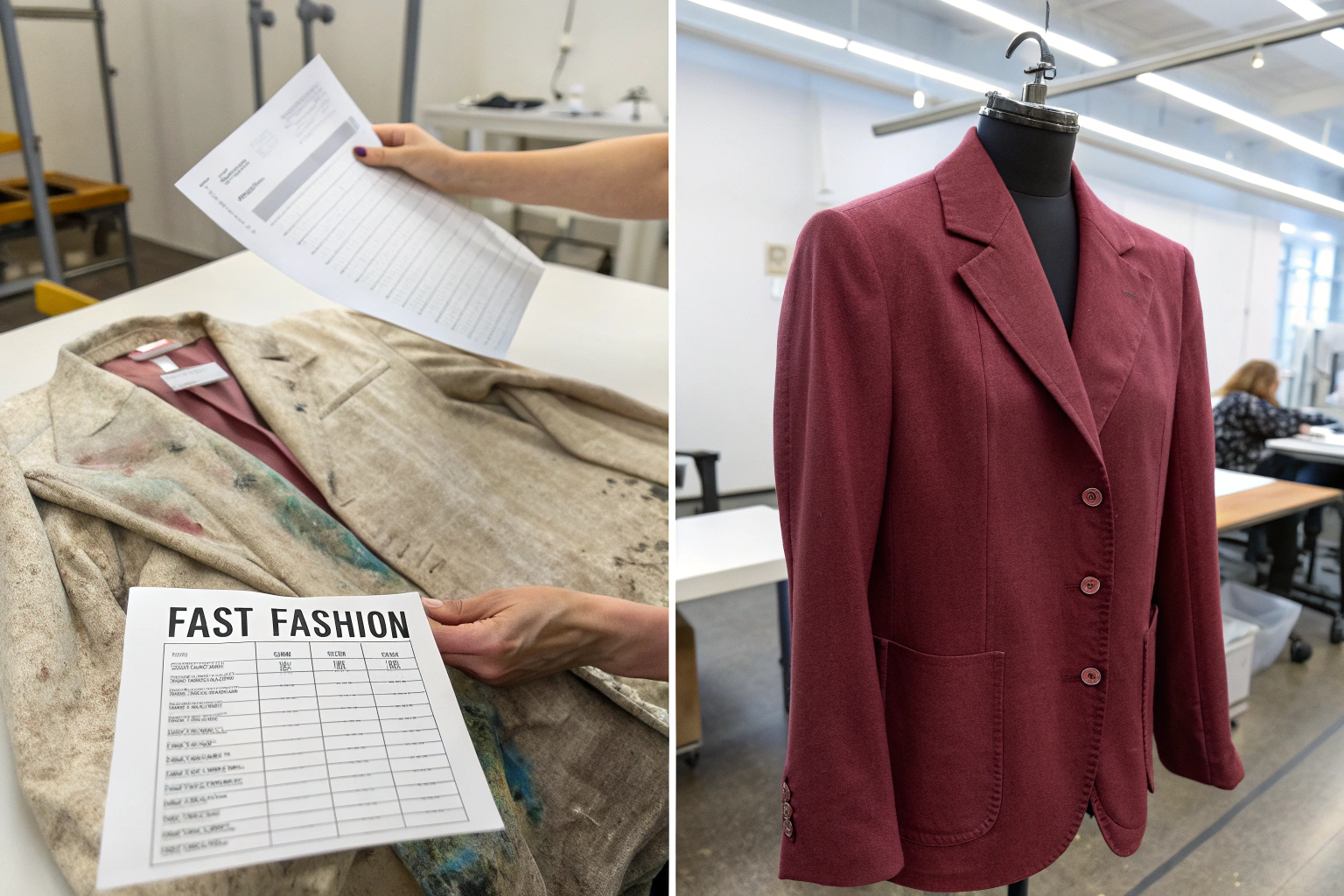
The most effective format we’ve seen brands use is the "comparative visual" on the product page: a split-screen photo or video showing the brand’s fabric next to a standard fast fashion equivalent after a specified number of wash cycles or abrasion rubs. "Our Supima jersey after 50 washes vs. standard carded cotton jersey after 50 washes." The visual evidence is more persuasive than any copy. It demonstrates the quality claim rather than asserting it. A brand that sells a $98 polo shirt and shows a side-by-side macro photo of their collar after 20 washes versus a $45 fast fashion polo collar after 20 washes—the fast fashion collar is curled, pilled, and faded, while theirs is clean and flat—has given the consumer a visual justification for the price premium that a competitor cannot easily refute. The effective technical specification translation into consumer-facing fabric quality marketing claims for premium apparel brands provides case studies of brands that built their entire positioning around specific, verifiable fabric quality metrics.
Can a Small Brand Actually Afford Premium Fabric with Low MOQs?
The math of premium fabric for small brands is counterintuitive. A startup sees a per-meter price quote of $6.50 for a premium cotton-modal jersey and compares it to the $2.80 they see on Alibaba for a standard cotton jersey. They conclude that premium fabric costs more than double and walk away. But the per-meter price is the wrong number to optimize. The right number is the total cost of fabric for a production run, and the total cost includes the cost of unsold inventory, the cost of returns due to quality complaints, and the cost of lost repeat purchases from disappointed customers.
A startup ordering 300 meters of premium fabric at $6.50/meter spends $1,950. A startup ordering 1,500 meters of cheap fabric at $2.80/meter—because the cheap fabric’s MOQ is higher—spends $4,200, plus the cost of storing 1,200 meters of unsold inventory, plus the cost of higher return rates. The premium fabric, even at a higher per-meter price, is often cheaper at the total-order level because the mill offers it at a lower MOQ. Specialty mills that produce premium fabrics know their customers are small and mid-size brands. They structure their MOQs accordingly. At Shanghai Fumao, our stock-supported premium fabrics—long-staple cotton jerseys, Tencel twills, silk charmeuses—are available at MOQs of 300 to 500 meters per color. The per-meter price is higher than a commodity jersey from a mass-production mill, but the startup can order exactly the quantity they need, avoiding the over-ordering that destroys the economics of a small production run. The total cost of ownership analysis for small-batch premium fabric procurement versus mass-market commodity fabric minimum order quantities lays out the hidden costs that make commodity fabric more expensive at the total-order level for small brands.

What Fabric Construction Types Offer the Best Quality-to-Cost Ratio for Startups?
The quality-to-cost ratio is not about finding the cheapest fabric that looks expensive. It’s about finding the fabric constructions where a small additional material or process investment produces a disproportionately large quality improvement. The highest-ratio upgrades for startup knits are: combed ring-spun yarn instead of carded open-end yarn (about $0.40-$0.60/meter extra, produces a dramatically smoother, less fuzzy surface and better pilling resistance), a higher stitch density in the knitting (about 5-8% more yarn consumption, produces a fabric that feels heavier and more substantial without increasing the GSM spec), and a bio-polished enzyme wash (about $0.20-$0.30/meter extra, removes surface fuzz and softens the hand feel permanently). For wovens, the highest-ratio upgrades are: long-staple cotton in the warp only (about $0.50-$0.70/meter extra, concentrates the upgrade where it most affects seam strength and drape), a higher thread count within the same weight category (about 5-10% more weaving cost, produces a fabric with better opacity and a tighter, more premium hand), and a sanforized pre-shrunk finish (about $0.15-$0.25/meter extra, eliminates the post-wash shrinkage that causes consumer returns).
A startup can apply all of these upgrades to a basic cotton jersey or cotton twill and produce a fabric that feels qualitatively different from the fast fashion equivalent, at a total per-meter cost that is still 30-50% below what they would pay for a designer-level Italian import with similar hand feel. The key is investing in the process upgrades that affect the consumer’s tactile experience—smoothness, weight, drape, and shrinkage—rather than the upgrades that affect only measurable but imperceptible properties. The quality-to-cost optimization matrix for fabric construction and finishing upgrades in small-batch premium apparel production provides the cost-benefit analysis for each upgrade by fabric type.
How Do I Structure My First Order to Minimize Financial Risk?
The first order is a test, not a commitment. A startup that commits to 1,500 meters of a custom-developed fabric they’ve never sold is gambling, not sourcing. The smart first-order structure is a "sampling-to-trial-to-bulk" funnel. Stage one is the sampling order: order 20 to 50 meters of the target fabric from the mill’s stock or a close stock equivalent. This costs $100 to $300 and produces enough fabric to sew 5 to 10 sample garments. Test those samples. Wear them. Wash them twenty times. Give them to friends. See how the fabric behaves in real life. Stage two, assuming the samples perform, is the trial production order: order the minimum dye lot—typically 200 to 500 meters—in one or two core colors. This order is large enough to produce a small commercial run of 100 to 200 units, enough to test market demand without overcommitting. Stage three, assuming the trial run sells and the customer feedback validates the fabric quality, is the bulk production order at a quantity that reflects actual demand data, not pre-production guesswork.
This three-stage funnel limits the startup’s financial exposure at each stage. The sampling order risks $300, not $6,000. The trial order risks $1,500, not $15,000. By the time the bulk order is placed, the fabric has been validated by real wear testing and real customer response, and the order quantity is calibrated to actual demand. The risk profile is fundamentally different from a startup that places a speculative 2,000-meter order based on a single showroom swatch and a gut feeling. At Shanghai Fumao, we structure all new-brand relationships through this funnel. The startup’s first order is always from our stock-supported fabric range at the minimum dye lot quantity. If the brand succeeds with that fabric, we develop custom constructions later, once the volume and the relationship justify the development investment. The startup fabric procurement risk management framework and sample-to-trial-to-bulk ordering strategy for emerging apparel brands provides the full risk-reduction playbook.
What Quality Control Standards Separate Startup Quality from Fast Fashion?
Fast fashion quality control is a statistical acceptance model. The brand sets an AQL limit—typically 2.5 or 4.0—which means they accept that up to 4% of the garments can have major defects. The economics of fast fashion make this rational: the cost of preventing those defects through tighter process control is higher than the cost of the returns and the brand damage from the defects that reach consumers. The fast fashion brand budgets for defect returns as a cost of doing business, just like they budget for credit card chargebacks. A startup cannot afford this model. A startup selling 500 units does not have the volume to absorb a 4% defect rate as a statistical inevitability. Ten defective units out of 500 is a return rate of 2%, which might be manageable. But the startup’s brand is built on word-of-mouth and social proof, and each defective unit is a potential negative review that disproportionately damages a small brand’s reputation. The startup needs a defect rate near zero, and that requires a completely different quality control philosophy.
At Shanghai Fumao, we call this the "craftsmanship inspection" versus the "statistical inspection." Craftsmanship inspection means every roll is inspected on a full-width fabric inspection machine under D65 lighting, not just a statistical sample. Every defect is marked, mapped, and recorded. The defect map is shared with the buyer before shipment. The buyer can decide whether to accept the fabric with the defects marked, or to reject the defective portions and receive a credit. This is more labor-intensive and more expensive than AQL sampling—about $0.10 to $0.20 per meter in inspection cost versus $0.03 to $0.05—but it produces a shipment where the buyer knows exactly what they’re receiving. A startup that pays the extra inspection cost reduces their defect risk to near zero, and that reliability translates directly into brand reputation protection. The comparative quality control methodologies for premium small-batch apparel production versus mass-market fast fashion manufacturing quantifies the defect rate differential and the brand value of near-zero-defect delivery.

What Is a "Premium Grade" Inspection and How Do I Request It?
A standard commercial inspection uses an AQL of 2.5 or 4.0, General Inspection Level II, and checks for major defects like holes, stains, and shade variation. A premium grade inspection uses an AQL of 1.0 or 1.5, General Inspection Level III (which pulls a larger sample from the lot), and checks for all defects checked in a standard inspection plus a set of premium-specific criteria: yarn evenness under magnification (to catch subtle barré effects invisible to the naked eye), shade continuity across the full roll width (checking the selvedge against the center for dye penetration variation), hand feel consistency (comparing the hand feel at the beginning, middle, and end of each roll), and residual shrinkage after a simulated wash (testing a swatch from each roll rather than from a composite sample).
To request a premium grade inspection on your purchase order, write: "Inspection standard: ANSI/ASQ Z1.4, General Inspection Level III, AQL 1.0 for major defects, AQL 2.5 for minor defects. Additional premium criteria to include yarn evenness, shade continuity, hand feel consistency, and per-roll shrinkage testing as per attached inspection protocol." This language signals to the mill that you are not a standard buyer accepting standard quality. You are a premium buyer demanding premium verification. The mill will price the inspection cost into the fabric quote, typically adding $0.05 to $0.15 per meter over the standard inspection cost. A startup that communicates premium inspection standards during the quoting process also filters out mills that cannot or will not meet those standards. The mill’s response to the premium inspection request—acceptance, negotiation, or deflection—is a diagnostic of their quality culture. A mill that says "we already inspect to a higher standard than that" without providing evidence is a mill to avoid. The premium-grade fabric inspection protocol specification and AQL level selection guide for luxury and premium apparel brands provides the standard language and sampling tables.
How Do I Use Third-Party Testing to Validate My Fabric Claims?
Internal mill testing is a starting point, not an endpoint. A mill’s CNAS-accredited lab produces reliable data, but the buyer has no way to independently verify that the data corresponds to their specific production lot unless they test it themselves or hire a third party. Third-party testing through SGS, Intertek, or Bureau Veritas provides an independent validation that the fabric meets the claimed specifications. The test report carries legal weight in a quality dispute, and it provides the technical documentation for the brand’s quality marketing claims.
For a startup producing their first serious collection, I recommend third-party testing on the first bulk production lot for the fabric properties that anchor the brand’s quality positioning. If the brand’s positioning is "pill-resistant," test the Martindale pilling grade at an independent lab and publish the report on the product page. If the positioning is "color that doesn’t fade," test the wash fastness and light fastness. If the positioning is "won’t shrink," test the dimensional stability. A single third-party test report costs $200 to $500, and it gives the brand a verifiable, legally defensible quality claim that a fast fashion competitor cannot make without also testing their fabric—which they won’t do, because their fabric would fail. The third-party textile testing lab service selection guide for apparel brands validating fabric performance claims for consumer-facing marketing provides the specific tests, costs, and turnaround times for each quality claim type.
How Do I Build a Supplier Relationship That Prioritizes My Quality Needs?
A fast fashion brand’s supplier relationship is transactional. The brand sends an RFQ to twenty mills, selects the lowest price, places the order, and never speaks to the mill until the next RFQ. The mill has no incentive to invest in quality improvements for a buyer who might disappear next season. The relationship is adversarial, price-driven, and quality-minimizing. A startup cannot win in this model because they will never be the lowest-price buyer. But a startup can win in a partnership model where the mill views the buyer as a long-term growth partner whose quality demands drive mutual capability development.
Partnership means multi-season commitments, not multi-season. It means the startup shares their growth plans with the mill: "We’re launching with 500 meters this season, projecting 2,000 meters next season, and 5,000 meters the season after if this SKU performs." The mill, seeing a growth trajectory, is willing to accept lower margins on the early small orders because the later larger orders will be profitable at scale. Partnership also means the startup involves the mill in product development rather than just handing over a completed spec. The mill’s technician knows more about fabric construction than the startup ever will. Inviting their input—"What yarn would you recommend for a heavier drape at this weight?"—turns the mill into a collaborative partner rather than a passive executor. The mill that helps develop the fabric has a stake in its success. At Shanghai Fumao, our most successful startup partnerships are the ones where the founder treats our development team as an extension of their own product development department, not as a vendor to be negotiated down. The supplier partnership development frameworks for small and emerging apparel brands building long-term quality-focused relationships with textile mills provides the relationship architecture that transforms a transactional supplier into a strategic partner.

What Information Should I Share with My Mill to Get Better Service?
Mills allocate their best resources—their most experienced technicians, their most flexible production slots, their first access to new yarn developments—to the customers they believe in. The mill’s belief in a startup customer is directly proportional to the information the startup shares about their business trajectory and their quality ambition. A startup that sends an opaque purchase order with no context receives standard service. A startup that shares their brand story, their target customer profile, their growth projections, and their quality positioning receives elevated service because the mill sees a future relationship, not a one-off transaction.
Share specific, credible information. "We are a DTC menswear startup focused on premium essentials. Our customer is a 30-45 year old professional who buys fewer, better things and is willing to pay a premium for measurable quality. Our first run is 300 units in two colors. Based on our waitlist and pre-launch engagement, we project 1,500 units for season two if the product meets our quality targets. We are looking for a mill partner who wants to grow with us." This message tells the mill who you are, what you stand for, how much volume you represent now, what volume you might represent later, and what you value in a partnership. It filters for mills who are interested in exactly this type of relationship. A mill who only wants high-volume commodity orders will decline or quote a high price. A mill who specializes in premium small-batch production will recognize a potential long-term partner and respond accordingly. The brand information sharing practices that increase supplier responsiveness and resource allocation for emerging fashion brands in textile manufacturing partnerships details the specific information types and formats that mills use to assess customer potential.
How Do I Handle a Quality Dispute Without Damaging the Relationship?
A quality dispute is a stress test of the partnership. Handled badly, it destroys trust and ends the relationship. Handled well, it strengthens the relationship by demonstrating that both parties can solve problems collaboratively. The key principles: separate the problem from the person, focus on the specific data rather than general accusations, and approach the conversation as a joint problem-solving exercise rather than a blame assignment.
The wrong approach: "The fabric you sent is poor quality. The color is off and it feels cheap. I need a 20% discount or I’m sending it back." This message attacks the mill’s competence, provides no actionable data, and presents an ultimatum. The mill becomes defensive, the conversation becomes adversarial, and the relationship degrades. The right approach: "We received Lot KQ-2406-A. We have three specific concerns based on our incoming inspection: first, the shade reads Delta E 1.8 against the approved lab dip standard, outside our 1.0 tolerance. Second, the weight measures 195gsm against the 210gsm specified. Third, the pilling test on our retained sample shows Grade 2 at 2000 rubs, below the Grade 3-4 we agreed. I’m attaching our spectrophotometer data, weight measurement photos, and pilling test photos. Can we set up a call to review these together and agree on a corrective action?" This message is specific, data-backed, and collaborative. It tells the mill exactly what is wrong, provides the evidence, and invites a joint solution. The mill can verify the data against their own retained samples, identify the root cause, and propose a fix. The relationship survives the dispute because the dispute was handled professionally, not emotionally.
Conclusion
Startups cannot out-scale fast fashion giants, but they can out-quality them. The fast fashion model is structurally incapable of delivering the fabric performance, garment durability, and quality consistency that a focused startup can achieve by making deliberate, technically informed sourcing decisions. The startup that upgrades from carded to combed compact-spun cotton, from standard AQL 2.5 to premium AQL 1.0 inspection, from commodity mill transactional purchasing to specialty mill long-term partnership, creates a product that justifies its price premium through demonstrable, communicable quality superiority.
The key is to make quality the central organizing principle of the sourcing strategy, not an afterthought or a marketing claim. Quality begins at fiber selection and runs through every decision from yarn twist to dye class to inspection protocol. A startup that builds this quality infrastructure into their first collection establishes a competitive moat that fast fashion competitors cannot cross without abandoning the cost structure that defines their business model. They don’t want to compete on quality. They want you to compete on price, where they win. Refuse that game. Play the quality game instead, where their advantages become constraints and your small scale becomes your strategic flexibility.
If you’re building a quality-first apparel startup and you’re looking for a mill partner who understands that "premium" is not a marketing word but a set of specific, measurable, and verifiable production decisions, I want to hear from you. At Shanghai Fumao, our stock-supported premium fabric range is built explicitly for brands like yours—brands that need 300 to 500 meters of exceptional fabric, not 3,000 meters of average fabric. Reach out to our Business Director, Elaine, at elaine@fumaofabric.com. She can send you our premium fabric line sheet with technical specifications, testing data, and MOQ details, and set up a development call to talk through the specific upgrades that will make your first collection feel unmistakably, unarguably better than anything your fast fashion competitors are putting on the rack.