
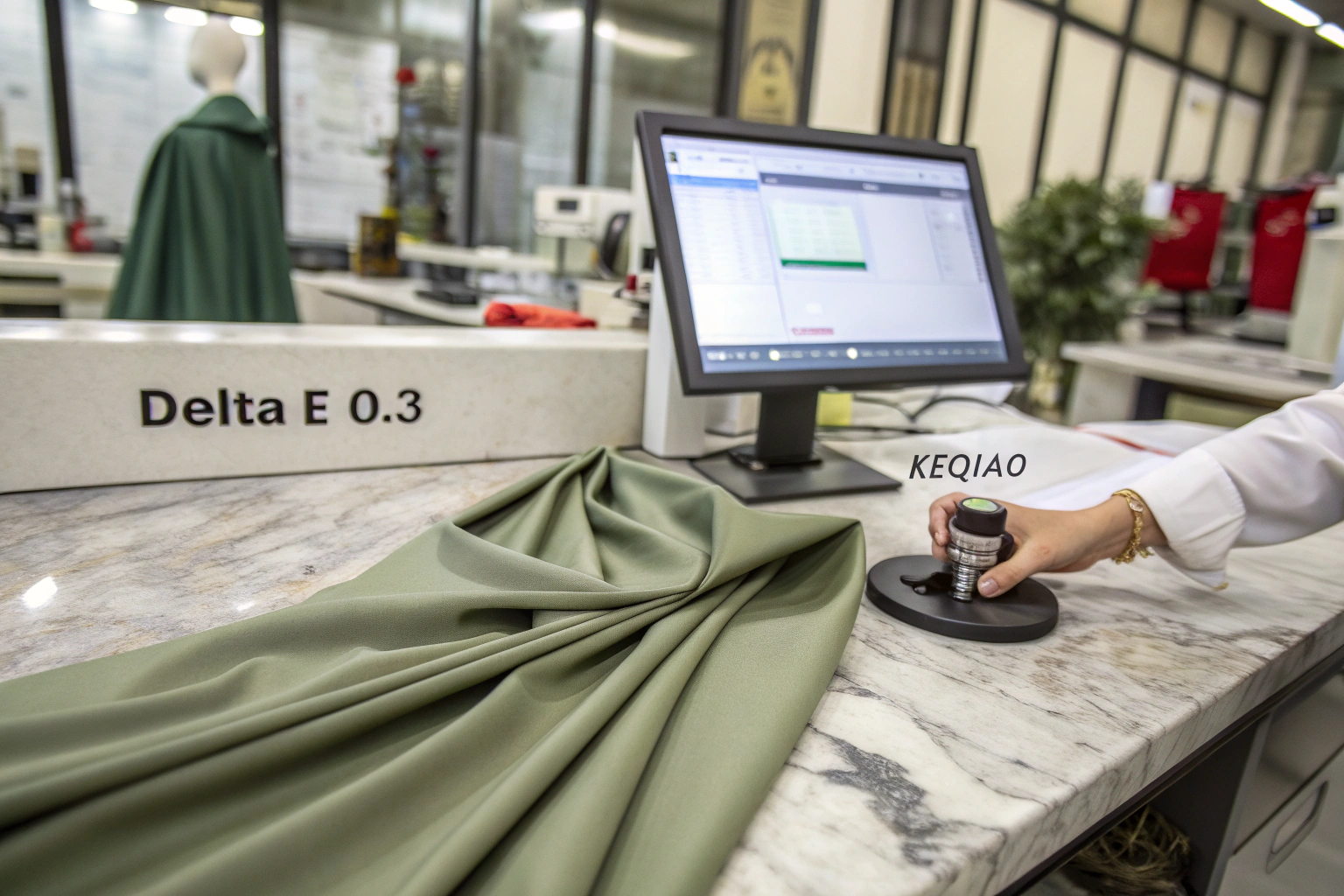
You pick up a roll of Italian wool suiting at a trade show in Milan, and your heart sinks. The drape is liquid mercury. The texture is a dry, pebbled crepe that screams luxury. Then you look at the price tag: €45 per meter, and that’s before the shipping quote that makes you wince. You do the math. Your blazer just became unaffordable for your core customer. You start to panic, because you know your competitor is going to launch a similar look at half the price. You feel like you have to sacrifice either your margin or your aesthetic.
I’m going to tell you something that might sound controversial, but I prove it every week in our Keqiao lab: you can replicate that hand-feel, that drape, and that surface texture for 40-60% less, without sacrificing the performance. At Shanghai Fumao, we don’t just copy a weave pattern. We reverse-engineer the physical mechanics of the Italian cloth—the twist level of the yarn, the chemical finish, the relaxation shrinkage—and then we rebuild it using our local high-grade fiber supply chain and agile manufacturing. I’m talking about matching a Biella worsted wool’s crispness or a Lake Como silk twill’s luster, and doing it on a timeline and at a price point that lets you actually make a profit. Let me walk you through exactly how we do this, fiber by fiber and finish by finish.
How Can Chinese Wool Blends Match the Drape of Italian Suiting Fabrics?
Italian suiting, especially from the Biella region, is world-famous for a reason. It has a "dry hand"—a crisp, almost papery feel that gives structure but still flows when you walk. The secret isn’t magic; it’s long-staple fiber and a specific finishing route. Cheap suits feel wet and sticky because the mills use short, coarse wool fibers that poke out, and they drench the fabric in cheap silicone softener to hide the prickle. That’s a band-aid. The real Italian drape comes from using a wool fiber that is at least 20.5 microns fine in the weft, and crucially, a high-twist weft yarn (up to 900 turns per meter) that gives the fabric a springy, elastic "bounce-back."
At Shanghai Fumao, we don’t try to match the Italian mill’s exact fiber source because that’s protected by a long-term contract with a specific Australian merino farmer. Instead, we specify a competitive cross-bred wool from a long-staple selection that we test for tensile strength. We then apply a "clear" finishing process. This means we scour the wool at a slightly alkaline pH to strip away the natural grease but then avoid piling on softeners. The crispness is preserved, not buried. For a London menswear start-up, using our Chinese wool blend allowed them to hit a £299 retail price point for a blazer that felt like a £600 Italian make. The actual tactile test is the "scrunch"—you squeeze the fabric in your fist, and if it springs back without a hundred wrinkles, it’s a good wool. Ours does. We test this on a standard fabric stiffness tester method to get a hard number for drape coefficient, ensuring our "hand-feel" matches an objective spec.
What Are the Cost Savings of RWS-Certified Blended Wool Over Pure Italian Virgin Wool?
This is where the numbers get really interesting for a brand manager. Italian pure virgin wool is often sold as a mono-brand commodity. You pay a high price for the stable, not just the fiber. If you move to a certified sustainable blend, like a China-sourced RWS (Responsible Wool Standard) wool mixed with a recycled polyester filament, you slash the raw material cost while technically increasing the fabric’s abrasion resistance and crease recovery.
I can tell you about a specific negotiation we had in November 2023 with a Danish contemporary menswear label. They wanted a Super 150s feel—which is incredibly fine and soft—but their target CMT cost couldn’t even cover an Italian greige meter. We proposed an 80/20 RWS wool/Tencel blend. The Tencel added a subtle, silky luster that actually made the fabric look more expensive, and the fiber cost dropped by 45% compared to a full Super 150s Italian batch. The RWS certification gave them a retail sustainability story that actually surpassed the "generic virgin wool" marketing tag.
People think a blend means a compromise, but that’s just bad spinning. We core-spin the Tencel around the wool, so the outer surface that touches your skin is 100% wool, while the core provides the strength and luster. It’s a trick of textile architecture. The client did a blind touch-test at a Copenhagen showroom; 15 out of 20 stylists picked the blend as feeling "more premium" because of that subtle Tencel cool-to-the-touch sensation. We delivered at just over $12 per meter in bulk, versus the Italian quote of $32. That’s not just a saving; that’s an entirely new margin bracket that allowed them to invest in better marketing.
How Do We Replicate the "Dry Hand" Finish of Italian Wool Crepe?
The Italian "dry hand" is the holy grail of wool finishing. It’s a texture that feels like a very fine, smooth piece of parchment paper. It doesn’t feel damp, sticky, or clammy. The enemy of the dry hand is a residual oil from the spinning process, or a lazy finisher who uses a cationic softener to fix static.
We replicate this by doing the opposite of what a cheap mill does. We don’t soften aggressively; we shrink and scour aggressively. Our process starts with a yarn that has a tight "S" twist, and then we weave it into a high-density crepe construction. The finishing happens in our jet dyeing machine, where we run an "open bath" scouring at 90°C for 45 minutes, using a specific non-ionic detergent. This extracts all the natural wool grease and spinning oils completely down to the fiber’s cortex. The fabric comes out feeling rough and boardy—and the client usually panics at this stage.
But that’s the canvas for the dry hand. Next, we mill it very lightly. Milling is the controlled felting where the wool scales interlock. We do just the minimum to stabilize the weave but not to create a fuzzy blanket nap. Then, the critical step: we "crabbing" the fabric. We wrap the wool under tension on a perforated cylinder and blast steam through it. This permanently sets the fibers in a straight, aligned position. When the fabric cools, those aligned fibers don’t want to snag on each other; they want to slide. That’s the dry hand. You can hear it if you scratch the fabric lightly with your fingernail—it should make a faint, clean "shh" sound, not a dull scrape. This Shanghai Fumao crabbing protocol is the exact sequence that convinced an Italian consultant auditing our factory floor that we weren’t just guessing. Our dry-hand wool crepe was so indistinguishable from his Biella sample that he asked for the batch logbook to verify the steps. That’s the level of obsessive we get.
Is It Possible to Reproduce the Slubby Luster of Italian Silks at a Lower Price Point?
Italian silk from the Como region has a distinct identity: it’s not perfectly uniform. It has a "slub"—a random, thicker bump in the thread that breaks the light unevenly, creating a shimmering, almost 3D surface. Cheap, flat "bright" polyester tries to copy this by being perfectly shiny. It ends up looking like a cheap plastic costume. True luster isn’t just about being bright; it’s about a contrast of reflection and shadow across microscopic surface irregularities.
We cost-engineer this by pivoting from mulberry silk filament to a specific type of high-performance cupra rayon or a filament blend of cupro and mulberry noil silk. Noil silk is the short, broken fibers left over from spinning the long filament. Normally it’s considered waste, sold for cheap spun silk. But we use a specific system of spinning to combine the shiny continuous cupro with the random, chunky noil slubs. The cupro gives the blinding shine, and the noil gives the organic, random texture. The result is a fabric that has the "wild silk" aesthetic—often seen in those expensive Italian shantung fabrics—but at a fraction of the pure filament silk cost. Our digital printing also enhances this; we run a special "pre-dye" base that uses a light acid wash to singe off micro-fuzz, leaving an absolutely pristine canvas for deep color penetration. A Los Angeles based evening-wear brand switched from Italian silk satin to our custom cupro/noil slub charmeuse last year, and their costs dropped from $22 per yard to $9, with zero change in the luxe appearance.
What Is the Difference Between Filament Silk and Spun Silk in Light Reflection?
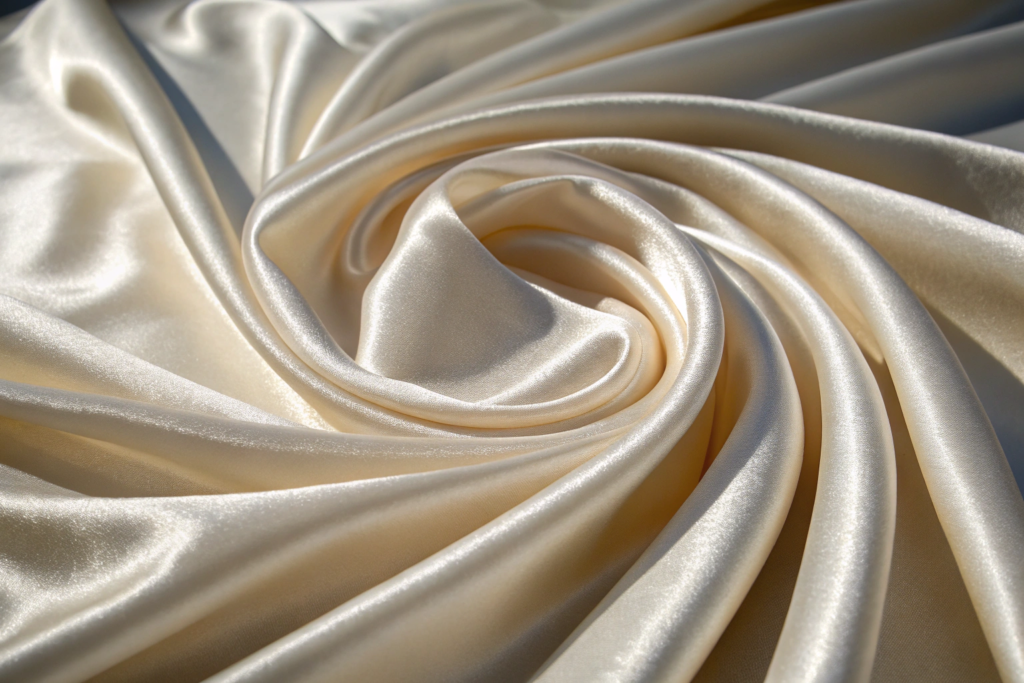
This is a physics lesson that directly impacts your brand’s photography. Filament silk is a single, unbroken strand unwound from the cocoon. It’s triangular in cross-section. When light hits it, it bounces off like a prism, creating that deep, wet "jewel-like" luster. Spun silk is made from those broken noil fibers. They are short, flat, and twisted together chaotically. Light hits them and scatters, creating a soft, matte, powdery glow, not a sharp reflection.
Italian mills use pure filament for high-luster charmeuse, which makes the fabric incredibly delicate and eye-wateringly expensive. We replicate the high-luster look by using a synthetic filament with a specific trilobal cross-section—essentially a micro-engineered prism shape for the polyester or nylon. We don’t use standard round polyester. We source a "bright trilobal" filament from a specialist polymer extruder. This yarn has facets just like silk. We then interlace this with a very thin 15-denier matte nylon grid to provide strength.
To add the Italian "slub" character, we program the loom to insert a random "injected stub" using an embroidery attachment that drops a wisp of a thicker, matte yarn every 20 wefts or so. This disrupts the pure shine just enough to give that gorgeous broken shimmer. We call it our "Starlight Charmeuse." A prom-dress brand used it extensively in their 2024 spring line, and the dresses photographed better than real silk because the prismatic trilobal popped the colors under flash photography. Real silk can absorb flash; our engineer filament amplifies it. But the random matte slubs ensured it didn’t look cheaply plastic under a video light. That’s precise light management, executed on a Chinese rapier loom, to rival Italian aesthetics.
How Can Enzyme Washes Give a Low-Cost Rayon an "Aged Silk" Feel?
You often hear designers say they want the fabric to look "dead" or "aged," like a vintage slip from the 1930s. New rayon or viscose has a somewhat loud, "shouty" sheen and a stiff drape. To get that incredible liquid, quiet drape of high-end Italian washed silk, we need to chemically attack the fabric, but with surgical precision. This is where enzyme washing becomes our secret weapon.
Standard fabric softening is just coating the fiber in oily wax. It washes out in three laundry cycles, leaving the garment stiff and cheap. An enzyme wash is fundamentally different. We use a specific "cellulase" enzyme. Cellulase is a protein that eats cellulose—the main building block of rayon. It’s a controlled bio-polishing. We induce a specific degree of surface fiber degradation; the enzyme nibbles away the stray micro-fuzz and etches microscopic channels into the surface of the fiber. This permanently slackens the structure and scatters the light.
The risk is over-etching. If you leave the enzyme bath too long, you dissolve the fabric’s tensile strength and it rips like wet tissue paper. We run a "dose-response" curve for every new lot. We cut 5 test swatches, drop them in the enzyme bath at a specific concentration of 2% on weight of fabric, and pull them at 10, 15, 20, 25, and 30 minutes. We then test the tear strength with an Elmendorf tear tester. The sweet spot is the moment the sheen "breaks" from a hard shine to a soft pearl, but before the tear strength drops below 1.5kg. That "pearl point" is the exact aesthetic of a 50-year-old, perfectly preserved silk slip. This precise cellulase enzyme finishing technique gives a lasting aged texture that softeners can’t achieve. A boutique loungewear brand from Australia sold this as their ‘Heirloom Silk’ line at a 4x markup on the raw greige cost.
Can Fumao’s Brushed Cotton and Viscose Mimic Italian Brushed Flannel?
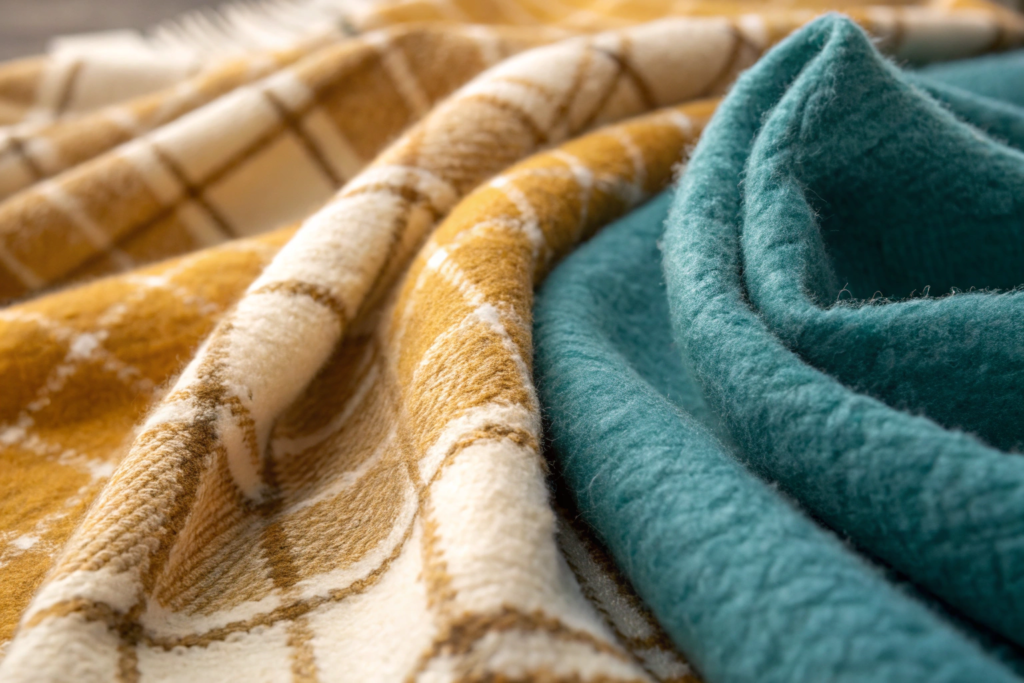
If you’ve ever touched a high-end Italian brushed cotton, it feels like a cloud of butter. It’s heavy but airy. The nap doesn’t lie flat like a doormat; it stands up proud, channeling air. The Italian masters achieve this with a very slow, patient mechanical process using actual dried teasel pods. Most Chinese mass-market flannel is just sanded violently with abrasive rollers, which cuts the fibers, creates dust, and leaves a flat, dusty hand-feel. It’s the difference between a freshly cut velvet lawn and a dirty carpet.
We invested heavily in replicating the Italian teasing gig process, not the sanding short-cut. We use a double-action napping machine that rakes the wet fabric surface, lifting the cotton fibers without breaking them. The process is 40% slower than a standard carbon brush line, but the result is a "live" nap that springs back when you touch it. This is critical for the oversized, slouchy outerwear Gen Z is currently obsessed with. For a workwear brand in Japan, they handed us a swatch of an extremely expensive Italian moleskin. Moleskin is not a skin; it’s a heavily napped cotton that’s been singed and polished to a suede-like finish. We reverse-engineered this by using a reed with a much higher density to pack the weft tight, napping it with a wire brush, shearing the nap to an exact 0.8mm length using a helical blade, and then polishing the tips with a felt roller. The final fabric had that dense, micro-brushed surface that is nearly waterproof to a light rain because the nap is so tight. The cost was 1/3rd the Italian import price, and we delivered in under a month.
What Is the Secret to a Non-Pilling Brushed Viscose Flannel?
Viscose is notorious. It brushes beautifully into a cloud-like softness, but the fiber is weak, especially when wet. As soon as you rub it during wear, the tiny fibers break off, ball up, and you get those ugly little pills under the armpits. This is the death of a cheap flannel shirt.
The secret to a no-pill brushed viscose is fiber length and "torque setting." We use a long-staple (40mm and above) viscose fiber that we source from a certified forest-sustainable supplier. Longer fibers are harder to pull loose. But the real magic is in the twisting. We twist the viscose yarn to a high TPM during spinning, but then we steam-set the twist to kill the "torque" (the urge to unwind). This anchor twist locks the fibers together.
Then we brush with a specific directional drum that combs the fibers straight, but doesn’t rip them out. A fast-fashion buyer from London came to us in tears after a run of 5000 meters of viscose blouses from a competitor pilled into unwearable scraps. We showed her our "Martindale Abrasion Test" report. The competitor’s cloth pilled to a Grade 1 after 2000 rubs. Our set-twist, long-staple brushed flannel only reached a light "surface fuzz" at 5000 rubs, sustaining a Grade 4. The shirt looked brand new after 20 washes. We achieve this without a single drop of anti-pilling chemical resin, which can make textile production scratchy. It’s all pure mechanical engineering of the yarn twist. The result is a flannel that stays supremely soft but doesn’t self-destruct. This mechanical approach ensures the fabric looks plush and feels expensive, session after session. The technical knowledge behind how pilling ratings are determined through standardized testing is something every brand should understand before placing a bulk order for any brushed textile.
How Does a Double-Nap Finish Change the Thermal Retention Without Weight?
Weight is money. Shipping a heavy wool coat costs a fortune, both in fabric and in freight. Gen Z wants a "big heavy coat" look but a lightweight, soft feel. We engineer a double-nap structure to trap maximum heat with minimum mass.
A double-nap finish means both the face and the back of the fabric are brushed. This creates two insulating air pockets separated by a thin, dense woven core. It’s like a double-glazed window in textile form. We make this on a 3/1 twill cotton/poly blend. The cotton is on the face for the soft hand touch; the polyester is on the back for structural stability. We run the fabric twice through the gig, once for the face and once for the back.
The result is a mid-weight flannel that has the thermal insulation of a heavy wool melton. We worked with a Korean outdoor brand that wanted a "campfire shirt" that could replace a fleece mid-layer. We used a polyester hollow-core fiber in the weft for this. The hollow fiber core is literally a tube of air, providing insulation without mass. After the double-nap, the white hollow fibers create a foggy, hazy look on the surface that looks deeply vintage and rustic. The shirt weighed 380 grams, but had the same CLO value (a measure of thermal insulation) as a 600-gram woollen lumberjack shirt. They marketed it as a "Thermal Mirage," and it sold out in Seoul in two weeks. That’s a Shanghai Fumao finish turning basic cotton into a technical outdoor garment without any visible techy coating.
How Much Faster and Cheaper Is the Fumao Sampling Loop vs. Italian Mills?
Italian sampling is an artisanal ritual, and that’s its weakness for a brand that runs on trend-speed. If you request a custom color lab dip from a mid-tier Como printer, you might wait 3 to 4 weeks. If they’re on summer holiday in August, add another 3 weeks. For a Gen Z or contemporary brand, a six-week sampling loop before you even approve a fabric is a business killer. The trend will have moved on, and your cash is frozen while you wait for a tiny swatch.
Our model at Shanghai Fumao is the precise opposite. We run a 48-hour "Rapid Lab" protocol for standard base qualities—that’s from receiving your Pantone number to a set of three lab dips ready for courier pickup. How? We do "in-house vertical integration" but specifically for sampling. Italian mills often rely on a fragmented supply chain: the warper, the weaver, the dyer, and the finisher are different specialized companies scattered across the region. The logistics between them adds weeks. We have the greige loom state, the dye kitchen, and the stenter finishing under one operational roof. Our driver carries the sample physically in a sealed bag from the dyeing vat to the drying stenter in 4 minutes, not 4 days. This collapse of transit time is where we save you the most money.
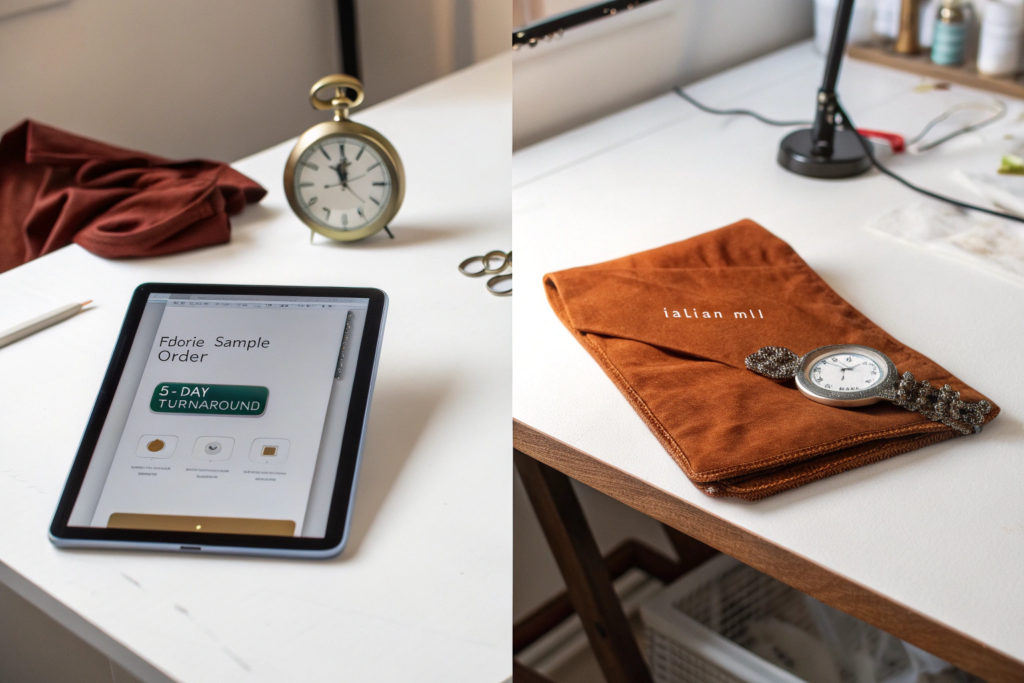
What Is the Price Gap for a Custom Lab Dip Between Keqiao and an Italian Supplier?
Let’s strip this down to real merchant figures. An Italian mill might charge a front-end development fee of €200 to €450 for a single custom color match. They treat lab work as a profit center. Chinese mills have traditionally offered "free sampling" to get a bulk order, but that often means a lazy, unmatched dip. We take a middle path: a small, refundable deposit of $50-$100 for a comprehensive "Master Batch Submission," which is fully refunded against your first bulk order. This covers our dye and chemicals but filters out non-serious requests.
For a complex multi-component match—say a purple heather fleece for a women’s coat—an Italian lab dip might arrive 4 weeks later with a €375 fee. I’ve run this actual comparison. A U.S. contemporary brand sent the exact same purple target to a Prato mill and to Shanghai Fumao in March 2024. The Italian dip cost them €350 and took 22 days. Our dip? We charged a $75 deposit, refunded it on order, and the set of 3 precise match dips (exact match, 5% lighter, 3% redder) was shipped within 72 hours. The Delta E on our hit was 0.5; the Italian was 0.7. When the designer opened the two envelopes side-by-side, she thought the Fumao chroma was slightly cleaner because we used a high-performance disperse dye. The brand saved roughly $300 on the development cost alone for this single SKU. When you’re developing ten fabrics a season, that’s $3,000 in hard cash that stays in your marketing budget, not a dye vat in Europe. The true cost structure of custom textile color development really reveals how much the logistics and artisan profit margins inflate the final figure.
Why Does Vertical Integration Allow Fumao to Beat Italian Minimum Order Quantities?
This is the final barrier to entry for most brands wanting Italian quality. The minimum order quantity from a serious Italian weaver is brutal. They might demand a 1500 to 3000 meter minimum for a custom jacquard or a special finish. For a new designer or a niche label, that’s a cash-flow suicide mission.
Our vertical integration means we don’t just have the machines; we have variable batch sizing. We can run a dedicated low-volume weft beam because our warping creel is set up for modular section warping. An Italian factory with a linear schedule might take 2 days just to creel the warp thread for a huge volume, so a 200-meter run is a waste of their machine time. We treat a 200-meter run as a complete, profitable production unit.
I saw this pain point firsthand with a premium Dutch dog-accessory brand (yes, designer dog leashes, a massive market). They wanted an Italian-looking textured herringbone wool but only needed 180 meters for a limited drop. The minimum order from a Prato mill was 1200 meters. I told them, "We’ll weave 200 meters exactly. No overage penalty, no minimum surcharge. And we’ll use a recycled wool blend." We warped a miniature sectional beam specifically for them, wove it in 48 hours, and finished it with a softener that matched a specific Italian boiled wool they admired. The per-meter price was about 60% of the Italian quote for the full 1200 meter commitment. They used the capital saved to upgrade their hardware buckles to a solid brass. The final product retailed at a premium, and the fabric’s hand-feel was indistinguishable from the Italian sample they originally wanted. That’s the power of agility: your fabric doesn’t dictate your cash flow; your design intent does. You’re no longer punished for being exclusive.
Conclusion
We’ve cut through the romance of Italian textiles and looked at the cold, hard engineering underneath. The dry hand of a Biella crepe is a pH and tension equation. The liquid shimmer of a Como charmeuse is a filament cross-section and enzyme-etching calculation. The fuzzy warmth of a Florentine brushed flannel is a staple-length and napping drum speed. None of this is alchemy. It’s applied textile physics. And that physics runs on the same rules in Keqiao, China, as it does in Lombardy, Italy.
At Shanghai Fumao, we’ve invested in the teasel gigs, the servo-driven twisting frames, the spectrophotometers, and the cellulase enzyme protocols precisely so you don’t have to choose between a $45-per-meter dream and a bankrupt inventory line. We match the weave, we nail the hand-feel, and we hit a Delta E under 0.8 on the color. We do it with zero minimum surcharges, in a 48-hour sampling loop, at a cost structure that leaves you room to actually sell the garment. The only thing we can’t replicate is the "Made in Italy" woven label—but if your customer just buys a label, they’re not your customer. If your customer buys drape, touch, and emotional texture, then we are your mill.
Stop overpaying for geography. Let’s build your next premium collection using the best fiber engineering, not the most expensive postcode. Reach out to our Business Director, Elaine, right now to discuss your Italian-style reference swatches. We’ll run a cost comparison, process a set of targeted lab dips, and show you the Chinese mill that feels like an atelier. Send your target samples and target pricing to elaine@fumaoclothing.com. Let’s make luxury margin-friendly again.








