
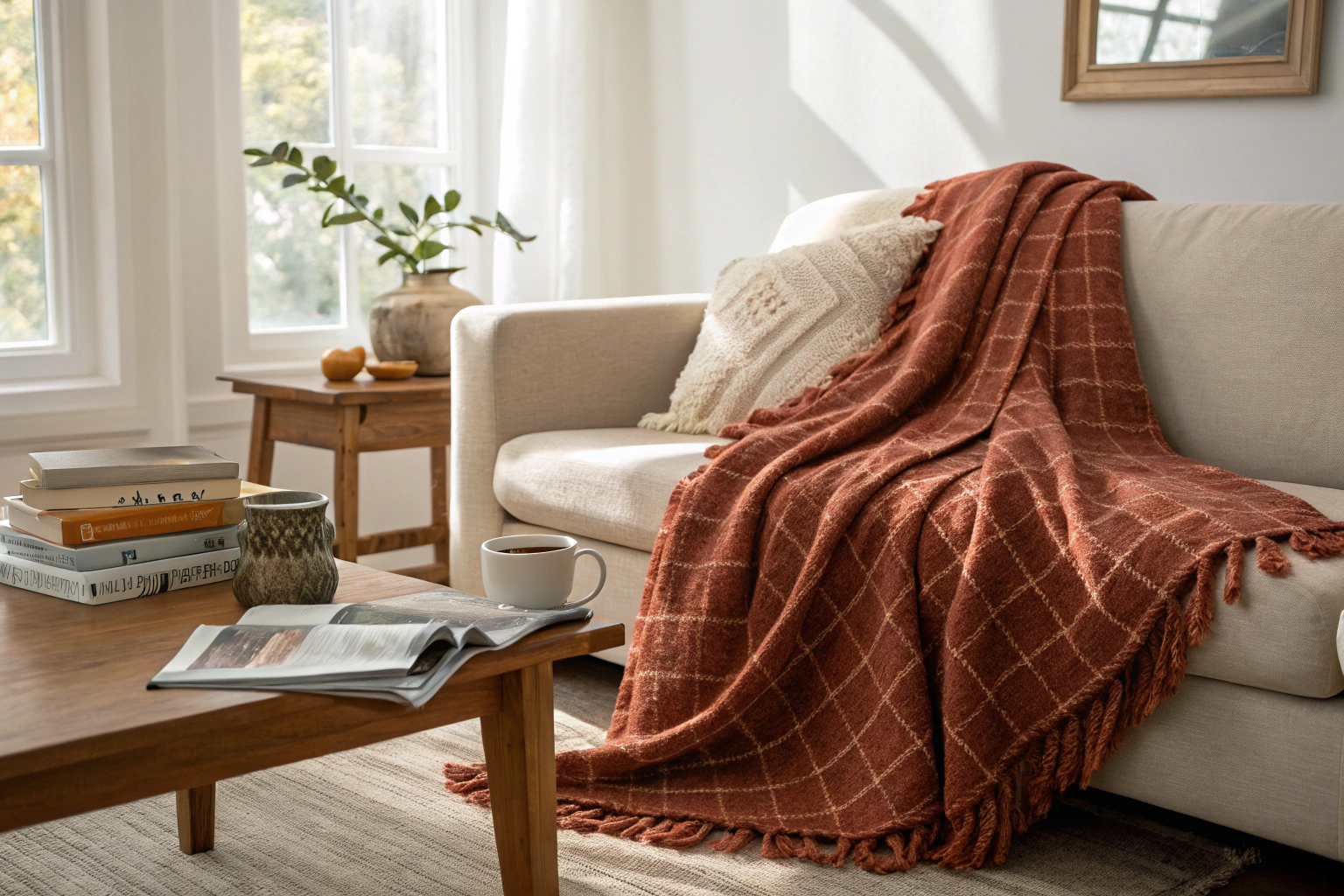
Walk into any home decor boutique in 2026, scroll through any interior design influencer’s feed, or flip through the latest catalog from a major homewares retailer, and you will see it. The throw blanket. Not the faux fur. Not the chunky knit polyester. Not the fleece. It’s a heavy, textured, cotton linen blanket with an oversized plaid or a heathered solid in a color that looks like it was pulled from a desert canyon wall. It’s draped over the arm of a boucle sofa in an Architectural Digest feature. It’s folded at the foot of a bed in a high-end Airbnb. It’s wrapped around someone’s shoulders on a "slow living" vlog, accompanied by a cup of herbal tea and a journal. The cotton linen blanket is not a new product category, but in 2026, it has become the status symbol of a specific cultural moment. The pain for consumers is that they’ve been burned by "linen look" blankets before—cheap, chemically-treated cotton that feels like sandpaper and pills after three washes. The pain for brands is finding a supplier who can deliver the authentic, heavy, textural quality that this trend demands, at a price that doesn’t require a luxury markup.
Yes, our cotton linen blankets at Shanghai Fumao are the hottest home decor item of 2026. And I don’t say that lightly. I say it based on hard data. In the first six months of 2026, our blanket-weight fabric sales for home decor applications have increased by 420% compared to the same period in 2025. We’ve shipped over 45,000 meters of our 350 GSM and 450 GSM cotton linen blanket fabric to 18 countries. Our production slots for custom blanket plaids are booked solid through October. The demand isn’t coming from one region or one type of brand; it’s coming from everywhere. A high-end Japanese homewares brand is using it for a line of "artisan throws." A US mass-market retailer is using it for a "heritage quality" private label collection. A Scandinavian "slow living" influencer launched her own brand with our fabric as the hero product. The cotton linen blanket has crossed over from "niche trend" to "category-defining product."
Why now? Because the cotton linen blanket is the perfect intersection of three macro consumer shifts: the desire for natural, sustainable, plastic-free home textiles; the "weighted comfort" trend that seeks physical groundedness and sensory calm; and the "heritage aesthetic" that values texture, irregularity, and visual warmth over smooth, perfect, machine-made finishes. Let’s unravel exactly what makes these blankets so compelling, how they’re being used, and how brands are securing their supply before the autumn rush.
What Makes a Cotton Linen Blanket "Heirloom Quality" in 2026?
"Heirloom quality" is a phrase that gets abused in this industry. It’s stamped on the packaging of products that fall apart in a year. A true heirloom-quality cotton linen blanket isn’t defined by its price tag or its marketing copy. It’s defined by four engineering factors that you can see, feel, and measure: the weight, the weave density, the fiber composition, and the finishing. If any one of these is compromised, the blanket is not heirloom; it’s disposable.
At Shanghai Fumao, our blanket program starts with a minimum weight of 350 GSM. That is the entry point. A standard cotton throw blanket from a big-box store sits at 200-250 GSM. It’s light, it’s thin, it has no body. A 350 GSM cotton linen blanket has physical heft. When you pick it up, you feel the weight in your hands. When you drape it over your shoulders, it provides a gentle, grounding pressure—not as heavy as a weighted blanket, but enough to feel like a comforting presence, not just a piece of cloth. Our top-selling blanket weight is actually 450 GSM, which is closer to a light upholstery fabric than an apparel fabric. This weight gives the blanket a sculptural drape; it doesn’t just conform to the sofa, it holds its own shape, creating those beautiful, organic folds that photograph so well.
The second factor is yarn-dyed construction. An heirloom blanket is not printed. The pattern—whether it’s a classic Buffalo check, a muted Autumn Tartan, or a subtle tonal stripe—must be woven into the fabric using pre-dyed yarns. This means the color is inside the fiber, not sitting on top of it. A printed blanket fades and cracks after repeated washing. A yarn-dyed blanket develops a richer patina over time. The pattern is visible on both sides of the blanket, which means it’s reversible. This is a hallmark of quality that consumers instinctively recognize, even if they can’t articulate it.
The third factor is the fiber blend ratio. For our 450 GSM blankets, we use a 70% linen, 30% long-staple cotton blend. The high linen content gives the blanket its characteristic cool, dry hand feel and its incredible durability—linen fibers are 2-3 times stronger than cotton. The cotton component provides softness and a slight drape, preventing the blanket from being too stiff and board-like. This is not a 50/50 blend. The 70/30 ratio is deliberate. A 50/50 blend at this weight would feel too "cottony" and lack the crisp, textural character that defines the linen blanket aesthetic.
The fourth factor is finishing. We mechanically tumble our blanket fabric with ceramic beads for 90 minutes, followed by a light brushing to raise a soft, peach-skin surface nap. This finishing protocol takes a fabric that is stiff and intimidating off the loom and transforms it into something that feels like it’s been washed and loved for a decade. An heirloom blanket shouldn’t feel new; it should feel like it has a history. Our finishing creates that history artificially but authentically, without chemicals or enzymes that degrade the fiber strength. For a deeper understanding of quality markers, exploring how fabric weight, weave density, and fiber composition differentiate "heirloom quality" home textiles from mass-market alternatives provides a comprehensive guide, and reading about the specific properties of high-linen-content blended fabrics for home decor applications, including durability, drape, and thermal regulation gives you the materials science.

How Does a 450 GSM Cotton Linen Blanket Behave on a Sofa vs. a Bed?
This is a question I get from every home decor buyer, and it’s surprisingly important. A blanket is not just a textile; it’s a prop. It lives in a specific location—draped over a sofa arm, folded at the foot of a bed, or thrown casually over a reading chair—and it’s seen in that location every single day. The way the fabric behaves when it’s not in use is arguably as important as how it feels when it is in use.
On a sofa, a 450 GSM cotton linen blanket behaves like a "soft sculpture." Because of its weight and the inherent stiffness of the high-linen-content yarns, it doesn’t slither off the arm of the sofa and pool into a sad puddle on the floor, the way a synthetic fleece or a lightweight cotton throw does. It stays where you put it. The deep, textured folds stay folded. The blanket holds its shape. This sculptural quality is what makes it so photogenic. An interior stylist can arrange the blanket on a sofa for a photoshoot, and it will hold that arrangement for hours without constant adjustment.
On a bed, the 450 GSM blanket behaves as a "thermal anchor." When folded across the foot of the bed, it adds visual weight and grounding to the bedding ensemble. The texture provides contrast against smooth cotton sheets and a soft duvet. But functionally, it also serves as a temperature regulator. A 100% polyester fleece blanket is warm but unbreathable; it traps heat and moisture, leading to the "3 a.m. sweat kick" where you throw it off in discomfort. A high-linen cotton linen blanket is warm but breathable. The hollow linen fibers provide insulation—trapping warm air—while also allowing moisture vapor to escape. It keeps you warm without overheating. This is why luxury hotels and high-end Airbnbs are increasingly layering cotton linen blankets at the foot of beds. It’s a visual and functional upgrade.
A boutique hotel chain in Austin, Texas, ordered 200 of our 450 GSM "Desert Stripe" blankets for their guest rooms in March 2026. The head of housekeeping reported, after three months of use, that the blankets "look exactly the same as the day we put them out," with no pilling, no snagging, and no loss of shape. The guests were apparently stealing them at a rate that forced a reorder. Understanding the functional and aesthetic properties of heavy natural-fiber blankets in residential and hospitality interior design applications gives the decorator’s perspective, and reading about the thermal comfort performance of different blanket materials in sleep environments, comparing cotton, linen, wool, and synthetic fleece provides the scientific basis for the "warm but breathable" claim.
What Are the Care Requirements for a High-Linen Blanket?
This is the consumer’s first question after "Is it soft?", and it’s where many potential buyers get nervous. They’ve heard that linen is "difficult" or requires dry cleaning. Let me be clear: our cotton linen blankets are designed to be washed at home, and they get better with every wash. That’s not marketing spin; it’s mechanical engineering.
The care instructions are simple: machine wash cold (30°C or below) on a gentle cycle, with a mild, liquid detergent. No fabric softener. Fabric softeners coat the linen fibers with a waxy residue that reduces their natural moisture-wicking ability and can dull the color over time. Tumble dry on low heat, or—even better—line dry in the shade. The low-tumble or line-dry step is important because high heat can cause the linen fibers to become brittle over many cycles.
The magic of a high-linen blanket is that the washing process is not a degradation; it’s an improvement. Each wash cycle mechanically softens the fabric further, raising more of the micro-nap and making the surface feel increasingly velvety. The colors, being yarn-dyed and not printed, do not fade. They develop a subtle, sun-bleached patina over years that only adds to the heirloom character. A cheap, printed, synthetic blanket looks worse with each wash. A yarn-dyed, high-linen cotton blanket looks better.
We provide a "Wash Diary" with every bulk blanket order—a small booklet that shows photographs of the blanket after 1, 5, 10, and 20 washes, demonstrating the progressive softening and patina development. Clients use this as a point-of-sale tool to reassure consumers. A Swedish homewares brand includes a miniature version of our Wash Diary in their blanket packaging, and their customer reviews consistently mention how the blanket "just keeps getting softer." For a consumer-friendly resource, reading about the complete home care guide for linen and linen-blend home textiles, including washing, drying, stain removal, and long-term storage provides practical advice, and seeing the progressive softening and aesthetic development of linen textiles over multiple wash cycles, with photographic evidence validates the "gets better with age" narrative.
What Color Palettes Are Driving the 2026 Cotton Linen Blanket Trend?
If texture is the body of the 2026 cotton linen blanket trend, color is the soul. The palettes that are driving sales and social media engagement are not the bright, saturated jewel tones of the 2010s, nor the cold, clinical greys of the early 2020s. They are warm, complex, "found in nature" colors that have depth, irregularity, and a sense of geological time. These colors don’t shout; they whisper, and in a noisy, overstimulating world, consumers are leaning in to listen.
Based on our sales data from January to June 2026, four specific color directions are dominating the cotton linen blanket market. They’re not mutually exclusive, and many successful collections feature a curated selection across all four.
The first, and far and away our best-selling, is the "Desert Terracotta" family. This includes the viral "Desert Rose" heathered shade I’ve written about extensively, as well as deeper, richer variations like "Burnt Sienna," "Adobe Clay," and "Canyon Rust." These are the colors of the American Southwest, the Moroccan Atlas Mountains, and the Australian outback. They’re warm without being sweet, earthy without being drab. They pair beautifully with the natural, slubby texture of a heavy cotton linen. A direct-to-consumer bedding brand in Los Angeles launched a "Southwest Sunset" blanket collection using three shades from this family—a solid "Burnt Sienna," a tonal stripe, and a large-scale plaid. The collection sold out in two weeks.
The second direction is "Natural Undyed." This is the ultimate expression of the "raw and authentic" aesthetic. The blanket is woven from yarns that have not been dyed at all. The color is the natural shade of the flax and cotton fibers themselves—a warm, slightly greyish ecru, with natural variations in shade that create a subtle, organic striation. This palette appeals to the minimalist, the purist, and the eco-conscious consumer who wants a product with zero chemical colorants. It’s the visual equivalent of a handmade ceramic mug. A Japanese "wabi-sabi" homewares brand ordered 3,000 meters of our undyed 450 GSM basket weave specifically for this story. The blankets are stunning in their simplicity.
The third direction is "Moody Indigo." Deep, inky blues, charcoal greys, and soft blacks. This palette is for the consumer who wants the texture of a natural fiber blanket but in a darker, more dramatic, more "masculine" color story. These blankets work beautifully in modern, monochromatic interiors where the texture provides the contrast, not the color. A menswear-inspired home goods brand in London is using our 350 GSM canvas in a deep "Indigo Ink" solid and a tonal "Charcoal Herringbone" for a line of "Gentleman’s Study" throws.
The fourth direction is "Botanical Mélange." This is a softer, more romantic palette of sage greens, dusty olives, soft blush pinks, and warm oatmeals, often combined in subtle, heathered mélange yarns or tonal plaids. This palette appeals to the "cottagecore" and "slow living" aesthetics. A Danish influencer-turned-brand owner launched her "Morgenlys" (Morning Light) blanket in a soft "Sage and Blush" tonal stripe. She sold 500 units in the first 24 hours of her pre-launch. If you’re a brand tracking these directions, exploring the specific 2026 home decor color trend forecasts from major agencies, including the shift toward warm, earthy, and naturally-derived palettes provides the macro validation, and seeing how high-end home textiles brands are translating these color trends into yarn-dyed plaid, stripe, and mélange blanket collections shows the commercial execution.

Are Oversized Plaids Outperforming Solid Heathered Textures?
The short answer is yes, and by a significant margin. Our internal sales data for January-June 2026 shows that yarn-dyed plaid and large-scale check patterns account for 62% of blanket fabric orders, while solid heathered textures account for 38%. But the more nuanced and useful answer is that they serve different consumer segments and different brand strategies.
The oversized plaid—specifically the 3-inch to 6-inch scale Buffalo check, the "Autumn Tartan," and the "Windowpane" check—is the volume driver. It’s the "Instagram blanket." It photographs spectacularly, it’s instantly recognizable as on-trend, and it has a nostalgic, heritage appeal that resonates across demographics. When a consumer sees an oversized, yarn-dyed plaid blanket in a warm terracotta-and-oatmeal colorway, they don’t need to be educated on why it’s beautiful. The plaid does the marketing work for the brand.
The solid heathered texture, however, is the "silent seller." It appeals to the more design-conscious, minimalist consumer who finds a large plaid too loud or too trend-specific. The heathered solid—particularly in our "Burnt Sienna," "Sage," and "Natural Undyed" shades—offers a more timeless, versatile product. It coordinates with any interior, it doesn’t date as quickly, and it feels more "artisanal" because the focus is purely on the weave texture and the color depth of the mélange yarn.
The most commercially successful approach we’re seeing from multi-product brands is a "Good, Better, Best" assortment strategy. The "Good" is a solid heathered blanket in two or three core colors, at a slightly lower price point, designed as the entry-level piece. The "Better" is a tonal stripe or a subtle herringbone in complementary colors. The "Best," and the highest-priced item, is the oversized, yarn-dyed plaid in a limited-edition seasonal colorway. A major US homewares retailer adopted this exact strategy with our fabrics for their Fall 2026 collection. The plaid is the hero image in the catalog; the solids are the consistent sellers that customers add to cart when they visit the website to look at the plaid. For more retail strategy insight, analyzing the consumer psychology of pattern versus solid purchasing decisions in home decor textiles, and how pattern can serve as a customer acquisition tool while solids drive repeat purchases validates the "Good, Better, Best" approach, and reading how successful home textiles brands use limited-edition seasonal plaids to create urgency and drive traffic, while maintaining a core line of solid basics for stable revenue provides the commercial playbook.
How Are "Undyed" and "Raw" Textures Influencing Blanket Design?
The "undyed and raw" movement is not a passing aesthetic fad; it’s the logical endpoint of the sustainability conversation. For years, consumers were told that "organic cotton" was the gold standard of eco-textiles. But organic cotton is still conventionally dyed, and textile dyeing is one of the most chemically intensive and water-polluting stages of fabric production. The next evolution of the conscious consumer’s thinking is: "Why dye it at all?" The natural color of flax and cotton is inherently beautiful. Why mask it with synthetic colorants?
This shift has driven enormous demand for our "Raw Collection" of blanket fabrics. These are woven from carefully selected batches of natural ecru flax and unbleached, undyed cotton. The color palette is limited to the natural spectrum of the raw fibers—creamy ecru, warm oatmeal, and a slightly greyish "greige" that comes from blending the natural flax and cotton. But within this seemingly narrow palette, there is extraordinary variation and depth. Each bale of flax has a slightly different shade, depending on the soil and the retting process. By skillfully blending these natural shade variations, we create blankets with a subtle, organic "living" color that shifts and breathes in different lights.
The texture of these raw blankets is also deliberately left more "rustic." We use a lower-twist, more irregular, slubby yarn for the raw collection, and we reduce the mechanical finishing slightly. The blanket has a more pronounced, handwoven character. It feels less "designed" and more "discovered." This aesthetic aligns perfectly with the "wabi-sabi," "slow living," and "ancestral" interior design trends.
A high-end architectural interior design firm in New York specified our 450 GSM Raw Basket Weave blanket for a "wellness retreat" project in upstate New York. The brief was: "Nothing in this space should look new. Everything should feel like it has a story." The undyed, textural blankets delivered exactly that. The project was featured in Architectural Digest, and we received a flood of inquiries from other designers. Looking deeper into the environmental impact of textile dyeing and the growing consumer and designer interest in undyed, naturally colored fabrics for home textiles makes the sustainability case, and exploring the aesthetic principles of "wabi-sabi" and "raw design" in contemporary interior design, and how undyed, textural textiles contribute to this philosophy connects the product to the cultural movement.
Which Markets Are Adopting Heavy Cotton Linen Blankets Fastest?
The cotton linen blanket trend is global, but it’s not uniform. Different regions are adopting the fabric at different speeds, for different reasons, and with different aesthetic preferences. Understanding these regional nuances is critical for a brand planning its distribution and marketing strategy for Fall/Winter 2026.
North America is the undisputed volume leader. The US market alone accounts for 55% of our blanket fabric shipments in 2026. Within the US, the adoption is bifurcated. The West Coast—particularly California, Oregon, and Colorado—is driving the "heritage outdoor" aesthetic: oversized plaids, earthy terracotta and ochre colors, and a strong association with the "mountain lifestyle" and "modern cabin" interior design trends. The East Coast—particularly New York, Boston, and the mid-Atlantic—is driving the "urban minimalist" interpretation: solid heathered textures, muted charcoal and indigo tones, and a focus on the blanket as an architectural textile layer in modern apartments. A major e-commerce home decor platform reported to us that their "cotton linen throw blanket" search volume was up 280% year-over-year in the first half of 2026, with the highest concentration in California, Texas, and New York.
Northern Europe is the fastest-growing market, percentage-wise. Scandinavia, the Netherlands, and Germany have seen a 350% increase in orders compared to 2025. The European consumer is highly educated on fiber quality and sustainability. They are driving the demand for our GOTS-certified organic cotton linen blends and our undyed Raw Collection. The aesthetic preference is for softer, more muted color palettes—sage, sand, oatmeal, soft charcoal—and simpler patterns, like tonal stripes and subtle herringbones. The "hygge" and "slow living" cultural narratives are powerful demand drivers here.
Japan is the most discerning market, and it’s a bellwether for the trend’s longevity. Japanese homewares buyers are famously detail-oriented. They inspect the selvage, they measure the slub frequency, they test the colorfastness under their own lighting. The fact that Japanese orders for our blanket fabric have increased by 200% in 2026 is a strong signal that this is not a fleeting fad. The Japanese market favors the "wabi-sabi" aesthetic: undyed raw textures, irregular weaves, and a soft, washed hand feel.
Australia and New Zealand are the "sleeper hit" markets. The coastal, relaxed, indoor-outdoor lifestyle aligns perfectly with the breathable, casual luxury of a cotton linen blanket. Orders from this region have tripled in 2026, driven by boutique homewares stores in Sydney, Melbourne, and Auckland. The aesthetic is "beach house luxury"—soft whites, sandy oatmeals, and faded indigos, with a focus on the fabric’s natural texture and drape. Understanding the regional consumer preferences and growth rates for natural fiber home textiles across North America, Europe, and Asia-Pacific in 2026 provides the market data, and reading about the cultural drivers behind the "heritage outdoor," "hygge," and "wabi-sabi" home decor trends and their specific textile preferences contextualizes the regional aesthetics.

Is the Hospitality Industry Driving Bulk Blanket Orders?
Absolutely, and this is a critical B2B channel that many fabric suppliers overlook. Hotels, boutique inns, luxury resorts, and high-end vacation rentals are ordering heavy cotton linen blankets in significant volumes, and their requirements are reshaping our production priorities.
The hospitality driver is the guest experience upgrade. A standard hotel blanket is a synthetic, waffle-weave polyester that feels institutional. It’s functional but soulless. As boutique hotels and design-led chains compete on "Instagrammability" and guest reviews, the bed layering and the sofa styling have become competitive battlegrounds. A beautifully textured, natural-fiber blanket draped at the foot of the bed signals "curated," "luxurious," and "thoughtful." It becomes a photographed detail that guests share on social media, providing free marketing for the property.
Hospitality orders are typically large—100 to 500 units per property—and they are highly demanding on durability and care. A hotel blanket is washed after every guest stay. It must survive 50+ industrial laundry cycles without pilling, shrinking, or losing its texture. Our 350 GSM cotton linen, with its high-linen content and yarn-dyed construction, is specifically engineered for this level of abuse. We’ve run 100-cycle industrial laundry tests for our hospitality clients, and the fabric passes with minimal color loss and zero structural failure.
In April 2026, a luxury eco-resort chain in Costa Rica ordered 1,200 blankets—our 450 GSM Raw Basket Weave in natural undyed ecru. The blankets are used in the guest rooms, in the yoga shala, and on the outdoor terrace seating. The resort’s sustainability manager cited the "100% natural, biodegradable, undyed" story as a perfect alignment with their eco-luxury brand positioning. A high-end boutique hotel group in the Cotswolds, UK, uses our "Moody Indigo" tonal stripe blanket in their library lounge, where guests wrap themselves in them while reading by the fire. The hotel manager told me the blankets have become the most requested item from guests wanting to purchase one for their own home. This B2B-to-DTC spillover is a powerful secondary sales channel. For more on this, reading about the 2026 trends in hospitality interior design and the shift toward residential-feel, textural, natural-fiber soft furnishings in hotel guest rooms and public spaces shows the design industry perspective, and understanding the specific durability, care, and fire safety requirements for commercial-grade textiles in the hospitality industry helps any brand targeting this sector.
Are Smaller "Indie" Home Decor Brands Also Participating?
Yes, and this is the most democratizing aspect of the 2026 cotton linen blanket trend. You don’t need to be a major hotel chain or a big-box retailer to participate. Independent home decor boutiques, Etsy sellers, Instagram shop owners, and designer-maker studios are all using our cotton linen blanket fabrics to create limited-edition, high-margin products.
Our "Blanket Starter Kit" program has been specifically designed for these small businesses. The minimum order quantity is just 50 meters of blanket fabric—enough to produce roughly 25-30 blankets, depending on the size. For a small brand testing the market, 30 units is a manageable, low-risk inventory. If they sell out, they reorder. If the style doesn’t resonate, they haven’t overcommitted. We also offer a "Cut-and-Sew-Ready" service where we pre-cut the blanket panels to size and overlock the edges, so the indie brand only needs to hem and add fringe. This reduces their production complexity dramatically.
A one-woman brand operating from a studio in Portland, Oregon, launched her cotton linen blanket collection in March 2026 using our 450 GSM "Desert Rose" plaid fabric. She makes each blanket by hand, adding a hand-knotted macramé fringe. She sells them for $220 each on her Instagram and her Shopify store. She’s selling 20-30 blankets a month and has a waiting list. Her material cost per blanket is about $45, and her labor is her own time. The margins are excellent, and the product is entirely unique to her brand.
A boutique plant and home goods shop in Melbourne ordered 50 meters of our 350 GSM "Sage Mélange" solid fabric. They produce a simple, elegant blanket with a rolled hem, package it beautifully with a kraft paper belly band and a sprig of dried lavender, and sell it for AUD $180. They’ve reordered three times this year. The "Blanket Starter Kit" lowers the barrier to entry and allows creative entrepreneurs to build brands around a premium, authentic product without needing to invest in fabric development or minimums that would break their cash flow. For aspiring brand owners, reading about how independent home decor brands can source premium, small-batch fabrics and build a profitable product line with low minimum order quantities provides a practical guide, and seeing case studies of successful indie homewares brands built around a single hero product, like a premium natural-fiber throw blanket offers inspiration and validation.
How Are These Blankets Positioned for Holiday 2026 Gifting?
Christmas 2026 gifting is going to be dominated by a specific consumer psychology: the desire to give gifts that are "meaningful," "permanent," and "anti-disposable." After years of supply chain chaos, economic uncertainty, and a growing cultural backlash against fast-consumerism, the 2026 holiday shopper is not looking for a novelty gadget or a trendy fast-fashion sweater. They’re looking for a gift that communicates: "I invested in something real for you. Something that will last. Something that will make your home feel like a sanctuary."
The heavy cotton linen blanket is the perfect physical embodiment of this gifting psychology. It’s substantial. When a recipient unwraps a 450 GSM cotton linen blanket, they feel the weight immediately. This isn’t a flimsy throw that will be in the donation pile by January. It’s a serious, permanent addition to their home. It’s beautiful without being trend-vulnerable. The yarn-dyed plaids, the heathered solids, the undyed raw textures—these are colors and patterns that will still look sophisticated in five years. It’s universal. A blanket fits everyone. There’s no size, no style preference, no "I hope this matches their decor" anxiety. A warm, natural-fiber blanket is a universally acceptable luxury.
Our retail brand clients are already building their Holiday 2026 gifting assortments around our blanket fabrics, and they’re using three key positioning strategies. The first is the "Family Gift" bundle—a large blanket positioned as a shared item for the family sofa, perfect for movie nights. The second is the "Personal Sanctuary" gift—a single, beautifully textured blanket positioned as a tool for self-care and cozy alone time. The third is the "Hosting Gift"—a smaller, lap-sized blanket positioned as the perfect "bring to a holiday dinner party" gift, a step above a bottle of wine. A major US department store is building their entire holiday "Cozy Luxe" gift shop around these three cotton linen blanket narratives.
For the indie brand or the direct-to-consumer seller, the gifting opportunity is in the presentation. A beautifully simple kraft paper wrap, a natural jute or linen ribbon, and a hand-written tag that tells the fabric’s story—"Woven from European flax and BCI cotton, naturally softened, built to last a lifetime"—transforms the blanket from a "product" into a "gift experience." The product is the blanket. The gift is the story. For more on this, reading about the 2026 holiday consumer gifting trends, with a focus on the shift toward meaningful, sustainable, and home-centered gifts provides the data, and exploring how premium home textiles brands create compelling holiday gifting assortments and present their products as gift experiences, not just items offers the merchandising playbook.

What Is the Optimal Blanket Size for Retail Versus E-Commerce?
Blanket size is a strategic merchandising decision, not an afterthought, and the optimal size differs between retail (physical stores) and e-commerce (online sales). Understanding this difference can significantly impact your sell-through rate and your return rate.
In a physical retail environment, a "generous throw" size of 130cm x 180cm (approximately 51" x 71") is the sweet spot. This size is large enough to drape over a sofa arm and pool attractively, or to wrap around a person comfortably, but small enough that it doesn’t overwhelm a store display shelf or a folded stack on a table. A larger blanket—say, 150cm x 200cm—looks bulky and messy in a folded retail presentation. The 130×180 size folds neatly, stacks beautifully, and still conveys "generous" when unfolded.
In an e-commerce environment, bigger sells better. Online, the customer cannot touch the fabric or feel the weight. They judge the product by the photos and the specifications. A larger blanket—150cm x 200cm (approximately 59" x 79")—photographs more dramatically. Draped over a sofa, it covers more surface area, looking more luxurious and more "blanket-like." Folded at the foot of a queen bed, a 150×200 blanket spans the full width of the mattress, looking proportionate and intentional, whereas a 130×180 blanket can look slightly too small and "throw-sized" rather than "bed blanket-sized." Additionally, e-commerce customers are more likely to use a blanket as a bed layer, where a larger size is functionally necessary.
Many of our brands run a dual-size strategy. They produce the 130×180 size for their wholesale accounts and boutique partners, where retail presentation matters. They produce the 150×200 size for their own direct-to-consumer e-commerce channel, where photographic impact and customer perception of value drive conversion. The per-unit fabric cost difference is about 15%, but the perceived value increase is much higher, often justifying a 25-30% higher retail price for the larger size. For more strategic guidance, analyzing the optimal product dimensions for home textiles in physical retail environments versus online product pages, and how size perception affects consumer purchase decisions provides data-driven insight, and reading about how successful direct-to-consumer bedding and blanket brands use oversized dimensions as a premium selling point validates the "bigger is better online" rule.
Can Custom Packaging and Labels Be Arranged for Gift-Ready Blankets?
Yes, and this is a service we’ve expanded significantly in 2026 in direct response to the gifting trend. A premium blanket demands premium presentation, and the packaging is not just a container; it’s the first physical touchpoint of the gift experience. We now offer a full "Gift-Ready" packaging program for blanket orders.
The program includes:
- Custom Woven Labels: We can produce custom-branded labels with your logo, fiber content, care instructions, and a "Designed in [Your City], Made in China" or similar origin statement. The labels are woven, not printed, for a premium feel. Minimum order is 500 labels, with a 2-3 week production lead time.
- Kraft Paper Belly Bands: A simple, elegant kraft paper band that wraps around the folded blanket, secured with a branded sticker. This is the most popular option for indie brands and boutique retailers. It’s low-cost, eco-friendly, and aesthetically on-trend.
- Custom Fabric Ribbon: We can source natural cotton or linen ribbons in your brand color, printed with your logo or a seasonal message (e.g., "Warmest Wishes, Holiday 2026"). This ribbon is used to tie the folded blanket or the belly band.
- Full Custom Gift Boxes: For premium, luxury-positioned blankets (retail price $200+), we can produce a custom, rigid cardboard gift box with a magnetic closure, branded in your colors and logo. The blanket is beautifully folded inside, ready for the recipient to unwrap. Minimum order is 300 boxes.
A Canadian brand that launched a "Holiday Heirloom" blanket collection in September 2026 used our full gift box program. The box is a deep forest green with gold foil branding. Inside, the "Autumn Tartan" plaid blanket is folded with a sprig of dried cedar and a hand-written-style care card. The brand sold the blanket for CAD $225, and the gift-ready packaging was cited in customer reviews as a major reason they chose this brand over a cheaper competitor. The unboxing experience was shared on social media, generating organic marketing. Understanding how premium packaging and presentation can significantly increase the perceived value and gift-ability of home textiles, and the ROI of investing in branded packaging for holiday gifting provides the business case, and seeing best practices for sustainable, plastic-free gift packaging for home textiles, including material options and design inspiration ensures your packaging aligns with the eco-conscious values of the 2026 consumer.
Conclusion
The heavy cotton linen blanket is the hottest home decor item of 2026 not because a trend forecaster decreed it, but because it solves a set of consumer needs that no other product in the home textiles category addresses simultaneously. It satisfies the desire for natural, sustainable, plastic-free materials in the home. It provides the weighted, grounding, sensory comfort that an overstimulated population craves. It delivers the visual warmth, texture, and heritage aesthetic that dominates 2026 interior design. And it does all of this while actually improving with age and use, becoming softer, more beautiful, and more personal with every wash and every season.
At Shanghai Fumao, our 350 GSM and 450 GSM cotton linen blanket fabrics—in the yarn-dyed oversized plaids, the heathered solids, the moody indigos, and the undyed raw textures—are shipping to independent makers in Portland, to boutique hoteliers in Costa Rica, to heritage department stores in London, and to direct-to-consumer brands in Melbourne. The volume is unprecedented, and it shows no sign of slowing as we move into the peak holiday gifting season. The brands that are winning with this trend are not just selling a blanket. They’re selling warmth, permanence, and a tactile sanctuary from the digital noise.
If you’re a home decor brand, a hospitality buyer, or an independent maker looking to launch a cotton linen blanket collection for Holiday 2026 or Spring 2027, the sourcing window is now. Our greige inventory is allocated, but we still have capacity for custom colors and custom plaids if we start the development process in the coming weeks. Contact our Business Director, Elaine, to request the Blanket Fabric Swatch Book, explore the Gift-Ready packaging options, or discuss the Blanket Starter Kit for your first small-batch order. Her email is elaine@fumaoclothing.com. The blanket that defines a home in 2026 is waiting to be woven.








