Last month, a designer from Texas called me in a panic. Her container of linen dresses had arrived at the Port of Houston, and the freight forwarder slapped her with a $2,400 bill for "pier pass fees," "chassis rental," and something called "exam dock staging" before they would release the goods. She had budgeted for the ocean freight. She had budgeted for the import duty. But these terminal handling charges? They blindsided her. She paid the ransom because she had a launch event in five days. That’s the dirty secret of international logistics—the port itself becomes a toll booth, and if you’re shipping under FOB or CIF terms, the key to that booth is in someone else’s pocket. You pay whatever they demand, or your goods rot on the dock.
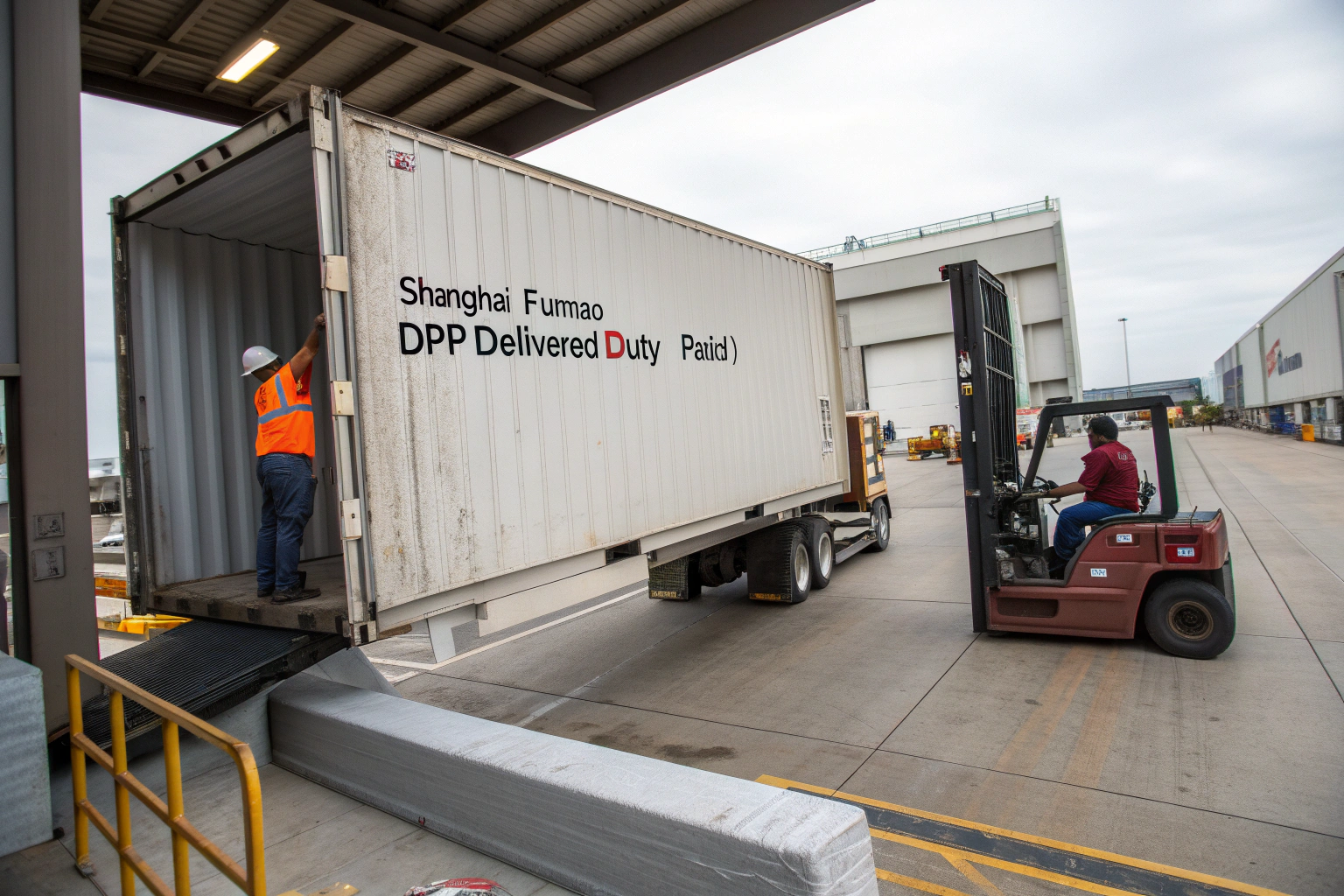
DDP (Delivered Duty Paid) shipping is the only Incoterm that truly seals the financial box. Under DDP, the seller—in this case, Shanghai Fumao—assumes absolute responsibility for every single cost from our loading dock in Keqiao to your warehouse door in Dallas. That means the ocean freight, the import duty, the customs bond, and yes, those nasty port fees like the "Congestion Surcharge" or the "Long Beach Clean Truck Fee" are all baked into one fixed price we quote you upfront. You don’t get a surprise invoice three weeks after delivery. You don’t fight with a customs broker you never hired. You pay one price, and you get your goods.
But protecting yourself from hidden fees is only the surface-level benefit. The real value of DDP is how it forces your supplier to care about the destination port’s chaos. When I hold the risk, I have to optimize the clearance process, pre-file the ISF, and select a trucker who won’t hold your container hostage. I’m going to walk you through the anatomy of port fees, how the DDP terms actually work on the ground, and how my team at Fumao ensures that the fixed DDP price we give you is the last price you ever see for that shipment.
What Hidden Destination Charges Does DDP Shipping Actually Cover?
When you sign a DDP contract with us, you are essentially purchasing an insurance policy against the creativity of terminal operators. The list of potential extra charges at a U.S. port is almost comical. There’s the "Chassis Usage Fee," because the chassis the container sits on belongs to a separate pool and they rent it by the day. There’s "Pier Pass," a fee invented to incentivize night pickups at LA/LB ports but which often just becomes a blanket tax. And my personal favorite: the "Port Security Fee," which sounds very official but rarely seems to correlate with any visible security improvement. Under FOB terms, these land on your invoice like a swarm of locusts.
With DDP, we absorb the volatility of these charges. Let me give you a specific example. In October 2024, a brief labor slowdown at the Port of Savannah caused a backlog. Truckers started charging a "waiting time surcharge" of $85 per hour after the first two free hours. A client shipping 300 meters of waxed canvas for a small batch of bags would have seen their trucking bill double on a CIF shipment. Because they were on DDP terms with Shanghai Fumao, my logistics coordinator in Keqiao had already factored a risk buffer into the price. The client paid the agreed-upon DDP rate, and we ate the extra $340 in detention costs. That’s how it should work.

Why Do U.S. Ports Charge Unloading and Staging Fees That Aren’t on the Original Quote?
If you’ve never imported before, you might think the ocean freight bill covers everything until the container hits your warehouse. It doesn’t. The moment that ship docks, the Marine Terminal Operator (MTO) takes custody of the box. They charge a fee just for lifting it off the vessel and placing it on the ground, called the "Terminal Handling Charge" (THC). Then, if Customs or the FDA decides to physically inspect your shipment—which happens randomly or because of a flagged Harmonized Code—the MTO charges an "Exam Staging Fee" to move the container to the X-ray bay. This can run $350 to $500 just to move the box 100 feet.
The real headache comes from the how to calculate U.S. terminal handling charges for textile imports. The MTO billing is notoriously slow. You might receive an invoice for a storage fee 60 days after the container has already been delivered. If you were on FOB terms, you’d have to verify with your trucker if they actually dropped the container late, and then argue with the MTO’s billing department in a different time zone. Under our DDP terms, we consolidate these post-delivery invoices. We keep a cost ledger for every container that arrives at the Port of Los Angeles. If a fee appears that we didn’t cause, we dispute it directly with the terminal. You never even see the bill.
Can DDP Terms Eliminate the Risk of Customs Exam Fees and Demurrage Charges?
Let’s talk about exams, because this is where the money really bleeds. If U.S. Customs and Border Protection (CBP) flags your container for an intensive tailgate exam, they open the doors, pull out a few cartons, and sample the fabric. But here’s the kicker: CBP does not pay for the labor to unload or reload the container. A bonded warehouse labor crew does that, and they bill you at a steep hourly rate. I’ve seen a non-intrusive inspection (NII) generate a $600 "handling" bill just for driving a forklift. With DDP, that’s our liability. Because our customs bond covers the movement of goods under our Importer of Record (IOR) number, any fees generated during the inspection stay on our side of the ledger.
Demurrage is an even bigger trap. Demurrage kicks in when your full container sits on the terminal beyond the allowed "free days." Usually, you get 4 working days. On day 5, the port starts charging you daily rent for the space. These charges snowball. I recall a client in Florida who was shipping a large batch of organic cotton knit under CIF terms; his freight forwarder forgot to dispatch a truck, and the container sat for 9 days. The demurrage bill was $1,800—almost the cost of the freight itself. With how DDP shipping terms can minimize US customs demurrage charges, we actively monitor the clock. Our logistics team in China runs a tracking board that pings us 24 hours before free time expires, forcing the trucker to pick it up. We pay the demurrage if we screw up. Simple.
How Does the DDP Incoterm Shift Financial Risk from the Buyer to the Supplier?
Incoterms are essentially a choreography of risk. With FOB (Free On Board), the risk passes to you the moment the container crosses the ship’s rail at the port of origin. If the ship sinks, you are theoretically covered by your insurance, but if the container simply gets lost in the maze of the Port of Newark, the cost of finding it falls on you. DDP is the polar opposite. The seller holds the bag—literally—until it’s sitting safely on your receiving dock. The financial risk only transfers to you when the forklift pulls the pallets off our truck.
This shift in liability fundamentally changes how a supplier makes decisions. If a freight forwarder tells me it costs $50 to file an entry but they have a 4-day processing time, I don’t take the cheap option. I pay the $75 for the express filing because a storage delay at the port would cost me $200. Under FOB, a supplier has zero incentive to optimize the trucking leg; they just push the freight forwarder’s contact info to you and wash their hands. When Shanghai Fumao ships DDP, I pick the trucker. I vet them. If they show up late and cause a missed delivery window, I have the power to fine them. You don’t have that leverage as an isolated buyer.

Who Is Responsible for Paying the Port Congestion Surcharge Under DDP?
Port congestion surcharges are like weather in logistics—unpredictable, severe, and nobody wants to pay for them. When a port like Long Beach gets backed up because of a strike threat or a chassis shortage, shipping lines impose a "Congestion Surcharge" to compensate for their vessels being stuck at anchor. This fee can appear on an invoice weeks after the ship has sailed. Under EXW or FOB contracts, you are legally on the hook for these retrospective charges because the goods were "in transit" on your account. I have seen these surcharges reach $1,200 per container.
Under DDP, the seller is the contract holder with the shipping line. We pay the surcharge directly. This is a huge advantage for small and medium brands because you avoid the "retroactive billing trap." To protect ourselves, we use a freight budget that historically maps surcharge patterns. For example, we know that the Trans-Pacific route often sees a peak season surcharge (PSS) hike around August. We adjust our DDP pricing to reflect this, so the quote you get in July for an October delivery still holds firm, even if the PSS doubles. This is how to protect your brand from unexpected port congestion surcharges when importing fabric. We absorb the market noise so your profit margin stays predictable.
How Does DDP Protect You If a Container Enters a U.S. Customs Hold?
Customs holds are a black hole of anxiety. If CBP suspects the fabric is misclassified to dodge a higher duty rate—say, labeling a synthetic blend as pure natural fiber—they can hold the container for a week. But even a "routine" hold for a document review generates a cost. The trucker who was scheduled to pick up the box now has an empty chassis sitting idle, and they charge a "dry run" fee of about $250 to $350. If you are shipping FOB, the trucker bills you directly. You pay for a truck that didn’t even touch your cargo.
Because we are the Importer of Record on a DDP shipment, we are the ones negotiating with Customs. My team manages this by pre-vetting every commercial invoice through a compliance checklist specifically for textiles. We know that the best practices for handling a US customs exam hold on textile imports require a clear description of the weave type—whether it’s a poplin or a twill—and the exact yarn count. We get granular with our descriptions. If CBP has a question, they call our customs broker directly. The broker has our power of attorney. They resolve the issue, and the container is released. You don’t spend your morning on the phone with a government agency; you spend it running your business.
How Does Fumao’s Logistics Team Calculate a True All-In DDP Price for Your Order?
Let’s get into the math, because a "transparent DDP price" is useless if it’s just a guess. We calculate your DDP price backwards, starting from your doorstep. We look at the ZIP code for final delivery, the weight of the fabric (a 20-foot container of velvet weighs a lot less than a 20-foot container of denim), and the applicable duty rate. For a standard polyester chiffon, the duty might be 14.9% under HTS code 5407. For a specialized waterproof nylon with a PU coating, it might be a different rate entirely. We plug these into a costing matrix that includes a live feed of the Shanghai Containerized Freight Index (SCFI) for the ocean leg.
But the crucial part is the "last mile" logistics. We factor in the class of the truck required—a standard 53-foot dry van for a dock that has a loading bay, or a liftgate truck if you are a home-based business that can’t unload pallets from a raised dock. A liftgate truck usually adds $75 to $150 to the trip. By asking for a photo of your receiving setup before we quote, we remove the ambiguity. This detailed breakdown ensures that the DDP price we give you covers the how to calculate true landed cost of importing fabric with DDP terms. There are no asterisks, no "subject to change" clauses in fine print. Just the final number.

Why Is the Importer of Record (IOR) the Most Critical Role in Avoiding Extra Fees?
The Importer of Record is the legal entity responsible for ensuring the goods comply with all U.S. regulations, paying the duties, and filing the entry documents. If the IOR is a shell company or a freight forwarder who doesn’t care about your long-term business, the entry gets sloppy. A sloppy entry triggers a CBP Form 28 (Request for Information), then a Form 29 (Notice of Proposed Action), and finally a penalty. When you use a supplier who ships EXW and tells you to "just use our forwarder," you are often trusting an IOR who has no skin in the game.
Shanghai Fumao acts as the IOR for our DDP clients, and we take this role extremely seriously. It means we have a continuous customs bond on file with CBP. It means we assume the legal liability for the truthfulness of the country of origin claim. For our eco-friendly Tencel blends, we maintain a master file of the mill certificates proving the fabric was woven in Keqiao, not transshipped to dodge anti-dumping duties. This is the essential checklist of responsibilities for an importer of record in textile DDP shipping. When we control the IOR role, we close the door on the "rogue broker" scenario where a third party under-declares the value to save a few dollars on duty, leaving you to face the penalty and the seizure.
How Does Fumao Consolidate Small Orders to Lower Your DDP Shipping Cost?
If you’re a startup or a boutique brand, you might not be ordering a full container load (FCL). You might be ordering a few rolls of silk charmeuse and some bamboo rib knit—less than a container load (LCL). Shipping LCL directly on DDP terms can be tricky because the destination terminal handling fees (like the CFS receiving charge) are split among the consignees in the shared container, but the bill is a flat rate per shipment. We use a consolidation strategy to lower this.
Instead of shipping your 5 cubic meters (CBM) of goods directly, we hold your fabric in our warehouse and consolidate it with other DDP orders heading to the same U.S. coast. We effectively build a full container in-house, ship it FCL, and then de-consolidate it on the other side. This cuts the ocean freight cost per CBM by nearly 35% and, more importantly, avoids the high per-shipment "CFS entry fee" charged by LCL terminals in Long Beach or Newark. Then, we use a regional last-mile carrier to palletize and deliver your specific rolls. This strategy, which leverages how to consolidate LCL fabric shipments to reduce DDP logistics costs, allows a designer ordering 100 meters of printed chiffon to pay a reasonable fixed DDP fee instead of a punitive one that kills their margin.
Is DDP Shipping to the USA Actually Faster Than Standard FOB Delivery?
Speed isn’t just about the time the vessel spends on the water. It’s about the friction at the ports. A standard FOB shipment suffers from what I call "handover inertia." The moment the container arrives, the consignee (that’s you) is suddenly scrambling to file the entry, pay the duty, and hire a trucker. The ship might dock on Monday, but if you don’t have a customs bond on file yet or your wire transfer for the duty hasn’t cleared, the container sits. That "free time" I mentioned earlier burns up fast. I’ve watched FOB cargo sit for 10 days post-arrival before it even gets a pickup appointment.
Because DDP pre-clears the responsibility, we can file the CBP entry 5 days before the vessel arrives. The duty payment is an automated ACH transfer from our customs broker’s account to CBP. As soon as the ship is unloaded and the carrier releases the hold—usually within 24 hours if there’s no exam—our trucker’s chassis is already positioned to pick it up. The container goes from the spreader beam on the crane to the truck chassis and exits the terminal gate in less than a day. This isn’t just a theory; it’s a rhythm. We’ve built the muscle memory on the Trans-Pacific route to keep the wheels turning while the FOB shipments are still waiting for a customs release.

How Do We Avoid the Pre-Pull and Terminal Waiting Time Logjam?
The biggest time-waster at a port like Savannah or LA/LB is the "dual transaction" trap. Your trucker arrives at the terminal, but the container isn’t in a "grounded" position where it’s easy to grab. They have to wait for a "live unload" from a stack, or worse, the terminal demands a "pre-pull" fee to move it to an accessible lane. These delays cascade into missed warehouse delivery slots. If you miss a slot at a big retailer’s distribution center, you are fined thousands of dollars.
We pre-pay the "PierPass" or similar traffic mitigation fees specifically to allow our trucks to pick up during off-peak hours (like 6:00 PM to 3:00 AM). Night pickups are significantly faster because the terminal gates are less congested. Our dispatchers also use the terminal’s online appointment system to snag a reservation the second it opens, avoiding the 9:00 AM rush. This granular control over drayage is something you cannot get on FOB terms unless you have a full-time logistics manager in the U.S. We build the strategies to speed up drayage trucking for US port deliveries of fabric imports into our operational DNA, because a container sitting idle is a container costing me money.
Does DDP Speed Up the Custom Clearance for Sensitive Textile Materials?
Sensitive materials, like organic cotton claiming a preferential duty rate or recycled polyester needing verification, can trigger a document flag. If CBP doesn’t trust the paperwork, they put a "hold" on the entry. On FOB, the resolution path is slow: CBP asks the broker for a mill certificate, the broker emails you, you email me, I contact the mill, the mill scans a blurry PDF, I send it to you, you send it to the broker, the broker uploads it. Three days vanish.
Under our DDP model, we pre-package the compliance dossier. Before the container sails from Shanghai, our logistics team uploads the full packet to our broker’s system: the certified organic transaction certificate, the detailed fabric construction sheet, the weight list, and the fumigation certificate for the pallets. If CBP queries the fiber content, our broker already has the answer on file. They can resolve the query by referencing a stored document immediately. This proactive approach has allowed us to clear containers of how to ensure fast customs clearance for organic and recycled fabric imports to the USA in under 4 hours post-berthing, even when they contain flagged material categories. It’s all about putting the paperwork in the officer’s hand before they even think to ask for it.
Conclusion
DDP shipping isn’t just an Incoterm—it’s a commitment. It’s a commitment from Shanghai Fumao that we have the financial stability to pay the duties for you, the logistics expertise to outsmart the port congestion surcharges, and the legal rigor to carry the Importer of Record responsibility without flinching. Hidden port fees, from chassis splits to exam staging, are designed to extract cash from unprepared importers. FOB and CIF leave you exposed to that extraction. DDP walls it off. You get a single price, a single point of contact, and a delivery that lands on your dock without a ransom note attached.
We’ve made this model the backbone of our export strategy because we believe fashion brands and fabric buyers should spend their energy on selling, not on decoding a port tariff sheet. By controlling the entire logistics chain—from our weaving and dyeing facilities in Keqiao to the final mile truck in the United States—we can guarantee the speed of clearance and the accuracy of the landed cost. You know exactly what your fabric costs before you even place the purchase order, and that cost sticks.
Stop letting the logistics tail wag the creative dog. If you’re ready for a shipping experience where the price we quote is the price you pay, let’s build your next DDP shipment together. Reach out to our Business Director Elaine for a personalized DDP quote on your upcoming collection. She can break down the duty rates for your specific fabric compositions and show you how affordable door-to-door security can be. Email her directly at elaine@fumaoclothing.com. Let’s lock in your landed cost and set your mind at ease.