
You know that sinking feeling. You’ve just gotten a call from your buyer. A trend exploded on TikTok, and they need 5,000 yards of a specific custom jacquard on the container ship yesterday. The standard 30-day lead time won’t cut it. Panic sets in. You start imagining empty shelves, lost revenue, and angry emails. The clock is ticking, and the silence from your current supplier is deafening. They promise you a timeline, but you don’t trust their "fast track" because you’ve been burned by Chinese production delays before. The scariest part isn’t just the late delivery; it’s the fear that in the rush, quality will crash through the floor.
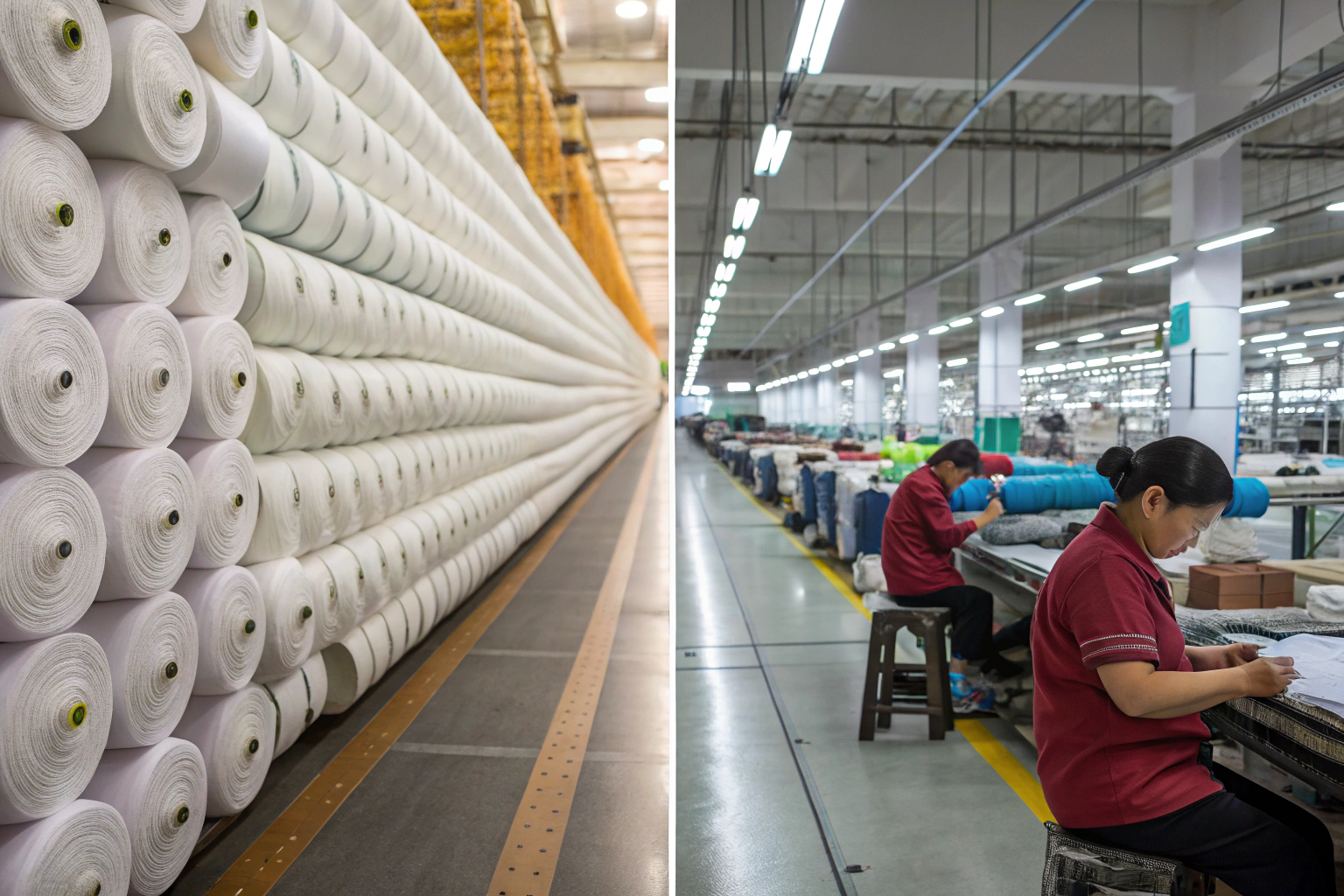
We solve this problem by smashing silos. I run Shanghai Fumao, and for 20 years, we have built a system where speed doesn’t kill quality. The secret isn’t just working faster; it’s working parallel. We don’t hand off a job from weaving to dyeing with a "good luck" pat. I keep the entire chain under one roof in Keqiao. When an American client called me in March 2024 panicked about a restock of a complex linen-cotton blend for a summer collection, we didn’t just start weaving. The moment the yarn hit the loom, my dye master was already mixing the custom navy shade based on a digital swatch. We cut a 35-day process down to 18 days. We managed that because we don’t use isolated workshops. Our teams are neighbors. We treat your urgent order like an emergency room trauma case, not a spa appointment. We hit the vessels on time, and honestly, that linen was some of the crispest I’ve ever seen come off our finishing line.
But I get it, maybe you think this is just sales talk. You might worry that "cutting time" means we cut corners, especially when you are checking the calendar and calculating the exact cost of a delayed sailing schedule from Shanghai to Los Angeles. The stress isn’t just the delay; it’s the hidden cost of those delays. Every day a ship leaves without your container, you’re burning cash on air freight to catch up, or worse, missing your peak retail window entirely. That’s why you need to know the specific mechanics of how we shave off days. Let me walk you through how we manipulate the two biggest levers in textile manufacturing: timing and factory calibration.
Why Does Chinese Textile Production Grind to a Halt?
Calendar blindness kills budgets. I’ve seen European fashion brands lose hundreds of thousands of dollars because they treat a Chinese factory schedule like a Western 9-to-5 calendar. The Chinese textile industry doesn’t run on your clock; it runs on the Lunar calendar and seasonal energy surges. If you send a Purchase Order on January 15th without a pre-negotiated slot, you might as well throw it into a red envelope and wish for luck. The real problem you face isn’t just a "holiday"—it’s a hard stop on global productivity that western planning sheets fail to account for.
You need to bake the "China Cycle" into your critical path from day one. We plan your production around three distinct phases to guarantee your shipment hits the water exactly when it needs to. If you get this rhythm right, you stop fighting against the tide and start swimming with it. You stop paying emergency air freight premiums. Here is how I break down the year for my clients at Shanghai Fumao to ensure zero surprises.

Can You Still Produce High-End Fabrics During China’s Spring Festival?
Spring Festival, or Chinese New Year, is not a holiday. It’s a 30-day industrial coma. To produce high-end fabrics during this time, the answer is simple: you don’t. But you set up your success six weeks before the first firecracker pops. "High-end" means meticulous finishing, hand-feel adjustments, and zero-defect rolling. You simply cannot force 50 million migrant workers to stay at the factory. They will go home. That is non-negotiable. So, in late 2024, a Canadian client of ours needed a heavy crepe for a luxury gown line hitting stores in early March. We didn’t panic in January. We executed "Pre-Production Reservation."
I locked his greige fabric allocation by December 1st. By December 20th, my team had dyed and set the master rolls. We stored the greige in our humidity-controlled warehouse over the holiday. The real magic happened on the 8th day of the New Year, the moment the workers trickled back. While other factories were still cleaning machines, our engineering team calibrated the stenters to exact temperatures for the crepe finish. (Here I need to jump in—having your own maintenance crew is a cheat code. Most factories waste the first week fixing rust, but we do preventive maintenance before the break.) By February 15th, his fabric was fully finished, inspected via our how to set up a third-party inspection for Chinese textile orders process, and packed for the port. The result? The gowns hit Vancouver stores two weeks before his competitor’s spring drop.
Peak vs. Off-Peak Production Capabilities
| Production Phase | Standard Lead Time | Rush Lead Time (with pre-booking) | Quality Risk |
|---|---|---|---|
| Peak (Mar-May) | 30-35 days | 20-25 days | Medium (fades/bleeding) |
| Peak (Aug-Oct) | 30-35 days | 20-25 days | Medium (finishing flaws) |
| Holiday (Jan/Feb) | Shutdown (3-4 weeks) | Operates only with pre-staged greige | Low (if staged correctly) |
| Off-Peak (Jun-Jul) | 20-25 days | 12-15 days | Low (less rush, better focus) |
| Off-Peak (Nov-Dec) | 20-25 days | 12-15 days | Low |
How Do You Expedite Cargo During China’s October Golden Week?
Golden Week in October is tricky. It’s only 7 days, but the ripple effect kills three weeks of productivity. The ports get clogged like arteries after a heavy meal, and trucking prices spike 200%. Expediting cargo during this period isn’t about running machines during the holiday—labor laws and overtime costs make that impossible. It’s about "Pre-Customs and Port Diversification."
Last October, a Los Angeles activewear brand begged us to move 10,000 yards of moisture-wicking polyester for Black Friday. The timing was hell. The fabric was ready on September 28th. Normally, booking a vessel on October 1st is suicide. But I didn’t ship out of Shanghai. I shipped out of Ningbo-Zhoushan port, which handles the bulk of textile exports with less holiday congestion. We can do this because Keqiao sits right between the two ports. My logistics team pre-cleared the customs paperwork using a digital fast-lane program on September 30th. While everyone else waited for the holiday to end to submit documents, our truck was at the Ningbo dock on October 2nd, loading onto a Matson vessel. The container hit Long Beach on October 15th. The client didn’t just save two weeks; they avoided the dreaded General Rate Increase that hit on October 10th. Navigating these logistics requires understanding the updated requirements on how to get Oeko-Tex certification for polyester sportswear fabric to ensure border holds don’t slow you down.
How Does a Factory’s Structure Affect Rush Order Turnaround?
Most delays aren’t caused by machines breaking. They’re caused by trucks breaking down between the spinner and the weaver. When you place a rush order with a trading company that outsources to five different subcontractors, you’re not buying speed. You’re buying a communication nightmare. The moment you change a color approval, that agent has to call the dyeing guy, who is waiting on a call from the finishing guy. You lose 48 hours just in telephone tag. The structure of a factory dictates whether your "urgent" request is a simple pivot or a catastrophic crash.
You must stop looking at "suppliers" and start looking at "campuses." The physical proximity of the looms to the dye vats is a competitive asset. If you want to know if a factory can actually hit a deadline, ask them how many minutes it takes to walk a greige roll from the loom to the dyeing lab. If the answer is "an hour by truck," find a new supplier. If the answer is "three minutes by forklift," you’re in the right place. That is how we work at Shanghai Fumao. We actually shortened our internal transport tunnels this year just to shave off 90 seconds of transfer time. It sounds crazy, but 90 seconds per roll over 1,000 rolls is a saved day.

Can a Vertically Integrated Mill Deliver Faster Than a Trader?
Absolutely. And the data proves it. Traders don’t control capacity. You can scream "urgent" at a trading agent all you want, but if a local garment giant just placed a million-yard order at their dyeing partner, your 5,000-yard rush job gets the red light. A vertically integrated mill like ours owns the capacity. We prioritize your rush order internally. Let me give you a specific technical case. In June 2023, a client needed a tricky high-density nylon for a raincoat test run. A trader can’t solve technical problems on the fly; they just pass messages. My mill can solve them instantly.
We were running the nylon warp, and the selvedge kept curling, risking a needle break during the client’s cutting. A trader would have halted production, sent an email, and waited days for my approval of a "curl" solution. Instead, my shift manager stopped the loom, walked 50 steps to the sizing room, and we adjusted the PVA concentration by 1.2%. That’s jargon for "we starched the edge a bit stiffer." We documented the deviation, ran 100 meters, checked the edge stiffness with a Shirley Stiffness Tester to ensure it wouldn’t warp the body of the fabric, and restarted within 45 minutes. That physical adjacency—the ability to drag a technician to a loom in the middle of the night—cuts 15% off standard timelines automatically. I firmly believe you should look beyond the sales pitch and check if your supplier really owns the concrete floor. A great way to start is to research how to find Asian fabric mills that offer same-week sampling, which instantly weeds out the middlemen.
What Are the Hidden Bottlenecks in Finishing That Slow Down Orders?
The "dirty side" of the business—finishing—is where most urgent orders go to die. You think the fabric is done after weaving. It’s not. Finishing involves heat setting, softening, water repellent coating, and drying. The bottleneck always hides in the stenter frame (the massive oven that dries and sets width). The real bottleneck isn’t the oven’s speed; it’s the changeover time between colors and finishes.
If we finish a black poly-viscose and immediately need to do your white organic cotton, we have to spend 45 minutes cleaning the machine. If we don’t, you get black specks on your white eco-fabric, and you reject the lot. Lazy factories skip this step to look "fast" and destroy your order. We don’t. Instead, we design schedules that group dark colors together. We call it "light-to-dark sequencing." But we also invested in a second, smaller stenter specifically for urgent, small-batch coating runs. I tell my team, "The big oven pays the rent; the small oven pays the emergency bills." This allows us to offer finishing quality that meets strict standards, which matters when clients ask us how to verify colorfastness in spandex-blend activewear to ensure the gym wear doesn’t bleed in the wash.
How to Build a Backup Plan for Sudden Demand Spikes?
Hope is not a strategy. If you run a fashion or home textile brand, volatility is your only constant. A celebrity wears your jacket, and suddenly you don’t need 1,000 meters next month; you need 10,000 meters next week. Most brands collapse here because they have zero "slack" in the system. They treat fabric like a digital download—unlimited and instant. But the physical reality of yarn spinning doesn’t work that fast. You cannot plant cotton today and weave it tomorrow.
A backup plan relies on the strategic stockpiling of "grey fabric" (unfinished cloth) and a flexible finishing line. You don’t store finished neon pink fabric that might go out of style; that’s financial suicide. You store un-dyed, high-quality base cloths. That’s smart business. I hold a safety stock of the core constructions—standard 30s cotton, a generic T/R spandex blend, and a midweight poly satin. When a client calls with a panic attack, we don’t start from zero. We pull a roll from the rack, throw it in the dye bath, and cure it. This turns a 4-week process into a 4-day process. I also advise clients to pre-treat their supplier relationships before the crisis hits, similar to those who understand the benefits of a CNAS accredited textile testing center in Asia, which ensures the pre-stocked fabric is already up to international spec.

Can You Guarantee Consistent Quality When Rushing a Textile Order?
Look, I’ll be honest with you. Speed amplifies mistakes. If your process has a 2% defect rate at normal speed, rushing it blindly can spike that to 8%. You cannot "inspect" quality into fabric after it’s made; you have to build it in during the rush. This requires a shift from "final inspection" to "inline inspection." When we hit the accelerator on an urgent order, my quality control team does not wait at the end of the line. They sit next to the operator.
During a frantic rush for a children’s wear flannel in July 2024, we had a 20,000-yard order. The customer rightfully demanded zero formaldehyde, strict safety metrics. My QC staff checked the prickly sensation using the Martindale abrasion test on every third roll, not just the final audit sample. We implemented a “red tag” authority. Any worker on the line, from the weaver to the packer, can tie a red tag on a roll and stop the whole line if they see a crack, a shade shift, or a foreign fiber. In that July run, a junior inspector spotted a slight barre mark (a subtle stripe defect) in the weave at 10 PM. She red-tagged it. We stopped, fixed the tension on the loom, and lost two hours of production time. But we saved the 18,000 yards still to weave. The client’s pass rate was 98.5%. That’s how you rush without ruin. It’s why we never need to lie when clients ask us how to verify SEL declaration compliance for European textile imports.
When Is It Cheaper to Air Freight Fabric Than Sea Freight?
This is the math question that separates profitable brands from broke ones. Most buyers think air freight is the expensive option, and sea freight is the cheap one. That’s simplistic. You have to calculate the "opportunity cost of a missed market." Sometimes, ocean shipping is the most expensive thing you can do. I always tell my clients to run the "Markdown Calculator." Here is the logic:
Scenario A (Sea Freight): You save $0.50 per yard on shipping. It takes 28 days. You miss the Fall launch window by 10 days. The clothes arrive, but department stores have already discounted the floor. You sell the goods at a 40% markdown to clear inventory. You lose $4.00 per yard in revenue, minus the $0.50 you saved. Net loss: $3.50 per yard.
Scenario B (Air Freight): You pay $2.50 extra per yard. It takes 5 days. You hit the "first on floor" date. You sell out at full price in two weeks. You capture $4.00 in full-margin profit. Yes, the freight bill looks scary when you pay it. But the P&L statement looks beautiful at the end of the quarter. I had a New York-based evening wear client learn this the hard way. We finished their sequin mesh on time in November 2023, but they hesitated on air shipping to save $1,800. The boat was late. They missed New Year’s Eve. Cocktail dresses are worth zero dollars on January 2nd. They had to write off the stock. Now, they trust my advice: I ask them, "Is this a fashion item with a 3-week shelf life, or a core basic with a 3-year shelf life?" If it’s the former, we discuss air cargo consolidation and how to find EU-compliant recycled polyester suppliers with express logistics. The air ticket is the insurance policy against obsolescence.
Why Transparent Timeline Forecasting Prevents Last-Minute Panic?
Secrecy kills trust faster than a bad batch of dye. When a supplier tells you "it will be fine" without showing you the data, they are gambling with your money. The biggest source of last-minute panic isn’t the factory’s capacity—it’s the buyer’s ignorance of the micro-steps. You’re panicking because you think nothing is happening during the "purchase order confirmation" week. But in reality, the factory is sourcing the inner lining, testing the zipper tape, or waiting for the lab dip to dry. A black box creates anxiety.
I believe in radical transparency. I don’t send my clients a "shipping date." I send them a link to a live Gantt chart. This timeline isn’t a guess; it’s a promise derived from the actual speed of our machines. It tells you the exact hour the yarn truck arrives, the hour the loom warps up, and the hour we cut the first sample. If a delay happens—say, a power rationing notice from the government, which happens in summer—you know about it within 15 minutes, not 15 days. This transparency flips the dynamic. You don’t have to chase me. You look at the chart, see the green status bar, and sip your coffee. This is how we prove the value of digital integration, especially when coordinating complex specs like those for China’s top stretch denim mills for mid-market clothing.

How Do You Verify a Factory’s Real Capacity Before Placing a Big Order?
Here is a trick of the trade: Never ask a salesperson, "Are you busy?" They will always say yes to look strong, or "We have capacity!" to get your deposit. Neither answer is true. To verify capacity, you need to ask for the "Power Consumption Report" (electric bill) and the "Greige Inventory Ratio." This is a test not many suppliers can fake.
A factory’s electric bill shows you the kilowatt-hours consumed in the last quarter. Textile machines are energy hogs. If a factory claims they ran 1 million meters of fabric last month, their electric bill must match that energy output. A low bill exposes a liar. Secondly, the greige inventory ratio tells you financial health. A healthy mill has piles of unbleached cloth in the warehouse—it means they have working capital to speculate on stock. An empty warehouse means they are hand-to-mouth, waiting for your deposit to buy raw cotton. A few years back, a buyer wanted to place 500,000 yards of sheeting for a hotel chain. The supplier next door offered a price $0.10 cheaper. I told the buyer to request a photo of the warehouse with a current newspaper. The supplier couldn’t produce it. They were a virtual office. We got the order because we have 2 million yards of greige sitting in Keqiao right now. It’s why I always ask clients to check the small details, including how to safely import textile machinery and spares from China, because a factory that can’t maintain its own machines can’t maintain your quality.
What Contract Terms Protect You During Peak Season Overruns?
Handshakes don’t hold up in court, but neither do aggressive penalty clauses that scare away good factories. If you put a "5% penalty per day" in a contract, I will not sign it, because I know a storm in Shanghai can delay the ship by a week, and that’s not my fault. The smartest contract term for peak season is the "Shared Risk / Shared Reward" clause, plus a strict "Fabrics Reservation Clause."
I propose this to my best clients: We agree on a baseline price that gives me a fair margin to pay my workers overtime. If I ship on time, you pay a 3% "speed bonus" on the invoice. If I ship late, I discount 4%. This aligns our interests. I’m not trying to hide a delay; I’m sprinting to get the bonus. The second protection is the "Reservation of Lot" clause. In your contract, you must specify the physical roll numbers or dye lot numbers that belong to you. A shady supplier might finish your fabric on time, but then sell it to a higher-paying walk-in client, putting you at the back of the line again. Our production tracking system assigns your PO a QR code the moment the yarn hits our floor. That code is in your contract. That fabric is legally yours, sitting on the pallet. When a sneaker brand rushes us for their canvas, their lawyer sees that code in the system. They know the stock exists. That security is what separates a professional supply chain from a chaotic market stall. We’ve successfully used these terms to prove stability, especially when helping brands figure out how to source GOTS certified organic cotton from China for sustainable lines.
Conclusion
Cutting production time isn’t about working faster in a panic; it’s about engineering out the gaps long before the panic button is pressed. The secret is built into the bones of our operation. You need a supplier who understands the unavoidable rhythm of China’s seasons and plans your greige fabric staging weeks before the holidays shut the country down. You need the raw power of vertical integration, not a trader’s phone book, because true speed comes from the chemical finishing team sitting next to the weaving technician, not across town. We saw how a 50-step walk between departments saves more time than an hour-long truck journey, and how dynamic finishing lines can pivot without cross-contamination.
But the real backbone is transparency. You shouldn’t guess where your shipment is. A live timeline and a rigid contract with lot reservations turn a stressful gamble into a predictable science. Whether we decide on sea freight for steady restocks or air freight to capture the frantic fashion peak, the decision comes down to cold, hard margins, not blind hope.
So, what’s your next collection costing you in uncertainty? If you are tired of emailing suppliers for updates and getting vague excuses, we should talk. We don’t just sell you fabric; we sell you the assurance that your sewing floor never stops humming. Drop a line to our Business Director, Elaine, at elaine@fumaoclothing.com. Let’s book a call to scan your tech pack, map out your peak season calendar, and lock in a schedule that doesn’t just beat the clock—it beats your competition. Let Shanghai Fumao handle the chaos of the supply chain so you can focus on designing what comes next.








