Your buyer just sent you an email you were not expecting. "Please attach the Mill Test Report for the recycled polyester fleece lot." You stare at the screen. You have the invoice. You have the packing list. You even have a photo of the fabric looking perfect on the inspection table. But a Mill Test Report? Is this just bureaucratic paperwork designed to slow down the deal? You worry that if you cannot produce this document in the next hour, the order—and the long-term contract—might vanish. The fear is that your supplier does not have the technical depth to back up their quality claims.
Let me be very direct with you. A Mill Test Report (MTR), which we often call a "Certificate of Analysis" or a "Lot Test Report" in the textile industry, is not a formality. It is the forensic fingerprint of your exact fabric batch. It translates "soft hand feel" and "looks navy to me" into hard mathematical limits. When a North American or European buyer demands this from your supplier, they are not trying to annoy you. They are protecting their brand from a lawsuit, a recall, or a social media scandal caused by shrinkage, toxic chemicals, or false fiber labeling. At Shanghai Fumao, our CNAS-accredited laboratory generates these reports for every single bulk lot that leaves our facility, and I sign off on the critical safety parameters personally before the container door closes.
I am going to walk you through exactly what is inside these reports, why your buyer trusts them more than their own eyes, and how you can read one like a quality assurance professional. This document is your best legal defense, and once you understand it, you will never ship a meter of fabric without one again.
What Specific Tests Are Included in a Standard Fabric Mill Report?
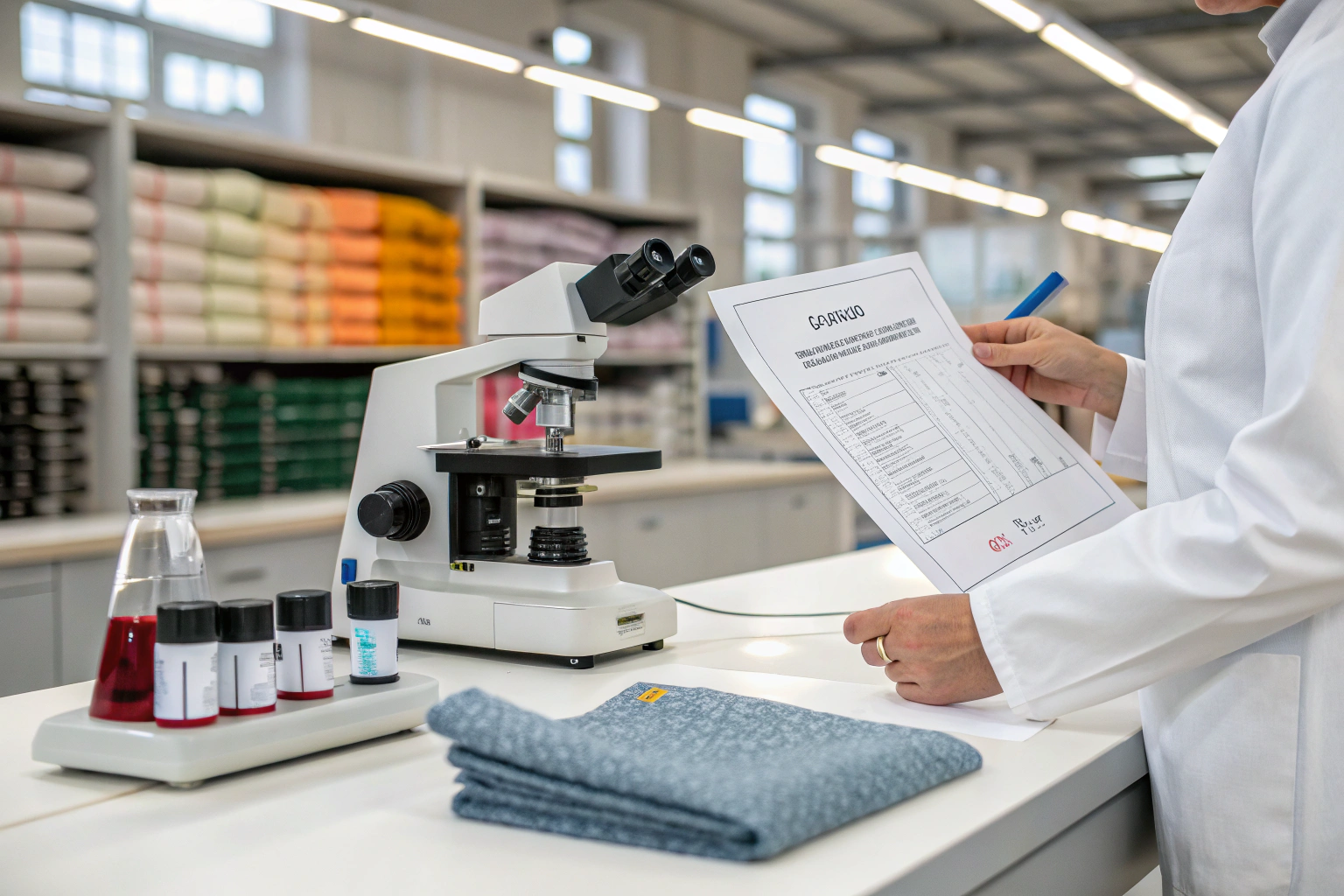
A proper mill test report is not a one-page "good quality" certificate. It is a multi-parameter data sheet that covers physical, chemical, and visual properties. When I send an MTR to a US activewear brand, they expect to see the exact grams per square meter we measured, not the target spec we aimed for. The difference between "target" and "actual" is where the trust lives. A factory that only prints the target spec is hiding the process variance. A factory that prints the actual tested values is opening the books for a true audit.

How Is Fabric Weight and Dimensional Stability Mathematically Verified?
The GSM (grams per square meter) and the shrinkage percentage are the two numbers that will get a garment returned faster than any other defect. If a customer buys a large tee shirt that shrinks to a medium, they do not blame the laundry machine; they blame your brand. In our lab, we do not guess the GSM. We cut a precise 100-square-centimeter disc from three different spots across the fabric width—left edge, center, right edge—using a calibrated pneumatic cutter. We weigh each disc on an analytical balance, calculate the average, and multiply by 100 to get the GSM. If the left edge is 195 GSM and the right edge is 210 GSM, that 15-GSM variation tells your buyer that our weaving tension was inconsistent. That data point allows them to reject the roll before it gets cut into panels that would hang differently on the same dress.
For shrinkage, we follow the AATCC 135 standard for woven fabrics or the AATCC 150 for knits. We draw a precise 50cm x 50cm square with an indelible marker on a sample. We throw it into a washing machine set to the exact cycle the care label will specify, dry it according to the standard tumble dry or line dry procedure, and then remeasure the square. If the length shrinks by 4% and the width shrinks by 2%, that is the number we print on the report. If your buyer has a strict tolerance of +/- 3% shrinkage, the 4% number triggers a rejection of the lot, or a requirement to re-process the fabric with a compaction machine. If you want to understand how to interpret a fabric shrinkage test report according to AATCC standards, this level of dimensional precision is what separates a professional supplier from a guessing amateur.
Why Are Colorfastness to Crocking and Light Rated on a Scale?
Colorfastness is not a yes-or-no question. It is a 1-to-5 scale, and a 0.5 difference can determine whether a black denim jacket stains a white leather car seat. "Crocking" is the technical term for color rubbing off. We test this with a Crockmeter, a small robot finger that rubs a standard white cotton cloth back and forth across your dyed fabric under a fixed pressure. We do this twice: once dry, once wet. The amount of color that transfers to the white cloth is compared against a standard grey scale. A dry crocking rating of 4.0 and a wet crocking of 3.0 is the minimum I recommend for any dark-colored bottom-weight fabric.
Lightfastness is equally critical, especially for outdoor and activewear markets. We use a Xenon arc lamp to blast the fabric with simulated sunlight for 20 to 40 hours, depending on the standard. A rating of Grade 4 under ISO 105 B02 means the fabric faded only slightly. A rating of Grade 2 means your vibrant turquoise jacket will look like a washed-out pale green rag after one summer. Your buyer demands these scale numbers because their customer service team is tired of processing refunds from customers who expected the color to last longer than two washes.
How Does a Mill Report Prove Forced Labor Compliance?
This is the new frontier. A physical quality report tells you the fabric won’t tear. A chemical report tells you it won’t poison anyone. A traceability report tells you that it was not made by slaves. Since the UFLPA enforcement began in earnest, US Customs and Border Protection has been detaining textile shipments at the border based on a "guilty until proven innocent" standard for certain cotton and viscose products. Your Mill Test Report must now include a chain-of-custody appendix, or it is incomplete for high-risk fibers. A buyer who demands your MTR is often actually looking for the "Origin Verification" section buried in the back pages.

What Is a "Bale-to-Bolt" Traceability Map in a Lab Report?
This is a document that connects your finished fabric roll back to the specific farm where the cotton was grown, or the specific forest where the dissolving pulp for your viscose was harvested. At Shanghai Fumao, when we ship organic cotton poplin to a US baby clothing brand, the MTR includes a serialized log. It lists the gin bale number, the spinner’s lot number, our greige weaving batch number, and the dyeing vessel number. Each number is cross-referenced with a date stamp and a transaction invoice.
If your buyer is a large retailer audited by the Fair Labor Association or subject to SEC human rights disclosure rules, they need this map to satisfy their own legal team. A bale tag is hard evidence. A generic "we don’t use bad cotton" letter is worthless in federal court. The bale-to-bolt map proves physical continuity. It shows that the finished bolt in the container matches a raw bale that was geotagged at a compliant farm. I have seen this specific piece of paper release a detained container in Los Angeles within 24 hours, because the CBP officer could scan the QR code, see the gin location on Google Earth, and verify it was not in a restricted region.
How Do Independent Audit Attachments Strengthen the Mill Report?
A chemical test is done inside our four walls. A forced labor audit is done by an outside firm, and that independence is what gives it legal weight. When I ship high-risk cellulose fabrics like bamboo rayon or modal to Canada or the US, I attach the latest social compliance audit of the dissolving pulp mill to the MTR. This audit is not done by Shanghai Fumao. It is done by a third-party firm that checked the pulp mill’s employee contracts, interviewed workers privately, and verified that recruitment fees were not charged.
By combining the physical test data with the social audit attachment, the MTR transforms from a quality document into a legal import permit. It answers the two questions every North American buyer has in 2026: "Is this fabric safe for my customer?" and "Is this fabric safe for my brand’s reputation?" If the supplier refuses to provide the audit attachment, your buyer assumes the audit does not exist.
Why the Tear Strength and Seam Slippage Numbers Matter to Retail Buyers
Retail buyers live in terror of returns. And the biggest return category for woven garments, after shrinkage, is seam failure. A customer sits down in their new linen trousers, hears a rip, and the back seam splits open. That is a 100% refund, a lost customer, and a bitter one-star review that mentions your brand name. The tear strength and seam slippage numbers in your mill test report predict exactly this scenario. They are the numbers that prove your garment can survive a body in motion.

How Does the Elmendorf Tear Test Translate to Real-World Durability?
The Elmendorf tear test is beautifully simple. We take a sample of your woven fabric, cut a precise slit into it with a razor blade, and then clamp it into a pendulum machine that rips the fabric apart from that starter slit. The machine measures the energy required to continue the tear, expressed in Newtons or pounds-force. If your lightweight rayon challis has a tear strength of 8 Newtons, it will rip if someone sneezes too hard. A good outdoor polyester taffeta should have a warp tear strength above 20 Newtons.
For North American childrenswear buyers, this number is legally mandated under CPSC (Consumer Product Safety Commission) regulations for sleepwear and other items. I cannot tell you how many times a small designer has brought me a beautiful 60gsm cotton voile for a children’s dress line, and I have had to gently explain that the tear strength is too low for the intended use. The MTR catches this mismatch before the CPSC does.
What Is Seam Slippage and Why Do Denim and Linen Buyers Obsess Over It?
Seam slippage is not the thread breaking. It is the fabric yarns sliding apart under stress, opening a gap along the seam line. You see this often in low-density linen pants or loosely woven wool-blend jackets. The thread holds fine, but the fabric structure itself separates. We test this by sewing a standard seam, clamping it into a tensile machine, and pulling perpendicular to the seam until a 6mm gap opens up. The force required to open that gap is the seam slippage value.
Denim buyers obsess over this because jeans are worn skin-tight. A pair of rigid denim jeans with a low seam slippage rating will split at the back yoke seam when the wearer bends over. Linen buyers care because linen yarns are naturally rigid and slippery; they do not grip each other like fuzzy cotton does. A linen fabric with a tight, compact weave might have excellent seam slippage resistance, while a loose, open-weave linen will gape horribly. Your buyer reads this number to predict how the garment will look after a day of wear. Will the seams stay crisp and closed, or will they yawn open and expose the lining or skin underneath? The MTR gives them that answer without them having to sew and wear-test every single lot themselves.
How to Read a Chemical Compliance Appendix for RSL and CPSIA Standards
The last section of a serious Mill Test Report is the chemical appendix. This is the part that scares non-technical fashion designers because it is full of parts-per-million (ppm) and CAS numbers that look like alien codes. But this section is the only thing standing between your fabric and a Class Action lawsuit. North American retail buyers, especially those selling to large department stores like Nordstrom or Target, must verify that every textile component meets the RSL (Restricted Substances List) of the American Apparel and Footwear Association and the legal requirements of the CPSIA (Consumer Product Safety Improvement Act).

What Are the "Heavy Metals" and "Phthalate" Thresholds for a Pass?
We digest your fabric sample in a microwave acid bath and shoot it into an ICP-OES machine that measures the concentration of heavy metals in parts per million. Lead content must be below 90 ppm total for accessible parts, and ideally under 10 ppm for children’s products. Cadmium is a zero-tolerance metal; if we detect anything above 40 ppm, the entire lot is scrap. Phthalates, those plasticizers that make a plastisol print rubbery and flexible, are restricted to under 1000 ppm (0.1%) for each of the six banned phthalates, including DEHP and DBP.
I once rejected an entire shipment of PVC-coated waterproof fabric from a third-party coater because our lab detected 1500 ppm of DEHP. It was destined for a children’s raincoat line in the US. The coater argued the print was fine for the European market. I killed the lot. The CPSIA violation would have triggered a mandatory recall, and my client would have been financially destroyed. The MTR caught the poison before it became a product. That is why your buyer demands it.
How Does a "Formaldehyde Spot Test" Work in a Factory Lab?
Formaldehyde is a resin used to make fabrics wrinkle-free and shrink-resistant. A little bit is legal. Too much is a skin sensitizer and a carcinogen. We test for free formaldehyde using a rapid "spot test" in our lab. A few drops of a reagent are applied to the fabric. If the fabric turns bright yellow, formaldehyde is present above 20 ppm. For a quantitative number, we run a water extraction and measure it on a spectrophotometer. The CPSIA limit is 75 ppm for adult garments and 20 ppm for children under three. I train my QC team to err on the side of caution. If the spot test shows even a faint yellow blush, we re-wash the fabric with a formaldehyde scavenger chemical until the spot test comes back crystal clear. Your buyer’s demand for this appendix is not academic. It is their defense against the claim that their clothing gave a baby a rash.
Conclusion
A Mill Test Report is the objective voice in a subjective industry. When a buyer touches your fabric and says, "It feels nice," the MTR says, "It will not shrink beyond 2%, it will not tear below 15 Newtons, and it has zero detectable lead." It transforms a handshake deal into a legally defensible, technically verified transaction. Your buyer demands it because they are not just buying your design taste. They are buying your supply chain’s integrity. The report proves that the fiber content on the label is true, that the forced labor risk has been audited, and that the chemicals in the finish will not trigger a recall.
At Shanghai Fumao, our CNAS-accredited lab generates these reports for every bulk lot as a standard operating procedure, not as an optional extra. We test the GSM, the crocking, the tear, the seam slippage, and the formaldehyde level so that when your buyer asks the tough questions, you already have the answers in a single PDF. If you are working with a buyer who is demanding technical documentation and you need a supply chain partner who can deliver both the fabric and the forensic proof behind it, please reach out to our Business Director, Elaine. She can send you a sample of our full Mill Test Report package so you can see exactly what your buyer will receive. Email her at elaine@fumaoclothing.com. Let us make sure your next shipment comes with the science that sells it.