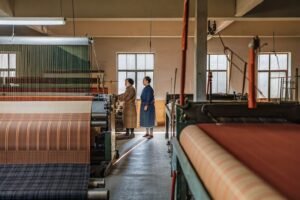
You get the proforma invoice. Your eyes scan down the page—unit price, quantity, shipping terms—and then they stop dead. "Payment Terms: 70% Deposit." Your pulse quickens. 70%? That is not just a safety net for them; that feels like you are buying the factory a new machine. You start doing the mental math: 70% before a single yard is cut means you carry almost all the risk. What if the color bleeds? What if the hand feel is rough? You feel vulnerable, almost like you are writing a blank check with no guarantee of return. The anger mixes with anxiety because you know your brand cannot afford to lose that cash flow.
I need to let you in on a trade secret: when a reputable supplier like us asks for a 70% deposit on custom fabric, it is rarely a greedy cash grab. It is an emergency alarm that screams, "This yarn is weird, expensive, and useless to anyone else if you cancel." Custom textiles are not like printing logo on a standard cotton tee. They are a deep dive into specific fiber blends, unique color lots, and finishes that turn a generic roll into a liability if left on our shelf. The deposit matches the salvage value—or lack thereof—of your dream fabric.
Stick with me here. I have been running Shanghai Fumao in the heart of Keqiao for over twenty years. I have seen this 70% number kill deals before they start, simply because the buyer did not understand the math behind the machine. I am going to walk you through the nitty-gritty of why custom orders demand heavy skin in the game, and how to tell if you are dealing with a thief or a genuine, risk-averse manufacturer trying to keep the lights on. Let’s sit down on the factory floor mentally and crunch the real numbers.
What Raw Material Risks Force a High Deposit on Custom Blends?
Back in March 2023, a startup from Los Angeles approached us with a brilliant but terrifying idea: a custom knit fabric blending 30% baby alpaca, 40% recycled polyester, and 30% mulberry silk. It sounded heavenly—soft as a cloud, warm yet breathable. I wanted to say yes immediately. But then I checked the raw material market. The problem wasn’t the silk or the recycled poly; it was the baby alpaca. You cannot just walk down to the corner market and buy 500 kilos of fine micron baby alpaca. We had to special-order it, with a lead time of four weeks, and pay 100% upfront to the yarn spinner. That is when I told the client the deposit was 70%. Not because I wanted to, but because the yarn merchant’s terms to me were "pay cash, no returns." If the client canceled that order the day we started knitting, I would be left holding 500 kilos of beige fluff, spending a decade trying to sell it as surplus. That is the reality of the spec game.

Why Do Niche Fibers Like Mohair or Cupro Require Upfront Yarn Purchase?
Mainstream cotton and standard poly are commodities. We buy them on credit or keep them in stock because we know they will sell eventually. But exotic or niche fibers, like the cuprammonium rayon you might know as cupro or the scratchy elegance of kid mohair, are a totally different beast. These fibers lack a liquid secondary market. If you order 2,000 meters of deep purple cupro twill and then vanish, I cannot just sell that to the next guy who walks in. The guy walking in wants black, or white, or navy. Deep purple is your signature. Because we operate a large-scale custom weaving factory, we carry no inventory of pre-dyed niche yarns. When we get your spec, we buy specifically for that PO. That 70% deposit covers the yarn spinner’s invoice. (Here I have to be blunt—suppliers who ask for a 70% deposit on standard 100% cotton poplin are likely just trying to rob you of free cash flow. You should question that heavily. But for a BAMSILK-viscose mix, it makes total sense.)
How Does Minimum Order Quantity Impact the Deposit Percentage?
It is a simple but painful equation: the lower your quantity, the higher the risk percentage for the mill. If ZARA orders 50,000 meters of a custom blend, losing 500 meters to machine setup waste is negligible. If a small fashion designer orders 500 meters, those same 500 meters of machine waste represent the entire order quantity. When you ask for a very small MOQ, like a 500-meter custom dye lot on a high-end functional poplin, we are running the dyeing machine at a loss, energetically speaking. The dye machine uses the same amount of water and energy whether we dye 500 meters or 3,000 meters. That inefficiency gets baked into the deposit. To get a lower deposit (say, the standard 30%), you need to commit to a volume that allows us to rationalize the run size. I often tell small buyers: pool your orders. Combine the grey fabric run with another client, and then split the dye bath. It’s a logistical headache for us, but it’s a way to knock that deposit down to 50% or lower, saving you cash flow for your marketing.
The "Dead Stock" Dilemma in Bespoke Finishes and Printing
Let me tell you about a heartbreak I suffered in the winter of 2018. A luxury loungewear brand asked us to develop a brushed velvet with a specific wax-printing technique—something that looked cracked and vintage. We spent two weeks on the R&D, mixing the chemical wash to degrade the pile just enough. It took four trials to get the "vintage crack" effect right, and we had to order a specialty binder from overseas to do it. The final result was breathtaking. But the brand’s campaign flopped. They paid their 30% deposit, took delivery of half the order, and abandoned the rest. I was left with 2,000 meters of "distressed turquoise velvet." For three years, that haunted my stockroom. Nobody on earth wanted a cracked, distressed turquoise velvet. I eventually had to sell it for less than the greige price to a car wash to use as rags. That is why custom finishes terrify suppliers—and why we now must charge a high deposit to avoid that ghost inventory.

What Hidden R&D Costs Are Loaded into Coated and Embossed Orders?
When you see a price per meter on a custom coated fabric, you are not just paying for the oilcloth finish; you are paying for the failed attempts. Developing a new technical coating involves trial and error. If you want a self-cleaning, hydrophobic finish, the chemical formulation must bond to the base cloth without peeling. We test for adhesion using a "crocking test," rubbing the fabric mechanically 20 times under pressure. If it fails, the batch is scrap. Those chemicals are expensive. A recent job I handled for an outdoor brand in Denmark required a fluorocarbon-free water repellent. The chemistry lab sent us three different auxiliaries. We ran pilot tests on 100 meters of base fabric each time. The first batch felt like sandpaper. The second batch washed off in a 30°C cycle. The third stuck. That client paid 70% upfront. It covered the cost of those first two ruined 100-meter batches. If you are learning how to design a custom tech pack for functional outerwear, you will realize these development costs are usually amortized over thousands of meters. If your run is small, you pay the R&D premium upfront.
Is Your Custom Print Creating an "Unusable Inventory" Risk for the Mill?
Print mills hate two things: neon colors and massive, specific placement prints. Let’s break down why a custom rotary print requires a high deposit with a simple math table based on our printing factory’s data:
| Print Type | Machine Setup Waste (Meters) | Resale-ability of Leftovers | Suggested Deposit |
|---|---|---|---|
| Standard Floral/Rotary | ~50m | High (Sellable as stock) | 30% – 50% |
| Placement/Border Print | ~100m | Zero (Useless scrap) | 70% |
| Foil Laminates | ~80m | Very Low (Niche style) | 60% – 70% |
| Pigment Digital | ~10m | Medium (Can be over-dyed) | 30% – 40% |
A placement print—like a specific hibiscus flower exactly 60cm from the edge—is a nightmare. The machine must register perfectly. If the fabric skews even slightly during the printing process, the flower is off-center. The whole 100-meter setup length goes into the garbage compactor. Plus, if we print 10 meters too many to ensure we hit your quantity, that excess is not a "bonus." It is a supply chain failure. You cannot make a shirt out of half a misaligned flower. Those leftovers are waste that the print house has to pay to dispose of. That environmental fee and the raw material loss are the driving factors behind that stiff 70% deposit. We aren’t financing your production risk; we are trying to survive it together.
How to Verify if the 70% Deposit is a Trustworthy Financial Request?
So, the supplier has justified the 70% fee with talk of rare fibers and tricky finishes. But how do you know they aren’t just a middleman taking a zero-risk joyride with your cash? After twenty years running the back end of Shanghai Fumao, I can tell you that a high deposit must come with absolute transparency, or it is a scam. A genuine factory has nothing to hide about where your money goes. We break down the deposit into a tangible pre-production schedule. If the supplier balks at showing you the math, your internal alarm bells should ring loud. You are not just a piggy bank; you are a supply chain partner. You have every right to see the recipe for your own fabric cake before you pay for the ingredients.

Can a Factory Breakdown of "Yarn vs. Labor" Costs Justify the Rate?
Absolutely, and you should demand it. When I send a 70% deposit invoice to a serious buyer, I attach a pie chart breakdown. It looks something like this: 45% for raw material procurement (certified organic cotton, specialty nylon), 15% for the dyeing chemicals and finishing auxiliaries, and 10% for the specific labor setup. The math proves that 70% purely covers the hard costs of goods sold, not our profit margin. Ask your supplier a direct question: "Can you send me your yarn purchase contract with the spinner?" If they are legit, they will blank out the spinner’s bank details but show you the date and the quantity. I do this frequently for new clients buying our high-tech moisture-wicking fabrics. I show them the receipt for the specialty anti-microbial agent from the chemical house. If the chemical costs $40 per kilo and we need 20 kilos, that’s $800 straight out of their deposit. Seeing is believing.
Why You Should Match the Deposit to a Supplier’s Financial Health Records?
A 70% deposit requested by a company that looks like it might go bankrupt next Tuesday is a massive no-go. You need to vet their "skin in the game." Check if they own the dyeing vessels or if they just rent time in a public dyeing house. A trading company that just rents time often demands a high deposit because the dyeing house demands it from them upfront, due to their poor credit history. A well-capitalized manufacturer like us, with a large-scale weaving factory and strategic banking partnerships, has the credit line to order raw materials without begging for cash. I sometimes offer a "Bank Guarantee Swap." If the buyer places a high deposit, I provide a photo of our factory’s fixed asset certificate or a bank reference letter to prove that the high deposit is not filling a financial black hole. It proves that Shanghai Fumao is solvent enough to refund the deposit if we fail to deliver. If the seller cannot prove they own any machinery, maybe that 70% is just funding a gambling debt, not your organic cotton.
Negotiating Milestone Payments to Lower Exposure While Satisfying the Mill
I get it. Even with all the logic in the world, handing over 70% before seeing a finished meter just feels wrong. It breaks the golden rule of business: never lose leverage. But there is a middle ground I love to use, which I call "Milestone Financing." Instead of one painful wire transfer, we break the risk into phases. This lets you, the buyer, inspect the product’s genetic makeup before the final tailoring. It’s like buying a house under construction: you pay when the foundation is laid, you pay when the roof is on, and you pay when the keys are handed over. It ties your cash flow directly to our progress, and honestly, it keeps our production team laser-focused on hitting those interim targets so we can unlock the next payment.

How to Structure a "Greige Good" Payment Release for Better Leverage?
Here is the playbook I use with skeptical European buyers who love our high-performance fabrics but hate my payment terms. We call it the "20/30/50 Split."
- 20% Deposit: Locks the order and buys the unique yarn.
- 30% Greige Release: We weave the raw, unfinished fabric. We ship you a 1-meter cut (no dye, no finish—just raw white cloth). You check the weave density with a magnifying glass, the yarn twist, and the weight. You sign off that the construction matches the spec sheet. Only then do you release the 30%.
- 50% Final Balance: After dyeing, finishing, and passing the third-party inspection, you pay the remaining 50% against the shipping documents.
This is brilliant because you can catch a fabric construction error before we pour expensive dyes into it. If the greige is wrong, we stop and re-weave it. You only lost the initial 20% commitment, not the full 70% dyeing cost. This method requires a supplier who is flexible in their production scheduling, but it is the ultimate safety net for a first-time custom batch.
What is a "Production Risk Insurance" Option and Does It Exist?
Actually, yes. And it surprises a lot of buyers. You can insure the deposit. This doesn’t cover you if you just don’t like the hand feel, but it protects you against the catastrophic: the factory burns down, the company goes into liquidation, or political unrest stops the shipment. Insurance brokers specialized in global trade finance offer what is essentially "Supplier Non-Performance Insurance." You pay a premium of roughly 1.5% to 3% of the invoice value. If we, the seller, fail to ship the goods due to a declared insolvency or force majeure, the insurer pays out your lost deposit. I have had a client from Australia use this for a $45,000 custom recycled fleece order. It cost them $900 to secure their $30,000 deposit. They told me it was the best night’s sleep they ever bought. It enables us to keep our strict 70% requirement to cover the recycled nylon cost, while they get to hedge their cash flow risk. It’s a sign of a mature buyer. If you are dealing with a massive contract, checking the business insights on supplier non-performance risk is worth every penny.
Conclusion
Your supplier isn’t necessarily trying to con you when they drop that 70% deposit figure. They are often just a manufacturer scared to death of holding a neon-green, cracked-texture, metallic-infused ghost that nobody else in the world wants. The deposit is a mirror reflecting the specificity of your design. It screams that your mohair is expensive, your print is too specific, or your coating chemistry took three tries to perfect. But understanding this doesn’t mean you blindly pay up. You arm yourself with the seller’s yarn receipts, you negotiate a 20/30/50 milestone plan to limit your dye risk, or you buy a cheap insurance bond to cover the catastrophe risk. You are no longer just a buyer; you are a production partner securing your supply chain.
At Shanghai Fumao, I have built our reputation around demystifying this process. We know a 70% deposit only works if it comes with 100% transparency. My team documents the R&D failures, shows you the raw material invoices, and holds your sealed swatch under lock and key so you know the final meter will be a twin of your approval.
If you are staring at a high-deposit invoice right now, or if you are planning a complicated custom development and want a partner who talks straight about money, please get in touch with our Business Director, Elaine. She can walk you through a structured payment schedule that protects your cash flow without insulting the complexity of the craft. Email her at elaine@fumaoclothing.com with a brief description of your dream fabric. We will figure out the safest, smartest way to fund it together. Let’s make that tricky custom batch happen without the financial nightmares.