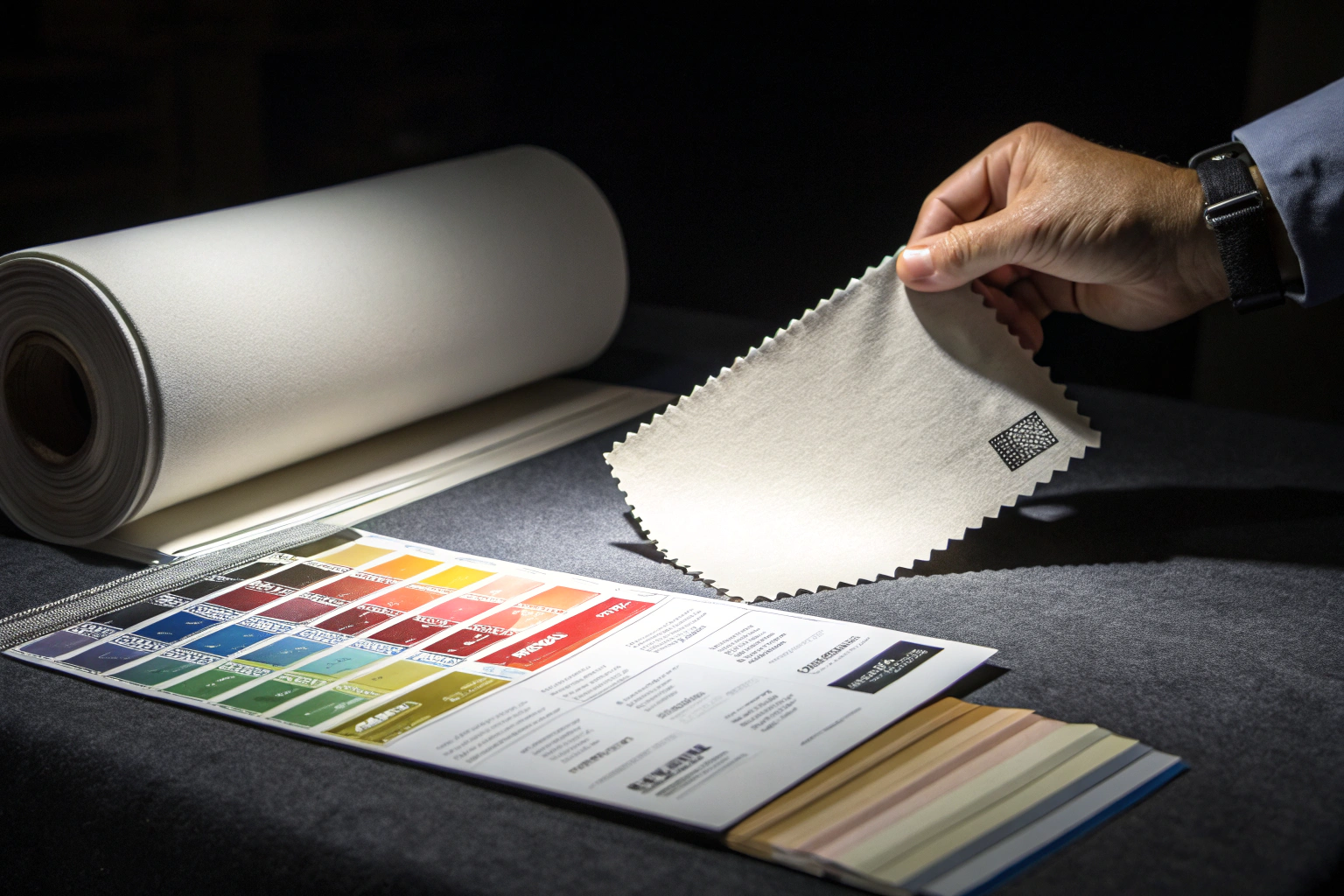
The swatch was a promise. You held it in your hand six months ago. It was the perfect weight—a 180 GSM slub cotton linen with a cool, dry hand and a warm "Desert Rose" heathered tone that looked like a sunset over sandstone. You built your entire collection around that 10-centimeter square of fabric. You designed the blazer, the wide-leg trouser, the wrap dress. You sold the collection to buyers based on that swatch. The bulk order arrived this morning. You unrolled the first meter, and your stomach dropped. The color is a shade flatter. The slub texture is less pronounced. The hand feel is slightly stiffer. The fabric isn’t "wrong" in a way that a lab test would easily catch. It’s just… not the same. It’s not the promise. And now you have 2,000 meters of "almost but not quite" fabric, a production deadline in three weeks, and a sickening feeling that you’ve been bait-and-switched.
At Shanghai Fumao, we’ve diagnosed this failure mode more times than I can count, both in our own early years and in the distressed calls we get from brands fleeing other suppliers. The swatch that looks perfect but the bulk order that fails is rarely a deliberate bait-and-switch. It’s almost always a failure of process—a disconnect between how the sample was made and how the bulk was produced. The swatch was woven on a handloom sample machine by a master technician with unlimited time. The bulk was woven on a high-speed rapier loom at 500 picks per minute, dyed in a 200-kilogram batch instead of a 500-gram lab pot, and finished on a continuous stenter at 40 meters per minute. The conditions were fundamentally different, and the fabric reflects those conditions. The swatch was a prototype. The bulk was a production run. They are not the same process, and if your supplier doesn’t actively manage that transition—if they don’t have a structured "bulk-to-sample" matching protocol—the fabric you receive will always differ from the swatch you approved.
I’m going to walk you through the four specific reasons why this happens: the sample loom problem, the dye lot scaling effect, the finishing tension trap, and the absence of a retained bulk reference standard. And I’m going to show you what a professional fabric supplier does—and what you, the buyer, should demand—to ensure that the bulk fabric in your warehouse is the twin of the swatch on your mood board.
How Does a "Handloom Swatch" Differ from a Bulk Production Loom?
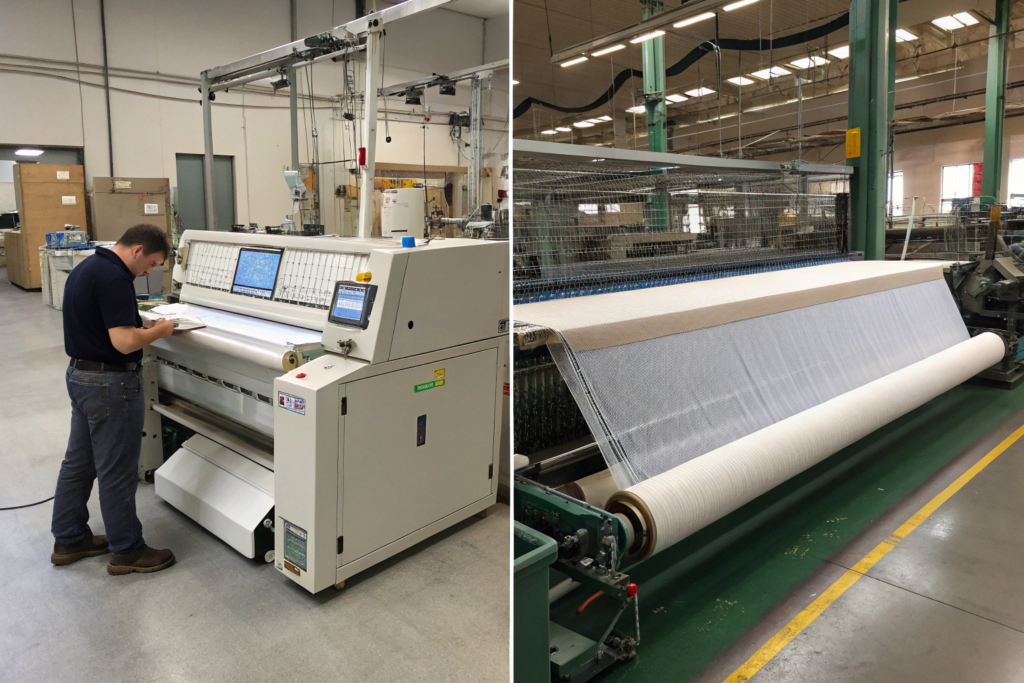
This is the most fundamental source of the swatch-to-bulk gap, and it’s a dirty secret that many suppliers hope you don’t understand. The beautiful swatch you approved was almost certainly woven on a handloom sample machine—a small, semi-manual loom designed for producing short lengths of fabric for development purposes. The bulk fabric you ordered was woven on a high-speed production loom—a completely different machine with different weaving physics. The fabric is the same in specification, but the process that created it is fundamentally different, and that difference shows up in the final product.
A handloom sample machine operates at very low speed—maybe 20 to 30 picks per minute. The weft yarn is inserted gently, one pick at a time. The warp tension is low and manually controlled. The reed beats the weft yarn into place with a gentle, consistent pressure. The result is a fabric that is almost perfectly uniform. The slubs—the thick-and-thin variations in the linen yarn—are preserved beautifully because the weaving forces are gentle. The surface texture is rich and pronounced.
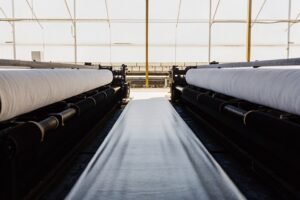
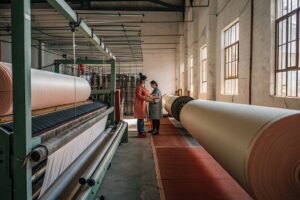
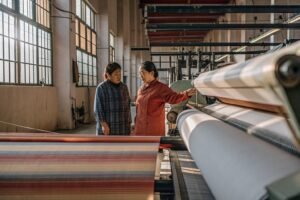
A high-speed rapier loom operates at 400 to 600 picks per minute. The weft yarn is shot across the warp at high velocity by a projectile or a rapier arm. The warp tension is high and mechanically maintained. The reed beats the weft into place with a violent, percussive force. This high-energy weaving process fundamentally alters the fabric’s character. The heavy beat-up flattens the slubs. The high warp tension stretches the linen yarns slightly, reducing the apparent texture. The high-speed weft insertion can cause the yarn to "balloon" slightly, creating a subtly different cover factor.
The fabric emerging from the production loom is not a failed version of the sample. It’s a correct production of the sample’s specifications under real-world manufacturing conditions. But if you were expecting the rich, pronounced, hand-crafted texture of the handloom swatch, the production fabric will feel slightly flatter, slightly smoother, and slightly "less special." This is not a defect. It’s a process reality.
A professional supplier manages this by producing a pre-production sample on the actual production loom that will run the bulk. This is not the handloom swatch. It’s a 20-30 meter length of fabric, woven on the production rapier loom at production speed, using the exact yarn batch that will go into bulk. This sample shows you the real texture, the real slub character, and the real hand feel that the bulk will have. If you only ever see a handloom swatch, you are approving a prototype, not a production fabric. Always demand a production-loom sample before approving bulk. Understanding the technical differences between handloom sample weaving and high-speed rapier loom production, and the specific fabric characteristics that are affected by weaving speed, warp tension, and beat-up force gives you the engineering background, and learning how to specify and evaluate a pre-production sample versus a handloom development swatch in a commercial fabric sourcing process provides the procurement protocol.
Why Does the "Slub Character" Change Between Sample and Bulk?
The slub—that beautiful, organic thick-and-thin irregularity in the linen yarn—is the signature of a premium natural fabric. It’s what makes a cotton-linen blend look expensive and artisanal. It’s also one of the first things to change between a sample and a bulk run, and the change is directly caused by the mechanical forces I just described.
On a handloom, the slub yarn is woven gently. The thick "slub" section of the yarn passes through the weaving shed and is beaten into place without being crushed. The slub stands proud on the fabric surface, creating that three-dimensional, textural peak. On a high-speed rapier loom, the reed—the metal comb that beats the weft yarn into position—strikes the fabric with significant force. This force literally hammers the raised slubs down into the fabric structure. The slubs are still there, but they are flatter, less prominent, less visually dramatic.
The difference can be quantified. We measure the "slub prominence" by the surface roughness profile. A handloom swatch of our SL-550 cotton-linen might have a Mean Peak-to-Valley Height of 120 micrometers. The same yarn, woven on a production rapier loom, might have a Mean Peak-to-Valley Height of 85 micrometers. The slub is still present—the fabric is still beautifully textured—but it’s 30% less pronounced. This is a normal, expected consequence of production weaving.
A professional mill compensates for this. We can amplify the slub character on the production loom by adjusting the warp tension downward slightly, by modifying the beat-up force, or by using a slightly heavier slub yarn specifically for production runs. The production-loom sample is where these adjustments are validated. If the buyer approves the production-loom sample, they are approving the production-level slub character. The handloom swatch is for initial concept approval. The production-loom sample is the contractual standard for bulk. For more technical background, reading about the behavior of slub and fancy yarns during high-speed weaving, including the mechanical forces that alter slub appearance and techniques to preserve slub character explains the physics, and understanding how to specify and measure slub characteristics—frequency, length, thickness amplification—in a fabric specification sheet gives you the quantitative vocabulary.
Can a Different Yarn Batch Cause the Same Color to Look Different?
Yes, and this is one of the most frustrating and subtle sources of the swatch-to-bulk mismatch. The swatch was woven with a small batch of yarn, perhaps a few kilograms from a specific spinning lot. The bulk order required 500 kilograms of yarn, spun over several days or weeks, possibly from a different batch of raw fiber. Even if the yarn is the same specification—same count, same twist, same fiber blend—it can behave differently in the dye bath.
The reason is the micronaire and maturity variation of the cotton fibers and the retting degree variation of the flax fibers. Cotton fibers from the same farm, harvested a week apart, can have slightly different micronaire values (fineness and maturity). Flax fibers from the same field, retted under slightly different weather conditions, can have slightly different degrees of pectin removal. These microscopic differences affect how the fiber absorbs and reflects dye. A yarn spun from a batch of slightly more mature, thicker-walled cotton fibers will dye to a slightly darker, richer shade than a yarn spun from less mature fibers, even if the dye formula is identical.
In a cotton-linen blend, the differential dye uptake I’ve described in previous articles—the linen slubs dyeing darker than the cotton background—is highly sensitive to the specific fiber batches. A different batch of flax, with a slightly different lignin content, will produce a subtly different heathered effect. The "Desert Rose" shade you approved on the swatch might become slightly more contrasted (darker slubs, lighter background) or slightly more blended in the bulk, depending on the fiber batch variation.
A professional supplier manages this by testing every incoming yarn batch for dye uptake consistency. We dye a small sample of each new yarn batch with a standard reference dye formula and compare the color to a retained standard. If the new batch shows a significant difference, we adjust the bulk dye formula to compensate. This is not a guess. It’s a quantitative, controlled process. You, the buyer, should ask: "How do you control for yarn batch-to-batch dye uptake variation? Can I see your incoming yarn dye test records?" A supplier that can’t answer this question is likely not controlling this variable, and you will experience color variation between the swatch and the bulk. For more detail, exploring the effect of cotton fiber micronaire and maturity on dye uptake, shade depth, and color consistency in piece-dyed woven fabrics provides the fiber science, and understanding the standard operating procedures for testing incoming yarn lots for dye affinity and adjusting bulk dye formulas to maintain color continuity shows the professional practice.
Why Does the "Scale-Up" Dyeing Process Drift from the Lab Dip?
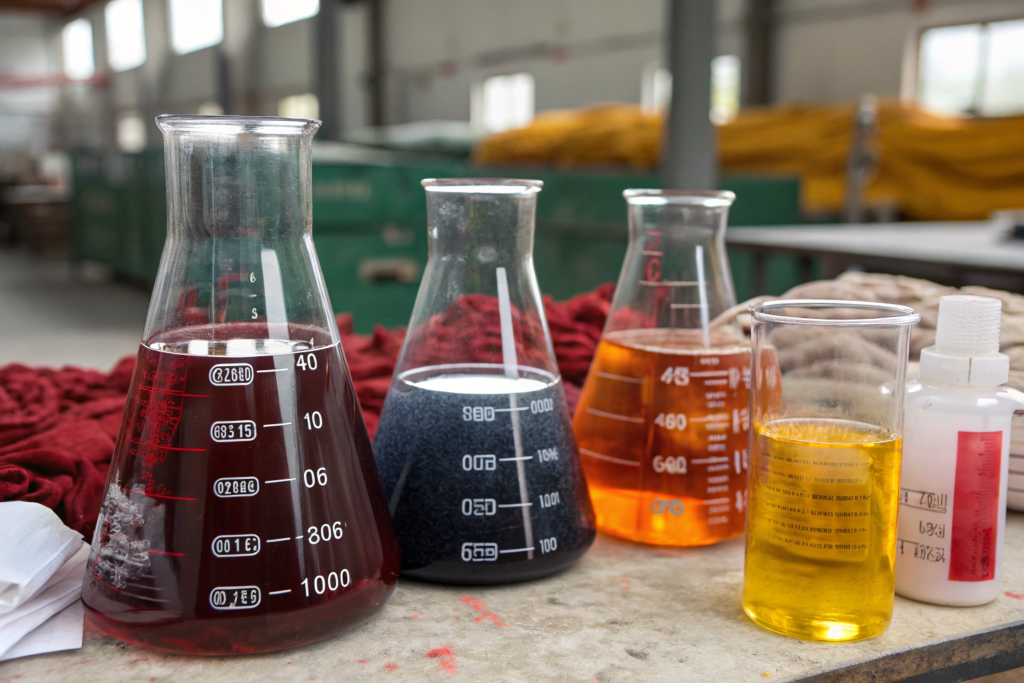
The lab dip is a miniature miracle of color precision. In a beaker on a magnetic stirrer, under controlled laboratory conditions, the dye master achieves a Delta E of 0.3 against your target Pantone chip. The color is perfect. You sign off. Then the bulk dyeing happens in a 200-kilogram vessel, in a factory where the steam pressure fluctuates, the water pH varies slightly, and the fabric moves through the dye bath at 30 meters per minute. The bulk fabric that emerges is visually close to the lab dip, but it’s a Delta E of 1.8 off—not terrible, but enough to notice when you hold the swatch next to the bulk. This is the scale-up drift, and it’s a chemical-engineering reality.
The dyeing process is not a simple "mix and apply" operation. It’s a complex chemical reaction where the rate of dye uptake by the fiber depends on the temperature ramp rate, the concentration of salt and alkali in the dye bath, the ratio of fabric mass to dye liquor volume (the liquor ratio), and the physical agitation of the fabric. In a lab beaker, the liquor ratio is very high—perhaps 20:1 or 30:1 (20 liters of dye solution per kilogram of fabric). This ensures extremely even dye distribution. In a bulk dyeing machine, the liquor ratio is much lower—perhaps 5:1 or 8:1—to conserve water and energy. The lower liquor ratio changes the chemical equilibrium of the dye-fiber reaction. The same dye formula applied in a different liquor ratio can produce a slightly different shade.
Furthermore, in a bulk dyeing machine, the fabric is moving continuously through the dye bath. The rate at which fresh dye is injected and circulated, the uniformity of the temperature across the vessel, and the contact time between the fabric and the dye liquor are all variables that differ from the lab beaker. The dye master must adjust the bulk formula to compensate for these scale-up effects. This is the art and science of bulk color matching.
A professional dye house uses a pilot-scale dyeing machine—an intermediate-sized machine that processes perhaps 5-10 kilograms of fabric—to bridge the gap between the lab beaker and the bulk vessel. The pilot-scale machine uses the same low liquor ratio as the bulk machine, so the scale-up chemistry is validated. The pilot-scale sample is the final color approval before bulk production. A supplier that jumps directly from a lab dip to a 500-kilogram bulk dye run is taking a significant color risk. Ask: "Do you use a pilot-scale dyeing machine to validate the bulk formula before production? Can I see the pilot-scale sample?" For a deeper dive, reading about the chemistry of reactive dyeing of cotton and cellulosic fibers, and the specific process variables—liquor ratio, temperature ramp, salt concentration—that cause color drift during scale-up from lab to bulk explains the science, and understanding the standard dyeing quality control procedures, including pilot-scale validation, spectrophotometric color measurement, and bulk shade banding defines best practice.
How Does Finishing Tension Flatten the Texture I Approved?
The fabric coming off the loom—the greige fabric—has one texture. The fabric coming off the dyeing machine has another. The fabric coming off the finishing stenter frame—the final fabric you receive—can have a dramatically different texture, and the difference is driven by one variable: tension.
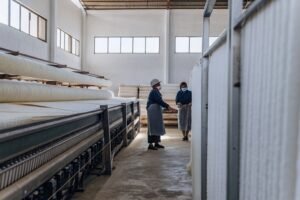
The stenter frame is the final machine in the textile finishing line. It dries the fabric, sets the final width, and applies any finishing chemicals (softeners, wrinkle-resistant treatments, etc.). The fabric is held at its edges by pins or clips and is pulled through a long, heated oven under controlled tension. This tension is necessary to control the width and to prevent the fabric from shrinking or wrinkling during drying. But the tension also pulls the fabric taut, flattening the three-dimensional surface texture.
A factory that is optimizing for productivity will run the stenter at high tension and high speed. The fabric exits the stenter faster, and the meters-per-day output is higher. But the high tension pulls the slubs flatter, smooths the surface, and can even reduce the apparent GSM by stretching the fabric slightly. This is the "over-stentering" trap.
A factory that is optimizing for texture and hand feel will run the stenter at low "overfeed." Overfeed means the fabric is fed into the stenter faster than it is pulled out. This creates a deliberate slack, allowing the fabric to relax, the yarns to bulk up, and the surface texture to bloom. The productivity is lower—fewer meters per day—but the fabric quality is higher.
This is not a difference you can specify on a purchase order unless you know to ask for it. A generic spec sheet says "Finish: Softener." It doesn’t say "Stenter overfeed: 4%, tension: Low, to preserve slub surface texture." A professional supplier that cares about matching the bulk to the swatch will specify the stenter parameters, not just the chemical recipe. Ask your supplier: "How do you control stenter tension to ensure the bulk fabric matches the hand feel and surface texture of the approved sample?" A supplier that can answer with specific overfeed percentages and tension settings is controlling this variable. A supplier that looks confused is not. For a complete understanding, reading about the mechanical finishing of woven fabrics, focusing on the stenter frame, the impact of tension and overfeed on fabric width, GSM, and surface texture, and how to specify these parameters provides the operational detail, and learning how to measure and specify fabric surface roughness and hand feel parameters in a production specification sheet, so the stenter operator has a quantitative quality target gives you the measurement tools.
Is the "Approved Swatch" Legally Binding for Bulk Quality?
This is a crucial legal and commercial question that many buyers get wrong. The handloom swatch you signed off on—that beautiful, perfect, tiny piece of fabric—is generally not, on its own, legally binding as the standard for bulk quality. A court or an arbitrator will recognize that a handloom sample and a production run are produced under different conditions. If your purchase contract only references "as per approved swatch," you are in a weak position to reject the bulk fabric if it differs in ways attributable to the production process.
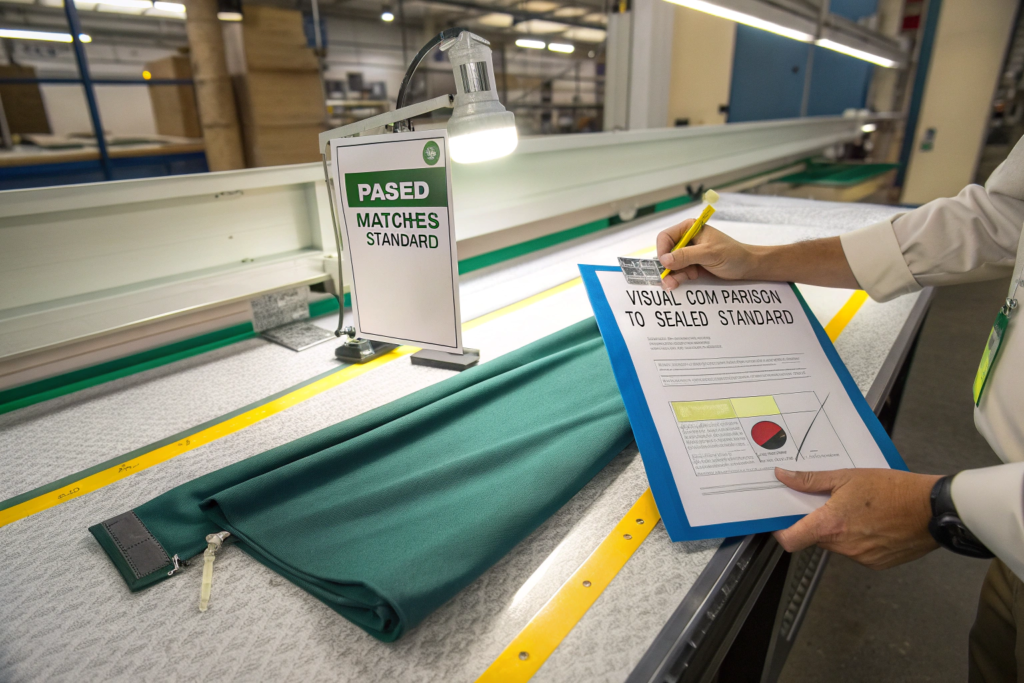
The document that is legally binding is the "Approved Pre-Production Sample" or "Sealed Standard," cut from the production-loom sample or the pilot-scale dyed fabric, and formally accepted by both parties. This sample is typically a larger piece of fabric—at least a meter—and it is accompanied by a detailed specification sheet that lists the measured parameters: GSM, width, yarn count, weave density, color (measured by spectrophotometer and expressed as CIELAB values or a Delta E tolerance from a standard), shrinkage, and hand feel standard.
Both parties sign a document that states: "The attached fabric sample, labeled [Lot Number], and the accompanying specification sheet dated [Date], constitute the agreed quality standard for bulk production. The bulk fabric shall match this standard within the following tolerances: GSM ±5%, Width ±2%, Color Delta E ≤1.5, Shrinkage ≤2%." Now you have an objective, measurable, legally binding standard.
Without this, you have an opinion. You think the bulk fabric doesn’t look like the swatch. The supplier thinks it’s close enough. There is no objective basis to resolve the dispute. Always, before releasing the bulk production, ensure that a sealed, signed, and specified pre-production sample is the contractual quality standard. For guidance, reading about the legal and commercial role of the sealed sample and the approved specification sheet in textile purchase agreements, and how they are used in dispute resolution provides the legal context, and understanding how to correctly seal, label, document, and store a reference sample so it maintains its evidentiary value over time is a practical necessity.
What Pre-Shipment Steps Should Catch a "Bait and Switch"?
The true "bait and switch"—where a supplier deliberately shows you a high-quality sample and then produces a cheap, non-compliant bulk—is less common than the process failures I’ve described, but it does happen. More common is the "drift" scenario, where the bulk is simply not a good match to the sample due to the scaling issues, and the supplier ships it anyway, hoping you won’t notice or won’t be able to prove it. The pre-shipment phase is your last line of defense. There are three specific, non-negotiable steps you should demand that will catch a mismatch before the fabric leaves China.
Step 1: The Third-Party Pre-Shipment Inspection (PSI). Commission an independent inspection company—SGS, Intertek, Bureau Veritas, or QIMA—to inspect the fabric before it’s packed. The inspector will pull a random statistical sample of the finished rolls, based on your specified AQL (usually 2.5 for textiles), and will compare the bulk fabric side-by-side with your approved sealed standard under controlled D65 lighting. They will measure the GSM, the width, the weave density, and the color on a spectrophotometer. They will note any visual defects using the 4-Point System. The PSI report will give you a data-driven "Pass" or "Fail" verdict. If the fabric fails, you have the power to demand a rework or a re-production before paying the balance.
Step 2: The "Shade Band" Review. Even if you don’t commission a full third-party PSI, always require the supplier to provide a shade band for your review before shipment. A shade band is a series of swatches cut from the beginning, middle, and end of every dye lot, mounted on a card next to your approved standard. The supplier should photograph this shade band under D65 lighting and email you the photos, and then courier the physical shade band to you. Review it. Does the color shift from the beginning to the end of the roll (a "tail shading" defect)? Does the bulk color visibly deviate from your approved standard? This is a quick, low-cost check that catches a high percentage of color problems.
Step 3: The "Gold Seal" Sample Request. Ask the supplier to seal one meter of the actual bulk production fabric, from a randomly selected roll, into a tamper-proof bag with a unique seal number, and courier it to you before the container ships. This is the "gold seal" sample. When the container arrives, you can open the gold seal sample and immediately compare it to the fabric on the container. If they don’t match, the supplier switched the fabric after the sample was taken. This is a powerful deterrent against a deliberate bait-and-switch. A supplier that knows a gold seal sample is in your hands is far less likely to try a substitution.
A US home textiles brand that had been burned by a color mismatch on a previous order now mandates all three steps for every bulk order over $10,000. The PSI caught a GSM issue on one order. The shade band caught a tail shading problem on another. The gold seal sample has never uncovered a switch, but the brand sleeps better knowing the deterrent is in place. For more detail, reading about the standard protocol for a third-party textile pre-shipment inspection, including the AQL sampling method, the 4-Point System, and the side-by-side comparison to a sealed standard provides the technical procedure, and understanding how to use shade bands, gold seal samples, and other pre-shipment documentation to create a legally robust quality verification process builds your inspection toolkit.
Can I Trust a Factory’s "In-House" QC Report Without Verification?
An in-house QC report from the factory is a useful document. It shows you that the factory has a quality system, that they are measuring their own output, and that they are aware of the standards. However, it is not an independent verification, and it should not be the sole basis for accepting a large shipment. The reason is obvious: the factory is grading its own homework. Even in a well-intentioned, honest factory, there is a natural, unconscious bias to interpret borderline cases in favor of "Pass." In a less scrupulous factory, the in-house report can be fictional.
An in-house QC report is most useful when it is compared to an independent third-party PSI report. If the in-house report says "Pass, AQL 2.5, 8 defect points per 100 square meters," and the independent SGS report says "Pass, AQL 2.5, 11 defect points per 100 square meters," the reports are broadly consistent, and you have confidence in the factory’s QC system. If the in-house report says "Pass, 5 defect points," and the independent report says "Fail, 45 defect points, barre mark detected," the factory’s QC system is either incompetent or dishonest, and you have a serious supplier problem.
The key is to require both. The in-house report is a management tool that drives the factory’s internal continuous improvement. The independent report is your verification and your contractual protection. Don’t accept one without the other, unless the order value is small and your risk tolerance is high. For a more complete perspective, reading about the role and limitations of factory in-house quality control reports versus independent third-party inspections in the textile and apparel supply chain provides a balanced view, and understanding how to compare an in-house textile QC report with an independent PSI report to assess the reliability and accuracy of the factory’s quality management system gives you the analytical framework.
What Does a "Retained Sample" Prove in a Quality Dispute?
A retained sample is a piece of the fabric from the specific bulk production lot that both you and the supplier agree to keep, in a sealed, labeled condition, as the definitive reference in case of a future quality dispute. It is the physical evidence of what was produced and what was agreed to.
The retained sample proves what the bulk fabric actually looked like at the time of shipment. Without it, a quality dispute six months later becomes a battle of memories and emails. You say the fabric was too light in color. The supplier says it met the standard. The retained sample, stored in a dark, climate-controlled environment, is taken out and compared to the approved pre-production standard under standard lighting. The retained sample doesn’t fade, doesn’t change, and doesn’t lie. It is the objective, physical truth.
A professional retained sample protocol includes: the sample is at least 1 meter x full width, cut from a randomly selected roll from the middle of the production lot. It is sealed in a black, opaque, archival-quality plastic bag to protect it from light and humidity. The bag is labeled with the fabric lot number, the date of sealing, and the signatures of both the supplier’s QC manager and, ideally, the third-party inspector. One sealed sample is kept by the supplier. An identical sealed sample is couriered to the buyer and kept in their files. If a dispute arises, both sealed samples are opened, and the fabric is compared. Any discrepancy between the two retained samples is itself evidence of tampering.
I insist on retained samples for every bulk order, and I recommend every buyer do the same. It costs almost nothing, and it turns a subjective argument into an objective examination. For practical implementation, reading about the standard protocol for creating, sealing, labeling, and storing retained samples in the textile industry, and their legal weight in quality disputes provides the legal and procedural framework, and understanding the proper archival storage conditions for textile samples to prevent degradation, color change, and physical damage over time ensures your evidence survives intact.
Conclusion
The swatch that looked perfect and the bulk order that failed is not an unsolvable mystery. It’s a predictable result of specific, identifiable process disconnects. The handloom sample machine does not produce the same fabric as a high-speed production loom. The lab beaker does not produce the same color as a 200-kilogram dye vessel. The stenter frame, if run at high tension, flattens the texture you approved. And a generic purchase order that says "as per sample" is a weak legal foundation for a quality claim. Each of these problems has a specific, proven countermeasure: the production-loom sample, the pilot-scale dye validation, the specified stenter overfeed, the sealed pre-production standard, the third-party PSI, the shade band, and the retained sample.
At Shanghai Fumao, we don’t expect a client to trust a handloom swatch and hope for the best. We provide the handloom for concept approval, the production-loom sample for bulk approval, the pilot-scale dye sample for color approval, and the retained sealed sample for long-term reference. We invite the third-party inspection. We share the shade bands. We do this because we know that the bulk fabric will match the standard we all agreed to, and we want you to have the proof.
If you’ve been burned by the swatch-to-bulk gap, or if you’re sourcing for your first large production run and want to ensure the fabric you receive is the fabric you designed around, apply these protocols with your supplier. And if you want to work with a factory that has already built these protocols into its standard operating procedure, contact our Business Director, Elaine. She can walk you through our sample approval process, show you an example of a sealed pre-production standard, and connect you with the third-party inspection firms we work with regularly. Her email is elaine@fumaoclothing.com. The swatch is the promise. The protocol is the proof.