
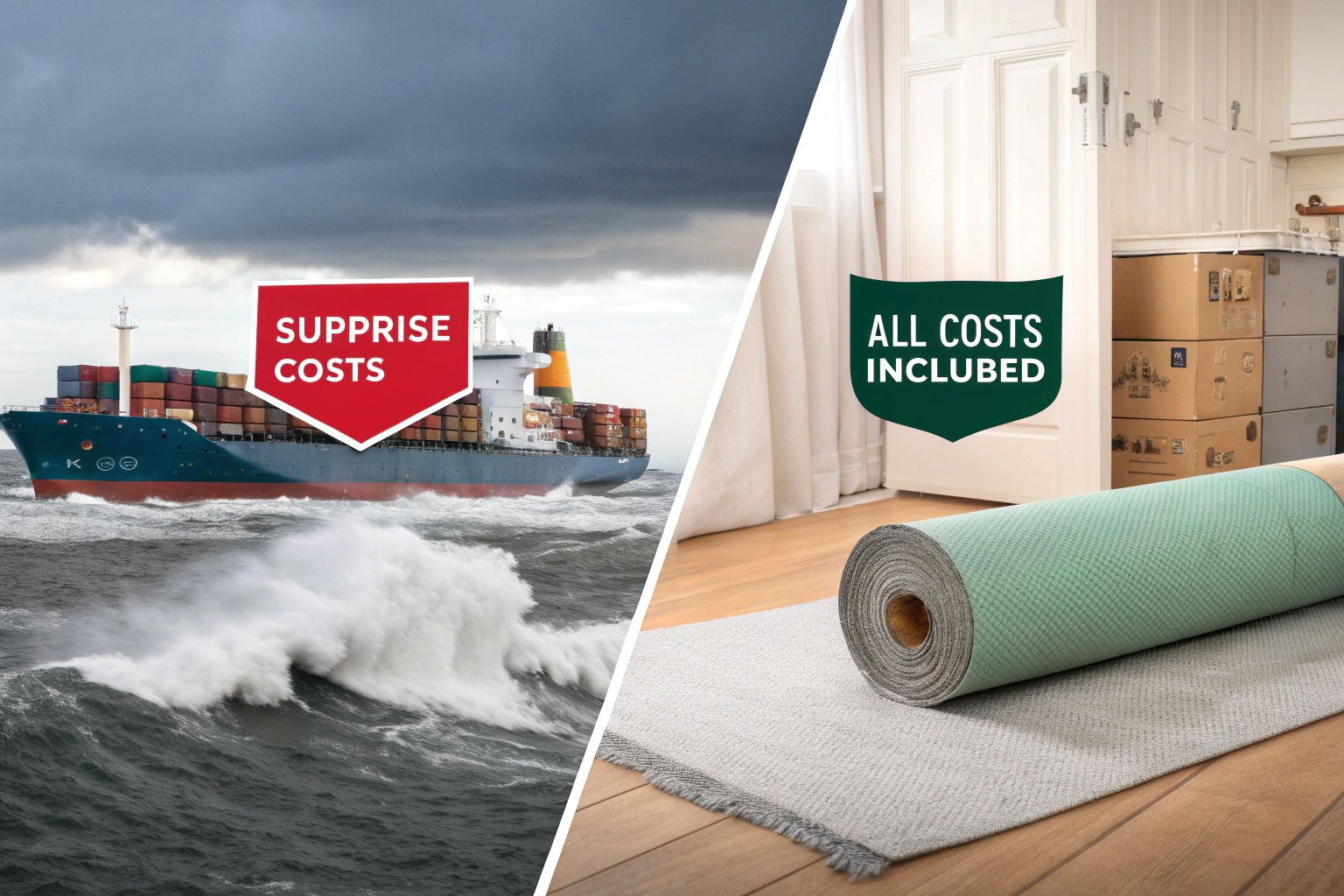
You’ve done the hard work. You spent months searching for the perfect cotton linen, negotiating the price, verifying the factory, and approving the strike-off. The fabric is exactly what your collection needs. You pay the final invoice, track the vessel across the ocean, and watch it dock at the Port of Los Angeles or Rotterdam. And then, the email arrives. Your freight forwarder sends you a bill for port handling charges, customs brokerage fees, import duties, and a "container detention" fee because the port was congested. The total is $2,400. You didn’t budget for this. Your landed cost just jumped by 18%. Your margin evaporated before the fabric even reached your cutting room. This is the pain of shipping on FOB or CIF terms. The price you negotiated with the supplier was an illusion. The real price, the price that actually gets the fabric into your hands, was hidden in a maze of destination charges that you, the buyer, were responsible for.
DDP shipping is the cure for that specific, margin-destroying pain. DDP stands for Delivered Duty Paid, and it is an Incoterm—an international commercial term defined by the International Chamber of Commerce—that places the maximum responsibility on the seller. When you buy fabric from Shanghai Fumao on DDP terms, the price we quote you is the price you pay. Full stop. That price includes the fabric, the export packaging, the origin port charges, the ocean or air freight, the insurance, the import customs clearance, the import duties and taxes, and the final delivery truck to your warehouse door. You don’t pay a single additional cent. You don’t argue with a customs broker. You don’t get a surprise detention bill. You don’t even need to have a customs bond. We handle everything, and you receive your fabric as if you ordered it from a domestic supplier.
For fabric buyers—especially small to mid-sized brands, first-time importers, and anyone who doesn’t have a dedicated logistics department—DDP transforms importing from a financial gamble into a predictable, budgetable line item. I’m going to explain exactly how DDP works for textile shipments, why the "all-in" price is almost always cheaper than the hidden costs of FOB when you account for risk, and how to ask your supplier for a DDP quote without revealing that you’re new to the game. This knowledge will save you money, stress, and possibly your business.
What Are the Incoterms Rules for DDP vs. FOB in 2026?
Incoterms are not boring legal jargon. They are the rules of the game that determine who pays for what, who owns the risk at each stage of the journey, and who is responsible when something goes wrong. Understanding the difference between FOB and DDP is not optional for a fabric buyer; it’s the difference between a clear, predictable cost and a murky, open-ended liability.
FOB (Free On Board) is the most common Incoterm used by Chinese textile suppliers. Under FOB, the seller’s responsibility ends when the goods cross the ship’s rail at the port of origin (usually Ningbo or Shanghai for our shipments). The seller pays for the fabric, the local trucking to the port, and the export customs clearance. The buyer pays for the ocean freight, the insurance, the import customs clearance at the destination, the import duties and taxes, and the final delivery to the warehouse. The risk transfers to the buyer at the ship’s rail. If the container falls off the ship, it’s the buyer’s problem (assuming they bought insurance). If the container is detained at US customs, it’s the buyer’s problem. If the trucking company at the destination damages the goods, it’s the buyer’s problem.
DDP (Delivered Duty Paid) is the opposite. Under DDP, the seller is responsible for everything—every cost, every risk, every customs interaction—from our factory door in Keqiao to your warehouse door in Chicago or Manchester. We pay the export charges. We pay the freight. We pay the insurance. We act as the importer of record, which means we pay your import duties and taxes directly to your government. We clear the goods through customs. We pay the destination port charges. We arrange and pay for the final truck delivery. You, the buyer, do absolutely nothing except receive the goods and pay the single, all-in invoice.
The critical difference for a US fabric buyer in 2026 is the importer of record liability. Under FOB, you (or your customs broker) are the importer of record. You are legally responsible for the accuracy of the customs declaration, the payment of duties, and the compliance of the goods with all US regulations, including the Uyghur Forced Labor Prevention Act. If there’s a problem, CBP comes after you. Under DDP, we (or our appointed customs broker) are the importer of record. The compliance burden is on us. For a small brand without a compliance department, this is a massive risk transfer. For a deeper dive into the legal framework, reading the official ICC Incoterms 2020 rules for DDP and FOB, with a detailed breakdown of cost and risk allocation at each stage of the journey is the primary source, and understanding the specific responsibilities and liabilities of the "importer of record" under US customs law, particularly for textile products subject to UFLPA enforcement is essential for US buyers.

Who Pays for the "Hidden" Destination Port Charges Under DDP?
This is the question that reveals the true value of DDP. The "hidden" destination port charges are the line items that FOB buyers never see on their supplier’s invoice but that appear, like uninvited guests, on the freight forwarder’s bill after the goods arrive. They include the Terminal Handling Charge (THC), the Container Freight Station (CFS) fee for LCL shipments, the customs examination fee (if your container is flagged for inspection), the customs bond fee, the single entry bond or continuous bond cost, the courier and messenger fees for document delivery, and the trucking chassis fee.
Under FOB, every single one of these charges is the buyer’s responsibility. A typical LCL shipment of 500 meters of fabric to the US might incur $400-$800 in these destination charges. A full container load (FCL) might incur $800-$1,500. These charges are not included in the ocean freight quote your forwarder gave you. They are additional. And they vary from port to port and from week to week.
Under DDP, all of these charges are the seller’s responsibility and are included in the DDP price. We pay the THC. We pay the CFS fee. We pay the customs bond. We pay the examination fee if one occurs. We negotiate these charges in volume with our global logistics partners, so we typically pay less than an individual buyer would pay. The buyer pays zero. The buyer never even sees these line items. The DDP price is truly all-in.
I recall a Canadian buyer who ordered 300 meters of our cotton poplin on FOB terms in 2025. The fabric cost was $1,200. The ocean freight was $350. He thought his total landed cost was $1,550. When the goods arrived in Vancouver, his forwarder sent him a bill for $680 in destination charges—THC, CFS, customs clearance, and a surprise "pier pass" fee. His actual landed cost was $2,230, nearly 45% higher than the FOB fabric price. He switched to DDP for his next order. The DDP price was slightly higher than the FOB fabric price, but lower than the FOB fabric price plus the hidden charges, and there were zero surprises. For a detailed breakdown, reading about the common destination port charges and fees that importers face when shipping FOB or CIF, with typical cost ranges for US and European ports reveals what you’re actually paying for, and understanding how DDP logistics providers consolidate and manage these destination charges within the all-in DDP price explains the economic model behind the single-price convenience.
Does DDP Include US Customs Duties and the Section 301 Tariffs?
Yes. This is the most powerful and valuable feature of DDP for a US fabric buyer. Under DDP, the seller is responsible for paying all import duties, taxes, and tariffs. When we quote you a DDP price for your cotton or linen fabric shipment, that price includes the US customs duty (which varies by HTS code and fiber composition), the Merchandise Processing Fee (MPF), the Harbor Maintenance Fee (HMF), and any applicable Section 301 China tariffs.
The Section 301 tariffs are the elephant in the room for US importers. Depending on the specific HTS classification and the current trade policy, certain woven cotton and linen fabrics from China are subject to an additional 7.5% or 25% ad valorem tariff on top of the standard duty rate. This is a massive cost that FOB buyers must pay out of pocket when the goods arrive. Under DDP, we calculate this tariff into the DDP price upfront. You know the exact cost before you order. There is no "surprise 25% tariff bill" from CBP six weeks later.
This is also where the documentation and traceability I’ve discussed in previous articles become commercially critical. If a fabric is misclassified or its origin is unclear, CBP may apply the wrong, higher duty rate, and the DDP supplier (or the buyer, if FOB) has to pay the difference plus penalties. Because we provide full, auditable documentation for every shipment—the Digital Cotton Passport, the mill certifications, the correct HTS classification—our customs entries are accurate and compliant. We pay the correct duty, not an inflated one, and we build that correct duty into your DDP price.
A New York-based importer told me he was quoted a DDP price by another Chinese supplier that seemed "impossibly low." He asked them to break down the duty component. They couldn’t. It turned out they were misclassifying the fabric under a duty-free HTS code to win the business, and the buyer would have been liable for the back duties and penalties if customs had detected the misclassification. The cheap DDP price was a trap. A legitimate DDP quote is based on accurate, verifiable tariff calculations. For more on this, consulting the US Harmonized Tariff Schedule for woven cotton and linen fabrics, including the applicable Section 301 China tariff rates as of 2026 is essential for verifying the duty component of a DDP quote, and understanding how professional customs brokers calculate the total landed duty and tax liability for textile imports, and how to audit a DDP supplier’s tariff assumptions helps you separate a genuine all-in price from a misclassified gamble.
When Should Fabric Buyers Choose DDP Over FOB Shipping?
DDP is not always the best choice. For a large, experienced importer who ships full containers every month, has a dedicated logistics team, maintains their own continuous customs bond, and has negotiated long-term volume contracts with freight forwarders, FOB is usually more cost-effective. They can manage the destination processes efficiently and capture the cost savings of self-managing the logistics chain. But for everyone else—and that’s the vast majority of fabric buyers—DDP is almost always the smarter, safer, and ultimately cheaper option when you account for the total cost of risk.
Here are the specific scenarios where I strongly recommend DDP for a fabric buyer.
Scenario 1: You are a first-time importer. You’ve never cleared a shipment through US or EU customs. You don’t have a customs bond. You don’t know what a "customs entry" is or how to file one. If you ship FOB, you will need to hire a customs broker and learn this process in real-time, under pressure, while your fabric sits at the port accruing storage fees. DDP eliminates this entire learning curve and risk. The seller handles everything. You learn nothing about customs clearance, and that’s a feature, not a bug, for your first few shipments.
Scenario 2: You are a small or mid-sized brand without a logistics department. Your team is you, a designer, and a marketing person. Nobody has the bandwidth to manage international freight, track a vessel, coordinate with a broker, and audit a destination charge invoice. Your time is better spent designing, selling, and marketing. DDP outsourcing the logistics complexity to the supplier, freeing your team to focus on the business.
Scenario 3: You need a predictable, fixed landed cost for your budgeting. If you’re pricing a collection for wholesale, you need to know your exact cost of goods sold (COGS) down to the penny. An FOB quote gives you a false sense of precision. The real cost is FOB + freight (variable) + insurance + destination charges (variable) + duties (variable if you don’t know the exact HTS code). A DDP quote gives you one number. That number is your COGS. You can price against it with confidence.
Scenario 4: You are shipping a small volume (LCL, less than a container load). The destination charges for LCL shipments are disproportionately high as a percentage of the shipment value. A $2,000 FOB fabric order might incur $600 in destination fees—30% of the order value. The DDP premium over FOB fabric price for a small shipment is often less than the separate destination charges would be. DDP is almost always more cost-effective for small volumes.
A London-based startup fashion brand learned this lesson in 2025. Their first order was 200 meters of our cotton linen on FOB terms. They spent three days trying to understand the customs entry process, paid a broker £350, and incurred £180 in unexpected storage fees because they didn’t realize the port free-time limit was only 5 days. Their second order was DDP. They paid one invoice, and the fabric arrived at their studio door. They told me the DDP premium was "the best money we ever spent." For a broader perspective, reading about the total cost of ownership comparison between FOB and DDP shipping for small to mid-sized e-commerce and fashion brands provides a practical, data-driven comparison, and understanding the specific logistics challenges and hidden costs of LCL (less than container load) shipping and why DDP can be particularly advantageous for small-volume importers validates the small-volume logic.

Can DDP Protect My Brand Against UFLPA Seizure Risks?
The Uyghur Forced Labor Prevention Act (UFLPA) is the single most disruptive trade policy affecting US cotton importers in 2026. Under UFLPA, CBP presumes that any cotton or cotton-containing product imported from China is produced with forced labor and is therefore prohibited, unless the importer can provide "clear and convincing evidence" to the contrary. This presumption has led to the detention of thousands of containers at US ports, some for months, while importers scramble to provide the required supply chain documentation.
DDP does not exempt your fabric from UFLPA enforcement. The law applies regardless of the Incoterm. However, DDP shifts the compliance burden and the financial risk to the seller in a way that can be profoundly protective for the buyer. Under DDP, the seller is the importer of record. The seller is the entity that CBP will hold responsible for providing the "clear and convincing evidence." If the seller cannot provide the documentation, the goods are seized, and the seller bears the financial loss. The buyer has not paid any import duties or customs charges directly; they’ve paid a single DDP invoice to the seller. If the goods are seized, the buyer’s recourse is against the seller for non-delivery.
Under FOB, the buyer is the importer of record. The buyer is the entity that CBP will hold responsible. The buyer must provide the documentation. If the buyer cannot, the goods are seized, and the buyer bears the financial loss. The buyer has already paid the supplier for the fabric (usually before shipment) and paid the freight and duties. The loss is entirely the buyer’s.
This risk transfer is significant. A legitimate, well-documented supplier like Shanghai Fumao can provide the Digital Cotton Passport that satisfies CBP. Under DDP, we take the customs risk because we are confident in our documentation. A supplier with weak or non-existent documentation will likely refuse to ship DDP because they would be taking on a risk they can’t manage. So, a supplier’s willingness to ship DDP can itself be a screening signal. A supplier that confidently offers DDP with full documentation is a supplier that is prepared to stand behind their supply chain’s legality. A supplier that refuses DDP and insists on FOB may be trying to offload the customs risk onto you. For more on this, reading the official CBP guidance on UFLPA enforcement, the "clear and convincing evidence" standard, and the responsibilities of the importer of record is essential compliance reading, and understanding how DDP shipping allocates UFLPA risk between buyer and seller, and why the importer of record designation under different Incoterms matters for enforcement liability provides the legal analysis.
Is DDP More Cost-Effective for Air Freight or Sea Freight?
The cost-effectiveness of DDP changes dramatically depending on the freight mode. For sea freight, DDP is often slightly more expensive than FOB on a pure dollar basis, but significantly more cost-effective when you factor in the hidden destination charges, the risk of port storage fees, and the administrative burden. For air freight, DDP is almost always significantly more cost-effective and less risky.
Here’s why. Air freight shipments are typically smaller, higher-value, and more time-sensitive. The destination handling process for an air freight shipment is complex and expensive. Airlines and airport handling agents charge high minimum fees for document processing, security screening, and cargo terminal handling. An air freight shipment of 50 kilograms of fabric samples might incur $150 in destination terminal fees—a cost that is wildly disproportionate to the freight charge. Under FOB, the buyer pays these fees. Under DDP, the seller’s logistics partner, who moves thousands of air freight shipments a year, has negotiated deeply discounted terminal handling rates and includes them in the DDP price.
More importantly, air freight shipments clear customs much faster than ocean shipments, but they also accrue storage charges much faster. An airport cargo terminal might offer only 24-48 hours of free storage before daily charges begin. If an FOB buyer’s customs broker is slow to process the entry, or if the buyer is slow to pay the duties, the storage charges can accumulate rapidly. Under DDP, the seller’s broker is pre-alerted, the entry is filed before the plane lands, and the goods are cleared and delivered with minimal, often zero, storage fees.
For a time-sensitive sample or a small, high-value production run, DDP air freight provides speed, predictability, and cost control that FOB simply cannot match. A US designer I work with regularly uses our DDP air freight service for 30-50 meter sample runs. She pays one invoice, and three days later, the fabric is on her cutting table in New York. She’s never seen a terminal fee or a customs bill. That seamless experience is worth a small premium. For a detailed comparison, reading about the total landed cost differences between air freight and sea freight for small to medium textile shipments, including all destination fees and handling charges provides the data, and understanding how DDP air freight services streamline the complex airport-to-door delivery process for importers explains the operational advantage.
How Can Fabric Buyers Request a Genuine DDP Quote?
Requesting a DDP quote is straightforward, but how you ask can affect the quality and speed of the response you get. A supplier who receives a vague "How much for DDP to the US?" inquiry knows they are dealing with a buyer who may not understand what they’re asking for, and the response may be a generic, inflated estimate. A buyer who sends a precise, professional DDP inquiry signals that they know what they want and that they’re comparing quotes on a like-for-like basis. Here’s how to structure a DDP quote request that gets a fast, accurate, and serious response.
Element 1: The Exact Product and Quantity. Don’t say "I need cotton linen fabric." Say "I need 500 meters of SL-550 Cotton Linen Slub Canvas, 180 GSM, 55% European Flax / 45% BCI Cotton, width 58/59 inches, in Natural Oatmeal." The more precise you are, the more precise the quote will be. If you haven’t finalized the exact SKU, ask for a DDP price range for a few candidate fabrics.
Element 2: The Exact Destination Address. DDP includes the final delivery truck to your door. The trucking cost from the port of Los Angeles to a warehouse in downtown LA is very different from the cost to a warehouse in rural Montana. Provide your complete delivery address, including the zip code. Ask for a DDP quote to "123 Main Street, Austin, TX 78701," not to "USA."
Element 3: The Requested Incoterm and the Year. State clearly: "Please quote this on DDP (Incoterms 2020) terms." This removes any ambiguity. Some inexperienced suppliers might confuse DDP with DAP (Delivered at Place), which does not include the payment of import duties. Specifying "DDP Incoterms 2020" eliminates the risk of an incorrect quote.
Element 4: A Request for the Duty and Tariff Breakdown. A serious, legitimate supplier will be able to show you how they calculated the DDP price, including the specific HTS code they are using, the duty rate, and any applicable Section 301 tariffs. Ask: "Please include the HTS code you will use and the breakdown of the duty and tariff component of the DDP price." A supplier that cannot or will not provide this is either guessing at the tariff (risking a customs problem later) or is not genuinely providing DDP.
I tell all new clients: send me this exact information, and I’ll return a formal DDP quotation within 24 hours. A buyer from a Chicago-based apparel brand did this in March 2026. She requested DDP quotes from three suppliers, including us, for the exact same fabric and the exact same delivery address. She compared the all-in prices, the stated HTS codes, and the duty assumptions. One supplier’s duty calculation was clearly wrong. One supplier’s DDP price was suspiciously low. Our quote was accurate, detailed, and competitive. We won the business. For a practical guide, reading about how to request and compare DDP, FOB, and CIF shipping quotes from Chinese suppliers, including a template for a professional inquiry email provides a step-by-step process, and understanding the red flags to look for in a DDP quotation, including vague tariff estimates, refusal to specify the HTS code, and unusually low prices that may indicate misclassification or fraud helps you weed out the risky quotes.

What Information Must I Provide for a Precise Fabric DDP Price?
Beyond the product, quantity, and destination, a truly precise DDP quote for fabric requires a few additional details that affect the freight calculation and the customs classification. Providing these upfront avoids the back-and-forth of "Can you clarify?" emails that delay the quote.
The Fabric Roll Dimensions and Weight. A 500-meter order of a lightweight 120 GSM cotton poplin has a very different volume and weight than a 500-meter order of a heavy 450 GSM cotton linen blanket. The freight cost is based on the chargeable weight (the greater of the actual weight or the volumetric weight). Provide the GSM, the fabric width, and, if you know it, the approximate roll length and diameter. Even an estimate is better than nothing. We can calculate the volumetric weight from these numbers.
The Desired Delivery Date or Window. DDP sea freight has a transit time of 25-45 days depending on the origin and destination ports, plus customs clearance time. DDP air freight has a transit time of 5-10 days. If you need the fabric by a specific date, state that. We can quote both options and you can decide whether the time savings justify the air freight premium.
Any Special Handling Requirements. Does the fabric need to be stored in a temperature-controlled container? Is it an oversized roll that requires special handling? Does your delivery address have a loading dock, or does it require a truck with a lift gate? These details affect the final delivery cost. If you don’t provide them, the quote will assume standard delivery conditions, and you might face an additional charge later if the actual conditions are different.
A German home textiles brand provided all of this information in their initial DDP inquiry to us. They specified the GSM, the roll length, the desired delivery window, and even noted that their warehouse has a narrow access road that requires a smaller delivery truck. We factored all of this into the quote. The delivery was flawless. For more preparation, reading about how to calculate the volumetric weight and chargeable weight of fabric shipments for accurate international freight quotations demystifies the freight math, and understanding the standard information checklist for an international shipping quotation, including Incoterms, cargo details, pickup, and delivery requirements ensures you send a complete, professional inquiry.
How Do I Compare DDP Offers from Different Fabric Mills?
Receiving multiple DDP quotes is smart. Comparing them accurately is where the real procurement skill lies. A DDP quote is a single number, but that number is built from multiple components, and two quotes with the same bottom line can be very different in their underlying assumptions, risk allocation, and eventual outcome.
Here is your DDP quote comparison checklist.
Check 1: The HTS Code and Duty Assumption. This is the most important check. Ask each supplier: "What HTS code are you using for this fabric, and what duty and tariff rate have you applied?" If Supplier A is using a correct, conservative HTS code with the full 25% Section 301 tariff applied, and Supplier B is using an ambiguous, aggressive code with a lower or zero tariff, Supplier B’s quote is not "cheaper." It’s riskier. If CBP reclassifies the goods, you (or the DDP supplier) will owe the difference, and the cheap quote becomes expensive.
Check 2: The Transit Time and Shipping Line. A DDP quote that uses a premium, reliable shipping line with a 25-day transit time is worth more than a quote that uses a cut-rate, unreliable line with a 35-day transit time and a history of rolling cargo. Ask: "Which shipping line and vessel schedule is this quote based on?" A 10-day longer transit time means your fabric is at risk on the water for longer, your inventory is delayed, and your production schedule is compressed.
Check 3: The Customs Clearance Responsibility. Confirm that the DDP quote includes the supplier acting as the importer of record and paying all import duties and taxes directly. Some suppliers may offer a "DDP-like" service where they arrange and pay for everything but ask you to be the importer of record, shifting the legal liability back to you. True DDP means the seller is the importer of record. Get this in writing.
Check 4: The Insurance Coverage. What insurance is included in the DDP price? A standard freight insurance policy covers 110% of the CIF value against total loss and general average. If the fabric is high-value, ask if the DDP price includes "all-risk" coverage. If it doesn’t, what is the cost to upgrade?
A procurement manager at a US workwear brand showed me a DDP quote comparison spreadsheet they built in 2025. They compared five suppliers across HTS code, duty rate, transit time, importer of record, and insurance. Two suppliers were eliminated immediately because their HTS assumptions were incorrect. One was eliminated because they refused to act as the importer of record. The remaining two were compared on price and transit time. This rigorous comparison is how professional buyers make DDP decisions. For a deeper methodology, reading about how to conduct a total landed cost comparison across multiple suppliers, normalizing for different Incoterms, freight assumptions, and duty calculations provides a financial framework, and understanding the key performance indicators for evaluating an international freight and logistics provider, including on-time performance, damage rates, and customs clearance speed helps you assess the logistics quality behind the DDP price.
Conclusion
DDP shipping is not just another Incoterm. For a fabric buyer, it’s a strategic tool that transforms importing from a high-risk, unpredictable, and administratively burdensome process into a simple, budgetable, and low-stress transaction. It transfers the financial risk of destination charges, the legal risk of customs compliance, and the logistical complexity of international freight from you—the buyer—to the seller. It gives you a single, all-in price that is your true cost of goods sold, allowing you to price your collection with confidence and protect your margins from the "hidden charge" erosion that plagues FOB shipments.
We’ve walked through the specific mechanics: how DDP places the seller as the importer of record, shifting the UFLPA compliance burden to the party best equipped to handle it (assuming you’re working with a legitimate, well-documented mill like Shanghai Fumaco). We’ve seen the scenarios where DDP is the clear winner—first-time importers, small brands without logistics teams, LCL shipments where destination charges are disproportionately high, and air freight shipments where terminal fees can explode. And I’ve given you the practical tools to request a precise, comparable DDP quote, including the exact information to provide and the four-point checklist to compare offers and weed out the risky ones.
If you’re tired of surprise freight bills, confusing customs forms, and the nagging fear that your fabric is stuck in a port somewhere accruing fees you don’t know about, DDP is the answer. It’s how professional buyers sleep at night. To get a genuine, fully specified DDP quote for the cotton or linen fabric you’re sourcing—with the correct HTS code, the duty breakdown, and a guaranteed delivery date to your exact warehouse door—reach out to our Business Director, Elaine. She manages our global DDP program and can turn around a formal quotation within 24 hours of receiving your product and destination details. Her email is elaine@fumaoclothing.com. Pay one price. Get your fabric. That’s the DDP promise.








