
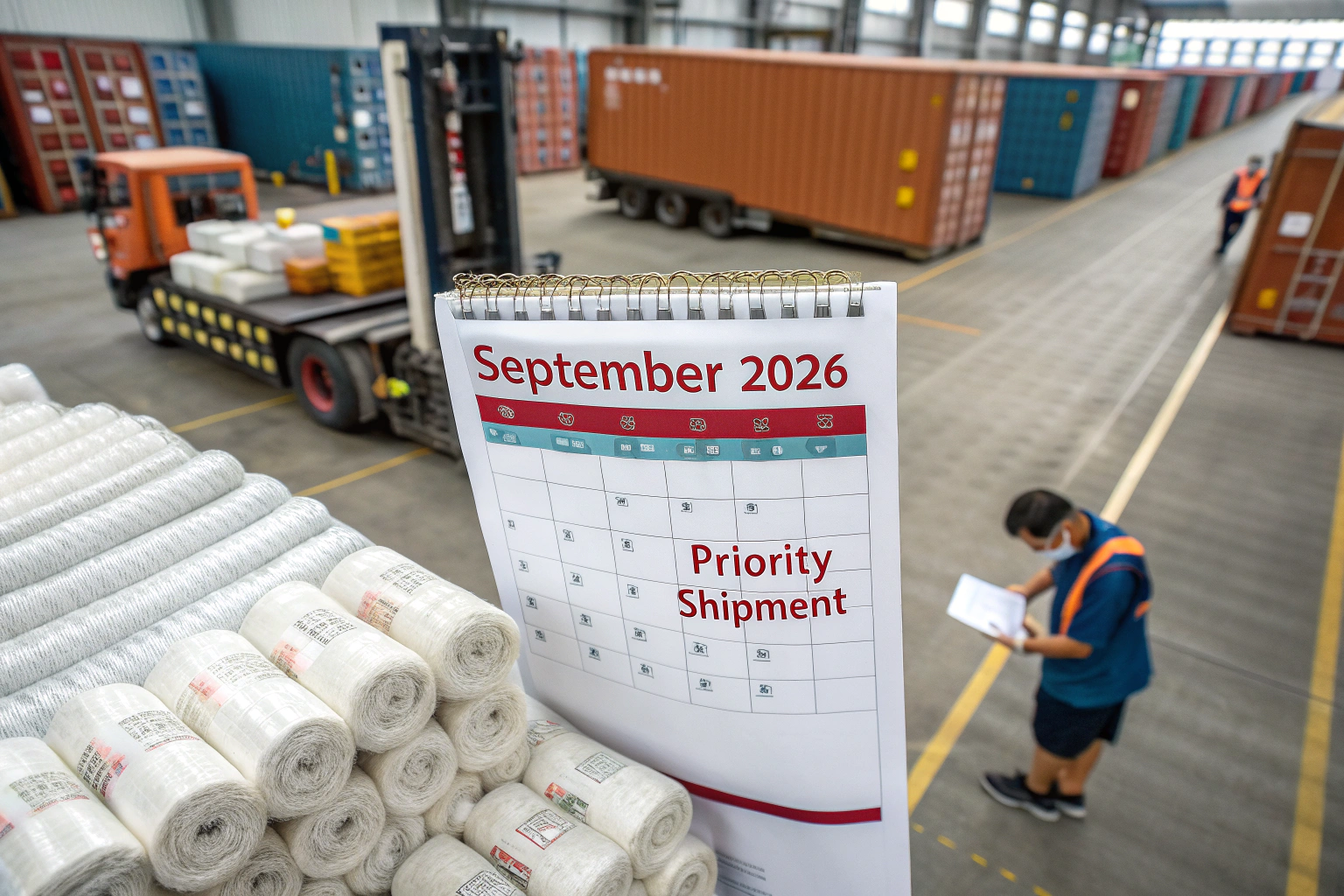
Here’s a scenario I watch unfold every single year, and it never gets easier to witness. A promising fashion brand from Los Angeles or Copenhagen has spent the entire summer perfecting their Spring/Summer collection. The samples are stunning. The buyers at the trade shows loved the cotton linen blazers and the matching wide-leg trousers. The brand owner, riding that high, finally emails me the bulk fabric order on September 28th. They’re cheerful. They’re excited. They need 1,500 meters of our signature Slub Cotton-Linen in "Dusty Cedar." And they need it shipped by mid-October to hit their production window.
I have to write back and explain that on October 1st, the entire Keqiao textile district essentially stops. It’s not a one-day bank holiday. It’s the Golden Week, the anniversary of the founding of the People’s Republic of China, and it triggers a massive, nationwide pause. Our dyeing cooperatives drain their vats for maintenance. Our finishing factory operators go home to their families. The trucking companies that haul containers to Ningbo port run on skeleton schedules. That September 28th order doesn’t just get delayed by a week; the dyeing won’t even start until October 8th or 9th, and the entire production queue that piled up during the shutdown is now ahead of you. Your "Dusty Cedar" cotton linen that could have shipped in late October now slips to late November. You miss your production slot. Your factory in Portugal is idle. Your launch is delayed by a season. The pain isn’t just the time; it’s the cascading logistical and financial chaos that one simple calendar oversight creates.
You can avoid all of this. The October shutdown is not a surprise attack; it’s the most predictable event on the Chinese textile calendar. Securing your cotton linen supply before the holiday is entirely about backward planning, decisive color approval, and leveraging pre-dyed stock. I’m going to walk you through the exact dates you need to circle on your calendar, the pre-holiday greige reservation strategy that protects your yardage, and the specific cotton linen blends you can still get even if you’re reading this in late August.
What Is the Final Order Deadline for Pre-Holiday Cotton Linen?
Let’s get surgical with the dates, because "sometime in September" is too vague to save your production line. The 2026 National Day holiday runs officially from October 1st to October 7th. But in the textile industry, the operational shutdown has a long tail on both ends. Workers begin mentally checking out and physically traveling as early as September 28th, and many factories don’t resume full, steady-state production until October 10th, as machines need to be recalibrated and dye baths reheated. This isn’t laziness; this is the reality of managing a workforce of thousands who travel hundreds of miles to see their families.
Working backwards from this operational blackout, the absolute final order deadline for custom-dyed cotton linen falls on September 10th, 2026. And that’s the "stressful, pay-a-rush-fee, pray-to-the-logistics-gods" deadline. The relaxed, "we’ve got this handled" deadline is September 1st, 2026. Here’s the day-by-day logic: you place the order on September 1st. We pull the greige cotton linen from the warehouse and load it into the dyeing queue. The dye cycle, including the precise color matching of your dusty rose or sage green, takes 5-7 working days. The finishing—tumbling for softness, Sanforizing for shrinkage control, stentering to width—takes another 5-7 days. Our QC team then needs 2-3 days to 100% inspect the fabric on our four-point system. By the time we’re packing the rolls and booking the container, it’s September 27th. The truck moves the container to Ningbo port on September 29th or 30th, just as the country is winding down. Any delay in the lab dip approval, any power outage at the dye works, any typhoon closing the port (September is peak typhoon season in Zhejiang), and you’re stuck on the wrong side of the holiday.
I recall a specific incident from 2024. A menswear brand from Stockholm approved their "Deep Olive" lab dip for a cotton-linen twill on September 12th. They felt good because they "beat the holiday." But the local dyeing factory had a two-day power rationing event, pushing their slot by 48 hours. Those two days meant the fabric finished processing on October 1st. The container couldn’t be loaded until October 9th. Their shipment arrived in Stockholm two weeks later than planned, and they missed their November campaign launch. The lesson: your September 1st deadline is your margin of safety against Murphy’s Law. Understanding the specific operational impact of Golden Week on Chinese textile supply chains is essential reading, and learning how to back-calculate your fabric order deadline based on your garment production window is a skill that will save you every season.

How Do Lab Dip Approvals Fit Into the Pre-Holiday Schedule?
The lab dip is the silent killer of pre-holiday timelines. You cannot place a bulk dye order until the lab dip is physically signed off. And a lab dip is not an instant process; it’s a chemical negotiation between your creative vision and the physical reality of how cotton-linen absorbs dye.
Cotton-linen is a bi-component fabric. The cellulose in the cotton portion absorbs reactive dye one way, and the bast fibers in the flax absorb it another. The result is a beautiful, heathered, slightly "vintage" color that’s unique to the blend. But if you want a very specific, solid Pantone match, we often need multiple rounds of adjustment. The first shot might be too "heathered" for your liking. We adjust the dye formula, perhaps adding a slight "reserving agent" that slows dye uptake on the flax to bring it closer to the cotton color. The second shot is better, but now the color is slightly too red under your boutique lighting. We tweak the blue component. The third shot is perfect.
Each "shot" takes 3-5 working days, plus courier transit time to your office. Three rounds of dips can easily consume three weeks. If you start this process in early August, you’re golden. If you start it on September 5th, you’re already behind. My hard advice to clients is to finalize their lab dips by August 20th, 2026 for a relaxed pre-holiday bulk order. If you are still iterating dips in September, I will strongly recommend you switch to a "stock color" from our seasonal palette to save the timeline. Delaying a dip decision by a week in September can push your bulk delivery by a month. Exploring the detailed process and timeline for custom fabric lab dips with Chinese textile mills demystifies the chemistry, and understanding the unique dyeing behavior of bast fiber blends like cotton-linen explains why your "simple beige" is so hard to nail.
Can We Still Negotiate Pricing Close to the Holiday Cutoff?
Let’s be blunt about the economics of desperation. A fabric order placed on September 10th is not a negotiation; it’s a capitulation. The dyeing factory knows you’re out of time. The freight forwarder knows you need a container slot in a shrinking window. You lose all leverage.
If you order in June, July, or early August for a pre-holiday delivery, we can apply our "Early Bird" summer discount, and I can negotiate with the dyeing cooperative for a lower batching fee because their vats are less congested. You might secure a 10-15% discount on the standard FOB price. If you order on September 15th, that discount evaporates. In fact, you might face a "holiday rush surcharge" of 10-20% because the factory has to pay overtime wages, expedite chemical deliveries, and bump other (earlier) customers.
Worse, the quality of the work suffers under rush conditions. A dye master working a 14-hour shift to clear a pre-holiday queue is more likely to make a slight temperature control error, resulting in a batch with a subtle "tail shade" variation. This isn’t greed on the factory’s part; it’s simply the cost of compressed time. The smartest financial move is to negotiate your cotton linen contract in the summer slump, lock in the price, and schedule the production for the late August/early September window. You get the low-season price with a pre-holiday delivery, and everyone wins. A buyer from a Canadian workwear brand does this religiously. Every June, he books his spring cotton-linen twill for a September 1st delivery. The price is locked, the slot is reserved, and we just execute. Looking at the seasonal pricing dynamics and how to negotiate fabric costs with suppliers in off-peak periods is a valuable primer, and analyzing the specific surcharges that Chinese mills apply during pre-holiday production rushes arms you with the knowledge to avoid them.
Which Cotton Linen Greige Fabrics Are Stocked Before October?
When the clock is ticking toward October, you don’t have the luxury of waiting for a custom yarn to be spun and a custom weave to be set up on the loom. Your salvation is our "Greige Bank"—a strategic reserve of the most popular cotton-linen base constructions, already woven, already inspected, and sitting on pallets in our Keqiao warehouse, ready to be pulled for dyeing and finishing.
This pre-woven inventory is the single biggest advantage of working with a large-scale, vertically integrated supplier like Shanghai Fumao. We don’t just weave to order; we forecast demand for our core cotton-linen blends and run them continuously on dedicated rapier looms during the quieter summer months, explicitly to build up a buffer for the September pre-holiday rush.
As of August 2026, the following greige constructions are actively stocked and available for immediate dyeing:
- SL-550 (55% Linen / 45% Cotton, 180 GSM): This is our workhorse medium-weight. It’s the fabric you choose for structured blazers, A-line midi skirts, and crisp wide-leg trousers. The 45% cotton content gives it stability and a slight drape, while the 55% linen keeps the authentic, dry, nubby texture. It’s available in a standard 58/59" width.
- SL-7030 (70% Linen / 30% Organic Cotton, 220 GSM): A heavier, more textured option for sculptural coats, heavyweight overshirts, and bags. The higher linen content gives it a very pronounced, rustic slub character. It’s also our GOTS-certified organic option, with the organic cotton component certified by Control Union.
- SL-4060 (40% Linen / 60% BCI Cotton, 140 GSM): This is our lightweight, soft-draping blend for shirting, blouses, and flowing dresses. The majority cotton content gives it a very soft, almost peach-like hand feel, while the 40% linen provides breathability and texture. It’s the most "civilized" of our cotton-linen fabrics, favored by brands who want a hint of linen texture without the aggressive stiffness.
- SL-STRETCH (53% Linen / 45% Cotton / 2% Spandex, 200 GSM): For fitted trousers, pencil skirts, and jackets that need movement. We use a corespun cotton-spandex weft yarn, so the spandex is hidden inside the cotton, preserving the natural fiber face.
A Sydney-based womenswear label contacted us in late August 2024, panicked because their original supplier had failed to deliver their cotton-linen greige. They needed 800 meters of a warm "Terracotta" for a trouser suit. We pulled SL-550 from the Greige Bank that same day. The lab dip was approved in one shot because they chose from our existing color library. The fabric was dyed, finished, and shipped by September 20th, beating the holiday shutdown. They salvaged their season. For a deeper understanding, exploring the standard fabric weight and composition variations for cotton-linen blended apparel helps you specify the right base, and learning how integrated textile mills build and manage greige fabric inventory for peak season demand shows you why this strategy works.

What Are the Limitations of Dyeing Pre-Woven Greige Quickly?
You gain speed with the Greige Bank, but you give up some flexibility. The weave structure is set. The yarn composition is set. The width is set. You cannot decide on September 1st that you actually want a herringbone instead of a plain weave, or that you need a 60-inch width instead of a 58-inch width. Those changes require a new warp chain to be set on the loom, which takes weeks.
The specific limitations you need to design around are:
- Width Constraints: Standard 58/59" width is cuttable for most apparel patterns. If you need a 63" width for oversized, flowing silhouettes, or a specific narrow width for scarf or home textile production, the Greige Bank standard stock might not work, and we need to discuss a custom weave, which likely pushes you past the holiday deadline.
- Slub Character: The slub profile (the frequency and thickness of the thick-and-thin "flame" yarns) is fixed for each stock SKU. SL-550 has a medium, organic slub. SL-7030 has a heavy, rustic slub. You can’t make the heavy slub fabric look "clean" and minimal through dyeing. The texture is locked.
- Dye Uptake Variation: A pre-woven greige fabric that’s been sitting on a shelf for three months will have slightly different moisture content and oxidation levels on its surface compared to a fabric woven yesterday. This is subtle, but it can cause a 2-3% difference in initial dye uptake on the very first meter of the roll. Our dye masters account for this by running a "pre-wash" cycle on stored greige to normalize the surface before dyeing, but it’s a step that adds a day to the process. It’s not a defect; it’s a material reality.
A brand from Berlin wanted to use our SL-550 base for a minimalist, clean blazer, but the medium slub was too "noisy" for their aesthetic. They tried to dye it a dark charcoal to suppress the texture visually, but the slubs still caught the light. The fabric was beautiful, but it wasn’t their brand’s visual language. They ultimately waited and did a custom weave with a fine, low-slub yarn, which shipped after the holiday. They were glad they waited for the right fabric rather than rushing with the wrong one. Understanding how fabric width affects garment pattern layout and material utilization saves you from cutting room waste, and reading about the influence of pre-weaving storage conditions on cotton greige fabric dyeing consistency prepares you for the subtle variables.
How Can I Reserve a Specific Greige Lot for My Project?
This is a proactive step I wish more buyers took. If you know in July that you’ll need 1,200 meters of SL-550 in "Ink Blue" for a September delivery, don’t just make a mental note. Reserve the greige lot. It’s a small financial commitment that guarantees your fabric doesn’t get sold out from under you.
Our Greige Reservation process is simple:
- Lot Inquiry: You tell us the exact SKU and meterage. We check our real-time warehouse inventory system and confirm that a sufficient, contiguous lot is available. A contiguous lot is important; it means all the yarn is from the same spinning batch, which guarantees the most uniform dye uptake.
- Reservation Agreement: We issue a simple, one-page reservation agreement. You pay a 10% deposit on the estimated bulk fabric cost. This is non-refundable if you cancel without cause, but it’s a fraction of the total cost.
- Physical Tagging: We physically pull the specific rolls from the shelf, wrap them in a protective black polyethylene film to prevent light yellowing and dust accumulation, and label them with your company name and the "Reserved for [Client Name] – Do Not Allocate" tag. We send you a photo of the tagged rolls in our warehouse. This is your visual confirmation.
- Color Approval Window: The reservation holds the greige until your agreed-upon "Lab Dip Approval Deadline." If you haven’t approved a lab dip by that date (say, September 5th), we have a conversation. We might release the reservation if another client urgently needs the stock, but we always contact you first.
A Los Angeles-based fashion brand reserves 2,000 meters of SL-4060 every July for their resort collection. They pay the 10% deposit, approve their "Sand Dollar" color by August 10th, and then take their time developing the trims and linings, knowing the main fabric is secured. They never panic in September. Looking at the standard terms and conditions for fabric greige reservation with Chinese textile suppliers provides a legal framework, and understanding how to manage supply chain risk by reserving raw material inventory before peak seasons is strategic thinking every brand needs.
What Are the Best Cotton Linen Options for Rush Pre-Holiday Orders?
Let’s say it’s September 1st. You haven’t reserved any greige. You haven’t approved a lab dip. Your production calendar just lit up with a "must-have" capsule for Spring ’26, and you need cotton linen fabric, dyed to a specific color, shipped in four weeks. Are you out of options? Not yet. But you can no longer afford the luxury of unlimited choice. You need to pivot to our "Express Path" program—a curated selection of cotton linen constructions that we’ve pre-qualified for rapid dyeing and finishing.
These aren’t "lesser" fabrics. They are specific constructions that we know, through years of production data, process quickly and predictably through our dyeing and finishing lines with minimal rework. The Express Path options for pre-holiday rush are:
- EP-01 (SL-550 in "Velocity Dye" Black, Navy, or White): Black and navy are high-demand, continuous-run colors. Our dye masters have the formulas perfected to a Delta E of <0.5. There’s zero iteration; the formula is loaded, the fabric is dyed, and the color is perfect the first time. White uses a fast, single-stage optical brightening, not a complex two-stage bleaching, so it processes quickly.
- EP-02 (SL-4060 in our Pre-Approved "Soft Neutrals" Palette): We’ve pre-dyed and cataloged a range of 6 soft neutrals—Oatmeal, Sand, Stone Grey, Mushroom, Ecru, and Blush. These colors have been wear-tested for lightfastness and wash fastness over multiple production runs. You can choose a color from the digital palette (we provide calibrated photos and CIELAB values) and bypass the entire lab dip phase. You’re essentially buying a custom stock color.
- EP-03 (SL-STRETCH in Garment-Dye-Friendly Greige): If you have garment-dyeing facilities, we can ship the greige SL-STRETCH fabric immediately. It’s prepped with a special wetting agent and heat-set so it’s ready for garment dyeing in your own facility without puckering. This cuts our dyeing time entirely.
A New York-based brand needed a "Caviar Black" cotton-linen for a last-minute blazer program in September 2023. We ran EP-01. They approved the black swatch from an existing roll we had in the showroom. No lab dip needed. We dyed 600 meters in 5 days, finished it in 3 days, and had it on a vessel by September 22nd. The entire process from first contact to FOB was 19 days. That’s not our standard, but it’s our Express Path capability when the situation demands it. For a broader view, reading about quick-turn fabric dyeing programs for fashion brands with tight deadlines reveals an industry trend, and understanding the color accuracy and repeatability of industrial continuous dyeing versus lab dip processes explains why black and navy are so reliable.

Can We Use Piece-Dyed Stock to Match Custom Pantone Requirements?
This is a common question born of hope and a tight timeline: "Can you just take a roll of your pre-dyed Oatmeal cotton linen and overdye it to my specific ‘Terracotta 17-1340 TCX’?" The short answer is no. The long answer is, "We can try, but the result will be unpredictable, and you won’t like it."
Overdyeing a piece-dyed fabric is like painting over a wall that’s already a different color. The base color acts as an undertone that you cannot fully eliminate. If we take a stock Oatmeal (a warm, yellow-beige) and overdye it with a Terracotta (a warm orange-brown), the resulting color will be a murky, brown-heavy brick color, not the clean, bright terracotta you envisioned. The chemistry of reactive dyes also becomes complicated; the first dye has already occupied many of the "dye sites" on the cellulose molecule. The second dye has fewer places to bond, leading to poor colorfastness and a higher risk of crocking.
The better Express Path approach for a custom color is a "speed lab dip" on our greige SL-4060 or SL-550. We skip the multi-round approval for deep shades that are dye-hungry. We run a single lab dip, and if the shade is commercially acceptable (Delta E <1.5 from your target), we proceed directly to bulk dyeing. The risk is that you don’t get the 0.8 Delta E perfection; you get a 1.2 Delta E commercial match. For many brands, especially on a textured fabric like cotton-linen where the slub creates natural color variation anyway, a 1.2 Delta E is visually imperceptible. For a brand with strict corporate identity color standards (like a luxury house with a signature "Blue"), it’s a dealbreaker. Honesty about this distinction is what builds long-term trust. Exploring the technical limitations of overdyeing existing fabric colors to achieve new shades is a practical dyer’s perspective, and understanding how Delta E color difference values translate to visual perception in textile quality control helps you set realistic approval thresholds.
Is There a "House Palette" That Bypasses Lab Dips Altogether?
Yes, and this is the single most effective time-saver we offer during the pre-holiday rush. For our core cotton-linen SKUs (SL-550, SL-4060, SL-7030), we maintain a "Fumao Seasonal Core Palette"—a library of 20 pre-formulated, pre-tested, and repeatedly produced colors that we can dye without any new lab dip development.
These aren’t just "generic" colors. We develop the palette annually based on global trend forecasts and direct feedback from our fashion brand clients. The 2026 Autumn/Winter Core Palette includes colors specifically chosen for cotton-linen’s natural heathering: "Smoked Olive," "Rustic Ochre," "Dusty Lilac," "Dark Chambray," "Burnt Sienna," and "Antique Ivory." Each color has a complete technical dossier: the exact reactive dye recipe (percentages of Red, Yellow, Blue components), the dyeing cycle parameters (temperature ramp rate, salt addition timing, fixation time), the finished fastness data (wash, light, crocking all at Grade 4 or higher), and the acceptable Delta E tolerance window.
If you choose a color from this palette, the order process short-circuits. You tell me "SL-550 in Smoked Olive." I pull the technical dossier, confirm the batch-to-batch Delta E consistency with the dye house, and we go straight to bulk dyeing. No samples shipped back and forth. No anxious week waiting for DHL. The lead time from order to finished fabric drops by 10-14 days. This is how we save brands from the holiday shutdown. A Danish home-textiles brand builds their entire cotton-linen cushion and throw collection around 4-5 colors from our Core Palette each season. They don’t even bother with custom lab dips anymore; the palette gives them the seasonal refresh they need and the reliability their production calendar demands. Learning how textile mills develop and maintain seasonal core color palettes for fast turnaround shows you how we think about color management, and seeing examples of how fashion brands use supplier core palettes to accelerate go-to-market timelines validates this as a real strategy, not a compromise.
How Does Quality Control Adapt Before the Holiday Shutdown?
There’s a dangerous myth that quality slips before a holiday shutdown because workers are rushing to get home. That myth exists because, in some factories, it’s true. A factory manager under pressure to clear a queue might reduce the inspection speed from 15 meters per minute to 25, or might loosen the AQL acceptance criteria from 2.5 to 4.0, hoping the client won’t notice. This is precisely why you need to know how your supplier adapts their QC protocols, not just their production schedule, during the pre-holiday rush.
At Shanghai Fumao, the pre-holiday period triggers an increase in QC rigor, not a relaxation. We call it our "Holiday Lockdown Protocol." We know that any defect that escapes our inspection in late September will be discovered by the client in November, long after the holiday is over, and resolving a quality claim across the October communication blackout is a nightmare for everyone. So we harden the system:
- Reduced Inspection Speed: Our fabric inspection machines normally run at 18 meters per minute. During the pre-holiday week, we drop the speed to 12 meters per minute. The inspectors have more time to see and flag defects.
- Double-Review for Color Continuity: We take a shade band (a swatch from the beginning, middle, and end of every roll) and perform a visual assessment under three light sources—D65 (daylight), TL84 (store light), and UV—to ensure no tail shading occurred during the rush dye cycle. If the shade band shows a visual difference exceeding a Grey Scale rating of 4-5, the roll is downgraded.
- Mandatory Pre-Shipment Lot Testing: We always do lot testing, but before the holiday, the sample size increases. For a 1,500-meter order, we normally wash-test one 2-meter sample. In the pre-holiday week, we wash-test three samples—one from the beginning, middle, and end of the production lot. We’re looking for any variation in residual shrinkage that might indicate an inconsistent Sanforizing process.
A German workwear brand that orders 3,000 meters of our cotton-linen canvas every September for a January production start specifically requests our "Holiday Lockdown" QC report. They want the extra data points. One year, the extra wash test caught a 2.8% warp shrinkage on one roll out of thirty. It was an outlier. We replaced the roll from our safety stock before shipping. If we had only tested one sample, that rogue roll would have made it into their cutting room, and a percentage of their trousers would have come out undersized. The extra vigilance paid for itself many times over. For peace of mind, understanding how AQL sampling standards apply to fabric inspection before international shipment gives you the inspector’s framework, and reading about the specific quality risks associated with pre-holiday manufacturing rushes in China validates the need for heightened vigilance.

How Do You Prevent "Rush Job" Defects in Cotton Linen Dyeing?
Cotton-linen is particularly vulnerable to rush-job dyeing defects because of its dual-fiber nature. The two most common pre-holiday dyeing failures are "tail shading" and "center-selvage shade variation," and they both stem from the same root cause: trying to push the fabric through the dyeing machinery too fast.
Tail shading occurs when a roll of fabric is dyed in a continuous process, and the dye concentration at the beginning of the roll is slightly different from the end. This happens when the dye bath isn’t properly replenished at a steady rate. A distracted operator rushing to finish a queue might let the dye concentration drift. The first 100 meters are perfect; the last 100 meters are a shade lighter. In cotton-linen, the linen portion is more susceptible to this because its dye uptake rate is faster than cotton’s, making the initial "strike" aggressive and the tail end starved of dye.
Our specific countermeasure is a "Standing Bath Replenishment Monitoring" system. We install a colorimetric sensor in the dye trough that continuously measures the dye concentration in real-time. If the absorbance reading drifts more than 2% from the target, an alarm sounds, and the operator must adjust the replenishment feed rate immediately. This is not a manual check; it’s an automated feedback loop. We run this system on all cotton-linen blends, but we double-calibrate the sensors in the last week of September to ensure they’re reading true.
Center-selvage variation—where the edges of the fabric dye darker than the center—is another rush risk, caused by uneven pad pressure on the dyeing mangle. In a hurry, an operator might not check the pressure gauge. We mandate a "Pressure Strip Test" before every new dye lot in September: a carbon paper test that shows the exact pressure distribution across the full width of the rollers. If the edges are lower pressure than the center, the maintenance team shims the rollers until the strip shows uniform pressure. No strip test, no bulk dyeing. Understanding the common dyeing defects in cotton and cotton-blend woven fabrics and their causes gives you a defect glossary, and learning how continuous dyeing range automation prevents shade variation in high-speed production shows the technology that protects your fabric.
What Documentation Proves the Cotton Linen Was QC’d Properly?
The final QC report is your insurance policy. If something goes wrong—a color mismatch, a shrinkage issue, a seam that slips—and you need to file a claim or simply understand what happened, the documentation is what separates a professional supplier from a fly-by-night trader. At Shanghai Fumao, every pre-holiday shipment of cotton linen includes a digital "QC Passport."
This passport is a single PDF document, but it’s comprehensive. It includes:
- The Production Lot Number: A unique identifier that traces the fabric back to the specific spinning batch, weaving date, dyeing vessel, and finishing line.
- The 4-Point Inspection Summary: A spreadsheet listing every inspected roll by number, its length, and its total defect penalty points. A summary line states the average points per 100 square meters and confirms it’s below the AQL 2.5 threshold.
- The Shade Band Continuity Report: A scanned image of the actual shade band swatches from the beginning, middle, and end of the lot, mounted on a card and assessed against the approved lab dip standard under D65 lighting.
- The Pre-Shipment Test Results: A one-page summary showing the AATCC 135 shrinkage results (warp and weft, with the pass/fail against our <2% standard), the AATCC 8 crocking fastness results (dry and wet), and the AATCC 16.3 lightfastness result. Each result is dated and signed by the QC lab technician.
- The Live QR Code Link: A QR code printed on the document that, when scanned, takes you to a secure online folder containing the full, unredacted raw data from the Uster yarn tester, the dyeing process parameters, and the fabric inspection machine logs. You can verify every number.
A sustainability manager from a London brand once told me that our QC Passport was the reason they passed their B Corp certification audit for supply chain transparency. The auditor was impressed that they could scan a QR code on a fabric invoice and watch a video of their actual cotton-linen being Sanforized. That level of documentation is what we provide as standard, and it’s what you should demand from any supplier, especially on a rushed pre-holiday order. For your own benchmarking, exploring the standard components of a textile pre-shipment inspection report for imported fabrics gives you the industry template, and understanding how QR code traceability systems are being implemented in premium textile supply chains shows you what’s possible and what’s now expected.
Conclusion
The October National Day shutdown is not a crisis; it’s a calendar event. And like any calendar event, it can be managed, planned for, and even leveraged to your advantage. The brands that sail smoothly through September and into their autumn production schedules are not the ones with the fastest couriers or the most aggressive lawyers. They are the ones who treat the deadline with the same seriousness as their launch date. They know that the real cutoff for a relaxed custom order is September 1st, not September 30th. They know that lab dips take three weeks, not three days, and they lock those colors in by mid-August. They reserve their greige lots in July, choosing from the SL-550 and SL-4060 stocks we’ve already woven and tagged. And when the timeline is truly compressed, they pivot intelligently to our Express Path colors—the pre-formulated Blacks, Navies, and Core Palette neutrals that bypass the lab dip phase entirely, shaving two weeks off the lead time.
We’ve also seen that a good supplier doesn’t just rush the work and pray. At Shanghai Fumao, our Holiday Lockdown QC protocol slows the inspection machines down, increases the sample size for wash testing, and deploys automated dye bath monitoring to prevent the "tail shading" that plagues hurried cotton-linen dyeing. You receive a QC Passport—a digital dossier of every test, every shade band, and every inspection point—that gives you the confidence to cut into that fabric the moment it hits your cutting room floor, knowing it’s right.
The window is open now, but it’s closing. If you have a Spring/Summer 2027 collection that depends on a specific, custom shade of cotton-linen—whether it’s a dusty rose, a weathered olive, or a crisp optic white—this is the moment to move. Don’t let the September calendar become your enemy. Contact our Business Director, Elaine, directly at elaine@fumaoclothing.com to reserve your greige lot, finalize your lab dips, or review the Core Palette for a faster path. Her team has the real-time warehouse inventory and the exact dyeing queue status. Secure your supply now, and let the October holiday be something you watch from a distance, not something that interrupts your business.








