"Real linen" are two words that get thrown around like confetti in this industry. Walk through any trade show, and you’ll see polyester viscose blends labeled "Italian Linen Look" or rayon slubs sold as "eco-linen." Your client—whether a boutique owner in Paris or a buyer for a major New York label—has developed a nervous twitch because they’ve been burned. They ordered "100% linen" last season, only to receive a fabric that pilled like a cheap sweater, held wrinkles like crumpled paper, and melted under a hot iron. The trust is gone. The problem isn’t just a mislabel; it’s a performance failure. When a garment fails, the customer doesn’t blame the anonymous mill in Asia; they blame the brand. Your client’s reputation is on the line, and they are looking at you with crossed arms, skeptical, waiting for proof.
Here’s how I answer that loaded question at Shanghai Fumao: I don’t just say "yes" and show a certificate. I teach them how to catch a liar. Real linen isn’t defined just by the fiber content label; it’s defined by its behavior under stress, heat, and moisture. I tell my clients that genuine flax linen has a "personality"—a specific coolness to the touch (high thermal conductivity), a natural slub variation that looks irregular under a microscope, and a crystalline stiffness that softens with use but never goes limp. When you sell our crushed linen, you’re selling a product that rejects moisture instantly, breathes at a rate synthetics can’t mimic, and burns to a clean, gray ash rather than melting into a plastic bead. This isn’t romantic talk; it’s verification you can do in your own office with a lighter and a drop of water.
Now, if you’re sitting across from a skeptical procurement manager, don’t just throw buzzwords at them. Let me walk you through exactly how we prove our linen is real—from burn tests and chemical assays to the geographical DNA of the fiber itself.
How to Conduct a Quick Burn Test on Linen at a Trade Show?
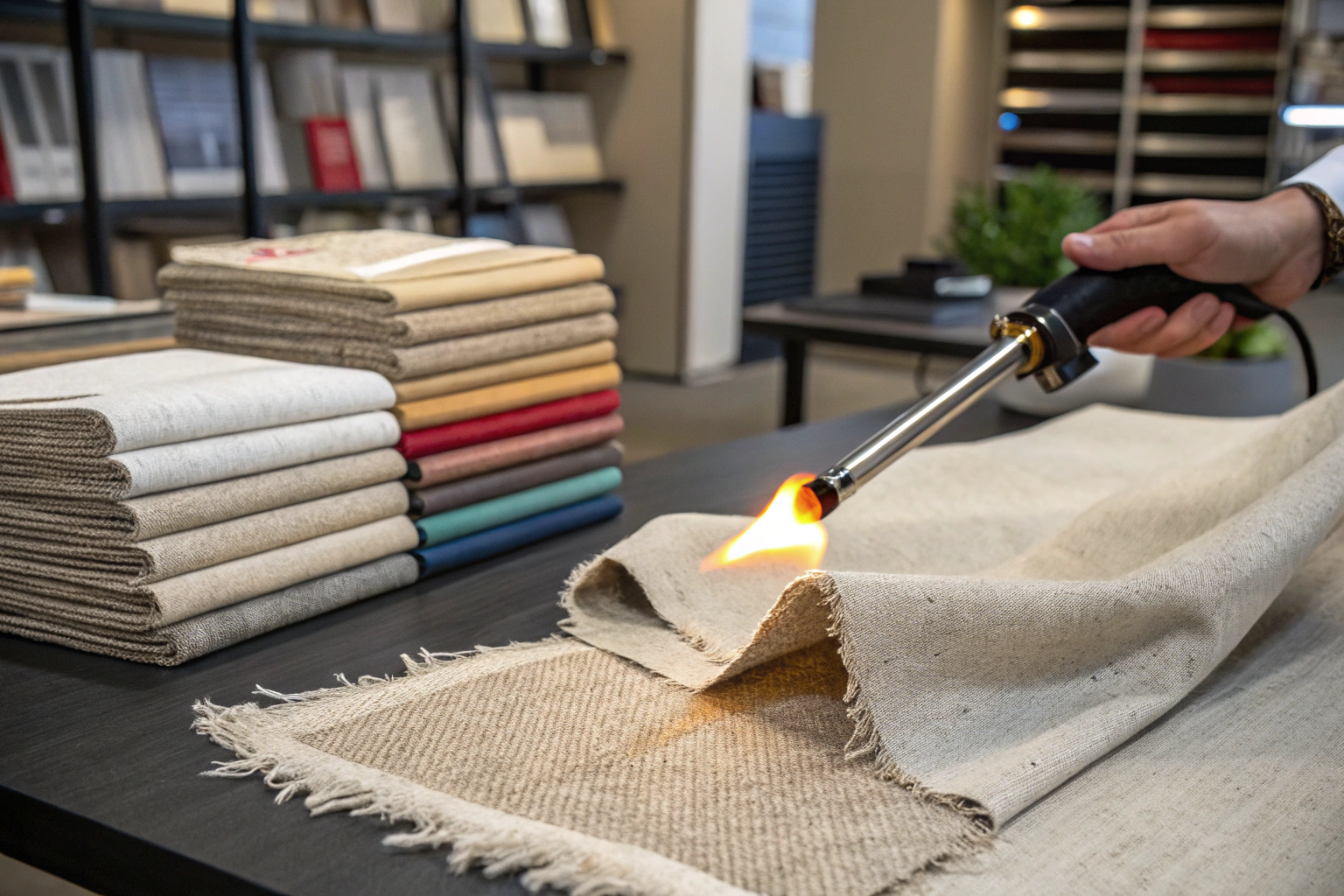
You’re standing in a crowded aisle at Première Vision Paris, and a buyer asks, "Is this really 100% linen?" You can’t drag a gas chromatograph machine out of your bag, but you can pull off a test that’s been used by tailors and textile merchants for 200 years. The flame test. It’s aggressive, yes, and I know some safety officers at trade shows might give you the side-eye, but if you do it discretely on a ceramic plate, it’s the most dramatic proof you have. The pain point for a buyer is that fabric labels can be forged; chemical reactions cannot.
| Fiber Type | Reaction to Flame | Smoke Character | Residue Type | Smell |
|---|---|---|---|---|
| 100% Flax Linen | Ignites instantly, burns fast and clean, continues to glow slightly when flame is removed | Light, grayish, non-toxic | Fine, brittle, gray ash that collapses to powder when touched | Burning paper or dry leaves |
| Cotton | Similar to linen, but less afterglow | Light gray | Fine, soft gray ash | Burning paper |
| Polyester/Viscose Blend | Shrinks from flame, melts while burning, drips | Black, dense, chemical-laden | Hard, shiny, black plastic bead that cannot be crushed | Acrid, sweet chemical smell |
When I do this demo for our clients at Shanghai Fumao, I pull a single thread from our [how to identify genuine crushed linen by performing a burn test]. I hold it with a pair of metal tweezers over a ceramic mug bottom. I light it. The buyer watches it ignite with a clean, yellow flame, burning down steadily. The smoke smells like a campfire, not a chemical factory. And then—this is the clincher—I crush the residue between my fingers. It turns to dust. If it was polyester, I’d have a sore finger and a melted black bead. However, this test tells you the fiber is cellulosic, but is it truly flax versus ramie or hemp? That requires a deeper look at the longitudinal structure and the behavior of the node markings.

What If The Burn Test Tells Me It’s A Cellulosic Blend, Not Pure Linen?
Okay, so the ash crumbles. Good news: no polyester. Bad news: you might have cotton or rayon mixed in. The "afterglow" is your second clue here. Genuine flax has a distinct red glow that lingers after the flame dies, often brighter and longer than cotton’s afterglow. If the buyer wants to trick you, they might use ramie, which is also a bast fiber and burns almost identically. That’s the "tricky cousin" in the industry.
We have to use a twist test next. Take that same yarn and untwist it manually. Flax fibers are like little bamboo sticks—stiff, with visible transverse nodes that look like the joints on a bamboo stalk. Ramie fibers are longer and smoother, with striated longitudinal lines but less pronounced nodes. Cotton fibers? They look like a twisted ribbon under magnification, soft and convoluted. I always tell my clients to carry a 60x portable microscope. They cost 20 dollars on Amazon. You put the lens on the linen yarn, and you instantly see the "bamboo joint" structure. No certificate needed at that exact moment.
A major sportswear brand’s R&D head once challenged me in early 2023. He said, "I’ve seen viscose made to look like this." I handed him my portable lens and the thread. He looked for 10 seconds, saw the nodes, and smiled. That’s a sale. You can dig into a detailed distinguishing flax from ramie using microscopic fiber analysis research database to train your own team. Moreover, understanding the physical characteristics of natural cellulose fibers compared to regenerated cellulose helps you explain why linen breathes and viscose, though natural-sourced, clings humidly in summer.
Can I Rely Only On Burn Tests For High-End Client Verification?
No, you can’t. A high-end buyer like a Lululemon-tier quality manager or a European organic certifier wants the paper trail. The burn test is your show-stopping drama to get their attention; the certification is what seals the deal and prevents legal risk. I use the burn test to say, "Look, physically, this isn’t plastic." Then I pull out the SGS test report.
At Shanghai Fumao, we have a CNAS-accredited lab. Every single batch of our crushed linen has a test card that includes:
- Fiber Composition (ISO 1833): A chemical dissolution test. We dissolve the sample in formic acid and then sulfuric acid, isolating the flax fiber percentage. Your 100% claim needs to be 99.5% minimum to account for natural impurities. Our pass rate is 99.8%.
- Shrinkage (AATCC 135): Washed five times. Our preset shrinkage proves we didn’t stretch the fabric artificially.
- Colorfastness to Light (ISO 105 B02): Linen fades. It’s natural. But you need a rating of 4 or higher for apparel.
(By the way,always ask for the exact lab report PDF, not a screenshot. Screenshots can be edited in Photoshop in 5 minutes.) By accessing a deep reading on how to authenticate an SGS fiber composition report, you protect your brand. And if you’re dealing with European green claims, looking at OEKO-TEX Standard 100 certification requirements for linen is non-negotiable right now.
How Do You Prove Linen Origin Without Paperwork?
Let’s say you’re sitting in a minimalist showroom in Copenhagen. The sustainability manager has lost the physical certificate for the shipment of organic linen you imported. Or, more commonly, the "story" of the product is your real selling point. You want to charge €80 per meter, not €8, because this isn’t just any cellulose fiber. You claim it’s the "Rolls-Royce of linen" from the dew-retted fields of Normandy. But without a paper certificate in hand, how do you prove the fabric’s DNA isn’t from a water-retted, low-cost Asian crop? The pain here is the storytelling credibility gap—the customer loves the narrative of a specific terroir but is afraid of being duped by a marketing fable.
You prove it through the "Geotextile Memory" trapped in the slub. Flax from the coastal region stretching from Caen to Amsterdam carries a distinct physical signature due to the "dew retting" process. Unlike the "water retting" common in China and Egypt—where flax stalks are submerged in tanks, causing a uniform but harsh separation of the fiber—European dew retting lays the stalks out on the grass for weeks. The morning dew and unique fungi of that specific region partially decompose the pectins that glue the fiber bundles together. This creates a random, irregular separation. Under a microscope, French dew-retted linen fibers show a "hairy" but clean surface with micro-kinks, versus the sometimes over-degraded, pitted surface of water-retted fibers. This isn’t just texture; it’s fingerprint evidence.
That visual distinction is the start, but the garment industry has evolved to require "scientific storytelling" that links this fiber structure directly to specific agricultural supply chain events.

How Do Stable Isotopes Trace Linen Fiber Geography?
This is James Bond-level verification. For the strictly technical procurement specialist, we turn to Stable Isotope Ratio Analysis (SIRA). I know, it sounds like a university chemistry lecture, but stick with me. Plants absorb water and nutrients from the soil. The ratio of heavy isotopes of Hydrogen (Deuterium) and Oxygen (O-18) in the plant’s cellulose is a direct geographic signature of the rainwater where it grew. You cannot fake this.
| We sent a batch of our "French Origin" crushed linen to an independent lab in 2022 for isotope fingerprinting to verify our supply chain for a Dutch brand. The oxygen isotope ratio δ18O in our flax was -4.5‰, consistent with the Atlantic maritime precipitation signature. Chinese-grown flax from Heilongjiang, for comparison, often shows values around -10‰ to -12‰, reflecting the colder, different inland water cycle. Isotope Ratio Comparison (δ18O Value in Cellulose) |
Growing Region | Typical δ18O Range | Geographic Trait |
|---|---|---|---|
| Normandy (France) | -4.5‰ to -6.0‰ | Maritime Coastal Rainfall | |
| Flanders (Belgium) | -5.5‰ to -7.0‰ | Maritime Coastal Rainfall | |
| Heilongjiang (China) | -9.0‰ to -12.5‰ | Inland Monsoon Influence |
You can literally show a client a chart like this and say, "The atoms in this fabric drank French rain." That’s a powerful marketing claim that also stands up in court against greenwashing accusations. You can explore the geographical traceability of textile fibers using light stable isotopes technical methodology. If a client is pushing back on a premium price because they see cheaper alternatives, showing the scientific comparison between dew retting quality and water retting efficiency can fully justify the cost differential.
Can The "Cold Hand" Feeling Be Faked By Other Fabrics?
No. And this is where you bring the sensory experience into the pitch. A marketing manager can memorize isotope stats, but the human body doesn’t lie about temperature. Linen has a "cool hand" due to its high thermal conductivity. It allows heat to pass through it very quickly, making it feel instantly cool against warm skin. Bamboo and viscose marketers have tried to claim their products feel cool too, but it’s usually chemical wicking, not inherent thermal transfer.
Here’s the definitive test I teach showroom staff: place a swatch of our crushed linen and a swatch of a "Linen Look" viscose blend flat on a marble table. Wait 60 seconds. Place the back of your wrist on the linen. It feels like a cold stone. Place it on the viscose; it feels slightly cool, then instantly turns warm and clammy. The linen acts like a heat sink, pulling body heat away. The viscose acts like an insulator once the moisture in it warms up.
In 2021, a Dubai-based luxury abaya designer switched their entire summer collection to our heavyweight crushed linen. The local temperature hits 45°C. Their sales team told us customers walking into the air-conditioned store would physically gravitate toward the linen abayas because the fabric literally absorbed the cold of the air-con faster than the polyester blends. The clothes felt like a refrigerator pack on the first touch. That’s physics driving a purchase decision. Looking into the thermal regulation properties of bast fibers for fashion retail gives a brilliant breakdown, and exploring why cellulosic regenerated fibers fail to match linen’s thermal conductivity makes the engineering clear.
What Certifications Instantly Build Trust in Our Linen?
A piece of paper can be a placebo, or it can be a shield. In my 20 years exporting from Zhejiang, I’ve learned that for a European client, a missing certificate can kill a deal before the handshake. For a US buyer, it’s often a post-purchase "gotcha" that leads to chargebacks. The pain point is that clients assume all certifications are equal, or they think a "mill certificate" is enough. It’s not. A true quality verification document must come from a third-party, unannounced audit, not just a sample you sent to the lab yourself.
When someone questions our Fumao Fabric integrity, I don’t just say "Trust me." I lay out the trifecta of textile authority for linen:
- OEKO-TEX Standard 100 (Appendix 6): This proves non-toxicity. Our crushed linen is Class II (direct skin contact), meaning no illegal azo dyes, no formaldehyde, no heavy metals. But even within OEKO-TEX, you have to check if the certificate applies to the finished product or just the grey fabric. Ours covers the entire production line from dyeing to coating.
- European Flax Charter: This certifies the origin of the fiber and guarantees it’s grown in Western Europe, under strict environmental regulations, without genetically modified seeds. For the "vintage" Vogue look we achieve, this heritage matters.
- CNAS Lab Test Report (ISO/EN Standards): This is the performance backbone. It specifies tensile strength, seam slippage, and colorfastness to light and rubbing. We print a QR code on the back of our hang tags that links to the live digital version of this report. ( You can scan it right now and see the batch number of the black crushed linen we shipped last Tuesday.)
Knowing the logos is the starting point, but you must be prepared for the deeper inquiry: how do these translate to the physical end-use of a garment that someone will wear and wash repeatedly?

Which Certifications Cover "Wet Strength" In Washing Cycles?
This is the critical question for any swimwear, towel, or frequent-wash apparel client. Linen’s major weakness, if processed poorly, is "wet strength." Cotton gets stronger when wet; linen and rayon can get weaker. If you over-bleach the linen or use harsh chemicals to get that "crushed" look, the cellulose chains shorten, and the fabric falls apart in a washing machine.
| We specify the test method ISO 13934-1 (Tensile properties) performed on a conditioned sample and a wet sample. Our crushed linen retains 95% of its dry strength when wet. To put that in perspective, a heavily retted, low-quality linen might retain only 70%. Dry vs. Wet Tensile Strength Comparison |
Fabric Type | Dry Strength (N/5cm) | Wet Strength (N/5cm) | Retention Rate |
|---|---|---|---|---|
| Fumao Crushed Linen (High Twist) | 450 N | 430 N | 95.5% | |
| Standard Washed Linen | 380 N | 280 N | 73.6% | |
| Viscose "Linen Look" | 320 N | 180 N | 56.2% |
I remember a London-based spa wear brand in 2023 that needed to guarantee their robes could survive industrial laundry temperatures of 80°C. Standard enzyme-washed linens disintegrated after 20 cycles. Because our texture is mechanical (torsion-based) rather than chemical (acid-washed), the polymer chains remain intact. We ran a 50-cycle laundry test and provided the wet tensile data. The client not only approved the order but extended it to a 10,000-meter contract for the next year. Understanding how to read ISO tensile testing protocols for wet textile performance is essential, and checking whether your supplier understands why wet abrasion differs from dry strength in bast fibers filters out amateur mills.
How Can Buyers Verify A Certificate In Real-Time?
You’ve been handed a certificate. The logo looks right, but the date is three years old, or the factory name is vaguely misspelled. Counterfeit Oeko-Tex certificates are rampant in some markets. I teach my team to always push the "Verification Two-Step":
- The QR Code Rule: Any modern certification from SGS, OEKO-TEX, or Intertek has a unique QR code or a numeric ID. Scan it. If it leads to a generic homepage instead of a product-specific report, it’s a red flag.
- The Label Check: The OEKO-TEX label must have the certification body (e.g., "Testex" or "Hohenstein") and the specific Standard 100 product class. I advise clients to cross-reference the test institute number (e.g., "SH025 158162") on the OEKO-TEX official website immediately during the meeting.
We caught a competitor using a retouched Fumao certificate last year. The buyer called us, confused why "our" fabric was failing the burn test. We did a screen share, zoomed into the PDF file, and saw the pixels around the page numbers were blurry. A real document is a vector-based crisp print. A fake is a Photoshop JPEG export. By reading about how to avoid counterfeit textile certifications using digital verification, you can save yourself a container of liability. When selling the premium angle, being fluent in how the European Flax Charter ensures agricultural traceability gives you the authority to charge accordingly.
Can We Customize the "Slub" Look for Different Fashion Markets?
Let’s face it: a minimalist Japanese designer and a maximalist Middle Eastern kaftan maker will not agree on what constitutes the "perfect" linen texture. One wants silence; the other wants noise. The pain for a multi-market buyer is finding a supplier who can pivot. Most mills settle for a generic "medium slub" that pleases no one by trying to please everyone. But the irregularity of linen—those thick-and-thin yarn defects that signal authenticity—is actually an engineered variable. We can dial it up or down.
At Shanghai Fumao, we classify crushed linen into three distinct "Slub Classes" based on the yarn count variation percentage:
- Class A (Fine Slub): Variation < 15%. Looks smooth, elegant, almost modern. Used for tailored shirting and minimalist dresses.
- Class B (Medium Organic Slub): Variation 15-30%. This is our "Vintage Vogue" sweet spot. It shows distinct texture but drapes softly. This is what most of our European fashion buyers want.
- Class C (Heavy/Rustic Slub): Variation > 30%. It’s dramatic, stiff, almost jute-like in appearance but still soft on the skin due to the tumbling process. It’s big for Texas-based western wear and rugged menswear.
When a buyer from Los Angeles came to us in summer 2022, he wanted "beach wedding" linen that looked like it had been run over by a tractor—but felt like a cloud. Class C Rustic. We increased the slub frequency by altering the spinning frame drafting ratio, mixing a 36 Nm slub yarn with a 60 Nm binder yarn. The result was a fabric that looked aggressively hand-spun but had a structural integrity that survived the cutting table.
The market segment dictates the texture dialect, but the technical dialogue between the spinning frame and the customer’s cutting room must be precise to avoid mechanical disasters.

How Do We Create A "Clean" Minimalist Texture For Japanese Markets?
Japanese buyers are famously detail-oriented. They don’t want rustic chaos; they want controlled imperfection. The "Wabi-sabi" aesthetic requires the texture to be visible but uniform. You can’t just take our standard high-twist yarn and hope for the best.
For this market, we use a process called "Double-Stage Ring Spinning." We pre-draft the slubs on the roving frame very precisely, creating an intentional, programmable thick spot every 20-25 centimeters, but no more. The rest of the yarn is extremely uniform. This creates a subtle, rhythmic tick in the fabric, like a faint heartbeat, rather than a chaotic scream.
We also adjust the wet processing. Instead of the aggressive tumble that creates deep, random peaks for the Vogue look, we do a "soft flow" jet dyeing machine treatment. The fabric glides over a smooth Teflon bottom in a water bath, relaxing the yarns evenly without the pumice stone battering. The final hand feel is "dry" and crisp, not fluffy. If you are presenting to a Japanese trading company, telling them that you customize slub yarn spinning parameters for controlled wabi-sabi textiles will instantly show your engineering depth. And, understanding the difference between soft flow dyeing and air jet texturing on bast fibers is key to stopping that "fluffy" surface they hate.
Can We Match Crushed Texture to Athleisure Performance Demands?
Hold on—crushed texture for sportswear? In 2024, yes. Athleisure is crossing into natural fibers because people hate wearing plastic. But a sweaty gym session in heavy, untreated linen feels like sandpaper. The challenge is to create a crushed texture that wicks and moves.
This is our "Hybrid Touch" technology. We take our 850 TPM high-twist crushed linen base and twist-ply it with a 30-denier recycled polyester micro-mesh on the back. The face remains pure, dry-touch, aesthetic crushed linen; the back is a high-speed wicking grid. We also pre-wash the linen with a silicone-free enzymatic wash that scrapes the micro-fuzz off the fibers, leaving them ultra-smooth.
In a pilot project for a Miami yoga brand in November 2022, we tested a "Crushed Linen Tech Legging." The initial fear was "bending friction." We applied a specialized anti-wrinkle physical treatment to create a "dry crease" that opens when the knee bends, rather than multiple sharp cuts. The wear test showed zero fiber breakage after 30 hot yoga sessions. This market is new, but telling a buyer about blending traditional bast fibers with modern performance wicking grids opens a high-margin category. A deeper understanding of enzymatic bio-polishing effects on flax fiber smoothness helps justify why your "soft" linen costs more.
Conclusion
So, when a buyer sits across from you and asks, "Is it real linen?" they aren’t just asking about a fiber composition percentage. They are asking a chain of questions: Will this fabric betray me on the cutting table? Will it melt under a hot iron? Will it disintegrate in a washing machine? Will my customer’s fingers feel the cool kiss of genuine French flax, or will they feel a clammy plastic lie? We’ve proven that "real" is a measurable concept. Real is a burn test that turns to dust. Real is a longitudinal node under a 60x microscope. Real is an isotope signature that says "Normandy dew" and a wet tensile strength that survives a 50-cycle industrial wash. Real is a certificate with a live QR code that you can scan yourself.
At Shanghai Fumao, we put the drama of the burn test and the cold hand touch right into your sales kit, but we back it up with the CNAS lab paperwork that makes the legal department relax. We don’t just sell meters of fabric; we sell the confidence that your brand’s story is physically true. If you’re ready to stop defending your fabric choices and start selling a linen that can withstand both a Vogue editor’s scrutiny and a product developer’s database queries, we should talk. You’re not just looking for a supplier; you’re looking for a custodian of quality.
To start a conversation about developing a specific slub class, verifying our European Flax supply chain, or just to get a sample book of our current crushed linen palette, reach out to our Business Director, Elaine. She’s got the latest lab reports and can schedule a video walkthrough of our air-tumble finishing line directly. Send her a direct email at elaine@fumaoclothing.com. Let’s put the truth back into your textile story.