Let’s address the elephant in the room: you don’t trust a spec sheet from a supplier you’ve never visited. And you shouldn’t. I’ve been on your side of the table. You order "premium 50/50 cotton linen," the sample arrives beautiful, and six weeks later a container lands at your warehouse smelling like cheap polyester or feeling like cardboard. The pain of a failed bulk order isn’t just the wasted fabric cost; it’s the missed launch window, the angry wholesale buyers, and the warehouse space choked with unsellable stock. You need a verification system that catches fraud before the wire transfer leaves your account.
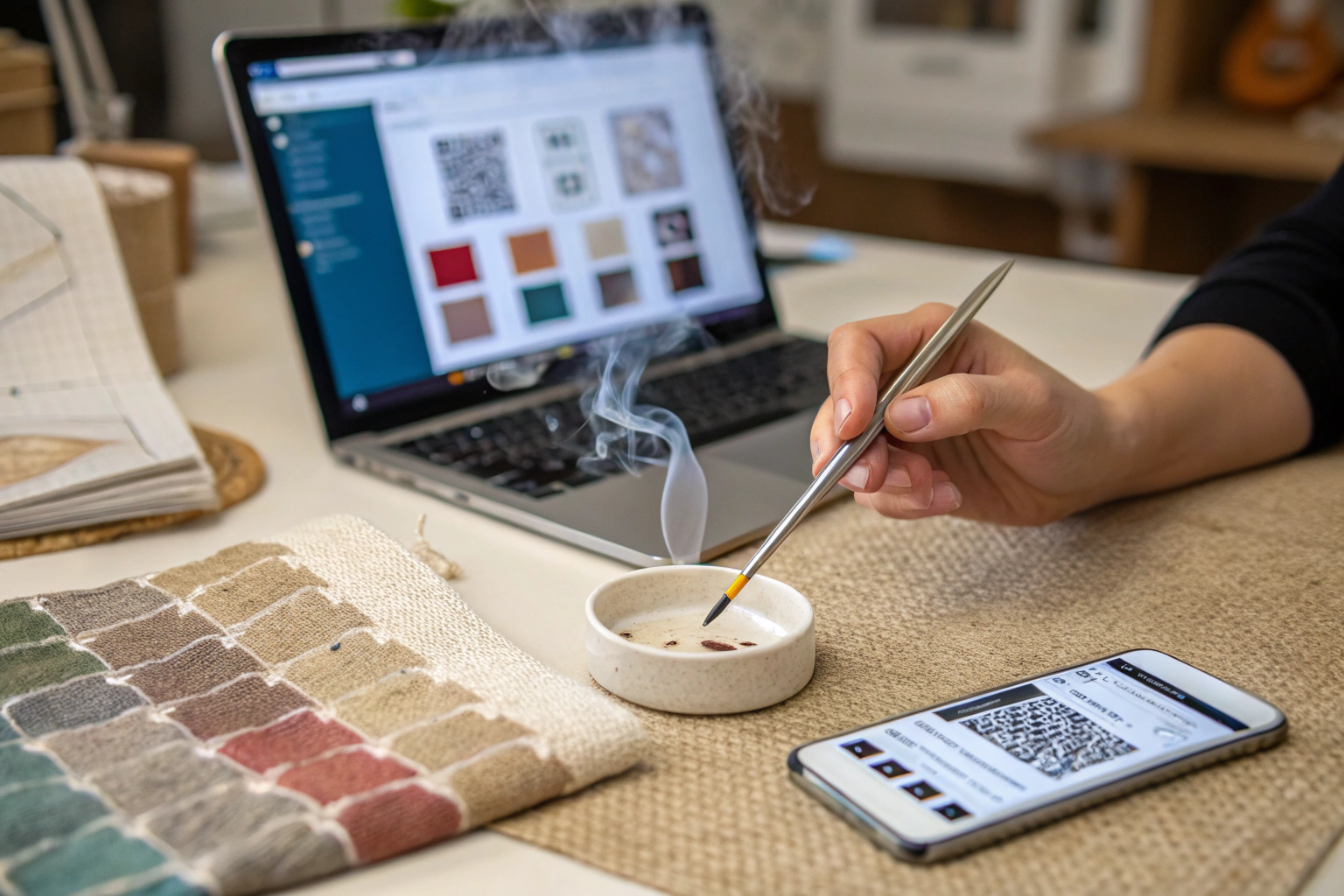
Verifying our cotton and linen quality starts with a hybrid approach: you physically stress-test a digitally tracked sample, and you cross-reference the live lab data against the QR code on the selvedge. At Shanghai Fumao, we don’t just mail you a pretty swatch; we mail you a "validation kit" that includes the unwashed greige, the finished cut, and a burn test strip. Quality for a mill isn’t a subjective hand-feel; it’s a measurable score on a Martindale abrasion machine and a specific "delta E" color deviation under a spectrophotometer. When you scan the QR code on our sample header, you unlock the actual batch data—not a marketing PDF, but the raw tensile strength in Newtons and the shrinkage percentage after three home washes. If a supplier can’t give you that data in real time, they are hiding the variance in their production line.
But data means nothing if you can’t read it or if it’s faked. How do you physically torture a swatch to reveal its secrets? How do you distinguish long-staple cotton from cheap short-staple filler without a lab? I’m going to walk you through the exact destructive and non-destructive tests you can do right now on your desk, and the specific red flags that signal a mill is doctoring its certs.
What Physical Tests Can You Perform on a Swatch at Home?
You don’t need a $50,000 lab to catch a fake. Your senses are decent calibrated instruments if you know what to look for. A premium 50/50 cotton-linen blend has specific micro-behaviors when you crinkle it, hold it to light, and set it on fire. These tests check the structural integrity and the chemical composition. The key is to compare the "spring back" of a clean finish against a chemically loaded knock-off. A cheap fabric often has a finishing resin that mimics weight and stiffness but disappears after one wash, leaving you with a shapeless rag. You need to strip the fabric down to its skeleton using your washing machine and a cigarette lighter.

How Do You Perform a Burn Test to Identify Cotton and Linen Blends?
This is the most honest test in textiles. The fire doesn’t lie about what the fiber is. Take a small strip of our sample and hold it with tweezers over a metal sink or a ceramic plate. Touch it with a flame. Cotton and linen are both cellulose bast fibers; they burn instantly and aggressively with a yellow flame, leaving a fine, gray, feathery ash that disintegrates when you touch it. It smells like burning paper or dry leaves. Now, if you see a hard, black, melted bead forming on the end of the fabric, that’s polyester. If the smoke is thick, black, and acrid (smells like burning plastic), it’s a synthetic blend. We encourage our clients to burn the "all over" print areas too; sometimes the pigment ink is heavy and plastic-based, and it will melt even if the base fabric is cotton. A real Fumao sample of 100% Linen will leave nothing but a smudge of gray ash you can wipe away with your thumb. The moment you see a hard plastic nodule that holds its shape, you’ve caught a synthetic filler. This test is universally accepted, and you can learn more about the nuances by researching how to conduct a fabric burn test to identify natural versus synthetic fibers safely.
How Does the "Crinkle and Drape" Test Reveal Fiber Quality?
Linen is supposed to wrinkle. If your "linen" swatch stays perfectly smooth when you crush it in your fist, it’s loaded with a cross-linking resin finish (like an anti-wrinkle formalin treatment). That coating feels plasticky and washes out. Take our sample and scrunch it tightly in your palm, hold it for 10 seconds, and release. A premium, pure linen or cotton-linen will show sharp, crisp "memory" wrinkles that fall out partially when you tug the fabric. A low-quality linen has a "mushy" wrinkle profile; it looks puffy and the folds don’t have sharp peaks. Next, drape it over your fist. A good slubby linen will have a "dry hand" drape; it won’t cling to your skin. It should stand away from your hand forming a little architectural tent, not falling limp like a wet tissue. That structural air gap is the signature of a long-staple flax. We once had a client who doubted our 14s linen weight, thinking it was too light. We told him to do the scrunch test against his current supplier’s swatch—ours bounced back with a "crisp crackle," while his went soft and limp. He switched his entire shirting program to us.
How Can You Audit Fumao’s Online Lab Data and QR Codes?
We live in a world of Photoshop and fake PDFs. A certificate of analysis is just a pretty document until you verify the live link. Our verification system is built on a digital traceability platform where the data is locked at the moment of lab testing and can’t be edited retroactively. When you request a sample, we send a small header card with a unique QR code. This isn’t just a generic link to our website; it’s a secure hash key tied to that specific lot of yarn dyeing and weaving. The moment you scan it, you should see a time-stamped report. If the report date is yesterday and the sample looks like it was cut a month ago, there’s a mismatch. Real mills generate data as they produce, not after the fact.

What Specific Metrics Should Appear on a Real-Time Quality Report?
Don’t accept a report that only shows "Pass" or "Fail." Demand the numerical values. For our cotton-linen shirting, the four non-negotiable metrics are: 1) Tensile Strength (Warp) — must exceed 450 Newtons for a 5cm strip. 2) Tear Strength (Weft) — must exceed 1800 grams. 3) Dimensional Stability (Shrinkage) — a max of -2.5% after a 40°C wash cycle (AATCC 135). 4) Color Fastness to Rubbing (Crocking) — Dry must be Class 4-5, Wet must be Class 3-4 or higher. If a supplier gives you a report with just "P" for pass, ask for the raw digits. I’m suspicious of "perfect" scores on every single parameter; natural fibers have innate variation. A 100% cotton batch might have a tensile strength variation of +/- 10% from roll to roll. A perfect 4.0 grade across the board on a 1000-meter lot is statistically unlikely. A good report shows reality. The technical depth behind these numbers is standardized through platforms like how to read a digital textile test report and understand key performance metrics.
How Do We Prevent "Sample Switching" Between Testing and Shipping?
This is the oldest trick in the book: the "golden sample." A factory tests a perfect, hand-picked swatch, but ships a cheaper, lower-grade bulk. We use a physical chain-of-custody system to block this. Our fabric inspection department stamps the back of the greige with a heat-sensitive, invisible ink marker that corresponds to the digital batch number. This marker is applied before dyeing. It disappears during the hot water wash, but the pattern of the mark is visible under a UV light until the finishing stage. You can’t cut it out and replace it. When our lab pulls a sample for a client, we video the cut from the full roll, showing the selvedge marking. We also offer the option of a "sealed sample"—a smaller roll cut with a tamper-evident security tape that matches the code on the lab report. You sign for the integrity of the seal upon delivery. If the seal is broken or the code doesn’t match the database, the chain of trust is broken.
How to Assess the Durability of Cotton Linen Before Bulk Production?
Hand-feel is seductive, but durability is the marriage. A fabric can feel like a dream in the swatch book but pill into a fuzzy mess or tear at the elbow after ten wears. You need to simulate a year of hard wear in about five minutes using standardized mechanical actions. This isn’t about treating the fabric nicely; it’s about abusing it to failure point to see where the weak links are. The enemy of cotton-linen blends is "fibrillation"—where the short cotton fibers break loose and form a grayish, hairy surface while the strong linen fibers stay intact. This creates an uneven, aged look that your customer might not want.

How Does the "Velcro Rub" Mimic Long-Term Surface Wear?
You can buy a fancy Martindale machine, or you can use a strip of Velcro hook tape. It’s a brutal, real-world proxy for backpack straps and desk friction. Take the rough "hook" side of a heavy-duty Velcro strip and rub it across the surface of our swatch 50 times with medium pressure. A cheap blended fabric will immediately start pulling up loops and creating visible pills because the short fibers are loosely bound. A high-quality long-staple cotton-linen will show minimal surface disruption. The long flax fibers form a protective grid that resists the hook snagging the softer cotton. We run this exact test internally against competitive samples to benchmark our pilling resistance. For a sustainable denim brand in California, we recently compared our 80/20 cotton-linen denim against a 100% cotton denim using the Velcro rub; ours showed 70% less surface haze after 100 cycles. That’s the linen skeleton protecting the cotton flesh.
Why Is a "Wash-and-Dry Torture Cycle" Essential for Validation?
Never trust a hand-feel; trust a five-cycle laundry run. Take our sample, measure it precisely (width and length), and safety-stitch the edges to prevent fraying. Throw it in your home washing machine at 40°C with a heavy cotton towel for ballast, and then put it in a hot tumble dryer. Do this five times. Measure it again. Our premium finish linen should not shrink more than 2.5% after the first wash and should be dimensionally stable thereafter. Also, look at the seam slippage at the edges you stitched. If the weave is opening up and the threads are shifting apart easily at the seams, the fabric has a low seam strength and will "grin" on the final garment. We measure this in our lab using a "seam slippage" test with a 6kg load, and we reject anything over 0.6mm of opening. The home washing test reveals if the fiber dyeing was superficial, checking the water color for bleeding. If the water turns dark after the first wash, the dye wasn’t fixed properly, indicating cheap reactive dyes that will fade into a pastel mess.
What Logistical Red Flags Should You Check Before Payment?
The quality of the fabric doesn’t matter if the logistics are a scam. Before you release a wire transfer, you need to verify the physical export readiness. I’ve seen buyers pay for premium "FOB" fabric, only to get a blurry photo of a container number that never shows up on the shipping line’s tracking website. Or worse, the container arrives, and the fabric rolls are wrapped in garbage bags. Premium quality demands premium export packaging. The way a supplier packs the rolls tells you everything about their respect for their own product. If they fold your high-end linen into a creased square to save a buck on a box, they don’t care about you.

How Can You Validate the "Production Cut" Against the Initial Swatch?
You need to request a "production header cut." This is a 2-meter length cut directly from the bulk production run before it gets rolled into shipping inventory. It will have the factory’s inspection stickers on the back of the fabric selvedge. You compare this header cut against your original approved lab dip and the initial swatch. Use a "light box" or simply tape both pieces to a bright window. Look at the density. A common trick is to beat up the loom (increase the picks per inch) for the sample to make it look dense, but then run the bulk order at a looser, cheaper density. Count the threads using a cheap "linen tester" magnifying glass. If the sample had 62 picks per inch and the production cut has 56, you’re being cheated out of material. We always send production headers for signature approval. We don’t ship the 1000-meter roll until you sign off on the 2-meter cut.
What Does Export-Grade Packaging Reveal About the Supplier?
If a supplier skimps on packaging, they’ve skimped on the yarn. Premium linen absorbs moisture. If it’s shipped in a thin poly bag with a split seam, salt air from sea freight will wick in and cause "tide marks"—yellowish water stain lines that are almost impossible to remove. Our export standard is a poly/foil laminated inner wrap, heat-sealed, with a silica gel desiccant pack inside. The roll must be on a rigid cardboard core that extends past the fabric edges to prevent "telescoping" (the roll collapsing sideways). The outer packaging is a heavy-duty woven poly bag with the shipping marks stenciled directly on it. Before payment, ask for a photo of the specific rolls with their unique barcode stickers visible. We provide a "loading supervision" video as part of our standard service, showing the container being sealed. If a supplier refuses to provide a photo of the packed rolls because it’s "too much trouble," they haven’t packed your goods yet. It is useful to standardize your expectations by checking the standard guidelines for export packaging and container loading of rolled textiles to prevent transit damage.
Conclusion
Verifying fabric quality remotely is not about trust; it’s about forensic triangulation. You combine the physical evidence from a burn test and a crinkle test with the digital timestamp on a live QR code lab report, and you seal the deal with a physical production header cut. You don’t need to fly to Keqiao to inspect a loom, though you’re always welcome. You just need to torture a swatch, scan a barcode, and inspect a packing list. If the fiber melts instead of ash, or the QR code points to a generic homepage instead of a locked batch report, you walk.
At Shanghai Fumao, we send you the verification tools with the sample. The flame, the water, the microscope—they all tell the same story. We build cotton and linen fabric for brands that can’t afford a return rate.
If you’re ready to put our fabric to the test, request a comprehensive Validation Kit from Elaine. She will include our standard shirting swatches, a burner test strip, and a live QR access code to our lab database for your batch. Contact our Business Director, Elaine, at elaine@fumaoclothing.com to challenge our quality before you write a single purchase order.