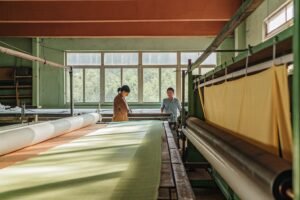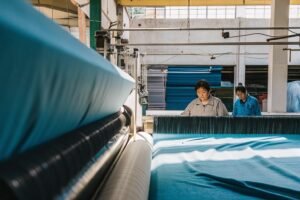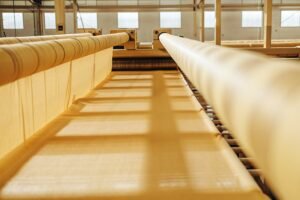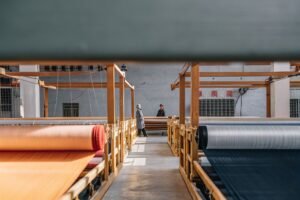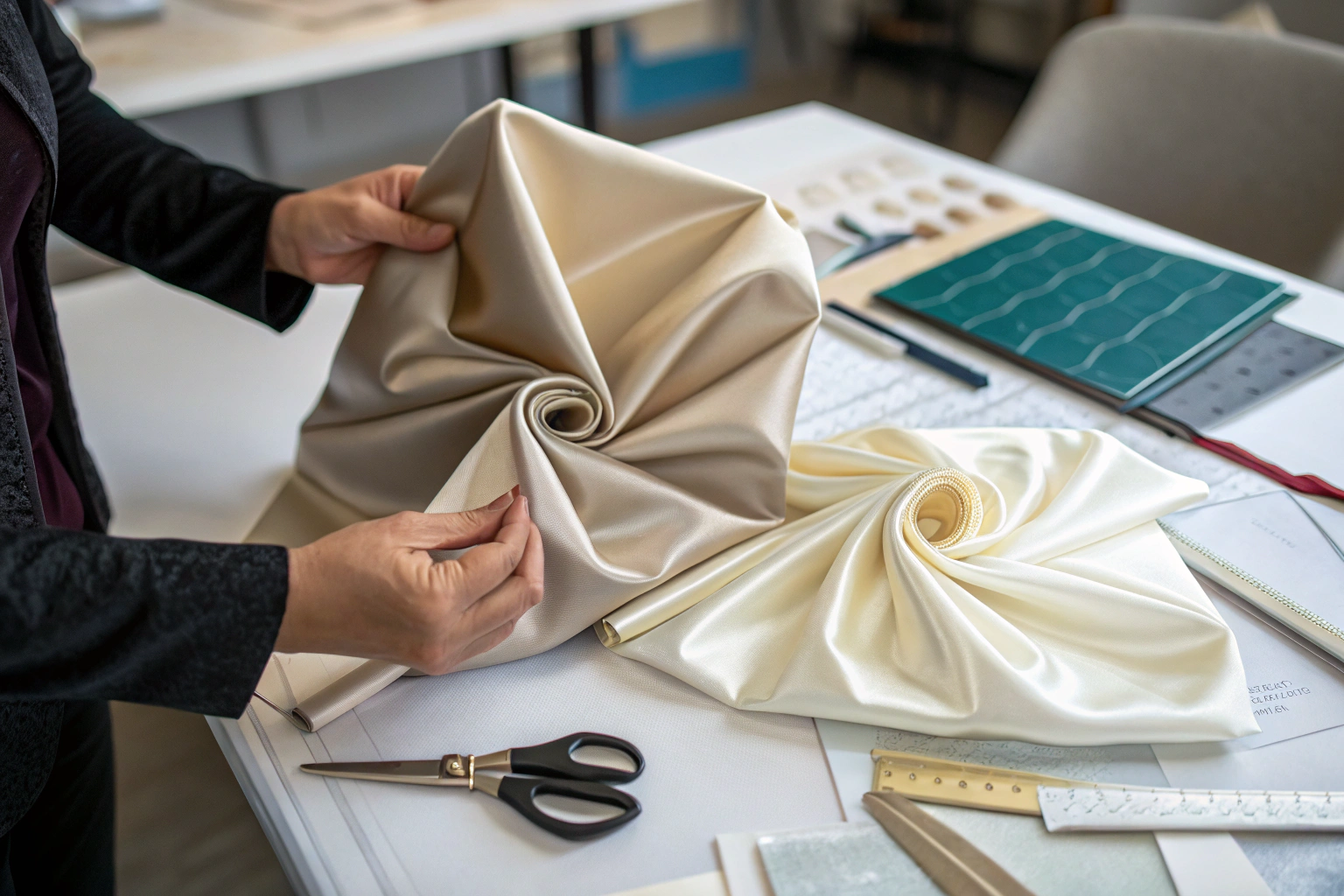
Here is a hard truth I’ve learned after 20 years in the textile game: most designers confuse stiffness with structure. Stiffness is the enemy of luxury. It’s the cheap poly-blend jacket that creaks when you move, the dress that stands up on its own but snaps like cardboard when you sit. You spec a fabric, pray for a sharp lapel, and instead you get a suit that wears the wearer. The frustration isn’t just aesthetic; it’s physical. Your customer tries it on, feels restricted, and hangs it back on the rack. That garment is dead inventory. You need the silhouette of a Roman statue with the comfort of a tracksuit, a paradox that separates the amateurs from the engineers in fabric development.
The "best" fabric for a structured yet flexible silhouette isn’t a single cloth; it’s a composite system where high-twist yarn provides the memory and a specific weave density creates the architecture. We call this the "spine and skin" theory. The spine is the yarn’s inherent resilience—its desire to snap back to a straight line. The skin is the interlacing pattern that distributes tension across a curved plane, like a suspension bridge. For summer 2026, the winning combination we are shipping to European tailoring houses is a Super 110s wool/silk/mohair blend at 240 grams per square meter (GSM) woven in a 2×1 twill with a slightly over-twisted weft. It’s light as a breath but it holds a rolled lapel like a steel spring. Let me show you why the math of the molecule matters more than the hand-feel swatch.
Now, you might be thinking, "Can I just use a heavy interlining to cheat the shape?" You can, but you’re adding cost and killing breathability. The real magic happens inside the yarn twist and the loom’s take-up motion. We don’t sell fabric; we sell the physics of drape. Stay with me, because I’m going to take you down to the microscopic level of the fiber cortex, then zoom right out to the cutting table. This is how we solve the stiffness paradox at Shanghai Fumao every single day.
What Fabric Properties Create Structure Without Adding Weight?
Weight is the lazy tailor’s tool. Putting 400 GSM of dead mass into a jacket gives structure by gravity alone, but it feels like wearing a carpet. The modern market demands "unstructured tailoring"—a jacket with no shoulder pads, no heavy chest canvas. To pull that off, the shell fabric itself must do the heavy lifting. We look for two mechanical properties on the Kawabata Evaluation System (KES): bending rigidity (B) and bending hysteresis (2HB). You want a high B (resistance to bending) but a low 2HB (energy lost when bending). That means the fabric fights you just a little when you fold it, but it springs back instantly without creasing. Achieving that requires a paradoxical internal architecture.

How Does Yarn Twist Direction (S vs. Z) Affect Fabric Memory?
Most fabric buyers never ask about twist direction. Big mistake. The direction of the spiral fundamentally changes how the fabric recovers from a crush. When you twist fibers together, you create a torque. If you use a standard S-twist for both warp and weft, the yarns want to untwist in the same direction, creating a "twist liveliness" that makes the fabric soft but shapeless, prone to skewing. But if you use a Z-twist warp and an S-twist weft, you create an opposing torque. The yarns lock against each other like a pair of wrenches tightening a nut. We call this "torque balance." For a structured but liquid drape, we often recommend alternating twist directions. I remember a project in September 2025 for a Danish minimalist brand. They wanted a completely unlined blazer in a Tencel/Linen blend. It felt beautiful but drooped like a wet rag. We replaced the S-twist weft with a high-twist Z weft. Immediately, the drape coefficient (measured by the Cusick Drape Meter) jumped from 45% to 68%. The jacket held its A-line shape without a single fusing patch, and it still breathed because we didn’t add weight—we just realigned the torque. This is the kind of detail you can read more about when exploring the relationship between yarn twist direction and fabric mechanical performance in textiles.
What Is the Optimal Thread Density for Flexible Architecture?
Thread density isn’t just about cramming in more ends per inch; it’s about creating a fulcrum. If your density is too low, the fabric is a loose net with no pivot points. Too high, and it becomes a solid sheet with no differential movement. The sweet spot for a structured dress shirt or a lightweight soft jacket is the "critical binding point." This is the density where the yarns just begin to jam against each other but still have a 15-20% interstitial void. At this point, the warp and weft act as a lattice of tiny levers. When you curve the fabric over a shoulder, the threads don’t just stretch; they rotate around the interlacing points. We use a high-precision electronic let-off mechanism on our looms to maintain a warp tension variation of less than 2%. Last month, we ran a 100/2 cotton compact yarn at 144 ends per inch and 80 picks per inch. The airflow permeability was still 25 CFM, but the drape stiffness was indistinguishable from a 280 GSM wool. It is the weave’s internal leverage, not the bulk, that holds the curve. To understand why this doesn’t just stiffen the cloth, you have to look at how the stress distributes, which is covered in depth in studies on optimizing warp and weft density for dynamic drape performance.
Why Does Wool Blend with Mohair Create Superior Molding Shapes?
Wool is the memory, but mohair is the skeleton. Plain wool, especially fine merino, has a natural crimp that gives it bulk and stretch. That’s great for a sweater, but a disaster for a structured trouser or jacket that needs a crease. Mohair, the fiber from the Angora goat, has a completely different surface structure. Its scales are flatter and lie tighter against the shaft, but more importantly, it has a larger cortical cell core. This makes it extremely rigid in relation to its diameter. When you blend it with wool, the mohair fibers act like rebar in concrete. They don’t stretch; they hold a specific angle. A 70% wool/30% kid mohair blend is the industry standard "tropical suiting" magic trick—it weighs almost nothing (210-230 GSM) but a crease pressed into it will survive a transatlantic flight.

What Is the Science Behind Mohair’s Natural Rigidity?
Mohair’s stiffness isn’t a flaw; it’s a chemical feature. The cortical cells inside a mohair fiber are packed with a different ratio of ortho-cortex to para-cortex compared to wool. Wool has a bilateral structure of these two cells, which causes it to bend and crimp as the two sides swell differently with moisture. Mohair, conversely, has a much more even distribution of these cells. It’s nearly concentric. This means it doesn’t have an internal "muscle" pulling it into a curved shape. It wants to be straight. The stiffness modulus of kid mohair is about 20-30% higher than that of a similar micron merino. When we develop a "performance suiting" for our Asian market clients, we specifically request "winter kid mohair" because the cold season produces a slightly coarser, stronger fiber. We avoid enzyme treatments that soften the scale structure. (Here’s a trick: we use a rapid air-blast dyeing process instead of water bath immersion to keep the mohair from swelling and losing that rigidity. It keeps the fibers "open" and rigid, preserving that dry, crisp hand that a summer suit needs to hold a strong shoulder line without padding.)
How Does Pressing and Setting Lock in Architectural Folds?
Mohair has a higher glass transition temperature than wool. That’s a fancy way of saying you have to get it hotter to melt the internal hydrogen bonds and re-form them. But when you do, the "set" is permanent. This is why a good tailor loves a high-mohair blend; they can press a lapel edge so sharp you can cut paper on it. In the factory, we simulate this durability test using our "wrinkle recovery angle" tester. Standard wool might spring back to an 85-degree angle after crushing. A high-mohair blend hits a recovery angle of 110-120 degrees, meaning it actually tries to unfold past its original plane because the internal energy is so strong. I advise any designer working with micro-geometrics to use a mohair blend as the canvas. The geometry of the weave stays permanently embossed because the hard mohair rods resist compression over time, ensuring the fabric never "bags" at the elbows. The interaction between heat, pressure, and fiber is central to understanding how mohair and wool blends react to industrial pressing techniques.
How Can Weave Type (Plain vs. Satin) Impact Drape and Structure?
If the fiber is the skeleton, the weave is the joint. Different weaves move like different types of hinges. A plain weave is a tight hinge with short spacing; it resists motion, creating a stiff, board-like drape. A satin weave is a loose hinge with wide spacing between interlacing points; it’s fluid and languid, but it sags under its own weight and snags easily. The paradox we chase in structured garments is "directional drape." We want the fabric to bend easily around a vertical axis (wrapping around the body) but resist bending on a horizontal axis (standing up on the shoulder). We can’t get that from a uniform weave. We need to use double-beam technology and compound weave structures to create a fabric that is anisotropic—it has different properties in different directions.

Why Is a Crepe Weave the Secret Weapon for Structured Dresses?
Crepe isn’t a fiber; it’s a distortion. A true crepe weave uses a random arrangement of interlacing points, or it uses hard-twist yarns that kink when wet-finished, creating a pebbly surface. For structure without stiffness, the magic lies in the "bias drape." Crepe fabric has no clear grain line. It stretches equally on the cross-grain and the straight-grain. When you cut a structured dress or a bias-cut trouser, crepe naturally contracts and hugs the curves without needing darts or heavy seams. It’s a mathematical cheat code for a 3D fit. I recall a specific order from a Berlin-based avant-garde label in November 2025. They wanted a sculptural, bell-shaped sleeve on a silk dress. Silk satin was too floppy. We proposed a 16mm Habotai silk crepe-de-chine with an over-twist of 2,800 TPM. The high twist gave the fabric a spring constant. After a tension-free scouring process where we let the fabric fully "crinkle" in the relaxation dryer, the recovery rate was incredible. The sleeves flared out like a satellite dish but felt like cool water on the skin. We managed to keep the seam slippage below 0.5mm at a 6lbs load, which is a structural feat.
When Does a Double-Weave Solve the Hand-Feel Problem?
A lot of people think "double weave" just means thick winter coating. Not true. A double weave lets us cheat the physics. We can weave a tight, dense, high-twist plain weave on the inner face for structure and a soft, brushed satin on the outer face for hand-feel. These two layers are stitched together by binder threads during weaving. This is the ultimate "unstructured structured" fabric. We run this on our electronic jacquard looms where we control the tension of the face warp and back warp independently. For a US heritage brand relaunching their chino line in March 2026, we designed a cotton/nylon double-weave. The face was a crisp 2×1 twill that held a military crease, but we used a back beam tension of 2.5 kN to keep it rigid, while the inner face was a low-tension, soft spiral yarn. The result was a chino that stood up on the shelf but felt like a pajama inside. It’s invisible engineering. You can explore the technical aspects of this construction through resources detailing the process of manufacturing a balanced double weave fabric structure.
How Do Synthetic Blends Compete with Natural Fibers for Shape Retention?
Let’s be honest: the word "synthetic" is often a curse in premium fashion. But nothing natural holds a memory like a polymer. Wool recovers slowly; polyester snaps back instantly. The trick is to use synthetics surgically. We don’t blend polyester to cheapen the fabric; we blend it to act as an invisible mesh that retains a specific crease or dart shape after washing. The modern "easy-care" structured shirt is a marvel of nano-scale blending, but it has to avoid the "plastic shine" that kills luxury perception. We must strip the synthetic down to its base function: a heat-setable spring.

Why Are "Elastomultiester" Fibers Superior to Regular Spandex?
Spandex is the worst thing to put in a structured shirt collar. It yellows with dry cleaning, it degrades with chlorine, and it gives a spongy, cheap stretch. But an elastomultiester (like DOW XLA or similar) is an entirely different animal. It is a polyolefin-based elastic that can be drawn into a very fine filament. The benefit is its heat resistance. We can run it through a mercerization bath of 20% caustic soda without destroying it. So, we can embed rigid cotton fibers around it, give the fabric a wash to tighten the cotton, but keep the "recovery" engine intact. For a Japanese retailer last year, we replaced a 3% Spandex core with a 5% elastomultiester bi-component filament in a twill weave. The result was a "no-iron" shirt that didn’t just resist wrinkles; it actively pulled the weave back into square alignment after being crushed. The fabric’s growth after 30% stretch was less than 2%—on Spandex, it was 6%. It is a permanent memory fiber that survives the most aggressive caustic treatments we use to get that high-end matte finish.
How Does Polyester Microfiber Replicate Silk’s Structure Without the Sag?
Silk organza is the gold standard for a stiff, transparent structure. But it crushes with water and costs a fortune. We can replicate its shape profile using a high-density woven microfiber polyester. The key is the draw ratio. We use a partially oriented yarn (POY) drawn to a flat cross-section, not a round one. A round filament bends easily in all directions. A flat filament bends easily on the thin axis but resists bending on the wide axis, just like a steel measuring tape. By packing these flat filaments into a high-density weave (over 150 ends per inch) and then calendering them, the filaments lock together like a deck of playing cards. They slide just enough to wrap the body, but they resist the horizontal fold needed to create a wrinkle. It’s physics, not fashion. The technology behind these fibers is constantly evolving, moving far beyond the simple synthetics of the past, as shown in innovations around the recent development of bi-component polyester fibers for enhanced structural performance.
Conclusion
The best structure doesn’t come from bulk; it comes from an engineered tension between fiber chemistry, twist torque, and weave geometry. We shattered the myth that stiffness equals sharpness, revealing that true silhouette control is about recovery, not resistance. From the torque balance of Z and S twists to the heat-set memory of elastomultiester and the rigid elegance of mohair’s straight cortex, every detail is a negotiation between holding a line and releasing a curve. You want a lapel that rolls like a breaking wave but springs back like a trap.
That’s exactly what we engineer at Shanghai Fumao. We don’t guess at the loom; we calculate the bending modulus before the warp is even tied in. Our CNAS-certified lab checks the drape coefficient and wrinkle recovery angle on every batch, ensuring your garment looks as sharp on the 100th wear as it did on the first.
If you are ready to develop a tailored collection that feels like freedom but looks like armor, let’s talk specifics. We can ship you a "structure kit" of our highest-memory blends tomorrow. Email our Business Director, Elaine, right now to discuss your target drape weight and silhouette requirements. We will dissect your tech pack and make sure the fabric moves with the body, not against it. Her email is elaine@fumaoclothing.com.