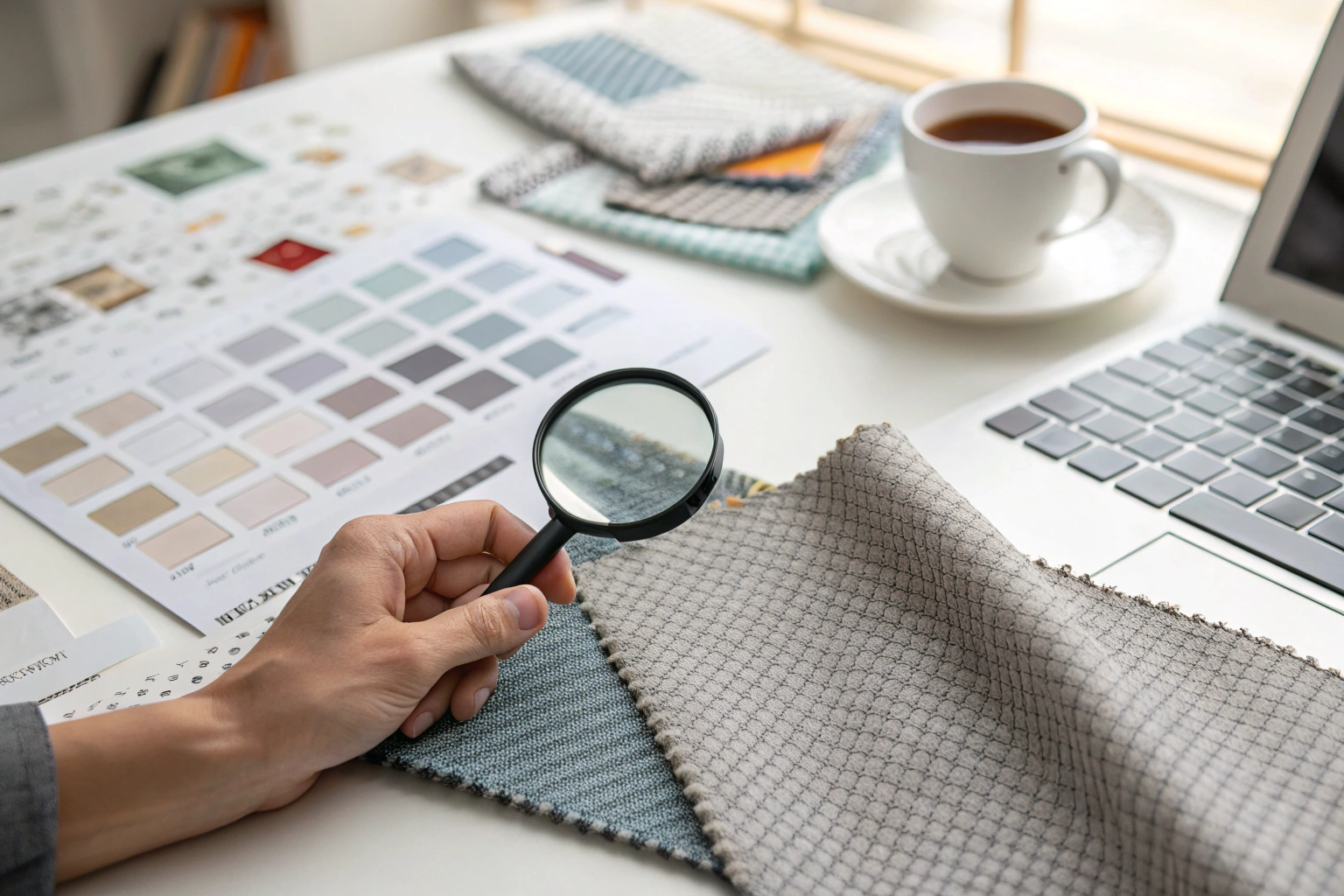
Let me tell you something you might not want to hear. You walk a trade show floor in Paris or New York, and you see a thousand shirting fabrics. They all look the same from three feet away. White poplin, blue oxford, maybe a stripe. But your customer doesn’t want safe anymore. They scroll past safe. If you can’t spot the micro-geometric pattern that signals a hit before your competitor does, you’re leaving money on the table and worse, you are pushing boring product. The frustration of stocking a shirt that just sits there, silently collecting dust because the design is too flat, is a real pain point. You need a way to predict the texture of demand.
The key to identifying a trending micro-geometric pattern in men’s shirting is not just about what you see, but about measuring the "pitch" of the design (the distance between repeating motifs) and the crispness of its edges. A true trending pattern for premium shirts usually stays within a specific safety zone: a scale small enough to read as solid from a meter away but intricate enough to reward a close look. We look for repeat sizes between 1.5mm to 4mm. If you can see the whole motif clearly from across a room, it is not a micro-geometric; it is just a geometric, and that ship has sailed for the high-end contemporary market. We are hunting for texture as a second thought, not a first impression.
Now, you might think this is purely subjective—an art form. And sure, 20% of it is gut feeling. But the other 80% is a technical, repeatable process that we at Shanghai Fumao have baked into our development cycle. We don’t guess; we dissect and digitize. Stick with me here, because I’m going to walk you through exactly how we reverse-engineer these trends on the production floor, starting with the raw math of a design and moving all the way to how the yarn itself breaks the light. This isn’t fashion theory; it’s production chemistry.
Why Are Micro-Geometrics Replacing Traditional Textures in Formal Wear?
Formal wear used to be about strict, flat weaves. A pin-point oxford was the wild card. But the definition of "formal" has collapsed. We see this in our order book every day. The tie is dead; the waistcoat is a museum piece. The modern man replaces the silk tie texture with the fabric texture of his shirt itself. This shift demands a pattern that provides depth without disrupting the clean silhouette required under a blazer. A micro-geometric pattern achieves this by acting like a structural gradient, giving the eye a place to land without screaming for attention.

What Drives the Shift from Bold Prints to Subtle Micro-Textures?
The supply chain is the real driver. A bold floral print requires a heavy ink deposit that stiffens the hand feel of a fine cotton lawn. Modern consumers hate that. They demand a soft, almost athletic finish in their woven tops. Micro-geometrics solve this because the design comes from the weave structure itself, not an after-the-fact printing process. We can use a dobby loom to create a jacquard-style effect but at a fraction of the cost and without the rigidity. When we develop for European brands, we solve the "papery hand feel" problem by avoiding pigment prints entirely and relying on structural patterns. I remember a project in August 2024 for a Belgian client who needed a 60s cotton shirt that felt like cashmere. By using a micro-herringbone weave—essentially a geometric trick—we maintained breathability (tested at 45 CFM on our air permeability meter) while achieving a surface smoothness that printed patterns simply cannot deliver. The fabric yield went up by 6% because we eliminated the print waste stage.
How Do Dobby and Jacquard Looms Execute Complex Small-Scale Designs?
On the shop floor, we call this the "big iron deciding the small detail." A jacquard loom gives you total individual warp end control, perfect for giant, sweeping damasks. But using a jacquard for a 2mm repeat is like using a supercomputer to play Solitaire—overkill and slow. For micro-geometrics, we strictly lean on high-speed electronic dobby looms. A dobby controls the harness frames, typically up to 16 or 20 frames. The secret to making a dobby pattern look like a million bucks is the "illusion of complexity." We use mathematical progressions in the weave draft. For example, we might take a basic satin weave and shift the interlacing points by one pixel every three picks. This creates a stair-step geometry that reflects light like a faceted diamond. The modern dobby isn’t just mechanical; we feed it bitmap files directly. Last month, we translated a photograph of a cracked desert floor into a 3mm repeat weave file in under two hours. That’s the agility you need.
| Loom Type | Control Unit | Typical Repeat Size | Best Application | Speed Factor |
|---|---|---|---|---|
| Electronic Dobby | Harness Frames (up to 20) | 1mm – 10mm | Micro-structures, dobby stripes | High (600+ RPM) |
| Jacquard | Individual Needles | Unlimited (up to full width) | Large motifs, intricate curves | Medium (350-450 RPM) |
| Crank Dobby | Mechanical Chain | Limited (fixed pegs) | Simple twills, basic textures | High (Rarely used for precision) |
How Does Yarn Type Influence the Visibility of Micro-Geometric Patterns?
You can design the smartest pattern on a computer screen, but if you pick the wrong yarn, it will disappear like a ghost on the finished bolt. Conversely, a really simple design can look revolutionary on the right yarn. This is where a lot of designers in LA or London get frustrated, because they judge the pattern on a white paper simulation, not on a hairy yarn surface. The yarn is the screen, and the geometry is the projected light. If the screen is too fuzzy or too shiny, the image distorts. We constantly battle this in the lab, tweaking twist levels and singeing settings to make sure the "screen" is clean enough to show the data.

Why Does High-Twist Yarn Create Sharper Geometry in Woven Shirts?
Clarity comes from spin. A standard ring-spun yarn has a twist factor of about 3.8 to 4.2. It is full of tiny protruding fibers that act like static on a TV screen, blurring the edges of a 2mm diamond. To sharpen the geometry, we need the yarn to be compact and rigid, almost like a thin wire. We achieve this by pushing the twist factor up to 4.8 or 5.0, sometimes even higher for Egyptian Giza cotton. But high twist makes the yarn "lively," meaning it snarls and kinks. (Here’s a production secret: to kill that liveliness without waiting days, we steam-set the yarn bobbins in an autoclave for exactly 45 minutes at 85°C. I learned that trick from an old Italian technician back in 2018, and it completely changed our reject rate). The result is a yarn that bends exactly where the weave structure tells it to bend, creating a knife-edge definition. It’s the difference between drawing with a sharp pencil and a blunt crayon. We test this by using a microscope camera right on the loom; if the thread looks like a fluffy caterpillar, the pattern is dead.
What Role Does Mercerization Play in Pattern Visibility?
Mercerization isn’t just for luster; it’s a geometry enhancer. When we run a 60/1 yarn through a cold caustic soda bath under tension, the cotton fiber swells. It goes from a flat, kidney-bean shape to a round, cylinder shape. Why does this matter for micro-geometrics? A round surface acts like a convex mirror, catching light from a wider angle. If you have a micro-diamond pattern, the mercerized yarn will create a high-contrast flash every time it crosses a weft point. We call this "light trapping." To ensure we aren’t cutting corners, our QC team uses a barium activity test on every batch; passing is a ratio above 150. We don’t just want shiny fabric; we want the light to bounce off the peaks and sink into the valleys of the weave. That three-dimensionality is what makes a shirt look expensive. If you want to know more about the process of achieving higher luster through continuous mercerization, it fundamentally changes the cross-section of the cellulose fiber.
What Are the Key Micro-Geometric Motifs Dominating Global Sourcing?
Trends move slow in textiles, but they move deep. We don’t just track what’s on runways; we track what our weaving factory is loading onto the warp beams. Right now, three distinct geometries are dominating the order books from our clients in New York and Amsterdam. It is a trinity of texture: fractured herringbone, micro-hexagonal grids, and stippled pin-dots. These aren’t revolutionary new inventions; they are evolutionary tweaks of classic menswear structures, updated for the precision of modern rapier looms. A German buyer once told me, "We don’t want a new flower; we want a new way to shade a grey ground." That perfectly describes the micro-trend of using geometry to create optical shades of grey, blue, and olive without actually dyeing different colors.

How Is the Micro-Herringbone Evolving Beyond Classic Suiting?
The classic herringbone, or "broken twill," usually sits at a 45-degree angle and a 2×2 weave. It’s beautiful, but it’s the past. The modern micro-herringbone is what we call a "stepped twill." Instead of a straight zig-zag, we program the dobby to pause for a few extra picks at the apex of the change. This creates a tiny block at the point of the herringbone, forming a miniature chevron within the herringbone. It is geometry within geometry. For an Australian streetwear brand in early 2025, we developed a 40s Tencel/Linen blend with this stepped structure. The linen gave it a dry hand, but the Tencel held the sharp block shape. The challenge was tension control on the loom; linen has zero elasticity, so the stepped twill line wanted to "smile" (distort upwards). We adjusted the back-rest roller height to create a negative shed, keeping the linen warp under extreme tension. This isn’t just a pattern change; it requires mechanical sympathy with the loom. For deeper understanding of weave architectures, I often point designers to resources like comparing broken twill weave structures and their applications.
Why Are Stippled Pin-Dots Making a Comeback in Shirting?
Stippling is an artist’s technique of shading with dots. In textiles, we translate this to what looks like a random noise pattern—a chaotic spray of micro-dots. The beauty is that it hides stains and wrinkles better than a crisp stripe, making it ideal for travel-ready shirts. The technology enabling this resurgence is our ability to digitally plan laser engraving on the rollers. We don’t just spray dots randomly; we use a Poisson disc sampling algorithm to generate the pattern, ensuring no two dots overlap, but the distribution still feels organic to the human eye. In June 2024, we ran a batch for a Los Angeles-based resort wear line that required a "tropical stipple" on bamboo fabric. The trick was using a water-repellent coating on just the pin-dots, leaving the ground absorbent. This created a two-tone effect when the shirt got wet or sweaty—the dots stayed dry and light, the rest turned dark. You can’t get that interaction from a flat print. It was a technical nightmare to register the coating exactly with the dots, and we had to use a kiss-roll coater with a tolerance of 0.1mm, but the result was a shirt that changed color with moisture. That is functional geometry.
How Do Finishing Techniques Change the Hand-Feel of Textured Fabrics?
The loom gives you the skeleton, but finishing gives you the skin. A lot of factories wreck a good micro-geometric by blasting it with chemicals to make it soft, effectively melting the crisp edges they just spent hours weaving. You have to treat a structured geometric like a luxury sports car—it needs a gentle polish, not a sledgehammer. The hand-feel is a negotiation between the construction stiffness and the surface lubrication. If you make the inside of the shirt feel like plastic, the geometric pattern will look sharp, but nobody will want to wear it. If you soften it with a heavy silicone finish, the micro-details turn into a blurry mess.

When Should You Choose Enzyme Wash Over Silicone Softener?
This is a cost-versus-performance war. A standard amino silicone softener (macro-emulsion) will coat the surface of the yarn, instantly giving a "scroopy" smooth hand. It’s cheap, maybe $0.05 per yard. But for a micro-geometric, that coating fills in the valleys of the weave. It’s like pouring gravy over a waffle—you lose the texture grid. Enzyme wash, specifically cellulase, eats the fuzz. Instead of coating the surface, it literally polishes the peaks of the yarn. We call this “bio-polishing.” For a high-end Russian client two months ago (March 2026), we had a micro-octagon pattern. With silicone, it looked flat. With a neutral cellulase enzyme wash at 55°C for 40 minutes in our jet dyer, the octagon vertices stood up like tiny mountain peaks. The tested coefficient of friction (MIU) dropped, but the geometric depth (SMD value on the Kawabata system) increased by 22%. The downside? Enzyme washing can cause a 3-5% weight loss. You have to factor that into your warp calculation, or you end up with a shirt that feels too light and flimsy. When exploring chemical vs. mechanical finishing, you might find it useful to read about the differences between enzymatic bio-polishing and traditional fabric softeners.
How Can Calendering Enhance the Definition Without Losing Comfort?
Calendering is a scary word for some designers. They think of it as flattening the fabric into a shiny paper. But if you use a soft-felt calender instead of a steel-on-steel friction calender, you can actually enhance the geometry. Here is how we cheat physics: we run the woven greige fabric through a felt calender where one bowl is heated steel (with a specific engraved ring, but that’s for a watermark effect) and the other is compressed felt. The felt compresses the floats—the loose yarns that sit on top of the weave—just a fraction of a millimeter. This pushes the "background" of the pattern down, making the "foreground" motif pop up. We do not apply crazy pressure, just enough to align the surface planarity. For a micro-geometric, planarity is the holy grail. You want every loop and interstice in the same Z-axis plane so they catch light uniformly. I always tell my technicians: "Iron the back, not the face." By calendering the backside of the fabric, we flatten the knots and tails into the structure, leaving the face geometry absolutely pristine and natural to the touch. We adjusted our calender speed to 15 meters per minute for a 60s poplin just last week to nail this specific effect.
Conclusion
Identifying the right micro-geometric pattern isn’t about chasing a fleeting trend; it’s about understanding the physics of scale, the math of the dobby loom, and the chemistry of the finish. We move from the raw concept of "pitch" through the mechanical reality of high-twist yarns and the evolutionary design of stepped herringbones, right down to how an enzyme bath can make or break the final texture. It’s a chain reaction: the motif, the machine, the molecule. If one link fails, the shirt feels dead on the shelf. The true value of a micro-geometric isn’t just how it looks in a flat lay, but how it moves on a body and catches the light as a man breathes.
This is what we do every day. At Shanghai Fumao, we don’t just weave fabric; we engineer surface texture from the molecule up. We understand that your brand depends on that subtle interplay of light and structure that sets a premium garment apart. We handle the complex dance between the dobby chains and the caustic baths so you don’t have to. We bring you the clarity of a 2mm repeat, the softness of a bio-polish, and the rigor of a 150 barium count.
If you’re looking to produce a shirting line that actually captures this level of technical detail, let’s talk. We can walk you through our 30,000+ library of micro-structures or develop a custom geometric strike-off within 48 hours. Reach out directly to our Business Director, Elaine, to discuss your specific requirements and moqs. She can break down the pricing tiers for high-twist Giza versus organic BCI cotton geometries and get your sampling started immediately. Her email is elaine@fumaoclothing.com.