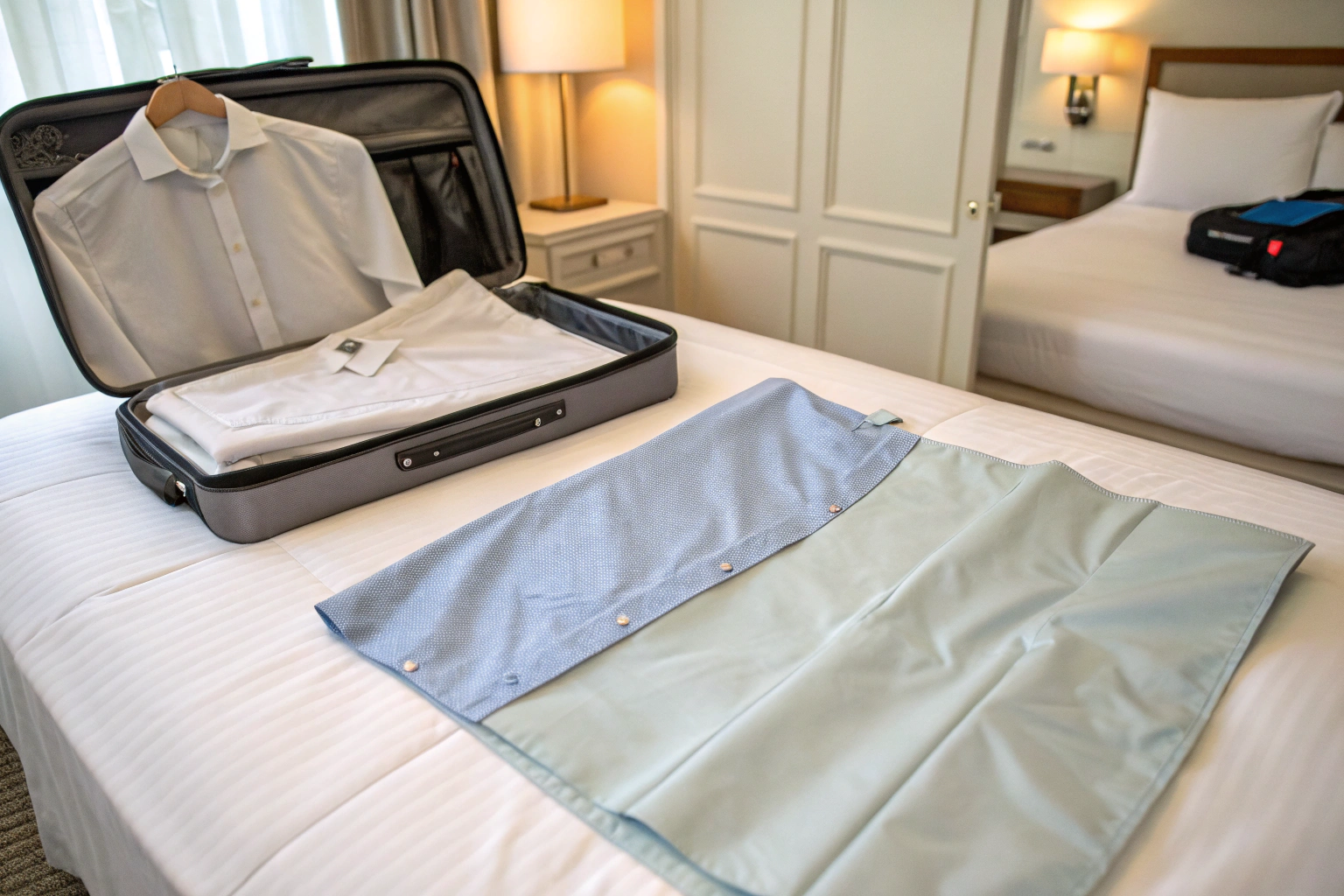
Last spring, I was on a video call with the product director of a travel clothing brand based in San Francisco. She held up two blazers to her laptop camera. One was a beautiful Italian wool-cashmere blend that retailed for $450. The other was a polyester-spandex blend with a mechanical stretch, retailing for $185. "Guess which one sells better," she said. I guessed the wool. I was wrong. "The polyester," she said. "Not because our customer wants polyester. Because she’s a management consultant who lives on airplanes, and the wool blazer looks like a crumpled napkin by the time she lands. The polyester one comes out of her carry-on looking like it just came off the steamer. She’s not buying a fabric. She’s buying an arrival state. She wants to walk off the plane and into the meeting room without stopping at the hotel first."
Wrinkle-resistant fabric has become a top priority for travel clothing brands because their customers no longer evaluate a garment by how it looks in a store or on a website. They evaluate it by how it looks after being compressed in a suitcase for eight hours, or after being worn for twelve hours on a long-haul flight, or after being washed in a hotel sink and hung to dry overnight. The purchase decision is driven not by the out-of-box experience, but by the out-of-suitcase experience. Traditional textile performance metrics—drape, hand feel, luster—still matter, but they are secondary to a single, overriding performance requirement: does this garment recover its original appearance after being crushed? If the answer is no, the travel brand loses the customer, not just for that product, but for the brand. A traveler who arrives at a client meeting looking rumpled doesn’t blame the suitcase. They blame the shirt. And the brand that made it.
At Shanghai Fumao, we’ve seen this shift in purchasing behavior reshape the fabric development priorities of our brand clients over the past five years. Wrinkle resistance used to be a niche request, mostly from uniform suppliers and hospitality brands. Now it’s a top-three specification for any brand positioning itself in the travel, performance workwear, or "modern commuter" categories. In this article, I’m going to explain what wrinkle resistance actually means at the fiber and finish level, how we engineer and measure it, and why the brands that win in this space are the ones that treat wrinkle recovery as a quantifiable specification, not a marketing claim.
What Causes Fabric to Wrinkle in the First Place?
Wrinkling is not a fabric defect. It’s a molecular event. When you fold a cotton shirt and press down on it, you’re physically displacing the long-chain cellulose molecules inside each fiber. In the unstressed state, these molecules are held in position by hydrogen bonds—weak but numerous attractions between the hydroxyl groups on adjacent cellulose chains. When the fiber bends, some of these bonds break. If the stress is released quickly, the bonds re-form in their original positions, and the fiber springs back. If the stress is held for hours—like a shirt compressed in a suitcase—the bonds re-form in new positions that accommodate the bend. The fiber doesn’t spring back when the stress is released because the hydrogen bonds are now holding it in the bent position. That’s a wrinkle.
Three factors determine how severely a fabric will wrinkle: fiber chemistry, yarn construction, and environmental moisture. Fiber chemistry is the most fundamental. Cellulose fibers—cotton, linen, viscose—wrinkle easily because they’re rich in hydroxyl groups that form abundant hydrogen bonds. Protein fibers—wool, silk—wrinkle less because they have fewer hydrogen bonding sites and their molecular structure includes natural cross-links that provide elastic recovery. Synthetic fibers—polyester, nylon—wrinkle the least because they’re thermoplastic. Their molecular chains are held in position by crystalline regions that don’t reform under normal wearing conditions. When a polyester fiber bends, it either springs back immediately or, if heated, can be reset to a new shape. Yarn construction affects wrinkling because tightly twisted yarns resist bending more than loosely twisted yarns, and they recover more completely. A high-twist cotton poplin wrinkles less than a low-twist cotton voile, even though they’re made from the same fiber. Environmental moisture accelerates wrinkling because water molecules penetrate the fiber and act as a lubricant, allowing the hydrogen bonds to break and re-form more easily. This is why a cotton shirt wrinkles more on a humid day, and why a shirt worn against sweaty skin wrinkles more than one worn over a dry undershirt.
How Do Hydrogen Bonds in Cellulose Fibers Create Permanent Creases?
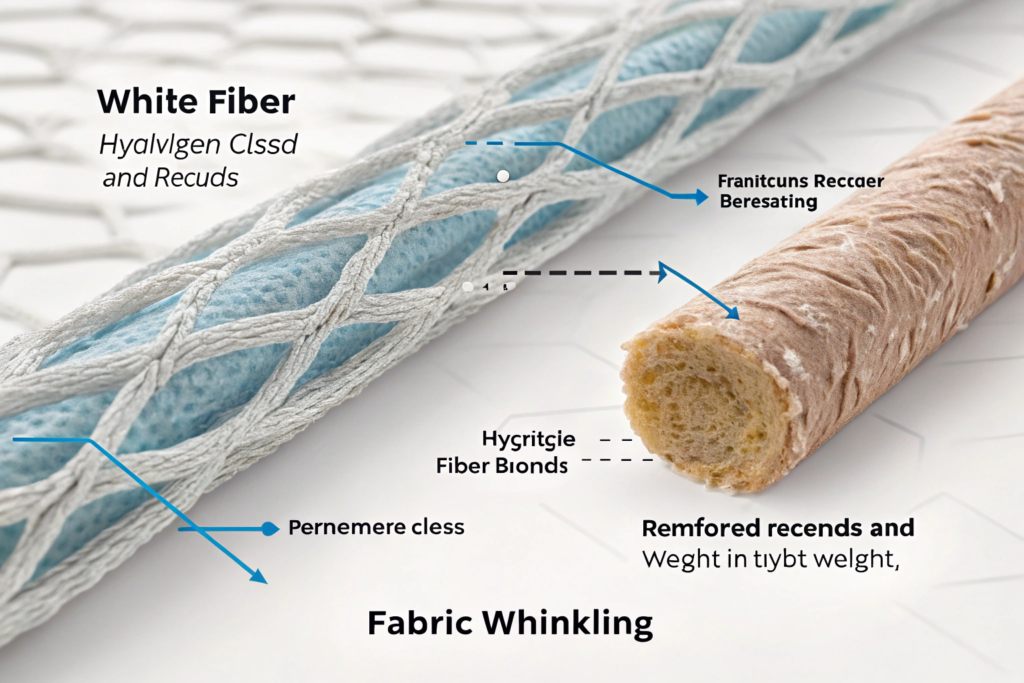
The hydrogen bond is the culprit behind every wrinkled cotton shirt in history. In a cellulose molecule, every glucose unit carries three hydroxyl groups—small clusters of oxygen and hydrogen atoms that carry a slight electrical polarity. These hydroxyl groups are like tiny magnets, constantly reaching out to form weak bonds with hydroxyl groups on neighboring cellulose chains. When the fiber is straight, the bonds form in a pattern that supports the straight configuration. When the fiber bends, some bonds are pulled apart. If the fiber straightens immediately, the original bonds re-form. If the fiber stays bent, the hydroxyl groups find new partners in the bent position, and those new bonds stabilize the crease.
This is why heat and moisture are so effective at removing wrinkles from cotton. When you iron a cotton shirt, you apply heat, which increases molecular vibration and breaks the hydrogen bonds holding the fibers in the wrinkled position. You apply pressure, which physically straightens the fibers. And then you remove the heat, allowing the hydrogen bonds to re-form in the straight configuration. The same principle applies to steam finishing. The steam provides both heat and moisture, accelerating bond breaking and reforming. This is also why a cotton shirt that has been folded in a drawer for six months develops creases that are harder to remove than one folded overnight. Over time, the hydrogen bonds in the bent position become more numerous and more stable, a phenomenon called "creep." The crease becomes "set." At Shanghai Fumao, when we’re developing a wrinkle-resistant cotton fabric, we’re essentially fighting the hydrogen bond at every stage of production and use. We can’t eliminate the hydrogen bond without eliminating the cotton—cellulose is defined by its hydroxyl groups. But we can interfere with the bond’s ability to reform in the bent position, which is the principle behind every durable press and easy-care finish on the market. For a deeper dive into the molecular chemistry, this textile science guide on the role of hydrogen bonding in cotton fiber wrinkling and recovery provides excellent molecular diagrams and a detailed explanation of the creep phenomenon.
Why Does Polyester Resist Wrinkles More Naturally Than Linen or Cotton?
Polyester resists wrinkles because it lacks the chemical feature that makes cotton and linen vulnerable: abundant, accessible hydroxyl groups. Polyester is polyethylene terephthalate, a long-chain polymer composed of repeating units with aromatic rings and ester linkages. It has very few hydroxyl groups, and those that exist are at the very ends of the polymer chains, not distributed along the backbone. Without hydroxyl groups, polyester cannot form the hydrogen bond network that sets wrinkles in cellulose fibers. Instead, polyester’s molecular chains are held together by weaker van der Waals forces and by crystalline regions—areas where the chains pack together in a regular, ordered structure. These crystalline regions act like physical anchors. They require significant thermal energy to disrupt—typically temperatures above the glass transition temperature, around 70-80°C for standard polyester. Below that temperature, the chains can bend slightly under stress, but the crystalline anchors pull them back to their original positions when the stress is released.
This is why a polyester shirt can be pulled from a suitcase looking nearly pressed, while a linen shirt pulled from the same suitcase looks like it was used as a pillow. The polyester fibers experienced the same mechanical compression, but their molecular structure didn’t allow hydrogen bonds to form in the bent position. The crystalline anchors held. Linen, incidentally, wrinkles even more readily than cotton despite being chemically similar—both are cellulose. The difference is that linen fibers are thicker, with a larger cross-sectional area, and they have less natural crimp. When a linen fiber bends, the stress is concentrated on the outer curve of the bend, and the hydrogen bonds in that region break and reform more readily. Cotton fibers, being finer and more crimped, distribute the bending stress more evenly and recover more completely. This is why a cotton-linen blend wrinkles less than 100% linen, even though both fibers are cellulose. The cotton acts as a recovery aid for the linen. For a comparison of fiber-specific wrinkle recovery data, this textile performance guide on wrinkle recovery angles by fiber type provides standardized AATCC 66 test results for common apparel fibers.
How Is Wrinkle Resistance Actually Engineered Into the Fabric?
Wrinkle resistance is engineered into fabric through three primary routes, and the best results often combine all three. The first route is fiber selection. Choose a fiber that is inherently wrinkle-resistant—polyester, nylon, elastane blends—and you’ve solved most of the problem at the raw material stage. The second route is cross-linking chemistry. Apply a resin finish to a cellulose fabric that creates permanent cross-links between the cellulose chains, essentially mimicking the crystalline anchors that give polyester its recovery properties. The third route is mechanical construction. Use high-twist yarns, tight weave structures, and heat-setting processes that create a fabric with high elastic recovery and low deformability.
The cross-linking chemistry route is the most technically interesting and the most commercially significant because it’s what allows a 100% cotton shirt to claim wrinkle-resistant performance. The chemistry was pioneered in the 1950s and 1960s with formaldehyde-based resins like DMDHEU (dimethylol dihydroxyethyleneurea). These resins are small molecules that penetrate the cotton fiber, react with the cellulose hydroxyl groups, and form bridges between adjacent cellulose chains. The cross-links prevent the chains from moving relative to each other, which means the hydrogen bonds can’t break and re-form in the bent position. The fiber is locked in its original configuration. The trade-off, which plagued early durable press finishes, was that the cross-linking made the fiber brittle, reducing tear strength and abrasion resistance. The fabric came out of the washing machine looking pressed, but it tore more easily and wore out faster. Modern cross-linking chemistry has largely solved this problem through modified DMDHEU resins and polycarboxylic acid cross-linkers that produce softer, more durable cross-links.
What Is the Chemical Difference Between a "Durable Press" and an "Easy Care" Resin Finish?
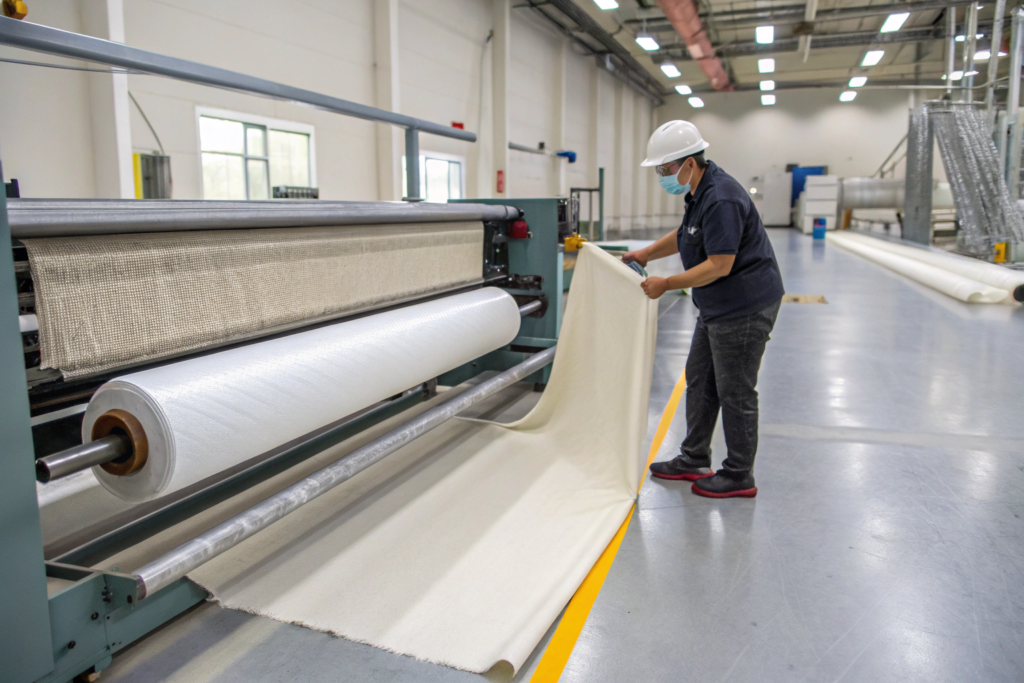
Durable press and easy care are terms that are often used interchangeably in marketing but mean different things in textile chemistry. The difference is the level of cross-linking, which is measured by the fabric’s wrinkle recovery angle and its durable press rating. An easy care finish is a light cross-linking treatment. The resin add-on is typically 2-4% on weight of fabric, producing a wrinkle recovery angle of 240-260 degrees and a durable press rating of 3.0-3.5 on the standard 1-5 scale. The fabric retains most of its original tear strength—typically 70-80% of untreated strength—and the hand feel is only slightly firmer than untreated cotton. Easy care is the standard finish for most wrinkle-resistant cotton shirting and casual wear. The shirt comes out of the dryer ready to wear with minimal ironing, but it’s not completely wrinkle-free. A durable press finish is a heavier cross-linking treatment with a resin add-on of 6-10%, producing a wrinkle recovery angle above 280 degrees and a durable press rating of 4.0 or higher. The fabric is truly wash-and-wear. It emerges from the dryer completely smooth, with sharp creases where they were pressed. The trade-off is significant: tear strength retention drops to 50-60% of untreated fabric, and abrasion resistance drops proportionally. Durable press garments wear out faster, particularly at points of friction like collars and cuffs.
The chemical systems used for the two finishes are often the same—typically a modified DMDHEU resin with a magnesium chloride catalyst—but the concentration and curing conditions differ. At Shanghai Fumao, we guide our brand clients through this trade-off with real data. For a travel shirt that needs to be worn under a suit jacket and will be dry-cleaned, we recommend an easy care finish. The light wrinkling that occurs during wear is hidden by the jacket, and the shirt lasts longer. For a travel dress or a stand-alone blouse that must look flawless upon arrival, we recommend a durable press finish. The garment has a shorter service life, but it delivers the performance the customer is paying for. For a detailed technical comparison of the resin systems, this textile finishing guide on DMDHEU versus polycarboxylic acid cross-linking for cotton provides chemical structures, application parameters, and performance data for each system.
Can a Mechanical "Heat-Set" Process Create Wrinkle Resistance Without Chemicals?
Yes, for synthetic fibers and synthetic-rich blends, and the result is often more durable and more comfortable than a chemical finish because the fabric retains its natural hand feel and breathability. Heat-setting is a process where a fabric is heated to a temperature above the glass transition point of the fiber—typically 180-200°C for polyester—while being held in a flat, tension-controlled configuration. At this temperature, the crystalline regions in the polyester fibers partially melt and the polymer chains can move. When the fabric is cooled while still under tension, the chains re-crystallize in the flat, smooth configuration. The fabric now has a "thermal memory." If it’s later bent or crushed at temperatures below the heat-set temperature, the crystalline anchors pull the chains back to the flat configuration. The wrinkling is physically reversible, not chemically prevented.
The limitation of heat-setting is that it only works on thermoplastic fibers. A 100% cotton fabric cannot be heat-set because cotton is not thermoplastic. It decomposes before it melts. But a polyester-cotton blend can be partially heat-set, with the polyester component providing wrinkle recovery and the cotton component providing comfort and moisture absorption. A typical travel suiting fabric might be a 65% polyester, 35% cotton blend, heat-set at 195°C for 45 seconds in a stenter frame, with the width precisely controlled to set the desired drape and recovery. The polyester component provides about 80% of the wrinkle resistance. The cotton component provides breathability and a natural-fiber hand. This combination, in my experience, is the most commercially successful approach for mid-market travel brands. It delivers performance that the customer can feel without the chemical story that some consumers find off-putting. For a process engineering perspective, this textile manufacturing resource on heat-setting parameters for polyester and polyester-blend woven fabrics provides dwell time, temperature, and tension specifications by fabric weight and construction.
How Do You Measure and Specify Wrinkle Resistance to a Mill?
"Wrinkle-resistant" is a marketing claim. A wrinkle recovery angle of 260 degrees is a specification. The difference between the two is the difference between a disappointed customer and a repeat buyer. When a brand tells me they want a wrinkle-resistant fabric, my first question is always the same: "What is your minimum wrinkle recovery angle, and under what standard?" If they can’t answer that question, we haven’t finished the product brief.
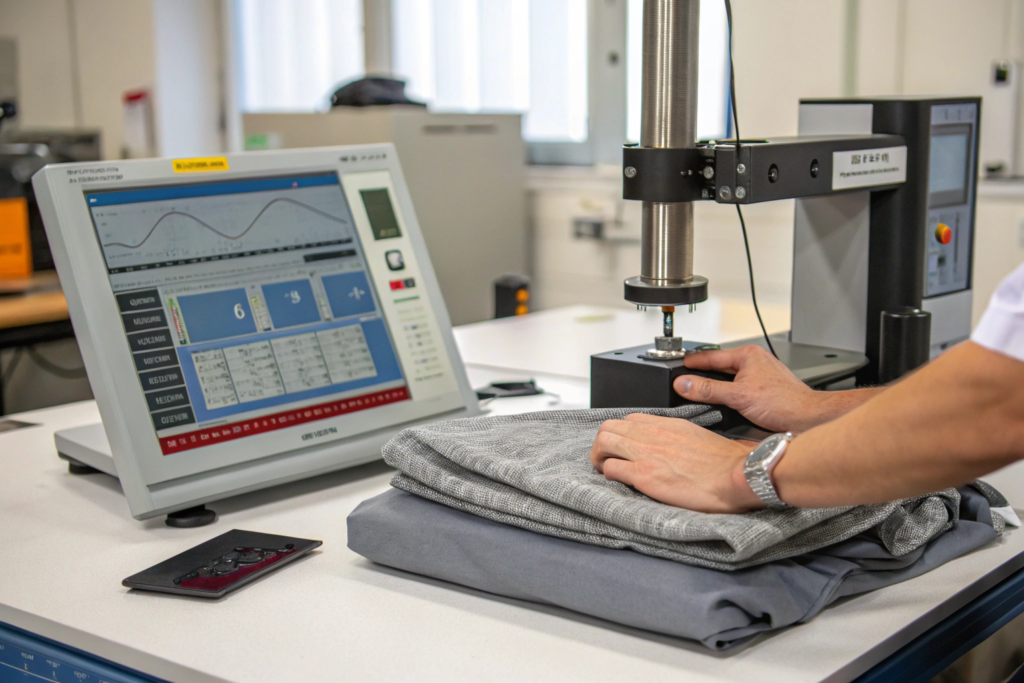
The industry standard method for measuring wrinkle resistance is AATCC Test Method 66, "Wrinkle Recovery of Woven Fabrics: Recovery Angle." A small specimen of fabric—typically 15mm x 40mm—is folded in half and placed under a specified weight for a specified time, usually 500 grams for 5 minutes. The weight is then removed, and the specimen is allowed to recover for 5 minutes. The angle through which the fold opens is measured with a protractor. A perfectly flat, unfolded fabric would have a recovery angle of 180 degrees—but wait, the specimen is folded, so the recovery is measured from the folded position. A fabric that springs back completely to flat shows a recovery angle of approximately 180 degrees in the standard test orientation. Fabrics are typically measured in both warp and weft directions, and the results are averaged. A recovery angle below 180 degrees indicates a visible crease remains. A recovery angle above 240 degrees indicates good wrinkle resistance. Above 280 degrees indicates excellent, durable-press-level performance. The method also includes a "delayed recovery" measurement, where the angle is measured again after 30 minutes, which is more representative of how a garment recovers on the body.
What Is an Acceptable "Wrinkle Recovery Angle" for a Travel Suiting Fabric?
For a travel suiting fabric that will be marketed as wrinkle-resistant, I recommend specifying a minimum wrinkle recovery angle of 260 degrees under AATCC 66, measured in both warp and weft directions after 5 minutes of recovery. This is a demanding but achievable standard. It means the fabric will show only light creasing after being packed in a suitcase, and those creases will relax significantly during the first 30 minutes of wear. For a premium travel suiting that commands a higher price point and makes stronger performance claims, the specification should be 280 degrees minimum. At this level, the fabric emerges from a suitcase with no visible creasing under normal packing conditions, and any residual fold marks fall out within minutes.
To put these numbers in context, let me share some real data from our lab at Shanghai Fumao. An untreated 100% cotton poplin typically has a wrinkle recovery angle of 140-160 degrees. It wrinkles badly and needs ironing. An easy-care finished cotton poplin recovers to 220-240 degrees. It’s wearable out of a suitcase with light touch-up. A durable press cotton reaches 260-280 degrees. It’s truly wash-and-wear. A heat-set 100% polyester woven reaches 290-310 degrees. It’s essentially wrinkle-proof but lacks the natural fiber hand. A heat-set polyester-wool blend—our most popular travel suiting base—reaches 270-290 degrees while retaining a wool-like hand and breathability. The specification you choose depends on your brand’s performance promise. But whatever number you choose, put it in the tech pack. Make it measurable. Make it part of the QC inspection. A mill that can’t hit your wrinkle recovery specification in the lab dip stage won’t hit it in bulk production. For a comprehensive benchmark, this textile testing resource on AATCC 66 wrinkle recovery angle specifications by apparel category provides industry-average and best-in-class data for different fabric types and end-uses.
How Do You Test for "Compression Recovery" to Simulate Suitcase Packing?
The AATCC 66 test measures recovery from a single, sharp fold. It’s a good general indicator of wrinkle resistance, but it doesn’t fully simulate what happens when a garment is stuffed into a carry-on suitcase and left overnight under chaotic, multi-directional compression. For travel brands, I recommend supplementing AATCC 66 with a compression recovery test that more closely mirrors the actual use case.
The compression recovery test we use at Shanghai Fumao is a modified version of the method developed by a major U.S. travel brand we’ve supplied for years. A 30cm x 30cm fabric specimen is loosely crumpled into a ball—not folded neatly, but randomly compressed by hand into a roughly spherical shape. The ball is placed between two flat, rigid plates, and a weight is applied to achieve a pressure of approximately 7 kPa, which simulates the pressure inside a moderately packed suitcase. The specimen remains under compression for 8 hours at 20°C and 65% relative humidity, simulating overnight packing. After 8 hours, the weight is removed, the fabric is gently shaken out once—simulating the traveler shaking out the garment—and laid flat on a table. Photographs are taken immediately, after 5 minutes, and after 30 minutes. The surface is visually assessed against a set of reference standards on a 1-5 scale, where 1 is "severe creasing, garment unwearable" and 5 is "no visible creasing, garment ready to wear." A fabric that scores 4 or above is approved for a "wrinkle-resistant" claim. A fabric that scores 3 is acceptable for "easy care" but not for premium travel positioning. This test is not an official industry standard—AATCC or ISO—but it correlates much more closely with actual consumer experience than the standard fold test. If your mill can’t or won’t run this test, you can run it yourself in your own QC lab with simple equipment. For a test protocol you can share with your suppliers, this garment performance guide on compression wrinkle testing for travel apparel provides the full method, scoring criteria, and reference photographs.
Which Fiber Blends Offer the Best Balance of Wrinkle Resistance and Breathability?
The Holy Grail for travel clothing brands is a fabric that performs like polyester—wrinkle-resistant, quick-drying, durable—but feels and breathes like a natural fiber. This balance cannot be achieved with a single fiber. Polyester gives you performance but traps heat and moisture. Cotton gives you breathability and softness but wrinkles and dries slowly. Wool gives you temperature regulation and natural wrinkle recovery but can feel heavy and requires careful laundering. The solution is blending, and the art of blending is in the ratio, the yarn engineering, and the finishing.
The most successful wrinkle-resistant breathable blends for the current travel market fall into three categories, and I recommend each for different brand positions. For the premium natural-fiber-focused brand, a 55% wool, 45% polyester blend with the polyester as a filament core wrapped in wool staple fibers. The polyester core provides strength and wrinkle recovery. The wool wrap provides the hand, the thermal regulation, and the natural fiber story. This blend recovers beautifully from compression, breathes well due to the wool’s natural moisture management, and can be marketed with a sustainability angle if the wool is responsibly sourced. For the mainstream performance workwear brand, a 65% polyester, 35% cotton blend with the polyester heat-set and the cotton given a light easy-care finish. The polyester does the heavy lifting on wrinkle recovery. The cotton provides next-to-skin comfort and a matte, non-synthetic appearance. This blend is cost-effective, machine washable, and performs reliably in consumer testing. For the entry-level direct-to-consumer brand, a 100% polyester filament fabric with a peach-skin mechanical finish. No blending, no cross-linking chemistry—just a micro-denier polyester woven with a slight texture and brushed to mimic the hand of cotton or suede. This fabric is the most cost-effective and the most wrinkle-resistant, but it sacrifices breathability and carries the potential stigma of being "just polyester."
Why Does a Wool-Polyester Core-Spun Yarn Outperform a Simple Intimate Blend?
An intimate blend—where staple wool fibers and staple polyester fibers are mixed together before spinning—distributes the two fiber types randomly throughout the yarn cross-section. Some polyester fibers end up on the surface. Some wool fibers end up in the core. The surface of the yarn is a mixture, and the hand feel is a compromise. The polyester on the surface can make the fabric feel slightly synthetic, and the wool in the core doesn’t contribute much to the hand because the wearer’s fingers never touch it.
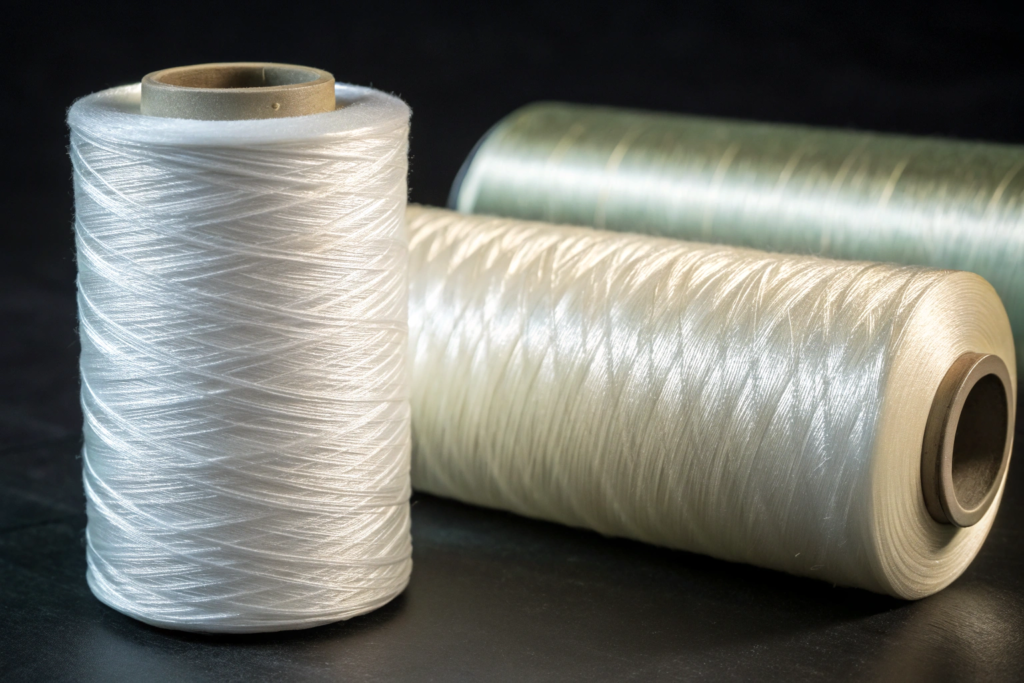
A core-spun yarn is fundamentally different and structurally superior for travel suiting. In a core-spun construction, a filament polyester core—usually a 50-75 denier multi-filament—is fed through the center of the spinning frame, and wool staple fibers are spun around it, completely covering it. The polyester core is invisible from the yarn surface. The hand feel is 100% wool because the wearer’s skin only contacts the wool wrap. But the structural performance comes from the polyester core, which acts as an internal skeleton. When the fabric is crushed, the wool fibers on the surface can bend, but the polyester core resists permanent deformation. The wrinkle recovery angle of a core-spun wool-polyester suiting can exceed 280 degrees, while an intimate blend of the same fiber ratio might achieve only 240-250 degrees. The core-spun yarn also has higher tensile strength and better seam strength because the continuous filament core bridges any weak points in the staple wool wrap. At Shanghai Fumao, our premium travel suiting base is a 60% merino wool, 40% polyester filament core-spun, woven in a 2/1 twill at 220 GSM. It has the hand of a lightweight wool suiting, the wrinkle recovery of a polyester, and the breathability of wool. It’s more expensive than an intimate blend—about 15-20% higher in yarn cost—but the performance difference is immediately obvious in a comparative compression test. For a detailed analysis, this yarn engineering guide on core-spun versus intimate blend yarns for performance fabrics provides cross-sectional microscopy images and mechanical property comparisons.
Is a 100% Synthetic Fabric Ever the Right Choice for a Luxury Travel Brand?
Yes, but the synthetic fabric in question bears no resemblance to the cheap polyester double-knit that gave synthetics a bad name in the 1970s. The current generation of premium synthetic fabrics—woven from micro-denier filament yarns, finished with peach-skin mechanical brushing, and designed with complex multi-layer weave structures—can honestly compete with natural fibers on hand feel, drape, and aesthetic appeal, while dramatically outperforming them on wrinkle resistance and packability. Luxury travel brands that have embraced these fabrics include several Japanese and European labels that position their products as "technical luxury" or "performance tailoring."
The synthetic fabric that currently wins in the luxury travel space is a 100% polyester woven from 0.5-denier sea-island microfilament. The "sea-island" terminology refers to the manufacturing process: 37 or more individual polyester filaments are extruded together within a dissolvable polymer matrix. After weaving, the matrix is dissolved, leaving individual filaments one-thirtieth the diameter of a standard polyester fiber. The resulting fabric has a surface area and flexibility that mimics natural microfibers like cashmere or suede, but the thermoplastic recovery of polyester. A blazer made from this fabric can be rolled into a ball, stuffed into a backpack, shaken out, and worn to a dinner meeting. It will not wrinkle. It will not crease. It will not betray the fact that it spent eight hours compressed under a seat in front of a laptop bag. The trade-offs are breathability—even with a microporous finish, it will not breathe as well as wool—and sustainability perception. Luxury consumers are increasingly conscious of synthetic fiber’s environmental impacts, and a 100% polyester garment carries a different story than a wool-rich blend. The brands that succeed with these fabrics are transparent about the trade-offs and position the performance benefit as the luxury. For a market perspective on this category, this textile innovation resource on micro-denier polyester fabrics for luxury performance tailoring provides case studies of brands that have successfully positioned synthetic travel tailoring at the premium end of the market.
Conclusion
Wrinkle-resistant fabric has become a top priority for travel clothing brands because the modern traveler’s primary quality metric is no longer the mirror in the fitting room, but the mirror in the airport bathroom after a long-haul flight. The brands that win in this space understand that wrinkle resistance is not a binary property—a fabric is not simply "wrinkle-resistant" or "not." It’s a measurable, engineerable, specifiable performance characteristic with a defined recovery angle, a defined compression recovery score, and a defined durability over wash cycles. They translate the marketing claim into a technical specification, and they hold their mills accountable to that specification with standardized testing.
The tools to engineer wrinkle resistance are available at every level of the market. For premium brands, core-spun wool-polyester blends and high-quality easy-care finishes on natural fibers offer wrinkle recovery with a luxury hand. For mainstream brands, heat-set polyester-cotton blends deliver reliable performance at an accessible price. For entry-level and direct-to-consumer brands, micro-denier polyester wovens with mechanical finishes provide wrinkle-proof performance at the lowest cost. No single solution is right for every brand, but every brand that serves the travel customer needs a solution. The customer who arrives rumpled doesn’t blame physics. They blame the shirt.
At Shanghai Fumao, we’ve developed a range of wrinkle-resistant fabric bases specifically for the travel apparel market, and we test every batch for wrinkle recovery angle and compression recovery before it leaves our facility. If you’re a travel clothing brand looking to upgrade your fabric performance or develop a new travel-specific product line, reach out to Elaine, our Business Director, at elaine@fumaoclothing.com. Tell her what kind of travel garment you’re developing, and she’ll send you our wrinkle-resistant fabric sample pack with full AATCC 66 test data for each base. The traveler who walks off the plane and into the meeting without a second thought? That’s your customer. Let’s make sure your fabric delivers.