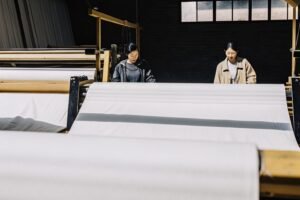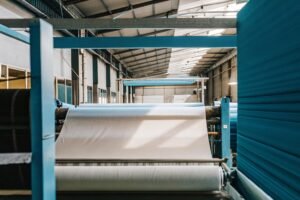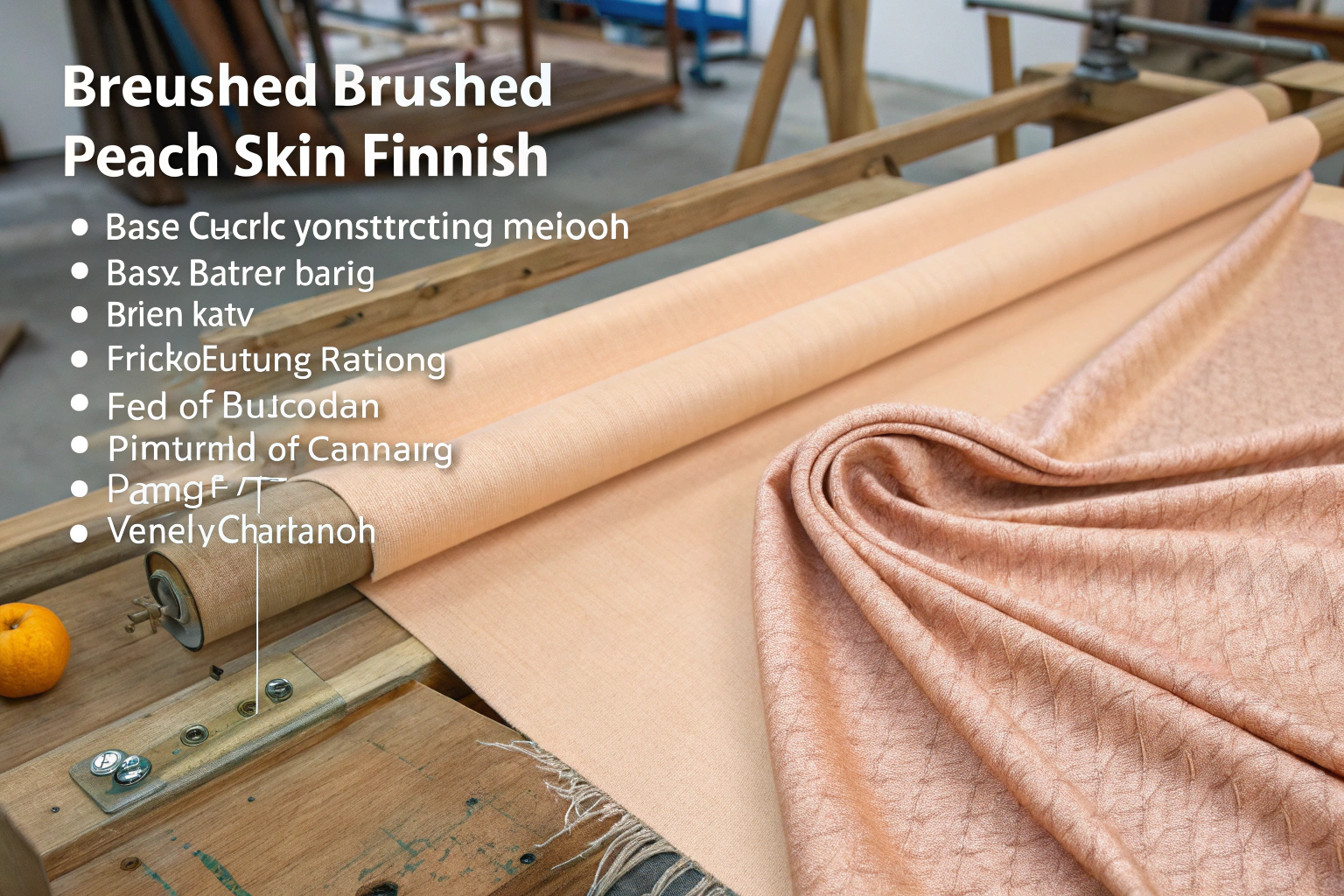
Last February, I was walking the halls of Première Vision in Paris, and I saw something I hadn’t seen in years: a queue. Not at a coffee stand. Not at a celebrity designer’s booth. A queue of buyers waiting to touch a fabric sample at a small Japanese mill’s stand. I waited my turn, and when I finally touched the fabric—a brushed cotton-polyester blend twill—I understood the line. It felt like running your fingers across the skin of a perfectly ripe peach. Not slick. Not fuzzy. Not sanded. Just impossibly, microscopically soft, with a dry, warm hand that made every other brushed fabric in my memory feel like sandpaper. I bought five meters on the spot and carried it back to Keqiao in my hand luggage, wrapped in tissue paper like a museum artifact. "Figure this out," I told our R&D team. "But don’t just copy it. Make it producible."
Replicating a brushed peach skin finish found at a Paris trade show requires reverse-engineering the base fabric construction, the brushing method, and the post-brushing finishing chemistry as a unified system. The peach skin effect is not a single process. It’s the outcome of a specific yarn type—typically a micro-denier or fine-count staple fiber, a specific weaving or knitting structure that presents those fibers to the surface, a precision sanding or brushing operation that raises the fiber ends without cutting them, and a finishing chemistry that sets the raised fibers in place while giving them that characteristic dry, warm hand feel. If you get any one of those four elements wrong, you don’t get peach skin. You get fuzz. Or pilling. Or a surface that feels great for one wash cycle and then collapses into a flat, sad shadow of its former self.
At Shanghai Fumao, we’ve spent the last eighteen months developing a systematic peach skin finishing capability precisely because we saw the demand building at European trade shows. Buyers were touching these fabrics, falling in love, and then failing to find suppliers who could deliver the exact same hand feel at scale. In this article, I’m going to walk you through exactly how we reverse-engineer a peach skin finish, from analyzing the original sample to running the bulk production, so you can walk into your next trade show, find the fabric that stops you in your tracks, and know exactly how to bring it to market.
What Is the Difference Between Peach Skin, Sanded, and Sueded Finishes?
I’ve lost count of how many times a buyer has emailed me a photo of a fabric and said, "Can you do this peach skin finish?" and when the physical sample arrived, it was actually a sueded finish. Or a sanded finish. Or a heavily peached finish that was more nap than skin. The terminology in the industry is loose, and different mills use different words for overlapping processes. But the physical differences between these finishes are real, and they matter for how the fabric will perform on a garment. If you spec "peach skin" and the factory delivers "sanded," the fabric will feel harsher, it will pill faster, and it will look matte and flat rather than having that subtle, multi-directional glow that makes peach skin so photogenic.
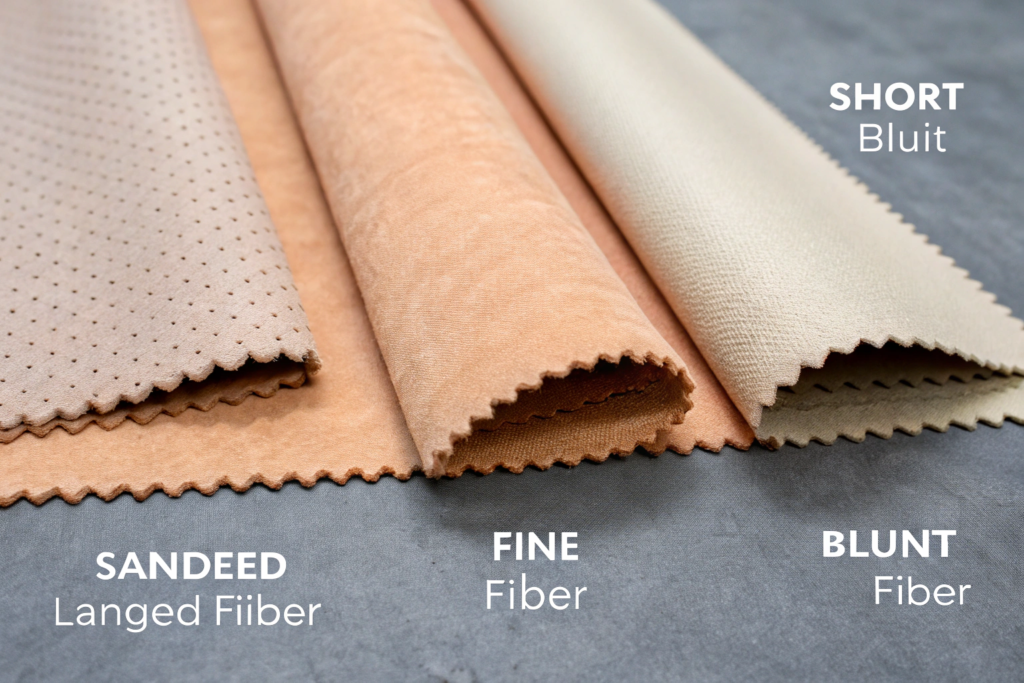
Let me define these terms with the precision I use when training new staff at Shanghai Fumao. A sanded finish uses abrasive rollers or belts covered in grit—usually aluminum oxide or silicon carbide—that mechanically cut the surface fibers. The result is a surface of short, blunt, evenly cut fiber ends. Sanding creates a uniform matte appearance and a soft-but-not-silky hand. Think of a well-worn cotton bedsheet. A sueded finish takes sanding further, using finer grits and multiple passes to create a very short, very dense, uniform nap that resembles the surface of natural suede leather. The fibers are cut so short and so densely that the underlying weave structure becomes invisible. Sueded fabrics have a lush, velvety hand but are more expensive to produce because the multi-stage process is slow and generates significant fiber loss. A peach skin finish is fundamentally different from both. Instead of cutting the fibers, peach skin finishing uses gentler abrasive action—often a combination of mechanical brushing with fine wire or carbon fiber brushes and enzyme treatment—to raise the fiber ends without cutting them. The raised fibers remain long, fine, and flexible, creating a surface that feels dry, warm, and microscopically fuzzy, like the skin of a peach. The underlying weave structure is still faintly visible. The surface has a subtle, multi-directional luster because the un-cut fibers catch light differently depending on the viewing angle.
How Can a Simple "Loop Test" Identify the Brushing Method Used?
If you have the original sample in your hand—the one you want to replicate—you can learn a lot about how it was made before you ever send it to a lab. I use a diagnostic method I call the "Loop Test," and it takes about 30 seconds. Step one: fold the fabric face-to-face and pinch the fold between your thumb and forefinger. Slide your fingers along the fold. A sanded fabric will feel slightly rough or gritty, like very fine sandpaper. The cut fiber ends create friction against each other. A peach skin fabric will feel smooth, with almost no friction. The long, uncut fibers glide past each other rather than grabbing. Step two: turn the fabric face-up and draw a line with your fingernail using light pressure. On a sanded surface, the line will be clearly visible because you’re laying the cut fiber ends flat in one direction. On a peach skin surface, the line will be faint or invisible because the longer fibers resist being flattened and spring back up. Step three: hold the fabric under a single light source and rotate it through 180 degrees. A sanded surface stays uniformly matte regardless of angle. A peach skin surface shows a shifting, subtle shimmer—we call it a "halo effect"—because the uncut fibers reflect light differently as their angle changes relative to the light source.
I taught this test to a U.S. contemporary brand’s sourcing team in 2023. They had been struggling for months with a supplier who kept delivering a sanded finish when they wanted peach skin. The supplier insisted the finish was peach skin because their process was called "peaching." The buyer did the loop test on a video call, showed the supplier the visual difference in real time, and the supplier finally understood what they were being asked to change. The next sample was correct. Sometimes you don’t need a $50,000 Kawabata machine. You need a fingernail and a lightbulb. For a more detailed guide on physical textile diagnostics, this textile forensics resource on how to identify fabric finishing methods through simple physical tests provides additional protocols for distinguishing between mechanical and chemical surface treatments.
Why Does "Peach Skin" Specifically Require Long-Staple or Micro-Denier Fibers?
The physics here is unforgiving. A peach skin finish relies on the raised fibers being long enough to bend rather than stand upright, and strong enough to withstand the brushing process without breaking. If the fibers are too short—like those in a carded, open-end cotton yarn—the brushing action will pull them out of the yarn entirely, leaving a patchy, pilled surface. If the fibers are too coarse—like a standard 1.5-denier polyester—the raised ends will feel prickly, not soft. The sweet spot is either a fine long-staple cotton with a fiber length of 28mm or more, or a micro-denier synthetic filament in the 0.3-0.8 denier per filament range.
Long-staple cotton—varieties like Egyptian Giza, American Supima, or Chinese Xinjiang Changrongmian—have individual fiber lengths of 30-36mm, compared to 22-26mm for standard upland cotton. Those extra millimeters mean that when the fiber end is raised during brushing, it stays anchored in the yarn structure. The fiber bends into a soft arc rather than being pulled out. For synthetic peach skin fabrics, the magic is in the denier. A standard polyester filament is 1.5-2.0 denier per filament, which is fine enough for most apparel, but when that filament is cut and brushed, it creates a stiff, plastic-like prickle. A 0.5 denier micro-filament is three times finer, and when it’s brushed, it bends so easily that the nerve endings in your fingertips can barely detect it as a separate fiber. The sensation reads as "soft" rather than "fuzzy." At Shanghai Fumao, we stock both a 32mm Xinjiang long-staple cotton specifically for our peach skin wovens and a 0.5D sea-island micro-polyester filament for our synthetic peach skin knits. The fiber selection adds about 18-25% to the base yarn cost, but without it, the peach skin finish is physically impossible to achieve. You cannot brush a short, coarse fiber into peach skin any more than you can carve a statue out of gravel. For more on fiber selection, this guide on how fiber length and denier affect brushed fabric surface quality provides technical data correlating fiber parameters with subjective softness ratings.
How Do You Reverse-Engineer a Brushed Finish from a Swatch?
Reverse-engineering a peach skin finish from a small swatch—often the only thing a buyer brings back from a trade show—is one of the most technically demanding things we do at Shanghai Fumao. The buyer hands us a 10cm x 10cm piece of fabric and says, "I want this, exactly this." The original mill is unknown. The yarn source is unknown. The finishing recipe is unknown. We have to reconstruct the entire manufacturing process from physical evidence. It feels a bit like archaeology, and honestly, it’s my favorite part of the job.
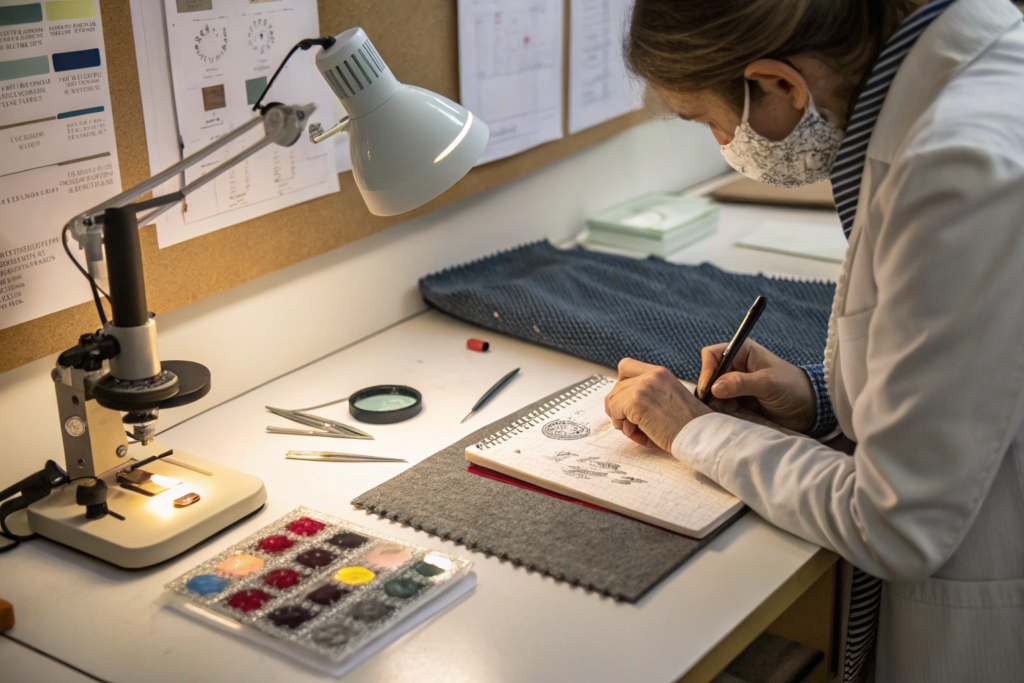
The process has four stages, and each stage generates data that feeds into the next. Stage one is fiber identification and yarn deconstruction. We do a burn test and a chemical solubility test to determine the fiber composition—is it 100% cotton, a cotton-poly blend, a viscose-nylon mix? Then we unpick a single warp yarn and a single weft yarn from the swatch edge. Under a microscope, we measure the yarn count in Ne or denier, the twist level in twists per inch, the twist direction, and whether the yarn is ring-spun, open-end, or filament. For peach skin, we’re specifically looking for evidence of long-staple fibers, micro-denier filaments, or filament-staple core-spun combinations. Stage two is weave analysis. Using a pick glass, we identify the weave structure—typically a twill, satin, or a variation like a 4/1 satin with a high float on the face—and count the ends per inch and picks per inch. Peach skin finishes almost always sit on a weave with a warp-float face because the long floats expose more fiber surface area to the brushing rollers. Stage three is weight and dimensional analysis. We measure the GSM, the width, and the thickness under a calibrated pressure foot. Stage four, and the most difficult, is the finishing analysis. We examine the surface under 60x-100x magnification to determine whether the fibers are cut (sanding) or raised (brushing), we measure the nap height and density, and we use a combination of wash tests and chemical extraction to identify the finishing chemistry.
Can You Identify the Original Finishing Chemistry with a Simple Burn or Solvent Test?
A burn test alone won’t tell you what softener was used, but it will give you critical clues about the fiber composition, which narrows down the chemistry considerably. Bring a lighter to the swatch—carefully, in a well-ventilated area—and observe the smoke, the flame, and the ash. Cotton burns with a yellow flame, smells like burning paper, and leaves a soft, gray ash. Polyester shrinks from the flame, melts, burns with a black, sooty smoke, and leaves a hard, black bead. Nylon burns with a blue base and yellow tip, smells like celery or burning plastic, and leaves a hard, tan bead. If the fabric is a blend, the burn test will reveal which fiber is dominant by the behavior of the flame. Once you know the fiber, you know what chemical classes are possible.
For the finishing chemistry specifically, a solvent extraction test gives more information. Soak a small piece of the swatch in warm water at 60°C for 20 minutes. If the water develops a cloudy, slightly oily film, the fabric likely has a silicone softener—the oil is the silicone emulsion releasing from the fiber surface. If the water stays clear but the fabric loses its softness significantly, the softener was likely cationic and water-soluble, washing out easily. If the fabric feels unchanged after soaking, the finish may be a reactive silicone or an enzyme treatment that’s chemically bonded to the fiber. A second test: soak the swatch in a small amount of ethanol or acetone for 10 minutes. If the solvent extracts a visible residue, the softener is likely a non-reactive silicone or a wax-based finish that sits on the fiber surface rather than bonding to it. If the solvent extracts nothing, the softener is likely a reactive amino-silicone that has cross-linked to the cellulose fibers and is effectively permanent. At Shanghai Fumao, we use these simple bench tests as a quick screen before sending samples for formal FTIR spectroscopy, which identifies the exact chemical functional groups present. The bench tests cost nothing and give you a working hypothesis in 30 minutes. For a practical guide to these diagnostic methods, this textile lab resource on how to identify fabric finishing chemicals through simple bench tests provides step-by-step protocols and interpretation guides.
How Many Washing Cycles Should a "Trade Show Sample" Survive Before You Approve It for Bulk?
The fabric you touched in Paris was pristine. It had never been washed. It had never been tumbled in a home dryer. It had been handled by exactly two people—the technician who finished it and the salesperson who hung it in the booth. The bulk production fabric you order will be worn, sweated in, washed, and dried dozens of times by a customer who doesn’t read care labels. If your peach skin finish collapses after three washes, you haven’t replicated the trade show fabric. You’ve replicated a photograph of the trade show fabric. It looks the same out of the box and performs completely differently in real life.
The standard I hold our peach skin developments to at Shanghai Fumao is a minimum of 20 home wash cycles without significant surface degradation. We test according to AATCC 135, normal cycle, tumble dry medium, and we photograph the surface at cycles 1, 5, 10, and 20 under standardized lighting and magnification. At cycle 5, we expect the nap to have "settled"—the longest, most loosely attached fibers will have released, and the surface will be slightly smoother than the unwashed state. This is normal and acceptable. Between cycle 5 and cycle 20, the surface should be stable. No additional fiber loss. No pilling. No flattening of the nap into shiny patches. If the fabric passes 20 cycles with stable surface characteristics, it’s approved for bulk. If it doesn’t, we go back to the finishing recipe and adjust. Usually, the failure mode is that the softener wasn’t durable enough—a non-reactive silicone that washes out—or the brushing process raised fibers too aggressively without anchoring them through sufficient enzyme or heat-setting treatment. A European premium brand we supply ran their own wash testing on our peach skin cotton-modal sateen in early 2024. They went to 30 cycles. At 30, the surface was still acceptable, but they noted a slight loss of the "cool-to-touch" sensation. We adjusted the finishing by adding a hydrophilic post-treatment after the brushing stage, which restored the thermal character even after repeated washing. The revised version is now their best-selling fabric across three seasons. For a technical standard you can reference with your own suppliers, this textile testing guide on how to specify wash durability for brushed fabric finishes provides AATCC and ISO test methods with acceptance criteria.
Which Mechanical Process Creates the True Peach Skin Effect?
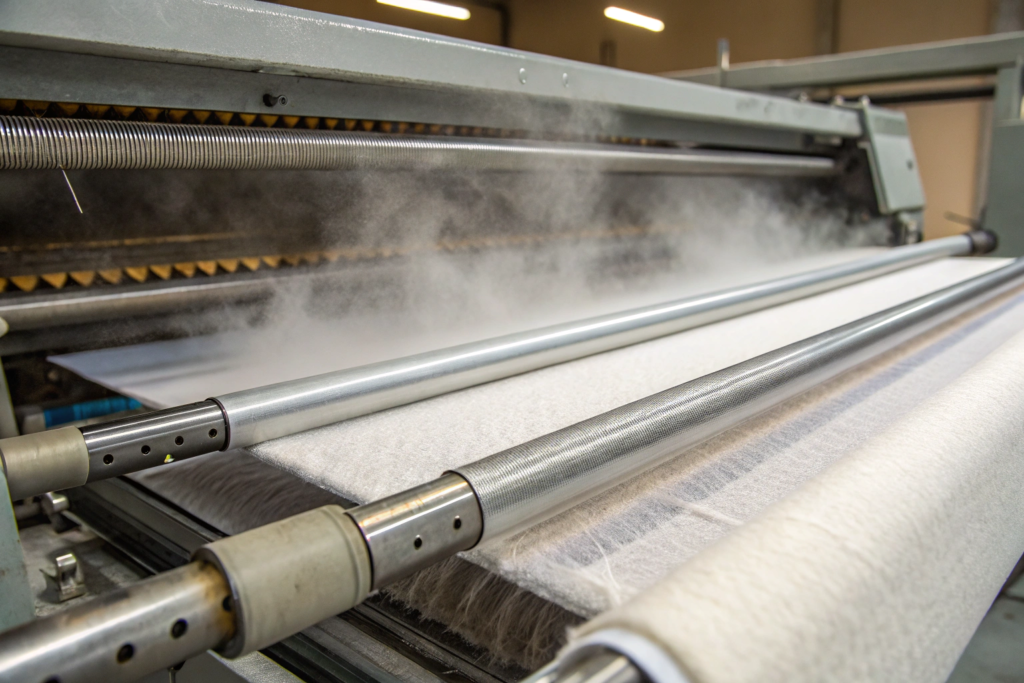
The mechanical heart of the peach skin finish is the brushing machine, and not all brushing machines are created equal. The classic approach—and the one that still produces the best results for woven fabrics—is the rotary brush sueding machine. This machine uses a series of rotating cylinders covered with fine wire bristles or carbon fiber filaments. The fabric passes over these cylinders at a controlled tension and speed, and the bristles sweep across the fabric surface, catching individual fiber ends and pulling them upright. The key variables are bristle material, bristle density, cylinder rotation speed relative to fabric speed, and the number of brushing stations. A typical peach skin line has four to six brushing stations, with the bristle density increasing and the bristle stiffness decreasing from station to station. The first station uses coarser, stiffer bristles to do the heavy lifting—raising the bulk of the fiber ends. The final station uses extremely fine, flexible bristles to polish the raised nap, laying down any fibers that are too long and creating that uniform, peach-fuzz surface.
At Shanghai Fumao, we use a six-station Italian-made Lafer brushing line for our premium peach skin wovens. The first two stations are wire-bristle, the middle two are carbon fiber, and the final two are a combination of carbon fiber and a felt polishing roller that gives the final surface its characteristic dry hand. We can adjust the pile/ counter-pile direction at each station independently, which means we can create different surface effects—a uni-directional nap that feels smooth in one direction and rough in the other, or a multi-directional "peach" finish that feels consistent no matter which way you stroke it. The machine speed for a typical 150 GSM cotton-modal fabric is 12-15 meters per minute. Go faster, and you sacrifice uniformity. Go slower, and you risk over-brushing—raising so many fibers that the fabric loses tensile strength and begins to look hairy rather than peachy.
Why Does the Peach Skin Finish Fail If the Fabric Tension Is Slightly Off During Brushing?
Fabric tension during brushing is the variable that separates professional peach skin from amateur hour. If the tension is too high, the fabric is pulled taut across the brushing rollers, and the bristles can only access the very tips of the surface fibers. The result is a weak, inconsistent nap that’s barely visible and disappears after the first wash. If the tension is too low, the fabric sags into the brushing zone, and the bristles dig too deep into the yarn structure, pulling out entire fiber bundles rather than just surface ends. The result is a rough, irregular surface with visible pulled yarns, which the industry calls "brushing chatter" because the irregularity looks like vibration marks.
The correct tension depends on the fabric weight, the weave structure, and the fiber elasticity, but as a starting point, a 150 GSM twill should enter the first brushing station at about 15-20 Newtons of tension per meter of fabric width. This is measured with a tension load cell at the entry roller, and it’s a setting that our machine operators check every 30 minutes during a production run. The tension also needs to be progressively reduced through the brushing line. The first station, which does the aggressive raising, runs at the highest tension to keep the fabric controlled against the strong bristles. Each subsequent station reduces tension by about 10-15%, allowing the fabric to relax slightly as the finer bristles polish the already-raised nap. Getting this right took us months of trial and error, and we destroyed a lot of perfectly good fabric learning it. If your supplier’s brushing machine operators can’t tell you what tension they run for a given fabric construction, they’re running by feel, and running by feel produces inconsistent results. For a deeper technical explanation, this textile machinery resource on fabric tension control in mechanical finishing explains the tension variables and their effects on different fabric constructions.
Can You Achieve a "Cold" Peach Hand for Summer vs. a "Warm" Peach Hand for Winter?
Yes, and this is where the artistry of finishing chemistry meets the mechanics of brushing. The temperature of a fabric’s hand—whether it feels cool and crisp or warm and cozy against the skin—is determined by a combination of surface structure and thermal conductivity. A "cold" peach skin, suitable for summer shirting and dresses, starts with a fabric base that has high thermal conductivity—typically a cellulose fiber like cotton, linen, or Tencel, which naturally draws heat away from the skin. The brushing is light, just enough to create a peach bloom on the surface without building a dense nap that would trap air and insulate. The finishing chemistry uses a hydrophilic softener that maintains the fiber’s natural moisture absorption, keeping the fabric feeling dry and cool to the touch. The result is a fabric that has the soft peach surface but still feels crisp and breathable—perfect for a summer blazer or a lightweight trouser.
A "warm" peach skin, suitable for winter loungewear and cozy shirting, uses a brushed polyester or a brushed cotton-modal blend as the base, with a deeper, denser brushing that builds a thicker nap. The nap traps a layer of still air against the skin, and still air is an excellent insulator. The finishing chemistry shifts to a slightly hydrophobic softener—often a reactive amino-silicone—that gives the surface a silky, warm hand rather than a cool, dry one. A Japanese brand we work with splits their peach skin program into "Summer Peach" and "Winter Peach" with completely different base fabrics and finishing recipes. The summer version is a 120 GSM Tencel-rich twill with a light, cool-hand peach finish. The winter version is a 200 GSM cotton-modal blend with a dense, warm-hand peach finish. Both are recognizably "peach skin," but they feel like different seasons. The brand’s wholesale buyers have learned to ask for the season-specific versions by name because the thermal character is so distinct. For more on how to spec seasonal hand feel differences, this fabric finishing guide on thermal hand feel engineering for seasonal collections explains how fiber choice, nap density, and softener chemistry interact to create cool, neutral, or warm tactile sensations.
How Do You Lock the Peach Skin Finish So It Survives Commercial Laundering?
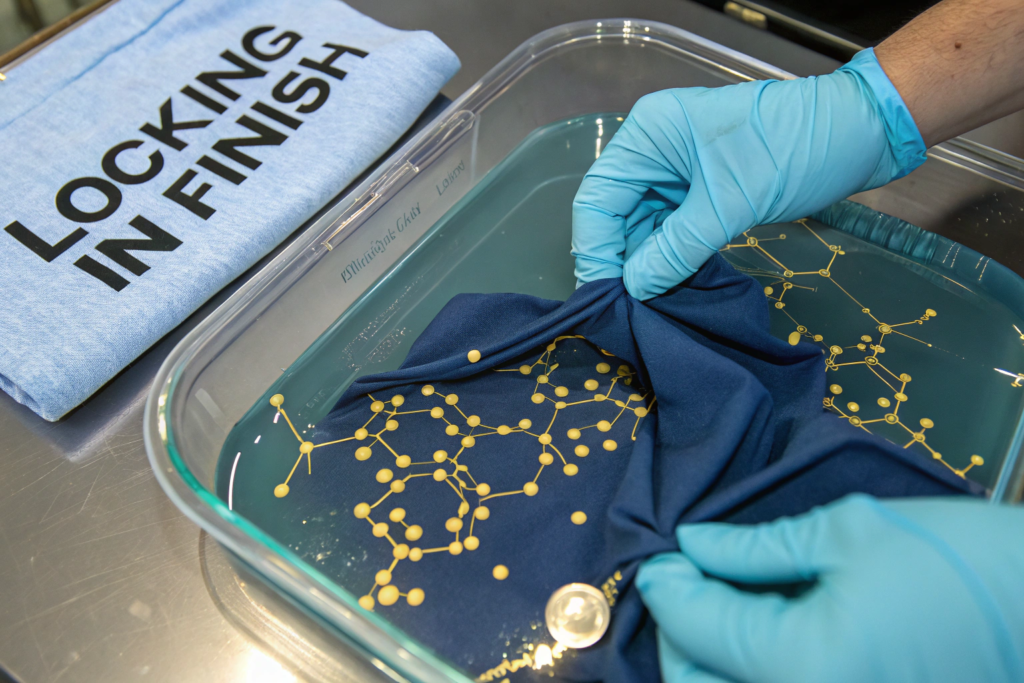
The mechanical brushing creates the peach skin effect. The finishing chemistry locks it in place. Without the locking step, the raised fibers are just standing up by mechanical force. They haven’t been anchored. The first time the fabric goes through a washing machine—with water, detergent, agitation, and heat—those un-anchored fibers will relax, collapse, and mat down against the fabric surface. The peach skin effect disappears, and the customer is left with a flat, slightly fuzzy fabric that feels nothing like what they bought. This is the single most common failure mode of cheap peach skin fabrics, and it’s why so many buyers are skeptical that a durable peach skin is even possible.
The locking chemistry depends on the fiber type. For cellulose fibers—cotton, viscose, modal, Tencel—the most effective locking system is a reactive, self-crosslinking amino-silicone. The amino groups in the silicone form hydrogen bonds with the hydroxyl groups on the cellulose molecules, essentially gluing the silicone to the fiber. The "self-crosslinking" part means that the silicone molecules also bond to each other, creating a three-dimensional network that’s physically durable. When the fabric is cured at 150-160°C in a stenter frame, the crosslinking reaction completes, and the silicone network locks the raised fibers in their brushed orientation. For synthetic fibers—polyester, nylon—the locking chemistry uses a different mechanism. Polyester doesn’t have hydroxyl groups for hydrogen bonding, so the finish relies on a combination of heat-setting and a film-forming polyurethane dispersion. The polyurethane forms a microscopic, flexible, invisible film over the raised fibers, holding them in place mechanically rather than chemically. The heat-setting step—running the fabric through a stenter at 180-190°C—relaxes the internal stresses in the polyester fibers so they "remember" their brushed position.
What Is the Ideal Silicone-to-Enzyme Ratio for a Durable Cellulose Peach Skin?
This ratio is one of our closely guarded internal standards at Shanghai Fumao, but I can share the principle that will help you evaluate your own supplier’s approach. The enzyme—typically a cellulase used in a bio-polishing step before the brushing—removes the weakest, shortest surface fibers before the brushing even starts. If you skip this step, the brushing will raise those weak fibers along with the strong ones, and the weak fibers will break off in the first wash, creating pilling and surface roughness. The silicone—applied after brushing—locks the remaining strong, raised fibers in place. The ratio that we’ve found optimal for cotton-modal peach skin fabrics is a 2% enzyme treatment (on weight of fabric) at 50-55°C for 30-40 minutes before brushing, followed by a 3-4% amino-silicone macro-emulsion application after brushing, cured at 155°C for 90 seconds.
If a supplier uses too much enzyme—say, 5-6%—the bio-polishing is too aggressive, and it weakens the fiber structure so much that the brushing stage pulls out entire fiber segments, leaving the fabric thin and weak. If they use too little enzyme—under 1%—the weak fibers remain, and the surface pills within the first five washes. If they use too much silicone—over 6%—the hand feel becomes greasy and the fabric loses breathability. If they use too little silicone—under 2%—the raised fibers aren’t adequately locked and the peach effect washes out. The window is narrow, and it took us approximately 40 lab trials to find the sweet spot for our standard 150 GSM cotton-modal peach skin base. For a deeper look at this chemistry, this textile finishing resource on enzyme and silicone process optimization for peach skin fabrics provides data from controlled experiments showing how different enzyme-to-silicone ratios affect durability and hand feel.
Should You "Wash Out" the Finish Before Shipping to the Garment Factory?
I learned the answer to this question the hard way, and it cost me an order from a very good client about eight years ago. We had developed a beautiful peach skin brushed cotton twill. The finish was locked, the hand feel was perfect, and we shipped it to the garment factory in Vietnam. The factory cut and sewed the fabric into jackets, and the jackets looked great. Then the factory did their standard post-production wash—a light enzyme wash to remove any handling marks and give the garment a soft, retail-ready hand. The wash stripped our peach skin finish. The silicone locked the fibers against home laundering, but it couldn’t withstand the more aggressive commercial enzyme wash. The jackets looked flat and washed-out, and the buyer was furious. We had tested the fabric for home wash durability. We hadn’t tested for commercial garment wash durability.
Since then, our policy at Shanghai Fumao is that any peach skin fabric destined for post-production garment washing must be "pre-aged" before shipping. We run the finished fabric through a single, controlled industrial wash cycle in our own facility—essentially, we simulate the garment factory’s wash process on the flat fabric. This pre-wash removes the most loosely attached surface fibers, relaxes any residual shrinkage, and stabilizes the hand feel. The fabric that arrives at the garment factory is the fabric that will emerge from their wash process. There are no surprises. The hand feel of the pre-washed fabric is slightly less dramatic than the fresh-off-the-brushing-machine fabric—it’s a bit more muted, a bit more settled—but it’s honest. What the buyer feels on the pre-production sample is what the customer will feel on the retail floor. If your peach skin supplier can’t provide a pre-washed hand feel standard, or if they resist the idea of pre-washing, they may be hiding a durability problem. For more on this topic, this garment manufacturing guide on how to specify fabric wash-down compatibility for brushed finishes provides test protocols for matching fabric finishes to garment wash processes.
Conclusion
Replicating a peach skin finish from a Paris trade show is not about finding one magic machine or one secret chemical. It’s about understanding the finish as a system—fiber selection, yarn engineering, weave structure, mechanical brushing, and chemical locking—and getting every element of that system right simultaneously. The fiber must be long or fine enough to bend without breaking. The weave must present enough fiber surface area to the brushes. The brushing must raise the fibers without cutting them. The chemistry must lock the raised fibers in place without coating them in a greasy film. And the entire system must survive 20 home wash cycles—or a commercial garment wash, if that’s your production route—without collapsing.
The reason a peach skin finish commands a premium price at trade shows is not that it’s expensive to make—the incremental cost over a standard brushed finish is about $0.40-0.70 per meter. It’s that it’s difficult to make consistently, and most mills won’t invest in the process control required. The mills that can deliver a true, durable peach skin finish at scale are the ones that have made a strategic commitment to the category, with dedicated brushing lines, automated chemistry control, and rigorous wash testing. At Shanghai Fumao, that commitment is real. We have the Lafer brushing line, the enzyme pre-treatment tanks, the silicone curing stenter, and the in-house AATCC wash testing lab. We can take your trade show swatch, reverse-engineer it in two weeks, and deliver a pre-production sample that matches it.
If you’re holding a fabric sample that you can’t stop touching, and you want to bring it to market with a supplier who actually understands how to make it, reach out to Elaine, our Business Director, at elaine@fumaoclothing.com. Send her a photo of the swatch, and she’ll let you know if we can replicate it—and in most cases, we can. We’ll send you back a strike-off that you can touch, wash, and test yourself. The peach skin finish is a technical challenge, but it’s one we’ve solved. Now it’s your turn to impress your buyers.