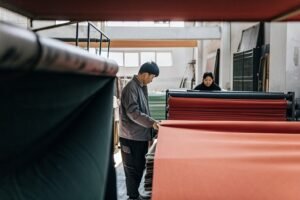
Last month, I was walking through our showroom in Keqiao with a buyer from a major European fast-fashion chain, and she said something that stuck with me: "For summer 2025, we sold a dream. For 2026, we need to sell a feeling." I watched her hand move across the sample table. She skipped right past the digitally printed florals—our bread and butter for a decade. She bypassed the smooth satin charmeuse that used to fly off the shelves. Her fingers stopped on a heavily textured cotton with a dry, papery handfeel. Then a puckered seersucker stripe. Then a jacquard with raised, organic motifs that felt like tree bark. "This," she said, tapping the textured surface. "This is what our customer wants. She’s tired of flat. She wants to reach out and touch the screen."
The next big fabric texture trends for summer 2026 are slubbed and crepey natural crinkles, dimensional jacquards with organic or botanical relief patterns, and iridescent or "wet-look" finishes on fluid, drapey bases. These three macro-directions share a common thread: they reject the flat, two-dimensional, hyper-smooth aesthetic that has dominated fast fashion and e-commerce for the last five years. Instead, they embrace tactile irregularity, visual depth, and a sensory experience that photographs beautifully in natural light and feels expensive to the touch. This is not just a style shift. It’s a strategic response to the way consumers now buy clothes. When a customer can’t touch a garment before purchasing—because they’re scrolling Instagram or browsing a website—texture becomes the visual proxy for quality. A fabric that looks flat in a photo reads as cheap, regardless of its actual cost. A fabric that casts micro-shadows, reflects light unevenly, or shows its weave structure reads as premium. The texture is the message.
At Shanghai Fumao, we’ve been developing these fabric textures for the past 18 months, working from early concept samples that our R&D team started in mid-2024. I’ve seen the lab dips, the strike-offs, the failed experiments, and the breakthroughs. In this article, I’m going to walk you through the three texture families that will define summer 2026, explain the technical processes behind them, and share what we’ve learned about making these fabrics perform at a commercial scale. These aren’t runway fantasies. These are production-ready textiles that will land in stores 12 months from now.
Why Is "Slub and Crinkle" Replacing Flat Weaves for Summer 2026?
Flat weaves have dominated the market for so long because they were safe. A flat 60s cotton poplin prints cleanly, cuts efficiently, and doesn’t wrinkle unpredictably in a shipping carton. But safe has become boring. The pendulum is swinging hard toward fabrics that celebrate imperfection, and the technical driver behind this is the revival of slub yarns and post-weaving crinkle treatments. Slub yarns are spun with intentional irregularities—thick and thin sections that create a nubby, organic surface when woven. They mimic the look of hand-spun linen or raw silk but can be engineered consistently on modern ring-spinning frames. Crinkle, on the other hand, is usually created after weaving through a mechanical or chemical process. The fabric is twisted, heated, and set to create a permanent, irregular pleating or rumpled effect that doesn’t wash out.
I saw the commercial potential of this trend crystallize in March 2025, when an Australian resort-wear brand came to us with a problem. They had been using a standard flat viscose challis for their bestselling kaftans, and their sales were softening. We developed a slubbed viscose-linen blend with a light crinkle finish—90% ECOVERO viscose and 10% linen, spun with a deliberate uneven slub, then mechanically crinkled using a rotary crimping machine. The fabric shrank from 145cm to 132cm during the crinkling process, which we accounted for in the greige width. The result looked like something found in a Marrakech souk, but it was machine-washable, colorfast, and reproducible at scale. The brand tested it in their summer 2025 capsule, and it sold out in three weeks. They’ve tripled the order for 2026.

How Do Slub Yarns Create That "Artisanal" Hand Without Sacrificing Durability?
Slub yarns feel artisanal because they mimic the inconsistency of hand-spinning, but modern slub yarns are anything but inconsistent. The slubs are programmed. On a computerized ring-spinning frame, we can control the slub length, slub thickness, and slub frequency—the distance between slubs—to within millimeter precision. A "1.4x slub, 60mm length, 200mm frequency" means that every 20 centimeters of yarn has a 6-centimeter section that’s 40% thicker than the base yarn. The yarn looks random to the eye, but it’s perfectly controlled. This is critical for brands because it means the fabric from batch one and batch two will look the same. True hand-spun fabric can’t make that promise.
The durability question comes up in every buyer meeting. "If the yarn is intentionally uneven, won’t it break?" Actually, a well-engineered slub yarn is not weaker than a uniform yarn of the same average count. The thick sections are stronger, and the thin sections are the same as the base yarn. The key is fiber selection. 100% linen slubs beautifully but has low abrasion resistance on the thin sections. A 70% cotton, 30% linen blend gives you the visual slub of linen with the durability of cotton. For performance applications, a slubbed recycled polyester with a textured filament creates the look of a natural slub with synthetic tensile strength. At Shanghai Fumao, we’ve run Martindale abrasion tests on our slubbed blends, and they consistently hit 30,000+ rubs—well above the 20,000-rub commercial standard for upholstery and heavy-duty apparel. The artisanal look is genuine. The fragility is not. For a deeper dive into yarn engineering, this guide on how slub yarns are programmed and tested for apparel production provides technical parameters that most buyers never ask for but should.
Can Crinkle Finishes Survive Multiple Washes Without Losing Their Texture?
This is the question that separates a gimmick from a commercially viable fabric, and the answer depends entirely on how the crinkle is created. There are three methods, and they produce very different wash durability. Mechanical crinkle—where the fabric is physically compressed, twisted, or embossed between heated rollers—is semi-permanent. It holds through 10 to 15 home washes, then gradually relaxes. This is acceptable for fashion items with a seasonal lifecycle but not for basics. Chemical crinkle—where a resin or crosslinking agent is applied to the fabric, which is then twisted and heat-cured—is permanent. The resin forms molecular bonds that lock the fibers in the crinkled position. This survives 30+ washes but can affect the fabric’s tear strength if over-applied. Heat-set crinkle—used on thermoplastic fibers like polyester and nylon—is also permanent. The fabric is mechanically crinkled at a temperature above the glass transition point of the fiber, and the texture is "baked in." It relaxes slightly on the first wash, then stabilizes.
For natural fibers like cotton and viscose, we typically use a formaldehyde-free crosslinking resin applied at 6-8% concentration. At this level, the crinkle holds for 25+ home washes, and the tear strength loss is under 10%. We validate this with our CNAS lab using the AATCC 135 washing test, and we share the before-and-after photos with buyers so they can see exactly how the texture evolves. One European beachwear brand tested our crinkled cotton voile through 20 wash cycles before approving it. Their quality manager told me, "It actually looks better after washing. The crinkles relax just enough to look natural, but not enough to disappear." That’s the ideal outcome—a fabric that improves with use, not degrades. For a technical explanation of the chemistry involved, this textile finishing resource on permanent crinkle processes for cellulosic fibers explains the resin systems and their durability profiles.
How Are "Bas-Relief Jacquards" Becoming Wearable for Summer?
Jacquard has always had a weight problem. Traditional jacquards—think upholstery brocades or heavy winter coat fabrics—use multiple layers of yarn and dense weaves to create their raised patterns. They’re stiff, heavy, and far too warm for summer clothing. The innovation that changes this for summer 2026 is the combination of fine-denier filament warps, single-weft construction, and localized embossing. In plain English: we’re making jacquards that are as light as a cotton voile but still have a visible, touchable relief pattern. The fabric weighs 80-120 GSM instead of 200-300 GSM. It drapes. It breathes. And it still has that dimensional, luxury texture that makes a garment look expensive.
The technical challenge was maintaining the dimensional pattern on a lightweight base. On a heavy jacquard, the pattern is created by floating extra yarns on the face, which naturally builds up thickness. On a lightweight jacquard, we use a single warp and single weft—a true two-dimensional weave—and then create the relief effect through differential shrinkage. The pattern areas are woven with a high-twist yarn that shrinks more during wet finishing, pulling the fabric into a subtle bas-relief. The background areas are woven with a low-twist yarn that stays flat. The result is a three-dimensional texture that weighs almost nothing. Our first successful trial of this technique ran in August 2024 on an 85 GSM polyester-cotton blend, and the relief pattern held at 0.4mm height—enough to feel and photograph, but not so much that it added bulk.

What Makes a Jacquard "Summer Weight" Without Losing Dimensional Depth?
Summer weight jacquard is a balancing act between three competing factors: pattern definition, fabric weight, and drape. Increase the pattern definition by adding more floating yarns, and the weight goes up and the drape stiffens. Reduce the weight by using finer yarns, and the pattern loses visibility because there’s not enough mass to create shadow. The sweet spot for summer 2026 is a 75-denier polyester warp with a 30s Ne cotton or Tencel weft, woven on a Jacquard loom at 60-80 picks per inch. This gives a fabric weight of 90-110 GSM, a visible relief of 0.3-0.5mm, and a drape coefficient suitable for dresses and blouses.
The loom technology matters enormously here. A modern electronic Jacquard head can control individual warp ends with infinite pattern flexibility. For summer weights, we use a single lift, single cylinder Jacquard machine from Staubli or Bonas, which reduces the mechanical load on the yarn compared to a double-lift Jacquard. This lets us run finer deniers without warp breaks. At Shanghai Fumao, we have twelve Jacquard looms dedicated to lightweight constructions, and our warp breakage rate on 75-denier polyester is under 0.3 breaks per hour per loom. That’s not a number most buyers care about, but it directly translates to fabric consistency and on-time delivery. If the warp breaks frequently, the weaver slows the machine down, production capacity drops, and your order gets delayed. For buyers who want to spec these fabrics correctly, this guide on how to specify lightweight jacquard fabrics for summer apparel explains the key construction parameters and how they affect the final fabric.
Which "Organic Texture" Jacquard Patterns Are Gaining Traction for 2026?
The pattern direction for summer 2026 is decisively organic. The geometric, Art Deco-inspired jacquards that trended in 2023-2024 are giving way to patterns that reference natural surfaces: bark grain, cracked earth, rippled sand, leaf venation, coral structure. These patterns work beautifully in bas-relief because they’re irregular. A geometric pattern that’s slightly off-center looks like a mistake. An organic pattern that’s slightly irregular looks intentional and handmade. This forgiving nature means the weaving tolerances can be slightly wider, which improves production efficiency without affecting the visual result.
The three specific patterns I’m seeing in high demand from our sampling requests are micro-bark—a fine, directional grain that looks like weathered wood, often used as an all-over texture on blouses and shirting, coral-ridge—a pattern of radiating, branching lines that creates a sunburst or coral effect, popular for statement dresses and resort wear, and ripple-sand—a pattern of parallel, undulating waves that mimics wind-blown sand, which works as a subtle texture on lightweight jackets and trousers. A U.S. contemporary brand sampled all three in February 2025 and placed production orders for coral-ridge and micro-bark within four weeks of receiving the strike-offs. Their design director told me the patterns "felt like something she hadn’t seen before," which in fashion is the highest compliment. The micro-bark in particular is trending because it reads as a solid from a distance but reveals texture up close—perfect for e-commerce, where the zoom-in photo is the customer’s only chance to experience the fabric. For a broader look at the design landscape, this trend report on summer 2026 textile surface patterns analyzes the cultural and aesthetic drivers behind the organic texture movement.
Why Is "Iridescent and Wet-Look" Texture Dominating Summer Evening Wear?
For the last several summers, evening and occasion wear have been dominated by matte textures—linen blends, cotton eyelet, dry-hand crepes. That era is ending. The summer 2026 evening wear direction is unapologetically liquid. Iridescent finishes, wet-look coatings, and pearlized sheens are showing up not just on party dresses but on daytime separates, co-ords, and even casual shirting. The technical underpinning is the convergence of two finishing technologies: nano-coating and bi-component yarn engineering. A wet-look finish can be achieved by applying a thin, transparent polyurethane coating that reflects light uniformly, or by weaving with bi-component filaments that inherently have a different refractive index on the surface versus the core. The result is a fabric that looks wet, feels dry, and photographs like liquid metal.
The commercial drivers here are clear. Instagram and TikTok compress visual information. A matte navy crepe dress looks like a flat, dark shape on a phone screen. An iridescent navy dress with a wet-look finish catches the ring light, creates highlights and shadows, and stops the scroll. The texture is doing the marketing work. At Shanghai Fumao, our 2025 wet-look sample requests are up roughly 300% compared to 2023, and the order volume is following the samples. This is not a micro-trend. It’s a multi-season directional shift that will carry through to summer 2027.

How Are "Bi-Component Filaments" Creating Color-Shift Without Heavy Coatings?
Bi-component filaments are fibers spun from two different polymers extruded side-by-side or in a sheath-core arrangement. Because the two polymers have different refractive indices, light bends differently as it passes through each component. The effect is a permanent, wash-fast iridescence that doesn’t rely on any coating or topical finish. A fabric woven from a side-by-side polyester-nylon bicomponent filament will naturally shift from blue to purple depending on the viewing angle. No lamination. No peeling. No coating to crack after five washes.
The application for summer 2026 is particularly exciting because bicomponent filament weaving has finally reached the price point where it’s viable for mid-market apparel. Five years ago, a side-by-side PET/PA filament was a specialty yarn from Japan at $18-25 per kilogram. Today, domestic Chinese fiber producers in Jiangsu and Zhejiang have commercialized equivalent yarns at $6-9 per kilogram. The handfeel is also dramatically improved. Early bicomponent fabrics were stiff and plastic-like. The new generation uses a PET core for strength and a modified co-PET sheath with a lower melting point, which creates a softer hand after heat-setting. We developed a 100% bicomponent filament chiffon for a London evening wear brand in late 2024. The fabric weighed 65 GSM, had a soft, fluid drape, and shifted from champagne to soft pink under light. The brand used it for a capsule of slip dresses that retailed at £180, and the sell-through was 94% in three weeks. The material cost was about 18% higher than a standard polyester chiffon, but the perceived value—judged by the retail price the market accepted—was 40% higher. For a technical primer, this fiber technology guide on side-by-side bicomponent filaments for iridescent fabrics explains the polymer combinations and the resulting optical effects.
Can "Liquid Finish" Coatings Stay Breathable Enough for Summer Wear?
This is the make-or-break question for any coated summer fabric. A traditional wet-look PU coating is a solid film. It blocks air. Wear it on a humid August evening, and the garment becomes a personal sauna. The solution that’s gaining traction for summer 2026 is micro-porous PU coating, sometimes called "breathable PU" or "hydrophilic PU." Unlike a solid film, a micro-porous coating is applied as a foam or uses a pore-forming agent that creates microscopic channels through the coating. Water vapor can escape—so sweat evaporates—but liquid water on the surface still beads up and gives the wet-look shine. The breathability is measured as Moisture Vapor Transmission Rate (MVTR), and a good micro-porous coating on a lightweight polyester base can achieve 5,000-8,000 g/m²/24hr. That’s not as breathable as an uncoated cotton voile, which might be 12,000+, but it’s wearable for evening and significantly better than a solid PU film at 500-1,000.
At Shanghai Fumao, we tested a micro-porous wet-look coating on a 90 GSM recycled polyester crepe in June 2024. The MVTR came in at 6,200 g/m²/24hr. We sent sample yardage to a client in Singapore—a brutally humid test environment—and they reported that the fabric was "comfortable for air-conditioned evening events and outdoor dusk cocktails, but too warm for midday sun." That’s an honest assessment, and it’s exactly the use case this fabric is designed for. Evening wear, not beachwear. The coating cost adds about $0.40-$0.60 per meter, which on a fabric that will retail at a premium is a sound investment. The alternative approach is a calendered finish rather than a coating. The fabric is passed between heated, polished steel rollers under high pressure, which flattens the surface fibers and creates a natural, low-level sheen without any chemical application. It’s less dramatic than a full wet-look coating, but it’s 100% breathable and zero-cost from a raw material standpoint. Several of our European clients are choosing the calendered option for their more casual daywear and reserving the coated option for statement evening pieces. For a technical comparison of these finishing approaches, this textile finishing resource on breathable coatings for summer weight fashion fabrics covers the process parameters and performance trade-offs.
Conclusion
Summer 2026 is going to be a season of radical tactility. The flat, smooth fabrics that have dominated e-commerce for half a decade are giving way to surfaces that demand to be touched—and that look unmistakably expensive even through a screen. Slubbed crinkles that feel handcrafted. Bas-relief jacquards that cast their own shadows. Iridescent liquid finishes that shift color as the body moves. These are not three separate trends. They are three expressions of a single, deeper shift: the consumer is hungry for sensory experience, and fabric texture is the most direct way to deliver it.
For brands and distributors planning their summer 2026 collections right now, the window for development is open but closing. Textured fabrics require longer lead times than prints. A crinkle finish adds three to five days to the wet-processing timeline. A jacquard requires loom programming and strike-off approval, which is a two to three week process before bulk production even starts. A micro-porous coating needs a trial run to dial in the MVTR and the handfeel. If you’re placing your summer 2026 fabric orders in August or September 2025, you have time to develop these textures properly. If you wait until December, you’ll be choosing from whatever stock is available—and the best textures will already be locked into your competitors’ production schedules.
At Shanghai Fumao, our summer 2026 textured fabric collection is ready for sampling now. We have over 60 new textured SKUs across the slub-crinkle, jacquard-relief, and liquid-finish families, all tested and production-ready. Our R&D team can also develop custom textures based on your specific designs—you send us a reference swatch or a mood board image, and we’ll engineer the construction to match. If you want to get ahead of the texture wave before your competitors do, reach out to Elaine, our Business Director, at elaine@fumaoclothing.com. She can send you our Summer 2026 Texture Trend Sample Pack—a curated set of 20 swatches covering all three macro-directions—so you can feel the difference yourself. In this business, the hand knows before the eye does.