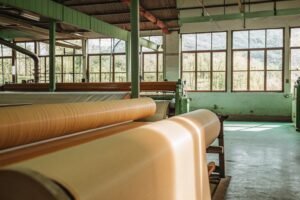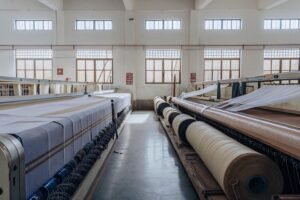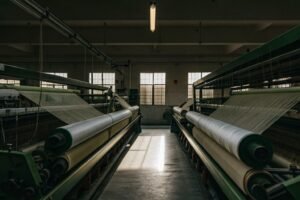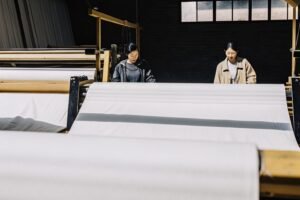
In 2019, a European luxury label I worked with discovered their signature jacquard pattern—a design they’d spent six months developing—on a competitor’s dress at a trade show in Paris. The fabric was identical. The weave structure, the color combinations, even the subtle metallic thread they’d sourced from a specialty mill in Japan. After a brief investigation, we traced it back. A freelance weaving technician at their contract mill in Jiangsu had saved the digital loom file to a USB drive and sold it to a local agent for ¥15,000. That’s about $2,100. For $2,100, a design that represented hundreds of thousands of euros in brand value was copied and commoditized. The brand had no recourse. They hadn’t registered the design in China. They hadn’t segmented their production. They hadn’t even watermarked their tech pack. They had, in effect, handed their recipe to a stranger and trusted them not to cook it for someone else.
You secure your fabric IP in China by building a defensive wall with four layers: legal registration, production fragmentation, relationship management, and technical countermeasures. The legal layer means filing design patents and copyrights in China specifically—not just in your home country—because Chinese courts only enforce Chinese IP rights. The fragmentation layer means splitting your production across multiple facilities so no single factory holds the complete recipe for your fabric. The relationship layer means working with mills that have a long-term stake in your success, not transactional suppliers who see your design as a one-time opportunity. The technical layer means embedding invisible markers, using encrypted digital files, and watermarking every physical sample you send. None of these layers alone is sufficient. Together, they create a system where stealing your IP is harder than developing something original.
I need to be direct about this because the fear of IP theft stops too many talented designers from accessing the best textile manufacturing in the world. China’s textile ecosystem—the dyeing expertise, the weaving speed, the finishing technology, the sheer creative energy of the mills in Keqiao—is unmatched. Walking away from it because you’re afraid is like refusing to use the internet because of hackers. You don’t need to be afraid. You need to be strategic. At Shanghai Fumao, we’ve been the production partner for brands ranging from startup designers to multinational fashion houses. I’ve seen what works and what fails spectacularly. This article is my practical guide to protecting what you create, drawn from real cases, real mistakes, and real solutions that have kept our clients’ designs secure for over 20 years.
What Are the Most Common Ways Fabric Designs Get Leaked in China?
I used to think IP leaks happened in dramatic midnight heists—someone breaking into the factory, stealing the files, and selling them to the highest bidder. After two decades in Keqiao, I can tell you the truth is much more boring and much more dangerous. The most common leak isn’t a theft. It’s an "overflow." A factory finishes your order of 5,000 meters. But they produced 5,500 meters because they anticipated defects. Your order ships, you’re happy, and those extra 500 meters sit in the warehouse. Six months later, a trader visits the factory looking for "interesting fabrics." They see the extra stock, buy it for cash, and it ends up in a market stall in Guangzhou or a small brand’s collection in another country. The factory wasn’t trying to steal your design. They were just monetizing excess inventory. The result is the same—your exclusive fabric is in the wild.
The second most common leak is sample trafficking. You send your tech pack and a reference swatch to five mills for quotation. Four of them are honest. One of them shares it with a trading company they’re friendly with. That trading company shows it to another buyer. Suddenly your "exclusive" design is being offered to your competitors before you’ve even placed an order. I’ve seen this happen to a swimwear brand from Australia in 2021. They sent out a request for quotation on a custom engineered stripe design for their signature rash guards. Within three weeks, a nearly identical fabric appeared on Alibaba, offered by a vendor they’d never even contacted. The original mill had shared the design with a sister company, and the sister company saw a commercial opportunity. The brand had no NDA in place, no paper trail, and no way to prove who leaked what.

How Do "Excess Production Runs" End Up in Local Markets?
Excess production—what we call "over-run" or "surplus" in the industry—is the silent killer of fabric exclusivity. Every mill builds a buffer into their production plan. For a woven cotton order, the standard overage is 3-5%. For printed fabrics with complex color matching, it can be 8-10%. The mill produces this extra fabric to cover for quality rejects—shade variation, weaving defects, finishing spots. You as the buyer typically agree to accept a ±5% quantity tolerance in the contract. So if you order 10,000 meters, the mill might weave 10,500 meters. You accept and pay for 10,200 meters because that’s within tolerance. The remaining 300 meters are technically the mill’s property.
Now, what happens to those 300 meters? If the mill has a strong IP protection policy—and at Shanghai Fumao, we do—that surplus fabric is destroyed or stored in a locked, client-specific area for a defined period and then destroyed. We actually send our clients a destruction certificate with photos of the fabric being cut or shredded. But many smaller mills don’t have this discipline. Those 300 meters sit in a corner. A local trader offers ¥8 per meter for it. That’s ¥2,400 in cash for fabric that was going to be thrown away. The mill owner says yes. Six months later, your exclusive fabric is being sold by street vendors at the Dongmen fabric market in Shenzhen. I confronted a small dyeing partner about this in 2020 after a client’s custom tweed appeared on a random WeChat store. The dyer was genuinely confused about why I was upset. "The order was finished," he said. "The client got what they paid for. This is waste fabric. Why can’t I sell it?" That conversation taught me that IP protection isn’t just about contracts. It’s about educating every link in the chain about what "exclusive" means to a brand. For a deeper understanding of the economics behind this practice, you can read this practical guide on how fabric mills manage surplus inventory and overstock, which explains the incentives that drive mills to sell excess rather than destroy it.
Why Are Tech Packs and Loom Files Often Shared Between Unrelated Factories?
The textile industry in China is a tightly networked ecosystem. The owner of a dyeing factory in Shaoxing plays mahjong with the owner of a weaving mill in Wujiang. Their wives went to school together. Their sons might do business together someday. In this environment, information flows like water through cracks. A tech pack sent to a weaving mill for quotation doesn’t stay with that mill. It gets forwarded to the mill’s yarn supplier to check if the specified yarn count is available. The yarn supplier forwards it to their spinning partner to confirm delivery times. Suddenly, your design is sitting on the desk of a company you’ve never heard of, in a town you’ve never visited.
I’m not describing a conspiracy. I’m describing standard operations. When we develop a new fabric at Shanghai Fumao, we might consult three yarn suppliers, two dyeing specialists, and a finishing expert—all before we give the buyer a final quote. Each of those consultations requires sharing some technical detail. The protection comes from controlling exactly what detail is shared and with whom. We never send the complete tech pack to a yarn supplier. They get the yarn spec only—count, twist, ply, fiber content. They don’t get the weave structure, the finishing recipe, or the brand name. That segmentation is manual, deliberate, and takes extra time. Most mills don’t bother. They forward the entire PDF and hope for the best. To see how other manufacturers approach this challenge, you can check out this industry forum thread on protecting customer designs when quoting in textile manufacturing, where factory owners discuss their internal protocols.
How Can You Legally Protect Your Fabric Designs in Chinese Courts?
Let me be blunt: if you haven’t registered your fabric design in China, you have zero legal protection here. Zero. Your U.S. copyright registration, your European design patent, your Australian trademark—none of them matter to a Chinese court unless you’ve also filed in China. This isn’t China being difficult. This is the principle of territoriality that governs IP law everywhere. A Chinese patent only protects you in China. An American patent only protects you in America. If you manufacture in China without Chinese IP registration, you are manufacturing in a country where your design legally doesn’t belong to you.
The good news is that registering a fabric design in China is faster and cheaper than most Western designers assume. The China National Intellectual Property Administration (CNIPA) allows you to file for a design patent that covers the visual appearance of a textile—the pattern, the color combination, the ornamental layout. This is not a utility patent. You’re not patenting the weaving technique. You’re patenting what the fabric looks like. The filing process takes about 6-8 months, costs roughly $800-$1,500 per design depending on complexity and whether you use an agent, and once granted, gives you 15 years of protection from the filing date. You can also file for copyright registration with the China Copyright Protection Center, which is even cheaper—around $100-$300—and faster, typically 1-2 months, though enforcement through copyright is generally considered weaker than through design patent.

How Do You Register a Textile Design Patent with the CNIPA?
The process is more straightforward than you might think, but it requires precision. You need to submit seven clear visual representations of your design—front view, back view, top view, bottom view, left view, right view, and a perspective view. For a fabric that’s essentially two-dimensional, the front and back views are the most critical. These must be high-resolution photographs or technical drawings on a white background, showing the pattern repeat clearly. You also need a brief description of the design, though you cannot include any functional language. You’re describing what it looks like, not what it does. "The fabric displays a repeating floral motif with metallic gold accents on a navy background" is appropriate. "The fabric is moisture-wicking and antibacterial" is not and will get your application rejected.
I helped a Canadian activewear brand register six print designs in 2022. We worked with an IP agent in Shanghai who specializes in textiles. The agent cost about $600 per design, and CNIPA’s official fees were about $150 per design. The applications took seven months to process. Three were approved on the first submission. Two required minor clarifications about the color scope—CNIPA wanted us to specify whether the design covered the exact colors shown or a broader color palette. One was initially rejected because the submitted images showed the fabric draped, which CNIPA considered ambiguous for a 2D design. We resubmitted with flat-lay photos and it passed. The total cost for six designs was just under $5,000, including the resubmission. That’s $5,000 to protect designs that the brand spent $80,000 developing. The math is not complicated. If you want to navigate this process without an agent, this unofficial guide on how to register a fabric design patent in China walks through each form and fee, though I still recommend using a professional for the first filing.
What Is the Difference Between a Chinese Design Patent and a Copyright for Fabric?
This is a question I get at least once a week from new designers, and the distinction matters enormously for enforcement. A Chinese design patent protects the ornamental appearance of a product—the shape, pattern, color, or combination thereof. For fabric, this means the visual design of the print, weave pattern, or surface ornamentation. A design patent gives you exclusive rights for 15 years, and enforcement is relatively strong because the patent certificate is a government-issued document that courts and customs officials can verify quickly. The downside is that the examination process takes 6-8 months, and the design must be novel—meaning it hasn’t been publicly disclosed anywhere in the world before the filing date.
Copyright in China, by contrast, arises automatically upon creation and can also be voluntarily registered. Copyright protects "works of authorship" including artistic works, which covers textile designs as applied art. Registration is cheap and fast—about 1-2 months and under $300. But enforcement is trickier. A copyright registration certificate is prima facie evidence of ownership, but the defendant can challenge it by claiming independent creation or prior art. In practice, design patents are stronger for stopping factory-level leaks because the patent document is technical and specific, making it easier for a judge to compare the registered design to the infringing product. Copyright is better for quick, low-cost protection while you wait for the design patent to be granted. Smart brands do both: file copyright immediately for fast protection, and file the design patent simultaneously for long-term enforcement power. For a more detailed comparison from a legal perspective, this resource on how Chinese design patent and copyright protection differ for textile designers is one I recommend to every new brand we onboard at Shanghai Fumao.
Why Should You Split Your Yarn, Weave, and Finish Across Different Suppliers?
This is the single most effective IP protection strategy I’ve used in my 20 years, and I learned it from watching how luxury maisons protect their supply chains. Never give one factory the full recipe. Think of your fabric like the formula for Coca-Cola. The company that mixes the final syrup doesn’t know the spice blend. The company that supplies the sweetener doesn’t know what it’s being mixed with. Only a tiny circle of people knows the complete formula. Your fabric can be protected the same way. The yarn supplier knows the fiber blend and the twist, but not the weave structure. The weaving mill knows the weave structure and thread count, but not the finishing chemistry. The finishing plant knows the softener and coating recipe, but not the yarn source.
This fragmentation creates a natural firewall. If the dyeing plant wants to run your fabric for another client, they have the greige fabric and the color recipe, but they don’t have the yarn source, so the next batch won’t feel the same. If the weaving mill wants to copy the construction, they can replicate the fabric, but they don’t have the finishing formula, so the hand feel will be different. If a competitor steals one piece of the puzzle, they still cannot replicate the full product. I implemented this approach for a Danish luxury home textiles brand in 2021. Their signature was a stonewashed linen-cotton blend with a specific enzyme finish that gave it a velvety hand. We sourced the yarn from a spinner in Zhejiang, wove it at our facility in Keqiao, and finished it at a specialty laundry in Guangdong—800 kilometers away. Each supplier knew their own step and nothing more. The total production cost was about 12% higher due to extra shipping between sites, but the brand hasn’t had a single IP leak in four years. Their CEO told me that’s the best 12% they’ve ever spent.

How Does the "Puzzle Piece" Approach Prevent Complete Design Theft?
The "Puzzle Piece" approach works because it attacks the economics of theft. Most IP theft in the textile industry is opportunistic, not targeted. A factory worker sees a beautiful fabric, realizes they have all the production files, and takes a chance. But if no single factory has all the production files, the barrier to theft rises sharply. To steal a fragmented fabric, a would-be thief would need to collude across two or three separate companies in different provinces, synchronize their data, and trust each other not to get caught or cheat. That’s no longer a quick ¥15,000 side hustle. That’s organized industrial espionage, and the penalties under China’s Unfair Competition Law—up to ¥5 million in damages plus criminal liability for trade secret theft—are severe enough to deter rational actors.
I saw this work in practice in late 2022. A fast-fashion brand approached one of our yarn suppliers, offering to pay for the exact yarn spec used in a high-end client’s fabric. The yarn supplier called me immediately. "Someone is asking for Client X’s yarn," they said. "What do I do?" Because the yarn supplier only knew the yarn spec—not the weave, not the finishing, not even the brand name—they recognized it purely by the technical parameters. They had no loyalty conflict because they didn’t know who the end client was. They just knew a strange request when they saw one. We thanked them, alerted the client, and the fast-fashion brand backed off. If that yarn supplier had also been the weaver and finisher, they would have known exactly whose fabric they were selling out. The temptation would have been much higher. For more thinking on this strategy, this supply chain security blog post on fragmenting textile production to protect trade secrets explores the operational details of how to structure these multi-supplier workflows.
What Is a "Blind Finishing" Program and How Does It Protect Hand-Feel Secrets?
A blind finishing program is when the fabric is sent to the finishing plant with a code number instead of a brand name, and the finishing recipe is pre-mixed and supplied in sealed containers rather than disclosed as a formula. Think of it like a blind taste test, but for chemicals. The finishing plant receives five 25-liter containers labeled "Component A," "Component B," and so on, with instructions for temperature, time, and sequence. They pour, mix, and apply. They never see the full formula. They never know what chemicals they’re actually using, or in what final concentration. They just follow the process.
We implemented a blind finishing program for a U.S. performance wear brand in 2023. Their competitive advantage was a silicone-based softener blend that gave their recycled polyester a cashmere-like hand without affecting moisture wicking. The softener was blended at a specialty chemical house in Shanghai, shipped in coded containers to our finishing partner in Keqiao, and applied by a single trusted technician who had signed a separate non-compete and confidentiality agreement. The finishing plant’s management knew they were applying "Client 37 Standard Softener." They didn’t know the chemical composition, the supplier, or the brand name. When a competitor approached that finishing plant a year later asking if they could replicate a "silky polyester hand," the plant said yes—but the result was different because they were guessing at the chemistry. The brand’s unique hand feel remained unique. The program added about 4% to the finishing cost, which for a premium brand selling $98 yoga tops was negligible. For a step-by-step breakdown of setting up this kind of arrangement, this practical resource on blind finishing protocols in textile chemical application explains how to work with chemical suppliers to pre-blend and codify your recipes.
How Do You Build Trust While Still Protecting Your Proprietary Processes?
There’s a tension here that every buyer feels. You need your supplier to understand your fabric intimately to execute it well. You need them to care enough to solve problems on the night shift when the dyeing machine acts up. But you also need them not to share what they learn with your competitors. How do you build a close, trusting relationship with someone while simultaneously building walls around your information? I’ve seen two approaches fail. The first is the "fortress" approach—treating the supplier as an adversary, demanding NDAs before every conversation, and making it clear you don’t trust them. This approach guarantees that when a problem arises, the supplier won’t go the extra mile for you. The second is the "naive" approach—sharing everything, assuming goodwill, and hoping for the best. This approach guarantees your design will eventually leak.
The middle path, which I’ve practiced at Shanghai Fumao with our own subcontractors, is what I call "trust with verification." You build a genuine human relationship—sharing meals, visiting their factory, understanding their business pressures—while simultaneously maintaining clear, verifiable boundaries around your IP. You say, "I trust you, and our contract is here to protect both of us." You share enough for them to do excellent work, and you’re transparent about what you’re not sharing. A good supplier will respect this. In fact, they’ll appreciate it, because it means you’re a professional who takes their work seriously. A bad supplier will push back, ask for the full formula, and that tells you everything you need to know.

How Can You Write an NDA That Actually Works in a Chinese Manufacturing Context?
Most NDAs I see are copy-pasted from American legal templates and are functionally useless in China. They’re 15 pages of dense legalese in English, referencing Delaware law, and signed by someone who doesn’t fully understand what they’re agreeing to. A Chinese factory owner looks at this document, sees a foreign language full of threats, and signs it because they want the order. But they don’t understand it, they don’t remember it, and a Chinese court will give it limited weight if it wasn’t properly translated and doesn’t reference Chinese law.
An effective NDA for Chinese manufacturing should be bilingual, with the Chinese version taking precedence. It should be short—two to three pages maximum—and written in plain language that a non-lawyer can understand. It should define trade secrets specifically: "The term ‘Confidential Information’ includes the attached technical specification sheet (Appendix A), the color standards (Appendix B), and the finishing recipe (Appendix C)." It should specify damages in concrete numbers, not just "reasonable royalties." "The parties agree that unauthorized disclosure of Confidential Information will cause damages of not less than RMB 200,000 per incident" gives a judge a clear number to work with. It should specify jurisdiction: "Any dispute shall be resolved by the Shanghai International Arbitration Center" is enforceable; "Any dispute shall be resolved in New York courts" is often not. I worked with a boutique fashion brand from London on their NDA in 2023. We used a Shanghai-based IP lawyer who charged $800 to draft a bilingual, China-specific NDA. The lawyer’s first piece of advice was "Delete the indemnification clause. Chinese courts rarely enforce American-style indemnification, and it scares factories for no reason." For a template to start from, this practical resource on drafting enforceable NDAs for Chinese manufacturing partnerships includes bilingual clauses and explanations of what Chinese courts actually look for.
When Should You Introduce a "Loyalty Clause" into Your Production Agreement?
A loyalty clause goes beyond an NDA. An NDA says "don’t share my information." A loyalty clause says "don’t work with my competitors using the knowledge you gained from my production." This is a step beyond standard confidentiality, and it must be negotiated carefully because it restricts the supplier’s future business. You can’t ask a mill to never produce a similar fabric for anyone else—that would be unreasonable and unenforceable. But you can ask them not to produce your exact fabric construction with your exact finishing recipe for a defined period, typically 12-24 months after your last order.
The right time to introduce a loyalty clause is after you’ve completed one or two successful production runs and the supplier sees you as a reliable, ongoing client. If you lead with a loyalty clause on a first inquiry, the supplier will either refuse or sign it without any intention of honoring it because there’s no relationship to back it up. But after you’ve paid on time, communicated clearly, and demonstrated that you’ll be a steady source of revenue, you have leverage. You can say, "We want to commit to three seasons of production with you, and in exchange, we need exclusivity on this specific construction until December 2026." This frames the loyalty clause as part of a mutual commitment, not a restriction. A Danish outdoor brand we work with introduced a loyalty clause in 2022 after their second season. The clause covered three specific fabric SKUs and expired 18 months after the final delivery. The mill agreed because the brand guaranteed a minimum volume of 8,000 meters per SKU per year. That volume commitment made the exclusivity worthwhile. The mill wasn’t giving up something for nothing. They were trading short-term flexibility for long-term stability. For more context on how these agreements are structured in practice, this industry analysis of loyalty and exclusivity clauses in textile production contracts shows real examples from brands that have successfully balanced IP protection with supplier relationships.
Conclusion
Securing your fabric IP in China is not about finding a perfectly honest supplier or a perfectly impenetrable legal wall. Neither exists. It’s about building a system where the cost and difficulty of stealing your design exceed the benefit. When you fragment your production across yarn, weave, and finishing suppliers, no single factory holds your full recipe. When you register your design patent and copyright in China, you have legal weapons that Chinese courts and customs will actually enforce. When you implement blind finishing programs and segmented tech packs, you reduce opportunistic leaks to near zero. When you build relationships with suppliers who see you as a long-term partner, you create a human incentive for loyalty that no contract can replicate. None of these measures is sufficient alone. Together, they make your fabric more trouble to steal than it’s worth.
I’ve watched this system protect designs worth millions of dollars in brand value. I’ve also watched talented designers lose everything because they trusted a single factory with their complete recipe and a handshake. The difference between those two outcomes isn’t luck. It’s preparation. You don’t need to be a giant corporation with a legal department to do this. You need to be a serious professional who treats their designs as valuable assets and their supply chain as a structure to be managed, not a black box to be hoped for.
If you’re developing a proprietary fabric and you want to build a secure production system from day one, reach out to Elaine, our Business Director, at elaine@fumaoclothing.com. Tell her about your design, and she’ll walk you through exactly how Shanghai Fumao segments production, manages documentation, and protects client IP. We don’t just sell you fabric. We give you the infrastructure to sleep soundly knowing your designs are safe while they’re being made. That’s the only way we do business, and it’s the only way we think you should accept.