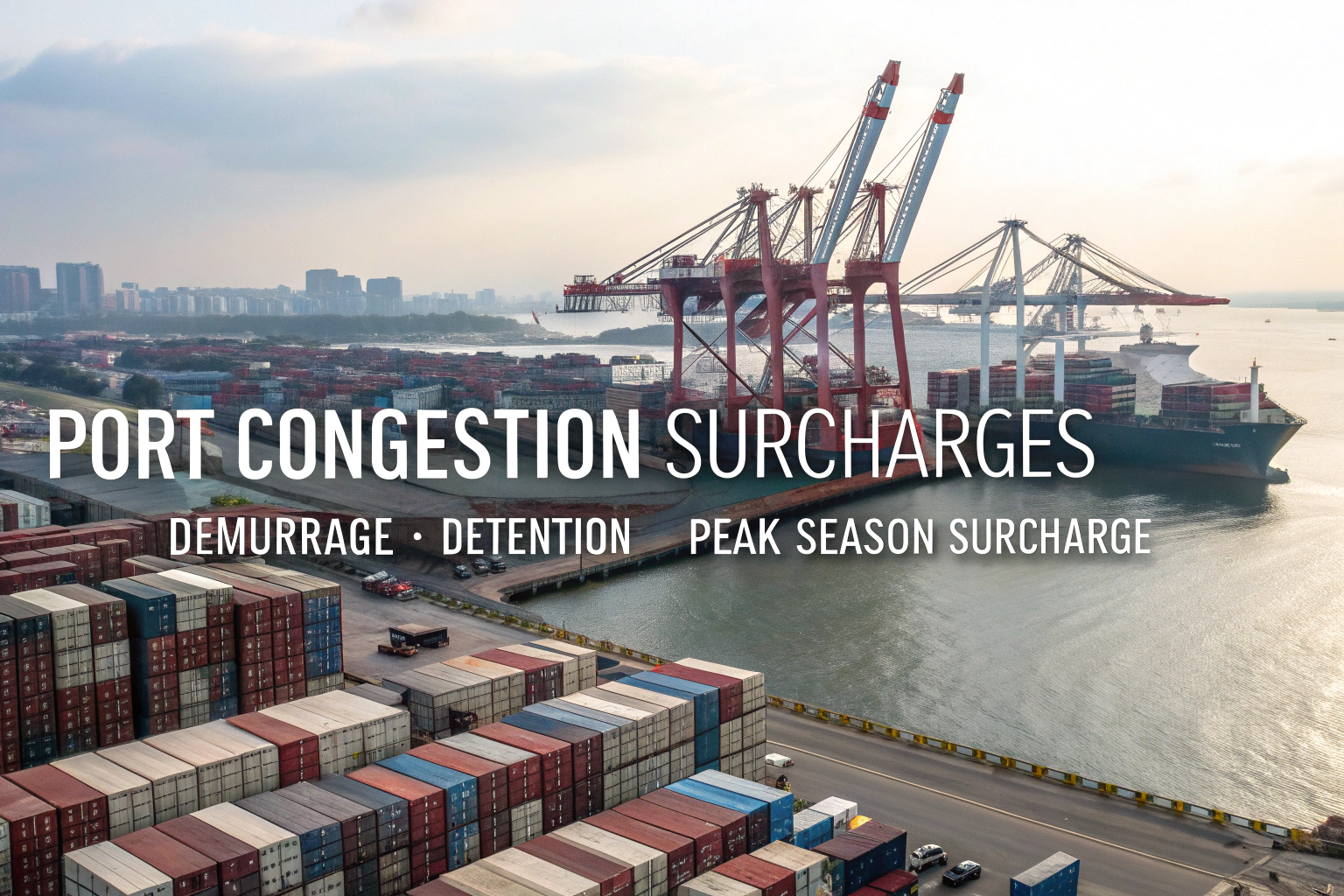
I once paid $1,200 for a container to sit in a parking lot. Well, not exactly a parking lot—a terminal at the Port of Los Angeles during the congestion crisis. The ship arrived on schedule in November 2022. The container was discharged within 48 hours. And then it sat. For 19 days. Every day after the free storage window expired, the terminal charged $65 in demurrage. The trucker couldn’t get an appointment because the terminal was gridlocked. The forwarder said there was nothing they could do. The charges accumulated silently, invisibly, until the final invoice arrived with a four-figure surcharge that hadn’t appeared on any quote. That was the moment I realized port congestion isn’t just a logistics headache—it’s a direct, unaccounted tax on fabric imports that can swing a shipment from profitable to underwater without warning.
Port congestion surcharges are fees layered on top of your standard freight quote when your container gets caught in the bottleneck at the destination port. They come under several names—demurrage, detention, port congestion surcharge, peak season surcharge—but they all originate from the same root cause: the container isn’t moving, and someone is charging you for the privilege of it not moving. In mid-2026, with the early peak season surge and the ongoing equipment imbalances we discussed in previous articles, these surcharges have become the single biggest unpredictable cost in the fabric import supply chain.
The good news is that these surcharges are more avoidable than most buyers realize. The strategies that work are not about hoping the port isn’t congested when your container arrives. They’re about routing decisions made before the container ships, contractual terms that shift the congestion risk to the party best able to manage it, and proactive actions at the destination that minimize the container’s dwell time. Let me walk you through the exact methods we use at Shanghai Fumao to keep our clients’ fabric moving while everyone else’s is sitting in the terminal accruing storage fees.
What Is the Difference Between Demurrage, Detention, and Port Congestion Surcharges?
The terminology is confusing because the charges overlap and the shipping industry uses the terms inconsistently across carriers. But the legal and practical distinctions matter because they determine who charges you, when the clock starts, and what you can do to stop it.
Demurrage is the charge for holding a container inside the terminal beyond the free storage period. The clock starts when the container is discharged from the vessel and made available for pickup. The free period is typically 3 to 5 calendar days for standard cargo. After that, the terminal operator charges a daily rate—usually $50 to $150 per day depending on the port and the equipment type. Demurrage is the terminal’s charge for using their storage space. Detention is the charge for holding a container outside the terminal beyond the free usage period. The clock starts when the container is gated out from the terminal. The free period is typically 3 to 7 calendar days for the round trip of trucking, unloading, and returning the empty container to the designated depot. After the free days, the shipping line charges $75 to $200 per day. Detention is the carrier’s charge for using their equipment.
Demurrage is paying for the container to sit at the port. Detention is paying for it to sit in your warehouse. Both clocks are ticking the moment the container becomes available, and neither one cares about your excuses.
The Port Congestion Surcharge is different from demurrage and detention. It’s a surcharge applied by the carrier to the freight rate itself, intended to compensate the carrier for the additional costs they incur when a port is congested—longer vessel waiting times for berth, slower turnaround, disrupted schedules. The PCS is typically $200 to $400 per container for major congested ports, and it’s applied at the time of booking based on the destination port, not on whether your specific container experiences a delay. The Peak Season Surcharge is similar—a demand-driven surcharge applied during the August-October peak shipping period when vessel space is tight. Both the PCS and the PSS are carrier charges added to the freight invoice, not terminal charges added after the container arrives. The distinction matters because the PCS and PSS can be avoided by routing decisions made before shipping, while demurrage and detention can only be avoided by actions taken at destination after arrival.

How Do Free Storage Days Work and How Can You Legitimately Extend Them?
The free storage period for demurrage is a fixed number of calendar days granted by the terminal operator through the carrier’s tariff. The standard for US ports is 4 working days or 5 calendar days, whichever is more generous to the shipper. Weekends and holidays count unless the terminal is closed, in which case the clock typically pauses. The free period for detention is also fixed, typically 5 to 7 calendar days for standard dry containers, and it starts when the container leaves the terminal gate.
Extensions to the free period are negotiable, but not at the moment the charges are accruing. The time to negotiate is when you’re establishing your freight contract with the carrier or forwarder, not when the container is already sitting in the terminal. High-volume shippers can negotiate extended free time as part of their service contract—10 days of free demurrage instead of 4, or 14 days of free detention instead of 7. The carrier agrees because the volume commitment is worth the marginal cost of the extended free time. For smaller shippers who don’t have volume leverage, the alternative is to use a forwarder who has negotiated extended free time on behalf of their consolidated customer base. The forwarder’s aggregate volume gives them the negotiating power that individual small shippers lack. At Shanghai Fumao, our freight contracts with the major transpacific carriers include extended free time provisions—typically 7 to 10 days free demurrage and 10 to 14 days free detention—because our aggregate shipping volume across all clients gives us the negotiating leverage to demand those terms. When we ship DDP for our clients, those extended free time provisions directly protect the client from demurrage and detention charges that would otherwise accumulate on a standard-contract shipment.
Why Do Some Forwarders Quote "All-In" Rates That Exclude Congestion Surcharges?
The "all-in" rate quote that turns out to exclude several hundred dollars in surcharges is a classic freight forwarder sales technique. The quote looks competitive—the base ocean freight per container is attractive—but the fine print excludes the Port Congestion Surcharge, the Peak Season Surcharge, the Bunker Adjustment Factor, and the destination terminal handling charge. These excluded items are listed in the quote somewhere, often in a footnote or a separate surcharge schedule, but they’re not in the headline number. The forwarder wins the booking on a deceptively low rate, and the actual invoice arrives with the surcharges added.
The defense is to demand a door-to-door, all-inclusive quote that breaks out every charge component but guarantees the total. The quote should include the ocean freight base rate, the BAF, the PCS if applicable at the destination port, the PSS if applicable during the sailing period, the origin and destination terminal handling charges, the documentation fee, the customs clearance fee if the forwarder is handling brokerage, and the trucking to the final delivery address. Any quote that doesn’t itemize these components or that uses vague category names like "other destination charges" is not an all-in quote. The forwarder who can’t or won’t provide this breakdown is either pricing opportunistically or doesn’t understand their own cost structure well enough to quote accurately. For practical advice on how to read freight forwarder quotes and spot hidden surcharge exclusions, you might find useful discussions on logistics industry forums where shippers share their experiences with specific forwarders and the pricing tactics to watch out for.
How Can You Choose a Less Congested Port of Entry for Fabric Shipments?
The port of entry decision is one of the most powerful and most underused levers for avoiding congestion surcharges. Most fabric buyers default to the port closest to their warehouse—Los Angeles for West Coast, New York for East Coast—without considering whether a nearby alternative port offers faster throughput, lower surcharges, or more reliable service. The difference in congestion levels between major gateway ports and secondary ports has widened in 2026 as carriers concentrate their largest vessels on the primary routes and the primary ports absorb disproportionate congestion.
The primary West Coast fabric entry ports are Los Angeles/Long Beach and Seattle/Tacoma. LA/LB handles roughly 40% of US container imports and experiences the most intense congestion during peak periods. Seattle/Tacoma handles about 8% and has consistently shown lower average dwell times and fewer congestion surcharges in 2025-2026. For a fabric buyer whose warehouse is in Chicago or the Midwest, the inland rail cost from Seattle might be $200 higher than from LA, but the avoided congestion surcharge and demurrage risk can more than offset that. The primary East Coast ports are New York/Newark, Savannah, and Norfolk. New York is the busiest and most congested. Savannah has expanded capacity significantly and is currently showing the fastest throughput times on the East Coast. Norfolk is the least congested of the three and has direct rail connections to Midwest destinations.
Rerouting from a congested gateway to a less congested secondary port can add $200 in trucking and save $800 in demurrage and surcharges.
The secondary port strategy works for Gulf Coast destinations as well. Houston handles significant fabric import volume, but Mobile and New Orleans are alternatives with lower congestion and competitive rail connections. The decision requires a door-to-door cost comparison that includes the ocean freight, the PCS and PSS at the alternative port, the inland transportation, and an estimate of the congestion risk based on current terminal dwell time data. Your forwarder should be able to provide this analysis. At Shanghai Fumao, we run this port optimization analysis for every client order and present the door-to-door cost and transit time for the primary port and the best alternative. The analysis often reveals that the "obvious" port isn’t the cheapest when congestion costs are factored in.

Why Are Secondary Ports Like Seattle and Savannah Showing Faster Turnaround Than LA?
The congestion dynamics at major gateway ports are driven by vessel size and volume concentration. The carriers deploy their largest vessels—15,000 to 24,000 TEU capacity—on the Asia to LA/LB route because the volume justifies the economies of scale. But these mega-vessels discharge enormous volumes of containers in a single call, overwhelming the terminal’s yard capacity, gate capacity, and truck appointment system. The terminal was designed for smaller vessels with more gradual discharge volumes. The mega-vessel creates a surge of containers that the terminal infrastructure can’t process at the same speed, leading to yard congestion, longer dwell times, and demurrage charges.
Secondary ports like Seattle and Savannah handle smaller vessels—8,000 to 12,000 TEU typically—and receive fewer weekly calls. The discharge volume per vessel is more manageable for the terminal infrastructure. The yard doesn’t reach capacity as quickly. The truck appointment system has available slots. The container dwell time is lower. The result is faster container availability for pickup and lower probability of demurrage. The PCS at secondary ports is also typically lower or non-existent because the carriers don’t face the same waiting time for berth that they experience at LA/LB. The trade-off is that secondary ports have less frequent vessel calls, so the sailing schedule options are more limited and the ocean transit time may be slightly longer. But when the total door-to-door timeline including terminal dwell time is calculated, the secondary port route often delivers the container to the warehouse faster than the congested primary port route. For current data on port dwell times and congestion levels across US entry ports, maritime logistics tracking platforms and port authority websites publish weekly performance metrics that buyers can use to inform their routing decisions.
How Does Routing Through Canadian or Mexican Ports Avoid US West Coast Surcharges?
The Canadian and Mexican port routing strategy uses the North American Free Trade Agreement land bridge to bypass US West Coast port congestion entirely. Fabric shipments are routed to the Port of Vancouver or Prince Rupert in Canada, or to the Port of Lazaro Cardenas or Manzanillo in Mexico, cleared through customs in that country, and then moved by rail or truck across the border to the US destination. The strategy is most effective for fabric buyers whose warehouses are in the Midwest, the Great Lakes region, or the Southwest, where the inland transportation from the alternative port is competitive with the inland cost from a US West Coast port.
The advantages are threefold. First, Canadian and Mexican ports currently have lower congestion levels than LA/LB and lower or no Port Congestion Surcharges. Second, the customs clearance process at the Canadian or Mexican port can be structured as an in-bond transit to the US, which defers the US customs entry until the goods reach the border or the final destination, providing additional logistics flexibility. Third, the rail connections from Vancouver and Prince Rupert to Chicago and the Midwest are well-established and competitive with the rail connections from LA/LB. The disadvantages are the additional complexity of the cross-border customs process and the need for a customs broker familiar with both the entry port country and the US entry requirements. The strategy is not for every shipment, but for high-volume fabric buyers with Midwest or Southwest destinations, the Canadian or Mexican port routing can reduce total landed cost and improve delivery reliability compared to the congested US West Coast gateway. For more detailed guidance on cross-border fabric shipping through Canadian and Mexican ports, international trade logistics resources and North American shipping forums provide routing guides and customs procedure documentation.
What DDP Contract Terms Eliminate Your Exposure to Destination Port Fees?
The DDP Incoterm fundamentally shifts the congestion risk from buyer to seller. When you buy fabric on DDP terms from a supplier, the supplier is responsible for all costs, risks, and responsibilities until the goods arrive at your named place of destination. This includes the ocean freight, the destination terminal handling, the customs clearance, the duties and taxes, and—critically—any demurrage, detention, or port congestion surcharges that arise during the import process. If the container gets stuck at the port for two weeks and incurs $1,500 in demurrage, the supplier pays that, not the buyer. The DDP price on the proforma invoice is the total price the buyer pays.
This risk transfer is valuable even when the DDP price appears higher than the FOB price plus estimated freight. The DDP price includes a risk premium for the congestion exposure, but in a volatile market like mid-2026, that premium is often less than the expected value of the congestion costs the buyer would absorb under FOB terms. The supplier, who ships hundreds of containers and has negotiated extended free time and optimized routing, can manage the congestion risk at a lower cost than an individual buyer shipping a few containers per year. The DDP contract also eliminates the administrative burden of dealing with forwarders, terminals, and customs brokers—the supplier handles all of it and delivers a single landed cost.
DDP doesn’t just transfer cost—it transfers the headache. You stop worrying about demurrage clocks and port surcharges because they’re someone else’s problem.
The DDP protection is only as good as the supplier’s capability to execute. A supplier who quotes DDP but doesn’t have the logistics infrastructure, the forwarder relationships, and the customs expertise to manage the import process may price the DDP too low and then delay or dispute when congestion charges arise. The buyer’s protection is to verify the supplier’s DDP track record—ask for references from US clients who have received DDP shipments, ask for documentation of the supplier’s US customs bond and broker relationship, and test the supplier’s logistics knowledge by asking specific questions about port routing, free time provisions, and congestion management strategies. A competent DDP supplier answers these questions fluently. At Shanghai Fumao, our DDP program for US clients is built on our continuous customs bond, our negotiated carrier contracts with extended free time, our port optimization analysis for every shipment, and our US-based logistics partner who monitors every container from vessel arrival to final delivery and intervenes immediately if a container shows signs of getting stuck at the terminal.

How Do "Door Delivery" Clauses in Supplier Contracts Make Congestion Someone Else’s Problem?
A "door delivery" clause in a supplier contract specifies that the supplier bears the risk and cost of transportation until the goods physically arrive at the buyer’s designated delivery address. This is the essence of DDP, but the clause can also be structured as a standalone term within a broader FOB or CIF contract if the parties want to split the risk differently. The door delivery clause means the supplier selects the freight forwarder, negotiates the freight contract, manages the customs clearance, arranges the last-mile trucking, and absorbs any intermediate charges that arise between the origin factory and the destination door.
The practical effect is that the supplier’s logistics team, not the buyer’s, is responsible for monitoring the container’s status at the destination port and resolving any issues that cause delays. If the terminal appointment system has no available slots, the supplier’s team escalates with the forwarder or the trucker to find a solution—an off-peak appointment, a peel-off program, or a transfer to an off-terminal yard. If demurrage charges start accruing, the supplier’s team disputes them if the delay was caused by the terminal or the carrier, or absorbs them if they were caused by the supplier’s own logistics failure. The buyer’s only responsibility is to be ready to receive the delivery when the truck arrives. The door delivery clause turns the buyer from a logistics manager into a recipient, and in a congested port environment, that role transformation is worth real money in avoided surcharges and saved time.
What Questions Should You Ask to Verify Your Supplier Actually Manages Port Risk?
Not every supplier who offers DDP or door delivery actually has the capability to manage destination port risk effectively. Some are trading companies that quote DDP by adding a rough freight estimate to the FOB price and hoping the actual costs come in under the estimate. When congestion surcharges spike, these suppliers either absorb a loss on the shipment or, worse, try to renegotiate the price with the buyer after the goods have shipped. The verification questions are designed to distinguish the genuine DDP logistics operator from the hopeful estimator.
Ask these five questions. "Can you show me your US customs continuous bond certificate?" A supplier with a continuous bond has a formal, ongoing US customs presence and a broker relationship, which means they’re set up to manage import entries professionally. "What free demurrage and detention time do you have in your carrier contract?" A supplier who doesn’t know their free time provisions isn’t managing the port risk. "Which port do you recommend for our delivery address, and why?" A supplier who answers with a single port without analysis isn’t optimizing the routing. "What’s your process when a container gets flagged for a customs exam at the destination port?" A supplier who can describe their exam management process—how they escalate, how they minimize the exam duration, how they handle the exam costs—is a genuine logistics operator. "Can you share a recent door-to-door cost breakdown for a similar shipment, showing all the destination charges?" A transparent supplier shares this data. An opaque supplier doesn’t. For more comprehensive supplier verification checklists and sample questions to assess logistics capability, import-export forums and supply chain professional networks have shared templates and real-world experiences from buyers who have audited supplier logistics claims.
Conclusion
Port congestion surcharges are a controllable cost, not an unavoidable tax on fabric imports. The control levers operate at three points in the supply chain: before the container ships, through routing decisions and contract terms that avoid the most congested ports and shift the congestion risk to the party best able to manage it; at the time of booking, through freight contracts and forwarder relationships that include extended free time provisions and all-inclusive pricing; and at the destination, through proactive container monitoring and escalation that minimizes dwell time and prevents demurrage from accumulating silently.
We’ve unpacked the terminology—demurrage inside the terminal, detention outside the terminal, PCS on the freight invoice—so you know which clock is ticking and who’s charging for what. We’ve analyzed the secondary port strategy, where routing through Seattle instead of LA or Savannah instead of New York can add a modest amount to inland trucking while saving multiples of that in avoided congestion charges. And we’ve examined the DDP contract structure as the ultimate congestion hedge, transferring the destination port risk from the buyer’s P&L to the supplier’s logistics operation.
The $1,200 demurrage bill I paid in 2022 was tuition for a lesson I didn’t need to learn twice. That experience fundamentally changed how we manage destination logistics at Shanghai Fumao. Our carrier contracts now include extended free time provisions. Our port optimization analysis is a standard part of every shipment planning process. Our US-based logistics partner monitors every container in real-time and intervenes the moment a container’s status indicates a potential delay. And our DDP contracts put all of this capability to work for our clients, who receive a single landed cost quote and a delivery date—no surprise surcharges, no demurrage invoices, no terminal phone calls.
If you’re tired of seeing unexpected surcharges on your freight invoices and want a fabric supply partner who manages the destination logistics as carefully as the fabric quality, reach out to our Business Director, Elaine, at elaine@fumaoclothing.com. She can provide a door-to-door DDP cost breakdown for your specific delivery address, walk you through our port optimization analysis, and explain how our US logistics infrastructure protects your shipments from the congestion costs that are eating other importers’ margins.