

Last year, a client in Chicago called me in a panic, and I could hear the letter shaking in his hand. CBP had sent him a Notice of Action for a focused assessment audit on his fabric imports from the past three years. They wanted the entry summaries, the commercial invoices, the mill certificates, the fiber composition tests, the country of origin records, and the anti-static performance data for every shipment he’d brought in under the Chapter 59 functional coating classification. He had three weeks to respond. His filing system was a combination of email attachments, WeChat photos, and a shoebox of paper documents. He spent the next two weeks barely sleeping, chasing down documents that should have been filed and cross-referenced the moment each shipment cleared. He ended up owing $18,000 in back duties because he couldn’t produce the lab reports to support his lower-duty classification on three shipments. The fabric was fine. The classification was correct. But without the documents, he had no proof.
A CBP audit isn’t a criminal investigation. It’s a verification process. Customs wants to confirm that what you declared on your entry paperwork matches the physical goods and the supporting documentation. If you can produce the documents that prove compliance, the audit closes and you move on. If you can’t, the assumptions default against you, and you pay the duties you can’t disprove plus potential penalties. The audit preparation isn’t something you do when the letter arrives. It’s something you build into your sourcing process from day one, so that when the letter comes—and statistically, if you import enough fabric, it eventually will—your response is a file transfer, not a panic attack.
The document package that satisfies a CBP textile audit has a clear structure. It connects the physical fabric to the commercial transaction to the customs entry, with lab test data and supply chain records bridging the gaps. Every document serves a specific verification purpose, and missing one link in the chain weakens the entire defense. I’ve helped clients prepare for and survive these audits, and I’ve built our own export documentation system at Shanghai Fumao to make audit compliance seamless for the buyers on the other end. Let me walk you through exactly what CBP looks for, what documents answer which questions, and how to organize them so that your audit response is boringly complete rather than terrifyingly scrambled.
What Specific Documents Does CBP Request in a Textile Compliance Audit?
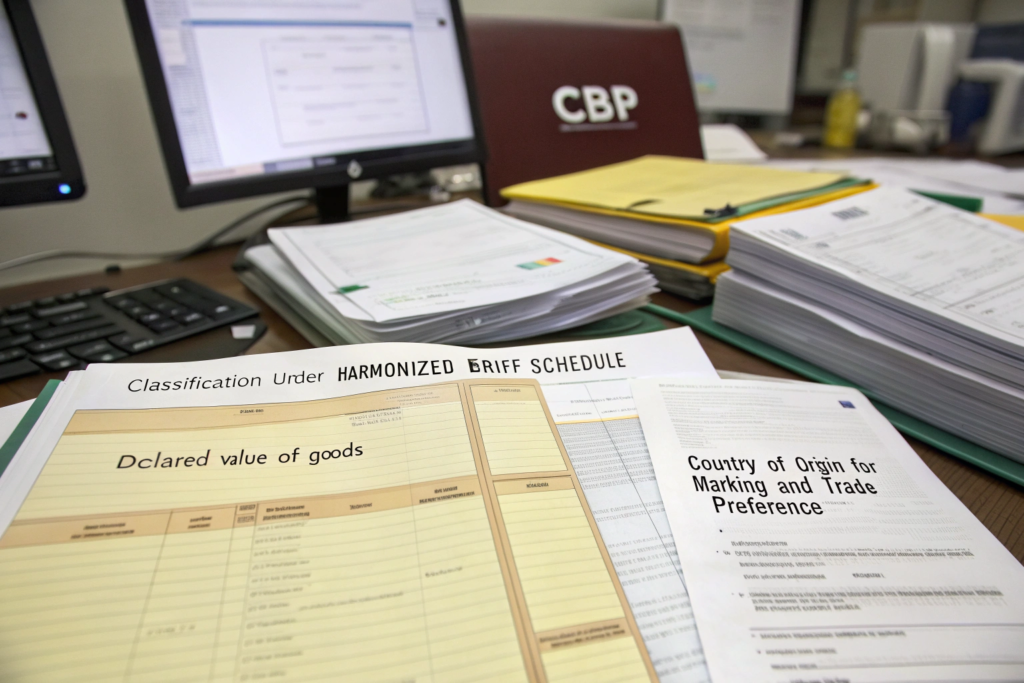
When CBP sends an audit notice, the document request list looks overwhelming, but it breaks down into logical categories. The auditors are trying to verify three things: the classification of the goods under the Harmonized Tariff Schedule, the declared value of the goods, and the country of origin for marking and trade preference purposes. Every document they request feeds into verifying one or more of these three elements.
The core document package starts with the entry summary, which is the CBP Form 7501 filed at the time of import. This is the document you’re being audited against—it shows the HTS code you used, the entered value, the duty rate you paid, and the country of origin you declared. Next, the commercial invoice and the packing list, which establish the transaction value, the parties to the transaction, and the physical quantity and description of the goods. The bill of lading or air waybill proves the shipment actually moved and connects the commercial documents to a specific vessel or flight. The evidence of payment—the wire transfer receipt or letter of credit documentation—proves that the transaction value on the commercial invoice is the actual price paid, not an artificial number.
CBP auditors start with the entry summary and work backwards. Every document you provide either supports what’s on that form or undermines it.
Beyond the transaction documents, textile audits specifically request fiber composition evidence. This includes the mill test report or lab analysis showing the actual fiber percentages, the fabric specification sheet from the manufacturer, and often a physical sample for comparison. If you claimed a functional coating classification under Chapter 59 that carries a lower duty rate, they’ll also want the lab test report proving the coating is visible and permanent. The country of origin documentation includes the manufacturer’s affidavit or certification, the production records showing where the fabric was woven and finished, and the textile declaration statement. For fabric sourced from China under Section 301 tariff exclusions, you need the specific exclusion ruling and proof that your product matches the exact product description in the ruling. The document list is long but finite, and every item on it answers a specific verification question.
Why Is the CBP Form 7501 Entry Summary the Anchor Document for Your Entire Defense?
The Form 7501 is the official record of what you declared to Customs at the time of entry. Every audit question traces back to a line on this form. The HTS code on the 7501 determines whether your duty rate was correct. The entered value determines whether you paid the right amount. The country of origin determines whether any preferential trade programs or additional tariffs apply. When CBP finds a discrepancy between the 7501 and the supporting documents, the 7501 is the starting presumption, and the burden shifts to you to prove the 7501 was correct.
The entered value on the 7501 must match the commercial invoice value exactly, and the commercial invoice value must be supported by the payment evidence. If the 7501 shows an entered value of $15,000 and the commercial invoice shows $18,000, CBP will ask why. If the answer is that the $15,000 was a mistake, you’ll owe duties on the $3,000 difference plus interest. If the answer is that the commercial invoice was deliberately split to reduce the entered value, that’s fraud. The HTS code on the 7501 must be justified by the product description and the lab test data. A code for "woven fabrics of synthetic filament yarn" requires evidence that the fabric is woven (not knit), synthetic (not cotton or wool), and filament (not staple fiber). A single wrong digit in the HTS code can change the duty rate by 10% or more, and the audit will catch it. The Form 7501 is also where textile category numbers and visa requirements are recorded for goods that were subject to quota, though most quotas have been phased out. For importers learning how to properly classify woven synthetic fabrics and avoid common HTS code errors on Form 7501, trade compliance forums often have detailed walkthroughs with real-world examples from textile importers who survived audits with clean documentation.
How Does a Mill Test Report Connect Your Physical Fabric to Your Commercial Invoice?
The mill test report is the technical bridge between a piece of fabric and a commercial document. The commercial invoice says "100% polyester anti-static lining, 85 GSM, width 150 cm." The mill test report proves that the actual fabric in the shipment matches that description. Without the mill test report, the description on the commercial invoice is just a claim. With it, the description is verified by physical testing.
A proper mill test report for fabric includes the fiber composition analysis with percentages, the fabric weight in GSM tested per ASTM D3776, the fabric width, the yarn count, the weave construction, and any functional test results like surface resistivity for anti-static properties. The report should reference the batch number or roll numbers that appear on the packing list, creating a traceable connection from the test results to the specific goods in the shipment. At Shanghai Fumao, our CNAS-certified lab generates a test report for every production batch, and the batch number appears on every roll tag, the packing list, and the commercial invoice. If CBP audits one of our shipments, the mill test report connects the fiber content on the invoice to the physical roll on the shelf. This is the level of documentation integration that auditors look for. A mill test report that doesn’t reference the shipment’s batch number, or that was clearly generated for a different order, raises more questions than it answers. For guidance on what textile testing standards CBP accepts and how to commission mill test reports that meet their evidentiary requirements, textile testing industry resources often have detailed specification templates aligned with customs enforcement priorities.
How Should You Organize Your Fabric Supplier Files to Survive an Audit?
Audit survival isn’t about having the documents somewhere. It’s about being able to produce the right document for the right shipment within the right timeframe. The organization system needs to mirror how CBP thinks about your imports: by entry number, not by supplier name or by date received. When the audit letter references Entry Number 123-4567890-1, you need to pull every document related to that entry in minutes, not days.
The organizational structure I recommend for every fabric importer is an entry-based digital filing system. Each entry gets its own folder, labeled with the entry number, the date of entry, and the supplier name. Inside that folder, subfolders organize the documents by category: entry documents (the 7501, the entry summary continuation sheets, the CBP release notification), commercial documents (the commercial invoice, packing list, proforma invoice, and purchase order), transport documents (the bill of lading, the arrival notice, the delivery order), payment evidence (the wire transfer confirmation, the letter of credit documentation, the supplier’s payment acknowledgment), and product documents (the mill test report, the lab analysis, the fabric specification sheet, the textile declaration, the country of origin certificate, and any Section 301 exclusion documentation).
File by entry number, not by supplier. CBP thinks in entry numbers. Your filing system should too.
This structure works because it mirrors the audit request. CBP will ask for documents by entry number and by category. When the auditor says "please provide the commercial invoice and the mill test report for Entry 456," you navigate to the Entry 456 folder, open the commercial documents subfolder, open the product documents subfolder, and attach the files. The entire response takes five minutes. The alternative—searching through email threads, WhatsApp conversations, and supplier WeChat messages for a document you know exists but can’t locate—is what turns an audit from a routine verification into a stressful scramble. At Shanghai Fumao, we maintain this organizational structure for our internal records and we provide a complete document package to every client organized in exactly this format. When a client gets an audit letter, they already have the files structured the way CBP will ask for them.

What Is the "30-Minute Rule" for Digital Document Retrieval and Why Does It Matter?
The 30-Minute Rule is a discipline, not an actual regulatory deadline. I developed it after watching clients struggle with audits over the years. The rule is this: you should be able to produce the complete document package for any entry within 30 minutes of receiving the request. If it takes longer than that, your filing system is failing you, and when a real audit hits with a two-week response deadline and fifty entries to document, you’ll run out of time before you run out of documents to find.
The 30-minute standard forces a specific kind of file organization. Documents must be named consistently so you can search by entry number. Files must be stored in a cloud-accessible location that you can reach from anywhere, not trapped on a single office computer’s hard drive. The folder structure must be standardized across all entries so you don’t have to remember whether you filed the bill of lading under "shipping" or "transport" or "BOL." The naming convention I use is: EntryNumber-DocumentType-Date.pdf. For example, "1234567890-1-CommercialInvoice-20260415.pdf." A simple search for the entry number pulls up every related document instantly. The test is to pick a random entry from eighteen months ago and time yourself. If you can’t find the mill test report in under five minutes, your system needs work. For practical templates and file naming conventions that have been vetted by other importers who’ve been through audits, import compliance communities often share the digital organization systems that proved effective under real CBP scrutiny.
How Do You Maintain a Three-Year Document Trail Without Building a Bureaucracy?
CBP’s audit lookback period for most import compliance issues is three years from the date of entry, though certain violations extend to five years. This means you need to retain and be able to access every document for every entry for at least three years after import. For an active fabric buyer bringing in a container every month, that’s 36 entries worth of documentation to maintain. The volume sounds intimidating, but the maintenance process can be simple if it’s built into your monthly workflow rather than treated as an annual archive project.
The system I recommend has three steps, all happening at the moment of entry clearance. Step one: your customs broker sends you the entry package—the 7501, the release notification, and the entry summary—within a week of clearance. Save these immediately to the entry folder. Step two: you consolidate the commercial and transport documents from the supplier and forwarder as soon as the shipment delivers. These are the invoices, packing lists, bills of lading, and payment confirmations that you already have in your email. Save them to the same folder. Step three: you request and save the product documents from the supplier at the time of order, not at the time of audit. The mill test report, the lab analysis, the fiber content certification—these should be part of the pre-shipment documentation package, and you file them when you file the commercial documents. If a document is missing—the mill test report wasn’t provided, the certificate of origin is pending—flag it with a placeholder file named "EntryNumber-MISSING-MillTestReport.txt" in the folder. This tells you exactly what’s incomplete without searching through emails. Once a quarter, run through the flagged entries and chase down the missing documents. A quarterly one-hour review keeps the three-year trail complete without requiring a dedicated compliance department. For further advice on building a low-maintenance document retention system that satisfies CBP requirements, small business importing forums often have practical workflows designed by importers who manage compliance alongside all their other responsibilities.
What Fabric Testing Data Stands Up to CBP Scrutiny for Anti-Static Claims?
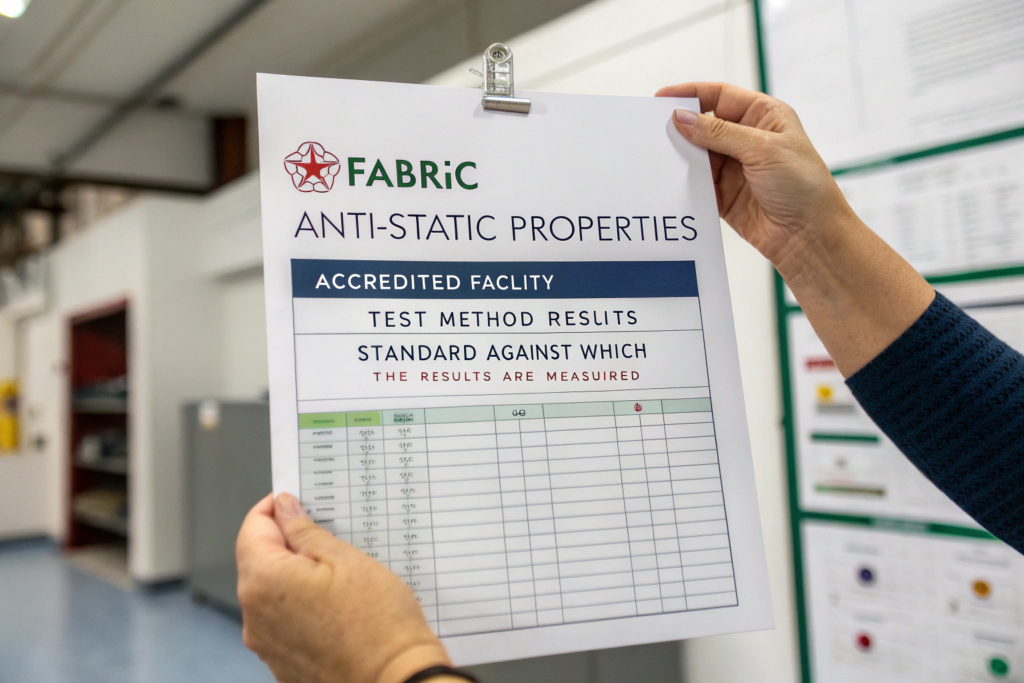
When you classify a fabric under a specific HTS code based on its functional properties—like an anti-static lining under a technical textile classification—CBP will want to see the testing data that supports that claim. Not a supplier’s marketing brochure. Not an email saying "yes, this fabric is anti-static." A laboratory test report from an accredited facility showing the specific test method used, the specific results obtained, and the specific standard the results are measured against.
For anti-static fabrics, the two key testing standards CBP recognizes are ASTM D257 for surface resistivity and EN 1149-1 for electrostatic properties. The test report must show the surface resistivity in ohms, the test conditions including the relative humidity percentage, the sample conditioning protocol, and the pass/fail criteria. A proper report doesn’t just say "pass." It gives the resistivity reading at multiple points across the fabric sample, shows the mean and standard deviation, and states clearly whether the fabric meets the performance threshold defined in the contract or the classification claim. The lab must be ISO 17025 accredited, which is the international standard for testing laboratory competence. Our CNAS-certified lab at Shanghai Fumao operates to this standard, and our anti-static fabric test reports include the full ASTM D257 procedure with multi-point surface resistivity mapping, which we’ve seen accepted by CBP in multiple client audits without question.
CBP doesn’t care about marketing claims. They care about accredited lab data. If you can’t produce the test report, the claim doesn’t exist.
Beyond the test data, CBP may also request evidence that the conductive property is permanent and not a temporary finish that will wash out. For carbon-woven anti-static fabrics, this means documentation showing that the conductive yarn is integrated into the weave structure rather than applied as a surface treatment. The mill specification sheet showing the yarn composition and the weaving instructions satisfies this. For coated anti-static fabrics, the test report should include the adhesion or durability test that demonstrates the coating remains after repeated washing or abrasion. A surface resistivity test after five wash cycles per AATCC Test Method 135, compared to the pre-wash test, shows whether the conductivity is permanent or temporary. The burden of proof is on the importer. If you classify a fabric as anti-static, you need the data that proves it.
How Does ASTM D257 Surface Resistivity Testing Satisfy CBP Functional Classification Requirements?
ASTM D257 is the standard test method for DC resistance or conductance of insulating materials. For anti-static fabrics, it measures the surface resistivity—how much the fabric surface resists the flow of electrical current. The test applies a known voltage across electrodes placed on the fabric surface and measures the resulting current. The surface resistivity is calculated in ohms per square, and a lower number means better conductivity and better anti-static performance.
CBP accepts ASTM D257 data for functional textile classifications because the test produces a quantifiable, repeatable number that can be verified by any ISO 17025 accredited lab. The test report must include the test voltage used (typically 100V or 500V for textiles), the electrode configuration, the conditioning environment (temperature and relative humidity), the number of test points measured, and the individual readings at each point. A report that gives a single number without these details is insufficient. The report should also include a statement of measurement uncertainty—the range within which the true value lies—which is a requirement of ISO 17025 accreditation. For a fabric claiming anti-static performance suitable for suiting lining, the typical acceptance threshold is a surface resistivity below 1.0 x 10^9 ohms, though some specifications require below 1.0 x 10^8. The test report should explicitly compare the measured value to the acceptance threshold. When CBP sees a complete ASTM D257 report with multi-point data, controlled conditioning, and a clear pass/fail statement, the functional classification claim is supported. When they see a one-line certificate from a supplier with no test details, they’ll set the claim aside and reclassify the fabric at the standard higher duty rate.
What Role Does ISO 17025 Lab Accreditation Play in Audit Evidence Acceptance?
ISO 17025 is the international standard for the competence of testing and calibration laboratories. A lab accredited to this standard has been audited by an independent accreditation body and demonstrated that it has the technical competence, the calibrated equipment, the quality management system, and the trained personnel to produce valid test results. When CBP receives a test report from an ISO 17025 accredited lab, they accept the results as competent evidence without needing to independently verify the lab’s capabilities.
The accreditation matters because it shifts the test report from "the supplier says so" to "an independent, verified expert says so." For anti-static fabric testing, the accreditation body—such as CNAS in China, A2LA in the United States, or UKAS in the United Kingdom—is a signatory to the International Laboratory Accreditation Cooperation mutual recognition arrangement. This means the accreditation is recognized internationally, and a CNAS-accredited test report from our lab in Keqiao carries the same evidentiary weight with CBP as a report from a US-based A2LA accredited lab. The test report must display the accreditation body’s symbol and the lab’s accreditation number. If the report lacks these, CBP may question whether the testing facility meets the competence standard. When we provide anti-static test reports to our clients, the CNAS accreditation mark and our lab’s registration number are prominently displayed on every page. We’ve found this eliminates the "who tested this and are they qualified" question from both CBP auditors and from clients’ own quality assurance teams. For a deeper explanation of how accreditation standards apply specifically to textile testing and what CBP auditors look for on lab reports, metrology and testing standards organizations publish guidance documents that are useful references when building your compliance documentation package.
What Are the Penalties for Incomplete Documentation During a CBP Fabric Audit?
The penalty structure for CBP audit findings ranges from "you owe the duty difference plus interest" to "criminal prosecution," and where your case falls on that spectrum depends on the nature of the documentation failure. CBP distinguishes between negligence, gross negligence, and fraud, and the penalty multiplier escalates dramatically at each level.
Negligence is the failure to exercise reasonable care in preparing your entry documentation. You had the correct information but made a clerical error, or you failed to obtain documentation that a reasonable importer would have obtained. The penalty for negligence is typically two times the lost duty revenue, plus interest on the underpaid amount from the date of entry. For a fabric shipment where the misclassification resulted in a $3,000 duty underpayment, a negligence finding would mean roughly $6,000 in penalties plus interest. Gross negligence is a more serious failure—an act with actual knowledge or reckless disregard for the facts. The penalty multiplier increases to four times the lost duty revenue. Fraud is an intentional act to deceive CBP, such as deliberately misclassifying goods or submitting false documents. The penalty is the domestic value of the merchandise—the full value of the goods, not just the duty amount. For a $50,000 container of fabric, a fraud finding means a $50,000 penalty, potentially plus criminal prosecution.
Reasonable care is your legal shield. Documented procedures, supplier verification records, and complete test reports prove you tried to get it right.
The reasonable care standard is the key defense against elevated penalties. CBP’s informed compliance publications define what constitutes reasonable care for importers, and it includes consulting the HTS, seeking binding rulings when classification is unclear, obtaining lab analysis of product characteristics, and maintaining documented compliance procedures. When you can show that you followed these steps—that you requested and filed mill test reports, that you sought classification guidance, that you maintained entry documentation for the required period—you demonstrate reasonable care. Even if the classification turns out to be incorrect, the penalty is likely to be assessed at the negligence level rather than gross negligence or fraud because you can show you tried to comply. The absence of documentation isn’t just a paperwork problem—it’s evidence that you didn’t exercise reasonable care, which elevates the penalty exposure. For practical guidance on how to build a reasonable care defense that CBP will accept, customs law resources and trade attorney blogs often have case studies showing what evidence importers successfully used to reduce their penalty exposure from gross negligence to simple negligence.
How Does the "Reasonable Care" Standard Protect You Even When Documents Are Imperfect?
Reasonable care is not perfection. CBP doesn’t expect importers to be infallible. They expect importers to have made a genuine, documented effort to comply with the law. The reasonable care checklist includes items like consulting with a qualified customs broker, seeking a binding ruling when the classification isn’t clear, obtaining product specifications and test data from the supplier, and reviewing the entry documents for accuracy before filing. When you can show evidence that you did these things, a classification error discovered in an audit is treated as a mistake, not a violation.
The practical protection of reasonable care is that it shifts the audit outcome from penalty assessment to duty adjustment. If CBP determines that your anti-static lining was misclassified under Chapter 59 when it should have been Chapter 54, but you can produce the lab reports, the broker correspondence, and the supplier documentation showing that you made a genuine effort to classify correctly, the typical outcome is that you pay the additional duties plus interest with no penalty or a minimal negligence penalty. The documentation you maintain for your own compliance purposes becomes the evidence of your reasonable care. The mill test reports that you filed with the entry documents, the email from your broker explaining the classification rationale, the specification sheet from your supplier—these are your reasonable care defense. The importers who get hit with gross negligence or fraud penalties aren’t the ones with slightly incomplete documentation. They’re the ones with no documentation at all, or with documentation that contradicts what they declared.
What Is the Difference Between a CF-28 Request for Information and a CF-29 Notice of Action?
The CF-28 and CF-29 are both CBP forms related to entry review, but they represent very different stages of the enforcement process, and the distinction matters enormously for how you respond. A CF-28, Request for Information, is CBP asking questions. It’s not an accusation. It’s not a penalty. It’s an invitation to provide documentation that supports your entry. A CF-29, Notice of Action, is CBP telling you they’ve made a decision—typically a proposed rate advance or a demand for additional duties. The CF-29 has a protest deadline, and if you miss it, the decision becomes final.
When you receive a CF-28, you’re being given an opportunity to prove your entry is correct before CBP makes a formal determination. The response should be prompt, complete, and document-supported. If the CF-28 asks for evidence of fiber content for a shipment classified as polyester, send the mill test report showing 100% polyester composition, the supplier specification sheet, and any independent lab analysis you commissioned. The quality of your CF-28 response often determines whether the matter escalates to a CF-29 or closes with no action. A complete, well-organized response that answers all the questions frequently results in the CF-28 being resolved with no further action. An incomplete or delayed response almost guarantees a CF-29 with a duty bill attached. When a CF-29 arrives, you have the right to file a protest within 180 days of the date of the notice. The protest must state the specific CBP decision being protested, explain the basis for the protest, and include all supporting documentation. A protest filed without documentation gets denied. The CF-28 to CF-29 sequence is designed to give importers a fair chance to demonstrate compliance before facing a formal adverse decision. For guidance on how to structure an effective CF-28 response that resolves the inquiry without escalating to a CF-29, customs broker professional communities often share response templates and checklists that have proven effective in practice.
Conclusion
A CBP audit is not a crisis if your documentation is in order. It’s a verification process that confirms what you declared on your entry paperwork matches the physical fabric and the supporting records. The preparation that makes an audit survivable is the same preparation that makes your sourcing process professional: obtaining and filing mill test reports, organizing documents by entry number, maintaining a three-year retrievable archive, and understanding the specific technical data that supports your classification claims.
We’ve walked through the core document package that CBP expects—the Form 7501 entry summary as the anchor, the commercial and transport documents that validate the transaction, and the product documents that connect the physical fabric to the commercial description. The mill test report is the critical bridge between a marketing claim and a verifiable fact, and for anti-static fabrics, the ASTM D257 surface resistivity data from an ISO 17025 accredited lab is the gold standard evidence. The organization system—digital, entry-based, cloud-accessible, and searchable within 30 minutes—transforms audit response from a panicked search into a calm file transfer. The reasonable care standard protects importers who make genuine efforts to comply, and the distinction between a CF-28 information request and a CF-29 action notice determines your response strategy.
At Shanghai Fumao, we structure our export documentation from day one to support our clients’ customs compliance. Every shipment includes the complete document package organized by category, with CNAS-certified lab test reports, QR-coded roll-level traceability, and the fiber composition and performance data that CBP looks for. We’ve seen our documentation package help clients resolve CF-28 inquiries without escalation and survive full focused assessments with zero additional duty findings. The key is that the documentation exists, it’s organized, and it’s provided at the time of shipment—not reconstructed three years later when the audit letter arrives.
If you’re concerned about your current document readiness for a potential audit, or if you want to build better documentation practices into your next fabric order, reach out to our Business Director, Elaine, at elaine@fumaoclothing.com. She can walk you through our standard documentation package, provide a sample document checklist you can use to audit your own files, and coordinate the testing and certification data that makes your customs entries audit-ready from day one.








