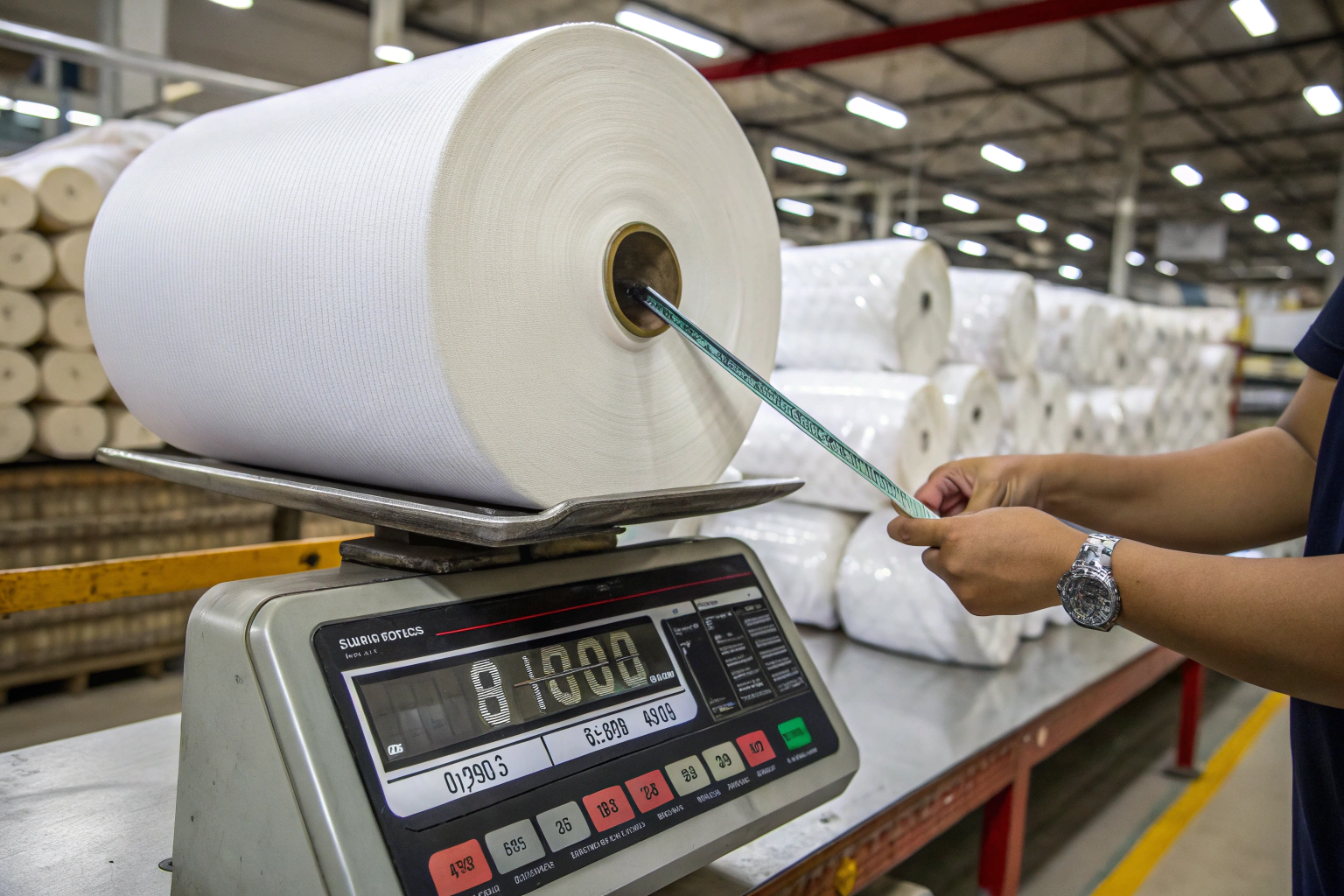
I once watched a distributor lose $8,300 on a single container of cotton twill. His brand buyer ordered 5,000 meters at 250 GSM, and the mill shipped 5,000 meters at 220 GSM. The fabric looked identical. The hand feel was fine. But that 30-gram deficit meant the mill used roughly 12% less cotton fiber. The distributor paid for 250 GSM worth of raw material and received 220 GSM worth of value. He never caught it because he only checked the meter count on the roll labels. That’s the silent margin killer hiding in your supply chain.
Weight tolerance isn’t a minor technical footnote. It is the direct mathematical bridge between the physical fabric you receive and the cost you agreed to pay. A roll that measures 100 meters but weighs 5% less than spec is effectively a 5% price increase hidden inside a compliant-looking length. If you’re distributing 100,000 meters annually, a 3% negative weight tolerance can quietly siphon $15,000 to $40,000 out of your pocket. At Shanghai Fumao, we print the actual delivered GSM on every roll label alongside the standard weight, because we want our distributors to see exactly what they’re paying for. No surprises, no hidden losses.
I’ve spent two decades on factory floors watching weighing scales like a hawk. Stick with me, and I’ll show you why GSM is your true purchase unit, not the meter. I’ll explain the specific tolerance bands that international standards allow, how moisture regain in cotton can trick your scale, and how you can write a purchase contract clause that shifts the risk of weight variance back to the mill. This is about protecting your margin in a business where pennies per yard decide whether you turn a profit.
Why GSM Is Your True Purchase Unit, Not the Linear Meter
There’s a reason the industry invented GSM—grams per square meter. A meter of fabric means nothing without the weight. Imagine buying a bag of coffee beans. Would you pay for the volume of the bag, or the weight printed on it? Fabric is the same. You’re buying fiber, not distance. When a mill ships you a roll labeled "100 meters," but the fabric is lighter than the approved sample, they’ve effectively given you less material for the same price.
The danger for a distributor is that visual quality checks don’t catch this theft. Your eye can’t see a 15% weight reduction if the fabric is fluffed up with a soft finish or a loose weave. You need the scale. Most US and EU brand buyers specify a target weight with a plus/minus tolerance, usually 5%. If the delivered fabric falls on the minus side consistently, the mill is pocketing the fiber savings. I teach every new merchandiser that the first check after unwrapping a sample isn’t the color—it’s the GSM. That single number tells you if the mill is being honest about the raw material content.
How Does a 5% Negative Weight Tolerance Translate to a Hidden Price Increase?
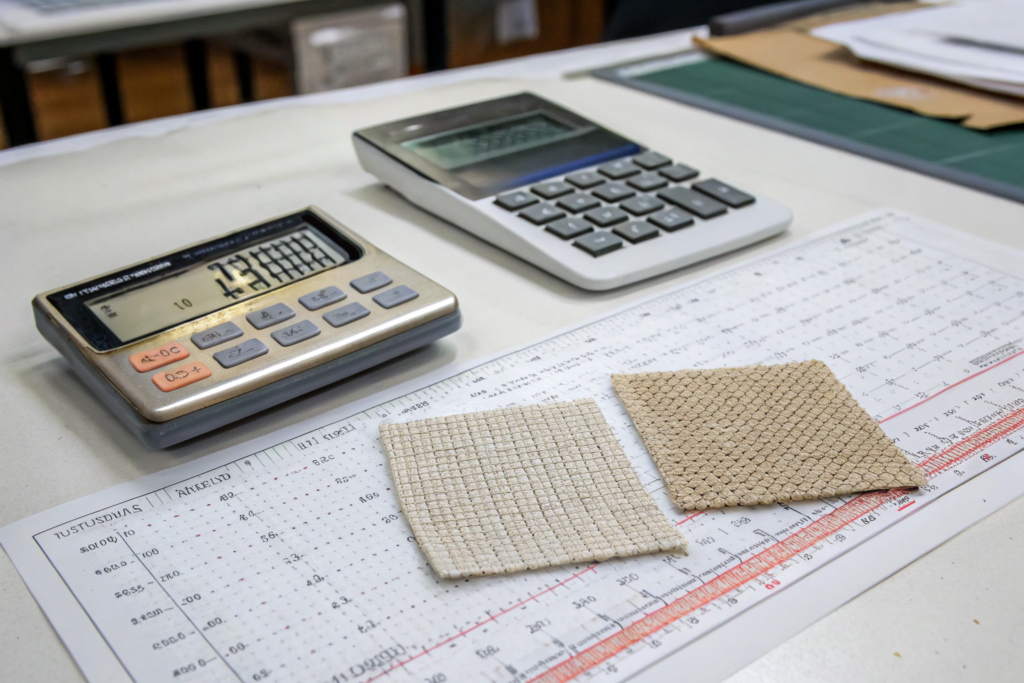
Let’s put real numbers on this so you can feel the impact. Say you negotiate a price of $3.50 per meter for a cotton elastane woven with a target weight of 280 GSM. You order 10,000 meters. You expect to receive 10,000 meters of 280 GSM fabric, which contains a specific amount of cotton fiber. Now the shipment arrives, and every roll is at 266 GSM—a 5% negative deviation.
The mill has shipped you roughly 5% less fiber by weight. You paid $35,000 for the order. Because the fabric is lighter, the mill’s raw material cost was lower, but they charged you the full price. The hidden loss is 5% of $35,000, which equals $1,750. That’s pure profit the mill gained by stretching your tolerance. Now multiply this across multiple containers per year. A mid-sized distributor buying 500,000 meters annually could leak $50,000 to $80,000 just through unchecked weight variance. You need to understand how to check GSM manually using a precision cutter and gram scale before bulk shipment acceptance. A simple 100cm² circle cutter and a $50 scale can save you tens of thousands.
Why Do Some Mills Intentionally "Fluff" Fabric to Pass Visual Inspection at Lower Weight?
This is a trick as old as textile finishing. A mill can overfeed the fabric on the stenter frame, blasting it with steam to create a fluffy, voluminous hand feel that temporarily masks a low fiber density. They’ll also use a heavy cationic softener that adds temporary weight and bulk. The fabric feels thick and plush when it arrives. You approve the sample. Six months later, your customer washes the garment once, the softener rinses out, the fluff collapses, and the fabric reveals itself as a thin, limp rag.
This is the "finishing deception." The softener adds maybe 2-3% temporary weight, which also fools a quick GSM check if you don’t wash the sample first. We call this "fugitive weight." To protect yourself, you must study how to detect artificially inflated fabric weight from heavy softener finishes during inspection. A simple wash test—one cycle with a mild detergent, air dry, and re-weigh—strips away the fugitive chemistry and reveals the true base fabric weight. At Shanghai Fumao, we report GSM in two states: "Loom State" (unwashed) and "Washed State" (after one home laundry cycle). The washed state number is the one you want to use for your cost calculation, because that’s what the end consumer gets.
International Tolerance Standards: ISO 3801 and ASTM D3776 Explained
A vague tolerance like "Weight: 250 GSM +/- 5%" is a legal gray area that favors the mill. 5% of what? Is that the average of the entire lot, or is each individual roll required to fall within that range? Without naming the specific international standard that defines how to measure, how many samples to take, and how to calculate the average, your purchase contract has a giant loophole. A mill can ship you one roll at 260 GSM and nine rolls at 230 GSM, average them to 233 GSM (within a 7% tolerance), and claim they met the spec.
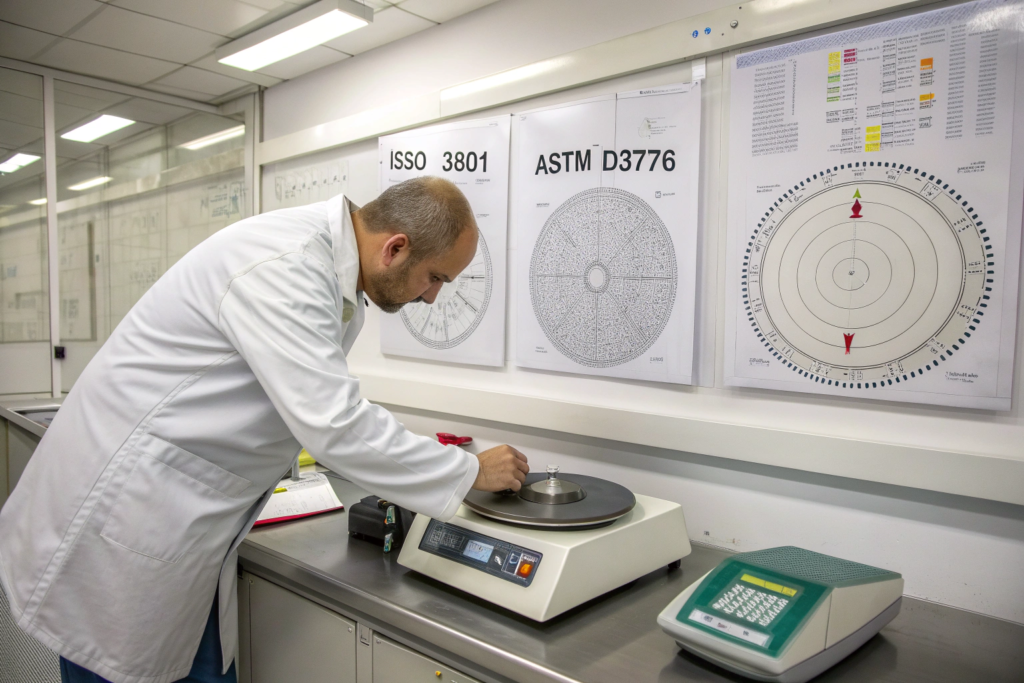
You must lock down the methodology. The two governing standards for fabric mass per unit area are ISO 3801 and ASTM D3776. They define the sampling procedure, the conditioning atmosphere (standard humidity and temperature), and the calculation method. Referencing these standards in your purchase order transforms a casual weight check into a legally enforceable technical specification. It tells the mill you know exactly how the test will be conducted during a third-party pre-shipment inspection.
What Is the Correct Sampling Procedure Under ASTM D3776 for a Bulk Lot?
You can’t just weigh one roll and call it a day. ASTM D3776 provides a statistically valid sampling plan. For a bulk lot, you must select a specific number of rolls based on the total shipment size, then cut samples from specific locations across the width (left, center, right) to account for selvedge-to-center weight variation. This matters because stenter frames sometimes stretch the edges tighter than the middle, creating a weight gradient.
Here is a simplified sampling table based on ASTM D3776 for woven fabrics:
| Total Rolls in Shipment | Minimum Rolls to Sample | Sample Locations per Roll |
|---|---|---|
| 1 to 10 | All rolls | Left, Center, Right (3 samples) |
| 11 to 50 | 5 rolls | Left, Center, Right (3 samples each) |
| 51 to 100 | 10% of rolls (min 5) | Left, Center, Right (3 samples each) |
| Over 100 | Square root of total rolls | Left, Center, Right (3 samples each) |
(I always insist the third-party inspector cuts the samples at least 1 meter in from the roll end. The very ends are often stretched or compressed from roll handling and give a false reading.)
Each sample is then conditioned in a standard atmosphere (20°C ± 2°C, 65% ± 4% relative humidity) until it reaches equilibrium moisture content. Only then do you cut the precise 100cm² circle and weigh it. This conditioning is not optional. Skipping it makes your weight data inadmissible in a dispute.
How Does the European Norm ISO 3801 Differ From the American ASTM Standard?
While both standards aim to measure the same thing—mass per unit area—the devil is in the conditioning and the acceptance criteria. ISO 3801 is more commonly referenced in European supply contracts, and it often specifies a tighter preconditioning step. The fabric must be dried to constant mass in an oven before being brought into the standard atmosphere for conditioning. ASTM sometimes allows "as received" conditioning if both parties agree (though I never recommend this).
The biggest practical difference is in how they calculate the "commercial weight." ISO 3801 often pairs with ISO 6741-1, which defines "commercial mass" by applying agreed-upon commercial moisture regain values. For cotton, this is 8.5%. If your fabric tests at a lower moisture regain in the lab, the ISO commercial mass calculation actually adds weight back in. This is a critical nuance for distributors in the EU market. You must reference the official ISO 3801 standard guide for determining fabric mass per unit area and per unit length. If you don’t account for commercial regain, you might reject a shipment that is actually within contractual tolerance, triggering an expensive false-fail dispute with your supplier.
Moisture Regain: The Invisible Variable in Fabric Costing
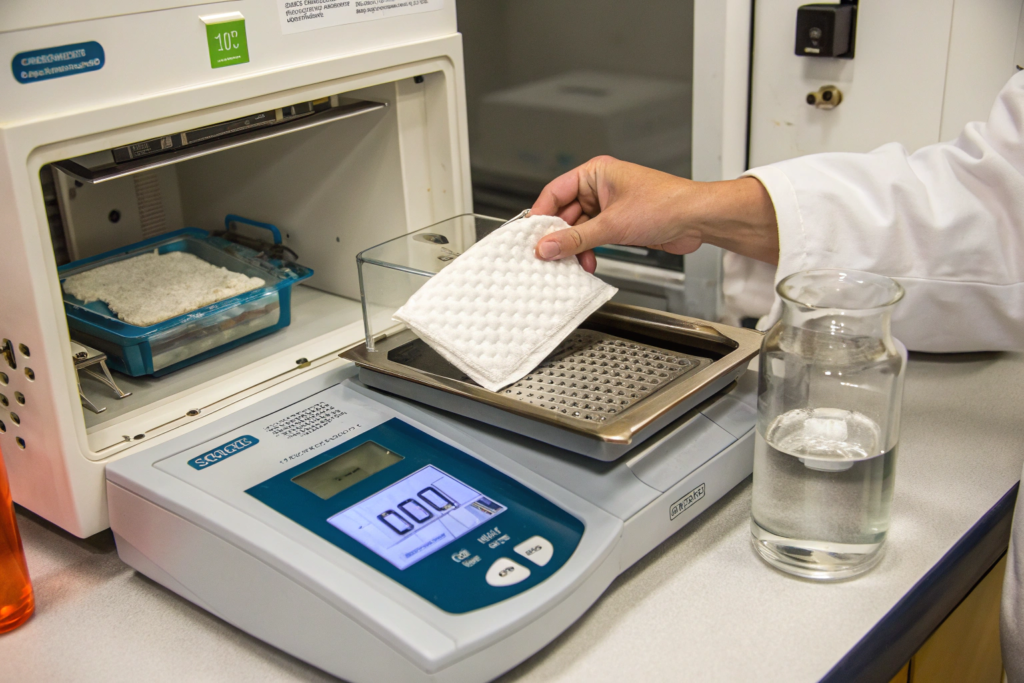
Cotton is a living, breathing material even after it’s woven. It absorbs moisture from the air like a sponge. A kilogram of cotton fabric in humid Guangzhou can weigh 8.5% more than the same fabric in a dry, heated warehouse in Chicago in January. This weight difference is pure water. If you buy fabric by the kilogram, and your supplier weighs it in a high-humidity environment, you are literally paying fiber prices for water. That’s a painful thought.
Moisture regain is the term for how much water a fiber holds relative to its bone-dry weight. Cotton’s standard commercial regain is 8.5%. Polyester’s is 0.4%. When you specify a fabric weight like 250 GSM, you must specify whether that’s "Oven Dry Weight" (zero moisture) or "Conditioned Weight" (at standard atmosphere) or "Commercial Weight" (with agreed regain added). If you leave this undefined, a clever supplier will condition your polyester blend in a steamy room, pump the "cotton fraction" up with 8% water, and sell you water at $5 a kilo. We’ve built our weighing room at Shanghai Fumao with climate control set precisely to 20°C and 65% RH, specifically to remove this variable from the negotiation.
Why Does Cotton’s 8.5% Commercial Regain Impact Your Landed Cost?
Let’s run a real shipment calculation. You import a container of 100% cotton poplin from Asia. The invoice says "Net Weight: 5,000 kg." Your warehouse is in Arizona. The fabric arrives, you weigh it, and it shows 4,850 kg. You just lost 150 kg of weight. Did the supplier cheat you? Probably not. The fabric simply dried out in transit through the dry desert air.
Now, whose financial responsibility is that 150 kg? If your contract says "Net Weight at Standard Condition," the supplier owes you a credit because they didn’t meet the conditioned weight spec. If your contract says "Actual Delivered Weight," you eat the loss. Smart importers always buy on "Conditioned Weight" or "Commercial Weight with agreed regain." You need to learn how to calculate the conditioned weight of a cotton shipment using the standard oven-dry method for contract negotiation. The formula is: Conditioned Weight = Oven Dry Weight × (1 + Standard Regain %). If the supplier’s conditioned weight calculation doesn’t match yours, you have a solid basis for a claim. If you don’t know this formula, you have nothing.
How Does Fiber Blend Complicate the Moisture Regain Calculation?
Blends make the math more interesting but also easier to get wrong. A 60% Cotton / 40% Polyester fabric doesn’t just average the regains. Cotton regains at 8.5%, Polyester at 0.4%. The blended commercial regain is calculated on a weighted average basis. So, for that 60/40 blend, the standard commercial regain is (0.60 × 8.5%) + (0.40 × 0.4%) = 5.1% + 0.16% = 5.26%.
Many small traders slap a flat 5% on everything and call it a day. But precision matters on large volumes. If you incorrectly apply 8.5% to a blend that should be 5.26%, you’re accepting a water weight that doesn’t exist, and your cost calculation per usable dry fiber is off by over 3%. This becomes particularly tricky with moisture-absorbent regenerated fibers like viscose or modal, which can have a regain of 11% to 13%. You should check out the standard guide to commercial moisture regains for common textile fiber blends for cost calculations. A modal-cotton blend can easily swing 2% in weight between a humid summer shipment and a dry winter delivery, and that 2% is pure water cost. A good weighing protocol at the receiving warehouse, coupled with a lab oven-dry test on one sample per lot, resolves all these phantom weight disputes instantly.
How to Draft a Fabric Weight Penalty Clause for Your Purchase Contract
A verbal agreement or a simple "GSM 250 +/- 5%" on an email is not a contract; it’s a wish. You need a binding penalty structure that automatically compensates you for weight shortfalls without requiring a long legal battle or a favor from the supplier. The mill will always push back on a "zero tolerance" policy because honest manufacturing has inherent variation. The solution is a graduated penalty scale that distinguishes between acceptable variance, minor penalty, and outright rejection.
This clause shifts the mill’s incentive. Without a penalty, the mill profits by shipping at the bottom of the tolerance range. With a sliding penalty, they profit by hitting the target. The cost of the discount exceeds the fiber savings from cutting corners. At Shanghai Fumao, we actually like clear penalty clauses because they prove to our distributor clients that we have the process control to consistently hit targets. A contract with teeth builds more trust than a contract with fuzzy handshakes.

What Is a Fair "Sliding Scale" for Weight Shortfall Discounts?
Fairness goes both ways. You want protection, but you also want the mill to actually ship the order. An unattainable spec will just get your PO rejected. A reasonable sliding scale based on industry practice looks something like this:
| Deviation from Target GSM | Classification | Contractual Consequence |
|---|---|---|
| Within ± 3% | Acceptable Tolerance | Full invoice price, no penalty. |
| -3.1% to -5% | Minor Shortfall | 5% discount on the affected roll quantity. |
| -5.1% to -8% | Major Shortfall | 10% discount on the affected roll quantity. |
| Exceeding -8% | Rejectable Defect | Mill pays return freight plus 100% refund. |
(One crucial detail: the tolerance should apply to the average of the sampled rolls, not just individual extremes, unless you explicitly want a roll-by-roll guarantee. I prefer a dual spec: the lot average must be within ±3%, and no single roll shall fall below -5%. This catches both systemic underweight and rogue outlier rolls.)
This table needs to be explicitly pasted into your Purchase Order Terms and Conditions. Don’t bury it in an appendix. Make the supplier initial it. You can reference this against guidelines for textile fabric weight defect commercial penalty schedule examples for comparison.
How to Use Third-Party Inspection to Enforce Your Tolerance Clause Before Payment?
The penalty clause is useless if you only check the weight after the container arrives at your doorstep. By then, you’ve already paid (via LC or TT advance), and recovering money from an overseas supplier is a slow, painful process. The enforcement mechanism is a pre-shipment inspection (PSI) conducted by an independent third party like SGS, Bureau Veritas, or Intertek while the fabric is still at the mill.
Your purchase contract must state: "Final weight determination shall be based on an SGS inspection report conducted per ASTM D3776. Payment release is conditional upon the inspected lot average falling within the acceptable tolerance range." This gives you leverage. If the inspection fails, the mill must either re-work the fabric (which is hard with weight—you often can’t add fiber back) or negotiate the discount before the ship ever sails. It forces the "fight" to happen in their backyard, on their time, before they get paid. You should also understand the scope and cost of a standard pre-shipment inspection for fabric weight verification. It costs maybe $300 to $500 per day for an inspector. That’s trivial insurance against a $30,000 weight shortfall. Pay for the PSI, and make it a non-negotiable line item in your sourcing budget.
Conclusion
Weight tolerance is the quiet accountant of your textile business. It works for you or against you in complete silence. We’ve seen how a few missing grams per square meter aren’t just a quality slip; they represent actual cotton, actual polyester, actual money that you paid for but never received. We connected the dots between the steam-fluffed softener finish and the eventual collapse of a garment’s body after a wash cycle, proving that the scale always tells the truth when the hand feel lies. We dug into the international standards—the ASTM and ISO protocols—that give you the legal language to challenge a supplier’s numbers with statistical confidence. And we demystified the ghost of moisture regain, that invisible weight of water that swings your shipment value between the loading port and your dry western warehouse.
You now have the tools: the GSM cutter, the conditioning oven logic, the sliding penalty scale, and the third-party inspection stopgap. Use them to write a purchase order that doesn’t just ask for a length of cloth, but demands a precise mass of fiber. That’s what you’re truly buying. If you’re ready to work with a partner who puts the actual delivered weight on every roll label and welcomes audit clauses, let’s talk. We’re ready to provide the consistent, on-spec fabric that makes your cost sheets predictable and profitable. Reach out to our Business Director, Elaine, at elaine@fumaoclothing.com. Let’s put a number on your quality and your margin.