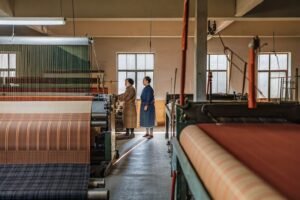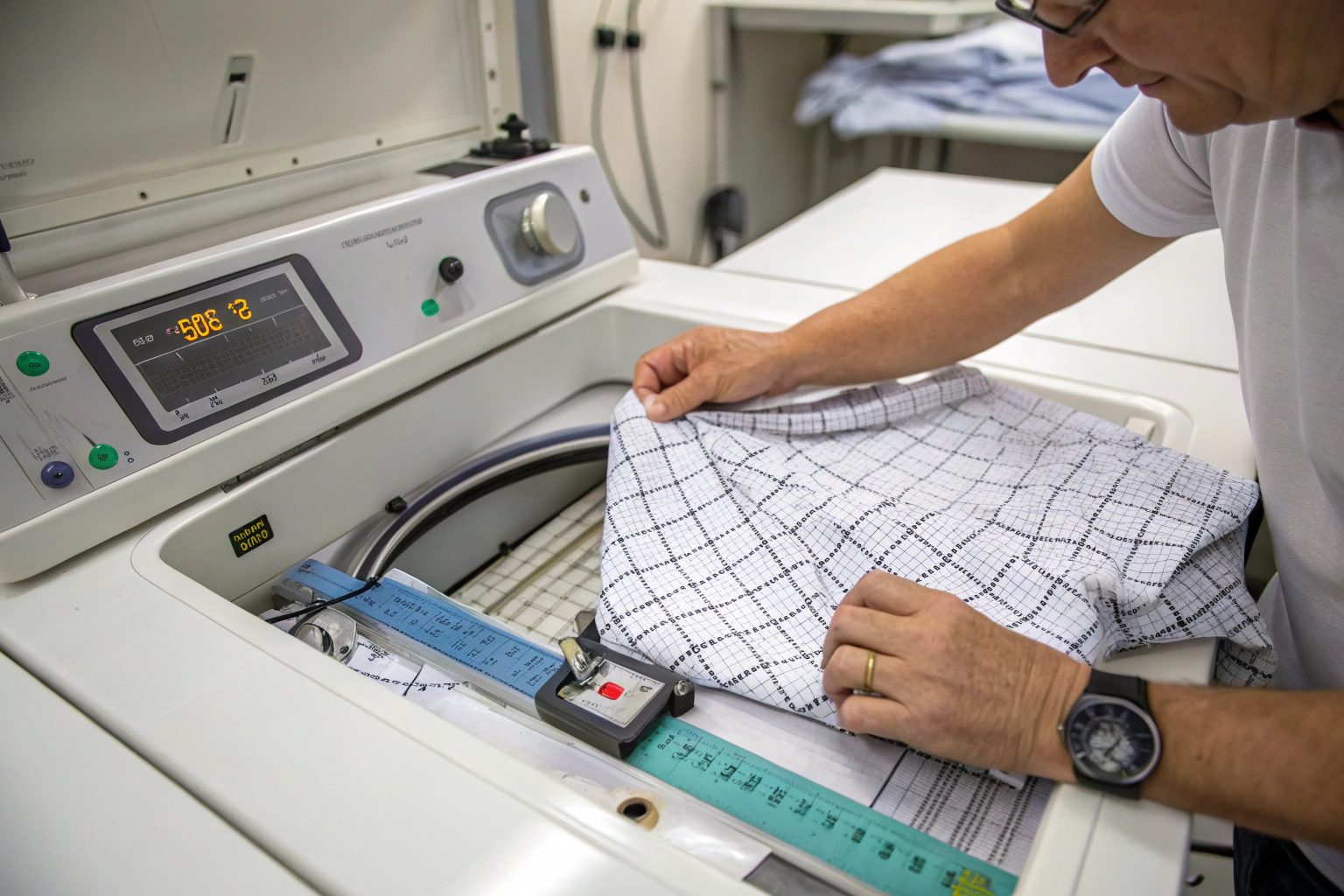
You’ve just unloaded a container of premium cotton tees at your Los Angeles warehouse, and your stomach drops. The size Large fits like a Medium, the sleeves are riding up, and the side seams are twisting like a corkscrew. I know that specific kind of panic—you’ve invested tens of thousands of dollars in fabric, freight, and duties, only to have a product that your retail buyers will instantly reject. The real killer isn’t just the lost inventory; it’s the ruined reputation with your wholesale accounts who trust you to deliver consistent sizing. This is the silent killer of profitability in the garment trade.
The way to absolutely prevent this nightmare isn’t washing a shirt and hoping for the best. It requires a three-pronged attack: pre-production mechanical shrinkage control at the mill, a mandatory fabric relaxation step before cutting, and a zero-compromise ASTM-compliant test on the finished bulk. At Shanghai Fumao, we don’t just sell you greige goods; we engineer the dimensional stability right into the yarn. If you control the tension during knitting or weaving, and force the fabric to shrink before the scissors hit it, you ship a garment that stays true to size wash after wash.
I’ve been standing over steaming compactor machines and pulling wet fabric swatches out of Whirlpool washers in Keqiao for two decades. The science of shrinkage isn’t a mystery to me, but I understand it feels like a black box to many importers. Stick with me for a few minutes, and I’ll pull back the curtain. I’m going to explain why "pre-shrunk" is often a meaningless marketing label, why the twist of the yarn in your basic jersey can either save or sink your shipment, and how a simple specification on your purchase order can shift the legal liability back to the supplier if the garment fails. You can absolutely take control of this.
Why Mechanical Pre-Shrinking Beats Chemical Finishes
When a US buyer asks for "low shrinkage cotton," the first instinct of an inexperienced mill is to reach for a chemical bucket. They soak your fabric in a resin that cross-links the fibers, effectively gluing them in place so they can’t move. It works, sure, but it often destroys the natural softness of the cotton and washes out in about ten laundry cycles, leaving the customer with a shrunken rag just when they started to love the fit. That’s a ticking time bomb for your brand reviews.
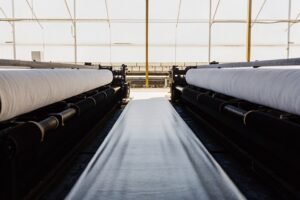
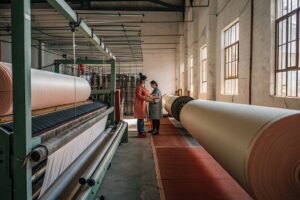
We take the mechanical route because it physically resets the fiber memory. A rubber belt compactor uses heat, steam, and pressure to scrunch the fabric lengthwise, forcing the yarns to bunch up into a relaxed, zero-tension state. It’s not a coating; it’s a physical restructuring. When you take a cotton jersey straight off a high-speed knitting machine, it’s under massive tension—stretched like a rubber band. If you cut it in that state, the first drop of warm water snaps those stretched loops back into their relaxed position. The compactor snaps them back first.
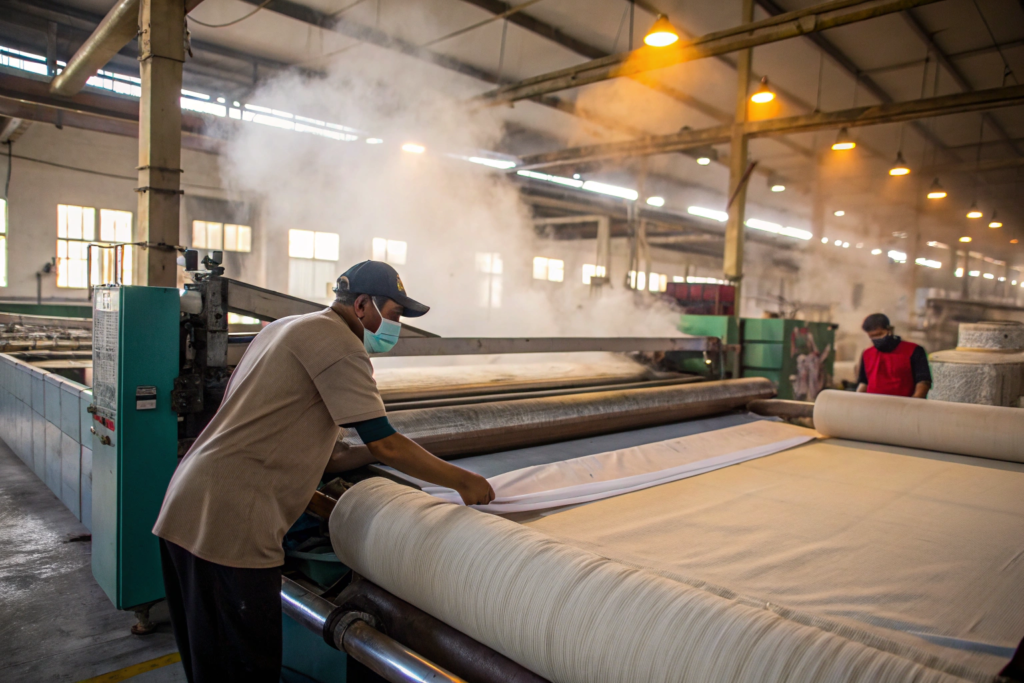
Is "Pre-Shrunk" Just a Marketing Term or a Real Measurable Result?
I want you to be skeptical when you hear "pre-shrunk." It means nothing without a number. In our world, we don’t just "shrink" the fabric; we target a specific "residual shrinkage" percentage. That’s the tiny bit of movement left in the garment for the end consumer. We strictly follow the standard method for determining dimensional stability of knitted cotton fabrics in home laundering.
Here is the reality check you need to do on a spec sheet before you approve a sample:
| Claim on Fabric Spec | What It Actually Means | The Real-World Result if Ignored |
|---|---|---|
| "Commercially Pre-Shrunk" | No specific standard quoted. Often just a quick steam pass. | Expect 5-8% length shrinkage. A size Large tee will look silly after one wash. |
| "Compacted Finish" | Mechanical compression applied. | Good, but ask for the "compaction percentage." We usually set it at 8-10% for cotton. |
| "Residual Shrinkage < 3% (AATCC 135)" | This is the gold standard. A certified test pass. | The garment will barely change size over its life. This is what you write into a contract. |
(Here’s an insider tip: a mechanical compactor can only do so much if the base yarn twist is wrong. If you use a high-torque, live-spun yarn, the fabric wants to shrink spirally, causing torque and skewing. The compactor can fix the length and width, but it can’t fully erase the twist memory. You need to check the "spirality" angle, too, which we’ll get to later.)
Why Does Heat Setting Prevent Progressive Shrinkage During Transit?
It’s not enough to just relax the fibers; you have to lock that new relaxed shape in place. Cotton is a thermoplastic material—it softens and reforms when it hits certain temperatures inside the drying drums. If you just compact the fabric cold and roll it up, the memory of the stretched state can slowly creep back in, especially inside a hot shipping container crossing the Pacific Ocean.
We use an overfeed stenter frame. The machine grips the fabric on the edges and feeds it onto a belt faster than it pulls it off, deliberately overfeeding it. Simultaneously, we hit it with steam at a specific temperature to "set" the relaxed structure. This is also why you need to understand how to master heat setting parameters for zero-shrinkage cotton interlock stability. If the temperature is too low, the bond breaks during transport; too high, and your white fabric turns to a sad, brittle yellow. For a 100% cotton single jersey, I like to set the stenter temperature at 150°C (302°F) with a 15% overfeed. That combination creates a mechanical lock that survives a three-month container journey from Shanghai to Long Beach without reverting.
The Critical Role of Relaxation Before Cutting and Sewing
You spent extra on compacted, low-shrinkage fabric. You’ve won half the battle. But if your cutting table operator grabs that roll and yanks it through an electric spreader at high tension, you’ve just undone all that mechanical work. Fabric is a viscoelastic material; pull it hard, and it stretches. Cut it while it’s stretched, and the pieces will spring back to a smaller size—mimicking a shrinkage failure. This is the most common mistake I see in smaller CMT factories.
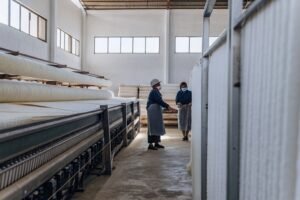
The secret here is time and gravity. You must let the fabric "breathe" in a relaxed state for a minimum of 24 hours, 48 is better. We call this the relaxation recovery period. When we ship a container of cotton jersey from our finishing plant, the fabric has been sitting in the roll on a pallet, often under compression. Before you cut it, you need to take it off the pallet, unroll it loosely onto a rack, and let the ambient humidity of the factory naturally relax the fibers back to their zero-stress state. Skip this step, and your neckbands will pucker.
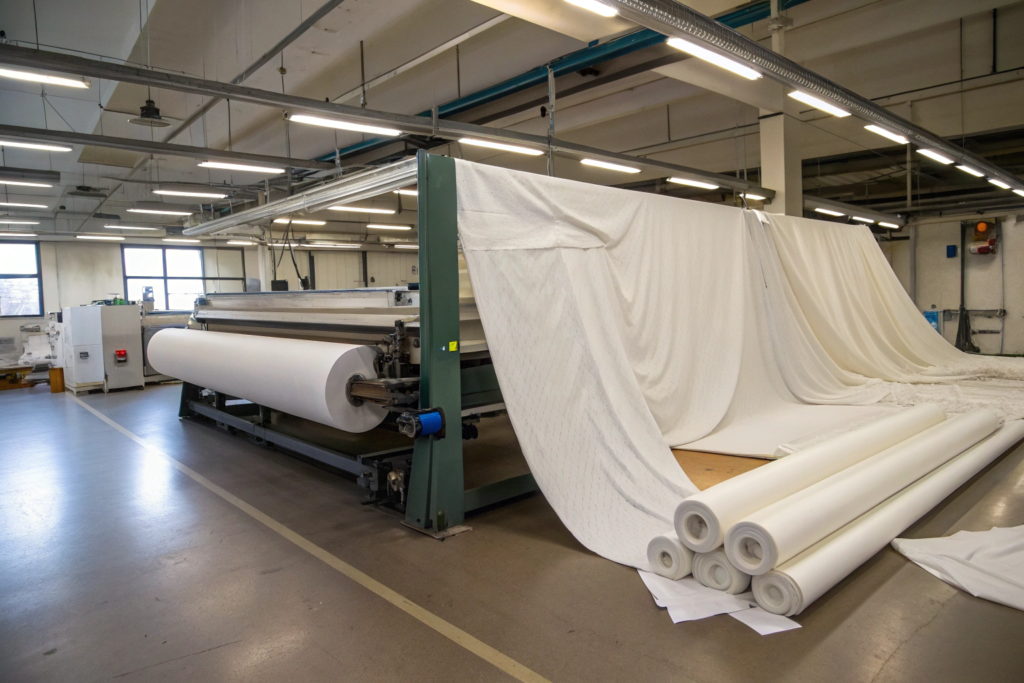
How Long Must 100% Cotton Jersey Rest Before Automated Spreading?
Don’t rush this. Time is the cheapest quality control tool you have. I’ve seen fast-fashion CMT units try to rest fabric for just 4 hours to hit a deadline, and the resulting dimensional variance across the spread is a disaster. A tight roll creates internal pressure; the outer layers of the roll are under different tension than the core. You have to let that pressure equalize.
Here is a simple minimum rest schedule I force my garmenting partners to follow:
| Fabric Type | Minimum Relaxation Time (Unrolled) | Reason |
|---|---|---|
| Lightweight Single Jersey (120gsm) | 24 hours | Low mass recovers quickly, but drape needs to settle. |
| Heavy Fleece/Terry (300gsm+) | 48 hours | The dense loop structure takes longer to decompress from roll pressure. |
| 2×2 Rib (Neckbands) | 24 hours in a loose stack | Never hang rib; it stretches under its own weight. Lay it flat. |
I always remind my teams to check the humidity in the cutting room. Cotton is hygroscopic—it absorbs moisture from the air. If your cutting room is a dry desert, the fabric will shrink when it hits a humid environment. You want a steady 60-65% relative humidity. It’s worth learning how to design a factory relaxation layout to eliminate residual shrinkage in cotton knitwear. This isn’t just about racks; it’s about airflow. If you stack the relaxed fabric too tight, the inner layers can’t breathe and won’t reach equilibrium. You’re looking for a steady "conditioning" phase.
Why Does Over-Stretching on the Spreading Table Ruin the Compaction Work?
An electric spreading machine is a beautiful thing, but it’s a brute. It pulls fabric off the roll. If your operator sets the feed tension too high, they are literally stretching the fabric every single layer they spread. A compacted cotton fabric can easily be stretched by 2% or 3% during a fast spread. That might not sound like much, but on a 70cm body length, that’s a loss of 1.4 to 2.1 cm. That’s the difference between a perfect fit and a midriff-baring top.
We teach operators to use the "creep" or "non-tension" mode on the spreader, or even better, to spread the fabric loose on a table by hand for delicate, slippery compacted weaves. I recall a disaster in June 2022 when a Portland, Oregon customer sent us an angry video of 2,000 henleys with twisted side seams. The shrinkage test on the bulk fabric passed at 2.5%, perfectly within spec. We flew a technician to the cutting factory in Vietnam and found the spreading machine was pulling the fabric with a tension of 4 Newtons. We told them to drop it to 1 Newton, and the problem vanished instantly. The fabric wasn’t the problem; the distortion was mechanical. You need to audit the spreading force, not just the fabric.
Specifying Shrinkage KPIs for a US-Bound Purchase Order
Lawyers don’t know fabric, and mills don’t like lawyers. This leaves a gap in your Purchase Order that can cost you a fortune. You can’t just write "color: white, shrinkage: minimal." That has no legal standing in an arbitration court. A bulletproof PO doesn’t just list a price per yard; it legally defines the exact test method, the acceptable tolerance, and the penalty for failure. This turns a subjective complaint into an objective, enforceable metric.
I’ve been burned before, so I now demand a technical appendix. Your KPI must state the international standard (AATCC or ISO), the washing machine type, the drying method, and the maximum percentage variance. By specifying this, you shift the responsibility for the bulk performance from your design team to the mill’s quality control department. We at Shanghai Fumao actually prefer strict KPIs because they eliminate ambiguity and let us prove our technical skill. Vague specs make us nervous; detailed specs tell us you’re a pro.

Which AATCC Washing Test Is the True Gold Standard for Apparel Imports?
You can’t just say "do a wash test." There are different machines that wash differently. If you specify a European ISO standard for a US-bound garment, the results won’t match the reality of a top-loading Whirlpool agitator in Texas. The North American consumer typically uses a top-loading machine with a central agitator—this is brutal on clothes.
For the US market, you must specify AATCC Test Method 135, but you need to define the parameters inside it. Here is the difference that matters:
| Test Specification | Machine/Cycle | Fails the Garment If… |
|---|---|---|
| AATCC 135 (1, III, A iii) | Normal Cycle, Tumble Dry. | This is our standard baseline. Length shrinkage > 5% is an automatic fail for basic tees. |
| AATCC 135 (3, V, A iii) | Delicate Wash, Damp Flat Dry. | Useful for fine-gauge modal blends. This test is gentler; standards are tighter (fail > 3%). |
| AATCC 150 (Home Laundering) | Consumer-like agitation. | Minimizes the "lab vs real life" gap. We use this for denim jeans. |
You should research how to pass the AATCC 135 dimensional stability test for lightweight cotton voile exports. Voile is a tricky one. Because the yarn is so fine and the twist is so high, it tends to "tighten up" aggressively in the first wash. To pass the test, we often have to over-compact it until the surface feels almost papery, then wash it with a softener to bring back the hand feel before cutting. It’s a two-step dance.
How to Structure a Chargeback Clause Based on Fabric Shrinkage Thresholds?
This is the negotiation no one likes, but it saves relationships. You need a pre-agreed sliding scale. If the fabric shrinks 3%, great, everyone is happy. If it shrinks 4%, maybe a small discount. But if it shrinks 7% and the garments are commercially unsellable, you need a full refund plus freight recovery. Without that clause in the PO, you’re just asking for a favor.
In our standard agreement, we define "Major Defect" and "Minor Defect" explicitly. A Major Defect is any shrinkage exceeding the agreed standard by 2% or more, or any spirality/torque over 5%. For the uninitiated, you need to check the requirement for finished fabric spirality skewing in knitted cotton garments for US retailers. If a t-shirt side seam twists to the front, it looks cheap.
I negotiated this with a New York buyer in March 2024. They wanted a 5% allowance, we guaranteed 3% on a 260gsm loopback fleece. We wrote it right into the order sheet: "Residual Shrinkage: Max 3% x 3% (Warp/Weft). Should bulk exceed 5%, Seller issues full credit for the defective rolls plus freight penalty." It forced our finishing manager to run the compactor at a slightly slower, safer speed to keep the heat consistent. The bulk shipped at 2.8%. That precise, slightly blunt contract language saved us a potential $40,000 chargeback. It aligned our interests perfectly.
Laboratory vs. Real-World Wash Testing Gaps
Your mill sends you a beautiful PDF report: "Shrinkage: Warp 2.1%, Weft 1.8%. PASS." But your customer sends you an iPhone photo of a doll-sized jacket fresh from their Maytag. Who is lying? Often, no one. The lab test is a perfectly controlled science experiment; the real world is a chaotic chemical attack. The lab uses a standard reference detergent; your customer uses a triple-concentrated "Deep Clean" Tide pod with enzymes and optical brighteners that eat away at the fiber lubrication.
You have to identify the "gap factor." We build a safety buffer into our specs to account for this consumer abuse. If you need a garment to shrink less than 5% in the real world, you better demand it shrinks less than 3% in the lab. We call this the "Consumer Abuse Factor" (CAF). At our testing center, we don’t just run one cycle; we run five, because the cumulative progressive shrinkage is what actually breaks the product. You might pass the first wash with flying colors, but fail the fifth wash miserably, and that’s where your brand reputation ends.
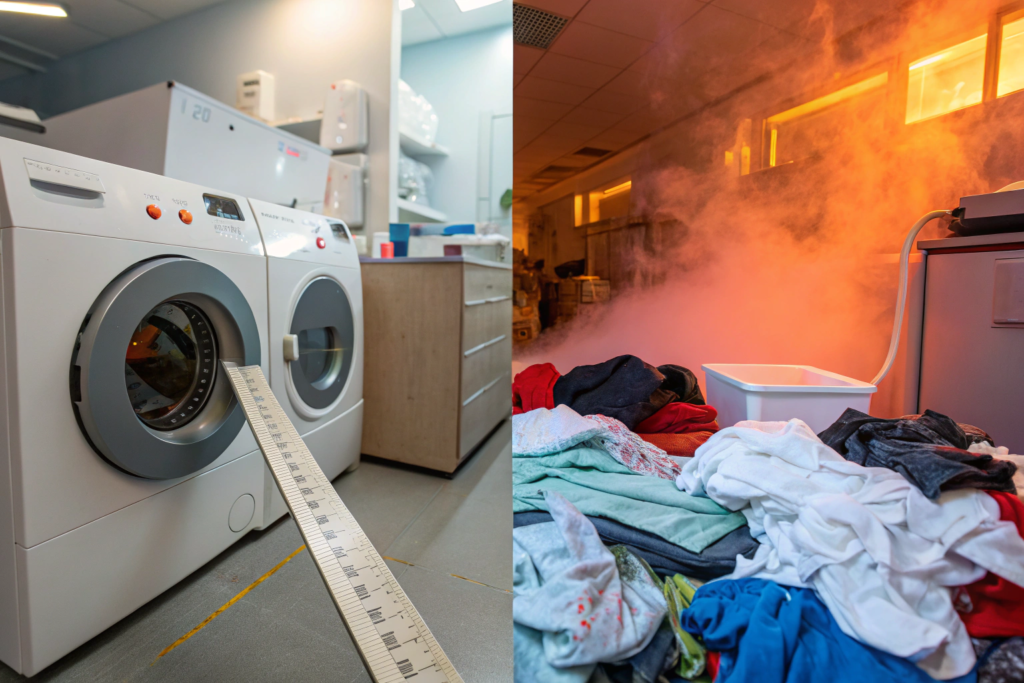
Why Do Enzyme Detergents Accelerate Cumulative Shrinkage Over Five Washes?
Cotton is a plant. It has a waxy outer cuticle that gives it a smooth, slick feel. Chemical softeners and silicone finishes add to that slickness, protecting the yarn from friction. Enzyme detergents are designed to literally digest organic matter—like grass stains, blood, and… cellulose. They don’t just eat the dirt; they slowly attack the outer layer of the cotton fiber itself, stripping away the natural wax and the protective finish.
This causes a phenomenon we call "mechanical felting." Once the protective lubrication is gone, the fiber surface becomes rough. In a tumble dryer, those rough fibers catch on each other and interlock, slowly ratcheting tighter and tighter. This doesn’t show up in a standard 1-cycle test using neutral detergent. To bridge the gap, you need to understand how to simulate aggressive consumer laundry habits using AATCC standard reference detergent with enzymes. We use AATCC 1993 Standard Reference Detergent WOB (with optical brighteners and enzymes) for our "real world" simulations. We run a 5-cycle progressive test, measuring after the 1st, 3rd, and 5th wash. The curve tells the story. A good compacted cotton might go from 2% (1st wash) to 4% (5th wash). A bad one goes from 4% to 9%. The curve is your early warning system.
Can You Trust a Mill’s In-House Lab Certificate Without a Third-Party Audit?
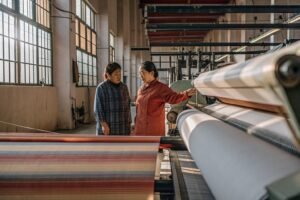
Here’s where I have to be brutally honest: not all labs are equal. Some factory labs are "show labs"—clean, pretty rooms with machines that are never calibrated. They exist to print a certificate. Others, like our CNAS-certified facility at Shanghai Fumao, are the beating heart of production. You need to know the difference between an internal pass and an external verification.
Don’t just accept a JPG of a certificate. Request the raw data sheets and the calibration logs of the machine. Ask for a video of the test being conducted. But even better, you must understand the benefits of third-party inspection for pre-shipment shrinkage testing in cotton garments. Companies like SGS or Bureau Veritas act as your disinterested referee.
In a 2023 project for a Boston children’s wear brand, our internal lab reported 2.5% shrinkage on a printed cotton interlock. The buyer’s third-party inspection (SGS) in Vietnam reported 4.1%. Panic ensued. We flew the exact same cut sample back from Vietnam to Keqiao and ran the test again. It was 2.6%. We then did a Zoom call with the SGS technician and found they were using a domestic dryer on "High Heat/Sanitize" cycle instead of the specified AATCC Tumble Dry Cotton setting. The gap wasn’t the fabric; it was the uncalibrated local equipment. A third-party audit is vital, but you must ensure the third party is actually following the letter of the standard, not just their "local practice."
Conclusion
We’ve covered the long, wet road from the looms to the laundry room. You now understand that avoiding shrinkage isn’t a single magical spray, but a disciplined sequence of physical events. It starts with the violent, steaming crunch of a mechanical compactor forcing the stretch out of the yarn before it ever meets a needle. It continues in a quiet cutting room where the fabric rests for a full day to shake off the stress of being rolled up. It locks in place through a rigid, legally explicit specification on your purchase order that names AATCC 135 and gives a hard number, not a fluffy promise. And finally, it stares down the harsh reality of American top-loading washers and enzyme-packed detergents, building a safety buffer into the tolerance.
The truth is, dimensional stability is the truest sign of a mill’s craftsmanship. It distinguishes a cheap, stretched product made in a hurry from a premium, stable garment that respects your customer’s wardrobe. You can push a fabric to pass a test once, but to make it survive five washes, a hot dryer, and an angry consumer requires a foundation of good yarn and honest finishing.
Stop playing roulette with your cotton bookings. We are ready to be your technical anchor in Asia, not just your supplier. Let’s build a standard operating procedure for your specific fabric weight and finish so that the word "shrinkage" never appears in your return requests again. I invite you to talk shop with our Business Director, Elaine. She knows the mill floor and the contract details equally well. Drop her an email at elaine@fumaoclothing.com, and let’s make sure your next shipment fits perfectly, right out of the box and after the hundredth wash.