A buyer sends me an inquiry for a cotton jersey. The specs are detailed: 180gsm, 100% cotton, reactive dyed, bio-washed. I quote a price. The buyer replies: "I found the same spec for $0.40 less per meter. Why is yours higher?" I ask one question: "Is the other quote using ring-spun or open-end yarn?" There’s a pause. The buyer doesn’t know. They didn’t ask. They assumed all cotton yarn is cotton yarn, and the price difference was just margin.
The yarn spinning method is not a minor technical detail buried in the production process. It determines the fabric’s hand feel, its pilling resistance, its durability, its dye uptake, and its fundamental character as a textile. Two fabrics with identical fiber content, identical weight, and identical finishing can feel and perform completely differently if one is knitted from ring-spun yarn and the other from open-end yarn. The ring-spun fabric will be smoother, stronger, and pill less. The open-end fabric will be bulkier, more absorbent, and cheaper. Neither is universally better. Each is optimal for different end-uses, and the buyer who doesn’t know the difference is paying for quality they’re not getting, or missing quality they should be charging for. At Shanghai Fumao, we spin both types in our partner spinning mills and use both extensively across our fabric programs. I’ll walk you through exactly how these yarns differ, how to identify them, and how to choose the right one for your product.
How Do Ring-Spinning and Open-End Spinning Actually Work?
The names "ring-spun" and "open-end" describe fundamentally different physical processes for converting a loose rope of cotton fibers into a continuous, twisted yarn. In ring-spinning, the process is continuous and mechanical. A thick strand of parallel fibers—called roving—is fed through a drafting system that progressively draws it thinner. The thinned strand enters a ring and traveller system where a rotating spindle inserts twist, binding the fibers together into yarn. The twist travels continuously up the fiber strand from the spindle, locking the fibers into a tight, parallel helical structure. The yarn is wound directly onto a bobbin. The process is relatively slow—spindle speeds are typically 15,000 to 25,000 RPM—but the yarn structure is highly controlled and the fibers are aligned almost perfectly parallel to the yarn axis, held in place by the twist.
In open-end spinning, the process is discontinuous and aerodynamic. A thick sliver of fibers enters the machine and meets a high-speed combing roller that separates the sliver into individual fibers—opening the fiber stream, hence the name. These individual fibers are carried by an airstream into a rapidly rotating rotor spinning at 100,000 to 150,000 RPM. Centrifugal force throws the fibers against the rotor wall, where they collect in a groove to form a ring of fibers. As yarn is withdrawn from the center of the rotor, twist is inserted by the rotation, and the newly formed yarn peels fibers from the groove, assembling the yarn from the inside out. The process is much faster than ring-spinning and eliminates the separate roving step, making it significantly cheaper per kilogram of yarn produced. But the fiber alignment is inherently less parallel, and the yarn structure includes a distinctive feature: wrapper fibers that are wound around the outside of the yarn core, holding it together. The ring-spinning versus open-end rotor spinning process comparison and yarn structure formation mechanisms provides detailed process descriptions with speed and cost comparisons.

What Are the Visual and Tactile Differences Between the Two Yarns?
You can distinguish ring-spun from open-end yarn with a simple hands-on examination. Take a length of yarn—if you’re looking at fabric, unravel a few centimeters from the cut edge. Hold it between your fingers and gently untwist it. Ring-spun yarn untwists smoothly into a flat ribbon of parallel fibers. The fibers are long, aligned in the same direction, and lie flat against each other. There are very few loose fiber ends sticking out. When you run the yarn between your fingers, it feels smooth and even, with a slight firmness from the high twist density.
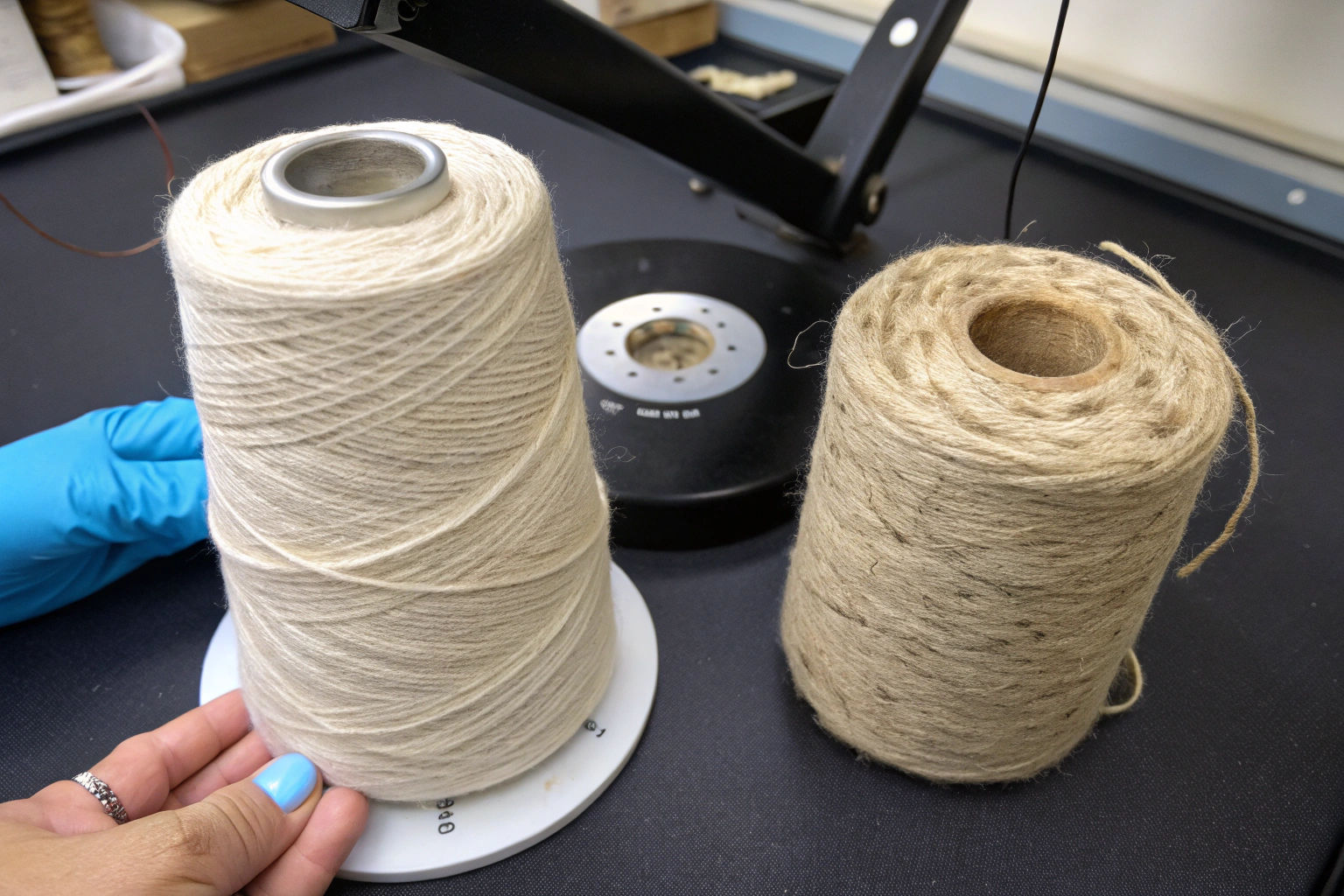
Open-end yarn resists untwisting differently. When you try to untwist it, you’ll see wrapper fibers—thin, tightly wound fibers that spiral around the outside of the yarn at irregular intervals. These wrapper fibers are the signature of open-end spinning. Under the wrapper fibers, the core fibers are less parallel and more jumbled than in ring-spun yarn. The yarn feels bulkier and slightly rougher when rolled between your fingers because the fiber ends are less controlled and the surface is covered with microscopic fuzz. Under a magnifying glass or a fabric inspection loupe, an open-end yarn looks like a slightly hairy cylinder, while a ring-spun yarn looks like a smooth, tightly wound rope. In the fabric, these differences translate directly into surface smoothness, pilling behavior, and dye appearance. A ring-spun jersey has a clean, almost polished surface. An open-end jersey has a slightly matte, dusty-looking surface with a softer, fuzzier hand. The visual identification and physical property comparison of ring-spun versus open-end cotton yarns for textile buyers and quality control provides magnified comparison images.
Why Is Open-End Yarn Faster and Cheaper to Produce?
The cost and speed advantages of open-end spinning come from three factors: process consolidation, higher production speed, and lower fiber quality requirements. Ring-spinning requires an intermediate process—roving—that draws the fiber sliver into a thinner, slightly twisted strand before it enters the spinning frame. Open-end spinning feeds the drawn sliver directly into the machine, eliminating the entire roving process, its equipment, its labor, and its floor space. The spinning speed itself is dramatically faster. An open-end rotor can spin at 150,000 RPM, producing yarn at speeds of 150 to 200 meters per minute. A ring-spinning spindle is limited to about 25,000 RPM by the physics of the traveller friction and heat generation, producing yarn at about 20 to 30 meters per minute. The throughput difference is roughly five to ten times in favor of open-end.
The fiber quality requirement is another cost driver. Ring-spinning requires longer, stronger, cleaner cotton fibers to run efficiently. Short fibers, neps, and trash particles cause ends-down—yarn breaks that stop the spindle and require operator intervention. The fiber length for ring-spinning is typically a minimum of 25mm, with premium ring-spun using 28mm to 38mm long-staple cotton. Open-end spinning is far more tolerant of shorter fibers—down to 18mm or even less—and of higher levels of cotton trash and neps. The combing roller’s opening action and the centrifugal fiber collection in the rotor homogenize fiber length variations and trash particles that would break a ring-spun yarn. This means open-end yarn can be produced from cheaper cotton grades, including cotton waste and recycled fiber, that ring-spinning cannot economically process. The combined effect of faster speed, fewer process steps, and cheaper raw material gives open-end yarn a production cost advantage of roughly 30% to 50% per kilogram compared to ring-spun yarn of the same count. The cost structure comparison of ring-spinning versus open-end spinning for cotton yarn production including raw material, labor, energy, and capital depreciation factors provides the detailed economic analysis.
How Does Yarn Type Affect Fabric Pilling and Durability?
Pilling is the most visible quality difference between ring-spun and open-end fabrics. Pills form when short, loose fibers on the fabric surface tangle together under friction, forming small balls that remain anchored to the fabric by a few unbroken fibers. The pill density and pill size depend on how many loose fiber ends are available on the surface to initiate the tangling process. Ring-spun yarn has fewer loose fiber ends because the tight, parallel fiber alignment and high twist density trap the fiber ends inside the yarn structure. Open-end yarn has more loose fiber ends because the wrapper fibers and the less parallel core fibers create a naturally fuzzier yarn surface with more protruding fiber tips. When these two fabrics undergo the same abrasion, the open-end fabric generates more pills, larger pills, and pills that form faster.
The quantitative difference is stark and consistent across our internal testing. A standard 20S ring-spun cotton jersey at 180gsm will typically achieve a Martindale pilling grade of 4 at 2,000 cycles. The same fabric construction in open-end 20S yarn will typically achieve grade 2-3 or 3 at 2,000 cycles. This is a full grade to a grade-and-a-half difference, and it’s visually obvious to the consumer after a few washes. The durability beyond pilling also differs. Ring-spun yarn is approximately 15% to 25% stronger than open-end yarn of the same count because the parallel fiber alignment and high twist density allow the fibers to share the tensile load more efficiently. A ring-spun fabric will have higher tensile strength, higher tear strength, and better seam strength than an equivalent open-end fabric. For garments that experience mechanical stress—workwear, children’s wear, activewear—ring-spun’s strength advantage translates directly into longer garment life. The pilling resistance and mechanical durability comparative study of ring-spun versus open-end cotton knitted fabrics under standardized Martindale abrasion testing provides the experimental data and statistical analysis.

Why Do Ring-Spun Fabrics Pill Less Than Open-End Fabrics?
The pill formation process has three stages: fuzz generation, entanglement, and anchor formation. First, abrasion raises loose fiber ends from the fabric surface to create a fuzzy halo. Then, continued abrasion tangles these loose ends together into a roughly spherical ball. Finally, some of the tangled fibers remain anchored to the fabric by a small number of unbroken fibers, and the pill becomes a permanent feature. Ring-spun yarns resist all three stages. At the fuzz generation stage, the tight twist and parallel fibers present fewer loose ends to the surface. At the entanglement stage, the fibers that do emerge are held more firmly by the surrounding fibers and are less likely to be pulled into tangles. At the anchor stage, the higher yarn strength means the anchoring fibers are less likely to break and more likely to hold the pill in place—which sounds bad, but actually means the pill stays attached longer and continues to accumulate more fibers, becoming larger and more visible, until the anchor eventually breaks and the pill falls off. This is the "pill-and-fall" behavior of high-quality ring-spun knits: they pill minimally, and when pills do form, they fall off cleanly rather than accumulating.
Open-end yarns struggle at the very first stage. The wrapper fibers are, by their nature, loose fiber ends wrapped around the outside of the yarn. Abrasion breaks these wrapper fibers and releases them as fuzz. The core fibers, being less parallel and less tightly twisted, also contribute more loose ends. The fabric surface is covered in fuzz almost from the first wear, and this fuzz provides abundant raw material for pill formation. The pills form quickly, accumulate additional fibers rapidly, and the weaker yarn strength means the anchoring fibers break more easily, releasing pills that then contribute loose fibers to start new pills. This creates a continuous pill-shedding cycle that makes the fabric look worn and tired after relatively few washes. The fiber entanglement mechanics and pill formation kinetics in ring-spun versus open-end cotton yarn knitted fabric surfaces provides the detailed tribological analysis.
Does Ring-Spun Yarn Produce Stronger Seams?
Yes, and this matters more than most buyers realize. Seam failure in a knitted garment often occurs not because the sewing thread breaks, but because the fabric yarn at the stitch line breaks under tension—a failure mode called "yarn severance" or "stitch cutting." The sewing needle punches through the fabric, and if the fabric yarns cannot withstand the repeated stress of needle penetration and the subsequent tension on the seam, they break. A stronger yarn resists stitch cutting better. Ring-spun yarn, with its 15% to 25% tensile strength advantage over open-end yarn of the same count, produces fabric with correspondingly higher seam strength. The seam will withstand higher loads before the fabric yarns at the stitch line fail.
The difference is most pronounced in lightweight fabrics and fine-gauge knits, where the yarn itself is thin and every bit of inherent yarn strength counts. A 40S ring-spun jersey for a lightweight t-shirt will have significantly better seam integrity than a 40S open-end jersey, and the difference will show up as seam failures at the shoulder and side seams after multiple wear-wash cycles. For heavyweight fabrics, the absolute yarn strength is high enough in both spinning methods that seam failure is less of a practical concern. The seam strength and stitch cutting resistance comparison of ring-spun versus open-end cotton knitted fabrics under standardized seam integrity testing provides the comparative testing data across yarn counts.
Which Yarn Type Works Better for Dyeing and Printing?
The dyeing difference between ring-spun and open-end fabrics is visual, not chemical. The same dye recipe applied to both yarns will produce a different perceived color because the yarn surface structure affects how light interacts with the dyed fibers. Ring-spun yarn’s smooth, parallel fiber surface reflects light more uniformly and with less scattering. The result is a deeper, richer, slightly lustrous color appearance. The dye appears more saturated because less light is scattered off fiber fuzz before it reaches the dye molecules in the fibers. Open-end yarn’s rougher, fuzzier surface scatters incoming light in many directions. This scattering dilutes the perceived color depth, making the same dye concentration look slightly lighter, more matte, and sometimes slightly heathered or dusty in appearance. The effect is most noticeable in dark, saturated shades like navy, black, and deep burgundy, where the ring-spun version looks noticeably deeper and richer than the open-end version.
The printing difference is about surface smoothness and print definition. A screen print or digital print sits on the fabric surface. On a ring-spun fabric, the smooth surface allows the print to lay flat and uninterrupted, producing crisp edges and even ink coverage. On an open-end fabric, the surface fuzz interrupts the print surface, creating microscopic gaps in the ink coverage and slightly less sharp edge definition. For high-detail prints, photographic prints, and prints with fine lines or small text, ring-spun fabric produces visibly better results. For solid block prints and intentionally distressed or vintage-look prints, the difference is less critical and the open-end surface texture may even contribute to the desired aesthetic. The dye uptake uniformity and color appearance comparison between ring-spun and open-end cotton knitted fabrics under standardized reactive dyeing conditions provides spectrophotometric color measurement data and microscopic surface analysis.

Why Does Open-End Fabric Look More "Heathered" When It’s Solid Dyed?
The heathered appearance of a solid-dyed open-end fabric is an optical illusion created by surface fiber fuzz. The loose fiber ends on the yarn surface, and the wrapper fibers in particular, present a slightly different angle to incoming light than the main yarn body. These fibers catch light at different angles, creating microscopic highlights and shadows across the fabric surface. The human eye integrates these micro-variations into a perception of slight color unevenness—a dusty or heathered look—even though the dye has penetrated every fiber uniformly. It’s the same optical principle that makes velvet look different from the same fiber in a flat woven construction. The surface texture, not the dye distribution, creates the color effect.
This is not necessarily a defect. Some brands intentionally choose open-end yarn for certain products—workwear, heritage-inspired basics, casual loungewear—because the slightly matte, dusty appearance contributes to an aesthetic of ruggedness, authenticity, or vintage character. The issue arises when a buyer expects the color depth and clarity of ring-spun but unknowingly purchases open-end, or when a buyer specifies a color on a ring-spun lab dip and then accepts bulk production in open-end without adjusting for the visual difference. The color will not match, not because the dye recipe is wrong, but because the surface structure is different. A spectrophotometric and visual perception analysis of solid-dyed open-end cotton knit fabrics showing pseudo-heathered color appearance provides the color measurement data that quantifies this effect.
Does Ring-Spun Yarn Fade Less Over Repeated Washing?
The wash-down behavior—how a garment’s color evolves over multiple wash cycles—differs between ring-spun and open-end fabrics, but the difference is not primarily about dye chemistry. It’s about fiber loss. Every wash cycle abrades the fabric surface slightly, breaking off short fiber ends and micro-fragments. Open-end yarn has more surface fiber fuzz and more short fibers to lose. Over repeated washes, an open-end fabric loses fiber mass at a slightly higher rate than an equivalent ring-spun fabric. This fiber loss removes dyed material from the fabric surface, contributing to a gradual lightening of the perceived color. The effect is subtle wash to wash but cumulative over the garment’s life.
Additionally, the surface fuzz on open-end yarn acts as a sacrificial layer during the first few washes. The loose fibers that create the initial fuzzy appearance are removed during early laundering, taking their dye with them and contributing to a more noticeable color change in the first five to ten washes. Ring-spun fabric, with its initially cleaner surface, has less of this initial wash-down and maintains a more consistent color through the early wash cycles. The long-term color retention converges somewhat over extended washing—after fifty or sixty washes, both fabrics have lost surface fiber and settled into a more stable color—but the ring-spun fabric will have maintained a more consistent appearance throughout the garment’s life. The color fastness and wash-down behavior comparison of ring-spun versus open-end cotton knitted fabrics under multiple standardized home laundry cycles provides the comparative laundering test data.
How Do I Decide Which Yarn Type to Specify for My Product?
The choice between ring-spun and open-end is not a simple quality judgment where one is always better. It’s a product positioning decision that aligns yarn properties with the target consumer’s expectations, the product’s price point, and the garment’s functional requirements. Ring-spun is the right choice when the product’s value proposition depends on surface quality, color depth, and pilling resistance—premium basics, dressy knits, fine-gauge jerseys, products positioned as "best quality" or "luxury feel." The cost premium for ring-spun is typically $0.40 to $0.80 per meter at the fabric level, which translates to roughly $0.60 to $1.20 per garment depending on fabric consumption. For a $48 t-shirt, that premium is easily absorbed and returned through higher perceived quality and customer satisfaction. For a $12 basic tee, the premium might be make-or-break for margin.
Open-end is the right choice when the product’s value proposition depends on price accessibility, bulk, or a specific tactile character—budget basics, heavyweight fleece, terry towels, products where a slightly matte, dusty appearance is aesthetically desirable. Open-end’s cost advantage is real and significant, and passing those savings to the consumer in a price-sensitive category is a legitimate product strategy. Open-end yarn also produces a bulkier fabric for the same weight, which is advantageous in products where thermal insulation and plush hand feel are more important than surface smoothness—heavyweight hoodies, thermal underwear, blankets. At Shanghai Fumao, we guide our clients through this decision based on their specific product category, price point, and brand positioning, not a blanket recommendation for one yarn type over the other. The ring-spun versus open-end cotton yarn selection decision matrix for apparel product categories based on performance requirements, cost targets, and consumer quality expectations provides a structured framework for this decision.

What Products Benefit Most from Ring-Spun Yarn’s Properties?
Ring-spun yarn’s advantages—surface smoothness, strength, dye clarity, low pilling—create the highest consumer-perceptible value in products where the fabric surface is highly visible and frequently touched. Fine-gauge t-shirts and polos, where the smooth, almost polished surface communicates quality instantly. Lightweight dresses and blouses, where the fluid drape and clean surface drape elegantly. Baby and children’s wear, where surface smoothness against sensitive skin and resistance to pilling under rough use are functional necessities. Performance activewear, where seam strength and surface integrity under friction are durability requirements. Premium bed linens and sheeting, where skin-contact smoothness defines the product experience.
Ring-spun is also the default for combed cotton products. Combed cotton is cotton that has been mechanically combed to remove short fibers and impurities before spinning. The combing process produces longer, cleaner, more parallel fibers that are ideally suited for ring-spinning. Most open-end yarn is carded, not combed, because the process doesn’t require the fiber length and cleanliness that combing provides. If a product specification says "combed cotton," the yarn is almost certainly ring-spun, because combing is rarely economically justified for open-end production. A buyer who specifies combed cotton is implicitly specifying ring-spun yarn. The ring-spun cotton yarn application optimization by apparel product category and consumer benefit mapping provides the category-specific guidance.
When Does Open-End Yarn Offer Advantages Beyond Cost?
Open-end yarn’s structural differences—bulkier, more absorbent, more textured surface—provide functional advantages in specific applications where ring-spun’s smoothness is actually a disadvantage. Terry toweling is the classic example. The loop structure of a terry towel requires yarn with good absorbency and the ability to hold its loop shape through repeated wetting and drying. Open-end yarn’s higher absorbency and bulkier structure produce thicker, more water-hungry loops that maintain their loft better than ring-spun yarn loops. The slight surface roughness of open-end yarn also increases the towel’s effective surface area for water absorption. Most premium towels use ring-spun yarn in the ground warp for strength and open-end yarn in the pile loops for absorbency.
Heavyweight fleece for hoodies and sweatshirts is another category where open-end’s properties align well with the product’s requirements. The brushed interior of a fleece hoodie depends on the yarn having enough loose surface fibers to create a dense, even nap when brushed. Open-end yarn’s naturally fuzzier surface provides abundant raw material for the brushing process, producing a thicker, warmer fleece interior. Ring-spun yarn can certainly be brushed, but it requires more aggressive mechanical action to raise the same nap density. Denim and workwear fabrics, where the slightly irregular, matte surface of open-end yarn contributes to the rugged, authentic aesthetic. The visual character of open-end denim—slightly streaky, slightly irregular in dye uptake—is a desired aesthetic feature, not a quality defect. The functional advantages of open-end cotton yarn in absorbency-dependent and texture-dependent textile applications beyond cost reduction details the technical property advantages in specific end-uses.
Conclusion
The difference between ring-spun and open-end cotton yarn is not a footnote in a fabric specification. It’s the structural foundation that determines how the fabric looks, feels, performs, and ages. Ring-spun yarn produces a smoother, stronger, more pill-resistant fabric with deeper, clearer dye color. Open-end yarn produces a bulkier, more absorbent, more textured fabric at a significantly lower cost. Neither is universally superior. Each is the right choice for specific products, specific price points, and specific consumer expectations. The mistake is not choosing one over the other—it’s not knowing which one you’re buying.
The fabric buyer who knows to ask "Is this ring-spun or open-end?" when comparing two quotes that otherwise look identical is a buyer who understands that fiber content and fabric weight are only the beginning of the quality story. The spinning method that produced the yarn is the rest of the story, and it’s a story that the consumer reads every time they touch the fabric, wash the garment, and see how it looks after a season of wear.
If you’re developing a product and you’re not sure which yarn type is right for your positioning, or if you’ve received conflicting quotes and you want to understand exactly what you’re comparing, reach out to us. At Shanghai Fumao, we’ll help you match the yarn type to your product’s requirements and your brand’s quality positioning, and we’ll show you the physical difference with comparative swatch samples so you can see and feel the difference yourself. Our Business Director, Elaine, can set up a consultation and get comparative swatches in your hands. She’s at elaine@fumaofabric.com. Let’s make sure you’re getting the yarn—and the fabric—that your product deserves.