You receive an email from your biggest European retail account. The subject line: "Digital Product Passport Compliance Required by Q3 2026." The body asks for granular production data on every fabric you shipped them last season—fiber origin down to the farm cooperative, chemical inputs used in dyeing and finishing with CAS numbers, water and energy consumption per kilogram of fabric produced, and certification numbers for every processing facility in the chain. The deadline is tight. Your current production records are a mix of paper inspection reports, handwritten dye logs, and a folder of PDF certificates that may or may not be current. If you cannot provide this data in a structured digital format by the deadline, your largest customer will be legally unable to sell your fabric in the European Union.
This scenario is not hypothetical. It is the operational reality facing every textile mill exporting to the EU as the Digital Product Passport regulation phases into mandatory compliance starting in 2026. The DPP is not a marketing initiative or a voluntary sustainability certification. It is a legal requirement under the EU Ecodesign for Sustainable Products Regulation that mandates specific, structured, verifiable data about a product’s environmental footprint and supply chain be digitally accessible via a QR code or NFC tag on every garment sold in the EU market. For brands, the DPP creates a compliance obligation. For mills, it creates an existential question: is your factory’s data collection, record-keeping, and certification management infrastructure ready to provide the granular, auditable data that your customers will demand as a condition of doing business? At Shanghai Fumao, we’ve spent the last eighteen months building our DPP-ready data infrastructure. In this article, I’ll show you exactly what data you need to provide, how to structure it, and how to close the gap between your current record-keeping and what EU regulators will require.
What Specific Data Does the EU Digital Product Passport Require from Mills?
The EU Digital Product Passport for textiles requires data that originates almost entirely at the mill level. The brand cannot generate this data independently. If the mill doesn’t capture it during production, the data simply doesn’t exist, and the brand’s DPP will be incomplete—which is a compliance failure, not a marketing shortfall. Mills that understand this dependency are becoming preferred suppliers overnight. Mills that don’t are losing their EU-bound customers.
The specific data requirements fall into six categories. Category one is material composition and origin: exact fiber percentages by weight, the country of origin for each fiber component, and for natural fibers, the production method (organic, conventional, regenerative). Category two is chemical inputs: the full inventory of dyes, pigments, auxiliaries, and finishing chemicals used in production, identified by CAS number, with their hazard classifications under EU REACH. Category three is manufacturing process data: water consumption in liters per kilogram of fabric, energy consumption in kilowatt-hours per kilogram, and the energy mix percentage (renewable versus non-renewable). Category four is facility identification: the legal entity name, physical address, and GPS coordinates of every production facility in the chain—spinning mill, dye house, finishing plant—not just the final seller. Category five is certification data: the certification numbers, issuing bodies, and current validity status for OEKO-TEX, GOTS, GRS, or any other applicable standard, linked to the specific production lot. Category six is circularity data: the presence of recycled content with percentage and source verification, instructions for repair, and end-of-life disassembly or recycling guidance. This data must be structured, machine-readable, and linked to a unique product identifier that follows the garment from factory to consumer. The EU Digital Product Passport textile data requirements and structured data fields specification under ESPR regulation provides the authoritative regulatory text.

Why Can’t the Brand Simply Generate This Data Themselves?
The brand sits at the end of the supply chain. They receive finished fabric rolls with a packing list and a test report. They do not see the spinning mill where the yarn was produced, the dye house where the color was applied, the chemical inventory of the finishing plant, or the water meter readings from the scouring and bleaching line. That data exists only at the production facilities where the physical transformation of fiber into fabric occurs. If those facilities don’t record the data, don’t structure it digitally, and don’t share it with the brand, the brand has nothing to upload to the DPP system.
This dependency fundamentally restructures the buyer-supplier relationship. Previously, a brand chose a mill based on price, quality, and lead time. The mill’s internal data practices were irrelevant to the buyer. Now, the mill’s data maturity is a critical selection criterion. A mill with digital batch tracking, a structured chemical inventory database, and per-lot utility consumption monitoring is a viable EU supply chain partner. A mill with paper records, no chemical inventory system, and no per-lot environmental data is a compliance liability. The brand cannot fix this by asking for data at the end of production; the data either exists from the production process or it doesn’t. The supply chain data dependency mapping for EU Digital Product Passport compliance in textile manufacturing tiers illustrates why tier-one and tier-two supplier data capabilities determine brand-level compliance.
How Granular Does the Fiber Origin Data Need to Be?
"100% Cotton" is no longer sufficient. The DPP requires the country of origin for the raw fiber, and for organic or regenerative claims, the certification body and certificate number that verifies the farming practice. "Cotton, India" is insufficient. "Cotton, grown in Gujarat, India, organic certified by Control Union, certificate number CU-XXXXXX-2025" is approaching the required granularity. For synthetic fibers, the requirement is similar: "Recycled Polyester, China, GRS certified by SGS, certificate number SGS-GRS-XXXXXX" rather than simply "Recycled Polyester."
This granularity requires the mill to maintain a chain of custody documentation for every fiber component, through every transaction in the supply chain. When we purchase yarn from our spinning mill partners, we now require that the yarn delivery includes a fiber origin declaration with country, region, production method, and certification reference. This declaration is linked to the yarn lot number, which is linked to the fabric lot number, which is linked to the roll numbers, which ultimately links to the garment’s unique product identifier. The data flows from the cotton gin to the consumer’s smartphone via a chain of lot-level documentation that cannot be reconstructed after the fact. A mill that starts building this documentation chain now will have two years of traceability data by the time DPP compliance becomes mandatory. A mill that starts next year will be scrambling to collect retroactive data that may no longer be accessible from upstream suppliers. The textile fiber origin traceability requirements and data granularity standards under the EU Digital Product Passport framework for apparel products provides the traceability data model and the documentation standards for each fiber type.
How Should a Mill Digitize Production Data for DPP Compliance?
Paper records are the mill’s biggest DPP liability. A paper dye log, a paper inspection report, a paper chemical inventory, and a filing cabinet full of supplier certificates cannot be efficiently queried, aggregated, or shared with a brand’s DPP system. The data exists, but it’s trapped in an analog format that requires manual transcription to become DPP-compatible. Manual transcription is slow, error-prone, and expensive at scale. A mill processing a hundred dye lots per month cannot assign a data entry clerk to manually type paper records into a digital format for every lot. The labor cost and the transcription error rate make this approach unsustainable.
The digitization pathway for a textile mill doesn’t require an expensive enterprise resource planning implementation. It requires a digital capture point at each production stage where data is generated. At yarn intake, a tablet-based form captures the yarn lot number, supplier, fiber origin declaration, and incoming inspection results, and generates a digital record linked to a barcode. At dyeing, the dye recipe software exports the chemical list with CAS numbers, concentrations, and the dye lot number, and this export is stored in a structured folder or cloud database. At finishing, the stenter machine’s process log—temperature, speed, dwell time, energy consumption—is exported as a CSV and linked to the fabric lot number. At final inspection, the inspection machine software captures the defect map, the weight, the width, and the shrinkage test results, and generates a digital batch report. Each of these capture points produces a structured digital record that can be aggregated into a lot-level data package for the brand.
At Shanghai Fumao, we built our DPP data system using a combination of barcode-scanned lot tracking, structured export files from our dyeing and finishing equipment, and a cloud-based quality management database that links every roll number to its lot-level production data. The system didn’t require custom software development. It required a disciplined commitment to digital capture at the point of data creation, rather than paper-first-then-transcribe. The textile mill production data digitization guide for small and medium factories preparing for EU Digital Product Passport compliance requirements provides a technology-light, process-heavy implementation roadmap.

What Minimum Software Infrastructure Does a Mill Need to Be DPP-Ready?
DPP readiness does not require an SAP implementation. It requires five specific digital capabilities that can be achieved with off-the-shelf, low-cost tools. Capability one is a barcode or QR-code-based lot tracking system that assigns a unique identifier to every yarn lot, dye lot, and finished roll, and links them in a parent-child relationship. This can be built with a simple spreadsheet database and a barcode label printer. Capability two is a structured chemical inventory database that lists every dye, pigment, and auxiliary chemical by its commercial name, its CAS number, and its REACH hazard classification. This can be maintained as a cloud-based spreadsheet shared with the compliance team. Capability three is utility consumption tracking with per-lot granularity—water meter readings and energy meter readings recorded for each dye lot or at least each production day, attributed to the specific lots processed. Capability four is digital certification management that stores every OEKO-TEX, GOTS, GRS, and OCS certificate as a PDF with expiration dates tracked in a calendar with automated renewal alerts. Capability five is a data export function that can package the lot-level data into a structured format—a CSV, a JSON file, or a direct API connection to a brand’s DPP platform—for transmission to the buyer.
A mill that implements these five capabilities, even using basic tools like Google Sheets, barcode scanners, and structured file naming conventions, can meet the data requirements for DPP. The gap is not technology cost; it’s process discipline. The mill must decide that data capture is as mandatory as quality control, not an optional administrative task to be done when there’s spare time. The minimum viable digital infrastructure requirements for textile manufacturing SMEs preparing for EU Digital Product Passport data sharing obligations provides the specific tools, costs, and implementation timelines.
How Do We Link a Fabric Roll to Its Digital Production Record?
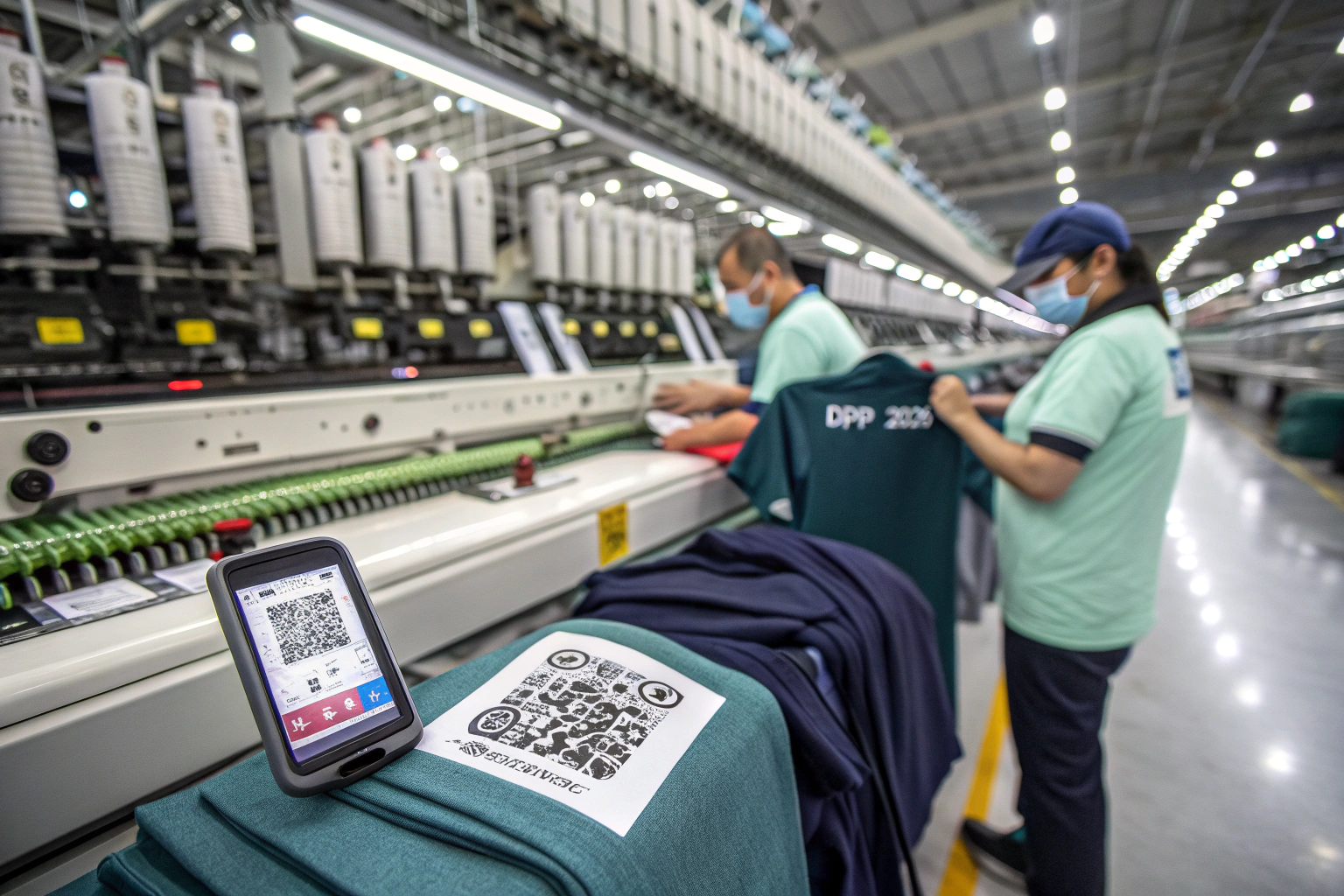
The link between the physical roll and its digital record is a unique identifier—typically a GTIN-128 barcode or a QR code—printed on a weatherproof label affixed to the roll end. This identifier is generated when the greige fabric enters the dyeing queue and follows the fabric through dyeing, finishing, inspection, and packing. Every digital data point captured at any stage references this identifier, so the complete production history of that specific roll can be retrieved by scanning the barcode.
The identifier structure should be hierarchical. The top level is the purchase order number. Below that is the dye lot number, which identifies the specific batch of fabric that went through the dye vessel together. Below that is the roll number, which is unique within the dye lot. This structure allows data aggregation at the lot level—all rolls from the same dye lot share the same chemical inputs, the same water and energy consumption, and the same dye recipe—while maintaining per-roll traceability for QC data like defect maps and meterage. At Shanghai Fumao, our roll labels carry a GTIN-128 barcode that encodes the product code, the dye lot number, the roll number, and the meterage. A single scan pulls up the complete digital batch record: fiber origin, chemical inventory, process parameters, QC results, and current certification status. The brand can scan the same barcode at their warehouse intake and populate their DPP system with the mill-level data for that specific roll. The GTIN-128 barcode standard for textile roll-level unique identification and digital record linkage in apparel supply chain traceability systems provides the encoding specification and label format.
What Chemical Inventory Data Must a DPP-Ready Factory Track?
The chemical inventory is the most sensitive and the most technically challenging component of DPP data for a textile mill. Every chemical that contacts the fabric during production—dyes, pigments, leveling agents, defoamers, softeners, water repellents, flame retardants, antimicrobials, UV stabilizers—must be identified by its chemical name or commercial name, its CAS number, its function in the process, the concentration used, and its hazard classification under EU REACH. This data proves that the fabric does not contain substances of very high concern above the regulatory thresholds and that the production process meets the ZDHC Manufacturing Restricted Substances List requirements.
The challenge for mills is that their chemical inventory has historically been managed by the production team for operational purposes, not for regulatory disclosure. A dye house manager knows they use "Blue G" dye from Supplier X, but they may not know the CAS number of the active ingredient, the REACH SVHC status, or whether the formulation contains a restricted auxiliary. That information lives on the Safety Data Sheet from the chemical supplier, which may or may not have been filed, translated, and digitized. A DPP-ready factory must close this gap by creating a chemical inventory database that maps every product used in production to its full regulatory identity. This requires collecting SDS documents from every chemical supplier, extracting the CAS numbers and hazard classifications, and maintaining this database as chemical formulations change or new products are introduced. At Shanghai Fumao, we maintain a ZDHC Level 3 conformant chemical inventory with all products registered in the ZDHC Gateway, which provides a standardized format for chemical hazard disclosure that is directly compatible with DPP data requirements. The ZDHC Gateway chemical inventory platform and Manufacturing Restricted Substances List conformance requirements for textile mills preparing for EU Digital Product Passport chemical disclosure provides the platform and the conformance standards.

How Do We Verify That Our Chemical Suppliers Are Providing Accurate SDS Data?
A supplier-provided SDS is a claim. Like a quality certificate, it can be incomplete, outdated, or intentionally misleading. The verification step is to check the SDS data against the ZDHC Gateway or a similar third-party chemical verification platform. The ZDHC Gateway assigns a conformance level to each chemical product based on an independent review of its formulation against the ZDHC MRSL. Level 3 products have been fully reviewed and found conformant. Level 2 products have been reviewed and found mostly conformant with minor deviations. Level 1 products are self-declared by the supplier with no independent review. A DPP-ready factory’s chemical inventory should target Level 3 or Level 2 ZDHC conformance for all products.
If a chemical supplier cannot provide a ZDHC Gateway listing, the alternative verification path is to commission independent testing of a sample of the finished fabric for the specific restricted substances that the chemical might contain. For example, if a novel softening agent isn’t listed in ZDHC, we test the finished fabric for APEOs, phthalates, and organotins—the common restricted auxiliary chemicals that might be present in unverified softeners. This is a reactive approach, more expensive and slower than using pre-verified chemicals, but it’s a valid stopgap while building the full ZDHC-compliant inventory. The ZDHC MRSL conformance levels and chemical supplier verification protocols for textile mills building DPP-compatible chemical inventories provides the conformance level definitions and the supplier verification documentation requirements.
What Is the Difference Between an MRSL and an RSL, and Which Does the DPP Require?
An RSL, a Restricted Substances List, is a list of chemicals that must not be present in the finished product above certain threshold concentrations. The OEKO-TEX Standard 100 and the AFIRM RSL are examples. The RSL is tested on the finished fabric. An MRSL, a Manufacturing Restricted Substances List, is a list of chemicals that must not be used in the manufacturing process, regardless of whether they appear in the finished product. The ZDHC MRSL is the global standard. The MRSL is tested on the chemical inputs at the point of use, not on the finished fabric.
The EU DPP framework is pushing toward MRSL-based chemical disclosure because it addresses the environmental impact of the production process—chemicals discharged in wastewater, worker exposure to hazardous substances—not just the safety of the final garment. A fabric that passes an RSL test might still have been produced using chemicals that harmed the environment or the workers, and those chemicals wouldn’t be detected in the finished product. The DPP, by requiring chemical input disclosure linked to hazard classifications, effectively demands MRSL-level transparency. A mill that only tests finished fabric against an RSL is not providing the chemical transparency the DPP requires. The MRSL versus RSL distinction in textile chemical management and the EU Digital Product Passport chemical disclosure expectations for manufacturing processes clarifies the regulatory expectation and the practical difference for mills.
How Can a Mill Verify Its DPP Readiness Before the Deadline?
DPP readiness is not a state a mill declares. It’s a state a mill demonstrates through a data test. The test is simple: pick one recent production lot. Assemble the complete DPP data package for that lot—fiber origin documentation, chemical inventory with CAS numbers, water and energy consumption, facility identifications, certification verifications, and the structured digital record linking all of this data to the specific roll identifiers. Send this data package to a brand customer and ask them to evaluate it against their DPP template. If the brand can populate their DPP fields for that lot without requesting additional information from the mill, the mill is DPP-ready for that lot. If the brand has to come back with questions—"Where was the yarn spun? What’s the CAS number for the navy dye? Is this GOTS certificate current?"—the mill has gaps to close.
This test should be conducted before the brand demands it under deadline pressure. A mill that discovers its data gaps in response to a panicked brand email in Q3 2026 is already late. A mill that conducts the test in Q1 2026, identifies the gaps, and closes them before the brand asks, is a proactive compliance partner. At Shanghai Fumao, we ran this test with three of our European brand partners in mid-2025. The exercise surfaced specific gaps—our utility metering wasn’t granular enough to separate water consumption by individual dye lot, and we were attributing consumption by day rather than by lot—that we then closed by installing sub-meters on individual dye vessels. The test cost us nothing, identified a fixable gap, and demonstrated to our brand partners that we were serious about DPP readiness. The EU Digital Product Passport readiness self-assessment framework and data package test protocol for textile manufacturing facilities provides the self-assessment checklist and the data package template.

What Is the Most Common Gap Mills Discover During a DPP Readiness Assessment?
The most common gap is not a missing technology or a missing database. It’s missing upstream supplier data. The mill can provide lot numbers, dye recipes, and QC reports perfectly well. But when asked for the fiber origin declaration—the country and region where the cotton was grown, the certification number for the organic claim—the mill discovers that their yarn supplier never provided this data, and the yarn supplier’s purchase order didn’t require it. The mill has a traceability gap at the boundary between themselves and their upstream suppliers. This gap cannot be closed by the mill’s internal digitization. It requires renegotiating data requirements with upstream suppliers.
The second most common gap is incomplete chemical hazard classification. The mill has a list of the dyes and auxiliaries they use, but the SDS documents from the chemical suppliers are incomplete—missing CAS numbers, missing hazard statements, or listing only the trade name without the active ingredient identity. The mill must go back to each chemical supplier and request updated, complete SDS documentation, and in some cases, the supplier may not have it or may be unwilling to provide it for proprietary reasons. This gap is solved by switching to chemical suppliers who provide ZDHC Gateway-listed products with full disclosure, or by commissioning independent analysis of the proprietary formulations. The common DPP data gaps identified in textile mill readiness assessments and corrective action plans for upstream traceability and chemical disclosure deficiencies provides a prioritized remediation roadmap.
How Do We Communicate DPP Readiness to Our Brand Customers?
Don’t wait for the brand to ask about DPP compliance. Communicate readiness proactively, with evidence. A mill that sends a proactive communication to their brand customers—"We have completed our DPP readiness assessment. Our production data is structured and available in the required format. Attached is a sample data package for a recent production lot demonstrating our capability. We are prepared to provide this data for all production from January 2026 onward."—positions themselves as a solution to the brand’s compliance challenge, not a problem to be managed.
The proactive communication should include a sample data file in the format the brand’s DPP platform expects, a summary of the mill’s digital data capture infrastructure, the current certification status for all relevant standards, and a named contact person for DPP data requests. This package tells the brand that the mill understands the regulation, has built the infrastructure, and is ready to transact in DPP-compatible data. A brand receiving this package from one mill and silence from another will preferentially allocate production to the ready mill, even at a price premium, because the compliance risk of the unresponsive mill is unquantified and potentially terminal. The supplier DPP readiness communication template and data sample package structure for textile mills engaging with EU brand customers on Digital Product Passport compliance provides the communication framework and the data package template.
Conclusion
The EU Digital Product Passport is the most significant regulatory shift to hit the textile supply chain since OEKO-TEX certification became a de facto market requirement thirty years ago. But unlike OEKO-TEX, which is a product testing and certification standard that mills have integrated into their quality control workflows, the DPP is a data management regulation that requires mills to build digital infrastructure, upstream traceability, and chemical transparency systems that most currently do not have. The mills that close this gap in 2026 will secure their position in the EU supply chain for the next decade. The mills that wait until a customer demands the data will find themselves scrambling, losing orders, and potentially losing their EU market access entirely.
The gap is closable. It doesn’t require a massive technology investment. It requires a disciplined commitment to capturing production data digitally at the point of creation, structuring chemical inventories with regulatory identifiers, requiring fiber origin documentation from upstream suppliers, and testing the data package against a brand’s DPP template before the brand asks. These are process changes, not technology problems, and they’re within the operational capability of any professionally managed textile mill.
At Shanghai Fumao, we made the decision to become DPP-ready in early 2025. Our lot tracking is barcode-based and digital. Our chemical inventory is ZDHC Gateway-conformant. Our certification management is automated with renewal alerts. We have tested our data package with multiple European brand partners and closed the gaps they identified. If your brand is facing DPP compliance pressure and your current mill partners are not providing the data transparency you need, or if you are a mill yourself trying to understand what DPP readiness looks like in practice, I invite you to reach out to our team. Our Business Director, Elaine, can share our DPP data package template, walk you through the infrastructure we built, and discuss how we can support your EU-compliant production requirements. She’s at elaine@fumaofabric.com. The DPP deadline is not moving. The mills that are ready will get the orders. Let’s make sure you’re one of them.