
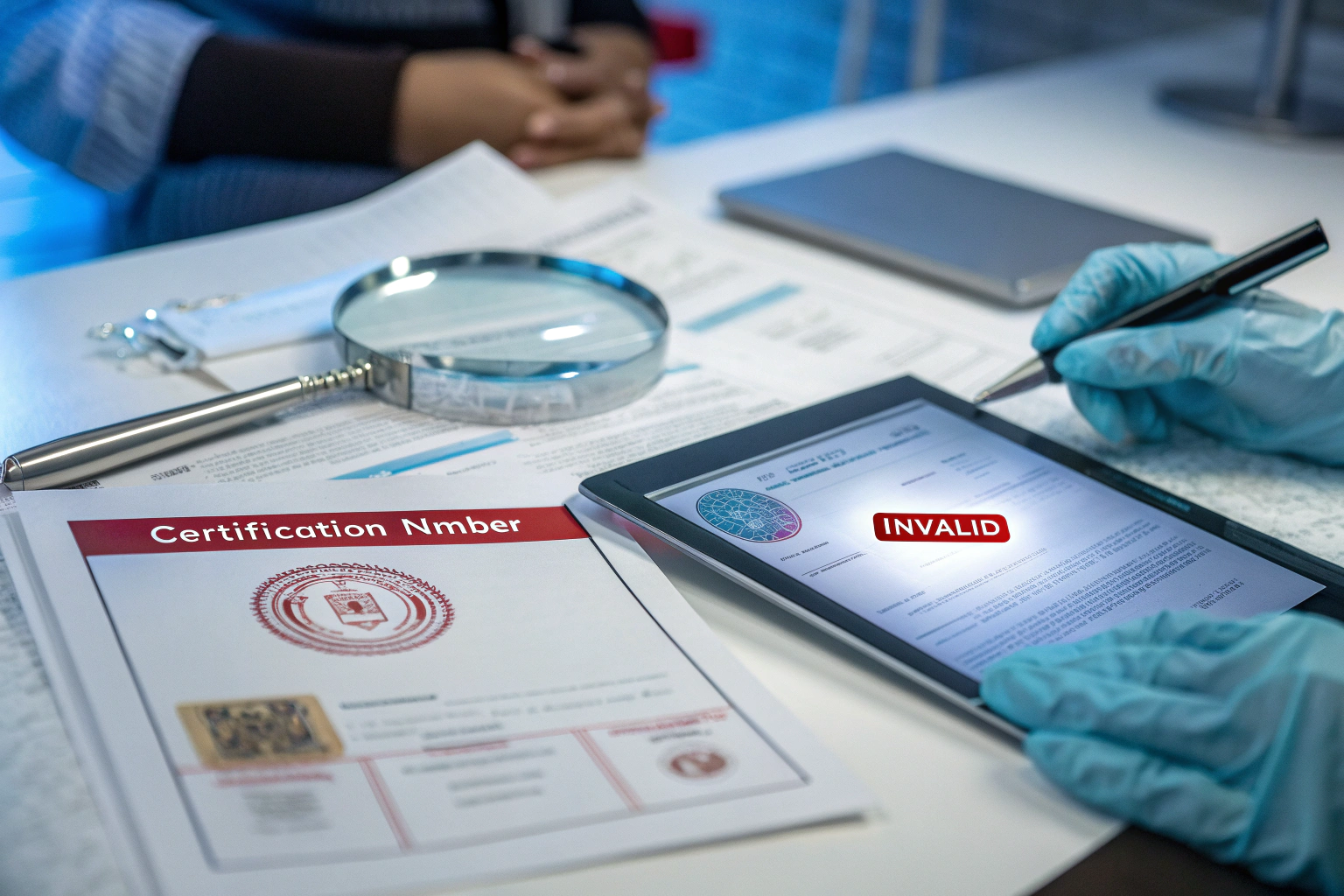
You request an OEKO-TEX certificate from a new supplier. The sales rep emails you a PDF within the hour. It has the green logo, the certification number, the testing institute stamp, and a validity date that’s still current. You file it in your compliance folder and wire the deposit. Six weeks later, your shipment is flagged at Rotterdam customs. The certificate number doesn’t match the exporter’s legal entity in the OEKO-TEX public database. The PDF was a forgery—a real certificate from a different company with the company name photoshopped. Your goods are detained, your production timeline is destroyed, and your brand’s compliance record with EU customs is now flagged for future scrutiny. That PDF cost you $40,000.
A fake certificate is worse than no certificate. No certificate means you know the risk and you can price it in, insure against it, or walk away. A fake certificate gives you a false sense of security that collapses at the worst possible moment—when your goods are already in transit and you’ve already paid. I’ve been in the textile export business for over two decades, and I’ve seen every forgery technique from crude Photoshop cut-and-paste jobs to sophisticated counterfeits that duplicate the hologram sticker and the QR code from a legitimate certificate. In this article, I’m going to teach you the forensic protocol I use at Shanghai Fumao to verify any certificate a supplier sends you. You don’t need a lab. You don’t need a lawyer. You need a browser, a phone, and a suspicious mindset. Let’s turn you into a certificate detective.
Why Do Some Mills Fake Their Certifications to Win Orders?
The economics of a fake certificate are brutally simple. A legitimate OEKO-TEX Standard 100 certification costs between ¥15,000 and ¥30,000 annually (roughly $2,000 to $4,000), depending on the product scope and the testing required. A GOTS certification, with the mandatory annual audits of both the processing facility and the chemical inputs, can cost ¥40,000 to ¥80,000 per year. These are not trivial overhead costs for a small mill or a trading company operating on thin margins. And yet, without these certificates, they cannot win orders from European and American brands who include certification requirements in their vendor qualification forms.
So some suppliers make a business calculation: the cost of getting caught is lower than the cost of getting certified. They forge the certificate. They know that most buyers—especially small and mid-size brands without a dedicated compliance team—will glance at the PDF, check that the logo looks right, and file it away. They know that only a tiny fraction of buyers will actually type the certification number into the public database and verify the legal entity match. The fraud works because it exploits the verification gap between the buyer’s assumption of honesty and the buyer’s actual verification behavior. In twenty years, I’ve only had perhaps five buyers out of hundreds ask me to join a live video call where they watched me log into the OEKO-TEX portal and display our certification status in real time. Five. The rest trusted the PDF. The counterfeiters know these odds and they play them. A detailed report on textile certification fraud statistics and the prevalence of counterfeit sustainability documentation in Asian fabric supply chains reveals that an estimated 10% to 15% of certificates presented by new, unvetted suppliers contain some form of misrepresentation.

How Do Counterfeiters Source Real Certificate Numbers to Copy?
A legitimate certification number is not a secret code. Under the OEKO-TEX and GOTS systems, a valid certificate number is publicly displayed on the certified company’s marketing materials, their website, their hangtags, and sometimes even on their Alibaba storefront. The whole point of the system is that a consumer or a brand can check the number against the database. But this transparency creates a vulnerability: a counterfeiter can simply copy a valid number from a real certified company and paste it onto their own forged document.
The counterfeiter knows that if a buyer does a cursory check—types the number into the database, sees that it’s "valid"—they might stop there. They won’t notice that the company name displayed in the database results doesn’t match the company name on the invoice they’re about to pay. I’ve seen this exact scenario with a GOTS certificate number copied from a legitimate Indian organic cotton mill and applied to a forged document for a completely unrelated Chinese trading company. The number checked out as "valid" in the database. The company name didn’t match. The buyer didn’t check the name. The fraud succeeded. This is why I tell every buyer: verifying a certificate number is step one. Verifying that the certificate holder name in the database exactly matches the legal entity name on the supplier’s business license and bank account is step two. Skipping step two invalidates step one. The OEKO-TEX label check database structure and how counterfeiters exploit public certification number visibility is the verification tool you must use every time.
What Types of Certificates Are Most Commonly Forged?
OEKO-TEX Standard 100 is the most frequently forged certificate in my experience. It’s the most widely recognized chemical safety standard, it’s required by most EU buyers, and the logo is simple to replicate. A forger can download the OEKO-TEX logo from Google Images, copy a valid certificate number from a real company’s website, and create a convincing fake in an hour. The second most commonly forged is GOTS, particularly the transaction certificate, because organic cotton carries a price premium and the buyer is paying extra for the organic claim. A fake GOTS certificate allows a supplier to charge a 15% to 25% price premium for "organic" fabric that is actually conventional cotton. The fraud isn’t just a compliance risk—it’s a direct financial fraud on the buyer.
Less frequently forged but worth watching for are ISO 9001 quality management certificates and SGS/Intertek test reports. A fake SGS test report is particularly dangerous because the buyer relies on it for specific performance data—color fastness, pilling grade, tensile strength. A forged SGS report with fabricated test numbers means the buyer is making production decisions based on completely imaginary quality data. The fabric could be Grade 1 pilling, but the forged report says Grade 4. The buyer doesn’t discover the truth until the garments are already in customers’ hands. The most commonly counterfeited textile certification types and their detection methods for international fabric buyers provides specific authentication features to look for on genuine SGS and Intertek documents.
How Do I Verify a Certificate Number Directly with the Issuing Body?
The PDF certificate is a claim. The issuing body’s database is the truth. Every legitimate textile certification—OEKO-TEX, GOTS, GRS, OCS, BCI—has a public online verification portal where you can enter the certification number or scan the QR code and see the live certification status. This database is maintained by the certification body, not by the supplier. The supplier cannot alter what the database displays. If the database and the PDF don’t match, the database wins. Always. No exceptions.
Here is the exact verification protocol I follow. For OEKO-TEX: go to the official OEKO-TEX Label Check page (oeko-tex.com/en/contact-us/label-check). Enter the certification number exactly as it appears on the supplier’s certificate. The system will display the certified company name, the certified product scope (which product classes and materials are covered), the issuing institute, and the certificate validity dates. Now, compare the company name on the database result to the company name on the supplier’s business license and the bank account details they gave you for payment. They must be identical—same legal entity, same spelling, same punctuation. A different company name means the certificate doesn’t belong to your supplier, even if the number is real. For GOTS: use the GOTS Public Database (global-standard.org/public-database). Enter the license number from the certificate. Verify that the certified entity is your supplier, that the product categories cover what you’re buying, and that the certificate scope includes the specific processing steps (dyeing, printing, finishing) your fabric requires. A supplier with GOTS certification for "trading" but not "dyeing" cannot sell you GOTS-certified dyed fabric—they can only trade GOTS-certified greige. The scope matters as much as the number.

What Should I Do If the QR Code on the Certificate Doesn’t Scan?
A legitimate modern OEKO-TEX certificate has a QR code that, when scanned with a smartphone camera or a QR reader app, should link directly to the verification result for that specific certificate on the OEKO-TEX website. If the QR code doesn’t scan, or if it links to a generic page that doesn’t display the company name and certificate details, the certificate is either a forgery or a badly produced legitimate document that needs re-issuing.
Don’t accept the supplier’s explanation that "the QR code is just having a technical issue." Request a new certificate with a working QR code. A legitimate certificate holder can request a re-issued PDF from their certification body within days, and the new file will have a functioning QR code. A counterfeiter cannot produce a QR code that links to a real database entry for their fake company name. The QR code is a cryptographic shortcut—it either works and displays the correct company, or it exposes the fraud instantly. I had a buyer tell me in early 2024 that a supplier’s OEKO-TEX QR code linked to a real certificate, but for a completely different company in a different province. The supplier had copied the QR code image from a legitimate certificate and photoshopped it onto their own forged document. The mismatch between the QR destination company and the invoice company was the smoking gun. Always read the company name on the page the QR code lands on. The OEKO-TEX QR code verification technology and its role in preventing counterfeit textile safety certifications explains the intended verification workflow.
How Do I Check If a Certificate Has Expired or Been Suspended?
A certificate can be valid today and suspended tomorrow. A supplier can present a PDF that shows an expiration date six months in the future, but if they failed a surveillance audit three weeks ago, the certification body may have suspended the certificate without updating the PDF. The only way to know the live status is to check the database at the moment you’re about to place the order—not last month, not when you first qualified the supplier, but right now.
The OEKO-TEX and GOTS databases display real-time status. A certificate can show as "Valid," "Suspended," "Withdrawn," or "Expired." If the status is anything other than "Valid," do not place an order that depends on that certification. A suspended certificate means the certification body found a non-conformity during a surveillance audit and the supplier has not yet corrected it. You cannot legally claim OEKO-TEX or GOTS certification on products shipped while the certificate is suspended. If your shipment arrives in the EU during a suspension period and you claim certification, you are mislabeling your product. I also recommend taking a screenshot of the database verification page showing the "Valid" status, with the date and time visible in the screenshot. This is your evidence, dated and timestamped, that you performed due diligence at the time of order placement. If the certificate is later suspended and a customs authority questions your shipment, the screenshot demonstrates that you acted on the best available information at the time of transaction. A real-time textile certification status monitoring protocol for supply chain compliance officers documents this verification workflow in detail.
Can I Trust a Test Report If I Can’t Verify the Lab?
An SGS test report with a stamp. An Intertek report with a barcode. A Bureau Veritas report with a reference number. These look authoritative. But a testing lab’s logo is just clip art to a counterfeiter. Forging a test report requires a bit more skill than forging a certificate—you need to fabricate realistic test data, not just copy a number—but the basic technique is the same: copy a legitimate report template, change the company name and the test results, and present it as original. A 2023 case documented in counterfeit textile test report detection methods and the rise of fabricated SGS and Intertek laboratory documentation found suppliers offering fully forged SGS test reports with fabricated heavy metal analysis results, complete with fake analyst signatures and counterfeit report authentication stickers.
Every legitimate international testing lab—SGS, Intertek, Bureau Veritas, TÜV—has an online report verification portal. The report itself carries a unique report number, and sometimes a QR code or an alphanumeric verification code, that you can enter on the lab’s official website to pull up the authentic test data. The verification page displays the sample description, the test methods used, the results for each parameter, and the date of testing. If the data on the verification page doesn’t match the data on the PDF the supplier sent you, the PDF has been altered. If the report number returns "not found," the PDF is a complete fabrication. Never accept a test report without verifying the report number against the lab’s database. The supplier is not the source of truth for the test data—the lab is.

How Do I Verify a Third-Party Lab Report Online?
The verification protocol is straightforward. First, identify the testing lab from the report’s header. It will be SGS, Intertek, Bureau Veritas, TÜV Rheinland, or another internationally accredited lab. Do not rely on a lab you’ve never heard of with a generic name like "China Testing Center" unless you can independently verify their ISO 17025 accreditation status on the ILAC database. Second, locate the unique report number on the document. It’s usually in the header or footer, formatted as a string of letters and numbers. Third, navigate to the specific lab’s online verification portal—not a link provided by the supplier, but the lab’s official website you find through Google. Enter the report number. The portal will display the authenticated test results.
Fourth, and this is where most buyers stop too soon, compare the sample description on the verification page to the fabric you’re buying. A supplier can take a legitimate test report for a different fabric—say, a 100% polyester woven they had tested last year—and send it to you as "proof" that the 100% cotton knit you’re buying is compliant. The report is real. The data is real. But the fabric it describes is not the fabric you’re ordering. The sample description on the verification page must match your purchase order: fiber composition, fabric construction, weight, and color. If the description says "100% Polyester Woven, 210gsm, White" and your order is "100% Cotton Jersey, 180gsm, Navy," you’re looking at the wrong test report, whether the supplier sent it accidentally or deliberately. A third-party textile testing lab online report authentication portal guide for international fabric buyers provides the direct links to major lab verification systems.
What Is the Difference Between an Internal Lab Report and a Third-Party Report?
An internal lab report is generated by the mill’s own quality control laboratory. It has the mill’s logo, the mill’s test data, and the mill’s signature. A third-party report is generated by an independent, ISO 17025-accredited laboratory like SGS or Intertek. The third-party lab has no commercial interest in the test outcome. The mill’s internal lab has every commercial interest in the test outcome—they want to ship the fabric, not reject it.
A legitimate internal lab report from a CNAS-accredited facility like our Shanghai Fumao lab carries real weight because the CNAS accreditation subjects the lab to annual audits and inter-laboratory proficiency testing against international standards. But a non-accredited internal lab report from a supplier with no CNAS or equivalent accreditation is essentially a self-assessment with no external verification of competence. That doesn’t make the data false—the mill’s spectrophotometer might be perfectly calibrated and the technician might be highly skilled—but the buyer has no way to know. The risk is higher because the checking mechanism is missing. If you’re relying on an internal lab report, always verify the lab’s accreditation status. Ask for the CNAS accreditation certificate (or equivalent national accreditation body), note the accreditation number, and verify it on the CNAS or ILAC website. Check that the specific test methods used on the report are within the lab’s accredited scope. A lab can be CNAS-accredited for fiber composition analysis but not for color fastness testing, and if your test report includes color fastness data, that data is outside the accredited scope and should be treated as unverified. The ILAC mutual recognition arrangement signatory database for verifying laboratory accreditation claims is the global reference for checking whether a lab’s accreditation is real and current.
How Do I Protect Myself from Certificate Fraud Before Paying?
The moment you wire the deposit, your leverage diminishes to near zero. Your fraud prevention must happen before the wire transfer, not after. The pre-payment verification window is your only period of maximum negotiating power. Once the money leaves your account, recovering it through a dispute with a fraudulent supplier in a foreign jurisdiction is a slow, expensive, and often unsuccessful process. Your defense is the verification protocol you execute before you authorize the payment.
Here is the pre-payment checklist I recommend to every buyer. First, verify every certificate the supplier has sent you using the issuing body’s live database—not a PDF, not a screenshot, not an email from the supplier’s "certification consultant." Second, confirm that the legal entity name on the certificate matches the legal entity name on the business license and the bank account. Third, conduct a live video call where you watch the supplier log into the certification body’s portal in real time and display their certification status. This is the gold standard of verification—a real-time screen share that shows the certificate is active, belongs to the entity you’re paying, and is being accessed by someone who has legitimate login credentials to the certified company’s account. A supplier who refuses this request, offers excuses, or tries to redirect you to a static PDF, is not a supplier you should wire money to. Walk away. There are thousands of fabric mills in China. You can find one that will verify transparently. A supplier financial fraud prevention and pre-payment verification protocols for international textile importers details the specific contractual clauses that tie payment to verification outcomes.

What Specific Clauses Should I Include in My Purchase Contract?
Your purchase contract should include a "Certification Warranty" clause that states, in plain English, that the supplier warrants and guarantees the validity and authenticity of all certifications and test reports provided in connection with the order, and that any misrepresentation constitutes a material breach of contract entitling the buyer to full refund of all payments and compensation for consequential damages. This clause doesn’t prevent fraud, but it creates a clear contractual basis for legal action if fraud is discovered, and it signals to the supplier that you take certification authenticity seriously enough to write it into the legal agreement.
I also recommend a "Pre-Shipment Verification" clause: "Buyer reserves the right to conduct a live video verification of all certifications via screen-share of the issuing body’s online database within 48 hours before shipment. Supplier’s refusal or inability to provide such verification entitles Buyer to cancel the order and receive a full refund of any deposits paid." This clause establishes that verification is not a one-time event at vendor qualification—it’s a recurring condition that applies to every shipment. It prevents the scenario where a supplier’s certificate expires or is suspended after you qualify them but before they ship your order, and they ship anyway without disclosing the status change. The international textile purchase contract terms for certification compliance and supplier quality warranties provides model language that’s enforceable in Chinese commercial law.
How Do I Spot a Rushed or Pressured Payment Request as a Fraud Indicator?
A legitimate factory has standard payment terms—typically 30% deposit with order, 70% before shipment, or similar structures that align with production milestones. A fraudulent or financially unstable operation will pressure you for faster payment, higher deposit percentages, or off-platform wire transfers. The pressure tactic is a signature of fraud because the fraudster needs to extract the money before the buyer has time to conduct verification, or before the fabricated certification story collapses.
Watch for these specific pressure signals: the supplier offers a significant discount for 100% upfront payment via TT directly to their bank account ("5% discount for full advance payment—this is a special promotion this month only"). The supplier claims that Trade Assurance or a Letter of Credit is not available for "new customers" or "trial orders." The supplier pressures you to approve the sample and wire the deposit within 48 hours because "another buyer is interested in the same fabric and we can only hold the stock for you if you pay now." The supplier sends the proforma invoice with payment details to a different company name than the one on the certificate, and explains it as "our trading company handles payments separately from our factory—it’s completely normal in China." These are all red flags. A genuine factory wants your long-term business and will respect your verification process. A fraudster wants your deposit and is willing to fabricate urgency to get it before you think too hard. The common payment fraud indicators in Chinese textile supplier transactions and deposit protection strategies catalogues these patterns with real case examples.
How Often Should I Re-Verify Certifications for a Long-Term Supplier?
Certifications expire, get suspended, or get withdrawn. A supplier who was fully certified when you qualified them twelve months ago may have lost their certification three months ago and not disclosed it. Re-verification is not a one-time event at supplier onboarding—it’s a recurring compliance activity that should happen at minimum every six months, and ideally before every production order that carries a certification claim.
I tell my clients to calendar the expiration date of every certification their key suppliers hold. If a supplier’s GOTS certificate expires on December 31st, set a calendar reminder for January 5th to re-verify their new certificate number in the database. Don’t wait for the supplier to send you the renewal—they might "forget" to mention that the renewal audit revealed non-conformities and the certificate was suspended. Proactively check. For a supplier you work with continuously, the six-month re-verification cycle is a reasonable cadence that balances compliance diligence with operational practicality. If a supplier resists re-verification, acts offended that you’re "checking up on them again," or delays providing access to the live database, treat that resistance as a potential red flag. A supplier with nothing to hide has no reason to obstruct verification, no matter how many times you ask. The supplier compliance monitoring schedule and re-verification frequency guidelines for textile certification management provides a recommended audit calendar for different certification types.
Conclusion
A fake certificate exploits a gap in your verification behavior. It counts on the probability that you’ll glance at the logo, note the presence of a number, and move on to the price negotiation. Closing that gap doesn’t require a degree in textile chemistry or a forensic document analysis lab. It requires a browser, the issuing body’s public database, and a disciplined routine of checking three things: the certification number status, the legal entity name match, and the product scope coverage. Every time. For every certificate. Before every payment.
I’ve watched too many buyers learn this lesson through loss—through detained shipments, failed compliance audits, and the hollow feeling of realizing that a price advantage was actually a fraud premium. The PDF on your screen is not a certificate. It’s a claim. The database is the certificate. The live video screen-share is the certificate. The phone call where the certification body’s customer service agent confirms the supplier’s status is the certificate. Everything else is an unverified assertion from a party with a financial incentive to mislead you.
At Shanghai Fumao, we don’t ask buyers to trust our certificates. We ask them to verify our certificates—live, in real time, on a video call, with the database open on our screen. We’ll show you our OEKO-TEX registration in the Label Check system. We’ll walk you through our GOTS scope certificate on the GOTS public database. We’ll share our CNAS lab accreditation number so you can verify it on the ILAC signatory search before you even request a sample. If your current or prospective supplier hesitates when you ask for this same level of transparent verification, I suggest you ask yourself why.
Before you place your next fabric order, before you wire your deposit, before you commit your production timeline to a supplier’s PDF, do the verification. If you want to see what genuine, verifiable certifications look like, or if you have a certificate from another supplier you’d like us to help you authenticate, reach out to our Business Director, Elaine, at elaine@fumaofabric.com. She can schedule a 15-minute video call where we’ll walk you through our live certification status on each issuing body’s portal, answer your verification questions, and show you the documentation structure you should demand from every supplier. Let’s make sure your compliance folder is filled with evidence, not illusions.








