
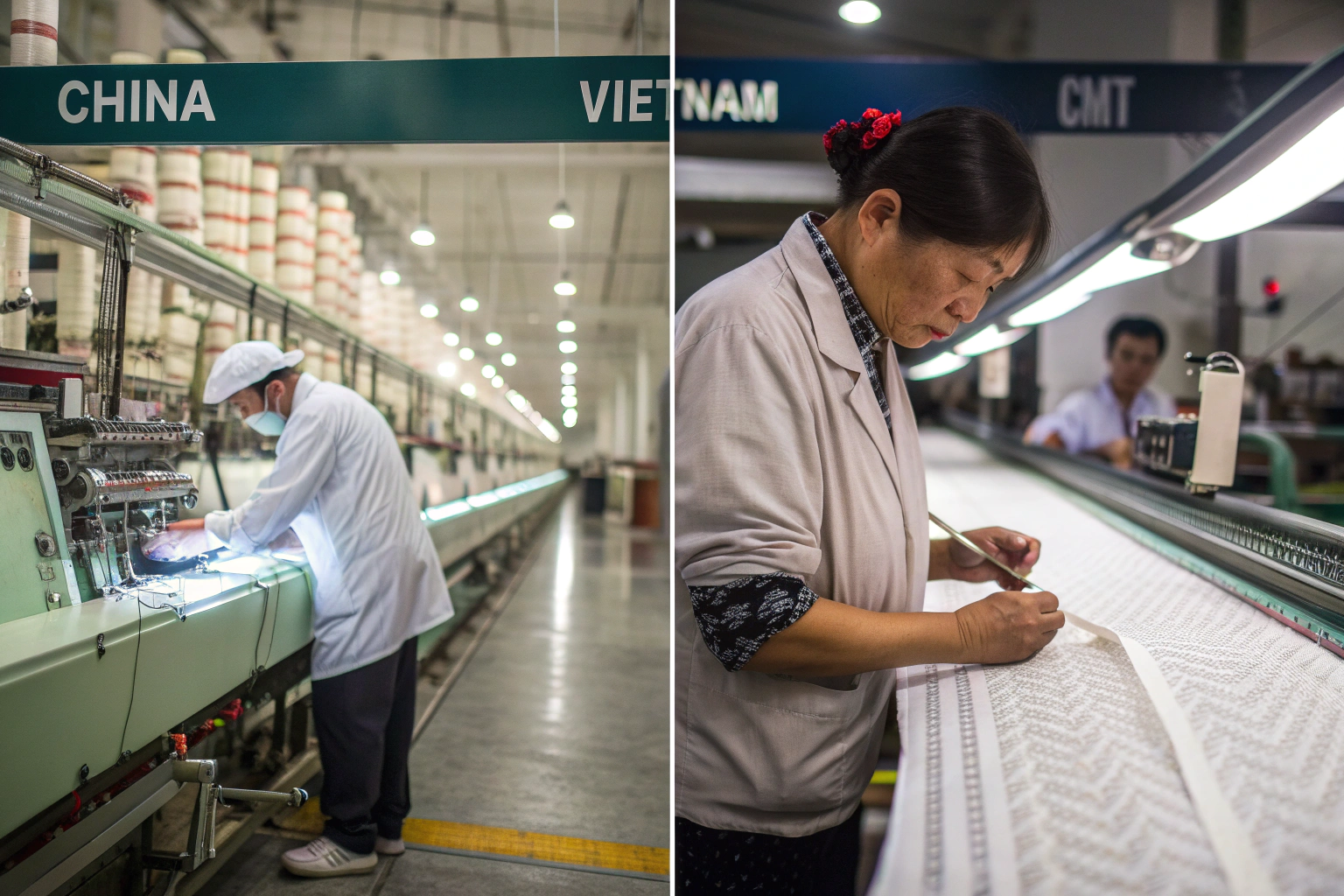
I have a factory in Keqiao, not in Hanoi. So you might expect me to tell you that China wins, hands down, no contest. But the truth is more interesting than that, and if you are making a sourcing decision that will define your brand’s quality for the next five years, you deserve the unvarnished reality, not a sales pitch. The answer to "China or Vietnam?" depends entirely on what you mean by "quality." If quality means a simple, well-sewn cotton t-shirt at a competitive price, Vietnam has built an impressive and increasingly capable manufacturing base. But if quality means a complex, innovative, high-performance fabric that defines your brand’s competitive edge, then in 2026, the gap between China and Vietnam is not a gap. It’s a chasm.
I have visited factories in Vietnam. I have met their textile engineers. I respect what they are building. But I also know what exists in the industrial cluster that surrounds my office in Zhejiang province—the accumulated expertise of three generations of dye masters, the machine parks that represent billions of dollars of capital investment, the CNAS-accredited labs that test fabric to standards that most countries cannot even measure. That ecosystem is not replicable in a decade. It is the product of thirty years of relentless, vertically integrated industrialization. And for brands that need fabric that performs, not just fabric that covers the body, that ecosystem is still the center of gravity for global textile quality.
This article is a factual, side-by-side comparison of Vietnam and China as fabric sources in 2026. I will compare raw material access, weaving and knitting capabilities, dyeing and finishing sophistication, quality control infrastructure, and the hidden costs that don’t appear on the pro forma invoice. I will share specific technical details from our own production lines and from conversations with brands who have tested both markets. By the end, you will have a clear framework for deciding where your specific product belongs.
How Do Raw Material Supply Chains Compare Between China and Vietnam?
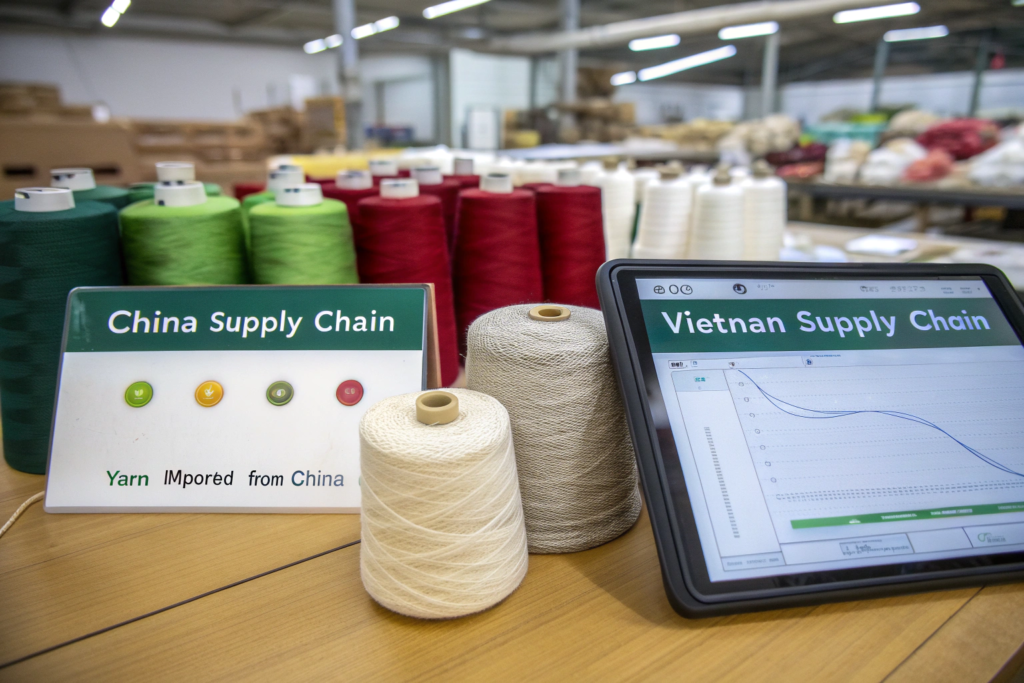
The quality of any fabric begins long before the loom. It begins with the yarn. And the yarn begins with the raw material supply chain. This is Vietnam’s fundamental structural weakness, and it is not a problem that can be solved with investment in more sewing lines. Vietnam’s textile industry is heavily dependent on imported raw materials—particularly yarns and greige fabrics—and the majority of those imports come from China. According to Vietnam’s General Statistics Office, the country imported over $14 billion worth of textile raw materials in 2024, with China accounting for roughly 55% of that total. This means that when a Vietnamese mill produces fabric, the yarn it is knitting or weaving often traveled from a Chinese spinner first.
This dependency has three consequences for quality. First, it adds a middleman. The Vietnamese mill is not buying directly from the fiber origin; it is buying through a trading chain that adds cost and reduces traceability. Second, it limits the range of yarns available. Chinese spinners keep their most innovative, highest-value yarns for their domestic weaving partners. The commodity yarns get exported. Third, it creates a time lag. A Vietnamese mill that needs a specific recycled nylon filament for a development project waits for the shipment from China. Our knitting department sends a WeChat message to a spinner 20 minutes away, and the yarn arrives before lunch. This raw material velocity is not a convenience. It is a quality multiplier. It allows us to iterate, test, and refine fabric constructions in days, not weeks.
Why Does China Still Dominate Specialty Yarn Production for Premium Fabrics?
Specialty yarns—high-gauge cashmere blends, bio-based nylon, ultra-fine merino, recycled aramid, conductive fibers for smart textiles—require three things: specialized spinning machinery, deep technical expertise, and a large enough domestic market to justify the capital investment. China has all three. The spinning mills in Jiangsu and Zhejiang have invested in the most advanced ring, rotor, and air-jet spinning frames available. They serve a domestic market of thousands of fabric mills that collectively consume an enormous volume of yarn, which drives competition, innovation, and cost efficiency.
Vietnam’s spinning sector, while growing, is concentrated on commodity yarns—standard cotton, standard polyester, and basic cotton-polyester blends. These are produced efficiently and exported in large volumes. But the infrastructure for specialty yarns—the compact spinning systems for ultra-clean yarns, the core-spun elastic yarns with precise draft ratios, the fancy yarns with slub and nep effects—is much less developed. I recently spoke with a European knitwear brand that tried to source a fine-gauge cashmere-silk blend yarn from a Vietnamese supplier. The supplier could not meet the evenness specification. The yarn had too many thick and thin places, which caused visible striping in the knitted fabric. The brand eventually sourced the yarn from a Chinese spinner and shipped it to their Vietnamese CMT factory for garment assembly. The yarn quality was solved in China. The sewing was done in Vietnam. That hybrid model works. But it proves the point: when the fabric itself requires specialty raw materials, China is still the primary source. If you are developing a how to source high gauge specialty yarns like cashmere silk blends and bio-based nylon from China for premium knitwear fabric production, you are sourcing from the spinning mills that invented the process, not the ones importing the output.
Can Vietnam’s Domestic Cotton and Polyester Match Chinese Quality Standards?
Vietnam has a small but growing domestic cotton cultivation sector, and several large polyester polymerization plants. The quality is adequate for mass-market, price-sensitive production. But it is not yet at the level required for premium, high-consistency fabric. The issue is not the fundamental capability; it is the maturity of the quality management systems and the scale of the technical workforce. Chinese polyester filament yarn, for example, benefits from decades of experience in controlling the polymerization process to achieve consistent intrinsic viscosity, which directly affects dye uptake and color consistency. Vietnamese polyester plants are newer and, in some cases, still climbing the learning curve on batch-to-batch consistency.
I have seen the impact on fabric quality firsthand. A client of ours, a US uniform manufacturer, tested an identical polyester-cotton poplin specification from a Chinese mill and a Vietnamese mill. The Chinese fabric had a shade variation of Delta E < 0.8 across a 5,000-meter bulk lot. The Vietnamese fabric had a Delta E of 2.1—still within commercial tolerance, but visibly less uniform when the garments were hung together on a retail rack. The difference was not the weaving. It was the yarn evenness and the dyeing process control, both of which trace back to the raw material consistency. If your brand’s quality standard is "good enough for the price," Vietnam can deliver. If your standard is "identical garment to garment, season after season," you need a supply chain where raw material quality is an obsession, not a target. At Shanghai Fumao, we test every incoming yarn lot for count variation, twist, and evenness using an Uster tester. Lots that deviate more than 5% from the agreed specification are rejected. That level of upstream control is standard practice in China’s premium textile cluster. It is still aspirational in much of Vietnam’s.
Which Country Has the Better Dyeing and Finishing Infrastructure for Complex Fabrics?
Dyeing and finishing are where fabric quality is made or destroyed. A beautifully woven greige fabric can be ruined by uneven dye penetration, incorrect reduction clearing, or a finishing process that degrades the fiber’s strength. Conversely, a mediocre greige fabric can be elevated by exceptional dyeing and finishing. This wet processing stage is the most technically demanding, capital-intensive, and environmentally sensitive part of the textile supply chain. And it is here that the gap between China and Vietnam is most pronounced.
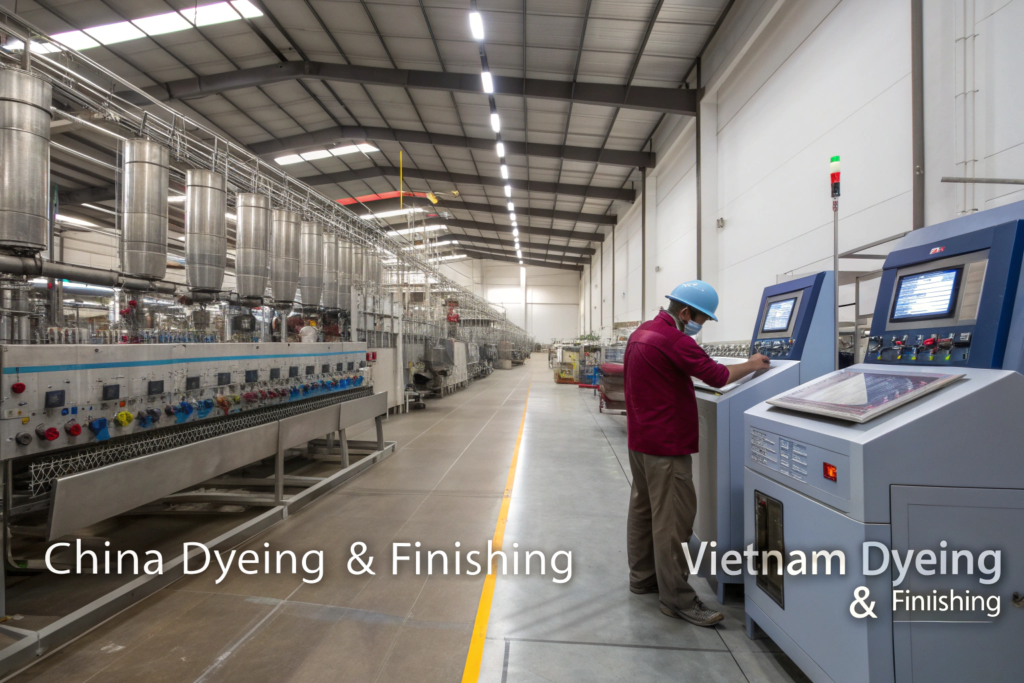
China’s dyeing and finishing sector, particularly in the Keqiao and Shaoxing regions, has undergone a brutal consolidation over the past decade. The government closed thousands of small, polluting dye houses and forced the industry to concentrate into large, compliant, technologically advanced facilities. The surviving dye houses operate at a scale and sophistication that is unmatched globally. They have invested in computer-controlled dye dispensing systems that eliminate manual weighing errors, continuous dyeing ranges with in-line spectrophotometers that adjust color in real time, and advanced wastewater treatment plants that recover and reuse 80% or more of process water. Vietnam’s dyeing sector is growing, but it is smaller, more fragmented, and in many cases still reliant on manual processes that introduce variability.
| Dyeing/Finishing Capability | China (Keqiao/Shaoxing Cluster) | Vietnam (Current State, 2026) | Quality Impact for Brands |
|---|---|---|---|
| Automated Dye Dispensing | Widespread; computer-weighed and dispensed recipes | Limited; manual weighing still common | Color consistency batch-to-batch |
| In-Line Spectrophotometry | Continuous monitoring on dyeing ranges; real-time correction | Mostly lab-based; off-line sampling with time lag | Shade matching speed and accuracy |
| Advanced Finishing (Coating, Laminating, Peach Skin) | Readily available; specialized finishing factories common | Limited availability; basic finishes dominate | Product differentiation and premium hand feel |
| Wastewater Treatment & Compliance | ZDHC compliant; advanced membrane bioreactors common | Improving but enforcement uneven; some facilities below EU standards | Brand ESG risk and EU market access |
| Specialized Dyeing (Pigment, Indigo, Acid, Disperse) | Full range available within 30km radius | Cotton reactive and basic disperse dominate; complex dye types outsourced | Flexibility to execute complex multi-fiber blends |
Why Is Color Consistency Still a Challenge for Vietnamese Dye Houses?
Color consistency is a function of process control, and process control is a function of automation. In a modern Chinese dye house, the entire dyeing cycle is managed by a programmable logic controller. The dye recipe is downloaded from the color matching system directly to the dispensing unit. The chemicals are weighed and mixed by the machine, not by hand. The temperature ramp, the hold time, the cooling rate—all are controlled to the degree and the minute. The result is a dye lot that matches the lab dip with a Delta E of less than 1.0, batch after batch.
Many Vietnamese dye houses still rely on manual chemical weighing and operator experience to manage the dye cycle. The best Vietnamese dye masters are highly skilled, but human variability is inevitable. A slight over-pour of the levelling agent, a few degrees too fast on the temperature ramp, a few minutes short on the hold time—and the shade shifts. The fabric passes a visual inspection but fails the spectrophotometer reading against the standard. This is the kind of variability that drives wholesale returns and chargebacks. A US client of ours, a large sportswear brand, attempted to shift their polyester fleece program to a Vietnamese dye house in 2025. The first two bulk lots had shade continuity issues between the body fabric and the rib trim. The brand spent six months and significant expense trying to resolve the problem with the dye house before returning the program to China. The issue was not the quality of the water or the dyes. It was the absence of automated dispensing and real-time color monitoring. If shade consistency across a multi-component garment is critical to your brand, the how automated dye dispensing and in-line spectrophotometry in Chinese dye houses achieve Delta E less than 1.0 color consistency for bulk fabric production compared to manual Vietnamese dyeing processes is a technical capability you cannot compromise on.
Can Vietnam Handle Advanced Finishes Like Coating, Laminating, and Functional Treatments?
This is the capability gap that is hardest to close quickly. Advanced finishing—polyurethane coating for water resistance, membrane lamination for waterproof-breathable performance, peach skin enzyme softening, antimicrobial treatments, UV protection, flame retardancy—requires specialized machinery, chemical expertise, and a deep understanding of how finishes interact with different fiber types. These skills are built over decades of trial and error, not acquired by purchasing a machine.
China’s textile cluster has dedicated coating factories, laminating factories, and functional finishing factories that serve the entire domestic and export market. They are not generalists. They are specialists who do one thing—like applying a non-PFC durable water repellent to a nylon taffeta—thousands of meters per day. Their chemists understand the surface energy of the fabric, the cure temperature of the crosslinking agent, and the exact dwell time needed to achieve a 80/20 spray rating after 20 washes. Vietnam does not have this depth of specialized finishing infrastructure yet. A Vietnamese mill that wants to offer a coated fabric will often send the greige fabric to China for finishing, then ship it back to Vietnam for garment assembly. This adds cost, time, and carbon footprint. For brands that need performance finishes—outerwear, activewear, medical textiles—China is not just the better option. It is often the only option within a workable supply chain radius. At Shanghai Fumao, our cooperative coating factory runs six different coating lines, each optimized for a different chemistry, and their technical manager has 22 years of experience specifically in textile coatings. That depth of specialization is what makes how Chinese textile finishing factories apply advanced functional coatings like DWR, membrane lamination, and antimicrobial treatments for performance apparel fabrics possible at the quality levels that global brands demand.
How Do Quality Control and Compliance Standards Compare Between the Two Countries?
Quality control is not a department. It is a system. And the sophistication of that system determines whether your 5,000-meter order arrives with zero defects or with a hidden problem that only surfaces when a customer returns a garment. In my experience, the quality control gap between China and Vietnam is as significant as the dyeing and finishing gap, and it stems from the same root cause: the maturity and capital intensity of the industrial ecosystem.
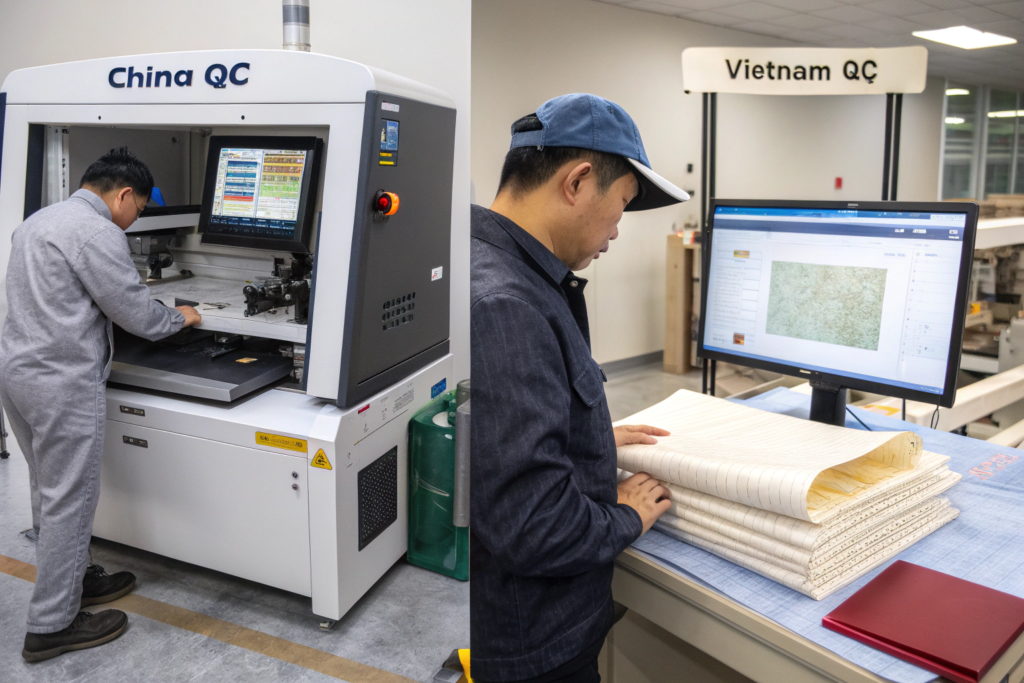
Chinese textile QC has evolved from manual inspection to automated, data-driven quality assurance over the past fifteen years. The mills that serve premium export markets use computerized fabric inspection machines that scan every meter of fabric for defects, recording their type, size, and location. This data feeds into statistical process control systems that identify trends before they become bulk problems. The inspection is linked to a laboratory that is often CNAS-accredited, providing test data that is legally recognized by customs authorities in the US and EU. Vietnam’s QC infrastructure is earlier in this evolution. Many factories still rely on manual inspection on traditional light tables, with paper records and operator-dependent defect classification. The best Vietnamese factories are investing in automation, but the installed base of advanced QC equipment is much smaller.
Do Vietnamese Factories Have the Same Laboratory Testing Capabilities as Chinese Mills?
No. This is not a criticism of Vietnam’s ambition. It is a statement of current fact. China has over 1,000 CNAS-accredited textile testing laboratories, concentrated in the major textile provinces. These labs are integrated into the production workflow, providing real-time fiber composition, colorfastness, shrinkage, tensile strength, and chemical safety data. The reports they generate are recognized under the ILAC mutual recognition framework, meaning they carry the same legal weight as a report from a US or EU lab for customs clearance purposes.
Vietnam has far fewer ILAC-accredited textile labs. The testing infrastructure is still developing, and many Vietnamese mills send samples to third-party labs in China, Hong Kong, or Europe for certification testing. This adds time and cost to the development and bulk production cycle. A Vietnamese mill that needs a GOTS transaction certificate or an OEKO-TEX Standard 100 certification for a new fabric will often wait days or weeks for the external lab report. At Shanghai Fumao, we run these tests in-house, with results available within hours. This testing velocity is not just a convenience; it is a quality assurance tool. When our dyeing department produces a new lab dip, the CNAS lab measures the colorfastness to washing before the dip is sent to the client. If the fastness is below our internal standard, the dip is reformulated. This internal feedback loop—produce, test, adjust—happens in a single day. A mill that outsources its testing cannot iterate at this speed. For a brand developing a collection under deadline pressure, this speed difference translates directly into development quality. The how CNAS accredited in house textile testing laboratories in China provide real time fiber composition colorfastness and chemical safety data for faster fabric development compared to outsourced Vietnamese lab testing advantage is a structural competitive moat that Vietnam will take years to bridge.
How Does Compliance with EU and US Chemical Regulations Compare?
Chemical compliance—OEKO-TEX, REACH, CPSIA, ZDHC—is the price of admission for selling textiles in Western markets. Chinese mills that have been exporting to Europe and the US for decades have built compliance infrastructure deep into their operations. They maintain restricted substance lists, they screen incoming chemicals against those lists, and they test finished fabrics to the required limits. The best mills, including Shanghai Fumao, have integrated chemical management into their ERP systems, so that a non-compliant chemical cannot even be ordered by the production department.
Vietnamese mills that are newer to Western export markets are building this compliance infrastructure, but the maturity level varies widely. The large, foreign-invested mills that supply major brands have robust chemical management systems. The smaller, locally owned mills often lack the knowledge, the testing infrastructure, and the supplier relationships to guarantee compliance to the latest standards. The 2027 OEKO-TEX updates I wrote about in a previous article—tighter bisphenol limits, new antimony thresholds, fiber release testing—will widen this compliance gap. Chinese mills have the in-house lab capacity to validate against the new standards quickly. Vietnamese mills without comparable labs will be dependent on external testing and will be slower to adapt. For a brand with zero tolerance for chemical compliance failures, the depth of China’s compliance infrastructure is a significant risk-reduction factor.
How Do the True Total Costs Compare When You Factor in Supply Chain Efficiency?
The per-meter FOB price from a Vietnamese factory often looks cheaper. The cost of labor in Vietnam is lower. The cost of factory space is lower. The utility costs can be lower. A buyer comparing a Vietnamese FOB quote against a Chinese FOB quote on a simple product—a basic cotton jersey, a standard polyester woven—will often see a price advantage for Vietnam. But the FOB price is not the cost of the fabric on your warehouse floor. It is the starting point of a cost journey that includes logistics, quality failures, development delays, and management overhead.
When you factor in the total landed cost, including the hidden costs that Vietnamese sourcing often entails, the Chinese price becomes significantly more competitive, and on complex fabrics, often cheaper in absolute terms. The reasons are structural: Vietnam imports its yarn, which adds a logistics margin. Vietnam outsources much of its testing, which adds fees and time. Vietnam’s logistics infrastructure—ports, roads, customs—is improving but less efficient than China’s, which adds transit time and unpredictability. And the management time required to coordinate a fragmented supply chain in a developing sourcing market is a real, allocable cost that brands often ignore until they have a dedicated Vietnam sourcing team on their payroll.
| Total Cost Factor | Vietnam | China (Shanghai Fumao DDP) | Net Impact on Landed Cost |
|---|---|---|---|
| Raw Material (Yarn) | Often imported from China; 5-8% freight and duty added to yarn cost | Domestic; no import cost on yarn | Vietnam fabric starts with a raw material cost disadvantage |
| Labor Cost | Lower than China | Higher than Vietnam | Vietnam has a labor cost advantage, but labor is < 15% of fabric cost |
| Third-Party Lab Testing | Often outsourced to external labs; $300-800 per test; days of delay | In-house CNAS lab; zero incremental cost; same-day results | Vietnam adds testing cost and development delay |
| Ocean Freight & Logistics | Port infrastructure less developed; fewer direct sailings; higher risk of delay | Mature ports; daily sailings to US and EU; bonded DDP logistics available | China logistics are faster and more predictable |
| Management Overhead | Requires more supplier management, more travel, more development follow-up | Integrated supply chain; single point of contact; development handled in-house | Vietnam requires higher brand-side management investment |
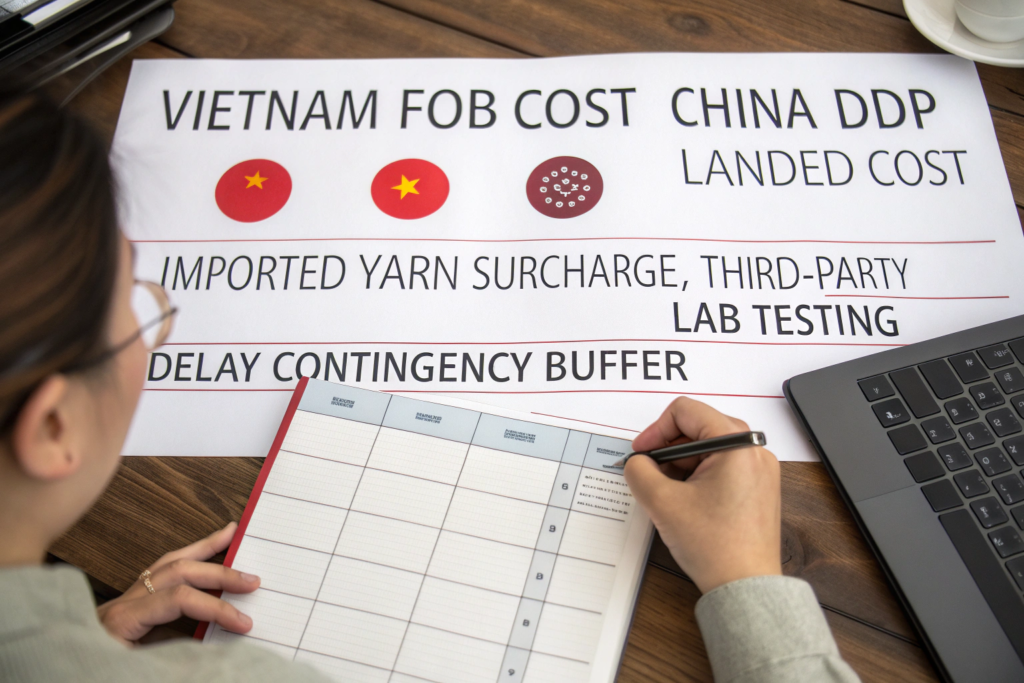
Is Vietnam’s Lower Labor Cost Enough to Offset Its Raw Material Import Dependency?
No, for the vast majority of fabric types. Textile manufacturing is a capital-intensive, raw-material-dominated industry. Labor typically accounts for 10-15% of the total cost of a finished fabric. Raw materials—yarn, dyes, chemicals—account for 50-65%. A 30% labor cost advantage applied to a 12% cost component yields a total cost advantage of roughly 3.5%. A 5-8% raw material cost disadvantage applied to a 55% cost component yields a total cost disadvantage of roughly 3-4%. The math roughly cancels out.
But that is the static math. The dynamic reality is that the hidden costs of supply chain fragmentation—the cost of managing multiple vendors, the cost of development delays, the cost of quality failures, the cost of air freight when a shipment misses its window—are not captured in a factory FOB quote. These costs are real, and they are higher in a less mature, more fragmented supply chain. A brand that switches from China to Vietnam to save 3.5% on labor often discovers that they have added 5-8% in logistics, quality, and management overhead. The net result is a higher total cost for a product that took longer to develop and arrived with more variability. I have seen this pattern repeat across multiple clients. The brands that return to China after a Vietnam experiment do not return because they love paying Chinese labor rates. They return because the total cost and total quality equation, honestly calculated, favors the mature, integrated supply chain.
How Does DDP Shipping From China Simplify the Total Cost Equation?
The DDP shipping model I have described in previous articles is a total cost transparency tool. When I quote a client a DDP price for fabric delivered to their US warehouse, that price includes the fabric, the ocean freight, the insurance, the US customs duty, the customs brokerage, and the trucking. It is a single, fixed, all-inclusive number. There are no subsequent invoices for demurrage, detention, customs exams, or brokerage fees.
A Vietnamese FOB quote contains none of these inclusions. The brand must separately contract and pay a freight forwarder, a customs broker, and a domestic trucker. Each of these entities adds its own margin and its own risk of error. The total cost is unknown until weeks after the fabric arrives, when all the invoices have trickled in. This opacity makes true cost comparison difficult and often leads brands to underestimate the Vietnamese total landed cost. When our DDP price is compared against a fully loaded Vietnamese total cost estimate—including all logistics, duties, testing, and a reasonable contingency for the unexpected—the Chinese option is often equal or lower in cost, and significantly lower in risk. The how DDP shipping from China provides total landed cost certainty and eliminates hidden logistics fees compared to Vietnamese FOB sourcing with fragmented freight and customs management model is not just a convenience; it is a financial instrument that makes the true cost of Chinese sourcing visible and comparable, while the true cost of Vietnamese FOB sourcing remains opaque until the invoices arrive.
Conclusion
The question of whether Vietnam or China is a better fabric source in 2026 is not answered by patriotism or prejudice. It is answered by engineering, economics, and supply chain physics. If your product is a simple, cotton-based, mass-market garment where the fabric is a commodity input, Vietnam can be a viable and competitive source, particularly if your garment assembly is also in Vietnam and you can capture the efficiency of a localized supply chain. Vietnam’s textile industry is growing, improving, and deserving of respect.
But if your product relies on fabric quality as a competitive differentiator—if you need specialty yarns, complex dyeing, advanced finishing, rigorous color consistency, rapid development iterations, or verifiable chemical compliance to the latest EU standards—then China is not just the better option. It is, in many cases, the only option that can deliver at scale. The industrial ecosystem that exists in Keqiao and the surrounding textile cities is a multi-decade, multi-billion-dollar accumulation of machinery, expertise, and infrastructure that cannot be replicated quickly. Vietnam is building. But it is not there yet. The gap in dyeing and finishing alone will take a generation to close. The gap in raw material independence will take even longer.
At Shanghai Fumao, we do not compete with Vietnam on commodity fabrics. We compete on quality, innovation, speed, and total cost certainty. Our CNAS-accredited lab, our vertically integrated supply chain, our advanced finishing partnerships, and our DDP logistics are designed for brands for whom fabric is not just a cost input but a product feature. If that describes your brand, we are the partner you need.
If you are evaluating a sourcing shift to Vietnam—or a return to China—and want to compare real numbers, not hypotheticals, our Business Director, Elaine, can prepare a comparative cost analysis for your specific fabric specifications. She can show you the DDP landed cost from our supply chain, and help you build a fully loaded total cost model for comparison. Let the numbers, not the narratives, decide.
Reach out to Elaine at strong>elaine@fumaoclothing.com. Ask for the China-Vietnam Comparative Sourcing Analysis for your fabric type. Quality has a home address. Let’s see if it matches yours.








