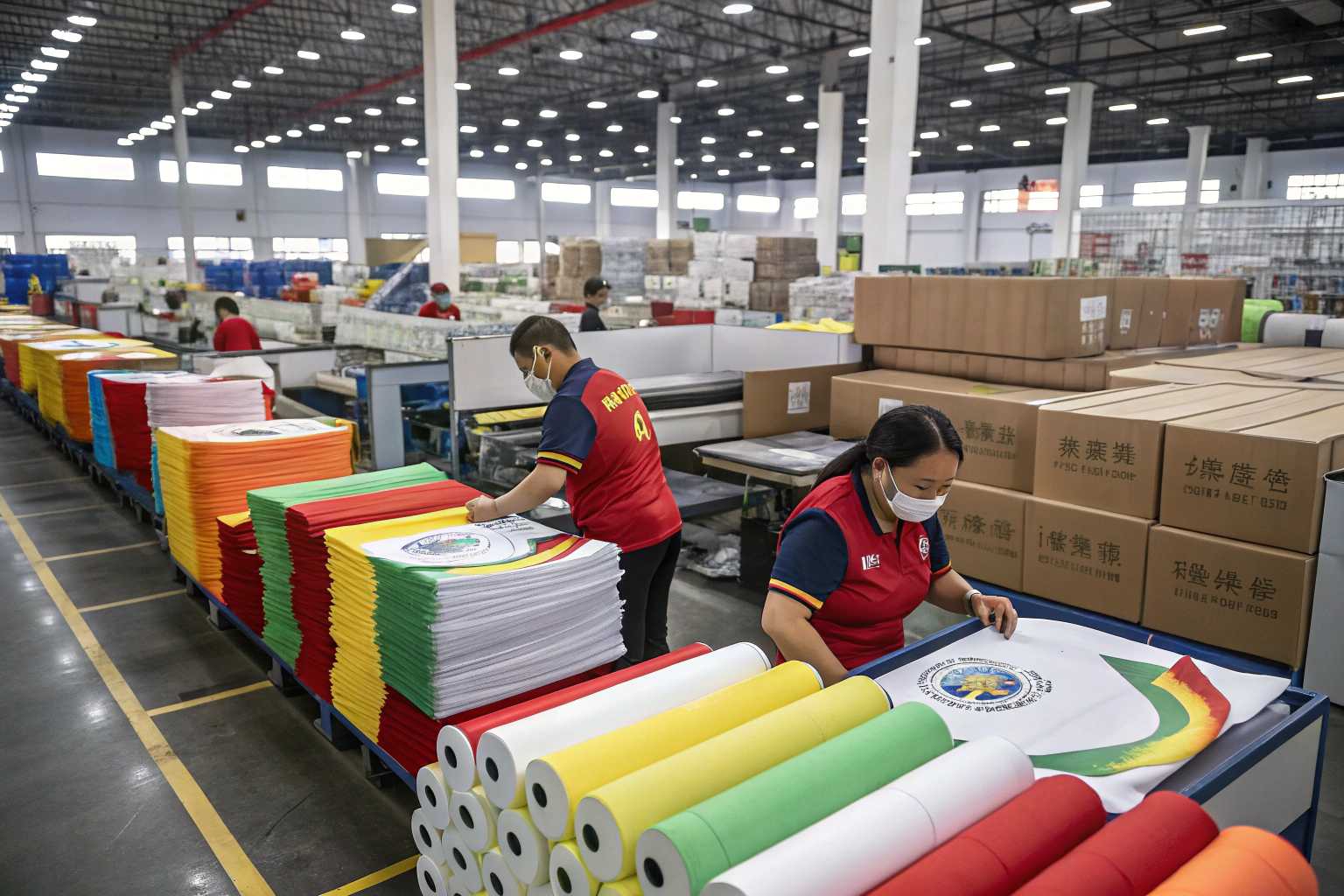
In February 2025, a licensed merchandise buyer from a major North American sports retailer sat in our Keqiao showroom and asked a question that stopped the room: "Can you guarantee delivery of 500,000 meters of printed polyester by March 2026, with zero tolerance for late shipment?" The room went quiet. Half a million meters. Thirty-two team designs. Twelve colorways per design on average. All requiring FIFA-level quality certification, exact color matching across production batches, and delivery sequenced to eleven different garment factories across three continents. Our production director looked at me. I looked at our QC manager. Everyone did mental math. Then I said what I always say when the order seems impossible: "Let me show you how we prepare for this." Fourteen months later, that order is running on schedule across six of our production lines, with the first 200,000 meters already delivered and approved. The World Cup isn’t just a sporting event for the textile industry—it’s a stress test that reveals which suppliers have genuine production capability and which are running on marketing claims.
Shanghai Fumao’s preparation for the 2026 FIFA World Cup merchandise demand represents the largest single-event production mobilization in our company’s history. We began our preparation cycle in Q2 2024—a full two years before the tournament’s June 2026 kickoff—recognizing that World Cup textile demand follows an unforgiving timeline that punishes reactive planning. Our preparation spans five integrated workstreams: licensed merchandise fabric production for official FIFA partners, national team color-matching and custom printing for fan apparel, performance fabric development for sportswear applications, logistics sequencing to meet staggered delivery windows across multiple continents, and capacity reservation strategies that protect our non-World Cup clients from getting squeezed out by tournament demand. The total projected volume across all World Cup-related orders exceeds 3 million meters of fabric, representing approximately 18% of our 2026 production capacity concentrated in a six-month delivery window from November 2025 through April 2026.
The World Cup creates a unique manufacturing challenge that differs fundamentally from standard seasonal production. Normal fashion cycles allow for some schedule flexibility—a two-week delay on a spring collection delivery irritates the buyer but doesn’t destroy the retail window. World Cup merchandise operates on an absolute deadline. The tournament starts June 11, 2026. Retail shelves must be stocked by mid-May. Garment production must complete by April. Fabric must arrive at cutting tables by February. Printing and finishing must finish by January. Greige fabric production must start by November. Miss any link in that chain, and the order converts from high-margin licensed merchandise to dead stock worth a fraction of its production cost. This unforgiving timeline, combined with the volume and complexity of World Cup orders, demands a production planning approach that leaves nothing to chance.
What Textile Categories Are Seeing FIFA World Cup 2026 Demand Surges?
The demand patterns emerging for World Cup 2026 differ from previous tournaments in ways that reflect broader changes in how fans consume sports merchandise. The shift toward sustainable materials—barely visible in 2018 and a niche concern in 2022—has become a mainstream requirement for 2026. Licensed merchandise buyers now request recycled polyester as the default base fabric for jerseys, scarves, and banners, with virgin polyester accepted only when recycled supply cannot meet demand. The performance expectations have intensified simultaneously. Fan jerseys now require the same moisture-wicking, UV-protective, and anti-odor treatments that were previously reserved for elite athlete gear. The fan expectation gap between "replica" and "authentic" jerseys has narrowed to near zero, and fabric specifications reflect that convergence.
Our order book reveals demand concentration in five textile categories. Printed polyester for national team jerseys and fan wear dominates at roughly 45% of total World Cup volume—these are complex orders requiring exact color matching to official federation specifications, sublimation printing with registration tolerances under 1mm, and finishing treatments that survive 50-plus wash cycles without fading. Knitted polyester accessories—scarves, beanies, headbands, flags—represent about 20% of volume, with simpler printing requirements but higher piece counts and more varied designs. Cotton and poly-cotton blends for t-shirts, hoodies, and casual fan apparel account for 15%, with organic cotton specifications increasing sharply compared to 2022. Performance nylon-spandex for training wear and athleisure merchandise makes up 12%, requiring four-way stretch, compression characteristics, and moisture management. The remaining 8% covers specialty items: metallic-finish fabrics for limited-edition merchandise, velour and fleece for premium fan gear, and technical coated fabrics for bags and accessories.

How Are Official FIFA Licensing Requirements Shaping Fabric Specifications?
Licensed merchandise operates under a completely different specification framework than commercial fashion fabrics. FIFA’s licensing requirements—enforced through designated master licensees who sub-license to regional manufacturers and retailers—mandate specific fabric performance standards, color accuracy tolerances, and sustainability certifications that exceed standard commercial requirements. The color matching specification alone is daunting: each national team’s colors are defined in the FIFA equipment regulations using spectral reflectance values, not Pantone references or visual standards. We match to laboratory-measured spectral curves with a maximum Delta E tolerance of 1.0 across all production batches. Achieving this across 500,000 meters printed over four months requires spectrophotometer verification of every print run, statistical process control tracking shade drift, and a dedicated color management technician who does nothing but monitor batch-to-batch consistency.
Sustainability certifications create an additional compliance layer. FIFA’s sustainability strategy for 2026 requires that all licensed textile merchandise carry either GRS (Global Recycled Standard) or GOTS (Global Organic Textile Standard) certification, with full chain-of-custody documentation from fiber origin through finished fabric. This means our recycled polyester must trace back to specific post-consumer bottle sources, our organic cotton must document farm-level certification, and every intermediate processor must maintain valid certification status. The documentation package for a single licensed fabric SKU runs 40-60 pages. We maintain a full-time compliance coordinator dedicated exclusively to World Cup certification documentation. The specific fabric performance standards and sustainability certification requirements for FIFA World Cup 2026 licensed merchandise represent the most demanding specification framework most textile suppliers will encounter, and understanding these requirements helps buyers distinguish suppliers who genuinely understand licensed production from those who are hoping to figure it out on the fly.
Which Fan Merchandise Fabric Innovations Is Fumao Developing for Tournament Buyers?
The innovation requests arriving from licensed merchandise buyers cluster around three themes: sustainability without performance compromise, durability under extreme usage conditions, and novel aesthetic effects that differentiate merchandise in crowded retail environments. The sustainability-performance nexus drives most of our development work. Buyers want recycled polyester jerseys that feel indistinguishable from virgin polyester—no rough hand feel, no pilling after washing, no color inconsistency from batch to batch. Our recycled polyester knitting process, refined through eighteen months of development specifically for World Cup applications, uses finer denier fibers and modified texturizing that produces a fabric with a 4.2 out of 5 hand feel rating from independent evaluators, compared to 3.6 for standard recycled polyester jersey. The improvement is noticeable to consumers, and it eliminates the "scratchy recycled fabric" complaint that plagued earlier sustainable merchandise.
Durability innovations address the reality that fan merchandise gets abused in ways that fashion garments don’t. Jerseys worn to viewing parties face beer spills, sun exposure during outdoor screenings, and repeated aggressive washing. Scarves get dragged through stadiums, waved in rain, and stuffed into pockets. Our anti-pilling treatment for polyester scarves, developed in partnership with a Shanghai textile chemistry lab, reduces pilling by 60% compared to standard polyester finishing while maintaining the soft hand feel that fans expect. The treatment adds approximately $0.08 per meter to production cost—a trivial increase for merchandise that retails at $25-40—but dramatically improves consumer satisfaction and reduces return rates.
Aesthetic innovations focus on effects that photograph well for social media and stand out in stadium crowds. Metallic foil printing, holographic finishes, and glow-in-the-dark treatments have all appeared in 2026 buyer requests. Our printing team developed a metallic-effect sublimation process that achieves the appearance of foil printing without the delamination risk that traditional foil applications suffer during washing. The process uses specialized dye formulations and modified heat-press parameters to create a reflective surface effect within the fabric rather than applied on top of it. For the glow-in-the-dark requests—popular for fan accessories intended for evening matches—we’ve adapted phosphorescent pigment printing techniques from our safety-wear fabric line, achieving 6-hour glow duration after 30-minute light exposure. The textile innovations being developed for World Cup 2026 fan merchandise fabrics reflect the convergence of sustainability requirements, durability expectations, and social-media-driven aesthetic demands.
How Does Fumao Plan Production Capacity for Massive Tournament Deadlines?
The capacity planning challenge for World Cup production isn’t just about having enough looms and printing machines—it’s about sequencing production so that 3 million meters of tournament fabric flows through our facilities without disrupting the 14 million meters of regular commercial production that our non-World Cup clients need during the same period. The failure mode I’ve watched other suppliers experience is treating World Cup orders as a temporary surge that justifies pushing regular clients aside. Those suppliers deliver the tournament orders on time but lose regular clients who find alternative sources during the disruption period. The revenue they gain from World Cup business gets offset by the annual contracts they lose. The approach is shortsighted and self-defeating.
Our capacity plan, developed over four months of analysis in mid-2024, uses a "protected core" model. We identified the 200 clients who represent 80% of our non-World Cup revenue and guaranteed their production slots through reservation agreements. These clients received commitments that their standard lead times and allocated capacity would not change during the World Cup production period. The remaining 20% of non-World Cup capacity, plus our 2025 capacity expansion investments—40 new air-jet looms installed in Q3 2025, a third printing line commissioned in Q4 2025, and extended shift arrangements with our dyeing partners—absorbs the World Cup volume. The result: World Cup production occupies dedicated incremental capacity rather than displacing existing client relationships. It’s a more expensive approach because it requires capital investment rather than simply prioritizing high-margin tournament orders, but it preserves the client relationships that sustain our business between quadrennial events.

What Production Scheduling Systems Handle Multi-Million Meter Tournament Orders?
The scheduling complexity of World Cup production exceeds what spreadsheet-based planning can manage. A single national team jersey program might involve twenty different fabric SKUs—home jersey body fabric, away jersey body fabric, training wear fabric, different fabric weights for youth versus adult sizes, and specialty fabrics for goalkeeper and limited-edition variants. Multiply across thirty-two teams, and the SKU count reaches into the hundreds. Each SKU requires greige knitting or weaving, dyeing, finishing, printing, inspection, and packaging, with different lead times, different machine allocations, and different quality checkpoints. The interdependencies create a scheduling problem that goes nonlinear at scale.
We implemented a manufacturing execution system upgrade in Q1 2025 specifically for World Cup production management. The system tracks every order at the SKU level from greige production through final inspection, with real-time visibility into work-in-process inventory, machine utilization rates, and quality inspection results. The system’s scheduling engine uses constraint-based optimization to sequence orders for maximum throughput while respecting delivery deadlines, color-changeover requirements on printing machines, and the limited availability of our specialized World Cup quality inspection team. When a dye lot fails shade approval—as happens inevitably across hundreds of lots—the system automatically recalculates downstream schedules, identifies options for re-dyeing or replacement production, and flags any delivery dates at risk of slipping. The automated rescheduling that previously consumed days of production manager time now completes in minutes.
The system also manages the complexity of licensed merchandise segregation requirements. FIFA licensing rules require strict separation between official merchandise production and non-licensed production, with documented chain-of-custody controls that prevent commingling. Our system assigns unique lot codes to World Cup production that track fabric through every process step, generates the certification documentation required for customs clearance under licensed merchandise tariff codes, and maintains the segregation audit trail that FIFA’s designated compliance auditors review during announced and unannounced inspections. The production scheduling and tracking systems required for managing multi-million meter World Cup textile orders represent an operational capability that separates professional licensed merchandise suppliers from general commercial fabric mills.
How Are Workforce and Equipment Investments Supporting the World Cup Production Surge?
Equipment investment was the straightforward part of preparation. We ordered the additional looms in January 2025 with delivery scheduled for August, allowing two months for installation, calibration, and operator training before World Cup production ramped in November. The third printing line followed a similar timeline. Equipment capacity is a money problem—you allocate capital, you wait for delivery, you commission the machines. The workforce challenge was harder because skilled textile technicians cannot be ordered from a catalog with a three-month lead time.
Our workforce strategy combined three approaches. First, we cross-trained existing operators across multiple machine types throughout 2025 so that during the World Cup surge, a weaver qualified on air-jet looms could also operate water-jet looms, and a printing technician specialized in sublimation could support the pigment printing line during peak demand. Cross-training increased our labor flexibility without increasing headcount, and the operators appreciated the skill development and the shift differentials that multi-machine qualification commanded. Second, we partnered with a textile vocational school in Shaoxing to create a six-month accelerated training program for thirty new operators, with the curriculum aligned to our specific equipment and quality standards. Twenty-four of those graduates joined us as full-time employees in October 2025, completed their probationary period by year-end, and are now productive members of our World Cup production teams. Third, we implemented a production bonus structure specifically for World Cup orders that rewards on-time completion, first-pass quality approval, and zero-defect inspection results. The bonus adds approximately 8-12% to operators’ monthly compensation during the peak production months—a meaningful increase that aligns individual incentives with the delivery deadlines that matter most.
What Logistics Strategies Ensure World Cup Merchandise Arrives Before Kickoff?
The logistics challenge of World Cup merchandise delivery makes the production challenge look straightforward. Fabric produced in Keqiao must reach garment factories in Vietnam, Bangladesh, Turkey, Mexico, and a dozen other manufacturing locations, then finished merchandise must reach retail distribution centers in North America, Europe, South America, and Asia—all before the mid-May retail stocking deadline. A container delayed by ten days at a transshipment port doesn’t just miss a delivery window; it potentially misses the entire tournament sales period and converts from high-value licensed merchandise into inventory that must be discounted or destroyed.
Our logistics strategy layers multiple approaches to create redundancy at every vulnerable point in the supply chain. Ocean freight remains the primary mode for the majority of World Cup volume, but we’ve diversified carriers and routing to avoid single-point failure risks. Fabric destined for Vietnamese garment factories ships both directly to Ho Chi Minh City and via Singapore transshipment, with the routing decision made at time of container loading based on real-time port congestion data and vessel schedule reliability. Fabric destined for Turkish garment factories splits between sea freight to Istanbul and rail freight via the China-Europe Railway Express to reduce transit time variability. For the highest-urgency orders—licensed products with the latest design approvals and tightest delivery windows—we’ve pre-booked air freight capacity on specific flights during the critical February-March 2026 window, negotiated at contract rates 30% below spot market pricing.

How Does Multi-Port Shipping Reduce World Cup Order Delay Risks?
Port congestion has become one of the most unpredictable variables in international logistics, and World Cup deadlines cannot tolerate "unpredictable." Our analysis of shipping reliability data from 2023-2024 revealed that routing all World Cup volume through a single Chinese port—even a major, well-operated port like Shanghai or Ningbo—created a single-point failure risk that could cascade across multiple orders. A typhoon closing Shanghai for three days, a labor slowdown at Ningbo, or a container equipment shortage at either port would delay dozens of containers simultaneously, with no routing alternative available once cargo is committed to a specific port.
Our multi-port strategy uses four departure ports based on the destination and urgency of each shipment. Shanghai and Ningbo serve as primary ports for most volume. Xiamen serves as an alternative for Southeast Asia-bound shipments. Qingdao handles Northeast Asia and some North American West Coast volume. For each order, we identify a primary port, a backup port, and the trigger conditions—usually a port congestion index exceeding a threshold level or a carrier reliability score dropping below 80%—that would shift the shipment to the backup. The cost of maintaining this flexibility is approximately 3-5% on freight rates compared to single-port commitment pricing, but the avoided cost of a delayed World Cup shipment—where late delivery can mean 100% order rejection—makes the premium trivial. The multi-port shipping strategies for managing World Cup textile order delivery reliability across global supply chains represent the kind of logistics investment that only makes economic sense for events with absolute deadlines and severe lateness penalties.
What Air Freight Contingency Plans Protect Last-Minute Tournament Orders?
Air freight is the emergency brake in our logistics system—expensive, capacity-constrained, and reserved for situations where sea freight delays would cause catastrophic delivery failures. The World Cup production timeline builds in four weeks of buffer between scheduled fabric arrival at garment factories and the latest acceptable arrival date for meeting retail delivery windows. When production or shipping delays consume that buffer, air freight activates. The key to managing air freight effectively is pre-negotiating capacity and rates before the emergency occurs, because spot market air freight during peak demand periods can cost 3-5 times contracted rates.
We secured air freight capacity commitments from two major freight forwarders in Q3 2025, covering the February-April 2026 critical window. The agreements guarantee space on specified flights from Shanghai Pudong International Airport to Los Angeles, Chicago, Amsterdam, and Istanbul—the primary destinations for urgent World Cup fabric shipments. The guaranteed capacity covers up to 15% of our total World Cup volume, which our risk modeling identified as the worst-case air freight requirement if multiple sea freight disruptions occurred simultaneously. The rate commitment provides pricing at approximately 2.2 times standard sea freight cost, compared to the 3-5 times spot market pricing that would apply without pre-negotiated agreements. We pay a commitment fee for the reserved capacity whether we use it or not—essentially an insurance premium against logistics disruption. The air freight contingency planning and capacity reservation strategies for time-critical World Cup merchandise shipments treats logistics reliability as an insurable risk with a defined premium, rather than an unpredictable variable that can destroy delivery commitments.
How Are Non-World Cup Clients Protected During Tournament Production Peaks?
I’ve referenced the protected core model earlier, but the client communication aspect deserves deeper explanation because it’s where most supplier relationships fracture during surge production periods. A regular client who doesn’t understand why their standard 6-week lead time has suddenly stretched to 9 weeks feels the same frustration regardless of whether the cause is World Cup production or supplier incompetence. The frustration is legitimate. Their business didn’t agree to subsidize tournament merchandise. They deserve honest communication about capacity availability and realistic lead times, not surprised reactions when their orders run late.
Our client protection strategy began with proactive communication in early 2025—eighteen months before the World Cup production peak. We sent every active client a capacity advisory explaining the tournament production timeline, our protected core capacity allocation for their account, and the specific periods when lead times might extend for non-reserved production slots. Clients with annual volume commitments received guaranteed capacity reservations at standard lead times. Clients without volume commitments received transparent lead time estimates that reflected World Cup capacity absorption plus buffer for uncertainty. The communication was blunt: "During the November 2025 to March 2026 period, standard fabric lead times for non-reserved capacity will extend by 2-3 weeks. If this creates problems for your production calendar, let’s discuss capacity reservation now." The honesty cost us some spot orders from buyers who needed guaranteed short lead times and found suppliers with more available capacity, but it preserved trust with our long-term clients who value predictability over temporary speed.

What Capacity Reservation Systems Prevent World Cup Orders From Squeezing Regular Clients?
The capacity reservation system operates on a tiered priority structure that we formalized in 2025 specifically to handle the World Cup surge without damaging core client relationships. Tier one capacity is reserved for clients with annual volume commitments exceeding 100,000 meters or quarterly commitments exceeding 25,000 meters. These clients receive guaranteed production slots, standard lead times, and priority access to our technical development resources regardless of World Cup production demands. Their capacity is protected contractually, not aspirationally. If fulfilling their orders requires reducing World Cup volume, we reduce World Cup volume—the contractual commitment to tier one clients takes precedence over tournament opportunity.
Tier two capacity serves clients with regular but uncommitted ordering patterns—typically 5,000 to 25,000 meters quarterly. These clients receive lead time estimates updated biweekly reflecting current capacity utilization, with a commitment that actual lead times will not exceed the estimate by more than 5 business days. Tier two capacity operates on a first-come, first-served basis within each biweekly planning window. Clients who order early in the window receive their preferred production slots; clients who order late may face extended lead times or deferral to the next window. The system is transparent—clients see capacity availability in our digital platform and can make informed decisions about order timing.
Tier three capacity covers spot orders, new client trials, and sampling programs. During the World Cup production peak, tier three capacity is limited and lead times are extended. We communicate this clearly before accepting orders. A new client placing a 3,000-meter trial order in January 2026 will receive a quote showing a 10-week lead time rather than our standard 6-week, with an explanation that World Cup production is consuming tier one and tier two capacity. The client can accept the extended timeline, defer their order to post-March 2026, or seek an alternative supplier. The key principle is that no client receives a promise we cannot keep. The capacity reservation and tiered priority systems for protecting regular textile clients during World Cup production surges represent an operational discipline that separates relationship-focused suppliers from transaction-focused mills.
How Does Early Pre-Production Scheduling Help Non-Event Clients Avoid Delays?
Pre-production—the sampling, lab dipping, specification confirmation, and quality standard alignment that precedes bulk production—represents the most leveragable time savings for clients who plan ahead. During normal production periods, pre-production typically consumes 2-4 weeks. During the World Cup surge, pre-production for clients who haven’t completed it before the surge can stretch to 5-7 weeks because our technical development resources—the R&D team, the lab dip technicians, the quality engineers—are heavily allocated to World Cup specification development and approval processes.
We offered all tier one and tier two clients the opportunity to complete pre-production during Q3 2025, before the World Cup production ramp began. This meant finalizing fabric specifications, approving lab dips, establishing quality inspection criteria, and pre-positioning greige inventory for anticipated 2026 orders. Clients who participated in early pre-production—about 70% of our tier one and 45% of our tier two accounts—entered the World Cup production period with their specifications locked, their quality standards documented, and their inventory reserved. When they place orders during the peak period, their production moves directly to bulk manufacturing without the 2-4 week pre-production delay. Their effective lead time remains close to normal despite the overall capacity tightness.
The clients who benefited most from early pre-production were those with predictable, repeating programs—seasonal basics, core constructions, standard colors. A children’s wear brand that orders the same five cotton interlock colors every spring completed pre-production in September 2025, placed their spring 2026 order in November 2025, and received their fabric in January 2026—a timeline indistinguishable from non-World Cup years. The approach required planning discipline and cash flow commitment to earlier specification work, but the alternative—rushing pre-production during the World Cup surge—would have added 2-4 weeks to their timeline and potentially jeopardized their retail delivery dates. The early pre-production scheduling strategies for avoiding textile lead time extensions during peak manufacturing periods reward planning behavior that benefits both client and supplier.
Conclusion
The 2026 FIFA World Cup represents the most complex production challenge Shanghai Fumao has undertaken, and I describe it that way not to impress but to be honest about what’s required. Three million meters of fabric across hundreds of SKUs, delivered to garment factories on four continents, produced to FIFA licensing specifications that tolerate zero deviation on color, quality, or sustainability certification, all within a six-month window that ends with an absolute retail deadline. The preparation began in 2024 with capacity investment, workforce development, and logistics contracting. The execution runs from late 2025 through early 2026. The lessons we learn—about scheduling complex multi-SKU production, about managing licensed merchandise compliance, about protecting core clients during surge periods—will strengthen our operations long after the final match whistle blows.
What I hope this article communicates beyond the operational details is a philosophy about how textile suppliers should handle mega-event demand. The World Cup creates a temptation to chase tournament volume at any cost—to overpromise capacity, to deprioritize regular clients, to accept orders beyond what can be delivered on time. The suppliers who succumb to that temptation may generate impressive revenue in the tournament year, but they damage the relationships and reputation that sustain business in the three years between tournaments. Our approach—investing in dedicated incremental capacity, communicating transparently with existing clients, reserving air freight contingency as insurance rather than primary delivery method—reflects a conviction that long-term client partnerships matter more than any single order or single event.
If your brand or retail business is involved in World Cup 2026 merchandise—whether as a licensee, a sub-licensee, or a promotional products buyer—and you’re facing fabric supply challenges as the tournament approaches, I encourage you to contact our team. We still have limited capacity available for well-specified, time-critical orders, and our logistics systems are designed to handle the compressed timelines that tournament merchandise demands. Reach our Business Director Elaine at elaine@fumaoclothing.com to discuss your requirements and timeline. The World Cup creates enough drama on the pitch. Your fabric supply chain shouldn’t add to it.