A procurement manager from a German workwear brand called me in March 2024 with a voice full of stress. "Our Vietnamese supplier just pushed our delivery date by six weeks. Again. This is the third season in a row. Our retail buyer is threatening to cancel the program. I need to move production to China, but I have 18 months of development history tied up in Vietnam. How do I switch without losing an entire season?" I could hear the fear in his voice. He was not just worried about a late shipment. He was worried about the transition itself. He had heard the horror stories. Fabric that did not match. Communication gaps that swallowed weeks. Quality that was fine in sampling and disastrous in bulk.
I told him the truth. A poorly managed supplier transition is a disaster. A well-managed supplier transition is a competitive advantage. The difference is not luck. It is a structured transition process that addresses the three specific failure points that kill most Vietnam-to-China moves: the spec translation gap, the sampling validation gap, and the logistics recalibration gap. We have guided multiple brands through this exact transition, and we have refined it into a repeatable, seven-week process that protects your production calendar and your quality standards.
What Are the Real Reasons Brands Are Moving Production From Vietnam to China?
The narrative in the apparel industry for the past five years has been "move to Vietnam." Lower labor costs. Tariff avoidance. Diversification away from China dependency. And many brands did move. They invested in Vietnamese supplier relationships, qualified fabrics, and built production programs. Some of those moves succeeded. But a significant number are now reversing, quietly, and the reasons are not political. They are structural.
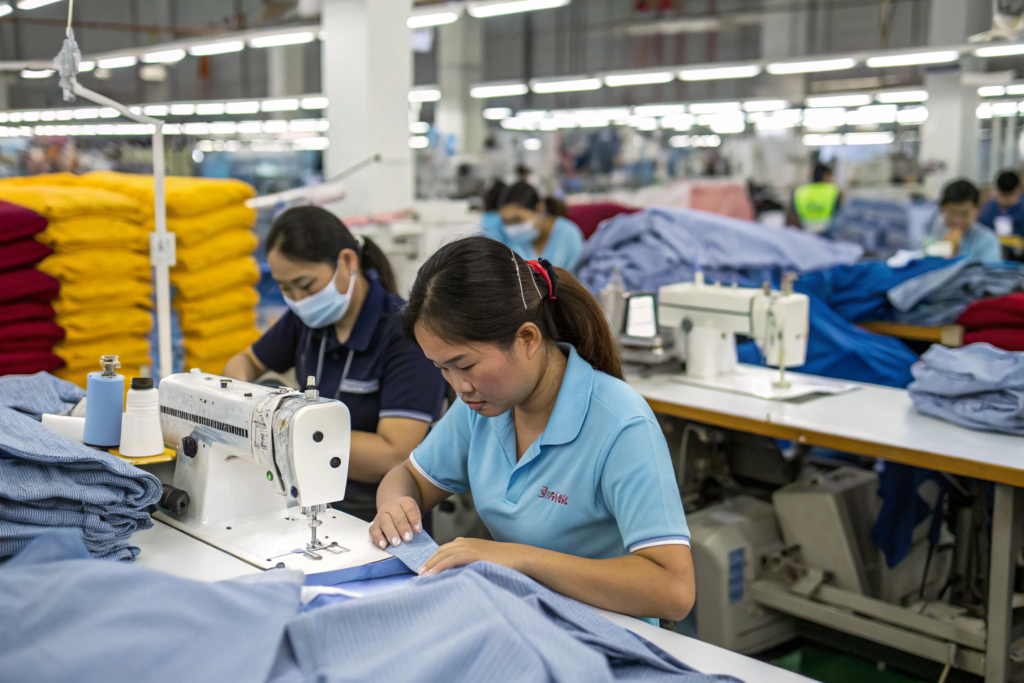
Vietnamese textile manufacturing has a specific strength: cut-and-sew operations for woven garments. The labor force is skilled at garment assembly. But the upstream supply chain—the yarn spinning, the fabric weaving, the dyeing and finishing—is still developing. Many Vietnamese garment factories import their fabric from China, cut and sew it in Vietnam, and re-export the finished goods. This model worked when lead times were generous and shipping costs were low. It breaks down when lead times compress, shipping costs spike, and the extra transit leg from China to Vietnam consumes the labor cost advantage.
Is the "China Plus One" Strategy Crumbling Under Logistics Complexity?
The China Plus One strategy sounded brilliant in boardroom presentations. Keep your core production in China, diversify a portion to Vietnam to reduce tariff exposure, and sleep better at night knowing you are not over-concentrated. The spreadsheet math was compelling. The operational reality has been brutal.
The problem is that Vietnam is not a self-contained textile ecosystem like China. When a Vietnamese garment factory needs a specific fabric, they often buy it from a Chinese mill. The fabric is woven and dyed in Keqiao, trucked to a port, shipped to Haiphong or Ho Chi Minh City, cleared through Vietnamese customs, trucked to the factory, and only then cut and sewn. That is an extra 10 to 14 days of transit time embedded in the production calendar, plus an extra layer of import duties and logistics coordination.
When the global shipping market is stable, this extra time is manageable. When a container shortage hits, or when a port congestion event closes Haiphong for three days, the entire production schedule collapses. The Vietnamese factory, which has no control over the fabric supply, simply delivers late. The brand absorbs the penalty. The cost advantage of Vietnamese labor vanishes into air freight charges to meet the retail delivery window. A growing number of brands are concluding that the operational friction of a split supply chain exceeds the theoretical diversification benefit, and they are consolidating back to a fully integrated Chinese supply chain where fabric and garment production happen in the same time zone, under the same quality system.
How Has Chinese Automation Closed the Labor Cost Gap That Vietnam Once Offered?
The original case for moving production to Vietnam was built on a labor cost differential. Vietnamese garment workers earned $2.50 to $3.00 per hour. Chinese garment workers earned $5.00 to $6.00 per hour. Moving to Vietnam saved roughly 50% on direct labor for cut-and-sew operations. That differential paid for a lot of logistics complexity.
But the differential is shrinking, and not just because Vietnamese wages are rising. It is shrinking because Chinese textile manufacturing is automating the labor out of the equation. Automated spreading machines reduce the labor hours per cutting order by 70%. Automated sewing units for simple operations like pocket setting and hemming run with minimal operator intervention. Digital printing eliminates the entire screen preparation and manual printing process. Robotic material handling moves fabric through the factory without human hands.
The result is that the labor cost per meter of fabric or per garment unit in China is declining as a percentage of total cost. The labor that remains is higher-skilled: machine operators who manage automated lines, quality control technicians, and finishing specialists. A Chinese factory with high automation can produce fabric at a total unit cost that is competitive with a Vietnamese factory using more labor-intensive processes, even before factoring in the logistics advantage. For a brand that values delivery reliability and quality consistency, the fully automated Chinese supply chain is increasingly the economically rational choice, not just the safe choice.
How Do You Translate Vietnamese Tech Packs to Chinese Production Specs Without Errors?
The most dangerous assumption in a supplier transition is that specs are universal. They are not. A tech pack created for a Vietnamese supplier is written in a specific technical dialect. It assumes certain default construction methods, certain standard tolerances, and certain material callouts that are standard in the Vietnamese garment industry. When that tech pack lands on a Chinese production desk, those assumptions are invisible and often wrong.
We have seen the consequences of assuming spec universality. A brand sent us a tech pack developed in Vietnam that specified "single needle topstitch, 5 stitches per inch" on a heavy canvas work pant. The Vietnamese factory had interpreted this as 5 stitches per 2.5 centimeters, which is the standard stitch density unit in much of Southeast Asia. The actual intended density was 5 stitches per inch, or roughly 5 stitches per 2 centimeters. The difference was small in the spec but huge in the finished garment. The Chinese sample produced seams that were 20% less dense than the Vietnamese original, and the brand initially blamed our sewing quality. It took three days of email exchanges to identify the unit-of-measure mismatch. We now check every single unit on every incoming tech pack against a standardized conversion table before any sample is cut.

What Hidden Measurement Assumptions Differ Between Vietnamese and Chinese Factories?
Beyond the stitch density unit issue, there are several measurement conventions that differ systematically between Vietnamese and Chinese garment factories, and they catch transitioning brands off guard every time.
Seam allowance is the biggest hidden variable. Vietnamese factories often default to a 1.0 centimeter seam allowance for woven garments, a convention shared with much of the ASEAN region. Chinese factories default to a 1.2 centimeter seam allowance for wovens, a slightly wider standard that provides more room for overlocking and trimming. If a brand’s Vietnamese tech pack specifies a "finished garment measurement" without stating the seam allowance, and the Chinese factory applies its default 1.2 centimeters, the finished garment will be 0.4 centimeters narrower at every seam than the Vietnamese original. On a garment with four vertical seams, that accumulates to 1.6 centimeters of lost circumference. The garment fits differently, and the brand does not understand why.
Another common mismatch is in collar and cuff interlining callouts. Vietnamese factories often use a locally sourced fusible interlining with a specific weight and adhesive type. When a brand simply specifies "medium-weight fusible interlining" on a tech pack, the Chinese factory substitutes its own equivalent, which may have a different hand feel, a different shrinkage rate, or a different fusing temperature requirement. The collar looks correct on day one but delaminates after five washes. We address this by requesting a physical interlining sample from the Vietnamese supplier as part of the transition package, then matching it to the closest Chinese equivalent with documented shrinkage and fusing performance data.
How Does a "First Article Inspection" Protocol Catch Spec Translation Errors Before Bulk?
The best translation check is a physical comparison, not a document review. We have integrated a First Article Inspection protocol specifically designed for supplier transitions that catches spec translation errors before they propagate into bulk production.
Here is how it works. Before we begin bulk production, we produce one complete, finished garment sample using our interpretation of the brand’s tech pack and any reference samples provided. This is the First Article. We ship this First Article to the brand along with a detailed measurement report that lists every point of measure from the original tech pack, our finished measurement, and the deviation. We also ship a side-by-side photo report showing our First Article next to the Vietnamese original reference garment, photographed from multiple angles under standardized lighting.
The brand inspects the First Article against their Vietnamese original. They identify any differences—a slightly higher collar stand, a pocket placement that is 5 millimeters off, a cuff that feels too stiff or too soft. They document these differences on our First Article Inspection form and return it to us. We adjust the pattern, the spec, or the material callout, produce a corrected Second Article, and repeat the process until the brand signs off. Only then do we cut bulk. This protocol typically adds 10 days to the transition timeline but eliminates the risk of producing hundreds or thousands of units that do not match the brand’s established quality standard.
What Sampling Timeline Should You Expect When Switching Between Countries?
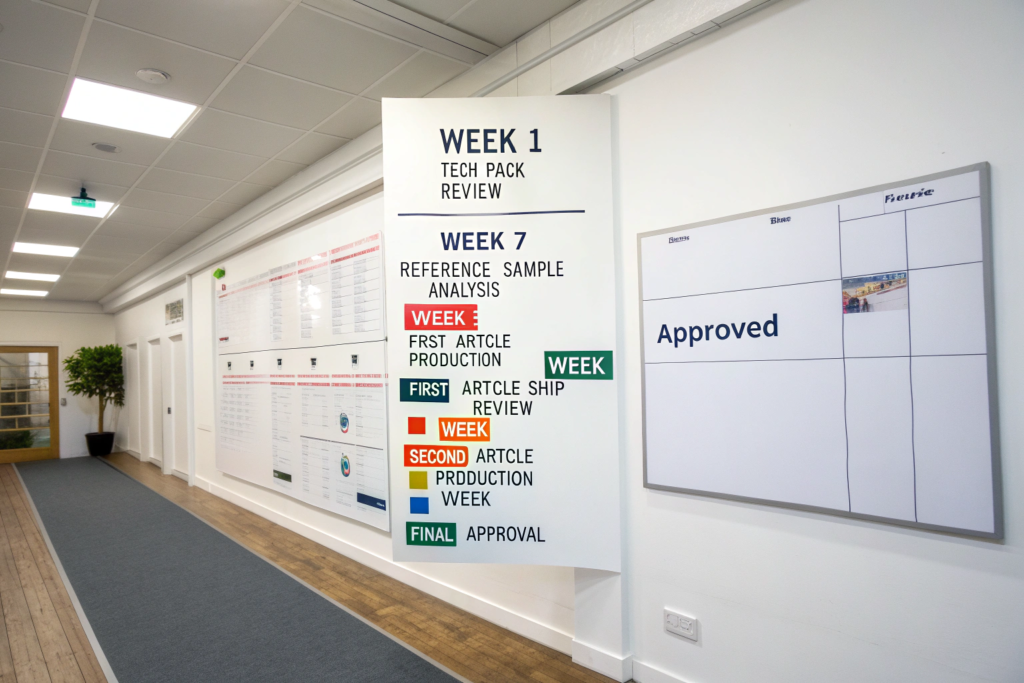
One of the first questions a transitioning brand asks is, "How long until we are in production?" They are bracing for bad news. They expect to hear that a supplier transition will cost them a season. They are often surprised when I tell them that a structured transition can be completed in seven weeks from tech pack handover to bulk cutting, and that this timeline can run parallel to the final order from their Vietnamese supplier, so there is zero production gap.
The key is overlapping the tail of the Vietnam relationship with the ramp-up of the China relationship. The Vietnamese supplier is finishing the current season’s bulk production while Shanghai Fumao is simultaneously developing the samples and specs for the next season. By the time the last Vietnamese container ships, our first samples are approved, and bulk production is ready to launch. There is no gap. There is no missed season. There is a deliberate, calendar-managed handover.
Can Fumao Accept a Vietnamese Reference Sample Instead of Starting From Scratch?
The single biggest time-saver in a supplier transition is the reference sample. A brand that has been producing successfully in Vietnam has a physical garment that represents their quality standard. That garment contains more information than any tech pack. It contains the exact fabric hand, the exact thread color, the exact construction technique, and the exact fit on a body.
We strongly prefer to receive a Vietnamese reference sample as part of the transition package. Our development team deconstructs it. We measure every panel. We identify the fabric composition with lab analysis. We cut open the seams to examine the stitch type and thread tension. We measure the interlining weight and fusing condition. We test the zipper and trim functionality. From this physical analysis, we reverse-engineer a complete specification that matches the Vietnamese output. We do not need the brand to translate their Vietnamese spec into a Chinese spec. We do that translation internally, using the physical reference as the ultimate arbiter of correctness.
This process eliminates multiple rounds of sampling. A tech-pack-only transition typically requires three to four sample rounds to dial in the fit and finish. A reference-sample-supported transition typically requires one to two rounds. The difference is two to three weeks of development time and a significant reduction in back-and-forth communication. Brands that can provide a physical reference sample from their Vietnamese production will transition faster and with fewer errors.
Why Does a "Pre-Production Parallel Run" Reduce Risk During the Transition?
The most risk-averse transition strategy is the parallel run. The brand places their final order with the Vietnamese supplier for the current season. Simultaneously, they place a small "shadow order" with Shanghai Fumao for the same season: perhaps 20% of the total volume. Both suppliers produce and ship. The brand compares the quality, the delivery performance, and the communication experience. They identify any issues with the Fumao output while the Vietnamese supplier is still producing the majority of the volume and can serve as a backup.
This parallel run costs more in the short term. The brand is splitting volume and losing some economies of scale on both sides. But the cost is an investment in risk reduction. If the Fumao shadow order performs perfectly, the brand transitions the full volume to Fumao in the next season with total confidence. If issues emerge, the brand resolves them with Fumao while still protected by the Vietnamese supply. No customer orders are at risk. No retail shelves go empty.
For brands with a high cost of failure—those with strict retail delivery windows, high brand equity, or limited tolerance for quality variation—the parallel run is the recommended transition path. It is the difference between hoping a transition works and knowing it works before you commit.
| Transition Phase | Week | Key Activity | Deliverable |
|---|---|---|---|
| Spec Translation | 1-2 | Tech pack review, reference sample deconstruction | Translated spec sheet, unit conversion table |
| First Article | 3-4 | Produce and ship first sample from translated spec | First Article sample, measurement report |
| Correction | 5-6 | Brand feedback, spec adjustment, Second Article | Approved sample, signed-off tech pack |
| Validation | 7 | Pre-production sample from bulk line, final approval | Golden Sample, bulk cutting authorization |
| Parallel Run | 8-20 | 20% shadow order alongside Vietnam bulk | Comparative quality and delivery data |
How Do You Reposition Your Logistics From Vietnamese Ports to Chinese Shipping Hubs?
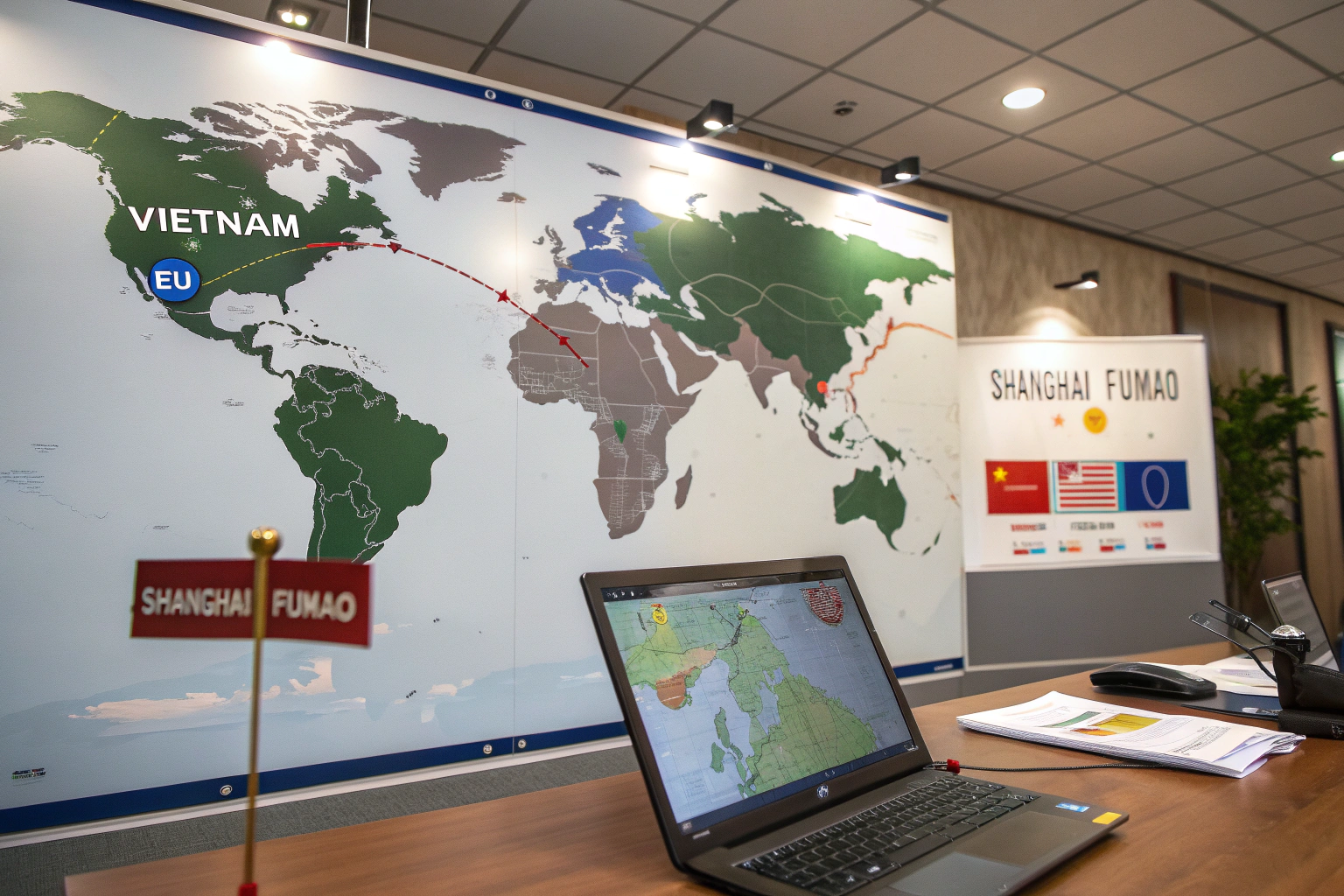
When a brand moves production from Vietnam to China, the factory address changes, but so does the entire logistics geometry. The departure port shifts from Haiphong or Ho Chi Minh City to Shanghai or Ningbo. The transit time to the destination market changes, usually for the better. The customs documentation changes because the country of origin on the certificate of origin form changes. The duty rate may change depending on the destination country’s trade agreements with Vietnam versus China.
These logistics changes are not a problem to be solved after the fabric is produced. They are variables to be planned before the first purchase order is issued. A brand that assumes Chinese shipping will work identically to Vietnamese shipping will encounter delays, unexpected costs, and compliance issues at the destination port. A brand that recalibrates their logistics in parallel with their supplier transition will experience a seamless handover.
What Are the Transit Time Differences From Shanghai Versus Haiphong to the EU and US?
Shanghai is the world’s busiest container port. It has more direct sailings to more destination ports than any port in Vietnam. This translates into faster, more reliable transit times for most major destination markets.
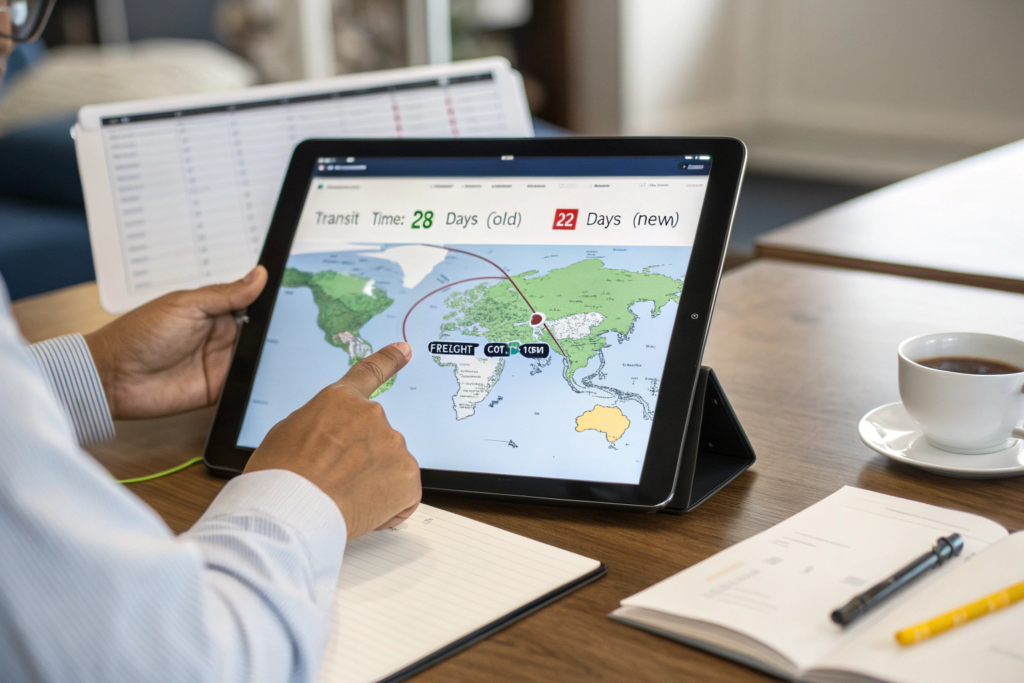
From Haiphong to Rotterdam, a typical transit time is 28 to 32 days, depending on the carrier and the transshipment routing. From Shanghai to Rotterdam, a direct sailing takes 22 to 26 days. That is a week saved on the water, every single shipment. For a brand operating on a seasonal replenishment calendar, that week is additional selling time at full price, or additional buffer in the production calendar. From Ho Chi Minh City to Los Angeles, transit times range from 18 to 22 days. From Shanghai to Los Angeles, direct sailings take 12 to 15 days. The difference is even more dramatic on the trans-Pacific route.
These faster transit times are not just about speed. They are about reliability. Direct sailings have fewer points of failure than transshipment routings. A container that transships through Singapore or Busan has two opportunities to miss a connection. A container on a direct Shanghai-to-Rotterdam vessel has one departure and one arrival. The risk of a rolled booking or a missed connection is halved. For brands that have been burned by Vietnamese transshipment delays, the reliability of direct Chinese sailings is often worth more than the speed improvement.
How Does the Shift to Chinese Ports Affect Your Customs Documentation and Duties?
The country of origin on the certificate of origin changes from Vietnam to China. This change triggers a different set of trade agreements, different duty rates, and different documentation requirements depending on the destination market.
For imports into the European Union, Vietnam benefits from the EU-Vietnam Free Trade Agreement, which eliminated duties on most textile and apparel products. Chinese textile imports into the EU face Most Favored Nation duties, typically 8% to 12% for woven cotton fabrics and garments. This is a genuine cost increase that must be factored into the transition calculation. However, the duty increase is often offset, partially or fully, by the lower FOB price from Chinese suppliers and the faster transit times that reduce in-transit inventory carrying costs.
For imports into the United States, the situation is different. Chinese textile imports are subject to Section 301 additional tariffs, which add 7.5% to 25% on top of the standard duty rate, depending on the HTS code. Vietnamese imports face only the standard duty rate, typically 8% to 15% for apparel. The tariff differential on US-bound goods is significant and cannot be ignored. However, brands that sell primarily to the European market or to domestic Asian markets may find that the Chinese logistics advantage and price advantage more than compensate for the EU duty differential.
We work with each transitioning brand to run a landed cost analysis that models the total cost per unit under both the Vietnamese and Chinese scenarios, including FOB price, ocean freight, insurance, customs duties, and inland trucking. The model identifies the true cost impact of the transition before any purchase orders are placed, so the brand makes the decision with full financial visibility. This guide to understanding the tariff implications of switching apparel sourcing countries between ASEAN and China provides a detailed walkthrough of the duty calculations.
| Logistics Factor | Vietnamese Port (Haiphong) | Chinese Port (Shanghai) | Net Impact of Switch |
|---|---|---|---|
| Transit to Rotterdam | 28-32 days | 22-26 days | ~7 days faster |
| Transit to Los Angeles | 18-22 days | 12-15 days | ~7 days faster |
| EU Duty Rate (Cotton Apparel) | 0% (EVFTA) | 8-12% (MFN) | Increased duty cost |
| US Duty Rate (Cotton Apparel) | 8-15% (Standard) | 15-37% (with Section 301) | Significantly increased |
| Direct Sailing Reliability | Moderate (transshipment) | High (direct calls) | Reduced delay risk |
Conclusion
Transitioning from a Vietnamese supplier to Shanghai Fumao is not a leap of faith. It is a structured, seven-week project with defined milestones, clear deliverables, and a risk mitigation strategy that protects your production calendar and your brand quality. The brands that struggle with this transition are the ones that treat it as a simple vendor swap—send the tech pack, wait for the sample, hope for the best. The brands that succeed are the ones that invest in spec translation, reference sample analysis, a First Article Inspection protocol, and a logistics recalibration before the first meter of fabric is woven.
We have guided multiple brands through this exact transition, and we have a standardized process that makes it predictable. We know the measurement conventions that differ between Vietnamese and Chinese factories. We know the interlining substitutions that cause problems. We know the shipping routes and the duty calculations. We have made the mistakes already so you do not have to.
If you are considering moving production from Vietnam to China, or if you are simply exploring the option and want to understand the timeline, the cost, and the risk, let us talk. We can provide you with a Transition Timeline and Landed Cost Analysis specific to your product category and destination market. Contact our Business Director, Elaine, at elaine@fumaoclothing.com to start the conversation. You do not need to commit to the transition to understand it. You just need to ask the questions, and we will give you honest answers backed by data, not promises.