It was a humid August afternoon in Keqiao in 2022 when I nearly lost a $180,000 order over the color "navy." A Los Angeles menswear brand had approved our physical lab dip under our in-house D65 lightbox. We dyed 8,000 meters of premium cotton twill to match that exact dip. The fabric shipped, arrived in California, and the buyer hit the roof. Under the LED lighting of their design studio, the navy read distinctly purple. Not slightly off—distinctly purple. The problem was metamerism: two colors that match under one light source but not another. We had matched under daylight simulation, but the brand’s retail environment used 3000K warm-white LEDs. We ate the cost of that batch—every yard, every cent—and I swore we would never let a client misunderstand what a lab dip truly represents ever again.
A lab dip is not a promise that the color will look identical everywhere. It is a precise, highly controlled contract that says: "Under this specific light source, measured with this specific instrument, this recipe produces this reflectance curve." The gap between that contract and what buyers believe it means is where fortunes are lost. At Shanghai Fumao, we have turned lab dips from a source of anxiety into the most transparent step of the entire production chain.
What’s the Real Difference Between a Lab Dip and a Color Standard?
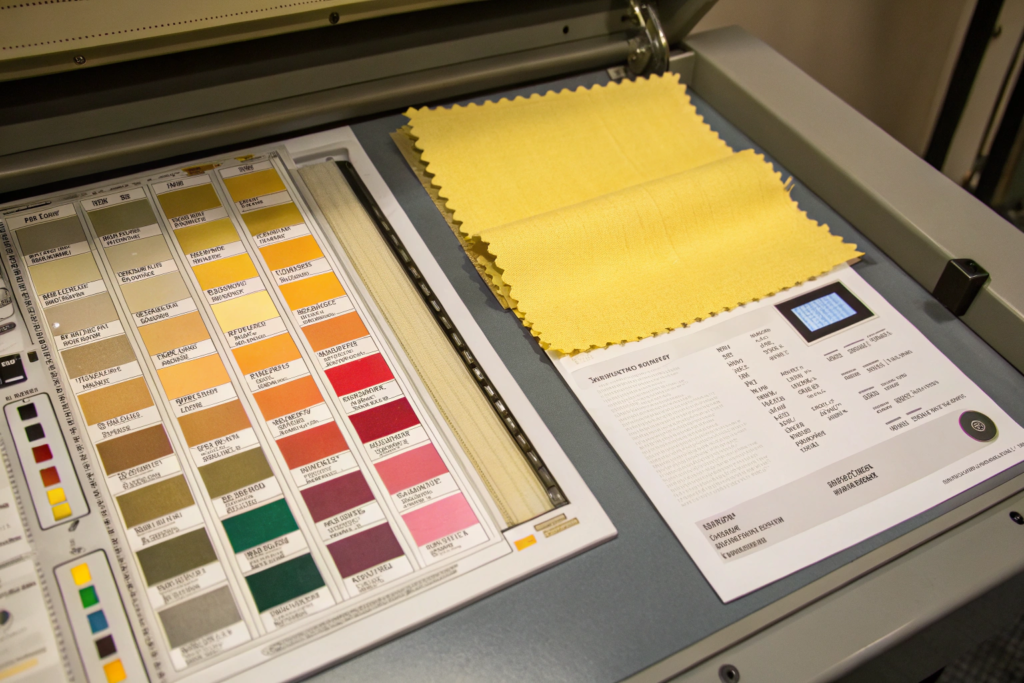
I have had buyers email me a photo of a Pantone chip from their phone and ask me to match it exactly. This is like asking a chef to replicate a dish from a watercolor painting of the meal. A color standard is the theoretical target. A lab dip is the physical reality of that target, translated through the messy, beautiful filter of actual yarn, actual dye molecules, and actual fabric construction.
A color standard can be many things: a Pantone paper chip, a competitor’s snipped-off swatch, a painted ceramic tile, or even a digital hex code. It lives in a perfect, platonic world. A lab dip lives in the real world where cotton absorbs dye differently than polyester, where yarn twist scatters light, and where a brushed finish pulls a color in a completely different direction than a calendered finish. When you approve a lab dip at Fumao, you are not approving a vague intention. You are approving an exact, metered recipe—down to the 0.01 gram per liter of dye concentration—that can be reproduced in a 500kg dyeing vat.
Why Can’t You Just Send Me a Pantone Reference and Skip the Dip Process Entirely?
This question comes from a place of efficiency, and I respect that. But it misunderstands the physics of textile dyeing at a fundamental level.
Pantone chips are made by layering ink on paper. Paper is smooth, flat, and opaque. Fabric is three-dimensional, made of interlocking loops or crossed yarns. Light hits a Pantone chip and bounces back in a single plane. Light hits a woven fabric and enters a tiny canyon of warp and weft, bouncing around, getting trapped in shadows, and escaping with a completely different spectral signature. A dark green on a Pantone chip can look almost black on a fluffy terry towel because the pile traps so much light. That same dark green on a satin weave can look bright and jewel-like because the long floats reflect light like a mirror. The color is technically the same dye recipe, but the visual perception is wildly different.
Then there is the chemical reality. Pantone does not tell you how to dye polyester. It just says "this is the color." But nylon takes acid dyes, cotton takes reactive dyes, and polyester takes disperse dyes. The exact same visual green might require a completely different chemical class of dye depending on the fiber. A reactive dye recipe for cotton simply will not work on polyester. And if you are working with a cotton-spandex blend, the spandex filament might not take the cotton dye at all, leaving a subtle white core visible under the surface. This is called "grin-through," and a Pantone chip will never warn you about it. A properly executed lab dip on your actual base fabric reveals all these gremlins before they ruin a bulk production.
How Does a Spectrophotometer Reading Actually Translate "Navy" Into a Number We Can Both Trust?
For centuries, color was a subjective argument. "Too green." "Too dull." "Not rich enough." Those words are poison to quality control. The spectrophotometer killed that argument. It measures color as a precise set of coordinates in a three-dimensional color space called CIELAB. It assigns an L value for lightness (0 is black, 100 is white), an a value for the red-green axis, and a b* value for the yellow-blue axis.
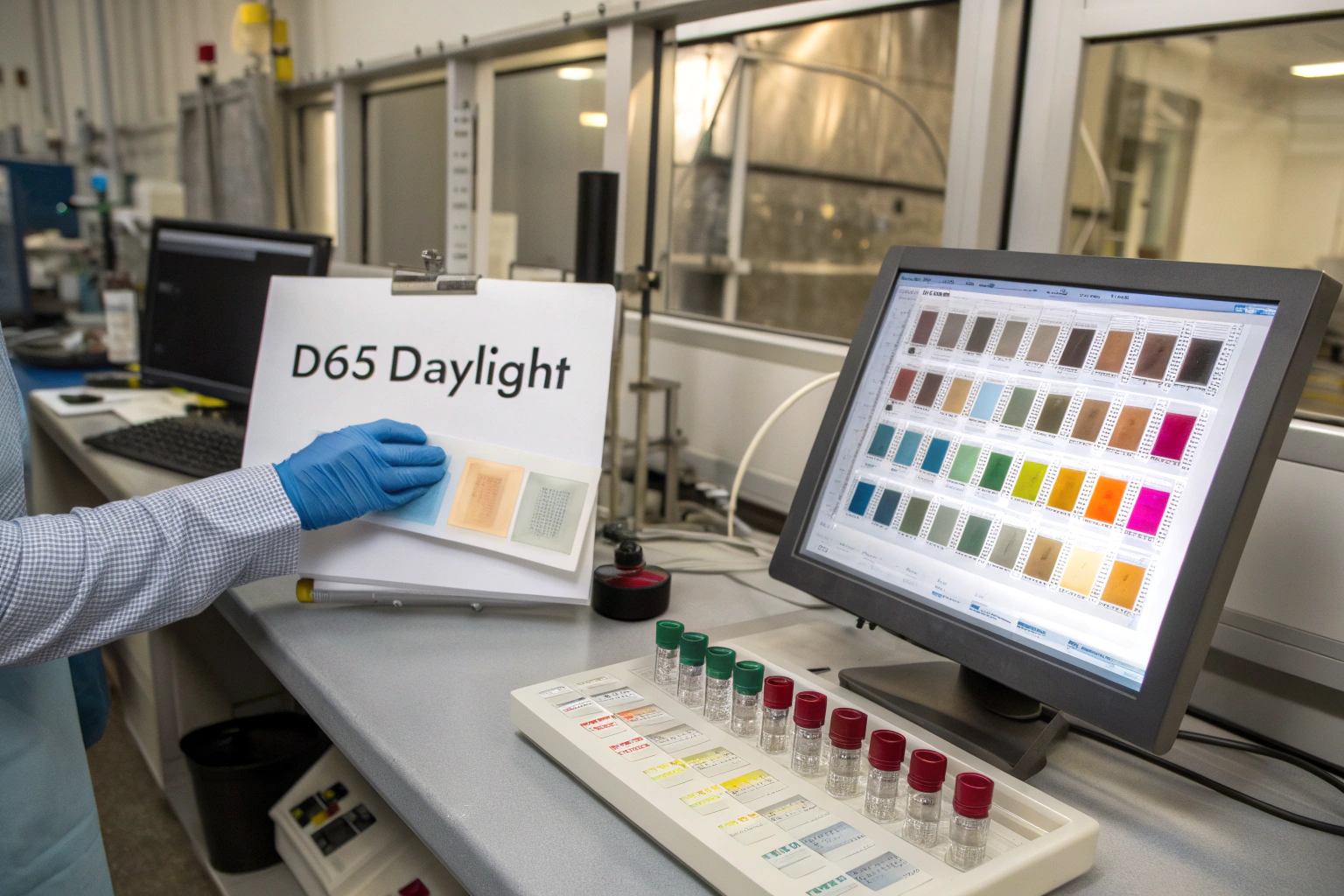
When our lab submits a dip to you, it also submits a Delta E number. Delta E is the calculated distance between your target standard and our dip in this 3D color space. A Delta E of 1.0 is considered the just-perceptible-difference threshold for the human eye under ideal conditions. At Fumao, our internal pass/fail line is a Delta E of 0.8 or less for solid colors, and 1.2 or less for complex heather blends. We hit this standard on 94% of our first-submission lab dips.
The instrument also reads the reflectance curve across the entire visible spectrum, from 400 to 700 nanometers. This curve is the DNA of the color. Two navy fabrics can have an identical Delta E but completely different reflectance curves if one uses a blue-red dye combination and the other uses a blue-yellow combination. They will match under D65 daylight but diverge dramatically under warm store lighting. We always send the reflectance curve alongside the Delta E reading. This allows the buyer to assess metamerism risk before they approve the physical swatch. You can learn more about this technology from the principles of spectrophotometry in textile color matching. It transforms color approval from an art critique into a science experiment with traceable, repeatable data.
| Approval Metric | Old Subjective Method | Fumao Objective Method | Impact on Accuracy |
|---|---|---|---|
| Color Description | "A rich, deep navy" | L=20.5, a=1.2, b*=-15.8 | Removes interpretation bias |
| Pass/Fail Decision | Visual inspection by mood | Delta E ≤ 0.8 under D65 | Replicable across all labs |
| Metamerism Risk | "Looks fine in the office" | Full reflectance curve 400-700nm | Predicts store lighting failure |
| Dye Recipe Lock | Handwritten notebook entry | Digital .qtx file with batch trace | Exact bulk reproduction |
Why Do Different Substrates Show the Same Dye Recipe Completely Differently?
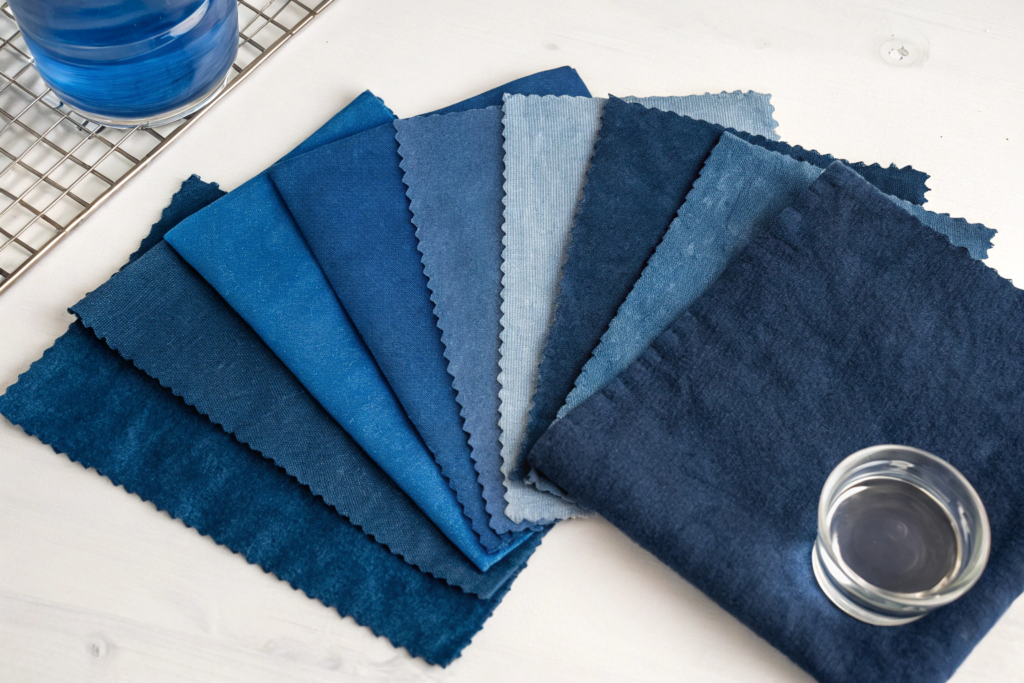
I keep a sample card in my office that I show to every new client. It has five swatches: cotton broadcloth, nylon taffeta, polyester crepe, wool gabardine, and rayon challis. Every single swatch was in the exact same dye bath at the exact same time. And not one of them matches the other. The cotton is matte and muted. The nylon is screamingly bright. The wool is deep and rich. The polyester is sharp and cool. The rayon is soft and warm. Same recipe, five different colors.
This demonstration shocks people who are new to textiles. It should not. The substrate is not a passive canvas. It is an active participant in the chemical conversation of dyeing. The fiber’s molecular structure, surface texture, and refractive index all act as filters that modify how the absorbed dye presents itself to the human eye. Understanding this is the difference between approving a lab dip that works in bulk and one that dooms the production run.
How Does Cotton’s Hollow Fiber Structure Absorb Light Differently Than Polyester’s Smooth Rod?
Cotton is a liar. It looks smooth, but under an electron microscope, a cotton fiber is a collapsed, twisted tube with a hollow central channel called a lumen. It is more like a drinking straw than a solid rod. This structure traps light. When light hits a dyed cotton fiber, some of it enters the lumen and bounces around until it is absorbed. The light that escapes back to your eye has lost energy. The color appears deeper but also duller.
Polyester, by contrast, is a solid, glassy rod extruded through a spinneret. It has no internal cavities. Its surface is much smoother than cotton’s convoluted topography. Light hits polyester and reflects straight back, carrying nearly all of its original spectral energy with it. The color appears brighter, sometimes even metallic. This is why a fluorescent pink on polyester activewear practically glows, but that same dye on a cotton tee looks dusty and muted.
This physical difference has a practical consequence for lab dip approval. If you are developing a cotton-polyester blend fabric, you must evaluate the dip for "union dyeing"—the appearance that both fibers have taken the same depth of shade. Often, the cotton component dyes darker than the polyester, giving the fabric a heathered, two-tone look even though only one dye bath was used. If you want a solid, uniform appearance, we need to dye the polyester component first using high-energy disperse dyes under pressure at 130°C, then overdye the cotton with reactives. It is a two-step process that doubles the lab dip lead time but delivers a uniform solid. We always discuss this before starting dips on any blend, because the price difference is significant, and surprising a buyer with a speckled result they did not expect is a fast way to lose trust.
What Exactly Is "Grin-Through" and Why Does It Ruin Dark Elastane Blends?
Grin-through is the textile industry’s name for a very specific and frustrating optical phenomenon. It happens in core-spun yarns where a spandex filament sits at the center, wrapped by a sheath of cotton or viscose staple fibers. Under tension, the sheath fibers separate slightly. If the spandex core is white or translucent, and it took little to no dye during the dyeing process, it suddenly becomes visible as a pale ghost at the center of the yarn. It looks like the fabric is grinning at you with white teeth.
This is a catastrophic failure for dark shades like black, navy, or burgundy. A black legging with grin-through looks faded and cheap, even if the cotton sheath is dyed perfectly. The fix is a "dope-dyed" black spandex core. Instead of using a natural translucent spandex, we source spandex that has carbon black pigment embedded inside the polymer filament itself. It is black all the way through. When the cotton sheath separates under stretch, the core that reveals itself is also black. The grin disappears.
The challenge is that dope-dyed black spandex costs more and has a longer minimum order lead time from the spandex spinner. If a buyer does not specify this up front, a mill will often default to standard clear spandex to save cost and hit a price point. Then the bulk fabric arrives with grin-through, and the buyer is stuck with thousands of meters of compromised material. Our lab dip protocol for any dark shade on a core-spun yarn always includes a stretch-recovery color assessment. We stretch the dipped fabric to 40% elongation and visually inspect for core visibility. If we see any grin-through, we flag it immediately and recommend the dope-dyed upgrade before any bulk dyeing begins. This single check has saved our clients from writing off entire production lots.
How Many Lab Dip Revisions Are Actually Normal Before You Approve a Color?
I once had a buyer go through 14 rounds of lab dips for a single shade of olive green. Fourteen. The process took seven weeks, and by the time we locked the color, their production window had slammed shut, and they missed their spring delivery completely. The tragedy is that the dip from round three was perfectly acceptable to 99% of consumers. The buyer just could not stop chasing a ghost that only existed in their memory of a jacket they saw in a Milan boutique three years ago.
Lab dips are a process of diminishing returns. The first submission usually captures the general neighborhood of the color. The second submission refines it into the right block. By the third submission, we are usually making adjustments so tiny that only a trained colorist with a lightbox can see them. Understanding where the point of diminishing returns lies is a critical skill for any production manager. More dips do not mean better color; they mean more time, more cost, and more frustration.
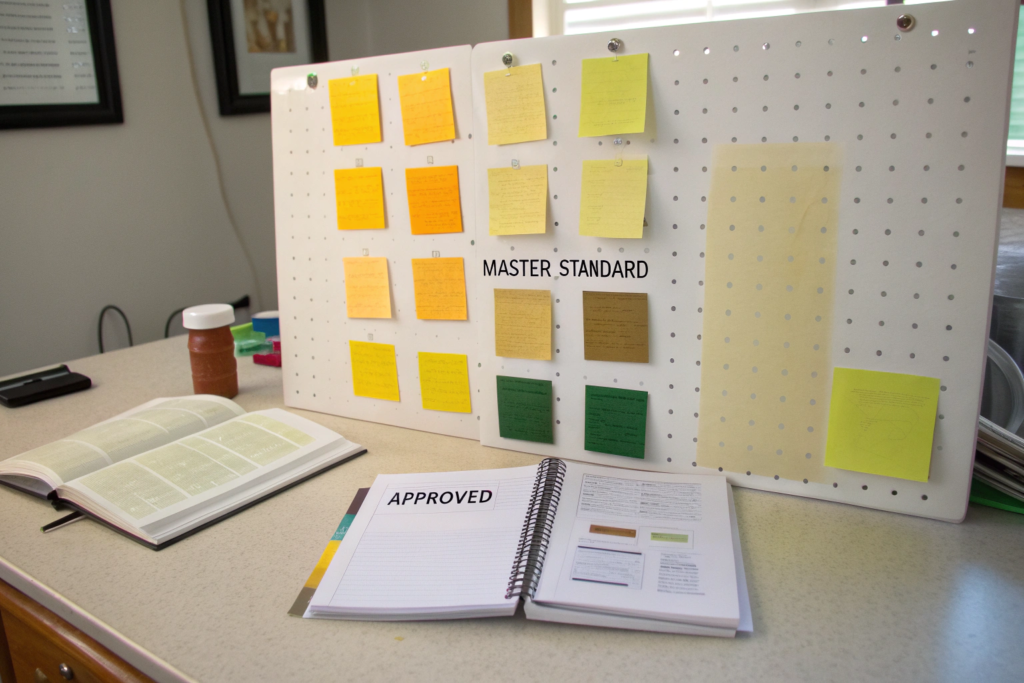
What Does a "Commercial Match" Really Mean Versus an "Exact Match" Approval?
These are the two most important terms in the lab dip lexicon, and they confuse buyers constantly. An "exact match" means the dip is within a Delta E of 0.5 of the standard under a single agreed-upon light source. It is a strict, narrow, almost laboratory-grade approval. We reserve this standard for critical applications: a solid trim color that sits directly against a white collar, or a branded corporate color where legal brand guidelines demand precision.
A "commercial match" is the industry’s practical, production-friendly standard. It means the color is visually acceptable under a range of lighting conditions, typically with a Delta E of 1.0 or less under D65 primary, and no catastrophic metamerism under TL84 or Incandescent A secondary sources. A commercial match says, "A reasonable consumer will not perceive a color difference between this fabric and the standard in normal wear conditions." For 90% of fashion and home textile applications, a commercial match is the right approval level.
Chasing an exact match when a commercial match will suffice is the most common cause of lab dip bloat. I once had a children’s wear brand reject a commercial match on a playful floral print because the sky-blue background was 0.3 Delta E units too green. They held out for an exact match. We got there, but it added 12 days. The irony? The printed flowers on top of that sky blue had a Delta E tolerance of 1.5 because multicolor prints are inherently forgiving. The background color that nobody would ever scrutinize held up the entire project. Do not let perfectionism become the enemy of a perfectly acceptable, commercially viable product.
How Can You Use a Gray Scale to Make Dip Approval Objective Instead of Emotional?
Color approval is emotional. It triggers a deep, lizard-brain response. A buyer sees a dip, and it just feels "wrong," even if the instruments say it is right. This is where the gray scale for color change enters the picture as a bridge between cold data and human perception.
The ISO 105-A02 gray scale is a physical card with five pairs of gray chips, each pair showing a progressively larger contrast difference. Grade 5 is no visible difference. Grade 4 is a trace difference. Grade 3 is a noticeable but acceptable difference. Grade 2 is a clear, unacceptable difference. When a buyer holds a gray scale next to the master standard and the lab dip, they can assign a grade to the color difference. A Grade 4 or better is a commercial match. A Grade 4-5 or 5 is an exact match.
This tool transforms the conversation from "I don’t like it" to "I rate this as a Grade 3-4, let’s push for one more round." It gives the buyer and the supplier a shared, objective language. We include a gray scale assessment with every physical lab dip we ship to clients who request it. Our technician rates the dip against the master standard under D65, TL84, and UV light, and writes the grades directly on the dip card. This has cut our average revision rounds from 3.2 to 1.8 over the past two years. You can find a more detailed explanation of this methodology in this guide on how to use the gray scale for assessing color change in textile testing. It is the single most effective tool for depersonalizing the approval process.
| Approval Stage | Typical Delta E | Gray Scale Grade | Business Impact |
|---|---|---|---|
| Initial Submission | 1.5 – 2.5 | Grade 3 | General color direction confirmed |
| First Revision | 0.8 – 1.5 | Grade 3-4 | Close; minor tweaks for preference |
| Second Revision | 0.5 – 0.8 | Grade 4 | Commercial match achieved for most uses |
| Final Revision | ≤ 0.5 | Grade 4-5 or 5 | Exact match for critical brand colors |
| Excessive Revision | < 0.3 | Grade 5 | Diminishing returns; often unnecessary |
Can Poor Lab Dip Management Really Delay Your Entire Order by Three Weeks?
I will be blunt. Lab dips are the number one bottleneck in the entire textile supply chain. They are small, they seem administrative, and they get deprioritized by busy buyers who are juggling a hundred other tasks. But while a physical swatch sits on a buyer’s desk in London waiting for a five-second glance, a 300-kilogram dyeing vat in Keqiao sits cold and empty. That empty vat represents fixed overhead cost burning with zero output.
The math is unforgiving. A standard reactive dyeing cycle from lab dip approval to finished bulk fabric takes 15 to 18 days. If the lab dip sits unapproved for just one week, the entire delivery date slips by that same week, because the bulk dyeing cannot start. And since shipping vessels sail on fixed schedules, a one-week delay at the dye house often cascades into a two-week delay at the port. We have measured this: late lab dip approvals are the single largest cause of missed shipment deadlines, accounting for 37% of all delay incidents in our factory last year. Managing lab dips is not a side task; it is a core production management discipline.

Why Does the "Last Dip" Mentality Trap Buyers Into Endless Revision Loops?
There is a psychological trap called the "last dip" fallacy. It goes like this: "Just one more dip, and it will be perfect." But perfection is a moving target, especially when the approval is being done by a committee. Marketing sees the dip under cool white office fluorescents and says it is too gray. The designer sees it under warm home incandescents and says it is too blue. The CEO sees it next to a window on a cloudy day and says it is just right. Three people, three lighting conditions, three opinions. And nobody is wrong.
The way out of this trap is a single, named "color approver." One person. One set of eyes. One liability. This person must evaluate all dips under the exact light source that will be used in the retail or catalog environment. If the product will be sold online, the evaluation must happen under a D65 simulator, because that is the standard for digital product photography. If the store uses 3000K spotlights, the evaluation must happen under a TL83 or similar warm source. The approver’s decision is final. No committee voting. No endless email chains.
At Shanghai Fumao, we enforce what we call a "Three Dip and Decide" policy for standard shades. We commit to hitting a commercial match within three lab dip submissions. If we cannot, we cover the cost of the fourth dip ourselves. This aligns our incentives with yours. It forces our lab technicians to be meticulous from the very first beaker, because they know there is a financial consequence for sloppiness. And it forces the buyer to be decisive, because they know the process has a clear, predefined endpoint. This policy has cut our average dip-to-approval timeline by 40% across all clients who have adopted it.
What’s the Fast-Track "Digital Dip" Option and When Does It Actually Work?
Physical lab dips are slow because they involve shipping small pieces of fabric across the ocean. A physical dip from Keqiao to New York takes three to five business days, assuming no customs holdups and no courier errors. For a two-revision process, that is ten days spent just on transit. "Digital dips" eliminate this physical lag entirely.
A digital dip is not a real dyed swatch. It is a high-resolution, color-calibrated digital image of the lab dip, captured on a calibrated scanner and displayed on a calibrated monitor. The technology relies on a closed-loop color management system where our scanner, our monitor, and your monitor all speak the same ICC color profile. When it works, a buyer can approve a color in minutes instead of days. It works brilliantly for solid colors on standard substrates where we have a long history of digital-to-physical consistency.
It does not work well for textured fabrics, heathers, or anything with a pile or luster variation. A digital dip of a velvet or a satin cannot convey the way light plays across the surface as the fabric moves. It also does not work if the buyer’s monitor is uncalibrated—and most are. We offer digital dips as an optional first step to narrow down a color direction quickly, but we always recommend a physical "confirmation dip" before bulk production. The hybrid approach—one round of digital screening, then one physical confirmation—collapses a four-week process into ten days. You can read more about the accuracy of this approach in a study on the feasibility of digital color communication for remote textile supply chains. For buyers who need speed and are working with standard fabrics, it is a genuine advantage.
Conclusion
A lab dip is not a sample. It is a contract. When you approve a dip at Shanghai Fumao, you are signing off on an exact chemical formula, measured by instruments that do not have bad days or tired eyes, and backed by a production team that will reproduce that formula at scale with a Delta E of 0.8 or less. That is the promise.
The mistakes that cost time and money are almost never about bad dyeing. They are about bad communication. They are about expecting cotton to behave like paper, expecting a single recipe to match across five different substrates, expecting a committee of five people to agree on a subjective color memory, and expecting a lab in China to read your mind. We close those communication gaps with hard data, gray scales, reflectance curves, and clear, pre-agreed approval protocols.
If you are placing an order for colored fabric—whether it is a single roll for sampling or a full container for production—let us show you our lab dip process in detail. We can send you a sample dip kit that includes our gray scale assessment card, our standard D65/TL84 evaluation protocol, and a physical swatch library of our most popular shades on your chosen substrate. Contact our Business Director, Elaine, directly at elaine@fumaoclothing.com to request your kit. Let us take the guesswork and the anxiety out of color approval. Because when the color is right, the rest of the garment just falls into place.