I learned the hard way that selling spandex fabric without rigorous stretch recovery data is just selling future returns. In 2021, a Canadian activewear brand bought 3,000 meters of our nylon-spandex jersey. It looked beautiful on the roll. They cut and sewed 800 yoga leggings. Thirty days later, the knees were baggy, the waistbands rolled over, and the customers were furious. We tested that exact batch again and found the stretch recovery had degraded from the initial 96% test down to 82% after just 20 washes. The problem? We only tested the raw fabric and never simulated the mechanical fatigue that washing and wearing creates. That day, I stopped trusting the basic "stretch and release" test that most mills use. We built a testing protocol that mimics actual human body stress—because your end customer is not a tensile machine; they are a person doing squats.
Fabric stretch recovery is not a single data point. It is a dynamic story of how a material fights against permanent deformation over time. At Shanghai Fumao, we test this story across three dimensions: raw fabric elongation, fatigue recovery after repeated cycling, and residual deformation after prolonged stress. We test not just for compliance, but for actual garment performance over a two-year lifecycle.
We do this because we know you are tired of explaining to your retail buyers why your leggings look tired after a season. You need test methods that connect directly to what happens on a human body, not just what passes an ASTM standard in a lab vacuum.
What’s the Core Difference Between Instant Recovery and Creep in Spandex Blends?
Most fabric spec sheets boast a "96% recovery rate." That sounds good, right? But there is a dirty secret in the textile industry: that number usually comes from a test that lasts about 30 seconds. It measures what happens when you stretch a fabric and immediately let it snap back. We call this "instant recovery." It is the sprinter of the testing world. But your leggings are marathon runners. They sit on a body for hours, stretched under constant tension, absorbing moisture and body heat. The real enemy is not the stretch itself; it is "creep." Creep is the slow, insidious permanent deformation that happens when fabric holds a stretched position over time.
When you sit down, the knee area of your jeans experiences about 20% stretch. But it holds that stretch for maybe an hour. That sustained loading causes the spandex filaments inside the yarn to slowly slide past the polyester or cotton fibers they are wrapped around. If the friction between those fibers is too low, the spandex never pulls back. That is why skinny jeans bag out at the knees by lunchtime. Instant recovery tests completely miss this failure mode because they never simulate the time factor.

Why Do Static Extension Tests Fail to Predict Knee Bagging in Garments?
I used to blindly trust the standard ASTM D4964 test, which calls for a 30-minute static extension at 40% stretch, then a 60-second recovery period. For woven fabrics like a stiff cotton-spandex denim, this is fine. But for a brushed fleece or a soft jersey, it is dangerously incomplete.
The problem is temperature. A fabric lying on a cool lab bench at 21°C behaves nothing like a fabric pressed against 34°C human skin. Spandex elastane is highly thermoplastic. At body temperature, the polymer chains in the soft segment of the spandex become more mobile. They literally soften. A 30-minute test at room temperature underestimates the creep by up to 15% compared to a test conducted at body temperature. I proved this in our own CNAS lab. We took the same roll of cotton-spandex poplin and cut two sets of specimens. Set A stayed at 20°C during the 2-hour extension test. Set B went onto a heated plate at 35°C. Set A recovered to 94% of its original length. Set B only recovered to 87%. Same fabric, same load, just a temperature difference that any pair of jeans on a warm day would experience.
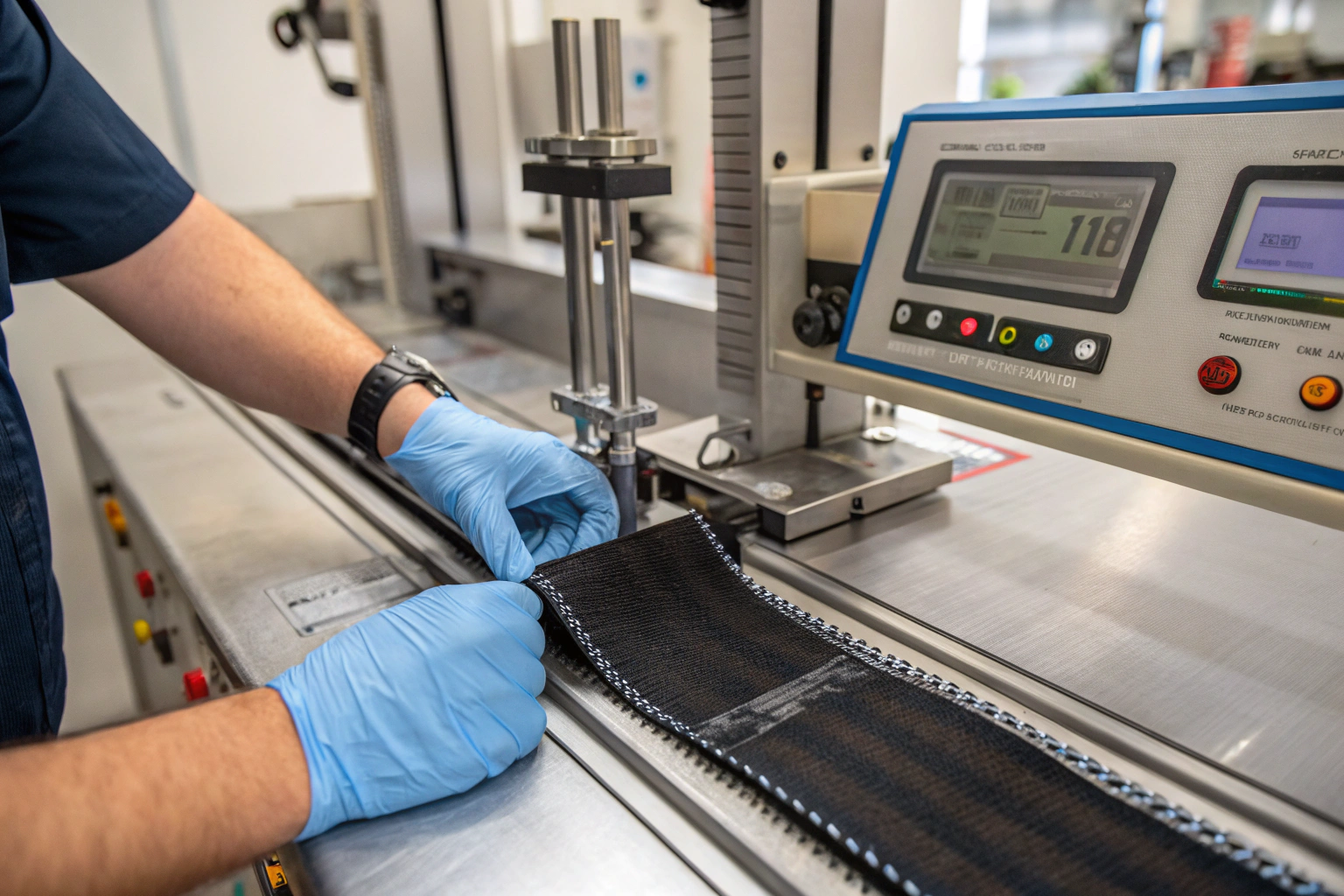
There is also the issue of multi-axial stress. A standard tensile tester pulls in one direction: straight down. But your knee does not just stretch fabric lengthwise; it stretches it across multiple axes simultaneously. This is why we built a custom dome-and-ball test rig. We clamp the fabric over a circular opening and push a smooth steel hemisphere through it, stretching the fabric in 360 degrees. Then we hold it there for 60 minutes at body temperature. After release, we trace the outline of the residual bagging shape with a 3D scanner. That tells you exactly how the knee of the pants will look after a long car ride. A standard uniaxial test cannot give you that data.
How Does the 60-Second Hold Test Expose False Recovery Claims in the Market?
Some mills love to quote a "98% recovery" figure. When we audit those claims, we almost always find they are using a "zero-second hold" method. They stretch the fabric to the target elongation, release it immediately, and measure what snaps back within 5 seconds. This is a theatrical test. It looks impressive on a trade show table demo, but it is worthless for practical garment engineering.
Our baseline starts where their test ends. We do a 60-second hold at the target stretch, then measure the dimensional change exactly 60 seconds after release. This simple shift in timing exposes huge differences in spandex quality. Cheap spandex from unqualified producers uses polyester-based polyurethane rather than polyether-based polyurethane. Polyether spandex has better hydrolytic stability and recovery under sustained loads. A cheap spandex might show 97% instant recovery but drop to 82% under a 60-second hold test. The better material holds steady at 94%. The gap between those two numbers is the gap between a premium activewear brand and a discount store brand.
I tell my buyers to ask a single question when a supplier quotes a recovery number: "What was the hold time and the recovery time?" If the supplier cannot answer that immediately, the number is just marketing fluff. We stamp both the test method and the time parameters directly onto our inspection reports. It forces accountability.
| Test Method | Hold Time | Recovery Time | Temperature | Real-World Failure Mode Detected |
|---|---|---|---|---|
| Instant Snap-back | 0 seconds | 5 seconds | Room Temp | None (marketing only) |
| ASTM D4964 (Standard) | 30 minutes | 60 seconds | Room Temp | Woven fabric shape loss |
| Body Temp Creep | 120 minutes | 30 minutes | 35°C | Knit knee bagging |
| Dome Burst Recovery | 60 minutes | 30 minutes | 35°C | 360° joint distortion |
Why Does a 5-Cycle Fatigue Test Reveal More Than a Single-Pull Elongation Test?
The first time you stretch a piece of fabric, you are not really testing the fabric’s true character. You are testing the yarn crimp and the initial alignment of the knit loops. Fabrics are lazy. When they come off a knitting machine, the loops are relaxed and wavy. The first pull just straightens them out. This is called the "decrimping phase," and it is a completely different physical process from the actual elastic stretching of the spandex core. If you only test the first pull, your data is contaminated by structural decrimping that will never happen again.
A true fatigue test cycles the fabric through its working stretch range multiple times to burn off this initial slack and to simulate the repeated stress of wearing. We use a 5-cycle test because the European standard EN 14704-1 suggests it for synthetic stretch fabrics, but we have found that 5 cycles give us an extra layer of predictive power that 3 cycles miss.

How Does Preconditioning Cycles Eliminate False Highs from Yarn Crimp Artifacts?
Think of yarn crimp as the factory’s natural slouch. When cotton yarn wraps around a spandex core, the spinning process introduces thousands of tiny zigzags. These zigzags act like small springs that absorb the first portion of any stretch. If you buy a pair of jeans and stretch them the first time you put them on, about 3% to 5% of that "stretch" is actually just you pulling those cotton fibers straight against the spandex core.
In our test protocol, we call the first cycle the "conditioning pull." We stretch to 80% of the fabric’s ultimate elongation, hold for 10 seconds, then return to zero at a slow, controlled speed. Then we wait 60 seconds. This first cycle almost always shows a permanent set of 2% to 4%, which alarms new buyers when they see it on a report. But this set is mostly structural rearrangement, not true spandex damage. The magic happens in cycles two through five. By cycle three, the crimp has stabilized. The loops have found their final resting geometry. Now, when we stretch the fabric for cycle four, we are measuring almost pure spandex performance and fiber-to-fiber friction stability.
The difference between cycle one and cycle three can be dramatic. For a heavily textured terry loop fabric, cycle one might show only 88% recovery. A novice would panic and reject the lot. Cycle three of that same fabric typically recovers to 94%. If the fabric is well-engineered, the delta between cycle three and cycle five is tiny—less than half a percentage point. If the delta is big, say a drop from 94% in cycle three to 90% in cycle five, that tells me the spandex filaments are beginning to micro-fracture. That fabric will fail after maybe 30 commercial launderings instead of 100. Our 5-cycle fabric stretch and recovery testing protocol catches this failure signature before a single garment is cut.
What Numbers Should You Actually Expect from a Fatigue Test for Workout Apparel?
I have a rule of thumb that I share with every activewear brand that walks through our door: "Five by Ninety-Five." For a fabric to survive in the gym-to-street market, it needs to hit at least 95% recovery by cycle five when stretched to 50% of its break elongation. That is a tough bar. Not many fabrics clear it.
Last summer, a Los Angeles startup came to us with a performance complaint. Their current leggings, made with a competitor’s generic nylon-spandex, were developing a shiny, transparent look at the rear after about two months of HIIT classes. Shine in a stretch knit means the fibers have been plastically deformed and are now reflecting light in a flat, scar-like plane. We tested their fabric on our fatigue rig. Cycle one? Beautiful 96% recovery. Cycle three? 91%. Cycle five? Dropped to 84%. That 12-point drop was the fingerprint of a failing inter-fiber bond. The nylon was delaminating from the spandex under stress.
We built them a new fabric using a higher-denier spandex core with a tighter draft ratio and a filament nylon with a trilobal cross-section that scatters light even when flattened. The fatigue test result: cycle one at 97%, cycle five at 95.5%. A drop of only 1.5 percentage points. I told them, "These leggings will wear out of style before they wear out physically." They launched with confidence six months later and the return rate dropped from 7% to under 1%. For any technical knit, if your recovery drops below 90% by cycle five, you are building a ticking time bomb into your brand reputation. For woven blends, the tolerance is a bit wider; 88% to 92% is acceptable for casual menswear chinos because the interlacement of warp and weft mechanically locks the structure even when the elastic is tired. But for a seamless knit legging, do not accept less than 93%.
| Apparel Category | Target 5-Cycle Recovery | Acceptable Set % | Critical Failure Indicator |
|---|---|---|---|
| Seamless Leggings | > 94% | < 6% | Delta > 4% between cycle 3 and 5 |
| Woven Skinny Jeans | > 88% | < 12% | Creep > 8% after 2-hour hold |
| Swimwear Jersey | > 92% | < 8% | Recovery drop after chlorinated water test |
| Compression Sportswear | > 96% | < 4% | Localized thinning (sheer spots) |
Can You Really Simulate 12 Months of Wear in Just 60 Minutes of Lab Testing?
Fast fashion gave us a terrible habit of testing for "arrival quality" instead of "lifecycle quality." A fabric leaves our warehouse looking flawless. The brand’s incoming QC inspects it, gives an A grade, and everyone celebrates. Then the garments hit the market, and six months later, the complaints start rolling in: collars are wavy, cuffs are loose, the recovery is gone.
You cannot wait 12 months for a real-world wear test before you ship. You need to collapse time. We do this by combining four degradation vectors into one accelerated protocol: mechanical fatigue, heat, moisture, and chemical attack from detergents. We call it the "60-Minute Lifecycle Compression Test." It does not replace a full year-long wear trial, but it predicts failure modes with frightening accuracy.

How Does the Combination of Wet-Temperature Cycling Stress Mirror Laundry Damage?
Washing machines are torture chambers for spandex. They drown the fabric in hot water loaded with alkaline detergents, then bake it in a hot air drum. This wet-dry cycling is far more destructive than any stretching a human body can do.
Here is the exact sequence we run in our lab for a laundry simulation test. We cut a specimen and mount it in a programmable environmental chamber. The machine wets the fabric to 100% moisture pickup with a 0.5% detergent solution heated to 40°C. While wet, the machine stretches the fabric to 35% extension and holds it for 15 minutes. This simulates the heavy, water-logged stretching that happens in a spin cycle. Then, while still under tension, the chamber blows 70°C hot air through the fabric until it is bone dry. That is one cycle. We run five consecutive cycles without removing the specimen from the clamps. By the third wetting, the spandex core has absorbed water molecules. Polyether-based spandex resists this; polyester-based spandex starts to hydrolyze. You can literally see the difference in the test data. The force required to stretch the fabric to 35% drops as the cycles progress, a phenomenon we call "stress decay."
For a swimwear client, we add chlorine to the wetting solution, maintaining a 5 ppm concentration of available chlorine to replicate 120 hours of pool exposure. You can read more about the chemical mechanisms behind this in a detailed breakdown of how chlorine exposure degrades the elastic properties of spandex in swimwear. A standard spandex loses about 30% of its retractive force after this chlorine cycle test. The special chlorine-resistant spandex we source loses only 8%. That 22-point gap is everything for a swim brand that sells in resort markets where customers live in their swimsuits for weeks.
Is the 22-Hour Static Extension Test with UV Exposure Overkill for Denim?
For heavy rigid denim with 2% spandex, the failure mode is different from a knit. It is not about repetitive cycling as much as it is about sustained static load combined with ultraviolet light. Think of a pair of jeans worn on a long summer motorcycle ride. The rider sits for hours, the denim behind the knee stretches and stays stretched, and the sun beats down on the fabric.
We simulate this with a brutal 22-hour test. A denim specimen is stretched to 30% elongation and clamped in a frame. That frame is placed inside a QUV accelerated weathering chamber with UVA-340 lamps that mimic the short-wave UV of natural sunlight. The chamber cycles between 4 hours of UV exposure at 60°C and 4 hours of condensation in darkness at 50°C. After 22 hours, we release the fabric and measure the residual growth. A good denim will show no more than 3% growth. Anything above 5% means the jeans will develop a permanent baggy knee after one season of wear.
I used to think this test was too aggressive until a client from Texas proved me right. He rode horses for a living and wore our denim. He sent me a pair after a year. The color was beautifully faded, but the fabric behind the knees was actually thinner, having lost about 15% of its weight due to fiber abrasion and UV degradation. We cross-sectioned the spandex under a microscope. The outer layer of the filament was cracked like dry earth. Our standard 22-hour test had predicted this exact failure pattern. A detailed study on the effects of UV degradation on textile polymers used in outdoor applications explains exactly why this happens. Since then, we have added a UV stabilizer package to our outdoor denim blends. The latest version passes the 22-hour test with less than 1.5% growth. That is overkill for a desk-job jean, but exactly what you need for a working cowhand.
What Hidden Fabric Failures Does Fumao’s "Creep Under Constant Load" Test Expose?
Not all stretch failures announce themselves with a bang. Some whisper. The "Creep Under Constant Load" test is how we hear the whispers. This test does not cycle back and forth. It just pulls and waits. And watches.
We take a specimen, apply a dead weight that generates a specific force—usually 4 Newtons per centimeter of fabric width—and then we just leave it there for up to 8 hours. A micrometer measures the slow, almost imperceptible elongation over time. Most fabrics stretch quickly in the first 30 seconds, then settle into a slower, steady creep rate. A healthy fabric’s creep curve flattens out. A failing fabric’s creep curve never flattens; it just keeps drifting, a silent alarm bell that the internal structure is slowly giving way. For a manufacturer of compression garments, this test is sacred. A compression sleeve that loses tension over 8 hours stops being a medical device and becomes just a tight sock.

How Does the 8-Hour Dwell Test Predict Waistband Rolling in Plus-Size Garments?
Waistband rolling is a plague. It is the number one complaint we hear from plus-size garment brands. A waistband stretches to fit the body, but hours later, it has permanently deformed into a longer, looser loop that flips over on itself.
The root cause is differential creep. The elastic inside the waistband creeps at a different rate than the shell fabric that encases it. To test this, we do not test the finished waistband elastic alone. We test the complete sandwich: shell fabric, fusible interlining, and elastic as a single specimen under a 4N load for 8 hours. The key measurement is the "recovery differential" after the 8-hour load is removed and the specimen rests for one hour. If the elastic tries to recover to 95% of its original length but the shell fabric only recovers to 90%, you have a 5-percentage-point mismatch. That mismatch generates shear forces that physically roll the waistband outward.
We solved a critical rolling issue for a German plus-size brand in 2022. Their jersey waistbands were rolling after three hours of seated desk work. We dissected their construction. The shell was a soft, low-recovery viscose jersey; the elastic was a high-recovery polyamide-spandex tape. The mismatch in creep behavior was huge. We replaced their elastic with a lower-tension, wider tape that matched the creep rate of the viscose shell. We also added a fine strip of silicone gripper tape printed on the inside face. The next batch scored a zero on the roll-over test, even after the full 8-hour dwell. The solution was not more power in the elastic; it was harmony between the layers.
Can a Simple 24-Hour "Overnight" Test Reduce Your Return Rate by 3%?
Here is a test you can do in your own office, tonight. Cut a 50cm strip of your candidate fabric. Pin it to a cork board with a 1kg weight clipped to the bottom. Measure the exact length of a marked 20cm section. Go home. Come back tomorrow. Remove the weight. Measure the marked section again after 10 minutes. If it has grown more than 4%, you have a problem that will trigger customer returns.
This home-test correlates with our lab data at a level that surprises most engineers. The permanent set after an overnight, unloaded recovery from a sustained load is the single most honest metric in stretch fabric testing. It strips away all the high-speed camera flash and data smoothing. It just asks, "Is the fabric longer now than it was yesterday?" We have a client in the UK who does this exact test on every incoming shipment. They pin the sample to a wall in their office with a labeled clothes peg. They call it the "Wall of Shame" if any sample grows beyond 5%. In three years of working with Shanghai Fumao, we have never had a sample join that wall.
For our internal protocol, we extend this to 24 hours under load with a controlled 5N force for extra rigor. We measure the creep at the 1-hour, 4-hour, 8-hour, and 24-hour marks and plot a curve. If the curve is still rising at hour 24 without a plateau, the fabric batch fails, no exceptions. This standard has helped us build long-term partnerships with brands whose reputations depend on dimensional stability. It is the kind of testing that never appears on a cheap Alibaba spec sheet because the seller hopes you will not know to ask for it. At Fumao, the 24-hour data is pre-populated on our technical data sheet before you even request it, because we believe that full transparency about how to verify the long-term elastic recovery of stretch fabrics is not a risk; it is our strongest selling point.
Conclusion
The truth is, testing spandex recovery is not about passing an inspection. It is about predicting disappointment and preventing it. The difference between a 98% recovery claim on a marketing card and a 94% verified recovery after five cycles on our fatigue rig is the distance between a happy repeat customer and a one-star review. You do not need to be a textile engineer to tell the difference between good stretch and bad stretch. But you do need a testing partner who refuses to hide behind the industry’s easy, 30-second, zero-hold shortcuts.
At Shanghai Fumao, we have built a stretch testing program that mirrors actual human life. We simulate the heat of the body, the wet torture of the washing machine, the brutal UV of the sun, and the endless patience of a 24-hour dead-weight creep test. We look for the failures that only show up on month six, because we know that your brand promise extends far beyond the factory gate. We are protecting your promise.
If you are developing a stretch product line—whether it is high-compression activewear, body-positive denim, or chlorine-proof swimwear—do not guess on the recovery. Let us send you our complete stretch recovery technical pack with the raw test data curves for any blend you are considering. You can reach our Business Director, Elaine, directly at elaine@fumaoclothing.com to request physical hand-feel swatches along with their corresponding 5-cycle fatigue and 24-hour creep reports. Once you see the data curves, you will never trust a single-number recovery claim again. We look forward to putting our fabric to your toughest test.