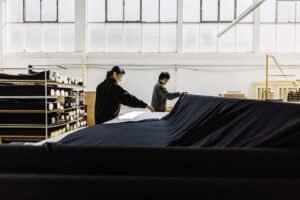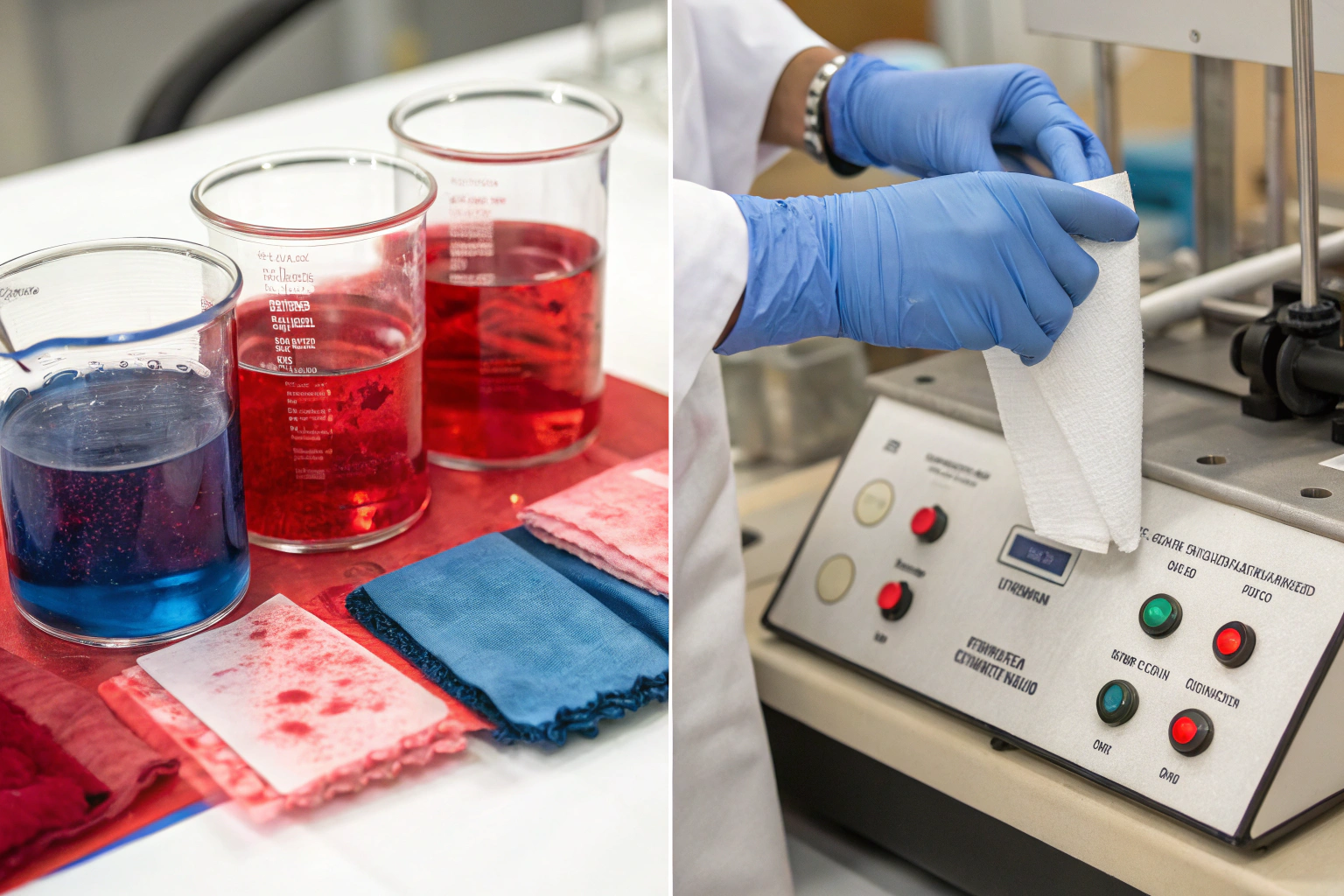
You just approved a rich, deep navy modal jersey for your autumn capsule collection. The lab dip was gorgeous. The bulk production lands at your warehouse in Los Angeles. You cut it, sew it into a beautiful wrap dress, and ship it to your stockists. A week later, the first customer review drops: "Wore it with a white leather handbag. The bag is now blue. The dress looks ruined." Your stomach drops. You paid for that "high-quality" dye. But you didn’t specifically ask for a wet crock test report. Now, you are staring at $20,000 worth of un-sellable inventory.
Color fastness is not about whether the fabric fades in the sun over five years. It is about immediate, catastrophic bleeding in the first washing machine cycle or in the rain. At Shanghai Fumao, we don’t guess on fastness; we measure it with a spectrophotometer and a Crockmeter. If a fabric cannot hit a Grade 4 on the Grey Scale for staining, it never gets loaded into a container.
I want to walk you through exactly how we perform these tests in our CNAS-certified lab, what the different scales mean, and how you can protect your own orders by asking for the right reports. Because a dye that can’t hold on isn’t a design feature—it’s a defect that turns a premium garment into a cleaning bill liability. Let’s get into the science of making sure the color stays on the fabric, and not on your customer’s skin.
How Do You Perform a Crocking Test for Knits?
Crocking is the transfer of dye from a dry or wet fabric onto another surface through friction. You know that phenomenon where your dark denim leaves a blue tint on your car seat? That is crocking. For woven denims, a little bit of this dry rub-off is tolerated, even marketed as "authentic." But for fashion knits, especially viscose and modal blends? Crocking is a flat-out failure. It signals that the dye molecules did not properly bond with the cellulose core.
I remember a tricky situation in July 2023 with a German sleepwear brand. They ordered a deep burgundy modal-elastane slub knit from us. The lab-scale samples passed dry crocking easily, hitting the top Grade 5. But the bulk production failed the wet crocking test miserably—the rubbing cloth came back looking like a crime scene. The culprit? The slub yarns (those uneven, bumpy thick-and-thin yarns) had created microscopic pools of unfixed dye inside the slub grooves during the dyeing cycle. Our fix was immediate: we introduced a double soaping process in the post-dye wash, using an anionic soaping agent at 90°C for 20 minutes. That flushed out the hydrolyzed dyes hiding in those grooves. The bulk was re-processed and passed with a wet crocking Grade 4.
What Is the Standard Method for AATCC Crocking Tests?
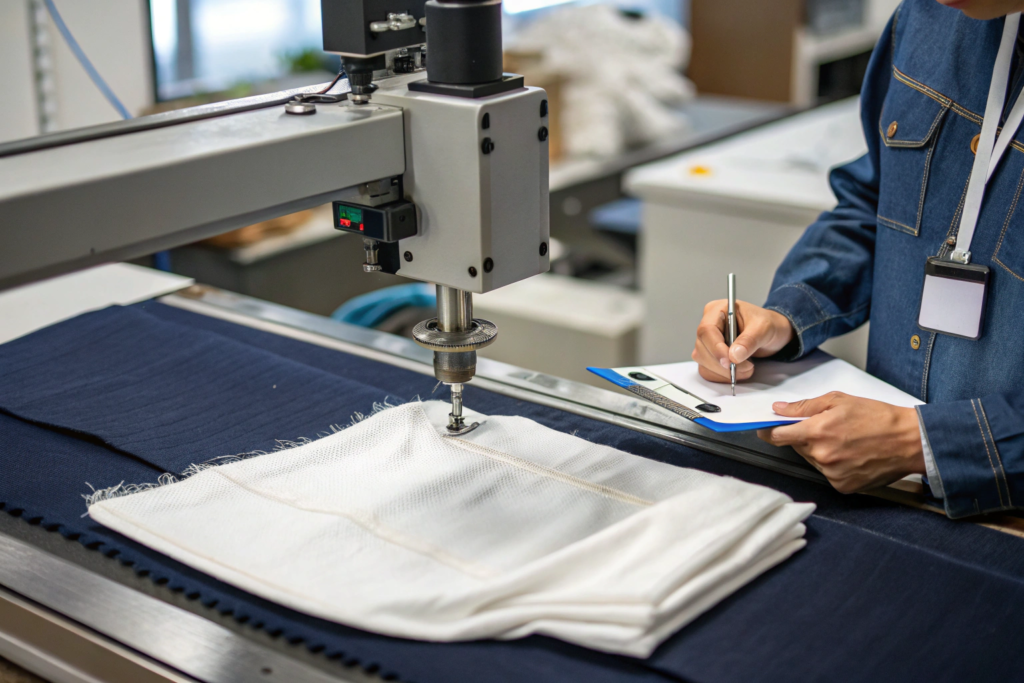
When you look at a test report from a lab like ours, the method matters. We use two main standards: AATCC 8 (Textiles—Colorfastness to Crocking) and AATCC 116 (Rotary Vertical Crocking). The straight-line Crockmeter rubs a finger back and forth 10 times on the fabric. The Rotary method spins a finger against the fabric. You might think, "What is the difference? It’s just rubbing."
The difference is everything for textured knits. A flat jersey gives you a clean flat surface for the straight-line Crockmeter. But a rib knit or a jacquard knit has peaks and valleys. A straight-line stroke just skims the peaks, giving you a falsely high passing grade. The rotary method digs into the texture. At Shanghai Fumao, if a knit has a depth texture greater than 1mm, we automatically run the AATCC 116 Rotary Crocking instead. We learned that lesson the hard way with a French terry jogger set that passed linear crocking but failed rotary at the customer’s overseas lab.
Here’s the real-talk pressure chart we use:
| Crocking Test Type | Applicable Fabric | Fumao Passing Standard (Dry/Wet) |
|---|---|---|
| AATCC 8 (Linear) | Flat weaves, fine jersey, satin | Min 4.5 / Min 3.5 |
| AATCC 116 (Rotary) | Ribs, slubs, pile fabrics, loops, terry | Min 4.0 / Min 3.0 |
| BS EN ISO 105-X12 | EU standard export baseline | Min 4-5 / Min 3-4 |
Why Do Wet Crocking Failures Happen More Than Dry Failures?
Water acts as a lubricant and a swelling agent. When that water hits the fabric, the fiber swells up like a sponge, opening up the polymer structure of the cellulose. This swells the "pores" of the fiber. If the dye molecule is not fully locked inside the amorphous region of the fiber via covalent bonds (in the case of reactive dyes), the water floats the loose dye right out.
That’s where the "unfixed dye percentage" comes in. In our lab, we don’t just rub the fabric; we boil a sample in water for 5 minutes and measure the optical density of the residual water with a UV-Vis spectrophotometer. If the transparency of the water drops below 90% light transmittance, there’s too much floating dye in the mix. We then tweak the recipe by increasing the sodium carbonate concentration in the dyebath or extending the steaming time by 15 minutes. (Here is an inside tip for buying dark modal: always ask for the unfixed dye washing ratio in reactive dyeing processes. If they don’t know the number, they aren’t testing it.)
What Is the Grey Scale Rating for Fabric Fading?
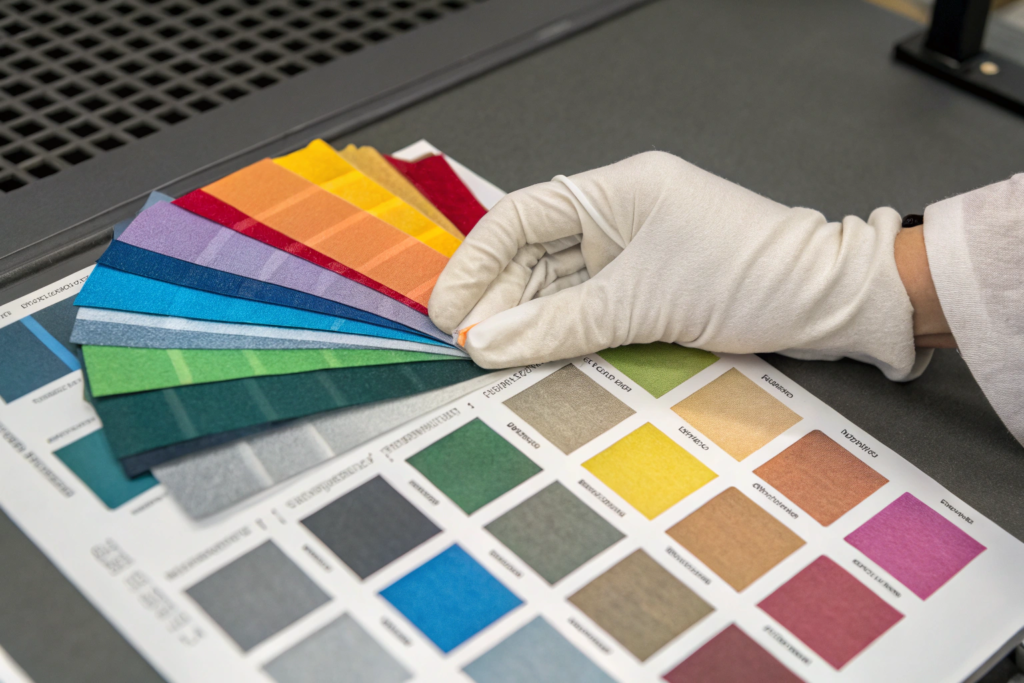
The Grey Scale is the universal language of color staining. It doesn’t measure "how much red" is gone; it measures the visual contrast between a treated specimen and an untreated original. There are two scales: the Grey Scale for Color Change (fading of the original fabric) and the Grey Scale for Staining (color transfer onto an adjacent white fabric). I’ve seen too many buyers confuse the two. "You said it was a 4, but it’s bleeding!" That happens because they were looking at the wrong chart.
We assess everything under a D65 daylight simulator lamp. This is critical. If you look at a stain under the warm yellow incandescent lights of a regular office, you might miss that yellow tint on a white multifiber strip. The D65 lamp mimics noon daylight, revealing the actual contrast. It’s like putting your car’s paint job under the gas station lights—flaws appear instantly. A Japanese streetwear client came to us in March 2024 specifically because our D65 cabin was calibrated to within 100 lux of the industry standard, and their previous supplier was just eyeing it in a warehouse.
How Does ISO 105-A03 Differ from AATCC Evaluation Procedures?
This sounds like academic nitpicking, but it saves money. The ISO grey scale is a range from 1 (worst) to 5 (best). The AATCC scale follows the same range. But the human visual perception steps between the grades are aligned differently in the physical scales provided by the standards bodies. An ISO Grade 4 card often has a slightly wider perceived visual tolerance than an AATCC Grade 4 card for staining. (Don’t quote me literally on the tolerance range metric, but in our inter-lab correlation tests, we’ve found that an ISO Grade 4 stain assessment correlates to about a 3.5 in the AATCC scale for some intense reds when scanned spectrophotometrically.)
This creates a problem for brands that use both EU and US retail channels. I always make sure the multi-fiber adjacent fabric used in the test matches the market. For ISO, we use DW multifiber (acetate, cotton, polyamide, polyester, acrylic, wool). For AATCC, we use the popular No. 10 multifiber, which also contains nylon and silk. The staining on secondary acetate is often the first to fail because acetate is shockingly easy to stain.
Here is a quick cheat sheet for picking the right adjacent fabric:
| Standard | Multifiber Type | Key Feature |
|---|---|---|
| ISO 105-F10 | DW Multi-fiber Strip | Includes acetate and wool |
| AATCC No. 10 | Multi-fiber Fabric | Includes nylon and silk, different absorption |
| AATCC No. 1 | Cotton Adjacent Only | Basic test, often misses synthetic staining issues |
Can I Use a Spectrophotometer to Skip the Grey Scale?
Vision is subjective. An old man’s cataracts can see a Grade 3 as a 4. Machines don’t have cataracts. We use a Datacolor spectrophotometer to assign a Delta E (CMC) value to the difference between the original and the washed sample. A Delta E value of less than 1.0 is invisible; a value above 4.0 usually corresponds to a Grey Scale rating of 3 or below.
But machines are stupid in other ways. If a piece of lint sticks to the specimen during the scan, the machine reports a massive color change that doesn’t exist. The human eye ignores the lint, but the spectrophotometer doesn’t. That’s why we never rely purely on the digital readout. We always pair the Delta E reading with a "visual pass" by a panel of three trained colorists. We call it the "Machine-Yes, Eyes-Yes" rule. This is particularly true for assessing fastness on brushed velvet and pile weave textiles. The directional pile creates shadows that trick the sensor, but not the human brain.
Why Does Reactive Dye Fastness Vary by Fiber Type?
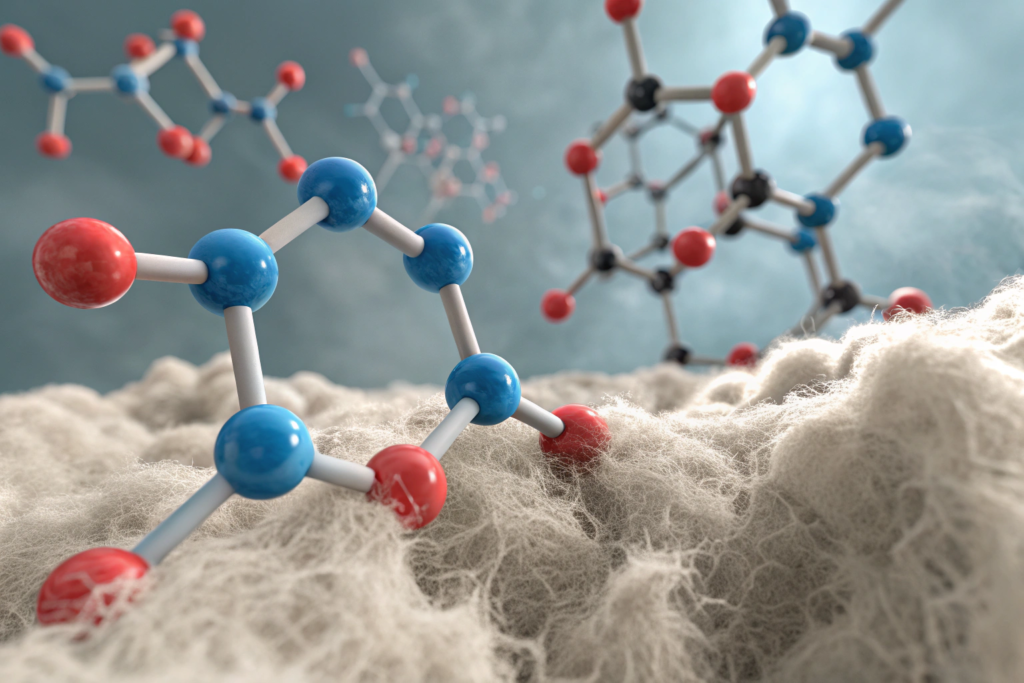
"Dye" is not paint. Paint sits on top of the fabric and hardens. Dye penetrates the fiber cell walls and chemically reacts, or physically settles, inside the polymer matrix. You cannot use the same dye class on cotton that you do on polyester. If you try, you get zero fastness. If a buyer asks me, "Why did the nylon panel in my multifiber test turn bright red during the wash test but the cotton didn’t?", the answer is hidden in the fiber’s chemistry.
This brings me to an instructive failure in early 2024. A Canadian activewear brand sent us a competitor’s fabric to reverse engineer—a heather grey marled look, 70% Cotton / 30% Polyester. The competitor’s sample bled like a slaughtered pig in warm water. Under our microscope, we saw the cotton was dyed with a standard reactive, which was fine, but the polyester portion was stained during the batch dyeing process via exhaust. The polyester wasn’t dyed—it was just soiled with cotton dye that wasn’t cleaned off. A cheap shortcut. We developed a "two-bath, two-stage" dyeing process: first disperse dye the polyester under pressure at 130°C, then reduction clear it to scrub the unfixed dye, then reactive dye the cotton in a separate alkaline bath. The final fastness to water was a perfect 5.0.
Why Is Polyester So Tricky for Wet Fastness?
Polyester is a thermoplastic, meaning it’s a hydrophobic plastic (like a polyester drink bottle). You can’t just mix it with water-soluble dye. You have to use disperse dyes—tiny insoluble color particles ground up into a fine powder and suspended in water. When you heat polyester to 130°C, the polymer chains vibrate so much that they create temporary gaps. The disperse dye particles slide into those gaps. When the fiber cools, the gaps snap shut, trapping the dye mechanically.
But here is the rub: if the "reduction clearing" after dyeing isn’t perfect, loose dye particles remain stuck to the fiber surface like dust. You can’t see them, but the Crockmeter finds them instantly. In our Keqiao dye house partnership, we perform an alkaline reduction clearing using sodium hydrosulfite and caustic soda. I am obsessive about the concentration there. If the sodium hydrosulfite is weak on a black shade, the rubbing cloth comes back grey. We literally test the reduction potential (REDOX) of the clearing bath with a meter to ensure it has enough reducing power to strip those surface particles. Don’t just rely on a time chart; a reduction clearing chemical concentration for disperse dyes changes if the water hardness changes. Chemistry is dynamic.
What Makes Reactive Dyes Stick Permanently to Cellulose?
Imagine a ladder (the cellulose polymer). A reactive dye molecule carries a "hook" (a reactive group, like a vinyl sulfone or a monochlorotriazine). When you apply alkali (soda ash), the hook activates and snaps onto a rung of the ladder, forming a covalent bond. It literally becomes part of the fiber molecule.
That is why a properly fixed reactive dye cannot be washed out—you would have to destroy the fiber molecule itself. But there is a villain in this story—water. The moment you mix the reactive dye with water, it tries to bond with the water molecules (hydrolysis) rather than the fabric. This "hydrolyzed dye" is a ghost. It looks like it colored the fabric, but it’s just physical entanglement. It rinses out forever.
To minimize this, at Shanghai Fumao we control the liquor ratio in the dye bath to be low (around 1:5 or 1:6 for knits). Less water means the dye is physically forced closer to the fiber, increasing the odds of the covalent bond happening before hydrolysis kills the dye. We also use a controlled hot-drop dosing system. The alkali is not dumped in all at once; it is dosed linearly over 40 minutes. This prevents a sudden spike in pH that "shocks" the dye and causes it to rush onto the fiber unevenly, leading to a high-surface-fixation-only level. We want penetration, not just a surface ring.
How Do We Test Fumao Wash Fastness for Global Brands?
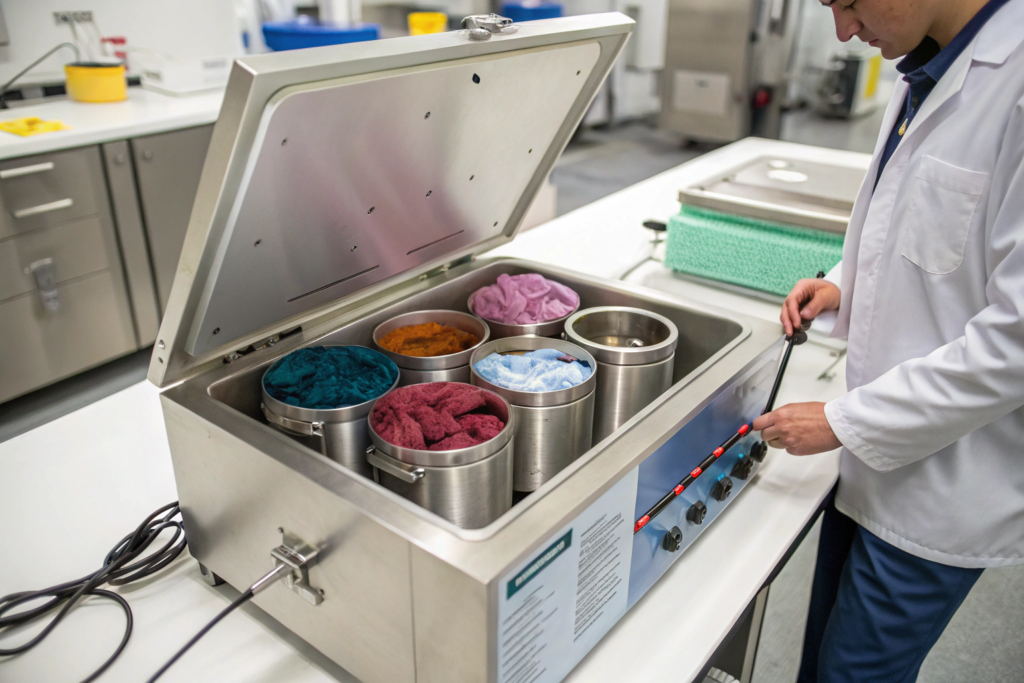
If crocking tests simulate dry friction, wash fastness tests simulate a domestic washing machine in a controlled nightmare scenario. You are putting your emerald green sweater in a steel pot with detergent, a bunch of white nylon and wool strips, and a dozen stainless steel balls, then tumbling it at 40°C. If the green stain on the white nylon is still acceptable after that, the fabric is a winner.
We test to ISO 105 C06, which is the fortress of wash fastness testing. It doesn’t just tell us if the garment survives a gentle hand-wash; it predicts cross-staining in the laundry basket. A client from Italy, who produces silk-blend luxury knit tops, was horrified to find that a competitor’s "Forest Green" color was staining the white silk chiffon trims even in a dry-cleaning cycle. They came to us because we had previously demonstrated a Grade 4-5 rating for that color on the Perchloroethylene solvent test (ISO 105-D01). We managed a full 50,000-meter order with zero staining complaints by swapping the standard black reactive dye with a high-wash-fastance polyfunctional reactive dye that forms multiple cross-links.
How Do We Conduct a Standard ISO 105 C06 Wash Test?
The procedure is strict. Size 4 samples are cut and sandwiched between the specified multi-fiber strips, with the face side of the fabric rubbing directly against the "witness" white fabrics. They are stitched together on all four sides to ensure intimate contact is maintained during the tumbling chaos inside the steel canister.
We add 150ml of water at 40°C, standard ECE reference detergent without optical brighteners, and 25 steel balls. The canisters lock into the Launder-Ometer rotor and spin for 30 to 45 minutes depending on the severity of the test. When the cycle ends, we don’t air-dry the multifiber strips immediately by just hanging them. We dry them in an "air-flow" oven with the fabric and the multi-fiber strip separated by a wire mesh to prevent any "contact bleed" during the drying phase. It sounds minor, but if you let a wet red stain and a white wool strip touch while drying, you get a falsely poor result. We must separate the variables. Following a strict ISO 105 C06 standard operating procedure for testing labs is the only way to ensure that a Grade 4 result in China is identical to a Grade 4 result in a London lab.
What Cross-Staining Issues Are Common in Nylon Trims?
This is the weak link. 90% of our major wash fastness failures don’t occur on the main fabric; they occur on the seam thread, the zip tape, or the lace trim. Especially nylon. Nylon has a weird affinity for acid dyes and even some loose reactive dyes. It’s like a dye magnet. If you have a white nylon zipper on a red dress, and you only test the red fabric fastness, you are missing the actual failure point.
In our new product development phase for a UK high-street retailer in October 2024, we introduced the "Full Trim Assembly Wash." We don’t just wash a piece of fabric; we cut a swatch, sew the exact zipper, the exact elastic, and the exact polyester sewing thread onto it, and wash the whole assembly. This found that their selected natural wood-effect button was leaching a brownish tint into the water at 40°C, which then stained the white background fabric. The lab isolated the button as the culprit, saving them a global product recall. We always recommend reading up on how nylon trim staining impacts garment wash fastness test results before finalizing your trim sourcing.
Conclusion
Color fastness testing is a genuine stress test. It puts a fabric through a controlled beating to see if it bleeds, fades, or stains. We have walked through the mechanical rub of crocking, the chemistry of reactive dyes bonding to fibers, and the chaotic tumbling of the wash fastness canisters. Every stage is a filter that separates a long-lasting garment from a one-time wear disaster. If you ignore the Grey Scale rating or the specific fiber chemistry of your blend, you are essentially gambling with your production budget.
These tests are not bureaucratic tick-boxes for customs clearance; they are the life insurance for your brand. A failed wash test in our lab is a small delay and a re-processing cost. A failed wash test in a customer’s washing machine is a chargeback and a social media crisis. We would much rather take the call about a Grade 2 result during pre-production than a Grade 2 lawsuit after delivery.
If you are working on a new blend or a vibrant, tricky shade like emerald, burgundy, or deep black, I want you to have the data before you commit. At Shanghai Fumao, we don’t hide from difficult colors; we just engineer the chemistry to handle them. Send your color standards and fiber specs to our Business Director, Elaine, at elaine@fumaofabric.com. She can arrange an immediate dry and wet crocking pre-screening on your lab dips before we even schedule the bulk lot. Let’s make sure that the color that sells the garment is the color that stays on it.