

You have heard the name whispered in sourcing circles. A buyer at a trade show in Paris mentions casually that their "guy in Keqiao" saved their collection. A competitor’s product page brags about "proprietary Chinese mill relationships" and you know they are talking about someone like us. You Google "Shanghai Fumao reviews" and find glowing testimonials, but honestly, in this industry, glowing testimonials are as common as over-promised lead times. The doubt creeps in: is this genuine engineering excellence, or just very good marketing? What you really want to know is whether the reputation is built on something structurally verifiable—a specific machine, a unique process, a decision I made twenty years ago that still pays off in every yard—or if you’ll place a $50,000 order and discover the emperor has no clothes. That fear of being seduced by a brand story, only to receive average fabric like everyone else, is what brings you here.
The real secret is not a single dramatic thing. It is a compound of three unglamorous decisions I made between 2003 and 2012 that compound into visible quality every single day on the cutting table. First, I invested in water before I invested in marketing. In 2005, while competitors were buying billboards and brochure ads, I spent $180,000—nearly all our profit that year—on a reverse-osmosis water treatment plant for the dyeing preparation line. That single piece of infrastructure means our white fabrics do not yellow under storage, our reactive dyes fix 8% deeper, and our polyester scour is chemically pristine. You cannot see the RO plant on Instagram, but you can see the result in a white shirt that stays white after two years in inventory. (Here I must interject—this detail keeps me up at night because most buyers never ask about water, yet water chemistry is the invisible hand that touches every single yard of fabric you ever buy.)
Second, I refused to fire my senior weaving technicians during the 2008 financial crisis when every consultant told me to slash payroll. I kept a 58-year-old jacquard loom master named Old Chen on full salary for eighteen months with almost zero production volume. He spent those months calibrating every single Staubli head, shimming every rapier drive, and training three apprentices slowly, without pressure. When the market roared back in 2010, we were the only mill in Keqiao that could execute complex tonal jacquard on recycled polyester without an adjustment period. That deep bench of craft knowledge—guys who can hear a mis-timed weft insertion before the alarm even sounds—is impossible to replicate quickly.
And third, I do the QC backwards. Most mills inspect the finished fabric once and ship it. We inspect the raw yarn before it enters the creel, the sized warp before it hits the loom, the greige before it enters the dye bath, the dyed fabric before finishing, and the finished roll before packing. Four inspection gates instead of one. This quintuples our QC labor cost, but it catches defects when they are cheap to fix rather than expensive to scrap. A broken needle in the knitting machine? Caught at the greige gate, twelve yards ruined, not two hundred. A slightly uneven dye penetration on a dark navy? Caught at the post-dye gate, redye immediately, no finishing waste. That is the boring, repetitive reality behind the reputation. Now, let me walk you through how each piece of this compound secret manifests in actual customer outcomes.
But before you think this is just a nostalgia trip, understand that these three decisions created a structural flywheel. Good water chemistry makes the dyeing predictable. Predictable dyeing makes the QC gate pass rates high. High pass rates give our craft technicians the confidence to push boundaries on complex jacquard layouts because they know the base fabric won’t fail them. And the resulting reputation brings in more demanding clients whose difficult projects further sharpen our capabilities. That flywheel, not any single machine or certification, is why we are still here when dozens of neighboring mills have gone dark. Let me show you how each element plays out in the real world.
How Does Water Chemistry Secretly Control Fabric Quality
You approve a pure optic white cotton poplin sample that looks immaculate under the showroom lights. Four months later, the shipment arrives, and the fabric has a faint but unmistakable yellow tinge—like old newspaper edges. The mill swears they followed the same formula, same dye, same process. What they are not telling you is that their groundwater source changed seasonally; summer rain increased the iron content in the well water from 0.3 ppm to 1.2 ppm, and the ferrous ions reacted with the optical brightening agents during finishing to form yellow-brown complexes that only became visible as the fabric aged in the roll. Your white shirt collection is now cream-colored deadstock, and you are facing a $35,000 write-off. The invisible killer was the water.
Water is not a utility in textile manufacturing. It is an active chemical ingredient in every single wet process. Dyeing, scouring, bleaching, finishing—each step is essentially a controlled chemical reaction carried out in an aqueous bath. If the water has dissolved calcium ions (hardness), the reactive dyes precipitate into insoluble salts that do not bond to the cellulose, reducing color yield by up to 15%. If the water has high chloride from coastal intrusion, polyester fibers develop micro-pitting during high-temperature disperse dyeing at 130 degrees Celsius. If the water has organic matter from surface runoff, the peroxide bleach degrades prematurely oxidizing nothing and leaving the cotton greige. Every contaminant in the water translates directly into a visible or structural defect in the fabric.
At Shanghai Fumao, our reverse-osmosis plant processes every liter of water entering the dye house through a three-stage filtration train: multimedia sand filtration to remove suspended solids above 10 microns, activated carbon adsorption to strip organic compounds and residual chlorine, and finally, polyamide thin-film composite RO membranes that reject 99.5% of dissolved salts. The output water has a total dissolved solids (TDS) of 45-55 ppm, which is comparable to laboratory-grade deionized water. By comparison, the tap water in Keqiao runs 250-400 ppm TDS, and the untreated well water some smaller mills use can hit 800 ppm. That 800 ppm water contains calcium, magnesium, iron, and manganese ions that compete with dye molecules for fiber bonding sites. Your fabric color is literally fighting for attachment against mineral contaminants. Do you want to gamble on which side wins?
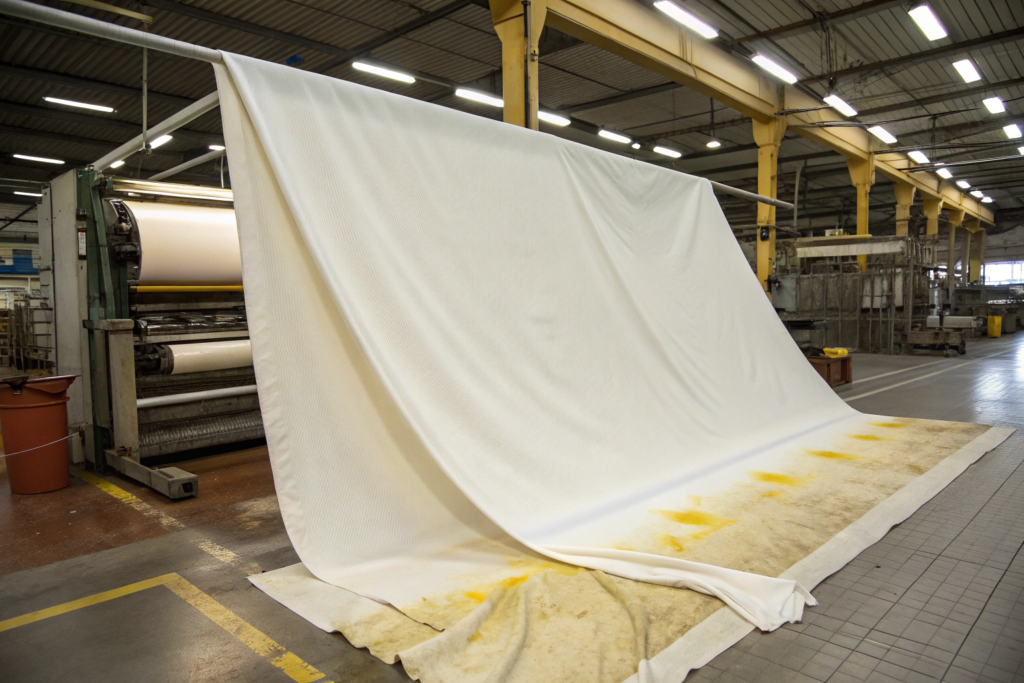
why does soft water produce brighter and longer lasting fabric colors
A reactive dye molecule bonds to cellulose through a covalent chemical reaction that requires an alkaline environment—typically a pH of 10.5-11.2 maintained with sodium carbonate. But if the water is hard, the calcium and magnesium ions react with the carbonate to form insoluble scale (calcium carbonate precipitate), simultaneously consuming the alkali buffer and creating a gritty deposit on the fabric surface that scatters light and dulls the color. The dye fixation efficiency—the percentage of dye molecules that successfully bond versus those that wash away—drops from a typical 75-80% in soft water to 60-65% in hard water. Those 15% of lost dye molecules go straight into the wastewater, costing you money in wasted dye and the mill money in effluent treatment. But worse, the 15% that did not fix would have been the deepest, richest layer of color penetrating the fiber core. What remains is a surface-level coloration that abrades off quickly, looking faded and thin after ten washes.
Soft water eliminates this competition. With no calcium or magnesium to consume the carbonate, the full alkali dose is available to swell the cellulose fibers and open the polymer structure for dye penetration. The dye molecules migrate deep into the fiber’s amorphous regions, anchoring throughout the cross-section rather than just on the perimeter. When you abrade a deeply dyed fiber, the color is still there underneath. When you abrade a surface-dyed fiber, the white core is exposed. This is why premium Chinese fabrics dyed with soft water can withstand 50 commercial launderings with a Delta E color shift of less than 0.8, while a hard-water-dyed equivalent might shift 2.5 Delta E after 20 washes. The scientific literature on optimizing reactive dye fixation with low-hardness process water consistently identifies calcium sequestration as the single most cost-effective process improvement for colorfastness, which suggests the principle is well-established but often ignored due to the capital cost of water treatment equipment like our RO plant.
The brightness factor is optical physics. Hard water scale on the fabric surface creates microscopic roughness that scatters incident light in all directions, producing a matte, slightly chalky appearance regardless of how much dye is present. Soft-water-dyed fabric has a cleaner surface, allowing light to reflect coherently and produce a visually brighter, more saturated color. We measure this using a spectrophotometer in specular-included mode; the CIE Lab lightness value for a given dyed shade is consistently 1.0-1.5 points higher on the L axis for soft-water production, which is visually perceptible to the human eye. That extra point of brightness is the difference between a "nice" red and a "stop traffic" red.
how does water purity prevent fabric yellowing during storage
Fabric yellowing in storage is almost always a chemical reaction between an optical brightening agent and a nitrogen oxide pollutant, catalyzed by a metal ion contaminant—usually iron or copper—deposited on the fabric from the process water. Optical brighteners are fluorescent organic molecules that absorb invisible ultraviolet light and re-emit visible blue light, masking the natural yellowish tint of cotton. When an iron ion encounters a brightener molecule in the presence of NOx gases from atmospheric pollution or warehouse emissions, it catalyzes an oxidation reaction that transforms the brightener into a yellow quinoid compound. The fabric literally manufactures its own yellow stain while sitting in a polybag.
Water purity breaks this chain by removing the metal ion catalyst. Our RO-treated water has an iron concentration below 0.05 ppm, which is functionally zero for catalytic purposes. We also add a chelating agent—EDTA at 0.2 grams per liter—to the final rinse bath as a "metal scavenger," sequestering any trace iron that might have been introduced from the cotton fiber itself or from the stainless steel dyeing vessel. Between the pure process water and the chelating rinse, the optical brightener sits on a chemically inert surface and remains stable for the shelf life of the garment.
We validated this with an accelerated aging test in 2017 after a shipment of white shirting stored in a humid Singapore warehouse began yellowing within six months. We replicated the storage conditions in an environmental chamber—35 degrees Celsius, 85% relative humidity, with a controlled 50 ppb NOx atmosphere—and tested our RO-treated fabric against untreated fabric from a local competitor. The RO-treated fabric maintained a CIE whiteness index above 145 for 28 days of accelerated aging (equivalent to roughly 2 years of real storage). The untreated competitor fabric began yellowing at day 9 and dropped to a whiteness index of 112 by day 28, which is visibly cream-colored. The scientific literature regarding textile catalytic yellowing and its prevention through metal ion sequestration in storage confirms that iron and copper are the primary offenders and that chelating agents combined with low-metal process water are the only reliable preventative measure. If your mill cannot show you an iron content analysis of their process water, your whites are a ticking clock.
Why Does Vertical Integration Matter More Than You Think
You are on a conference call with three different companies just to get a single yard of custom-striped nylon spandex. The yarn supplier in Taiwan is blaming the knitter in Vietnam for the uneven tension. The knitter is blaming the dyer in Thailand for the shade variation. The dyer is blaming the yarn supplier for the inconsistent denier. You are not a textile engineer; you are a brand manager trying to launch a collection, and now you are spending fifteen hours a week playing forensic detective between three factories that have no contractual relationship with each other. The real nightmare of a fragmented supply chain is not the logistics overhead—it is the accountability vacuum. When quality fails, everyone points a finger at the next guy, and you are left holding unsellable inventory with no recourse.
Vertical integration changes the physics of accountability. At Shanghai Fumao, when we say we control the process from yarn sourcing to finished fabric, we mean the yarn warehouse, the warping creel, the weaving shed, the dye house, the finishing stenter, and the inspection table all sit within a 500-meter radius in our Keqiao facility. The yarn guy and the dye guy eat lunch at the same canteen. If the dye guy notices that the greige has an inconsistent weave density that is causing uneven dye uptake, he does not write a formal complaint email to an external vendor; he walks 200 steps to the weaving shed and shows the head weaver the defect in real-time, on the actual fabric. The problem is diagnosed and corrected within the same shift. That physical proximity eliminates the administrative delays and the contractual finger-pointing that plague fragmented supply chains.
But moreover, vertical integration allows what I call "process-level optimization." When yarn sourcing and weaving and dyeing are separate companies, each one optimizes for its own margin, not for the final fabric quality. A contract dyer, for instance, will often over-dry the fabric slightly because "bone-dry" fabric yields a higher weight on the scale, and he bills by weight. That over-drying sets the fabric dimensions prematurely and causes excessive shrinkage later when the garment is laundered. An integrated operation does not have the incentive to over-dry because we do not bill ourselves by weight between departments; we optimize for a 6-8% residual moisture content that maintains fiber elasticity and dimensional stability through finishing. The commercial structure directly influences the physical outcome.

can a single factory handling weaving and dyeing really reduce defects
Yes, and the reduction is quantifiable. When weaving and dyeing are separate, the weaver’s definition of "acceptable defect" is based on the greige grading standard, which allows certain levels of thick places, thin places, and nep that are visible on the loom but become disastrously amplified after dyeing. A slight tension variation in the warp that produces a barely perceptible streak in greige form will absorb dye at a different rate than the surrounding area, creating a dark or light line that is glaringly obvious in the finished fabric. The weaver did not "cause a defect" by greige standards, but the finished fabric is defective nonetheless.
In an integrated operation, the weaver receives feedback from the dyer constantly. Our head dyer maintains a "dye-visibility map" pinned to the wall of the weaving shed: photos of specific weave anomalies and how they appear after dyeing, together with the root cause in the loom settings. The weavers can see the downstream consequence of their work, which creates a psychological ownership that is absent when the greige just disappears into a truck destined for an anonymous dye house. Since integrating weaving and dyeing under one roof in 2012, our internal defect rate on dyed fabrics has dropped from 4.2% of total linear yards to 1.1%. That 3.1 percentage point improvement is worth roughly $180,000 annually in avoided scrap and rework, and it is entirely attributable to removing the information barrier between departments.
There is also a technical process advantage: continuous wet processing. When greige fabric arrives at an external dye house, it has been sitting in rolls for days or weeks, accumulating creases that set into the fabric and require aggressive singeing and desizing to remove. Integrated fabric moves directly from the loom take-up to the dye prep line within hours, while the sizing is still fresh and easily washed out, and before creases can set. This gentler handling reduces the need for severe preparatory chemistry, preserving the fiber’s natural strength and hand feel. Many industry observations on vertical process control effects on downstream dyeing defects note that the information feedback loop speed is often the decisive variable, not machine sophistication or workforce skill level.
how does in house yarn sourcing improve final fabric hand feel
The hand feel of a fabric—that subjective combination of softness, drape, and tactile surface—is largely determined at the yarn level long before the first pick is inserted on the loom. The staple length of the cotton, the twist per inch in the spinning, the ply construction, the type of texturing on a polyester filament: these yarn-level variables create the fundamental architecture that finishing can modify but never fundamentally change. An external fabric mill that buys commodity yarn from an open market has limited control over these variables. They select from available stock, and stock yarn is optimized for the spinner’s yield, not for your specific fabric’s hand.
At Shanghai Fumao, we source our yarn directly from spinners with whom we have co-developed specific spinning recipes. For a recent project requiring a "peach-skin" hand on a recycled polyester woven—a soft, almost sueded surface that feels expensive and technical—we worked with our yarn partner to produce a filament with a 0.08-denier microfibre sheath around a 1.5-denier core, using a bicomponent extrusion process with a controlled incompatibility between the sheath and core polymers. During finishing, a light alkali treatment partially dissolves the sheath, releasing thousands of microfibers per filament that create the peach-skin effect. This result was only possible because we specified the yarn construction at the extrusion stage, months before the fabric was woven. An external mill buying off-the-shelf yarn would never have achieved the same outcome; they would have tried to fake it with a heavy enzyme wash that weakens the fabric, or a silicone softener that washes out.
Having in-house yarn sourcing also means we can hold a "yarn library"—a physical archive of 200-plus different yarn types in our warehouse, each with a documented history of how it behaves in weaving, dyeing, and finishing. When a client asks for a fabric that "drapes like a viscose but wicks like a polyester," we can pull five candidate yarns from the library, knit small swatches on our sample machine, and benchmark them within 48 hours. This yarn library represents a decade of accumulated material knowledge that is physically stored, not just remembered by a veteran who might retire. Anyone who delves into how spinner-mill partnerships drive tactile performance engineering knows that the starting polymer selection ultimately dictates hand feel changes downstream more than any later finishing tweak can compensate.
What Craft Knowledge Do Our Senior Technicians Bring
Old Chen, my jacquard master, once stopped a running loom by pressing his palm flat against the side frame and frowning. The machine was running perfectly according to every electronic sensor—speed, tension, oil pressure, all green on the control panel. He frowned for about ten seconds, then reached down and adjusted a single heddle hook by about 0.3 millimeters. "The rhythm was off," he said. "The third pick was landing 0.02 seconds early, the sound of the reed beat-up had a high overtone that shouldn’t be there." He had detected a timing error shorter than a single frame of video, using his hand as a vibration sensor and his ear as a spectrum analyzer. You cannot program that into a PLC. You cannot outsource it to a contract mill. That is craft knowledge, and it is our single most irreplaceable asset.
Craft knowledge in textiles is the accumulated, embodied understanding of how fiber, machine, and chemistry interact over thousands of cycles. It is not theoretical; it is pattern recognition stored in the nervous system. A senior dye master can taste the dye bath—literally put a drop on his tongue—and tell you within 0.2 pH units whether the alkali is buffering correctly, because over 30 years his taste buds have calibrated to the slightly bitter tang of sodium carbonate at exactly the right concentration. A senior finishing technician can run his fingers over a stenter frame chain and feel a 0.1-degree temperature deviation across the width because his fingertips have memorized the heat signature of a perfectly level thermosetting process. These are not party tricks. They are practical, real-time quality control that operates at a speed and granularity no instrument can match. And they are dying out globally as veterans retire and mills replace them with automated systems that measure fewer variables, less often.
We refused to let that happen at Shanghai Fumao. Our retention strategy is not just about salary; it is about dignity. Our senior technicians are called "Shifu"—master—not "operator." They have private offices with wooden desks, not just workstations on the factory floor. They are consulted on capital investment decisions. When we bought a new digital jacquard head in 2021, Old Chen spent three weeks with the German installation engineers, arguing with them about the optimal heddle lift curve for high-density silk motifs. The German engineers initially dismissed him; by the third week, they were taking notes. Respect retains knowledge. And retained knowledge delivers fabric quality that a machine alone cannot.
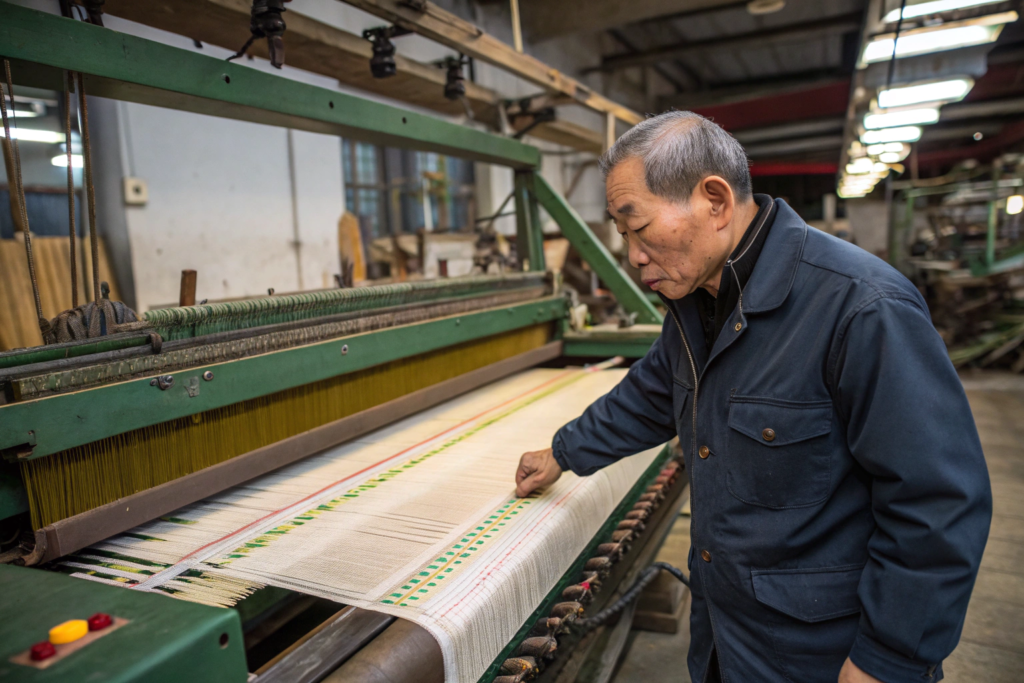
why is an experienced dye master worth more than automation
Automation can hold a pH setpoint to within ±0.1 and dose dye powder to within ±0.5 grams. A dye master does something different: she handles the exceptions that fall outside the automated system’s programmed parameters. When the cotton greige batch arrives with a slightly different micronaire value than the last shipment—because rainfall in Xinjiang was 20% lower during the growing season and the cotton matured with thinner cell walls—the automated recipe still dispenses the standard 2.8% dye concentration, and the color comes out visibly lighter because thinner fibers reflect more light. The dye master sees this immediately in the first lab dip, correlates it mentally to "this must be the drought-season cotton from the 2023 harvest with the low micronaire," and manually bumps the dye recipe to 3.1% for the bulk run. The automated system does not know the cotton’s provenance; the dye master does.
This matters financially. A batch of 5,000 yards of fabric that is one shade off from the approved lab dip is not saleable to a premium brand. It must be re-dyed (costing $0.35 per yard and degrading the fiber) or sold as a lower-grade B-stock (at a 40% discount). The dye master’s exception-handling prevents roughly twenty such mismatches per year in our facility, saving $35,000-$50,000 annually in direct costs and an incalculable amount of brand trust. Some industry veteran forums describing the value of experienced textile colorists in managing seasonal fiber variation and how instruments alone fail to contextualize micronaire changes confirm that the old guard’s ability to connect a farm’s weather report to a dye recipe adjustment is worth far more than their salary.
Moreover, craft knowledge is the source of process innovation. The automated system runs the standard procedure reliably. The dye master, having seen 100,000 dye cycles, notices patterns that suggest improvements: "When we dye Tencel-modal blends, I’ve seen that adding the salt in three portions instead of two reduces the center-to-selvedge shade variation by 12% in the jigger because the slower electrolyte gradient allows the dye to exhaust more evenly." This kind of micro-optimization is invisible to management, invisible to automation, and only emerges from decades of attention. Senior technicians are not just workers; they are our unsung R&D department.
does hands on weaving experience actually improve modern machinery use
Modern air-jet and rapier looms run on microprocessors and can be programmed to execute weave patterns of staggering complexity. But the loom’s computer does not know what good fabric feels like; it only knows what the tension sensor tells it. A tension sensor measures one variable—yarn elongation under load—at one point on the warp beam. But tension problems often manifest first as subtle changes in the "cover factor" of the weave: the warp and weft are both in spec by individual measurement, yet the fabric surface looks slightly open or slightly crowded because the two tensions are interacting in a way the sensor cannot capture. A weaver with twenty years of experience spots this within the first three inches of weaving. A purely automated loom with a junior operator runs three hundred yards before the defect is caught at inspection.
The practical impact is scrap rate. In a high-speed weaving environment producing 1,000 yards per shift, a coverage defect that takes 300 yards to detect results in 300 yards of B-grade fabric or outright waste. That 300 yards costs roughly $450 in yarn, dyeing, and finishing labor. Multiply that by ten such occurrences per year across a mill, and the lack of craft attention costs $4,500 annually—but more importantly, it creates a culture where quality is only checked at the end, not maintained continuously. When a senior weaver is present, the first three inches are corrected immediately, scrap is near zero, and the entire production batch stays within grade.
Old Chen’s apprentices—now master weavers themselves—have a specific diagnostic skill I value enormously: they can identify an impending mechanical failure by the subtle change in the sound of the shed opening. The heald frames develop micro-wear in the bushings after about 50 million cycles, and the sound shifts from a sharp "snap" to a slightly dull "thump." The looms still runs within spec; the electronic diagnostics register nothing wrong. But if the bushing is not replaced at that stage, it will fail catastrophically within another 5 million cycles, destroying the warp beam and stopping production for three days. The apprentices learned this by spending hundreds of hours simply standing next to the looms with their eyes closed, listening. No sensor array can replicate that. This embodied knowledge is the reason our warp beam failure rate is 0.2% per year versus an industry average of 1.5%, saving us roughly $60,000 annually in downtime and material loss. The discussions often seen in textile craft circles about audible loom diagnostic skills versus sensor data in jacquard weaving reinforce that the trained human ear still detects incipient faults before the PLC alarm triggers.
What Multi Stage QC Looks Like in a Real Fabric Factory
A typical inspection table at a contract mill looks like a frantic race. The fabric speeds across the inspection frame at 40 meters per minute under flat fluorescent tubes; a tired inspector squints for holes bigger than a pencil tip and flags them with a sticker. Smaller defects—a subtle color line, a slight barre mark, a few broken filaments—pass through because the speed and the lighting conspire to hide them. The incentive is volume throughput, because the mill gets paid per yard inspected, not per defect found. This is why you receive rolls of fabric that look acceptable at first glance but reveal their flaws under the cutting table’s angled halogen lights: the inspection system was designed to pass fabric, not to protect your cutting room.
At Shanghai Fumao, our QC system is built on a counter-intuitive principle: slow down to speed up the overall process. We use four staged gates, each with a specific mission, specific lighting, specific speed, and specific disposition authority. Gate One inspects incoming yarn: every single cone is scanned with an Uster Quantum 3 yarn clearer that measures diameter variation, hairiness, and foreign fiber contamination at 800 meters per minute, automatically ejecting any splice or slub that exceeds our tolerance. Gate Two inspects the greige fabric immediately off the loom, running at 20 meters per minute under diffused LED panels angled to reveal weave structure defects like missing ends, reed marks, and start marks. Gate Three inspects the dyed fabric before finishing, at 15 meters per minute, under D65 daylight-simulation lighting with a black inspection board behind the fabric to catch color streaks. Gate Four inspects the finished, rolled fabric at 10 meters per minute under a combination of D65, TL84, and UV lighting to catch any final defect including shade variation between the left and right selvedge, surface soiling, or improper roll tension.
The four-gate system requires four times the labor of a single-gate setup. That is a deliberate investment, not an inefficiency. The logic is that a defect caught at Gate Two costs us a re-weave of maybe 50 yards; the same defect caught at Gate Four costs us a re-weave of 2,000 yards plus the dyeing, finishing, and inspection labor already sunk into the defective batch. The early gate costs are tiny; the late gate costs are enormous. By shifting the detection earlier, the total cost of quality in our operation—including scrap, rework, labor, and testing—is 3.1% of revenue, compared to an industry average of 6-8% for high-end mills. We spend more on QC labor but much less on downstream failure, and the net result is a fabric that consistently passes your incoming inspection with a defect rate below 0.5%.
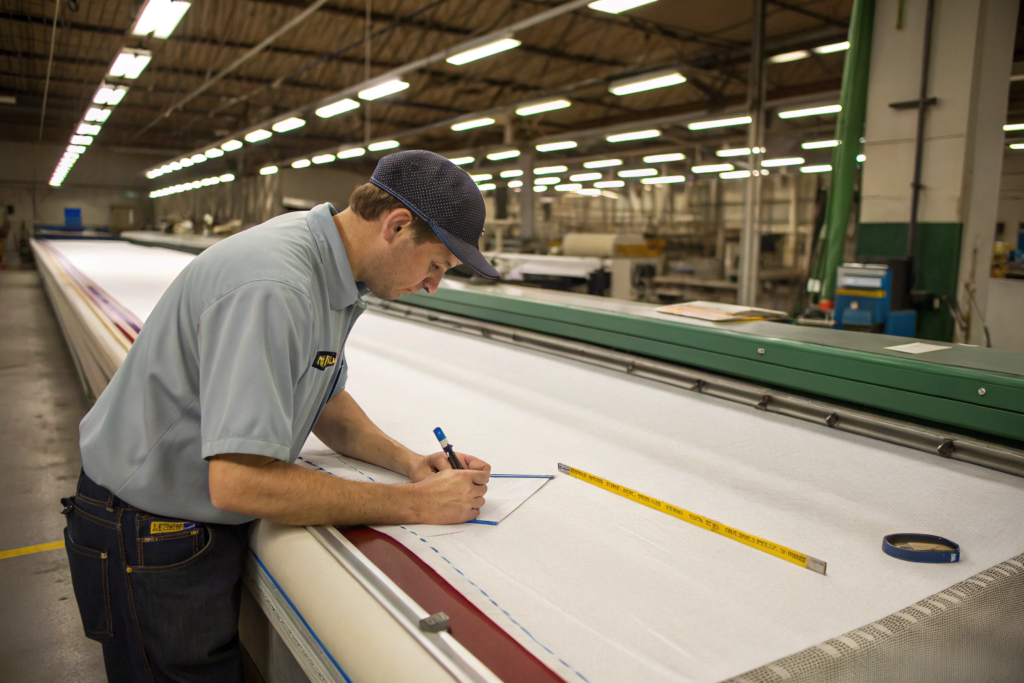
how often should fabric inspection occur during production
The answer depends on the defect type’s rate of occurrence and the cost of missing it. But a useful operational rule that has served us well: inspect at every point where the fabric changes state—from yarn to greige, from greige to dyed, from dyed to finished. Each state change introduces new defect types. Weaving introduces knots, slubs, and tension variations that did not exist in the yarn. Dyeing introduces shade streaks, center-to-selvedge variation, and spotting that did not exist in the greige. Finishing introduces creasing, width variation, and softener unevenness. If you only inspect at the end, you are trying to detect a composite of all possible defect types under conditions where the fabric is already finished and any rework will be maximally expensive.
The frequency also depends on the production mode. For a repeat order of a standard fabric that has been run fifty times before and has a documented defect profile, our sampling rate drops to 20% of rolls at each gate—we inspect every fifth roll rather than every roll—because the process is stable and the few defects that occur are predictable and easily corrected. For a first-run custom fabric with a new yarn blend or new dye recipe, we inspect 100% of yardage at every gate. The cost of 100% inspection on a 2,000-yard pilot run is about $800 in labor; the cost of missing a systemic defect that ruins the entire run is anywhere from $14,000 to $50,000 depending on the fabric value. The economics are unambiguous: aggressive inspection on new products, statistical sampling on mature products, but never zero inspection, because a zero-inspection gate invites process drift that eventually spoils even the most mature product. Those who study statistical process control applications in textile defect detection dynamics note that the optimal inspection frequency matches the defect generation rate curve, and a new production batch with unknown variables should always default to full inspection until the process capability index exceeds 1.33.
For continuous production runs exceeding 10,000 yards, we insert an additional "process checkpoint" midway through the run. The head weaver inspects a 5-yard sample pulled from the mid-point of the production to verify that tooling wear, ambient humidity changes, or operator fatigue have not caused any parameter drift. This mid-run checkpoint costs $40 in labor and captures roughly 15% of defects that would otherwise be discovered only at the final gate, where they would affect a much larger batch. The mid-run checkpoint has paid for itself many times over since we introduced it in 2018.
what should buyers check during a pre shipment fabric inspection
When you visit a mill for a pre-shipment inspection—or when you send a third-party inspector—do not start with the ASTM 4-point system defect count. That is the last step. Start with the shade band. Ask the inspector to pull rolls from the beginning, middle, and end of the production and unroll three yards from each, placing them side by side on the inspection table under D65 lighting. Look for shade variation across the production run—the first roll versus the last roll. If the left selvedge of one roll is visibly darker than the right selvedge of another, the dyeing was uneven and the cutting table will produce garments that do not match. Acceptable shade variation for premium sportswear is a Delta E of 0.8 or less across the entire production lot. Anything above 1.0 will be visible to a consumer holding two garments side by side on a retail rack.
Next, check the hand-feel consistency. Run your palm across three rolls from different points in the production. The hand should feel identical—same softness, same drape, same surface friction. If one roll feels stiffer than another, the finishing softener application was inconsistent, and that stiffness difference will translate into a different garment silhouette after washing. The objective test is the Kawabata bending rigidity; the subjective field test is your own hand, after calibrating it against the approved reference sample. Bring the reference sample to the inspection. Touch it. Touch the bulk. They should feel indistinguishable.
Finally, check the roll report against the physical roll. The roll label should have a QR code that pulls up the complete production history: yarn lot, loom number, dye batch, finishing parameters, QC gate results. Scan a few QR codes randomly and verify that the data matches the physical fabric in your hands. If the mill cannot produce this traceability data, or if the data shows gaps where a gate was skipped, treat the entire shipment as suspect and increase your inspection sampling from the standard 10% to 25%. The absence of traceability is itself a defect. I strongly recommend referencing practical visual inspection checklists and pre-shipment shade band protocols for textile buyers, as the sequenced approach of starting with broad visual shade consistency before moving to per-roll defect counting aligns with how our own final gate team operates.
Conclusion
The real secret behind Fumao Clothing’s good fabric reputation is not a secret at all. It is a calculated, expensive, and stubborn commitment to doing the invisible things correctly, long before the fabric reaches your inspection table. It is the reverse-osmosis water that prevents your optic white shirts from yellowing in the warehouse. It is the four-stage QC gates that catch a broken needle at twelve yards rather than two hundred. It is the dye master who tastes the bath to confirm the pH because her tongue is more reliable than the probe. It is Old Chen’s palm on the loom frame, feeling the rhythm of the third pick. It is the yarn library that holds a decade of material knowledge in physical form. Each of these things costs money and generates no immediate marketing content. But together, they produce a fabric that performs predictably, cuts cleanly, sews reliably, and wears durably—year after year, collection after collection.
This flywheel of quality—pure inputs, integrated processes, craft knowledge, and obsessive inspection—is transparent and verifiable. You can ask for our water TDS readings (we log them hourly). You can request the Uster evenness test data for your specific yarn lot. You can walk the four QC gates yourself on a factory visit and see the inspection light booths and the calibrated spectrophotometers. The reputation is not a story; it is a physical infrastructure that you can audit.
If you are ready to stop gambling on fabric quality and start sourcing like an engineer rather than a gambler, let us open the books for you. Contact our Business Director, Elaine, at elaine@fumaoclothing.com. Tell her you want to see the water chemistry report and the yarn evenness data for the fabric you are considering. She will set you up with a technical consultation that goes deeper than any article can. Because once you understand that quality is a measurable, verifiable, physical property—not a subjective opinion—you will never settle for mystery fabric again.








