
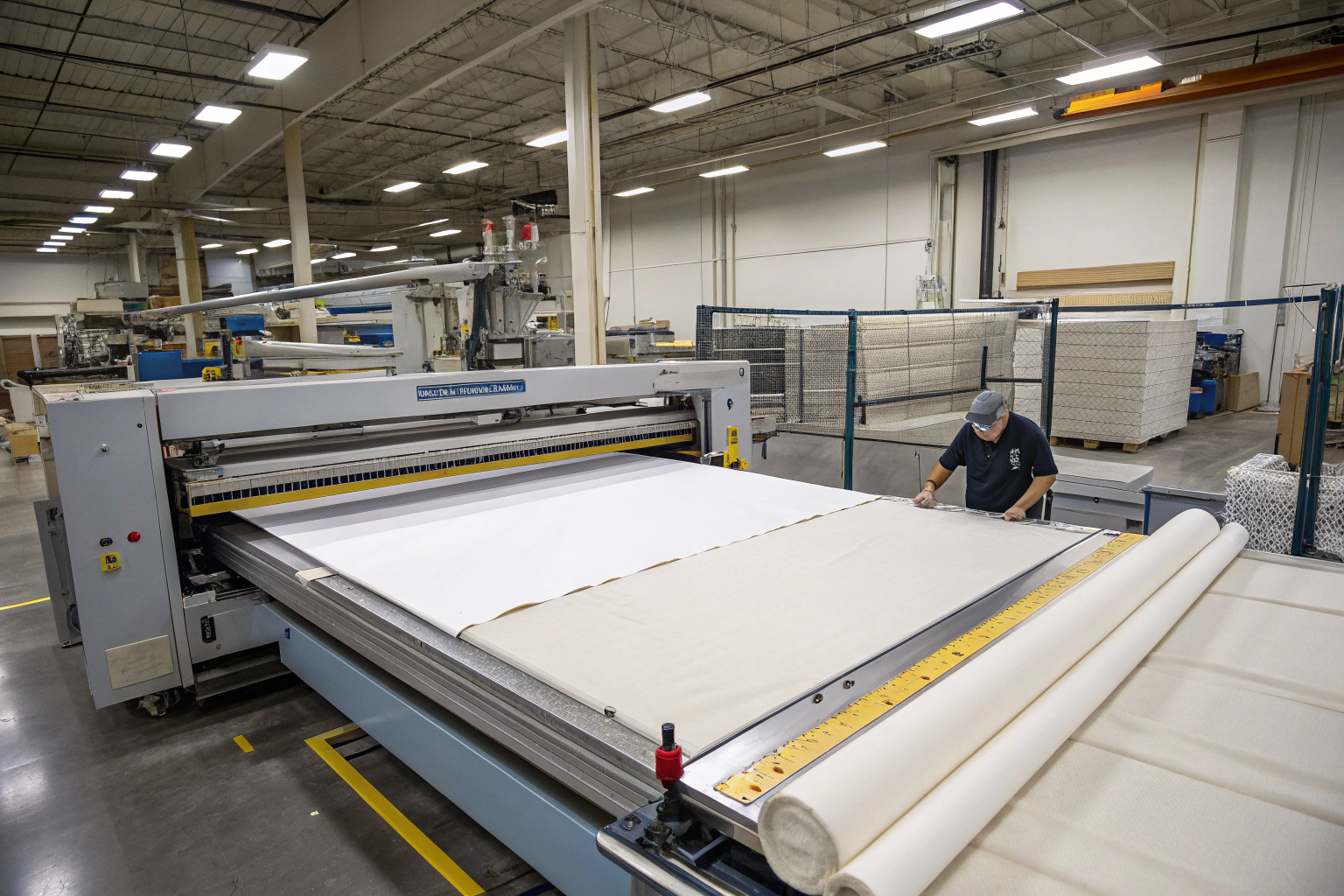
I walked into a automated cutting facility in New Jersey in 2021, coffee in hand, ready to watch a state-of-the-art Gerber cutter slice through 80 layers of our cotton twill like a hot knife through butter. The machine started its run, the vacuum compressed the lay down tight, and the reciprocating blade began its high-speed dance. Ten seconds later, the blade snapped. The operator groaned, hit the emergency stop, and muttered, "Too stiff." Seventy layers of partially cut fabric sat frozen on the table, the top layers fused together from friction heat, the bottom layers untouched. An afternoon of downtime, a replacement blade, and a re-cut cost that ate the margin on the entire order. That moment burned a permanent lesson into my brain: fabric stiffness is not just a hand-feel preference on a designer’s mood board. It is a mechanical variable that directly determines whether an automated cutting line runs profitably or bleeds money in downtime, blade consumption, and rejected cut parts.
Automated cutting systems—whether reciprocating knife, rotary blade, or laser—are precision engineering machines with tight operating envelopes. They expect a fabric to compress predictably under vacuum, to offer a consistent resistance to the cutting blade, and to remain dimensionally stable when separated into individual plies. Stiffness disrupts every one of those expectations. A stiff fabric resists compression, forcing the vacuum system to work harder and often failing to achieve the lay height reduction required for a clean cut. It resists blade penetration, increasing cutting force, blade temperature, and blade wear rate. It creates a higher likelihood of ply-to-ply fusion on synthetics because the blade friction generates more heat, and the stiff fiber structure holds that heat at the cut edge rather than dissipating it. And stiff fabric can physically deflect a thin blade, causing top-ply to bottom-ply dimensional variation that produces mismatched pattern pieces.
At Shanghai Fumao, I think about automated cutting compatibility from the moment a fabric specification lands on my desk. The bending rigidity of the fabric—measured in micro-Newton meters in our CNAS lab—is a key performance parameter I track alongside the usual suspects like shrinkage and colorfastness. I know that my clients are increasingly investing in automated cutting to solve labor shortages and speed up production. A fabric that cuts poorly on an automated line will cost them more in hidden operational waste than any marginal savings on the fabric price. My job is to deliver fabric that feeds, compresses, and cuts predictably so their machines can run at maximum throughput. Let me walk you through the physics of how stiffness interacts with the three main automated cutting mechanisms, the specific fabric properties that determine cutting performance, and the pre-cutting and finishing interventions we can apply to make a stiff fabric cut like a compliant one.
Why Does Fabric Bending Rigidity Matter More Than Thickness in Automated Cutting?
Buyers fixate on fabric thickness—GSM, millimeters, ounces per square yard—as the primary predictor of cutting difficulty. This is a mistake. Thickness matters, but bending rigidity is the true master variable that governs how a fabric behaves under an automated cutting head. Bending rigidity is the fabric’s resistance to being deformed out of its plane. It is a function of the fiber modulus (inherent stiffness of the fiber material), the yarn diameter, the weave or knit structure, and the finishing chemistry, all multiplied together. Two fabrics can have identical thicknesses and identical GSM but radically different bending rigidities. A stiff, tightly woven 200 gsm linen canvas will stand up like a board when you hold it at one edge. A soft, loosely knitted 200 gsm cotton jersey will drape like a liquid and collapse under its own weight. The linen will fight an automated cutting blade and win; the jersey will submit cleanly.
The physics of the cutting zone explains why. An automated reciprocating knife does not slice like a kitchen blade; it saws vertically at thousands of strokes per minute, relying on the vacuum-compressed lay to hold the individual plies stationary and provide a stable, solid medium for the blade to cut through. A fabric with high bending rigidity resists being compressed flat. Even under high vacuum, the fabric retains micro-gaps between the plies or a slight internal springiness. As the blade enters, the stiff fibers do not part and allow passage; they push back against the blade flanks, increasing lateral friction. This lateral friction generates heat, dulls the blade edge, and increases the cutting force required. The machine’s force sensors may even register an overload and trigger a shutdown to prevent blade breakage. I had a situation with a US workwear client in 2023 where their automated line kept shutting down on our 12-ounce cotton duck canvas. The GSM and thickness were within their spec, but the bending rigidity was off the charts because we had used a high-twist, compact yarn for increased abrasion resistance. The fix was not to change the yarn—that would compromise durability—but to apply a targeted cationic softener in finishing that reduced bending rigidity by 22% without sacrificing the fiber integrity. The fabric still looked and performed like workwear canvas, but it bent just enough to flow through the cutting line without triggering overloads.
How Does Stiff Fabric Cause Top-Ply to Bottom-Ply Dimensional Variation in a Lay?
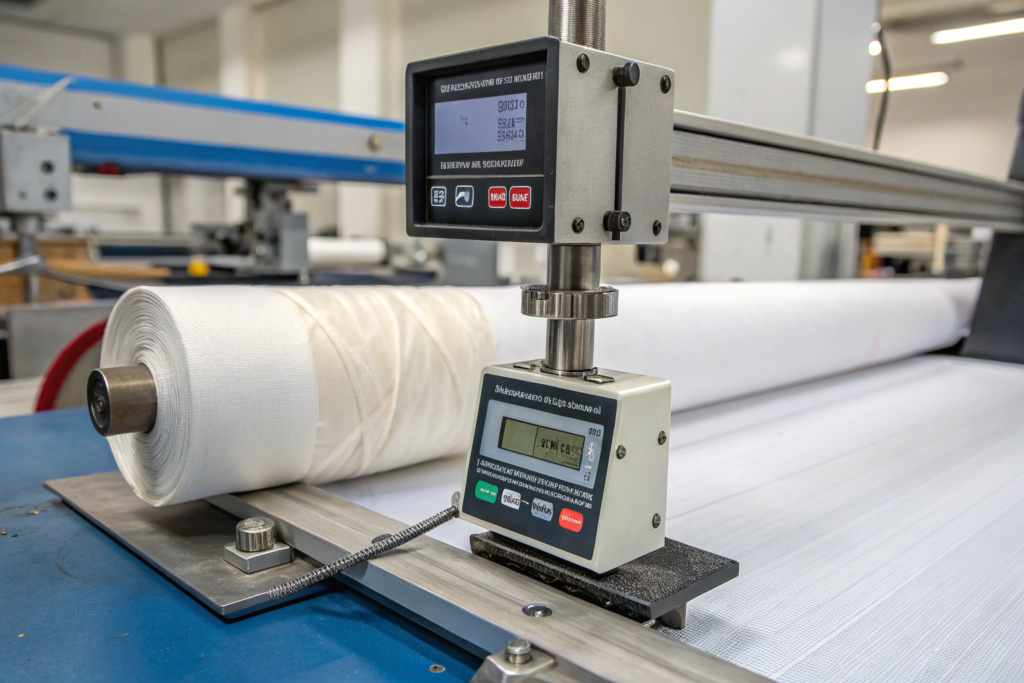
When a reciprocating blade cuts through a compressed stack of fabric, ideally the blade travels perfectly vertically, and each ply is cut to exactly the same dimension. In reality, stiff fabric introduces lateral blade deflection. Imagine pushing a thin, flexible blade through a stack of cardboard sheets. If the cardboard is soft and pliable, the blade pushes through with minimal lateral force. If the cardboard is stiff and resistant, the blade experiences sideways pressure as the material resists being parted. That sideways pressure deflects the blade slightly, creating a cut line that is not perfectly vertical but slightly angled. The top ply is cut to the correct dimension, but the bottom ply is cut slightly smaller or larger depending on the direction of deflection. This dimensional variation between top and bottom plies can be as much as 2mm to 3mm in a 50-ply lay of stiff fabric. On a precise pattern piece like a collar or a pocket flap, 2mm is visible and unacceptable.
This deflection problem gets worse with higher lays. More plies mean more cumulative lateral resistance, more blade deflection, and more dimensional drift. The solution space is limited by the mechanical realities of the cutting machine. You can slow down the cutting speed to reduce the instantaneous force on the blade, but that directly reduces throughput and labor efficiency. You can reduce the lay height, but that increases spreading labor and material handling costs. You can switch to a thicker, stiffer blade, but a thicker blade has a wider kerf, removing more material and creating a rougher cut edge. The most elegant solution is to reduce the fabric’s bending rigidity at the finishing stage, so the material presents less lateral resistance to the blade in the first place. This is why I advocate for cutting-compatible finishing as a standard specification, not an afterthought.
What Is the Relationship Between Fiber Modulus and Blade Wear Rate?
Fiber modulus of elasticity is a measure of how much a fiber resists deformation under load, expressed in grams per denier or Newtons per tex. High-modulus fibers like aramid, high-tenacity polyester, and linen have a stiff molecular backbone that resists bending and stretching. When an automated blade encounters a high-modulus fiber, the fiber does not easily bend out of the way or compress. It stands its ground and forces the blade edge to cut directly across its cross-section. This direct cutting action generates high localized pressure at the blade edge, and the harder the fiber, the faster the blade edge abrasion. Think of cutting a bundle of soft wool roving versus a bundle of stiff nylon monofilament. The wool gives way and spreads; the nylon resists and grinds the blade edge down.
The relationship is roughly linear. In our internal testing, a standard high-speed steel reciprocating blade cutting a 100% cotton twill with a fabric modulus of 50 grams per denier will show measurable edge dulling after about 8,000 linear meters of cutting. The same blade cutting a 100% high-tenacity polyester with a fabric modulus of 110 grams per denier will dull noticeably after only 3,000 to 4,000 meters. Blade replacement frequency doubles. Given that a single blade change on an automated line costs 10 to 15 minutes of downtime and a $15 to $40 blade, the accumulated operational cost over a year of production on stiff, high-modulus fabrics is significant. My advice to brands spec’ing high-modulus fibers for durability reasons—aramid for protective workwear, high-tenacity nylon for tactical gear—is to build the higher blade consumption cost into their production budget and to work with the fabric supplier on finish optimization to reduce the cutting resistance as much as possible without compromising the functional performance.
How Does Fabric Stiffness Interact With Laser, Reciprocating Knife, and Die Cutting Methods?
The three dominant automated cutting technologies in apparel and textile manufacturing—laser, reciprocating knife, and die cutting—each interact with fabric stiffness in distinct mechanical ways. A fabric that cuts beautifully on a laser may be a nightmare on a reciprocating knife, and vice versa. The physics of the cutting mechanism determines the stiffness sensitivity. Laser cutting uses a focused thermal beam to vaporize the fabric along the cut path, so it cares relatively little about bending rigidity. The laser beam encounters no mechanical resistance from the fabric; it simply burns through. A stiff fabric actually cuts cleaner on a laser because it stays flat and stable under the beam rather than curling or shifting. However, laser cutting of synthetics creates a fused, hard edge bead that can feel scratchy against skin, and the thermal damage zone can weaken the fabric at the cut line.
Reciprocating knife cutting is the most stiffness-sensitive method because it relies on mechanical penetration and material displacement. The blade must physically push the fibers apart and shear through them, and any resistance from a stiff fabric translates directly into cutting force, heat, and blade wear. This is the method used by the majority of automated cutting lines in apparel manufacturing—Gerber, Lectra, Bullmer, Eastman, and others—so stiffness is a frontline concern for most of my clients. Die cutting, where a shaped steel rule die is pressed down through the fabric stack with hydraulic force, is less sensitive to bending rigidity than a reciprocating knife because the massive downward pressure overcomes the fabric’s resistance. But die cutting is limited to simpler shapes, has high tooling costs for each pattern change, and is typically used for accessories, footwear, and automotive textiles rather than fashion apparel with frequent style changes.
Why Does Stiff Polyester Fabric Create More Fused Edge Problems in Laser Cutting?
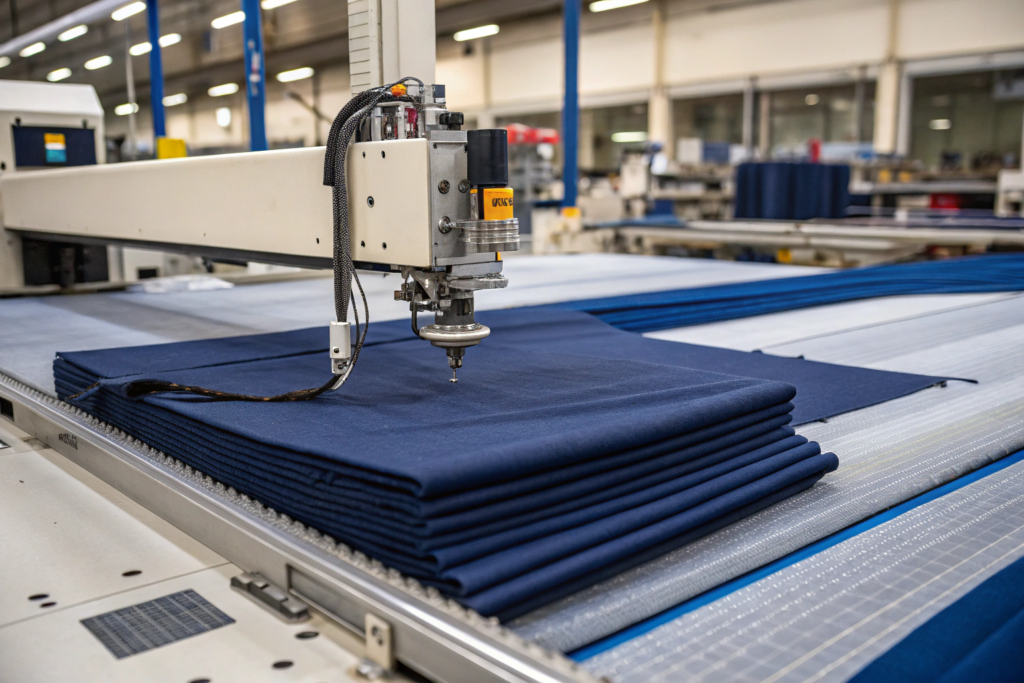
Laser cutting of polyester is a thermomechanical process with a narrow operating window. The laser beam heats the polyester fibers to their melting point—around 260°C for standard PET—and the material vaporizes, creating a gap. However, the heat does not confine itself perfectly to the beam diameter. Heat conducts outward from the cut line into the adjacent fabric, creating a heat-affected zone (HAZ). In this zone, the polyester fibers partially melt, fuse together, and then re-solidify when the beam moves on, forming a hard, rigid bead along the cut edge. The width and severity of this bead depend on the laser power, cutting speed, and—critically—the fabric’s thermal conductivity and stiffness.
Stiff polyester fabrics tend to have higher fiber density per unit area, more tightly packed yarns, and higher—higher crystallinity from heat-setting, all of which increase thermal conductivity along the fiber axis. The heat travels further into the fabric before dissipating, enlarging the HAZ and creating a wider, harder fused bead. Softer, more loosely constructed polyester fabrics have more air gaps between fibers, which act as thermal insulators, limiting HAZ spread. I worked with a US performance activewear brand in 2022 that was laser-cutting their own polyester-spandex compression fabrics in-house. They sourced a stiffer version of the fabric from a different supplier for cost savings, and suddenly their laser-cut edges were stiff, scratchy, and causing customer returns for skin irritation. The fabric composition was identical—82% polyester, 18% elastane—but the stiffer variant had a higher yarn packing density and less thermal dissipation volume, resulting in a HAZ width of 1.2mm compared to 0.4mm on the original fabric. They switched back to a softer-construction fabric with the same fiber content.
Does a Reciprocating Knife Require Different Blade Angles for Stiff vs Soft Fabrics?
Absolutely, and the blade angle selection is an underappreciated operational detail that separates efficient cutting rooms from struggling ones. A reciprocating knife blade has a bevel angle—the angle at which the blade edge is ground, typically between 15 and 30 degrees from the blade centerline. A steeper angle, like 25 to 30 degrees, creates a stronger, more durable edge that resists chipping and withstands the high lateral forces of cutting stiff fabric. The trade-off is that a steeper angle requires higher cutting force and generates more friction heat. The blade is essentially a wedge being driven straight down; a wider wedge pushes more material sideways and encounters more resistance.
A shallower angle, like 15 to 20 degrees, is sharper, cuts with less force, generates less heat, and slices through soft, compliant fabrics beautifully. But on stiff fabric, that shallow, sharp edge is fragile. It chips, rolls over, or snaps under the lateral resistance. I have a standard recommendation matrix I share with clients who operate their own cutting lines. For fabrics with a bending rigidity below 20 micro-Newton meters—soft jerseys, lightweight rayons, silks—use a 15-degree blade. For fabrics between 20 and 40—standard cotton twills, lightweight denims, medium-weight interlock knits—use a 20-degree blade. For fabrics above 40 micro-Newton meters—heavy canvas, stiff linens, compact-woven nylons—use a 25-degree blade and expect to replace it more frequently. I also recommend using a coated blade, such as titanium nitride or DLC (diamond-like carbon), for high-stiffness fabrics. The coating reduces the coefficient of friction between the blade flank and the fabric, lowering cutting force and heat generation by 10% to 15%. The coated blades cost 30% to 50% more per unit, but the reduction in downtime and the improvement in cut quality justify the premium on stiff materials.
What Pre-Cutting Fabric Treatments Can Reduce Stiffness Without Harming Quality?
The finishing room is where the battle against stiffness is won or lost before the cutting machine ever powers up. When I receive a fabric specification with an automated cutting requirement, my first instinct is not to overhaul the weaving or knitting process—that would change the fundamental fabric identity the client already approved. My first instinct is to optimize the finishing route to reduce bending rigidity while preserving the fabric’s visual character, dimensional stability, and functional properties. The primary tools available are mechanical softening, chemical softening, and moisture conditioning, and each has a specific mechanism, a specific effect size, and specific limitations.
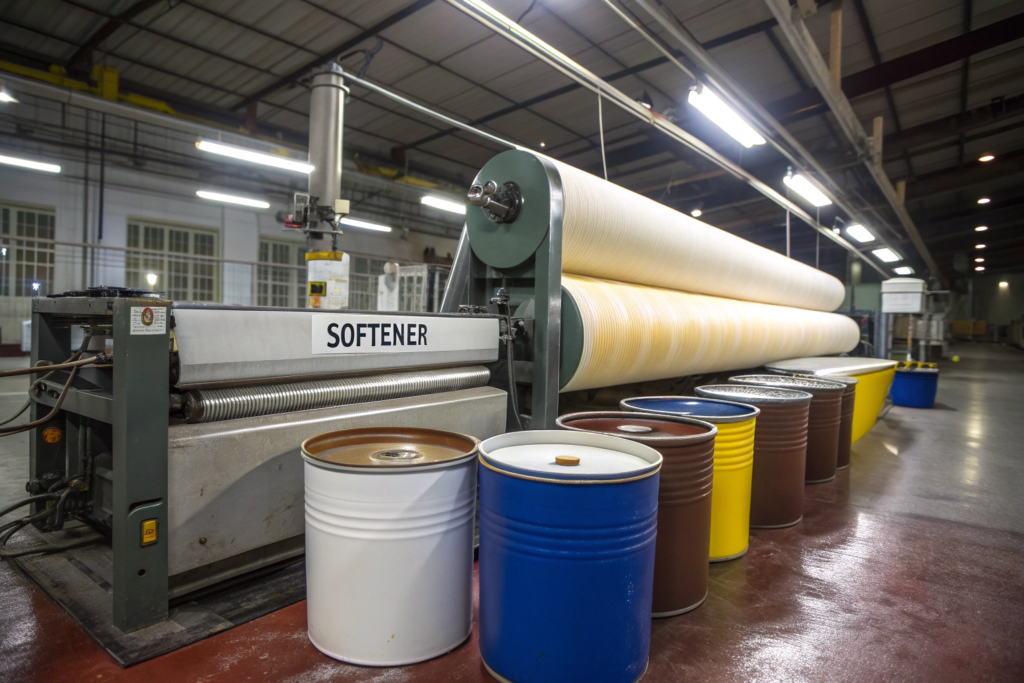
Mechanical softening involves physically working the fabric to break the internal hydrogen bonds and fiber-to-fiber frictional bonds that contribute to stiffness. On a woven fabric, this might mean passing the fabric through a series of breaker rollers or a micro-sanding unit that gently flexes the yarns in multiple directions, loosening the weave structure slightly without tearing fibers. Chemical softening involves applying lubricating agents—cationic softeners, fatty-acid amides, or low-concentration silicone emulsions—that deposit a thin, low-friction film on the fiber surfaces, allowing individual fibers within the yarn to slide against each other more freely. The bending rigidity drops because the internal friction that resists inter-fiber movement has been lowered. Moisture conditioning is the simplest intervention: stiff, dry fabric often softens naturally when brought to a proper regain moisture content of 6% to 8% for cotton or 2% to 3% for polyester. Over-dried fabric straight out of a stenter oven can be temporarily brittle and stiff; simply conditioning it in a controlled humidity environment for 24 hours before cutting can measurably improve compliance.
Can a Simple Water Spray or Steam Treatment Improve Stiff Fabric Cutting Performance?
Yes, and this is one of the cheapest, fastest interventions available to a cutting room facing a stiff fabric problem. The mechanism is straightforward: water molecules penetrate the amorphous regions of the fiber structure and act as internal plasticizers, breaking hydrogen bonds between adjacent polymer chains and increasing molecular mobility. The fiber becomes more flexible, and the fabric’s bending rigidity drops measurably. For cellulosic fibers—cotton, viscose, Tencel, linen—the effect is pronounced because cellulose is highly hydrophilic and readily absorbs water into its structure. A cotton fabric at 3% moisture content can have a bending rigidity 30% to 50% higher than the same fabric at 8% moisture content. For synthetics, the effect is more modest because polyester and nylon absorb very little internal water, but a topical water spray can still lubricate the yarn surfaces and reduce inter-yarn friction during cutting.
The practical application in a cutting room is to use a controlled steam or misting system over the spread fabric lay just before the vacuum compression cycle. The moisture slightly relaxes the fibers and reduces the cutting resistance, and the vacuum system pulls the moisture-laden air through the lay, distributing the conditioning effect through all plies. I caution against over-wetting. If the fabric becomes too damp, it swells, and the cut dimensions will be slightly off when the fabric dries and shrinks back. The target is a regain moisture content at the higher end of the fiber’s normal range, not saturation. For cotton, that means 7% to 8% moisture content; for polyester, 2% to 3%. A simple moisture meter probe inserted into the lay can verify the condition. I have recommended this steam-conditioning approach to several small and mid-sized cutting facilities that cannot afford major finishing line modifications, and the feedback is consistently positive: blade life improves, cut quality improves, and the only cost is a steam generator and a few minutes of dwell time.
What Chemical Softener Types Are Compatible With Downstream Bonding and Printing?
Compatibility is the constraint that makes softener selection a technical puzzle rather than a casual choice. The general rule is: cationic softeners and fatty-acid amide softeners are the most compatible with downstream processes; amino-silicone softeners are selectively compatible; standard dimethyl-silicone softeners are the least compatible and should be avoided entirely if the fabric will be printed, coated, or laminated. Cationic softeners work by adsorbing onto the negatively charged fiber surface, forming a thin, lubricating molecular layer that reduces inter-fiber friction. They are water-soluble or water-dispersible, meaning they re-wet easily. A printing paste or an adhesive coating can penetrate through a cationic softener layer and bond to the fiber underneath. The softening effect is moderate—not as dramatic as a full silicone wash—but for the purpose of cutting stiffness reduction, moderate is often sufficient and safe.
Fatty-acid amide softeners, derived from natural plant or animal fats, provide a waxy internal lubrication to the yarn without creating a continuous hydrophobic film on the surface. They are excellent choices for fabrics destined for water-based pigment printing or PU coating because they do not significantly lower the surface energy of the fiber. The key metric to monitor is the fabric’s surface tension after softening, measured in dynes/cm using a dyne pen test kit. A surface tension of 38 dynes/cm or higher is generally adequate for water-based printing and most adhesive bonding. Below 38, wetting problems begin. When I develop a softener package for a fabric that will undergo downstream printing or coating, I specify a cationic or fatty-acid amide softener and validate the finished surface tension with a dyne pen before shipping. I include the surface tension reading in the QC report. This gives the client confidence that the fabric will print cleanly without having to wash off a silicone contaminant first.
How Do You Specify Stiffness Tolerance to Ensure Consistent Automated Cutting?
Specifying stiffness for automated cutting is a matter of defining an acceptable bending rigidity range and a consistent test method, and then treating that range as a production tolerance with the same rigor as color matching or shrinkage limits. The most common laboratory test for fabric bending stiffness is the Shirley Stiffness Tester, standardized as ASTM D1388 or BS 3356. This test measures the bending length—the length of fabric that will bend under its own weight to a defined angle, typically 41.5 degrees—and calculates the bending rigidity from that length and the fabric’s areal density. The result is expressed in micro-Newton meters or milligram-centimeters, depending on the unit system. For the purpose of automated cutting compatibility, the bending rigidity is the relevant value, not the bending length alone, because bending rigidity incorporates the fabric weight and gives a true measure of the material’s resistance to bending.
A typical specification might read: "Bending rigidity per ASTM D1388 shall be within the range of 15 to 35 micro-Newton meters in the warp direction and 10 to 25 micro-Newton meters in the weft direction." A fabric below the lower limit is too limp and may cause feeding or registration problems on the cutting table. A fabric above the upper limit is too stiff and will cause the blade wear, deflection, and fusion issues we have discussed. I recommend a three-point minimum measurement—one near each selvedge and one in the center, for both warp and weft directions—to capture any stiffness variation across the fabric width. A fabric that is stiff at the selvedges but soft in the center may have been over-stretched on the stenter frame during finishing, creating an internal stress profile that will cause differential cutting behavior and dimensional instability after relaxation.
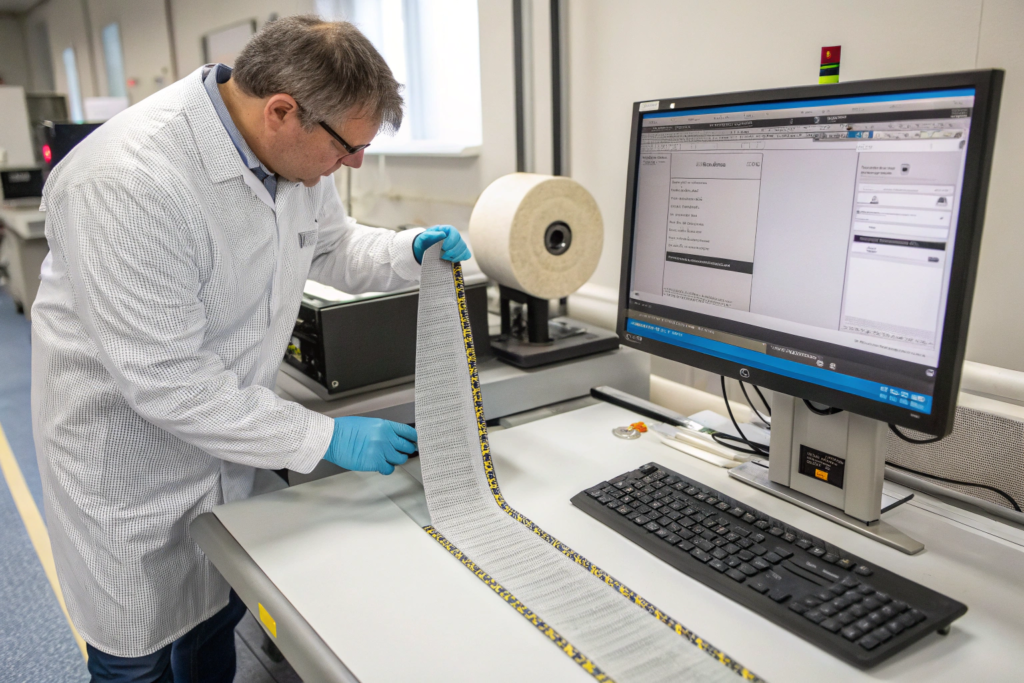
What Is the ASTM D1388 Standard and How Does It Measure Bending Rigidity?
ASTM D1388 is the standard test method for stiffness of fabrics, maintained by ASTM International. The test uses a simple but elegant instrument: a horizontal platform with a smooth, low-friction surface and a calibrated angled mirror or optical sensor set at 41.5 degrees from the horizontal plane. A rectangular fabric specimen, typically 25mm wide and 200mm long, is placed on the platform and slowly slid forward by a motorized carriage or manually by the operator. As the leading edge of the specimen extends beyond the platform edge, it bends downward under its own weight. When the tip of the bending fabric intersects the 41.5-degree line of sight, the overhang length is recorded. The test is performed with the fabric face up and face down, and in both the warp and weft directions, giving four sets of data per sample.
The bending length c is half of the overhang length at the 41.5-degree angle, and the bending rigidity G is calculated as G = (9.81 x m x c^3) / 1000, where m is the fabric mass per unit area in grams per square meter, and the result is in micro-Newton meters. The test is deceptively simple, but operator technique and specimen preparation have a huge influence on the accuracy and reproducibility. The specimen must be cut precisely parallel to the yarn direction; a bias-cut specimen will give a falsely low stiffness reading. The fabric must be conditioned for at least four hours at 21±1°C and 65±2% relative humidity before testing, because moisture content changes the bending rigidity of cellulosic fibers. I require all stiffness testing at Shanghai Fumao to follow these conditioning and specimen preparation protocols exactly as written in the standard. I have seen too many disputes arise from stiffness measurements taken on unconditioned fabric fresh off a hot stenter, which gives a transient, falsely high reading that does not represent the fabric’s equilibrium stiffness in the customer’s air-conditioned cutting room.
How Should You Define a Stiffness Pass-Fail Band to Balance Flexibility and Stability?
The pass-fail band must be wide enough to accommodate normal production variation—different yarn lots, slight finishing fluctuations, humidity changes—but narrow enough to guarantee consistent cutting machine performance. I recommend a band width of approximately 40% of the target mean value. If the target bending rigidity is 25 micro-Newton meters, the band should be roughly 20 to 30—a 10-point span. This band is derived from empirical observation of cutting line performance. A fabric that varies in bending rigidity by more than 10 points within a single order will behave differently enough to cause the cutting machine operator to notice, and to require parameter adjustments that slow down production.
Stability within the band is as important as the band limits themselves. A fabric that arrives at 22 micro-Newton meters in Roll 1 and 28 micro-Newton meters in Roll 10 technically passes the band but will cut noticeably differently. The operator will need to adjust vacuum pressure, cutting speed, or blade angle between rolls, costing time. I aim for a coefficient of variation (CV%) of bending rigidity across rolls within a single order of less than 10%. Achieving this requires process consistency at the finishing stage: consistent softener application, consistent stenter temperature and dwell time, and consistent moisture conditioning before rolling. I provide a bending rigidity run chart in the production quality report for every custom fabric order, showing the individual values for each roll sampled, the mean, and the CV%. This gives the client full visibility into the stiffness consistency of the lot and allows them to plan their cutting room workflow—put the softer rolls through the line first when the blades are fresh, or group similar-stiffness rolls together to minimize parameter adjustments.
Conclusion
Fabric stiffness is a cutting-line productivity variable, not a cosmetic attribute. I have shown you how bending rigidity, more than thickness or weight, drives the mechanical interaction between the fabric and the cutting blade, causing blade deflection, dimensional variation, heat fusion, and accelerated blade wear when it exceeds the machine’s optimal operating envelope. We walked through the specific differences in how laser, reciprocating knife, and die cutting systems tolerate stiffness, and why a softer polyester cuts cleaner on laser while a stiff polyester generates a wide, scratchy fused edge. We explored the finishing toolkit—chemical softening, mechanical flexing, and moisture conditioning—that I use at Shanghai Fumao to bring fabric stiffness into the compatibility zone before the fabric ships. And we covered the laboratory measurement standards, the ASTM D1388 bending rigidity test, and the practical pass-fail bands that turn stiffness from a subjective complaint into an objective, traceable quality metric.
My philosophy is simple: the best fabric in the world is worthless if it cannot be cut efficiently. A beautiful color, a perfect hand feel, and a durable construction mean nothing if the fabric snaps blades, holds up production, and generates rejected cut parts. I design our fabrics to perform in the factory as well as on the body.
If you are experiencing cutting room problems with stiff fabric, or if you are developing a new fabric and want to ensure it is optimized for automated cutting from the start, I can help. At Shanghai Fumao, I have the bending rigidity test data, the finishing chemistry expertise, and the willingness to work with your cutting room technicians to dial in the right softness window. Reach out to our Business Director, Elaine, at elaine@fumaoclothing.com. Send her your cutting machine specifications, your lay height, your blade type, and the current stiffness issues you are facing. She will coordinate with our finishing lab to produce a compatible sample and a full bending rigidity report for your evaluation. Let us make sure your fabric feeds, compresses, and cuts as efficiently as your automated line was designed to run.








