I’ve seen a single digit on a spec sheet destroy the feel of a luxury hotel pillowcase. The buyer changed "Ne 40/1" to "Ne 30/1" to save 15% on the raw yarn cost. The pillowcases arrived heavier, rougher, and completely wrong for the marble lobby they were destined for. The hotel returned the entire shipment. The $3,000 saved in yarn cost turned into a $30,000 logistics disaster. That single digit—the difference between a 30 and a 40—is not just a thread thickness. It’s the genetic code of your fabric’s weight, drape, softness, breathability, and durability. Change the yarn count, and you change the DNA of the garment.
Yarn count is the measurement of how thick or thin a yarn is. But the numbering system is completely counterintuitive. With the English Cotton Count (Ne), the higher the number, the thinner the yarn. Ne 30/1 is a medium-weight yarn. Ne 40/1 is a significantly finer, lighter, more silky yarn. This system describes how many 840-yard hanks of yarn weigh one pound. If 30 hanks weigh one pound, it’s Ne 30. If 40 hanks weigh one pound, it’s Ne 40. The second number after the slash is the "ply"—how many singles are twisted together. Ne 30/1 is a single-ply yarn made of Ne 30 fibers. Ne 40/2 is a two-ply yarn made of twisting two Ne 40 singles together. More hanks per pound means thinner fiber, less bulk, and a higher surface area for dyeing and printing. It’s the difference between a crisp poplin dress shirt and a rugged canvas work pant. At Shanghai Fumao, we spin both counts daily, and I watch buyers stare at a swatch book, rub a fabric, and ask "Why does this feel more expensive?" The answer is almost always hiding in the yarn count spec.
Let me walk you through the physics of how a 10-count jump transforms the hand-feel, the weave density, the shrinkage behavior, and the cost per meter. Because once you feel the difference between a 30 and a 40, you’ll never un-feel it. And you’ll stop ordering the wrong pillowcase.
What Is the English Cotton Count System (Ne) and Why Does Higher Number Mean Thinner Thread
The English Cotton Count (Ne) is an ancient indirect numbering system that feels backwards to every new designer. Let me break it with a simple mental image. Imagine a spinning wheel. You have one pound of raw cotton fiber. You stretch that pound into a single long thread. If you stretch it so thin that you create 30 hanks, and each hank is 840 yards long, you have just spun a "Ne 30/1" yarn. The total length is 30 × 840 = 25,200 yards. Now take that same single pound of cotton and stretch it even thinner—40 hanks instead of 30. The total length is 40 × 840 = 33,600 yards. The pound weight never changed, but the yarn got longer. Longer from the same weight means thinner. So Ne 40 is thinner than Ne 30. It’s that simple physics.
This is called an "indirect" system because the number goes up as the thickness goes down. This is the opposite of the Denier system (used for silk and synthetics) where the number goes up as the thread gets heavier. You mix these up, and you’ll order a 40 Denier nylon (sheer stocking weight) when you wanted a 40 Ne cotton (shirting weight). That’s a catastrophic mistake. Now, about the "ply" notation: Ne 30/1 means a single yarn (the /1). Ne 30/2 means two strands of Ne 30 twisted together. A two-ply yarn is stronger, more even, and resists pilling. Most luxury shirting uses 2-ply (like Ne 40/2 or Ne 50/2). In a 2-ply yarn, the resulting combined thickness is roughly equivalent to a single yarn with half the count number. So Ne 40/2 has a similar thickness to Ne 20/1, but with far superior strength and smoothness because the two plies balance each other’s twist irregularities. A single-ply yarn has a natural "torque" (it wants to untwist), which creates that premium "crepe" texture, but also can cause seam spirality in knitted garments. A two-ply yarn cancels out the torque, creating a stable, smooth, flat surface. Understanding this fundamental explanation of the English cotton count indirect yarn numbering system and its relationship to hank length and weight is the first thing I teach any junior merchandiser.

How Many Hanks Per Pound Define a True ‘Fine Cotton’ Poplin Weave?
A poplin shirt is defined by its crisp, smooth hand. That hand comes from a high-density weave of fine yarns. A "fine cotton" poplin typically starts at Ne 40/1 in the warp (the vertical threads that run the length of the loom) and might use Ne 40/1 or Ne 50/1 in the weft (the horizontal fill). That means 40 hanks of 840 yards each weigh one pound. The fiber length (staple) required to spin a yarn this fine must be long. You cannot spin Ne 40 out of short, dusty Indian cotton. The fibers would slip apart. You need a minimum staple length of 1.1 inches (28mm), which means you’re looking at premium long-staple cotton like Supima, Giza, or high-grade Xinjiang machine-picked cotton.
The "poplin" construction itself is a plain weave with a warp-to-weft ratio of roughly 2:1. A classic luxury poplin might be 144 ends per inch (EPI) of Ne 40/1 warp and 76 picks per inch (PPI) of Ne 40/1 weft. That’s 144 fine threads crammed into every single inch of width. The result is a fabric that is dense (high thread count), lightweight (because the yarns are fine), and incredibly smooth. The high EPI with fine yarn creates a "sealed" surface that resists down leakage in bedding and creates a sharp printed edge in shirting. If you substitute Ne 30/1 and keep the same EPI, the yarns are thicker and the interstitial gaps close up tighter, making the fabric stiffer and less breathable. It goes from a dress shirt to a casual oxford. If you’re trying to benchmark a supplier, ask them to send their fine cotton poplin specification standards comparing Ne 40/1 and Ne 30/1 warp yarn in high thread count woven shirting. The spec sheet numbers are the fingerprints; the yarn count is the identity.
Why Does the Single Ply Twist Affect the Air Permeability of a Summertime Knit?
A single-ply yarn like Ne 30/1 or Ne 40/1 has a specific "twist per inch" (TPI). The twist is what holds the short cotton fibers together. Higher twist creates a harder, smoother, cooler-feeling yarn that resists pilling but breathes less because the fibers are packed tight. Lower twist creates a softer, more open, more "hairy" yarn that traps more air (warmth) but pills faster. For a summer knit, you want a higher twist in a finer count. Ne 40/1 with a twist multiplier of 3.8 creates a crisp, cool, dry hand that doesn’t cling to sweaty skin. It’s like a linen shirt from a 1950s Havana novel.
Ne 30/1 with the same high twist creates a thicker, heavier yarn that’s still crisp, but it holds heat because the yarn itself is a larger thermal mass. For summer, I usually recommend a Ne 40/1 in a "compact spun" process. Compact spinning burns off the loose fiber hairs via a vacuum suction during spinning, leaving a perfectly smooth, almost silk-like strand. This smoothness minimizes skin friction and maximizes airflow through the knit loops. The air doesn’t get trapped in the fiber halo; it flows straight through the open stitch. I once helped a Miami golf brand switch from a Ne 30/1 ring-spun pique polo to a Ne 40/1 compact-spun jersey polo. The weight dropped 20%, and the breathability score in their wearer test jumped from 6/10 to 9/10. The fabric looked more "expensive" simply because the yarn count went up. The science behind this is found in the impact of single ply ring spun twist factor on air permeability and thermal comfort of lightweight Ne 40/1 summer knit jersey. It’s not just about thickness; it’s about the surface geometry of each fiber bundle.
How Does a Higher Yarn Count Like Ne 40/1 Translate to a Softer and Smoother Bedding Hotel Sheet
A hotel sheet’s job is not just to be soft. It’s to survive 300 industrial boil-wash cycles without pilling into sandpaper, to resist the bleach that strips cheap dyes, and to feel like chilled butter against the face of a guest paying $800 a night. The yarn count is the invisible engine that delivers this. Ne 40/1 cotton percale sheets are the gold standard for luxury hospitality because the fine yarn allows a very tight, dense weave without becoming heavy or hot. A percale is a simple one-over, one-under plain weave. The tightness comes from the high thread count. A premium hotel percale might have 250 to 300 threads per square inch, using Ne 40/1 in warp and weft. The fine yarn means the individual threads are so small that even at 300 TPI, the sheet feels light and breathable. If you tried to reach 300 TPI with Ne 30/1, the fabric would be a stiff, heavy, hot canvas. The "thread count ceiling" is set by the yarn count. You physically cannot pack thick yarns into a dense weave.
The "smoother" feel of Ne 40/1 comes from the smaller fiber diameter. The bumps in the weave are shallower. Your skin makes contact with a more continuous, flat surface. Under a scanning electron microscope, a Ne 30/1 percale looks like a gently rolling hill landscape. A Ne 40/1 percale looks like a frozen lake. The "crispness" also increases with finer yarns because the starch finish holds a sharper fold. A Ne 40/1 sheet makes a quiet "snap" sound when you fold it, the sound of starch on a high-density fine-yarn plain weave. That snap is the audible signal of luxury. In the hospitality industry, the "snap test" is a real thing. I supply to a Singaporean 5-star chain that does a blind snap test on every batch. If the sheet doesn’t snap, it’s rejected. The Ne 40/1 percale snaps. The Ne 30/1 percale flops. It’s a specific tactile-auditory experience that defines the guest’s perception of the room’s value. For a deep dive into this, I’d recommend looking at the percale weave thread count limits and tactile smoothness comparison between Ne 30/1 and Ne 40/1 cotton yarns in hotel bed sheets. You feel the thread count, but you’re actually feeling the yarn count.

What Is the ‘Sateen vs. Percale’ Debate When Applied to Ne 40 vs. Ne 30?
Sateen and percale are structural patterns, but they amplify the yarn count effects. A sateen weave is a four-over, one-under satin structure. The long "floats" of yarn across the surface create the silky luster. To make an ultra-lustrous sateen, you need a fine, smooth yarn like Ne 40/1 or finer. A Ne 30/1 sateen will feel soft and heavy but will lack the liquid shine because the thicker yarns scatter light more. Think of a mirror versus a brushed aluminum panel. The smooth fine yarn is the mirror. The thicker yarn is the brushed aluminum.
Percale (plain weave) with Ne 40/1 gives a crisp, cool, "European hotel" feel. Sateen with Ne 40/1 gives a warm, drapey, "silky cocoon" feel. Sateen with Ne 30/1 is often sold as a "heavy winter sateen" but can sleep hot and lack the subtle gleam. I’ve seen home textile brands try to cut costs by using Ne 30/1 but finishing it with a heavy caustic mercerization and a silicone softener to fake a Ne 40/1 sateen luster. It looks shiny out of the bag but washes dull. True Ne 40/1 sateen shines because the fiber alignment is mechanical; it doesn’t wash out. The mercerization (swelling the cotton in caustic soda under tension) makes the fiber round and reflective. This effect layers on top of the fine count. So a mercerized Ne 40/1 sateen is the drenched, liquid-metal-shine high-end bedding. When sourcing, you should directly request samples that illustrate the visual sheen comparison test between Ne 30 mercerized cotton sateen and Ne 40 mercerized cotton sateen for luxury bedding. You’ll see the depth of the light reflection immediately.
How Does Yarn Count Impact the Dye Penetration and Color Fastness for High-End Print?
The finer the yarn, the higher the surface area to volume ratio. A Ne 40/1 yarn has significantly more fiber surface area per gram of mass than a Ne 30/1 yarn. This means the dye liquor penetrates the yarn core faster and more evenly. Prints on Ne 40/1 pop with higher definition because the ink sits on a flatter, smoother, less "hairy" substrate. The unprinted white spaces between the dot patterns stay cleaner. There are fewer loose fiber hairs for the ink to wick and bleed into, causing a blurry edge.
However, there is a catch. A fine yarn has a lighter mass; a small loss of dye creates a bigger visual color difference. You must "over-engineer" the dye fixation for Ne 40/1. At Shanghai Fumao, our dye master increases the reactive dye concentration by about 5% for our Ne 40/1 shirting compared to the Ne 30/1, because the thinner fiber needs a slightly higher chemical potential to force the dye molecules deep into the crystalline cellulose regions. The colorfastness to washing and light must be tested per AATCC standards. A Ne 40/1 fabric can pass a Grade 4 wash fastness, but it requires a more precise steaming temperature and a longer dwell time in the ager. I remember a Californian bedding startup that sent me a competitor’s Ne 40/1 printed duvet. The pattern was a sharp zebra stripe, but after ten washes, the black stripes faded to a charcoal grey, and the crisp edges became fuzzy. The competitor had used a standard Ne 30/1 dye recipe, and the shallow dye penetration washed out of the thin fibers. If you’re printing digitally, you absolutely must validate the colorfastness to home laundering test results for reactive digital printing on Ne 40/1 versus Ne 30/1 single jersey cotton knit. The yarn count changes the chemistry.
What Is the Cost-Per-Meter Trade-Off Between Ne 30/1 and Ne 40/1
Let’s talk raw money. Ne 40/1 is more expensive per kilogram than Ne 30/1. Period. The reason is embedded in the physics of spinning. To stretch a pound of cotton into 33,600 yards (Ne 40) instead of 25,200 yards (Ne 30), the spinning frame must run slower. The roving must be drafted more gently. The twist insertion must be more precise. More machine time per pound means higher conversion cost. You also need a higher grade of cotton lint. Short fibers will break under the drafting tension needed for fine counts. You typically need a cotton staple of at least 28mm for Ne 40/1 versus 26mm for a decent Ne 30/1. Longer staple cotton is more expensive because it yields fewer bales per acre. The raw material cost jumps about 10-15% per incremental staple millimeter.
But here’s the counterintuitive math on your fabric cost. Ne 40/1 is physically thinner, so one kilogram of Ne 40/1 yarn produces more meters of woven fabric than one kilogram of Ne 30/1 yarn, assuming the same fabric construction. However, that’s only true if you reduce the thread count. In most applications, you keep a high thread count. The cost of the weaving conversion (loom time) is similar per linear meter. So, the final fabric cost per meter is typically 15% to 30% higher for a Ne 40/1 construction compared to a Ne 30/1 construction, depending on the pick density. But the perception of value? That jumps 50% higher. A consumer will pay double for a "silky smooth" sheet versus a "standard soft" sheet. The profit margin on Ne 40/1 bedding is significantly higher. A brand making a Ne 40/1 percale set can retail for $200, while the Ne 30/1 set retails for $80. The cost difference to manufacture might be $4. That $4 buys a $120 perceived value increase. It’s the most profitable cost-up in textile sourcing if your brand is positioned as "premium." I always guide my private-label buyers to understand the raw material and conversion cost comparison per linear meter between ring spun Ne 30/1 and Ne 40/1 cotton fabric for high thread count shirting. The yarn cost is the biggest line item, but the margin return on fineness is exponential, not linear.

Why Does a Fine Yarn Require a Higher Staple Length and Better Fiber Grade?
I call this the "Spaghetti Test." If you have a very short spaghetti noodle, you cannot stretch it into a long, thin angel-hair pasta. It snaps. Same with cotton lint. Short fibers (under 1.0 inch) cannot be drafted fine. They will create thick-and-thin unevenness (slubs), neps (tiny fiber knots), and weak yarn that snaps on the loom. These loom stoppages destroy weaving efficiency. A mill running Ne 40/1 with low-grade cotton will have a machine efficiency of maybe 75%. A mill running Ne 40/1 with premium long-staple Supima will run at 95% efficiency. The breakages stop.
The "fiber grade" refers to the color, the trash content (leaf, seed coat), and the micronaire (fiber fineness and maturity). For Ne 40/1, you need a micronaire of 3.8 to 4.2—a fine, mature, well-opened cotton ball. A low micronaire (below 3.5) means the fiber is immature and will create dead cotton neps that don’t dye. A high micronaire (above 5.0) means the fibers are coarse and will produce a scratchy, cardboard-like Ne 40/1. The spinning limit for Short-Staple Cotton (Upland) is usually around Ne 40/1. To go to Ne 60/1 or Ne 80/1, you must switch to Extra-Long Staple (ELS) cotton like Egyptian Giza or Pima. The fiber architecture is the structural limit. You physically cannot spin a fine, strong Ne 60/1 yarn from Upland cotton with a 28mm staple. The twist can’t grip enough fiber ends. I would recommend any buyer validate this by checking the minimum cotton staple length and micronaire grade requirements for efficiently spinning Ne 40/1 ring spun yarn without loom breakage. The raw cotton bale ticket tells you whether the yarn will run smoothly or snap constantly.
If I Am on a Tight Budget, Is a Higher Twist Ne 30/1 a Good Fake for a Ne 40/1 Hand-Feel?
You can fake it, but the lie has limits. A high-twist Ne 30/1 with a strong caustic mercerizing treatment and a dose of silicone softener can feel "cool and smooth" to an untrained hand. The mercerization makes the cotton fibers round and reflective, mimicking the natural luster of a finer yarn. The silicone fills in the gaps between the thicker fiber ridges, creating a surface-slick sensation that says "luxury" for the first five washes. It’s a chemical and mechanical disguise.
But the disguise fails under thermal stress and washing. A mercerized high-twist Ne 30/1 will still be heavier (GSM). It will hold more thermal mass. Sleep under it, and you’ll feel the weight difference within an hour. It traps heat. A true Ne 40/1 percale breathes and floats. The chemical silicone softener will also wash off gradually, revealing the coarser base fiber. After 20 washes, the "fake 40" becomes a "heavy 30" again, while the real Ne 40/1 remains structurally fine and crisp. So yes, if you are doing a runway show or a photo shoot where the garment lives for three wears, the high-twist mercerized Ne 30/1 is a brilliant budget counterfeit. If you are building a DTC bedding brand that relies on 5-star reviews after six months of wash and dry, don’t fake it. The reviews will expose the chemical mask. I’ve seen the review curve: a spike of "so soft!" followed six months later by "pilled and rough." That’s the silicone ghosting the brand owner. There is a very instructive durability washing cycle comparison between high twist mercerized Ne 30/1 cotton and genuine Ne 40/1 cotton hand feel and pilling performance that shows exactly when the chemical mask falls off. Genuine fineness is a permanent physical property; a finish is a rental.
How Do You Calculate Final Fabric GSM From the Yarn Count and Construction
You can predict the weight of your fabric before a single thread is spun. I do this during the costing stage. The formula is the "Pierce’s Fabric Weight Equation," but in simplified shop-floor language, it’s: weight comes from the total length of yarn in a square meter. If you know the yarn count (Ne), the ends per inch (EPI), and the picks per inch (PPI), plus the crimp percentage (how much the yarn waves up and down around the intersecting threads), you can calculate the GSM to within a 2% margin of error.
Here is the core math for woven fabric. The weight of warp yarn per square meter: (EPI × 39.37 × 100) / (Ne × 840 × 0.9144 × 2.2046) and then multiply by (1 + warp crimp%). It’s a mess of constants, so I use an Excel macro. But the intuitive principle is this: GSM goes down if the Ne goes up (thinner yarn), assuming the same EPI/PPI. To maintain the same GSM with a finer yarn, you must increase the thread count. This is why a "heavy" 200 GSM fabric can be made from Ne 30/1 with a low thread count or Ne 40/1 with a very high thread count. The Ne 40/1 version will feel denser, smoother, and cooler because it’s a tightly packed sheet of fine fibers. The Ne 30/1 version will feel open, airy, and rougher because it’s a looser grid of thicker cables. At Shanghai Fumao, my R&D team runs a "GSM matrix" for every yarn count. For a standard 1×1 plain weave, a Ne 30/1 with 110×60 EPI/PPI yields about 125 GSM. A Ne 40/1 with 140×80 EPI/PPI yields about 130 GSM. The Ne 40/1 fabric is actually 5 GSM heavier, but feels lighter and softer because the threads are so much finer that the density is invisible to the touch. Understanding the mathematical formula to calculate woven fabric GSM from English cotton count Ne ends per inch picks per inch and crimp percentage for workwear and shirting is essential. I once corrected a buyer’s spec by simply adjusting the picks per inch to hit their exact target GSM after they upgraded the yarn count.

If I Change From Ne 30/1 to Ne 40/1, How Do I Adjust the Loom to Keep the Same Privacy and Opacity?
A finer yarn creates a sheerer fabric if you keep the same thread count. The gaps between threads are smaller in number but still present. To maintain opacity with Ne 40/1, you need to increase the "cover factor." The cover factor is the ratio of the thread diameter to the thread spacing. Ne 40/1 has a smaller diameter, so you must reduce the spacing to keep the ratio constant. This means increasing the EPI and PPI. As a rule of thumb, to match the opacity of a Ne 30/1 woven at 120×70 EPI/PPI, you would need roughly 145×85 EPI/PPI with the same weave structure in Ne 40/1.
This adjustment requires a loom that can physically fit 145 wires per inch in the reed. A standard reed might max out at 120. You would need a high-density reed, which adds a slight cost. Additionally, increasing the weft picks per inch slows down the loom. A Ne 40/1 high-density fabric might run at 300 picks per minute, while a Ne 30/1 standard fabric runs at 420 picks per minute. The weaving cost per meter rises about 15% due to the slower speed and more frequent weft insertion. This is the hidden cost in upgrading to a fine count while keeping coverage. You’re literally buying more yarn ends and running the machine slower. But the resulting fabric is a masterpiece. It’s a dense, silk-like, opaque shield that also breathes. If you need this level of spec, I’d point you toward the loom reed count adjustment and weft insertion speed calculation to maintain fabric opacity when changing from Ne 30/1 to Ne 40/1 yarn. It’s a mechanical chess game between the weaver and the loom.
What Is the Crimp Contraction Ratio, and Why Does It Make a 40-Count Yarn Lose More Length?
Crimp is the "waviness" of a yarn in the fabric. A thread in a plain weave doesn’t lie flat like a ruler; it undulates over and under the crossing threads. This path is longer than the straight-line distance across the fabric. The extra length is the crimp. For warp yarn, warp crimp is typically 5-12%. For weft yarn, weft crimp is typically 3-8%. When you use a finer yarn like Ne 40/1, the yarn is thinner but the weave crimp percentage increases slightly because the finer threads can bend around each other in a tighter radius. The tighter bend creates a shorter overall projected length.
In practical terms, if you need one meter of finished woven fabric, you might need to feed 1.08 meters of Ne 40/1 warp yarn onto the loom beam to achieve that finished meter. With Ne 30/1, you might only need 1.05 meters. The thinner yarn "loses" more length to the wave path. This is called the contraction ratio. It affects your yarn purchasing quantity. If you budget for 1,000 meters of fabric with Ne 40/1 warp and ignore the crimp contraction, you will actually run out of warp yarn at about 920 meters. The 8% crimp eats your inventory. I always calculate the exact "warp take-up" and "weft take-up" per construction in my costing sheet. This is not just a weaving detail. This is a material purchasing liability. If your yarn supplier doesn’t account for this, you are buying an unknown amount of raw material. A precise deep dive into the warp and weft crimp contraction percentage calculation for Ne 40/1 plain weave fabric during take-up on a power loom will save you from ordering 10% too little yarn and having to wait three weeks for a re-spin.
Conclusion
The difference between Ne 30/1 and Ne 40/1 is the difference between a solid handshake and a velvet whisper. Ne 30/1 is your workhorse, your heavy-duty casual shirting, your rugged percale that takes a beating in a vacation rental. Ne 40/1 is your liquid silk, your crisp luxury hotel sheet that snaps when you fold it, your summer-weight polo that breathes like a mesh but looks like a dream. One gets the job done. The other tells a story about taste. The physics of the hank-per-pound system, the air permeability gains from compact spinning, the opacity adjustment on the loom reed, the darker dye fixation requirements—these are the micro-details that separate a buying decision from a guessing game. The $4 cost difference per meter transforms into a $120 retail perception gap.
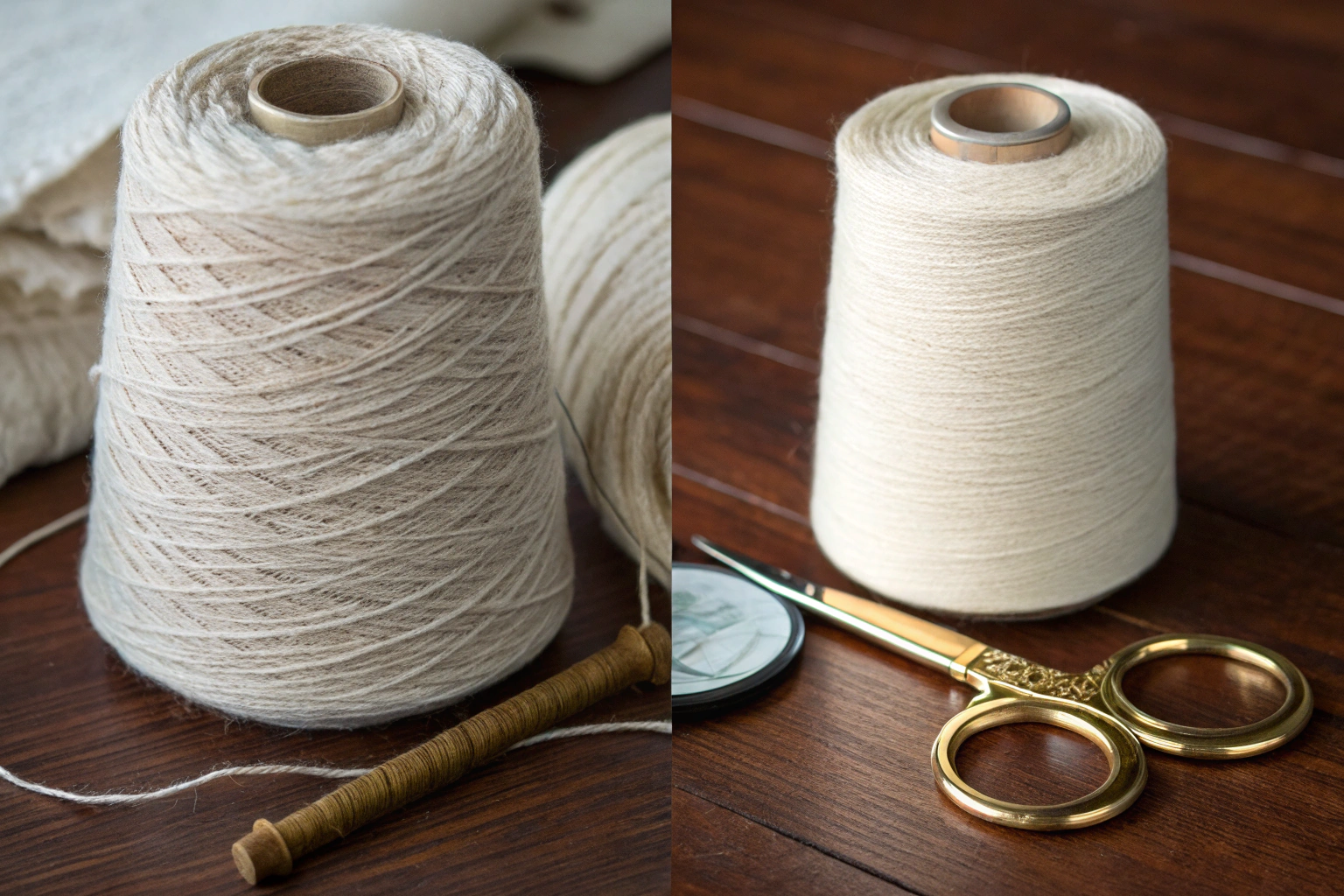
At Shanghai Fumao, we spin both counts across a range of 100% cotton, organic cotton, Tencel blends, and recycled polyester corespun. We stock Ne 30/1 greige and Ne 40/1 greige on the SSP shelves so you can order a custom dye lot without waiting eight weeks for a spin. If your brand is debating whether the bump to Ne 40/1 will pay back on the balance sheet, I have a GSM hand-feel swatch book that shows the same weave in four different counts side by side—Ne 20/1, Ne 30/1, Ne 40/1, and Ne 50/1. You can rub your thumb across the sequence and literally feel the value escalate. Don’t order yarn count like a number. Order it like a texture.
For a custom consultation on exactly which yarn count and ply combination will hit your target drape, opacity, and cost per meter for your next woven or knit program, email our Business Director Elaine at elaine@fumaoclothing.com. Mention the end-use—hotel sheet, dress shirt, summer knit, or workwear—and she’ll send you a calibrated swatch ladder and a spec matrix. Let the numbers create the sensuality. That’s what fine yarn does.