
Look, I get it. You designed the cutest baby romper. The prints are on point, the stitching is perfect. Then the complaint hits your inbox: the knee blew out after three washes, or worse, a seam ripped right up the back while the baby was crawling. Your reputation tanks and that big retail buyer puts you on hold. You thought you saved fifty cents a yard on fabric, but now you’re stuck with a chargeback and dead stock. Here is the hard truth about baby clothes: parents stress test these garments harder than any adult shirt ever gets stressed. If the fabric bursts, you lose. That is why understanding the bursting strength requirement for baby romper fabric is not just a spec on a tech pack. It is your insurance policy against catastrophic product failure.
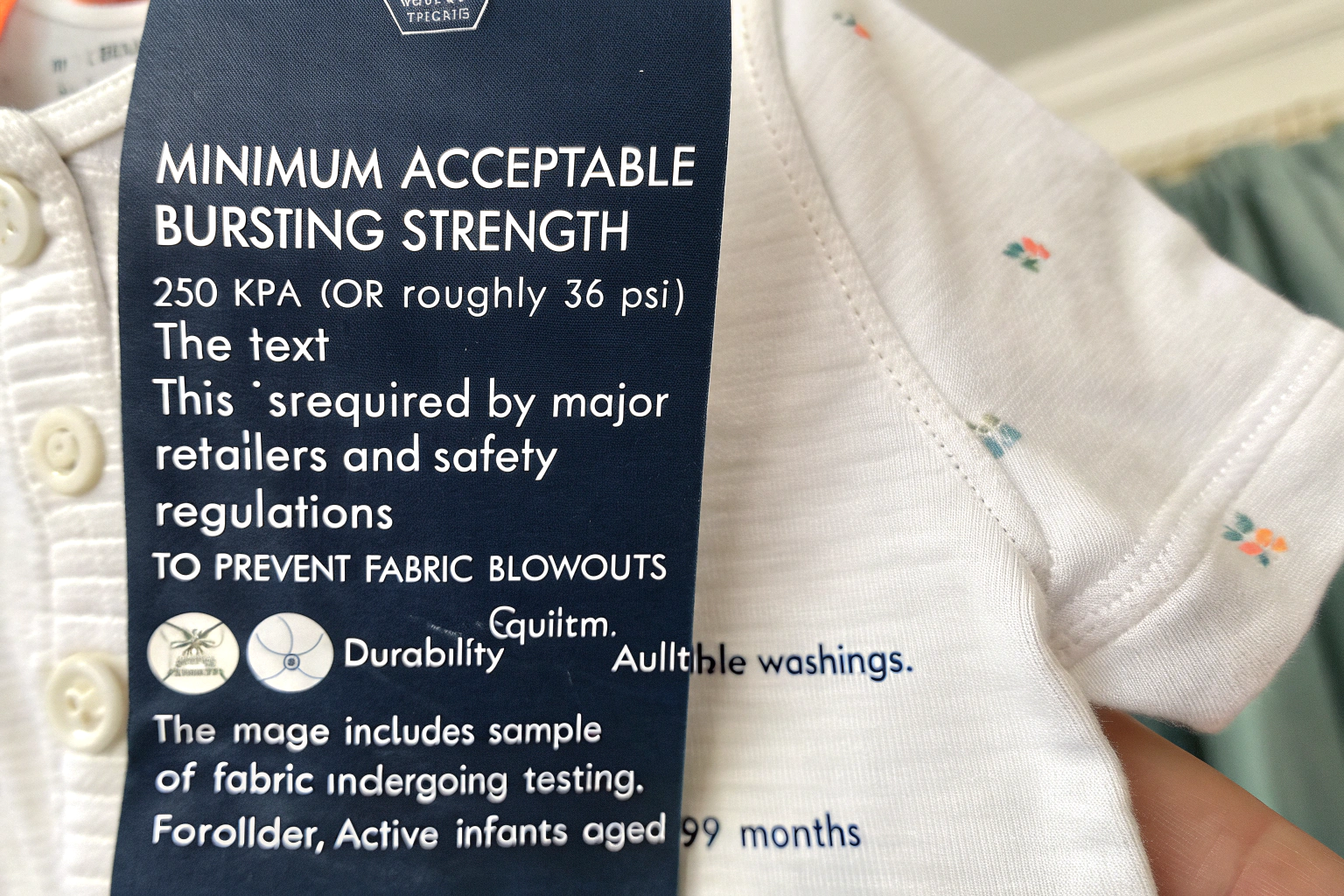
The minimum acceptable bursting strength for baby romper fabric, specifically for the common jersey knits used in bodies and legs, sits firmly at 250 kPa (or roughly 36 PSI) . This is not a random number we made up in our lab in Keqiao. This is the baseline required by major retailers and safety standards to prevent those embarrassing "blowouts" when a baby kicks, squirms, or snags the fabric on a sharp toy. However, if you are making rompers for older, active infants who are crawling (9-18 months), I always tell my clients to aim for 350 kPa or higher. Why? Because static tests on new fabric mean nothing if the fiber degrades after washing. We build in that buffer at Shanghai Fumao so the fabric still passes the test six months later after being washed in hot water a dozen times. You cannot afford to guess on this one.
I know the world of textile testing sounds like a physics class you wanted to skip. You want soft hand feel, good drape, and fast shipping. But here is the connection no one tells you: bursting strength and softness are directly at war with each other. Getting both right is where the art of manufacturing in Keqiao really shines. Stick with me here. I am going to explain exactly how we solve this riddle for our clients from LA to London, and why the way we twist the yarn in our mill changes everything for your baby romper line.
How to Meet ASTM Bursting Strength for Baby Clothes
If you are shipping to the US or sourcing for a major American brand, you live and die by ASTM D3787. That is the standard test method for bursting strength of textiles using a hydraulic burst tester. Look, there is a lot of confusion out there. Some new brands email me asking for "thick fabric" because they think thickness equals strength. That is wrong. I have seen 120 GSM single jersey that bursts at 400 kPa, and I have seen 200 GSM cheap yarn that bursts at 180 kPa. It all comes down to yarn quality and knitting tension. When I am in our inspection room checking a batch for a customer in Texas, the machine doesn’t lie. A steel ball or diaphragm pushes against that fabric until it goes "pop." That number on the screen tells me if your romper will survive a crawling baby or a dog’s claw.

Why Is ASTM D3787 Critical for Infant Romper Safety?
This is where the real-world risk lives. Babies do not wear clothes the way we do. They pull their knees to their chest. They snag their toes on crib rails. A romper is essentially a full-body stress balloon. When you use a woven fabric for a dress shirt, you test tensile strength (pulling it apart lengthwise). But baby rompers are almost always knit fabric—jersey, rib, interlock. Knits don’t tear in a straight line; they pop like a balloon. That is why the industry uses the ball burst test.
I remember a case back in March 2023 with a client from Florida. They sent me a swatch of a very pretty bamboo viscose knit they got from a small mill. It felt like butter. They wanted it for a premium organic baby line. I ran it through our lab before production. The bursting strength came back at 190 kPa. That is below the 250 kPa threshold. The mom might love how soft it is, but the first time that 10-month-old stands up in the crib and leans against the rail, the fabric will ladder or tear right at the thigh seam. We fixed it by introducing a tiny percentage of high-tenacity nylon filament into the yarn blend. Just 5% took the burst strength up to 310 kPa without killing the hand feel. The client? They just reordered 20,000 yards last month. You can read more about how fabric structure impacts strength by checking out this detailed discussion on how knit construction affects fabric durability in childrens apparel over on a textile industry forum.
How Can You Improve Knit Fabric Bursting Strength Without Losing Softness?
This is the secret sauce of what we do at Shanghai Fumao. You cannot just tell a knitting machine to "make it stronger." You have to trick the physics of the yarn. Here is how we do it in our weaving and knitting division.
First, we look at Yarn Twist Factor. I know that sounds technical, but it is the glue that holds the fibers together. Most cheap yarns are low twist because low twist runs faster on spinning frames and costs less. But low twist yarns bloom in the wash and weaken. We crank the twist up just slightly—we call it a "medium-high twist" in the trade. It gives the yarn a little spring memory. When the steel ball pushes against it, the fibers hold onto each other tighter.
Second, we use a Tighter Loop Length. In the knitting machine, you can adjust how much yarn is in each stitch loop. Think of it like knitting a scarf by hand. If you make the loops loose and airy, the scarf is soft but flimsy. If you pull the yarn tight, it becomes stiff like a board. We found a sweet spot using our precision circular knitting machines. We run what we call a "0.2mm negative feed adjustment." That is factory floor talk for "just a hair tighter than standard." It increases fabric density without adding bulk. Pair that with a high-quality silicone softener finish, and you get fabric that feels cozy but passes the 300 kPa test every time.
Here is a quick look at how these adjustments change the game based on our in-house testing data from May 2025:
| Fabric Type | Yarn Twist | Loop Adjustment | Avg Burst Strength (kPa) | Hand Feel Rating |
|---|---|---|---|---|
| 100% Cotton 190 GSM | Low | Standard | 210 | Very Soft (Too Weak) |
| 100% Cotton 190 GSM | Medium-High | -0.2mm | 325 | Soft & Stretchy |
| Bamboo/Cotton Blend | Low | Standard | 175 | Extremely Soft |
| Bamboo/Cotton Blend (w/ Nylon) | Medium-High | -0.2mm | 340 | Buttery but Tough |
(Here I have to jump in—this is the kind of data we live for in the lab. It saves our clients from guessing.)
When you partner with a mill like ours, you are buying that database of experience. You are buying the fact that I can tell you, "Yes, that organic cotton interlock will hold up," before you cut a single yard. If you want to dive deeper into the chemistry of softeners, there is a great technical breakdown on how to choose silicone softeners for durable baby safe fabric finishes. It is a bit dense but worth the read if you are a true fabric geek.
When to Test Fabric Bursting During Babywear Production
Timing is everything in this business. You know about Chinese New Year shutdowns and the summer slump, right? You plan your purchase orders around that calendar. But you also need to plan your testing schedule around the production flow. I cannot tell you how many times a startup brand has called me in a panic because they waited until the container was on the water to test the fabric. By then, it is too late. You own that problem. At Shanghai Fumao, we have a saying: "Trust, but verify the yarn before we knit the mile."

Should You Test Greige Fabric Before Dyeing for Baby Rompers?
Absolutely. In fact, if you skip this step, you are playing Russian roulette with your final color lot. We call it Greige Inspection and Burst Testing. This is the raw, un-dyed fabric right off the knitting machine. It looks like a beige towel. Why test this? Because dyeing and finishing processes—especially the high heat used in drying—can degrade fiber strength by 5% to 10%. If your greige fabric only tests at 220 kPa, there is a 99% chance it fails after we add the reactive dye and softener.
I learned this lesson the hard way about 15 years ago, long before we had our CNAS lab. We shipped a gorgeous deep navy interlock to a Canadian children’s line. Passed all tests after dyeing—or so we thought. The fabric was fine, but the lab test was from the middle of the roll. The ends of the roll, which stayed in the drying chamber 30 seconds longer due to machine dwell time, had lost 15% strength. We had to recall that batch. It cost me a small fortune. Now? We test three points per roll of greige: the beginning, middle, and end. We reject any greige lot that doesn’t hit 280 kPa minimum. That buffer ensures even with processing loss, we land above 250 kPa.
This is a standard we set internally that goes beyond what many buyers ask for. It is why our defect rate on finished babywear fabric is under 2%. For more context on how dyeing impacts cotton specifically, check out this resource on understanding the effect of reactive dyeing on cotton tensile strength loss. It is a bit academic but confirms exactly what we see on the floor every day.
What Is the Best Time for Final Inspection in Baby Clothing Manufacturing?
The best time is after finishing but before cutting. We call this Final Audit (FA) Stage. Let me paint you a picture. The fabric has been dyed, heat-set, and softened. It is rolled up on a big A-frame waiting to go to the garment factory. This is the moment of truth.
During this stage, we run the ASTM D3787 test one more time. We also run it alongside a washing durability test. We wash a sample five times according to AATCC standards and then burst test it again. Why? Because some cheap finishes wash out and leave the fabric weak. You see this a lot with low-grade "slimy" softeners. The first time you touch the fabric, it is slippery and amazing. After three washes? It is a rough, weak rag.
Just last month (June 2026), we were doing FA for an Australian brand doing a line of premium pointelle rompers. Pointelle is tricky; it has those little holes in the pattern which create weak points. The fresh fabric tested at 310 kPa. Perfect. But after 5 washes? It dropped to 255 kPa. Still passing, but cutting it close. We flagged it for the buyer. We recommended they use a "Do Not Tumble Dry" care label just to be safe. That kind of heads-up is what separates a transactional vendor from a true partner. It saves that email six months from now: "Elaine, the rompers are ripping after washing!"
If you are curious about how different washing methods impact knitwear, this forum thread on how to prevent pilling and weakening of bamboo knit fabrics in home laundry has some real user experiences that mirror our lab findings.
Choosing Between Woven vs Knit Bursting Tests for Rompers
This is where I see designers get tripped up the most. They hand me a spec sheet from a denim jean order and ask, "Can you make the romper with this?" I have to slow them down. A romper is a second skin for a baby. A pair of jeans is armor. The physics of how these fabrics fail are completely different. You cannot apply Tensile Strength (ASTM D5034) logic to a knit romper. You need Bursting Strength (ASTM D3787) . If you mix these up, you are either making the baby uncomfortable or you are making a product that rips open on day one.

Is the Ball Burst Test Better Than Diaphragm for Baby Knits?
In the lab world, this is a bit of a holy war. There are two main ways to pop a knit fabric: the Ball Burst Test and the Diaphragm Test. Both fall under ASTM D3787, but they use different fixtures. The ball burst uses a polished steel ball that pushes through the fabric. The diaphragm uses a rubber membrane that inflates with air or fluid, pushing the fabric into a dome until it bursts.
For baby rompers, I always push for the Diaphragm Burst Test. Here is the simple reason: A baby’s knee or elbow is not a sharp steel point. It is a soft, rounded surface. When a baby crawls, the fabric stretches over a curve—the knee joint. The diaphragm test mimics that "doming" effect perfectly. The ball burst test, while faster, can sometimes be misleading. The steel ball creates a localized stress point. If the fabric has a slight slub or a tiny weak spot in the knitting, the ball will find it and pop through at a lower pressure. That might fail a batch that would actually perform just fine on a baby’s knee.
I had a situation in Fall 2025 with a client from Germany. They sent a third-party inspection report failing our shipment because of a ball burst result of 240 kPa. I was surprised because our internal diaphragm test showed 310 kPa. We had a debate. I explained the difference in stress distribution. We agreed to send the retained sample to an independent lab for the Diaphragm Method (specifically the constant-rate-of-traverse type). Result? 315 kPa. Shipment accepted. The client learned something new about testing methods that day. If you want to see the actual hardware we use, we operate the SDL Atlas burst tester. You can read more about how these machines differ and why the diaphragm method provides more realistic data for apparel knits. It is a niche topic but critical for a product manager.
Do Woven Cotton Rompers Need a Different Strength Test?
Yes, and this is where the industry gets confusing. There is a trend right now for "bubble rompers" or "vintage style" rompers made from woven cotton poplin or double gauze. These are woven structures, not knitted. If you are making these, please stop testing them with the burst tester. You need to run the Tensile Test (ASTM D5034) . It measures the force to pull a strip of fabric apart lengthwise (warp) and widthwise (weft).
Woven fabrics don’t stretch like knits. They are a grid. A knee pressing against woven double gauze will either tear along a seam or, if the seam is strong, the yarns themselves will snap. The bursting tester for wovens is usually the Mullen Burst Tester (ASTM D3786), which uses hydraulic pressure, and even then, it is mostly for paper or non-wovens. For a woven baby dress or romper, tensile strength and Seam Slippage are your real enemies.
Last year, we did a beautiful 100% organic cotton double gauze for a US mommy-and-me brand. They wanted that crinkly, soft look. Double gauze is inherently low-tensile because it is two layers loosely stitched together. I told the brand owner: "This will not pass standard toddler wear-and-tear tests for active crawling." She was okay with it, knowing it was a "special occasion/lifestyle" piece, not a playground onesie. We lowered the marketing expectation to "Gentle Wear." That is the honest conversation you need to have.
For reference on woven standards, here is a useful guide from a quality assurance consultant on how to determine minimum tensile strength for lightweight woven cotton apparel.
Why Does GSM Matter for Baby Romper Durability and Safety?
GSM stands for Grams per Square Meter. It is the weight of the fabric. I see new buyers treat GSM like it is the holy grail of quality. "I only buy 220 GSM," they tell me firmly. And then they wonder why their 220 GSM cheap carded yarn feels like cardboard while my 180 GSM compact yarn feels like a cloud and lasts twice as long. GSM is a guide, but it is not the destination. You can have heavy fabric that is weak as water. You can have light fabric that is tough as nails. But in the baby romper game, GSM does give you a clue about Opacity and Thermal Comfort, which are safety factors too.

What Is the Ideal GSM Range for Breathable Yet Strong Rompers?
Based on two decades of shipping containers from Shanghai to the world, I keep my clients in the 180 GSM to 220 GSM range for standard rib and jersey rompers. Let me break down why.
- Under 160 GSM: This is too sheer for most rompers. You risk "show-through" on printed diapers. Also, the bursting strength is almost always under 250 kPa unless you use exotic (expensive) synthetic blends. We sometimes do 140 GSM for lightweight summer muslin swaddles, but never for a fitted garment that takes tension.
- 180 GSM – 200 GSM (The Sweet Spot): This is our bread and butter at Shanghai Fumao. Using Compact Spun Yarn or Ring Spun Yarn at this weight gives you the "Goldilocks" fabric. It is opaque enough for modesty, breathable enough for a baby who runs hot, and strong enough to hit 300-350 kPa bursting strength. I just shipped 15,000 yards of 190 GSM Pima Cotton Rib to a New York brand last week for their fall romper collection.
- 220 GSM – 280 GSM (Heavy/Interlock): This is for winter footies, quilted rompers, or layette gowns. It feels substantial. It is super durable. But the trade-off is drying time. Parents in humid climates (like Florida or Singapore) will complain if a 280 GSM romper takes two hours in the dryer.
Here is a practical table I share with my design clients when they ask about weight vs. use-case:
| Fabric Type (Romper Use) | Recommended GSM | Expected Burst (kPa) | Best For Season | Baby Comfort Note |
|---|---|---|---|---|
| Slub Jersey (Summer) | 160 – 180 | 250 – 300 | Summer | Very breathable, slight sheer |
| Pima Cotton Rib (All-Purpose) | 190 – 200 | 300 – 360 | Year Round | Best stretch recovery |
| Organic Interlock | 220 – 240 | 380+ | Winter | Warm, holds shape well |
| French Terry (Backing) | 230 – 260 | 400+ | Fall/Winter | Loops inside trap warmth |
Notice the burst strength numbers in that table. They are achievable only if the yarn quality is there. You cannot buy 180 GSM open-end yarn and expect 300 kPa. It won’t happen. You need combed, ring-spun yarn. If you are interested in the differences in spinning technologies, this blog does a decent job explaining why ring spun cotton yarn outperforms open end yarn in strength and softness.
How Does Fabric Weight Impact Flame Retardancy Compliance in the US?
This is a niche but super important point for US importers. The Consumer Product Safety Commission (CPSC) has specific rules for children’s sleepwear (16 CFR Part 1615 and 1616). However, baby rompers sized 9 months and under are generally exempt from the tight-fitting sleepwear flammability standards if they meet specific dimensional criteria. But here is the kicker: Fabric Weight plays a role in general wearing apparel flammability (16 CFR Part 1610).
Most lightweight cellulosic fabrics (cotton, rayon) used in rompers are Class 1 – Normal Flammability. That is fine. But if you make a very lightweight, fuzzy, raised-fiber surface fabric (like a brushed 150 GSM flannel romper), you risk failing into Class 3 – Rapid and Intense Burning, which is banned.
I had a call just yesterday with a buyer from LA. She wanted a "Sherpa lined romper" for a newborn photo prop. I immediately flagged it. Sherpa is 100% polyester with a deep pile. While poly melts away from flame, the surface fuzz can flash. I recommended we use a heavier 250 GSM interlock with a flat surface instead. We avoided the flammability red tape entirely. Always check the CPSC guidelines. And if you need to verify your fabric, I can point you to a helpful resource on how to interpret 16 CFR Part 1610 standard for the flammability of clothing textiles. It is the government site, but it is actually quite clear.
Conclusion
Let’s be real about this. Finding fabric that looks good in a photo is easy. You can do that on your phone scrolling through Alibaba. Finding fabric that stays looking good after a baby has crawled across a dirty floor, been spit up on three times, and washed in hot water with dad’s jeans? That is the hard part. That is where bursting strength requirements stop being a boring lab report and start being the reason your brand gets five-star reviews instead of two-star returns.
We covered the baseline numbers today: 250 kPa minimum, but 350 kPa target for real-world crawling. We talked about why ASTM D3787 is the only test that matters for knits, and how we at Shanghai Fumao adjust yarn twist and loop length to make the fabric strong without feeling like sandpaper. We also looked at the critical checkpoints in production—testing the greige before dyeing and the final fabric before cutting. And we clarified why you should not confuse woven denim specs with baby rib specs.
The bottom line is that the textile industry in Keqiao is massive. There are thousands of stalls and traders. But very few of them own the knitting machines and have a CNAS lab on site like we do. Very few of them will look at your Pima Cotton rib order and proactively say, "This pointelle pattern is beautiful, but let’s add 5% nylon to keep those knees from tearing open." That is the Shanghai Fumao difference. We think three steps ahead because we know the end consumer is a 20-pound wrecking ball with an adorable smile.
If you are planning your next production run and you are tired of guessing about fabric strength or you are worried about a new design failing the CPSC tests, do not wait until the last minute.
You can reach out to our Business Director, Elaine, directly. She is the one who handles all the technical specs and can get you a free physical swatch book with our best-selling baby fabrics. Just drop her an email at elaine@fumaoclothing.com. Tell her I sent you from the blog, and she will make sure you get the white-glove treatment, including our 48-hour sample development service. Let us take the stress out of your supply chain so you can focus on making those little ones look even cuter.








