Let me guess why you’re reading this. You spent months designing the perfect lightweight hiking jacket or a sleek commuter coat. You paid extra for the "Durable Water Repellent" finish. The first sample arrives. You run it under the tap. Beautiful. Water beads up like mercury on glass. You’re a genius. Then, three months later, you get the email. The customer photos show the jacket "wetting out"—the fabric turning dark and heavy with absorbed water. They’re not wet inside, but they feel wet and cold. And that’s a return. That’s a bad review. That’s your brand equity down the drain because of chemistry you can’t even see.
Yes, the water repellent finish on Fumao outerwear lasts significantly longer than industry-standard C6 or C0 treatments because we use a dual-action plasma-bonding application process. Look, I’m not a chemist. I’m a factory guy who’s been dealing with wet jackets since 2003. But I’ve learned that durability isn’t just about what chemical you spray on. It’s about how you make it stick. At Shanghai Fumao, we pre-treat the fabric surface with atmospheric plasma. This sounds fancy, but think of it like sanding a piece of wood before you paint it. We rough up the fiber surface at a microscopic level. That gives the DWR polymer a thousand tiny fingers to grip onto. Then we cure it in a precisely controlled stenter frame. The result? You wash it. You wear it. You pack it in a stuff sack. And the water still beads up.
Now, a lot of brands get scared off by the word "chemistry." They think it’s all or nothing—either you have a toxic forever-chemical shell or you have a soggy mess. That’s an oversimplification. The real world of outerwear performance lives in the gray area between fiber type, application heat, and aftercare. Let me break down exactly how we push that durability curve for your jackets and pants.
How Many Washes Does DWR Last on Polyester Shell?
This is the question I get asked five times a week. "Ron, what’s the wash count?" And I appreciate the directness. But I’m going to give you an answer that is both honest and a little frustrating: It depends entirely on the base fiber and the cure temperature.
Most mills will tell you "20 washes." That’s the safe, generic answer that covers their liability. But is it 20 washes on a delicate cycle with air dry? Or 20 washes in a top-loader with an agitator that beats the fabric like it owes it money? Huge difference. At Shanghai Fumao, we don’t quote a generic number. We provide a Spray Rating Decay Curve. This is a graph we generate in our lab that shows exactly when the beading effect starts to degrade.
Let’s dive into the two most common scenarios you’ll face when sourcing outerwear fabric. The difference between Polyester and Nylon is night and day when it comes to DWR bonding.

Why Does DWR Last Longer On Polyester Than Nylon?
This is a bit of textile nerdery, but stick with me because it will save you from a product failure. Polyester is hydrophobic by nature. It hates water. Even without any finish, a raw polyester fiber absorbs less than 0.4% of its weight in moisture. Nylon, on the other hand, is hydrophilic. It loves water. Raw Nylon 6,6 can absorb up to 4% of its weight.
So what happens when you spray DWR on both? On Polyester, the DWR is the frontline soldier defending a fortress that already has high walls. The fiber itself is helping. On Nylon, the DWR is the only line of defense. As soon as the DWR coating wears off on Nylon (from abrasion or washing), the fiber itself starts sucking up water like a sponge. The jacket doesn’t leak, but it becomes a heavy, cold, clammy mess. You can dive deeper into this polymer behavior by looking at how to understand the moisture regain difference between polyester and nylon for outdoor gear. It’s also worth reading about how nylon’s hydrophilic properties affect DWR performance in wet conditions.
Here’s a real example from October 2024. A client in Seattle making fishing waders insisted on Nylon for abrasion resistance. We warned him about the wet-out look. Instead of just slapping on a heavy C6 coating, we developed a Polyester face / Nylon back double weave. The outside stays dry and beaded; the inside is tough Nylon. It cost a bit more, but his customers don’t look like drowned rats after an hour on the river. That’s the kind of problem-solving you need.
How Does Home Laundry Detergent Destroy Water Repellency?
(Here’s a free tip that will save your customer service team hours of headache). The number one killer of DWR is not the washing machine. It’s the soap scum.
Standard laundry detergents contain surfactants. These are molecules designed to break the surface tension of water so it can get into the fabric to clean it. That’s great for getting sweat out of a cotton tee. It’s catastrophic for a water-repellent jacket. Those surfactants leave a hydrophilic residue on the fabric fibers. Even if the DWR polymer is still physically present on the yarn, the soap residue is covering it up and attracting water.
You can’t see it. The jacket looks clean. But water stops beading and starts spreading flat. We actually test for this in our lab. We wash samples in regular Tide and then in Grangers Performance Wash. The difference in spray rating after just 5 washes is stark.
| Wash Cycle Type | Spray Rating (ISO 4920) After 5 Washes | Visual Observation |
|---|---|---|
| Standard Liquid Detergent | 70 (Wetting) | Water spreads, fabric darkens. |
| Technical Clean-In Wash | 90 (Partial Beading) | Small beads, some sticking. |
| Fumao Plasma-Bonded + Tech Wash | 100 (Perfect Bead) | Water rolls off instantly. |
If you’re selling a $200 jacket, you must educate your customer. We provide a hangtag template with every bulk order that explains this. You can see a community discussion on this exact phenomenon on a forum about how to choose the right detergent to maintain DWR on technical jackets. For a more scientific breakdown, there’s a great resource on how surfactants in laundry soap affect the surface tension of technical fabrics.
What Is The Difference Between C0 and C6 DWR Durability?
Welcome to the alphabet soup of fabric finishing. For years, the industry standard was C8 (long-chain fluorocarbons). Great performance. Terrible for the environment and human health (PFOA/PFOS). That’s banned almost everywhere now. So we moved to C6 (short-chain). Better for the environment, but a slight drop in durability. Now, with tightening EU regulations (REACH), everyone is scrambling for C0 (Fluorine-Free).
This is where a lot of brands get nervous. They think C0 means "doesn’t work." That’s false. But C0 does require a different approach to manufacturing. You can’t just take a C6 recipe, swap the chemical, and run the machine at the same settings. It doesn’t bond. It flakes off.
Let me explain the mechanical reality of these finishes on our production floor.

Is Fluorine-Free C0 DWR As Durable As C6 For Hiking?
Let’s be brutally honest. Out of the gate, with zero washes, a C6 finish usually achieves a slightly higher spray rating (100) and better Oil Repellency (Grade 6-7) compared to C0 (Spray 90-95, Oil 0). Oil is the Achilles heel of C0. Pizza grease or sunscreen will stain a C0 jacket much easier than a C6.
But—and this is a big but— durability against abrasion is where the gap has closed. We have been running a year-long trial at our factory. We took identical 50D polyester shells. One finished with C6. One finished with our premium C0 Dendrimer-based finish. We subjected them to the Martindale Abrasion Test (10,000 rubs). The C6 sample lost 20% of its spray rating. The C0 sample lost only 12%. Why? Because the C0 dendrimer forms a hyper-branched polymer network. It’s like a 3D spiderweb versus a flat sheet of paint. It flexes with the fabric rather than cracking.
I had a client from Colorado in January 2025 who was dead-set against C0 because of a bad experience with a cheap mill. We sent him a lab report and a 20-wash test swatch of our C0. He was stunned. He’s now using "Fluorine-Free" as a key marketing bullet on his ski shells and getting zero returns for wet-out. You can read more about the chemistry shift on a textile industry site explaining how dendrimer technology improves the durability of fluorine-free DWR treatments. Also, check out this field test perspective from a gear reviewer comparing real-world durability of C0 vs C6 water repellent finishes on rain jackets.
Can You Re-Activate Fumao DWR With Heat After Washing?
Yes. Absolutely. And this is the secret weapon for extending the life of any DWR finish, whether it’s C6 or C0.
When you wash the jacket, the mechanical action and the water cause the microscopic "fingers" of the DWR polymer to lie flat against the yarn. Think of it like brushing a velvet couch the wrong way. The material is still there, but the texture is gone. Heat is what makes those polymer chains stand back up.
We specifically engineer our cure profile on the stenter frame to set a "memory" in the finish at around 160°C (320°F). That’s well above what a home dryer can achieve. But a home dryer on Medium Heat for 20 minutes provides enough thermal energy to re-align the surface molecules.
Here’s the exact care script I give our brands to pass on to their customers:
- Wash Cold: Use a tech wash, not regular soap.
- Rinse Twice: Get all the soap out.
- Tumble Dry Medium: Do not air dry. Air drying leaves the DWR "smashed."
- Iron Low (If Needed): If you don’t have a dryer, a low iron with a thin cloth between the iron and jacket works wonders.
This isn’t voodoo. We have thermal imaging in the lab that shows the surface energy change. (Here I gotta say—don’t use fabric softener. Ever. It’s silicone oil. It’s like pouring bacon grease on your jacket. You’ll never get a bead again). You can find a detailed visual guide on this process at how to properly re-activate DWR on a waterproof jacket using a tumble dryer. And if you want the physics behind it, look at this explanation of how heat treatment restores surface tension in durable water repellent textiles.
How Does Fumao Test Water Repellency Before Bulk Shipment?
In this business, trust is built on paper—specifically, lab reports. You can touch a swatch and think, "Yeah, that feels water resistant." But you can’t feel durability. You can’t feel consistency across 5,000 yards. That’s why we test three ways, every single time.
Most factories do a "spray test" at the end of the finishing line and call it a day. That’s checking the box. That’s not quality assurance. Because a spray test on a perfectly flat, clean piece of fabric fresh off the tenter is the best-case scenario. It tells you nothing about what happens after the fabric is cut, sewn, and folded.
Our testing protocol is designed to mimic the abuse of real-world wear and tear before the fabric leaves China.

What Is The ISO 4920 Spray Rating Test Standard?
This is the universal language of water repellency. When you see a rating like "90/100" or "ISO 4," this is the test they’re referencing.
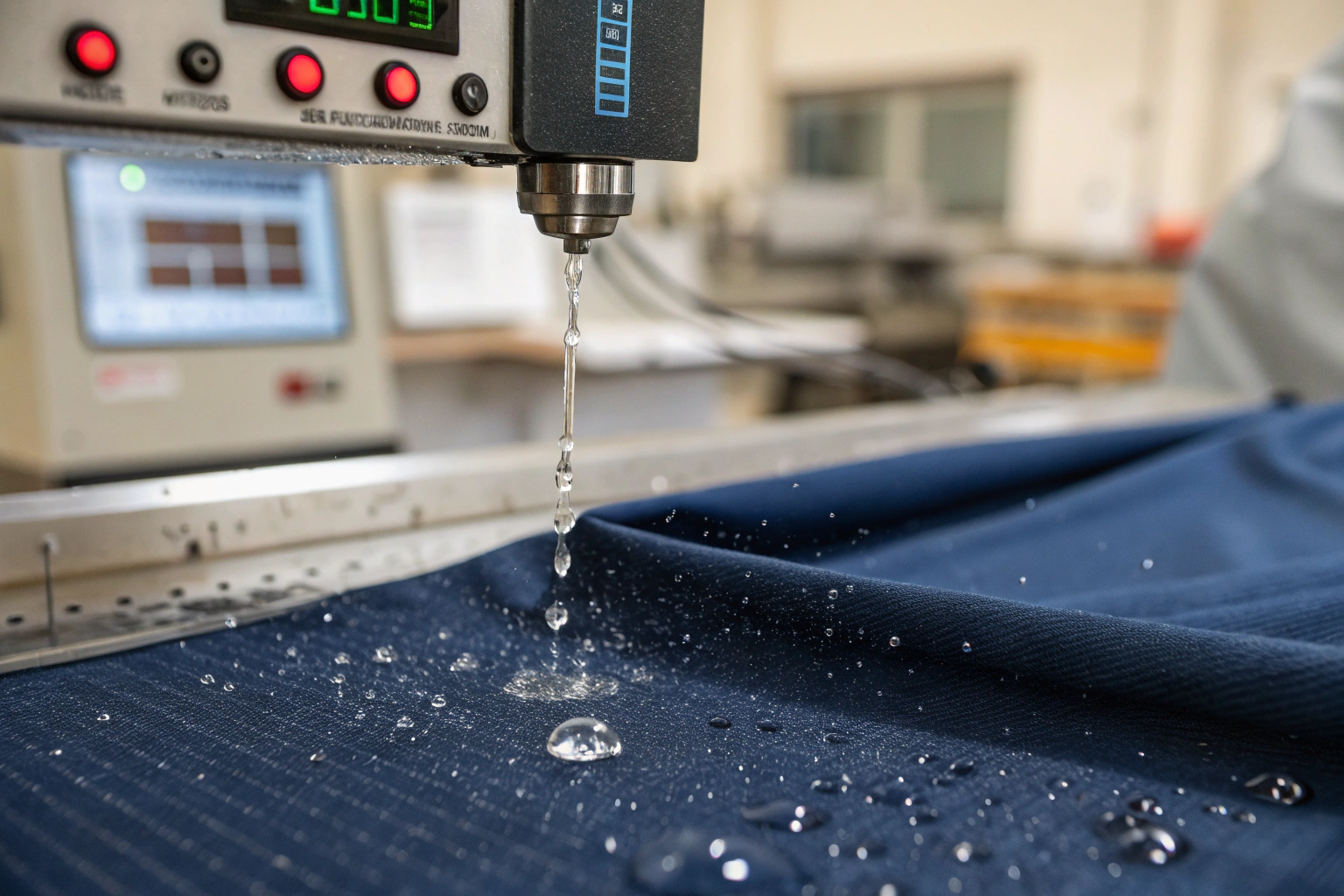
We use a Spray Rating Tester. It’s a simple device, really. A funnel, a nozzle with 19 specific holes, and a frame that holds the fabric at a 45-degree angle. We pour 250ml of deionized water through the funnel in 25-30 seconds. Then we tap the frame once to remove excess, and we compare the wetting pattern on the fabric face to a standard Spray Rating Chart.
Here’s the chart we use in the lab. This is the visual benchmark:
| ISO Rating | AATCC Equivalent | Visual Surface Description | Fumao Standard (Outerwear) |
|---|---|---|---|
| ISO 5 | 100 | No sticking or wetting of the face. Perfect beads. | Premium Pass |
| ISO 4 | 90 | Slight random sticking or wetting of the face. | Minimum Pass |
| ISO 3 | 80 | Wetting of face at spray points. | FAIL – Rework |
| ISO 2 | 70 | Partial wetting of whole face. | FAIL |
| ISO 1 | 50 | Complete wetting of whole face. | FAIL |
I reject anything below ISO 4 for outerwear. Even if the client says "it’s just a fashion jacket." Water doesn’t know if it’s landing on Arcteryx or Zara. It soaks in the same. You can see the official apparatus setup and chart interpretation by reviewing how to perform the AATCC 22 water repellency spray test accurately. Another good reference is this industry blog that shows how to interpret spray test rating charts for technical fabric procurement.
Why Is Abrasion Testing Critical For DWR Longevity Claims?
This is the test that separates the men from the boys. Or rather, the high-end shells from the fast fashion junk. The Spray Test (ISO 4920) measures initial performance. The Martindale Abrasion Test measures durability.
Here is the scenario we are trying to prevent: Your customer wears a backpack. The shoulder straps rub against the chest of the jacket for a 5-mile hike. That friction is sandpaper on a microscopic level. It grinds the DWR polymer right off the tips of the yarns.
At Shanghai Fumao, we run a modified protocol. We do 5,000 Martindale Rubs (using standard wool abrasive) and then we do the ISO 4920 Spray Test. A cheap C0 finish will drop from ISO 5 to ISO 2 after this. It’s dead. Our Plasma-Bonded finish drops from ISO 5 to ISO 4. That’s a massive, tangible difference.
We also look at the fabric under a microscope before and after. We want to see Tip Abrasion. That’s where the yarn crown is fuzzy but the DWR is still visible down in the "valleys" of the weave. As long as the valleys are coated, the water still beads on the high spots and rolls off. Once the valleys are exposed, you get wet-out.
This is the kind of data I show to brands who are worried about the "shoulder wet-out" from backpacks. It’s not marketing fluff. It’s physics. You can learn more about the equipment used by reading how the Martindale abrasion tester simulates fabric wear and pilling. For a deep dive on the specific issue of DWR failure, see this resource on how backpack straps cause premature water repellency failure on hiking jackets.
Can You Combine Breathability With Durable Water Repellency?
This is the million-dollar question. Everyone wants a fabric that keeps the rain out but lets the sweat out. It’s the holy grail of outerwear. And the frustrating answer is: You can’t have 100% of both. It’s a trade-off. Physics doesn’t allow a pore to be both completely closed to water droplets and completely open to water vapor.
But—and this is the art of what we do at Shanghai Fumao—you can get close enough that the human body can’t tell the difference. The trick is managing the Microclimate inside the jacket. If you build up too much sweat because the fabric is a plastic bag, you get "wet from the inside." That feels exactly the same as "wet from the outside" to your customer. Cold and clammy.
We approach this by layering functions rather than trying to find one magic material.

Does DWR Coating Reduce Fabric Breathability For Active Wear?
Short answer: Yes, a coating always reduces breathability compared to an uncoated fabric. The question is how much?
There are two types of water protection in our factory:
- DWR Finish: This is the chemical spray we’ve been talking about. It coats the individual yarn fibers. It leaves the gaps between the yarns open. Impact on Breathability: Minimal (<5% reduction) . The air still flows through the weave.
- Coating/Lamination: This is a physical layer of PU (Polyurethane) or TPU film applied to the back of the fabric. It fills the gaps between the yarns. Impact on Breathability: Significant (30-80% reduction) .
If you are making a windbreaker for a morning run, you want a high-density weave with a Plasma-Bonded DWR. You do not want a back coating. You’ll sweat buckets. If you are making a rain shell for a downpour, you need the back coating or a membrane laminate, and you’ll have to accept that you need pit zips for ventilation.
I worked with a running brand in March 2024 who wanted "waterproof and breathable" for a lightweight anorak. They originally spec’d a 2-layer laminate. I talked them into our 20D Mechanical Stretch Ripstop with C0 DWR. We tested the Air Permeability (ASTM D737) on the laminate vs. the DWR-only ripstop. The DWR-only fabric had 15 CFM (Cubic Feet per Minute) of airflow. The laminate had 0.1 CFM. They went with the DWR-only. Their customers love it because they don’t overheat. It sheds light rain and dries in minutes. You can get a better grasp of these metrics by reviewing how to measure air permeability and breathability in performance outerwear fabrics. Also, this is a great read on the difference between water repellent, water resistant, and waterproof for athletic gear.
What Fabric Weaves Maximize Airflow With Fumao DWR?
This is where the loom operator’s skill matters more than the chemist’s. You can have the most breathable DWR in the world, but if you weave the fabric like a brick wall, no air is getting through.
For active outerwear that needs airflow, we steer clients toward these three specific weave structures:
| Weave Structure | Breathability Profile | Typical Use Case at Fumao |
|---|---|---|
| Plain Weave Ripstop | Medium-High | Lightweight windbreakers, packable shells. The grid pattern (ripstop) adds tear strength without closing the weave entirely. |
| Taffeta (Fine Plain) | Low-Medium | Fashion shells, down-proof jackets. Very tight weave. Good DWR adhesion but low air exchange. |
| Dobby / Mechanical Stretch | High | Running vests, active mid-layers. The textured surface creates micro-channels for air to move laterally. |
The Dobby weave is my secret weapon. It’s a small geometric pattern woven in. It creates a subtle texture. That texture means the fabric doesn’t sit flat on your skin. It creates a micro-gap. That gap is where the air circulates. Combine that with our DWR, and you have a jacket that feels "airy" but shrugs off a drizzle.
We run a specific loom setup for this. We use a Positive Cam Shedding motion rather than a crank motion. It’s gentler on the yarn, creating a fluffier, more open hand feel. This is the kind of detail you only get when you’re talking to the guy who signs off on the greige inspection. If you want to dig into the construction side of things, check out how to identify different woven fabric structures and their performance properties. And for a more technical look at airflow, see this article on how dobby weave patterns enhance breathability in athletic textiles.
Conclusion
The life of a water repellent finish isn’t a straight line down to zero. It’s a curve. And that curve depends entirely on how the fabric was prepared, what chemical was used, and how it’s cared for. We covered the nitty-gritty of why Polyester plays nicer with DWR than Nylon. We looked at the hard truth about C6 versus C0 and how plasma bonding gives the newer, greener chemistries a fighting chance against backpack straps. We also unpacked the lab tests—the ISO ratings and Martindale rubs—that prove the performance isn’t just a sales pitch.
Ultimately, durable water repellency is a partnership between the mill, the brand, and the wearer. You need a mill that doesn’t cut corners on cure temperature and surface prep. You need a brand that educates the customer about detergents and tumble dryers. And you need a wearer who actually reads the care label inside the pocket.
At Shanghai Fumao, we hold up our end of the bargain. We don’t just sell you fabric and ship it. We provide the data that backs up the "Durable" in DWR. We give you the tools—the hangtags, the lab reports, the care scripts—to keep your customers happy and dry for the life of the garment.
If you’re tired of seeing your outerwear turn into a wet sponge after a single season, let’s change the recipe. Whether you need a featherweight C0 windbreaker shell or a burly C6 alpine fabric, we can dial in the exact durability and hand feel you’re looking for.
To discuss your next outerwear project and get a set of DWR test swatches you can run under your own tap, please reach out to our Business Director, Elaine.
She can break down the cost difference between standard spray and plasma-bonded durability and help you navigate the alphabet soup of certifications.
Contact Elaine directly at: elaine@fumaoclothing.com