
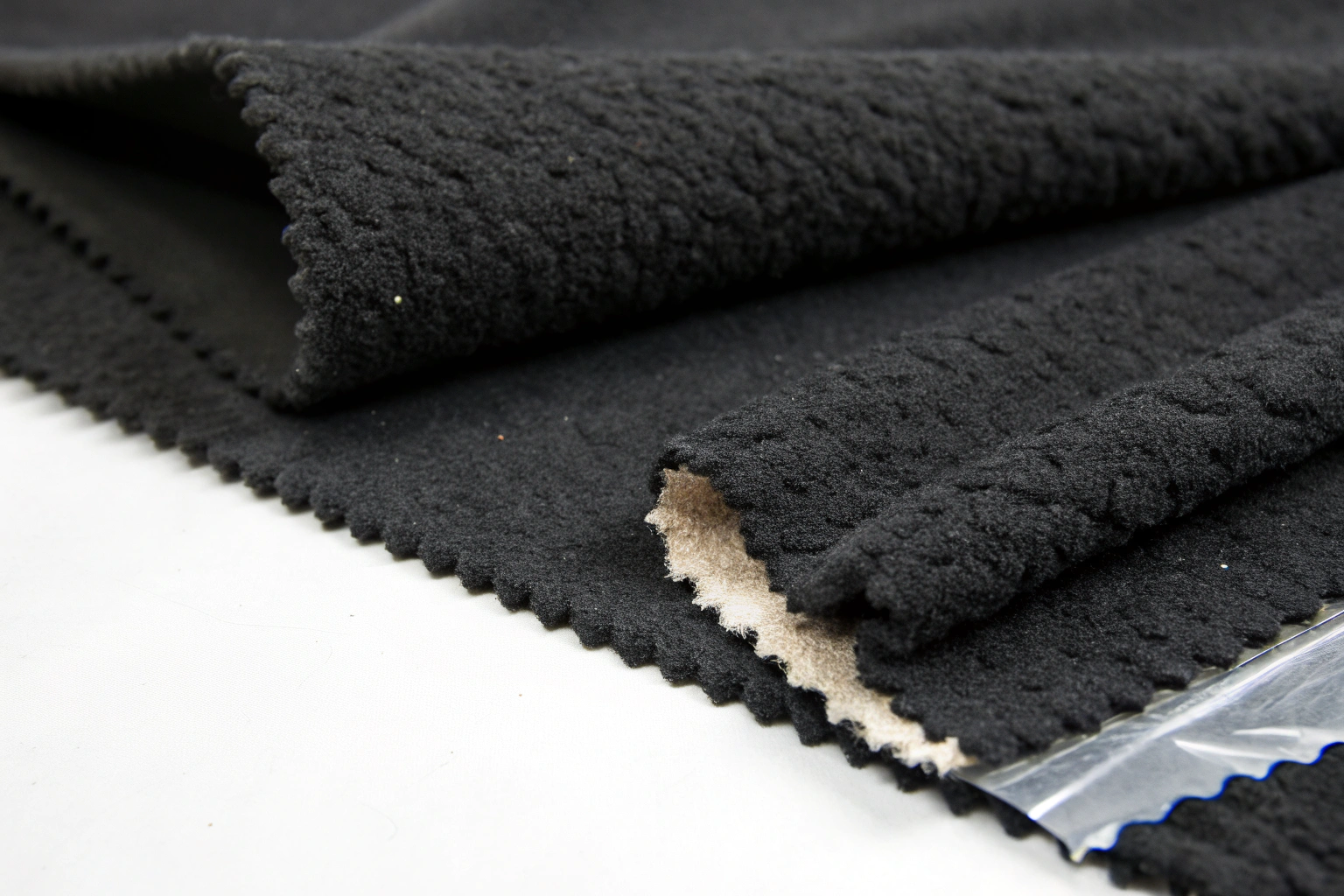
I was standing in my warehouse last winter with a client who runs a successful streetwear brand. He was furious. He had just received a container of black fleece hoodies from another supplier. He pulled one out of the box, held it up, and shook it. A cloud of black lint filled the air. It looked like a snow globe full of soot. He put the hoodie on over a white t-shirt. Five seconds later, he took it off. The white t-shirt was covered in black fuzz. He looked at me and said, "I can’t sell this. My customers will destroy me in the reviews. What am I supposed to do with 5,000 lint grenades?"
I felt for him. I really did. Lint shedding is one of the most common and most infuriating quality failures in knit fabrics. It destroys the customer experience. It ruins other clothes in the wash. And it makes a premium garment feel cheap and disposable.
At Shanghai Fumao, we have spent years engineering our fleece programs to eliminate this problem. High-quality fleece does not shed lint. It just doesn’t. And the reason it doesn’t is not magic. It is a specific combination of yarn selection, knitting structure, and finishing processes that lock the fibers into place. Let me explain exactly what causes shedding and exactly what we do in our mill in Keqiao to make sure our fleece stays on the garment, not on your customer’s couch.
This is the kind of quality issue that gets worse when you are rushing. During peak production in March-May or August-October, some mills skip the anti-pilling finish to save a day. That’s a false economy. Planning your fleece orders properly, just like we advise clients to finish pre-production 6 weeks before Chinese New Year, gives us the time to do every step right.
What Causes Fleece Fabric to Shed and Pill Excessively?
To understand why fleece sheds, you have to understand how fleece is made. Fleece is not a flat fabric. It is a three-dimensional structure. It starts as a basic knit fabric, usually a jersey or a terry knit. Then it goes through a violent mechanical process called napping or brushing. The fabric is fed through a machine with rotating metal cylinders covered in sharp wire teeth. These teeth rip into the surface of the yarn, pulling the fibers up and out to create that soft, fuzzy "pile" that we associate with fleece.
That napping process is a controlled act of destruction. You are intentionally breaking fibers to create the soft handfeel. The problem arises when you break too many fibers, or when the fibers you have are too short and weak to stay anchored in the yarn core. Once a fiber is broken and pulled to the surface, it is held in place only by friction and entanglement with its neighbors. If it’s not locked in tightly, it will simply fall out. That’s lint shedding. If it tangles with other loose fibers on the surface, it forms a little ball. That’s pilling.
The severity of shedding and pilling is determined by three main factors: Fiber Type, Yarn Quality, and Finishing Process. A failure in any one of these three areas will result in a fleece that sheds like a nervous cat in summer.
How Does Staple Length Affect Lint Shedding in Cotton Fleece?
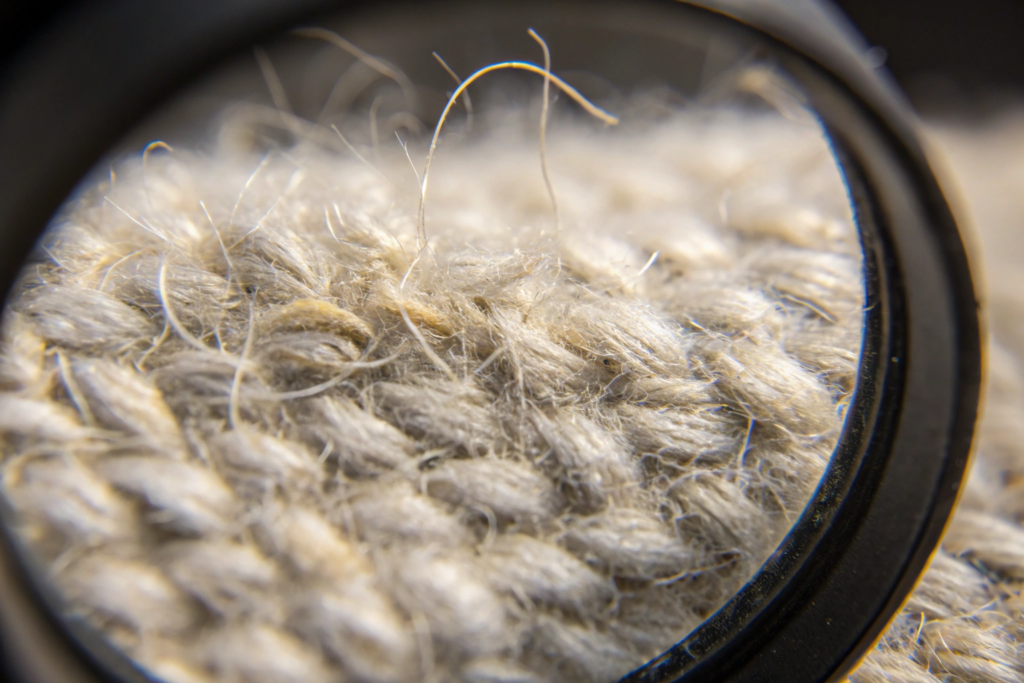
This is the single most important technical factor. Let me explain Staple Length. Cotton fibers are not continuous filaments like polyester. They are short little hairs that grow on the cotton seed. The average length of these fibers is the staple length. It is measured in inches or millimeters.
- Short Staple Cotton: Fiber length less than 1 1/8 inches (about 28 mm). This is the cheap stuff. It’s used for denim and low-cost basics.
- Long Staple Cotton: Fiber length 1 1/8 to 1 1/4 inches.
- Extra Long Staple (ELS) Cotton: Fiber length over 1 3/8 inches (35 mm). This includes premium varieties like Supima (American Pima) and Egyptian Giza.
Here is the physics of it: When you spin yarn, you are twisting these short fibers together. The longer the fiber, the more points of contact it has with its neighboring fibers. A 35mm ELS fiber has significantly more contact area and friction inside the yarn than a 25mm short staple fiber.
When the napping machine hits a yarn made of short staple fibers, those fibers are already weakly held. The wire teeth easily pull them completely out of the yarn. They become loose lint. When the napping machine hits a yarn made of ELS cotton, the fibers are deeply anchored. The wire teeth can lift the fiber to create the soft pile, but they cannot easily extract it. The fiber stays anchored at its midpoint.
At Shanghai Fumao, for our premium anti-pill fleece, we specify a minimum staple length of 30mm and we blend it with a percentage of TENCEL™ or Modal, which are continuous filament fibers cut to a long staple. This blend creates a yarn core that is incredibly strong and resistant to fiber pull-out. If you are sourcing how to choose low lint shedding cotton fleece for apparel brands, the first question to ask is: "What is the staple length of the cotton used?" If the answer is "regular cotton" or they don’t know, expect shedding.
Why Do Polyester and Cotton Blends Sometimes Shed More?
This seems counter-intuitive. Polyester is a strong, continuous filament fiber. You would think adding it to cotton would make the fleece stronger and shed less. And sometimes it does. But sometimes it makes it worse. Here is why.
The problem is differential abrasion. In a blend like 60% Cotton / 40% Polyester, the cotton fibers are short and relatively weak. The polyester fibers are long, strong, and slippery. When the napping machine hits this blended yarn, the wire teeth grab both fibers. The weak cotton fibers break and pull out easily. The strong polyester fibers do not break. They just get pulled to the surface and sit there.
Now you have a fleece surface covered in long, slick polyester filaments that are still anchored at one end but loose at the other. These filaments don’t easily fall out as lint. But they do pill. They wrap around the broken cotton fibers and form hard, shiny little balls that are incredibly difficult to remove. This is the classic "polyester pill" that makes a garment look old and worn after just a few washes.
The key to a good cotton/poly fleece blend is using high-quality, long-staple cotton as the majority fiber. The cotton provides the soft, absorbent handfeel. The polyester (or better yet, recycled polyester) provides strength and shape retention. But the ratio and the fiber quality matter immensely. We find that a 70% Cotton / 30% Polyester blend with a 30mm+ cotton staple length performs best. It minimizes the weak fiber pull-out while still getting the durability benefit of the poly.
I had a client in October 2025 who was using a 50/50 blend from another supplier. The pilling was atrocious. We switched them to our 80% BCI Cotton / 20% Recycled Polyester fleece. The cost per yard went up by $0.40. Their return rate for "pilling" dropped by 70% in the first season. The higher upfront fabric cost was more than offset by the reduction in returns and the improvement in customer reviews. If you are dealing with how to reduce pilling in cotton polyester blend fleece, focus on the cotton staple length. Don’t let them use cheap, short-staple cotton just to hit a price point. You’ll pay for it later in returns.
How Does Fumao’s Finishing Process Lock Fleece Fibers in Place?
Weaving or knitting the fabric is only half the battle. The finishing process is where the fleece is born, and it’s also where the shedding problem is either solved or made permanent. You can have the best yarn in the world, but if you brutalize it in the finishing department, you will create a lint monster.
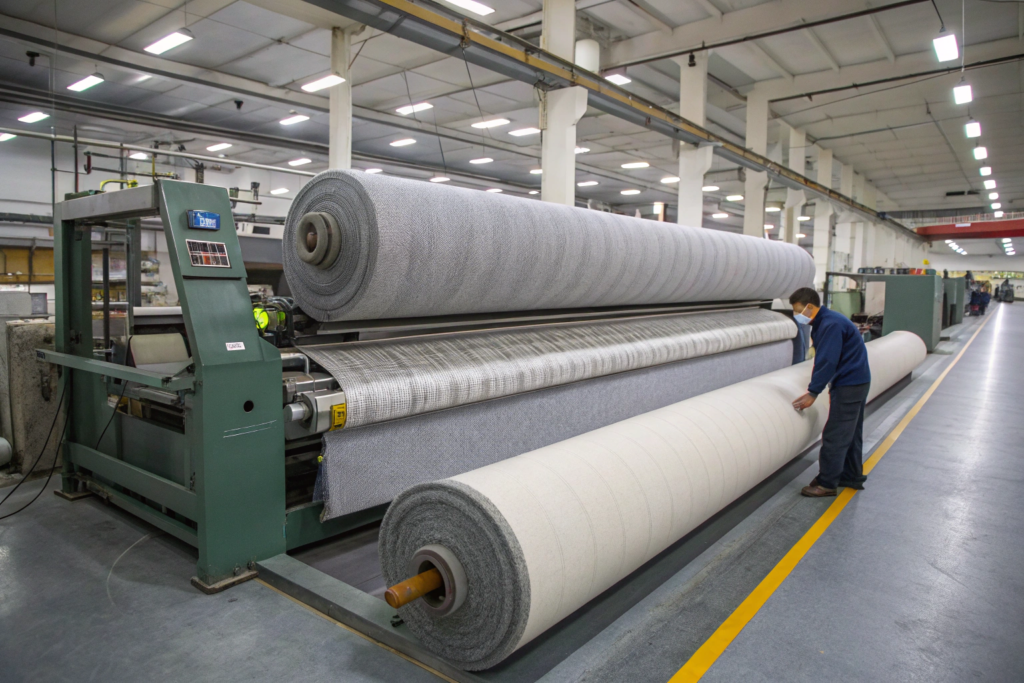
At Shanghai Fumao, our finishing process for fleece is a carefully choreographed sequence of mechanical and chemical steps. We don’t just "brush it and ship it." We have a specific protocol that we have refined over years of trial and error.
The sequence is:
- Gentle Napping: We use a multiple-pass napping machine with progressively finer wire. The first pass raises the pile gently. Subsequent passes even it out. We don’t try to do it all in one aggressive pass, which breaks fibers unnecessarily.
- Shearing/Cropping: After napping, the pile surface is uneven. Some fibers are sticking up too high. These long, loose fibers are the primary source of lint shedding. We run the fabric through a shearing machine. This is like a precision lawnmower for fabric. It cuts all the pile fibers to a uniform, short height. It also cuts off the loose, barely anchored fibers that would have fallen out later.
- Bio-Polishing (Enzyme Wash): This is a critical step that many low-cost producers skip. We wash the fleece in a bath with cellulase enzymes. These enzymes are like tiny Pac-Men that specifically eat the micro-fuzz and loose fiber ends on the surface of the cotton. They digest the weak, protruding fibers without damaging the strong fibers anchored in the yarn. This leaves a incredibly clean, smooth pile surface.
- Anti-Pill Finish: After bio-polishing, we apply a durable anti-pilling finish. This is a soft, flexible resin that coats the individual fibers at the microscopic level. It reduces the friction between fibers. Less friction means fibers are less likely to grab each other and twist into pills.
What Is Bio-Polishing and How Does It Prevent Lint?
I want to dive deeper into bio-polishing because it is the unsung hero of high-quality fleece. Let me give you a specific, recent example from our production log.
In January 2026, we ran two batches of the same exact 100% cotton fleece fabric. Same yarn. Same knitting machine. Same dye lot.
- Batch A: Standard napping and shearing only. No bio-polish.
- Batch B: Standard napping, shearing, plus a 45-minute bio-polish enzyme wash at 55°C.
We then ran both fabrics through a standardized Martindale Pilling Test (ISO 12945-2, 2,000 rubs).
- Batch A Result: Grade 2-3. Visible pilling and surface fuzzing. Significant lint was collected on the abradant fabric.
- Batch B Result: Grade 4-5. Very slight surface fuzzing. Almost no pilling. Minimal lint transfer.
The bio-polish removed the weak, short fibers that were destined to become lint before the fabric ever left the factory. It’s a proactive solution. We are essentially causing a tiny amount of controlled shedding in the wash bath so that the customer’s washing machine doesn’t have to.
The cost of bio-polishing? About $0.15 to $0.20 per yard. For a premium fleece hoodie selling for $80, that’s an insignificant cost for a massive improvement in quality. I insist on bio-polishing for every single cotton-rich fleece we produce. It is not optional. If you are looking for how enzyme washing improves fleece fabric quality and reduces lint, demand it in your tech pack. The specification should read: "Fabric must be bio-polished with cellulase enzyme to achieve a clean surface and Grade 4 minimum pilling resistance."
How Does Proper Shearing and Brushing Technique Minimize Shedding?
This is the artisanal, mechanical side of the equation. The napping and shearing machines are not just "set and forget." They require skilled operators who understand the fabric they are running.
The key variables are:
- Wire Type: The napping machine has rolls covered in wire. The wire can be coarse or fine. The wire can be bent at different angles. For cotton fleece, we use a finer wire with a more aggressive angle for the first pass to open up the surface, then a finer wire with a less aggressive angle for the second pass to even out the pile without pulling out more fiber.
- Tension: The fabric tension as it passes over the napping rolls is critical. Too much tension, and the wire rips the fabric. Too little tension, and the wire doesn’t engage the yarn properly. Our operators adjust the tension based on the fabric weight and stretch.
- Shearing Height: The shearing machine has a razor-sharp blade that spins at high speed. The distance between the blade and the fabric bed determines how much of the pile is cut off. We set this to cut the pile to a uniform height of about 1.5mm to 2.0mm for a standard cozy fleece. This removes the long, wispy fibers that are the primary source of lint.
I recall a problem we had in November 2025. A new operator on the shearing machine set the blade height slightly too high. The pile looked great—super plush and long. But the fabric shed like crazy. We caught it in our 100% inspection. The loose fibers were visibly falling off the fabric as it moved on the inspection table. We had to re-shear the entire lot to the correct height. It cost us a day of production time, but we stopped a disaster from reaching the client. If you are evaluating how proper fabric shearing reduces fleece lint shedding, the rule is: Shorter, more uniform pile = Less shedding. A super long, shaggy fleece will always shed more than a dense, close-cropped fleece.
What Tests Measure Fleece Shedding and Pilling Resistance?
You can feel the difference between a good fleece and a bad one. But for a professional buyer, "feeling" isn’t enough. You need quantifiable data to put in your quality assurance manual and to hold your supplier accountable. There are standardized, internationally recognized tests for exactly this purpose.
At Shanghai Fumao, our CNAS-accredited lab runs these tests on every single lot of fleece we produce. We don’t guess. We measure. And we provide the test reports to our clients so they can see the data for themselves.
The two most important tests for fleece performance are the Martindale Pilling Test and the Random Tumble Pilling Test. They simulate different types of wear and abrasion. Understanding the difference between them is crucial for specifying the right test for your product category.
How Is the Martindale Pilling Test Performed and Interpreted?
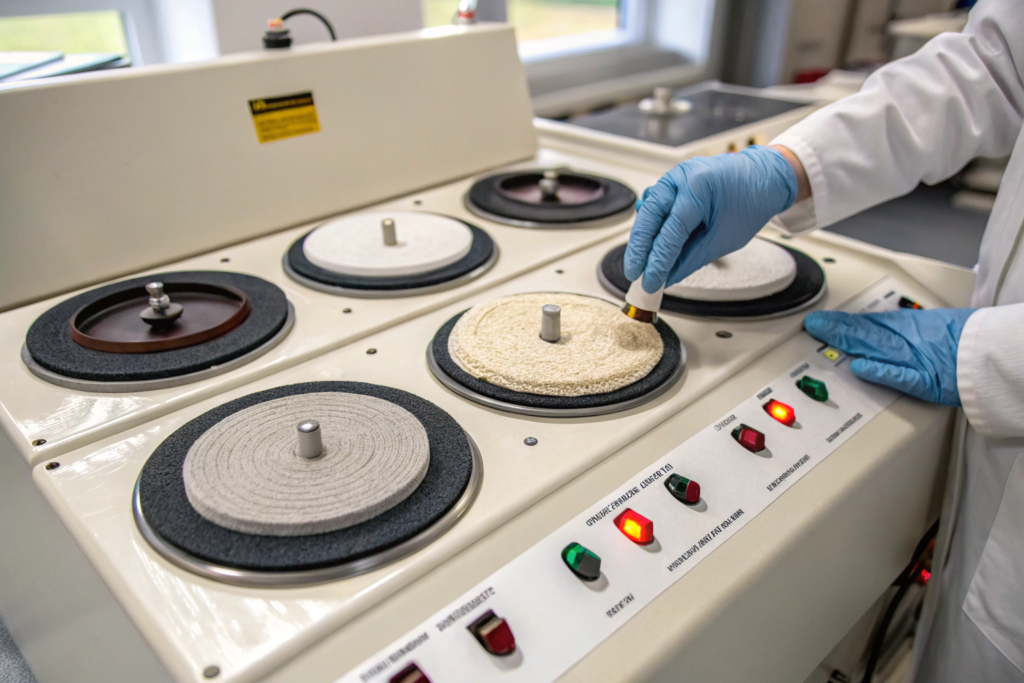
The Martindale (ISO 12945-2) is the workhorse test for apparel fabrics. It simulates the kind of rubbing that happens when a garment is worn. Think of the friction between a sleeve and the body of a hoodie, or the rubbing of a shoulder against a seatbelt.
How it works:
- A circular specimen of the test fabric is mounted in a holder.
- It is rubbed against a standard wool abradant fabric in a complex, figure-8 "Lissajous" motion.
- The machine runs for a set number of cycles, or "rubs." The standard for fleece is 2,000 rubs.
- After the test, the technician removes the specimen and compares the appearance of the rubbed area to a set of standard rating photographs.
The Rating Scale:
- Grade 5: No change. No pills, no fuzz. (Excellent)
- Grade 4: Slight surface fuzzing. No pills. (Good. This is our minimum standard at Fumao for premium fleece.)
- Grade 3: Moderate fuzzing and/or isolated small pills. (Borderline. Acceptable for low-cost, fast-fashion items.)
- Grade 2: Distinct pilling. Pills of varying size cover the surface. (Fail. This fabric will generate returns.)
- Grade 1: Severe pilling. Dense pills cover the surface. (Catastrophic fail.)
I show the Martindale report to every client who is concerned about quality. A Grade 4 rating at 2,000 rubs is a promise. It tells the client: "This hoodie will look good after a season of wear." I had a client in March 2026 who was sourcing fleece for a workwear brand. They needed extreme durability. We ran the Martindale test to 5,000 rubs on our heavy-duty fleece. It still achieved a Grade 4. That’s the kind of data that closes a deal. If you are researching how to test fabric pilling resistance for apparel quality control, the Martindale at 2,000 rubs is the industry standard. Demand the report.
What Is the Random Tumble Pilling Test and When Is It Used?
The Random Tumble Pilling Tester (ASTM D3512) is a different beast. It doesn’t simulate surface-to-surface rubbing. It simulates the chaotic, tumbling action of a home laundry dryer.
How it works:
- Small specimens of the test fabric are placed inside a cylindrical chamber lined with cork.
- A small amount of cotton sliver (loose cotton fibers) is added to the chamber to act as an abrasive and to simulate lint.
- The chamber is rotated by a fan blade, causing the fabric specimens to tumble randomly against the cork walls and against each other.
- The test runs for a set time, usually 30 or 60 minutes.
- The specimens are removed and evaluated against the same 1-5 rating scale.
This test is brutal. It is specifically designed to accelerate pilling and lint generation. It is the test I recommend for fleece blankets, throws, and home textiles that will be laundered frequently. It is also a good test for fleece jackets that will be washed often.
The Random Tumble test exposes a different kind of failure. A fabric might pass the Martindale (surface abrasion) but fail the Random Tumble (laundry simulation). Why? Because in the Random Tumble, loose fibers from the fabric itself (or from the added cotton sliver) can get tangled into the fleece pile during the tumbling action. This mimics what happens when you wash a red fleece with a white cotton towel. The red fleece might not be shedding its own fibers, but it is attracting and trapping lint from the towel.
A high-quality fleece should have a tight enough pile structure to resist lint attraction during tumbling. We test our fleece for this specifically. If a fleece picks up too much foreign lint in the Random Tumble test, we know it will be a customer complaint magnet. We then adjust the shearing or the anti-pill finish to tighten the surface. If you are specifying how to test fleece fabric for lint shedding in home laundry conditions, the Random Tumble test is the one to ask for.
How to Source Anti-Pill and Low-Lint Fleece for Your Brand?
You have the knowledge now. You know what causes shedding. You know the processes that prevent it. You know the tests that measure it. Now, how do you translate that knowledge into a purchase order that actually gets you the good stuff?
The key is to stop being vague. Stop saying "good quality fleece." That means nothing to a mill. Start using the specific language and standards we have discussed. Put it in writing in your Tech Pack and your Purchase Order. A supplier who knows you are watching these specific metrics is a supplier who will take your order seriously.
At Shanghai Fumao, we actually prefer it when clients give us clear specs. It eliminates ambiguity. We know exactly what target we are aiming for. When a client just says "soft fleece," we have to guess what their customer expects. When a client says "80% Cotton / 20% Poly, 330 GSM, Martindale Pilling Grade 4 minimum," we know exactly what to produce.
What Specific Fabric Specifications Should I Request in My Tech Pack?
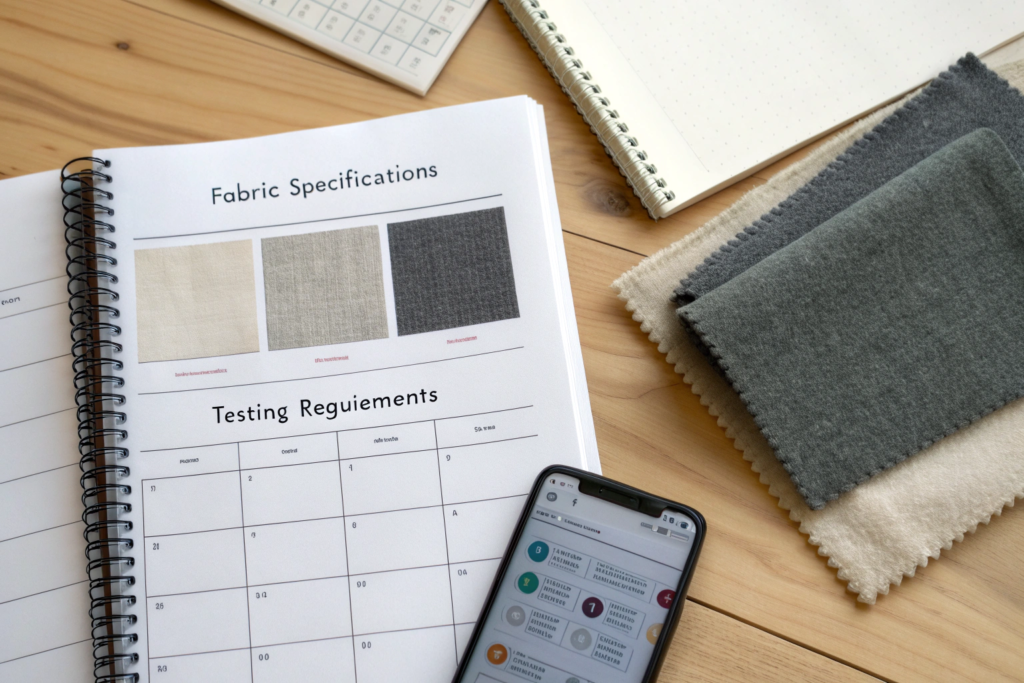
Here is a template of the exact language I recommend you copy and paste into your tech pack for any fleece product. This language will immediately signal to the supplier that you are a professional who understands fabric quality.
Suggested Fleece Tech Pack Specifications:
Fabric Description: 3-Thread Fleece (or French Terry Fleece)
Fiber Content: [e.g., 80% BCI Cotton / 20% Recycled Polyester] (Note: Specify if organic or BCI cotton is required)
Fabric Weight: [e.g., 330 GSM +/- 5%] (Note: Use GSM, not just ounces per yard)
Fabric Width: [e.g., 68" Cuttable Width]Quality Requirements:
- Pilling Resistance (Martindale): Minimum Grade 4 after 2,000 rubs (ISO 12945-2).
- Random Tumble Pilling: Minimum Grade 4 after 60 minutes (ASTM D3512).
- Surface Finish: Fabric must be Bio-Polished with cellulase enzyme to remove surface fibers.
- Linting: Fabric must not exhibit excessive loose fiber fallout when shaken or rubbed against a contrasting dark fabric.
- Shrinkage: Maximum 5% Length x 5% Width after 3 home launderings (AATCC 135).
- Colorfastness to Crocking: Minimum Grade 4 Dry / Grade 3 Wet (AATCC 8).
This spec sheet is a contract. If a supplier signs off on this and then delivers fabric that fails the Martindale test, you have a clear basis for a claim or a return. Without this language, you are relying on goodwill. Goodwill doesn’t pay for returned inventory.
I had a new client use this exact template in February 2026 with another supplier. The supplier pushed back, saying, "We don’t usually test to Grade 4." The client came back to us. We said, "We do. It’s our standard." That transparency won us the business. If you are drafting how to write a fleece fabric specification to prevent quality issues, use this template. It covers the critical failure points.
Why Does Fleece Weight and Density Correlate with Shedding?
There is a simple, almost universal rule in fleece: Heavier and denser fleece sheds less. This is not a linear relationship, but a strong correlation.
Lightweight fleece, say 200-240 GSM, is often used for fashion hoodies and lightweight joggers. To achieve this low weight, the yarns are finer and the knit structure is looser. There are fewer fibers per square inch to anchor the pile. The napping process is more likely to pull fibers completely out. Lightweight fleece is inherently more prone to shedding.
Heavyweight fleece, 330-380 GSM and above, uses thicker yarns and a tighter knit structure. The pile is denser. There are more fibers per square inch sharing the anchoring load. The fibers are packed so tightly that they physically cannot escape.
This is why a classic, heavy, reverse-weave sweatshirt from a premium brand doesn’t shed. It’s dense. It’s heavy. The fibers are locked in by sheer weight of numbers.
I always advise my clients who are launching a new brand: Start with a 330 GSM or 350 GSM fleece. It’s a safe, premium weight that drapes well, feels substantial, and has excellent resistance to shedding and pilling. If you need a lighter weight for a spring layer, go with a French Terry (which is unbrushed on the back) instead of a brushed fleece. French Terry has zero shedding because the loops are intact. It’s the perfect low-lint alternative for warmer weather. If you are deciding what is the best fabric weight for high quality non shedding fleece, 330 GSM is the sweet spot for year-round premium loungewear.
Conclusion
Lint shedding in fleece is not a mystery. It is a direct, measurable consequence of decisions made at the spinning frame, the knitting machine, and the finishing plant. Cheap, short-staple fibers break loose. Aggressive, single-pass napping rips them out. Skipping the bio-polish and shearing steps leaves them dangling on the surface, waiting to fall off on your customer’s black jeans or white sofa.
High-quality fleece, the kind we engineer at Shanghai Fumao, is built from the fiber up to resist this failure. It uses longer, stronger fibers. It uses a controlled, multi-step finishing process that locks the pile in place. And it is tested against international standards to prove it. The result is a garment that feels incredibly soft but doesn’t leave a trail of fuzz behind it. A garment that builds brand loyalty instead of generating return requests.
You shouldn’t have to gamble on whether your next fleece shipment will be a lint nightmare. You should be able to specify the quality you need and have a partner who can deliver it consistently, yard after yard, season after season.
If you are ready to source fleece that performs as good as it feels, we can send you our fleece sample pack. It includes swatches of our different weights and blends, along with the corresponding Martindale test reports so you can see the data for yourself.
Reach out to our Business Director, Elaine. She can discuss your specific weight and blend requirements, minimum order quantities, and current lead times. You can email her directly at elaine@fumaoclothing.com. Let’s make fleece that stays on the garment, not on everything else.








