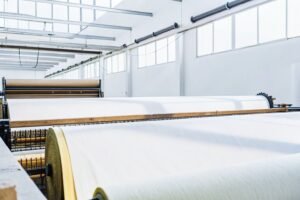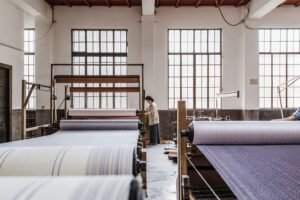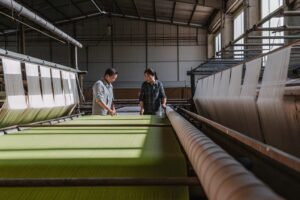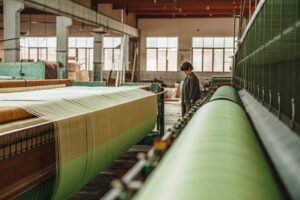
Let me tell you something I’ve learned running a textile mill for over twenty years. Murphy’s Law applies double in the fashion industry. Your pre-booked fabric from Italy gets stuck in customs. Your influencer campaign goes viral and you need 500 units next week not next month. Or you simply saw a trend on TikTok on Monday and you need to be on sale by Friday week. Whatever the reason you’re now in a situation where the standard 8-12 week lead time might as well be 8-12 years. You need fabric and you need it yesterday.
Most fabric suppliers will tell you it’s impossible. They’ll say "Sorry our dye house is booked for six weeks." They’ll say "Minimum order quantity is 3000 yards." They’ll say "Sample yardage takes 10 days." And if you’re dealing with a giant corporate mill or a lazy trading company those things are true for them. But they’re not true for the entire industry. The Chinese textile supply chain specifically in Keqiao has a secret weapon that we use for these exact situations. It’s called Spot Inventory or Stock Lot Fabric.
Here’s the reality of last-minute sourcing. You are trading choice for speed. You cannot be picky about a specific Pantone shade if you want it tomorrow. You cannot demand a custom blended yarn if you need it this week. But you can get high-quality on-trend fabric in your hands within 48 to 72 hours if you know where to look and how to ask. At Shanghai Fumao we maintain a massive warehouse of greige goods and finished stock specifically because we know this is how modern fashion works. The era of planning collections 18 months in advance is dying. The era of the agile drop is here. And I’m going to show you exactly how we navigate the chaos to get our clients out of a jam.
The mindset shift you need to make is from "Made-to-Order" to "Available-to-Ship." This is not about compromising on quality. It’s about compromising on customization. You might not get the exact zipper pull or the custom hang tag. But you will get a garment that fits well washes well and sells out. And in the world of last-minute drops cash flow is king. A sold-out collection in a second-choice fabric beats a perfect collection that arrives two weeks after the trend died.
Where Can I Find Ready Stock Fabric for Immediate Shipping
Let me pull back the curtain on the spot market in Keqiao. There’s a whole ecosystem here that exists solely to move excess inventory. Every major mill overproduces by about 5-10% to account for quality rejects. That "safety stock" ends up sitting in a warehouse. Then there are canceled orders. A big brand changes their mind on a color or goes bankrupt mid-production. That fabric is already woven and sitting there fully finished ready to go. That’s the gold mine you’re looking for.
The first place to look is what we call the "Stock Lot Markets" . In Keqiao there are entire buildings the size of football fields filled with booths selling nothing but available inventory. The problem is you can’t access this from overseas easily unless you have a local partner. The inventory changes daily. What’s there on Monday might be sold by Tuesday afternoon. This is where working with a company like Shanghai Fumao changes the game. We have buyers who walk these markets every single morning with coffee in hand looking for specific categories. If a client in LA emails us at 9 PM our time we have an answer on available stock by noon the next day because we know exactly which booth has the brushed fleece and which one has the satin.
The second place is Mill Direct Overstock. We ourselves hold about 200,000 yards of core basics in our own warehouse. Why? Because we know that 180GSM Cotton Jersey in White Black and Navy will always sell. We keep it on the shelf like a grocery store keeps milk. You want 500 yards of Black Cotton Jersey? We can cut it and ship it within 24 hours of payment. No dyeing. No finishing. It’s already done and inspected. This is the only viable strategy for a true last-minute drop. You have to design into what exists not design first and hope it exists.

How Do Fabric Stock Lots Differ from Made-to-Order Production
This is the most important concept to understand when you’re in a hurry. The difference between these two sourcing methods is night and day.
Made-to-Order (MTO) means the fabric does not exist yet. You pick a Pantone color. The mill sources the specific yarn count. They warp the loom. They weave the greige. They dye it in a pressure jet for 8 hours. They dry it. They finish it. They inspect it. That’s a 4-6 week process minimum even in a fast Chinese mill. It’s like ordering a custom-built car. It’s perfect but it’s slow.
Stock Lot or Ready Stock means the fabric is sitting on a shelf in a warehouse right now. It has already been woven dyed finished inspected and rolled onto a tube. It’s like walking onto a used car lot with cash. You drive it home today. The catch? You can’t change the color. You can’t change the width. You take what’s there. But if what’s there happens to be exactly what you need or close enough to work you just saved six weeks of lead time.
Here is a table that breaks down the practical differences you’ll encounter in the real world. This is what I walk my clients through when they call in a panic.
| Sourcing Aspect | Made-to-Order (Custom Production) | Stock Lot / Ready Stock |
|---|---|---|
| Color Options | Unlimited (Lab Dip Required) | Limited to Available Inventory |
| Minimum Order Quantity | 1000-3000 Yards per color | As low as 1 Roll (50-100 Yards) |
| Lead Time | 4-8 Weeks | 1-3 Days |
| Price Per Yard | Standard Market Rate | Often 20-40% Discount |
| Consistency | Perfect match to lab dip | Slight variation possible between rolls |
| Repeatability | Guaranteed for reorders | Not guaranteed once sold out |
Why Is Keqiao the Global Hub for Spot Textile Inventory
You might wonder why all this stock ends up here in Keqiao. It’s not an accident. It’s infrastructure. Keqiao is the largest textile cluster on the planet. We have 80 plus manufacturers within a 20-mile radius. When a mill in Shengze overproduces polyester taffeta they truck it 40 minutes down the road to the Keqiao spot market. When a dye house in Binhai has a canceled order they send it to the stock lot dealers in Keqiao.
This concentration creates liquidity. Liquidity means you can find almost anything if you know the right broker. There’s a saying here: "If it’s woven and it exists someone in Keqiao has a roll of it." That’s only a slight exaggeration.
The other advantage is the Logistics Hub. The "Silk Road Keqiao" initiative means we have bonded warehouses and direct rail lines to the ports of Ningbo and Shanghai. If I find fabric in a spot market booth at 10:00 AM I can have it on a truck to Shanghai Pudong Airport by 4:00 PM the same day. It can be on a plane to LAX that night. That speed is only possible because the entire ecosystem manufacturing inspection packing and freight forwarding is within a 10-kilometer radius. It’s a huge advantage that we leverage for clients who need things done fast. For anyone interested in the scale of this operation I recommend reading about the scale and infrastructure of the China Textile City in Keqiao and its role in global fabric distribution. It’s a government-backed ecosystem designed for exactly this kind of commerce.
How to Negotiate Lower MOQs for Urgent Production Runs
Let’s talk about the dreaded three letters: M-O-Q. Minimum Order Quantity. In normal times it’s the factory’s way of saying "This is the smallest amount of work we’ll do before it’s not worth setting up the machine." But in a last-minute scenario normal rules go out the window. The factory’s calculus changes. A small order that fills a gap in the schedule today is better than an empty machine.
The key to negotiating MOQs when you’re in a rush is to understand the factory’s pain points. A dye house doesn’t hate small orders because they’re small. They hate small orders because of the Setup Cost and the Cleanup Cost. If you can solve those problems for them they’ll run your 300 yards with a smile. How do you solve them? You offer to pay a Surcharge. I know it sounds counterintuitive to offer more money when you’re trying to save money but hear me out. If the MOQ is 1000 yards and you need 300 yards the factory loses money if they charge the standard rate. But if you say "I’ll pay the 1000 yard price for my 300 yards" suddenly the math works for them. You pay a premium per yard but your total outlay is still far less than buying 1000 yards of fabric you don’t need and your cash isn’t tied up in dead stock.
Another tactic that works wonders is Piggybacking. If we are already running a 5000-yard order of Navy Cotton Jersey for Client A adding your 300 yards of the exact same fabric to the same dye bath costs the dye house almost nothing. There’s no extra setup no extra cleanup. We do this at Shanghai Fumao constantly. We combine smaller orders into larger production batches. You get the benefit of the scale without having to meet the scale yourself. That’s the power of working with a mill that has multiple clients not just a single brand captive factory.

What Surcharges Are Acceptable for Small Batch Fabric Orders
If you’re going to offer to pay extra to get your order done you need to know what’s fair and what’s a ripoff. Here’s a breakdown of the standard surcharges we use internally.
The first is the Small Batch Dyeing Fee. For orders under 500 yards we add a flat fee of about $150 to $300. This covers the extra labor of handling a smaller beam and the increased risk of color variation. It’s a fair fee. The dye machine uses the same amount of water and steam whether it’s full or half empty. You’re paying for that energy.
The second is the Loom Changeover Fee. If you need a specific weave that’s not currently on the loom the factory has to stop production unthread the old warp and thread the new one. That takes a skilled worker about 4-6 hours. That time is lost production. A fee of $200 to $400 is reasonable for this. (Here’s a tip ask if there’s a similar weave already running. If they’re making a 2×1 Twill and you need a 3×1 Twill the setup time is minimal.)
The third is the Express Sampling Fee. If you need a lab dip in 48 hours instead of 7 days the lab has to stop their queue and prioritize you. That’s a $50 to $100 rush fee. Pay it. It’s worth every penny to get the color approved before the bulk run.
Here is a quick reference table for what we consider fair market rates for these rush services. Use this to benchmark conversations with your suppliers.
| Rush Service Requested | Standard Timeline | Rush Timeline | Fair Surcharge (USD) |
|---|---|---|---|
| Lab Dip / Color Matching | 5-7 Days | 48 Hours | $50 – $100 per color |
| Handloom / Strike-off | 5 Days | 2 Days | $100 – $150 |
| Small Batch Dyeing (<500 Yds) | N/A | Same as bulk | $150 – $300 flat fee |
| Weekend Production Run | Weekdays Only | Saturday/Sunday | +15% on labor cost |
Can I Use Digital Printing for Fast Turnaround Small Orders
This is a game-changer for last-minute drops and I wish more designers knew about it. Traditional screen printing requires engraving cylinders. That takes a week and costs about $500 per color. It’s great for 10,000 yards. It’s terrible for 200 yards.
Digital Textile Printing uses inkjet technology just like your office printer but for fabric. There are no screens. No cylinders. The design goes straight from a Photoshop file to the printer. Setup cost is zero. Lead time for sampling is 24 hours. Bulk production can be done in 3-4 days. The quality on cotton and silk is now nearly indistinguishable from screen printing for most fashion applications.
The trade-off is the price per yard. Digital printing is usually 20-30% more expensive per yard than screen printing for large runs. But for a 200-yard last-minute drop? It’s actually cheaper because you don’t have the $500 screen engraving fee amortized over a tiny yardage. You save money and you save three weeks. If you’re doing a small capsule of printed tops or dresses digital is your best friend. I’ve seen brands build entire business models around this technology.
For those of you looking into this option I recommend reading up on the latest advancements in digital textile printing technology and ink compatibility for natural versus synthetic fibers. It helps to understand the difference between reactive dyes for cotton and sublimation for polyester before you send your file over.
How to Verify Fabric Quality When Time Is Running Out
This is where most last-minute sourcing goes wrong. You’re in such a rush to get any fabric that you skip the quality check. You open the box from the stock lot dealer and the fabric is off-grain smells like chemicals or has a handfeel like sandpaper. Now you’re stuck. You have no time to return it and you have orders to fulfill. You ship the product anyway and you get a 30% return rate.
Speed does not mean you skip verification. It means you verify faster and smarter. When you’re working with Ready Stock you don’t have time for a 5-day lab test for shrinkage. You need Field Tests that give you 80% of the information in 5 minutes. I’m going to teach you the exact tests our QC team does on the spot when we’re buying stock lots from the market. These are not ASTM lab tests. They are "gut-check" tests that have saved us from buying bad fabric a hundred times over.
The first test is the Burn Test. Carry a lighter. Yes a lighter. Pull a few threads from the fabric and light them. If they melt into a hard black bead it’s synthetic polyester or nylon. If they burn to a soft gray ash and smell like burning paper it’s cellulose cotton rayon linen. If they smell like burning hair and leave a crushable black bead it’s protein silk wool. This tells you instantly if the fiber content on the label is a lie. I can’t tell you how many times we’ve found "100% Silk" in the stock market that burned like polyester. This test takes 10 seconds.
The second test is the Stretch and Recovery Test. Grab a fistful of fabric in the center and squeeze it hard for 10 seconds. Let go. Does it bounce back flat? Or does it stay wrinkled like a prune? This tells you about the finishing quality and the resilience. A cheap finish will wrinkle instantly and permanently. This matters for e-commerce photos and customer satisfaction.

What Are the Essential 5-Minute Field Tests for Fabric Handfeel
Beyond the burn test there are three more checks you must do in under five minutes. I require my team to do these on any stock lot purchase.
The Skew Test: Tear a small notch in the selvage and rip the fabric across the width. Does it rip in a straight line following the crosswise grain? Or does it curve diagonally? If it curves the fabric is off-grain. Garments cut from this fabric will twist on the body and hang crooked. Reject it. There’s no fixing severe skew without re-finishing the fabric and you don’t have time for that.
The Light Box Check: Hold the fabric up to a bright window or a lamp. Look for thin spots. Look for vertical lines (reed marks). Look for tiny holes. These are weaving defects. One or two in a roll might be acceptable for cutting around. More than three defects per 10 yards is a problem.
The Water Drop Test: Wet your finger and press it onto the fabric. Does the water bead up and roll off? Or does it sink in and leave a dark spot? This tells you about the finishing. If you’re making a raincoat and the water soaks in instantly you have a problem. If you’re making a towel and the water beads up you also have a problem.
Here is a quick checklist for the field test kit we keep in our sourcing bag.
| Test Name | Tool Needed | Time Required | What It Reveals |
|---|---|---|---|
| Burn Test | Lighter | 15 Seconds | True Fiber Content |
| Skew / Tear Test | Scissors or just hands | 10 Seconds | Grain Alignment / Bow |
| Light Box Check | Window or Lightbox | 30 Seconds | Weaving Defects / Holes |
| Water Drop | Wet Finger | 5 Seconds | Absorbency / Finish Type |
| Crocking Test | White tissue or cloth | 15 Seconds | Color Transfer / Fastness |
How to Interpret Mill Test Reports in Under 60 Seconds
If you’re lucky the stock lot comes with a Mill Test Report. It’s a page of numbers. Most people’s eyes glaze over. You don’t have time for that. Here are the only three numbers you need to scan for.
Look for Shrinkage % . It should say "Warp: 3% / Weft: 3%" or less. If it says 5% or higher or worse "N/A" you need to pre-shrink that fabric before cutting. That takes time you don’t have.
Look for Colorfastness to Crocking. This is the rub test. It should say "Dry: Grade 4 / Wet: Grade 3" or better. If it’s Grade 2 it will stain your customer’s white sofa. Avoid.
Look for Weight (GSM) . Grams per Square Meter. If you ordered 180 GSM and the report says 160 GSM the fabric is thinner than expected. That changes the drape of the garment completely. This is a common trick in stock lots. They sell it as "heavyweight" but the report tells the truth.
If the report mentions AATCC or ISO standards you’re in better shape. If you want to understand what those specific test methods actually measure there are good resources explaining the differences between AATCC and ISO test methods for textile colorfastness and dimensional stability. It’s technical but knowing the code numbers helps you spot a fake report instantly.
How to Plan Logistics for a 48-Hour Turnaround Drop
You found the fabric. You verified it’s good. You paid for it. Now you have to get it from our warehouse in Keqiao to your cutting room in Los Angeles or London in two days. This is where most brands make the fatal error of choosing the wrong shipping method.
If you choose Ocean Freight for a last-minute drop you have already failed. A container takes 14-18 days just on the water plus 3-5 days for drayage and customs clearance at either end. That’s a month. Your drop is dead.
You have exactly one viable option for a true 48-hour turnaround: Air Freight . Yes it’s expensive. Yes it hurts your margin. But you didn’t choose this path because it was cheap. You chose it because it was fast. The calculation is simple. The cost of air freight for 200 yards of fabric is roughly $800 to $1500. The cost of missing your launch window and losing all your pre-sale revenue? Priceless. Air freight is your insurance policy against the calendar.
But even with Air Freight there are traps. You cannot just show up at Pudong Airport with a box and hope it flies. You need to know the Cut-Off Times. For a flight to LAX departing at 1:00 AM the cargo must be tendered to the airline by 7:00 PM the previous evening. If you miss that window your fabric sits for another 24 hours. At Shanghai Fumao we have a dedicated courier who does nothing but run fabric rolls to the airport cargo terminal. We know the cut-off times for every major carrier. That’s the level of detail required to actually hit a 48-hour promise.

What Is the Difference Between Air Courier and Air Freight Consolidation
This is a crucial distinction that impacts both cost and speed.
Air Courier (UPS FedEx DHL) is the fastest door-to-door option. We pick the fabric we box it we create a label and a driver takes it directly to the carrier’s hub. It flies on the next available passenger or cargo plane. It clears customs using the carrier’s in-house brokerage. It’s delivered to your door in 2-3 days. The cost is the highest but the handling is minimal. For anything under 100 kg this is the only logical choice.
Air Freight Consolidation is for larger shipments usually over 200 kg. A freight forwarder combines your cargo with other shipments to get a better rate on a pallet or a container position on a cargo plane. This saves you about 30-40% compared to courier but it adds 1-2 days to the transit time for consolidation at origin and deconsolidation at destination. You also have to arrange your own customs broker on the receiving end.
Here is a comparison based on real shipments we’ve handled for last-minute drops.
| Shipping Method | Transit Time (Door-to-Door) | Best For Weight | Cost Level | Customs Clearance |
|---|---|---|---|---|
| Express Courier | 2-3 Days | Under 100 kg | Highest | Included by carrier |
| Air Freight Consol | 4-5 Days | 200-500 kg | Medium | Separate broker required |
| Priority Air Freight | 3-4 Days | Over 500 kg | High | Separate broker required |
| Sea Freight (LCL) | 25-35 Days | Any weight | Lowest | Not suitable for rush |
How to Prepare Customs Paperwork for Expedited Clearance
If you want your air shipment to clear customs in 2 hours instead of 2 days the paperwork must be perfect before the plane lands. This is a non-negotiable part of the process.
First use a Continuous Bond if you import regularly. If you use a Single Entry Bond the customs broker has to process the bond application before they can even file the entry. That adds hours. A continuous bond is already on file with CBP. It’s instant.
Second ensure the Commercial Invoice matches the Air Waybill exactly. The piece count the weight and the description must be identical. A discrepancy of even 1 kg will trigger a "Manifest Hold" and your 2-day air shipment becomes a 5-day nightmare.
Third we include a Fabric Specification Sheet inside the box and send a PDF copy to the broker. If CBP wants to know if this is "Knit" or "Woven" the broker has the answer instantly. They don’t have to email us at 3:00 AM China time and wait 12 hours for a reply.
For those new to importing by air I always suggest familiarizing yourself with the customs clearance process for air freight shipments including the role of the Automated Manifest System and ACE entry filing. Understanding the flow of data helps you understand where the bottlenecks occur.
Conclusion
Sourcing fabric for a last-minute collection drop is not about finding the perfect fabric. It’s about finding the available fabric that is good enough to sell out. It’s a different mindset. It’s about speed and pragmatism. You leverage the spot inventory markets of Keqiao. You negotiate MOQs by understanding the factory’s cost structure and offering fair surcharges. You verify quality in minutes with field tests instead of waiting weeks for lab reports. And you accept that Air Freight is the price of admission for playing the fast fashion game.
The brands that win in this environment are the ones with a supply chain partner who can pivot in hours not weeks. They need someone on the ground in the textile cluster who can walk the stock lot aisles who can run a burn test on the spot and who knows the cut-off time for the FedEx truck to Pudong. That’s the role we play for our clients. We don’t just weave fabric. We solve logistics problems under extreme time pressure.
If you’re staring down a launch deadline and you need a partner who speaks the language of "right now" rather than "next month" we should talk. You can reach out to our Business Director Elaine. She handles all our rush order coordination. She knows what’s sitting on our shelves right this minute and she can tell you honestly if we can hit your date or if you need to pivot to Plan B. No sugarcoating just real talk about fabric and calendars.
Contact Elaine directly at: elaine@fumaoclothing.com