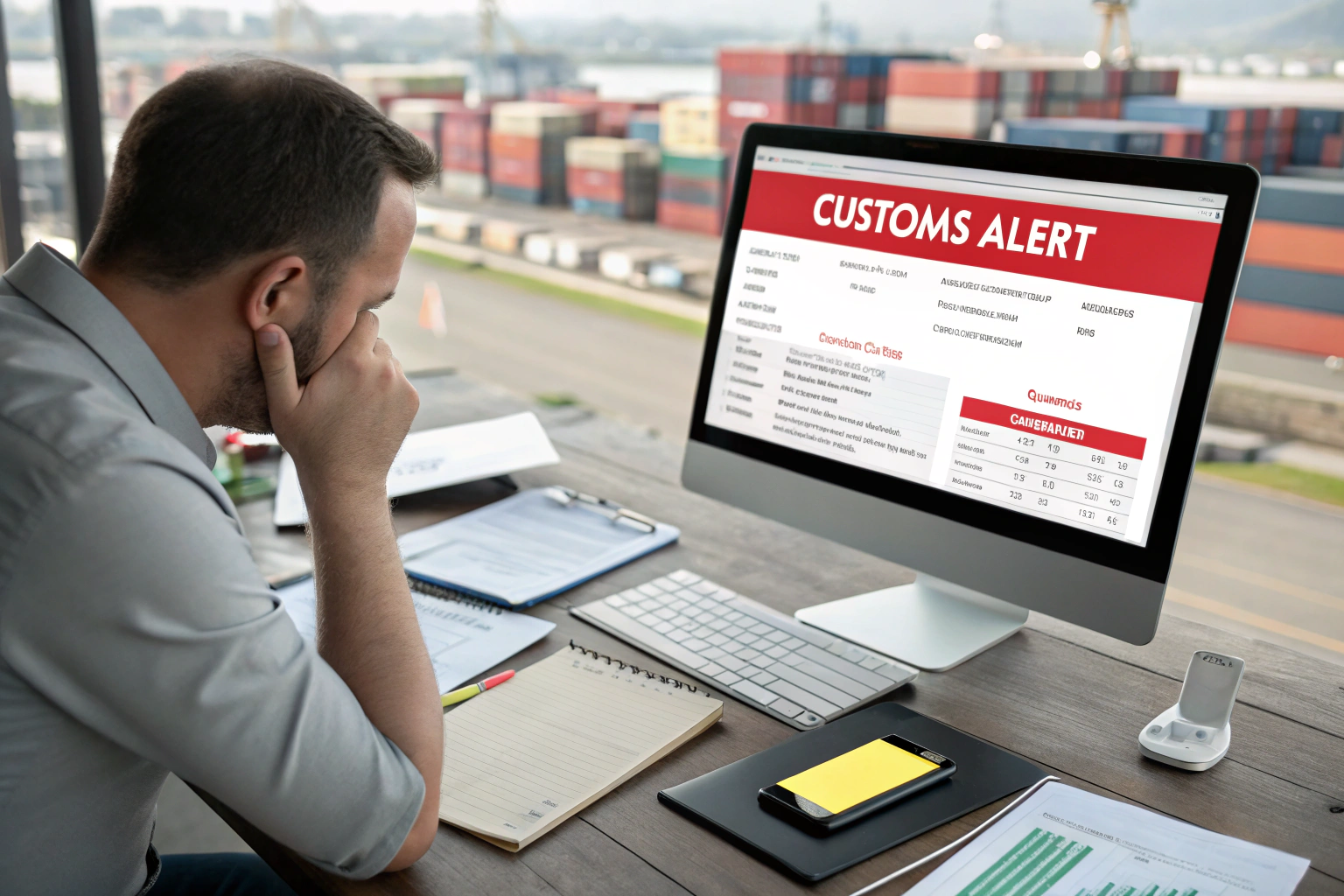
I’m going to be brutally honest with you. That moment when you check the tracking number and see "Clearance Delay" instead of "Out for Delivery"? That feeling in your stomach? I know it well. After two decades of shipping fabric and garments from Keqiao to every corner of the globe I’ve had my fair share of containers sitting in customs limbo. It never gets less stressful. But it does get more manageable if you know exactly what steps to take in the first 24 hours.
Here’s what most importers do wrong. They panic. They start calling every number they can find. They send angry emails to the factory in China demanding to know "why this happened." And while they’re doing all that the clock is ticking. Storage fees at the port are accruing. Demurrage on the container is adding up by the hour. The buyer’s delivery window is closing. The worst thing you can do is waste the first 48 hours on emotional reactions instead of tactical actions. The customs delay itself is rarely the real problem. The real problem is how long you let the container sit there while you figure out who to call.
The key to resolving a customs hold is understanding that it’s almost never the factory’s fault and it’s almost never random. US Customs and Border Protection (CBP) or the equivalent agency in the EU doesn’t just roll dice to decide which container to stop. There’s a reason. It’s either a paperwork discrepancy a tariff classification issue or a random security exam. Knowing which one you’re dealing with determines your next move. At Shanghai Fumao we’ve built our entire export documentation process around minimizing these exact scenarios because we know that a delayed shipment erases all the goodwill you built with a fast production turnaround. Let me walk you through exactly what to do from the moment that dreaded status update appears.
I want you to think of this process like a triage nurse in an emergency room. You don’t treat every patient the same way. You assess the symptoms categorize the severity and then apply the specific treatment. The same goes for customs holds. A hold for "Manifest Hold" is a minor paperwork fix. A hold for "Intensive Exam" is a major surgical procedure that requires patience and the right documentation. My goal in this post is to give you the exact playbook we use internally when one of our clients hits a snag at the port of Los Angeles or Rotterdam.
Why Is My Fabric Shipment Stuck in US Customs Inspection
Let’s decode the language of customs. When you see that status update it usually falls into one of three buckets. And each bucket has a completely different timeline and cost implication.
The first and most common bucket is Document Review. This is actually good news. It means the data in the Automated Manifest System (AMS) or the Importer Security Filing (ISF) doesn’t match the commercial invoice. Maybe the piece count is off by two cartons. Maybe the weight declared by the factory doesn’t match the weight slip from the shipping line. Maybe the HTS code on the entry summary looks suspicious. This is a paperwork problem. It’s fixable within 24 to 48 hours if you have a competent customs broker. You just need to provide a corrected invoice or a mill certificate clarifying the fiber content.
The second bucket is the X-Ray or VACIS Exam. This is a non-intrusive inspection. They run the container through a giant scanner that looks for anomalies. For fabric shipments this is usually triggered by dense organic material showing up as a solid block. A container full of heavy denim rolls looks very similar on an X-ray to… well other things they’re looking for. If the scan is clean the container gets released. If the scan is "inconclusive" they escalate to bucket three.
The third bucket is the nightmare scenario. Intensive Exam / Tail Gate Exam. This means CBP physically opens your container pulls out the boxes and goes through your fabric. They cut open the poly bags. They take samples for lab testing. This is where the real money gets burned. You’re paying for the exam fee the labor to unload and reload the container and the storage for every day it sits. This is why proper documentation before shipping is not just bureaucratic busywork. It’s insurance against this exact scenario.

How Long Does a Customs Hold Usually Last for Textile Goods
I get this question from clients with panic in their voice. "How long am I looking at here?" The honest answer depends entirely on the port and the type of hold but I can give you the real-world averages we track at Shanghai Fumao.
For a simple Manifest Hold at Los Angeles/Long Beach you’re looking at 2 to 5 business days. That’s if your broker is sharp and the CBP officer processing the paperwork isn’t swamped. During peak season August through October that can stretch to 7 days just because of volume.
For a VACIS Exam the bottleneck is the queue for the X-ray machine. At the Port of Savannah or Newark this is usually 3 to 7 days. The scan itself takes 10 minutes. The waiting in line for the scan takes the rest of the time.
For an Intensive Exam you need to take a deep breath. At a major port like LAX/LGB you are looking at a minimum of 2 weeks. Often it’s 3 to 4 weeks. If it goes to a Centralized Examination Station (CES) and they decide to send a fabric sample to a lab for fiber content verification you can add another 2 to 3 weeks on top of that. I’ve seen a container of linen stuck for 9 weeks over a classification dispute about whether it was "flax" or "hemp." The demurrage bill was higher than the value of the fabric itself. It’s a brutal lesson.
Here is a realistic timeline table based on our shipping data from the last two years. This shows the average wait time from the moment of hold notification to release.
| Type of Customs Hold | Port of LA/LGB (Avg Days) | Port of NY/NJ (Avg Days) | Port of Savannah (Avg Days) |
|---|---|---|---|
| Document / Manifest Hold | 3-4 Days | 2-3 Days | 2-4 Days |
| VACIS / X-Ray Exam | 5-8 Days | 4-6 Days | 6-9 Days |
| Tail Gate / Intensive Exam | 18-25 Days | 14-21 Days | 20-28 Days |
| Laboratory Testing (Fiber) | +14 Days (additional) | +14 Days (additional) | +14 Days (additional) |
What Are the Most Common Triggers for Fabric Customs Exams
Knowing what triggers an exam helps you avoid one in the future. Here’s the inside baseball from talking to brokers and freight forwarders over the years.
First trigger is Value Discrepancy. If you declare a shipment of silk satin at $0.80 per yard CBP knows that’s impossible. They have a database of average values. You’ll get flagged for undervaluation which leads to an intensive exam and a potential penalty. Always use the actual transaction value.
Second trigger is Generic Descriptions. Writing "Fabric" on the commercial invoice is asking for trouble. You need to write "100% Polyester Woven Dyed Taffeta 58/60" Width 190T." The more specific you are the less they need to look inside. We train our shipping department to use the exact HTS language on every invoice.
Third trigger is Country of Origin Issues. If the yarn was spun in China but the fabric was woven in Vietnam and then dyed back in China the origin rules get complicated. CBP is cracking down hard on transshipment to avoid Section 301 tariffs. If the paperwork trail is fuzzy they will hold the container until you prove the origin. For more details on this I often point buyers to the official US Customs and Border Protection guidelines on textile and apparel marking and origin determinations. It’s dense reading but it saves you from an exam.
Fourth trigger is ISF Non-Compliance. You must file the Importer Security Filing 24 hours before the vessel leaves the foreign port. If you file late or file inaccurate data your shipment gets flagged automatically for a "Do Not Load" or an exam upon arrival. This is why working with a freight forwarder who knows the essential data elements required for Importer Security Filing 10 plus 2 compliance is non-negotiable.
How Can I Expedite My Container Release from Port Authority
Alright the container is on hold. You’ve identified the type of hold. Now you want it out as fast as humanly possible. Let’s talk about what you can actually do versus what is out of your control.
First let’s kill a myth. You cannot "call customs" and ask them to hurry up. It doesn’t work that way. CBP officers are law enforcement. They don’t care that your customer is waiting. They care about national security and revenue collection. The only people who can accelerate the process are your Customs Broker and your Freight Forwarder. Your job is to feed them the exact information they need within minutes not hours.
The most effective thing you can do in the first hour is to provide a Corrected Commercial Invoice and a Mill Test Certificate. If the hold is for a classification issue you might need a Lab Report showing the fiber breakdown. For example if you’re shipping a blend of cotton and modal and you declared it as just cotton that’s a misclassification. You need to send a PDF from the factory showing the exact percentage of each fiber. At Shanghai Fumao we keep these certificates on file for every dye lot we produce. We can email them to a broker in under 10 minutes. That’s the difference between a 3-day hold and a 3-week hold.

What Information Does My Customs Broker Need Immediately
Here’s a checklist. Print this out and put it on your wall. When the broker calls or emails with "Need info on HBL 12345" this is exactly what you need to have ready.
- Commercial Invoice with HTS Codes: Not just the 4-digit heading but the full 10-digit HTSUS code. And make sure the unit of value matches. If the HTS code requires "kg" and your invoice shows "yards" that’s an automatic rejection.
- Packing List with Piece Count and Weight: The total weight on the packing list must match the Bill of Lading within a small tolerance. If there’s a 500kg difference because the factory estimated the weight you need to issue a corrected packing list immediately.
- Fabric Specification Sheet: This is your secret weapon. It shows the yarn count the weave construction the weight in GSM and the finishing process. If CBP questions the classification of "Woven Fabric of Synthetic Staple Fibers" this spec sheet proves it’s not a knit and it’s not continuous filament. It’s the evidence they need to close the case.
- Proof of Payment: If they suspect undervaluation you need the wire transfer receipt showing what you actually paid the factory. This is why I tell buyers never to ask for a fake invoice to lower duties. When CBP asks for the bank record you’re caught.
I want to show you a comparison of how information quality affects release time. This is based on our internal tracking of about 50 customs exams over the last five years.
| Information Provided | Broker Response Time | CBP Review Time | Outcome |
|---|---|---|---|
| Generic "Fabric Roll" Description | 4-6 hours to request detail | 3-5 days waiting | Possible Intensive Exam |
| Full HTS Code + Mill Spec Sheet | 1 hour to submit entry | 1-2 days review | Release with no exam |
| Lab Test Report (CNAS Certified) | 30 mins to upload to ACE | 4-8 hours (expedited) | Immediate release |
Can a Bonded Warehouse Move Help Reduce Demurrage Costs
This is a tactical play that not enough importers know about. When a container is on hold for a long intensive exam you are racking up Demurrage on the container itself. That’s the fee the steamship line charges for keeping their box. It’s expensive. It can hit $200 to $500 per day after the free time expires.
You have the right to request a move to a Bonded Warehouse or a Centralized Examination Station (CES) of your choice. Actually your broker makes the request. Moving the cargo off the terminal and into a bonded facility stops the clock on the steamship line demurrage. Yes you will pay a drayage fee to move the container a few miles down the road. And you’ll pay storage at the bonded warehouse. But the bonded warehouse storage is usually cheaper per day than steamship demurrage and you’re not holding up the ocean carrier’s equipment.
However and this is a big however you cannot move the cargo until CBP releases the hold. You can’t just take it. But for an intensive exam CBP usually prefers the cargo to be at a CES where they have better lighting and equipment. You can request the transfer to a CES close to your final destination. For example if the container landed in LA but your warehouse is in Chicago and it’s going to be a month-long exam moving it to a Chicago CES saves you the cross-country trucking delay after release. This is an advanced logistics strategy that requires a sharp broker but it can save you thousands of dollars on a bad exam.
How to Prevent Future Customs Delays for Apparel Imports
You’ve survived the delay. The container is finally on a truck heading to your warehouse. You let out a sigh of relief. But the work isn’t over. If you don’t change your process you’ll be right back in the same situation three months from now. The definition of insanity in importing is filing the same bad paperwork and expecting a different result from CBP.
Prevention is about building a Compliance Mindset into your supply chain. It starts before the fabric is even woven. It starts with how you communicate with your supplier. Many buyers treat the factory as just a production unit. They forget that the factory is also the source of the data that CBP will scrutinize. If the factory gives you bad data you will have a bad time at the border. It’s that simple.
At Shanghai Fumao we approach this by having a pre-shipment documentation review meeting internally. For every new client or every new fabric construction we ask: "What is the correct HTS Chapter? Is this knit or woven? Is the fiber content certified? Do we have the GRS certificate if it’s recycled?" By answering these questions before the container is loaded we eliminate 90% of the variables that cause holds. It’s not rocket science. It’s just discipline.

Why Is Proper HTS Classification Crucial for Smooth Clearance
I cannot stress this enough. The Harmonized Tariff Schedule (HTS) code is not a suggestion. It’s a legal declaration. Picking the wrong code even by accident is a violation of 19 U.S.C. 1592. That’s federal law. The penalties are real.
Most problems come from the distinction between Chapter 60 (Knits) and Chapter 54/55 (Wovens) . A fabric with a little bit of mechanical stretch from a textured yarn might look like a knit to a rookie. But it’s woven. If you classify a woven as a knit the duty rate might be lower but you’re misclassifying the goods. CBP’s textile enforcement team knows this trick. They will stop you.
Another common trap is Fiber Content. A blend of 51% Cotton and 49% Polyester is classified as Cotton (Chapter 52). A blend of 49% Cotton and 51% Polyester is classified as Synthetic (Chapter 55). That 2% swing changes the duty rate and changes the quota category. If the factory’s lab test shows 50.5% cotton and you declared it as synthetic you are in violation.
I always recommend that my clients use the CROSS database (Customs Rulings Online Search System). It’s a free government website where you can look up previous binding rulings for similar fabrics. If you find a ruling that matches your fabric description you can cite that ruling to your broker. CBP usually respects their own prior decisions. For complex classifications you might even want to request a binding ruling from US Customs on your specific fabric construction and composition. It costs nothing but time and it gives you 100% legal protection for that import.
What Documentation Should I Always Request from My Factory
Stop asking for just a "Commercial Invoice." You need a full documentation package. Here’s the standard I hold my own team to and the standard you should demand from any supplier.
First a Detailed Packing List with Inner and Outer Carton Marks. Not just "50 rolls." It should say "Roll #1 of 50: Article ABC123 Color Navy Lot L2024-01 Weight 25.4kg."
Second a Mill Test Report or Certificate of Analysis. This shows the actual tested values for Fiber Content Yarn Count Fabric Weight (GSM) and Shrinkage. It should have a date and a signature. This is the single most valuable piece of paper if CBP questions the fabric specs.
Third a Certificate of Origin if you are claiming preferential duty treatment under a Free Trade Agreement. If the yarn is from Korea and the fabric is woven in China you might not qualify for the lower rate. The factory needs to sign this document under penalty of perjury. Be careful here. Many factories will sign anything to get the order. You need a factory that understands the rules of origin for the textile and apparel rules of origin under various free trade agreements and preference programs.
Fourth High-Resolution Photos of the Shipment. I have my warehouse team take photos of the open container doors showing the load bars in place and the cartons stacked neatly. If there’s a damage claim or a piece count dispute later those photos are worth their weight in gold. They prove the condition of the cargo at origin.
What Are My Options If Customs Seizes My Fabric Shipment
This is the worst-case scenario. A "Hold" is stressful. A "Seizure" is a legal action. It means CBP believes the goods are counterfeit violate intellectual property rights are made with forced labor or are otherwise prohibited. You will receive a Notice of Seizure via certified mail. You have a limited time to respond usually 30 days. Do not ignore this letter. If you ignore it the goods are forfeited and destroyed.
When this happens to one of our clients the first thing I tell them is "Don’t talk to CBP directly without a lawyer." This is not a paperwork mix-up you can fix with a polite email. This is a legal proceeding. You need a customs attorney. The attorney will review the notice and tell you if you have a case for Petition for Remission. This is basically begging for mercy. You admit the mistake show that you acted in good faith and ask for the goods back or for a mitigated penalty.
The most common reason for seizure in our industry is Counterfeit Trademarks. If you ship fabric with a "Gucci" logo print or a "Burberry" plaid without authorization that’s not just a delay that’s a crime. CBP will seize it and the rights holder will likely sue you. Another increasing reason is Forced Labor allegations specifically regarding Xinjiang cotton. CBP is detaining shipments with vague or suspicious origin documentation. You need a clear supply chain map from yarn field to finished fabric to fight this.

How Does a Customs Penalty Differ from a Seizure Notice
Let’s be clear on the terminology because it affects your strategy.
A Penalty is a fine. It’s money. You usually get a Notice of Penalty (Form 5955A). This happens for negligence or gross negligence in filing entry documents undervaluation or incorrect classification. You can negotiate this. You file a Petition for Mitigation arguing that you didn’t mean to do it and you’ve fixed your internal processes. Often CBP will reduce the penalty amount significantly especially for first-time offenders.
A Seizure is the taking of the physical property. The goods themselves are the subject of the action. You have to fight to get the goods back. The legal standard is higher. The burden of proof is on you to show that the goods are admissible. This is an expensive and uphill battle.
Here is a simple comparison of the two scenarios to help you understand the difference in process and cost.
| Aspect | Customs Penalty (Fine) | Customs Seizure (Goods Taken) |
|---|---|---|
| Trigger | Negligent misclassification undervaluation | IPR violation prohibited merchandise |
| Your Response | Petition for Mitigation | Claim and Cost Bond or Petition |
| Legal Standard | Show "reasonable care" | Prove "admissibility" |
| Typical Resolution | Pay reduced fine | Goods destroyed or returned with fine |
| Attorney Involvement | Recommended | Almost Mandatory |
What Steps Should I Take Immediately After Receiving a Seizure Notice
First open the letter and find the Fines Penalties and Forfeitures (FP&F) Officer contact information. That’s the specific person assigned to your case file.
Second do not call that officer yourself. I mean it. Anything you say can and will be used to support the seizure. Have your attorney call them. The attorney will find out the specific legal basis for the seizure. Is it trademark? Is it forced labor? Is it drug paraphernalia? (Yes fabric printed with marijuana leaves can get seized).
Third gather your Supply Chain Evidence. If the seizure is for suspected transshipment to avoid tariffs you need to provide the factory’s production records showing the machines used and the dates of production. You need the purchase order for the yarn. You need the electricity bill from the mill for that month. The more data you can provide to prove the origin the better your chance of getting the goods released.
Fourth evaluate the Commercial Value of the goods versus the Legal Cost of fighting. This is a hard business decision. If the shipment is worth $5,000 and the attorney wants a $7,500 retainer to fight the seizure it makes no economic sense. You abandon the goods to CBP and write it off as a very expensive lesson in compliance. It’s painful but it’s math. That’s why prevention is so much cheaper than the cure. This is the reason we invest so heavily in the compliance paperwork on our end at Shanghai Fumao. We don’t want our clients to ever have to make that calculation.
Conclusion
Dealing with a customs delay is one of the most frustrating experiences in the textile business. It feels like you’re stuck in a black box with no control and a meter running on your profits. But as I’ve outlined here you actually do have control. You have control over the documentation before the ship sails. You have control over how quickly you respond to your broker’s requests during a hold. And you have control over whether you hire a competent customs attorney if things escalate to a seizure.
The key takeaway I want you to remember is this: Speed of information is your only weapon against port storage fees. You need a supplier who can produce a Mill Test Certificate or a revised packing list in the time it takes to brew a cup of coffee. You need a freight forwarder who knows the exam queues at different ports. And you need a customs broker who picks up the phone on the first ring. This is a team sport. If any one link in that chain is weak you pay the price in demurrage and lost sales.
At Shanghai Fumao we’ve spent two decades building our side of that chain. We keep meticulous records of every dye lot and every shipment. We know what CBP looks for and we structure our invoices to answer those questions before they’re asked. We can’t promise you’ll never get examined. Anyone who makes that promise is lying to you. But we can promise that if you do get examined we’ll have the paperwork ready to get you out of that jam as fast as the law allows.
If you’re tired of fighting customs fires and want a fabric partner who treats documentation as seriously as they treat dyeing and weaving let’s talk. You can reach our Business Director Elaine directly. She manages our export compliance and shipping logistics. She knows the documentation requirements for US EU and Australian customs better than most brokers I’ve met. Email her with your specific project details or your current customs headache. She might not be able to fix a past shipment but she can make sure your next one sails through without a hitch.
Email: elaine@fumaoclothing.com