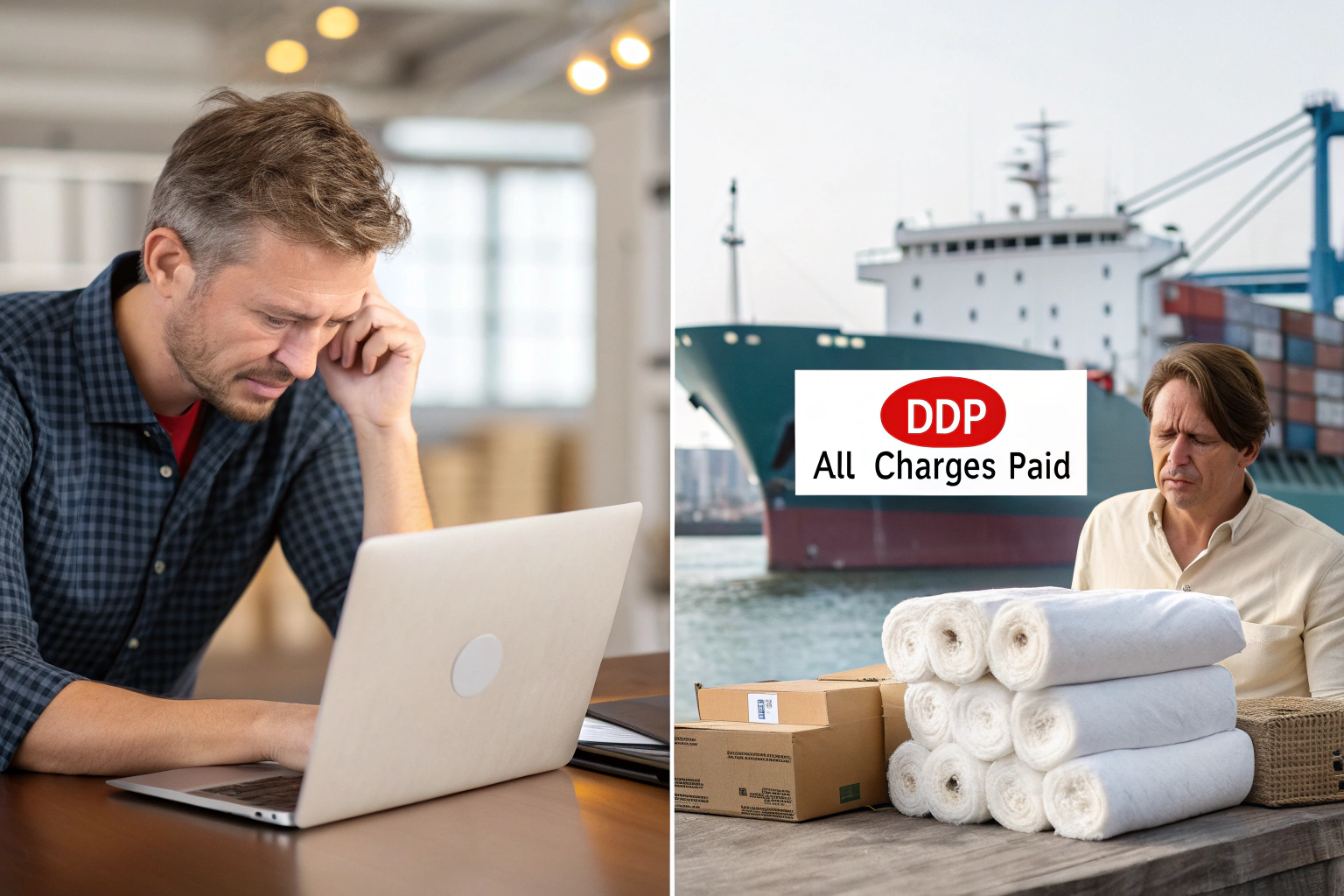
Let me tell you a story that makes my blood boil every time I think about it. Last year, a new client from Amsterdam—great guy, amazing eye for sustainable fabrics—called me in a panic. He had ordered 2,000 meters of our Tencel twill. He negotiated a "great price" on EXW (Ex Works) terms from a broker. He thought he was a genius. He saved maybe $0.15 per meter. Fast forward three weeks. The fabric landed in Rotterdam. He got a call from the freight forwarder demanding €1,850 for "Terminal Handling Charges," "Customs Clearance," and "Port Security Fee" before they’d release the container. Oh, and another €900 for import duty and VAT that he forgot to calculate. His cheap fabric suddenly cost him €1.38 more per meter than if he’d just let us handle it DDP. He was furious. But he wasn’t angry at the broker—he was angry at himself for not understanding the rules of the game.
That’s the dirty secret of international fabric sourcing. The price on the proforma invoice is almost never the price that hits your warehouse floor. And nowhere is this more painful than in the European Union. EU customs are not like US customs. They are precise. They are bureaucratic. And they love charging storage fees while they check your organic certification paperwork. At Shanghai Fumao , we’ve watched this shift happen in real-time over the last five years. More and more of our EU clients—from big Parisian ateliers to small Berlin streetwear labels—are demanding DDP (Delivered Duty Paid) shipping terms. Why? Because they’ve been burned by "hidden fees" one too many times, and they value predictability over a fake discount.
This isn’t just about shipping; it’s about cash flow, compliance, and your sanity. In this guide, I’m going to explain why DDP has become the gold standard for the European textile trade, what specific traps EXW and FOB set for EU buyers, and why we at Shanghai Fumao actually prefer you choose DDP. Yes, you read that right. We prefer it. It makes our life easier too.
Let’s unpack this container.
What Does DDP Shipping Mean When Importing Fabric to the EU?
Before we talk about why it’s preferred, we need to be crystal clear on what it actually is. I’m surprised how many seasoned buyers get this wrong. They think DDP means "free shipping." It does not. It means Maximum Responsibility for the Seller, Minimum Headache for the Buyer. Let’s walk through the alphabet soup of Incoterms so you see exactly where the risk shifts.

How Does DDP Differ from EXW and FOB Shipping Terms?
This is the most important table you’ll read if you’re comparing quotes from different Chinese suppliers. You might see three different prices for the same 1,000 meters of cotton jersey, and wonder why the spread is $500. The answer is usually hidden in these three little letters.
| Incoterm | What You Pay Factory (Shanghai Fumao) | What You Pay Later (The Hidden Cost) | Who Owns the Risk at Sea? | Complexity Level for Buyer |
|---|---|---|---|---|
| EXW (Ex Works) | Lowest upfront price. Just the cost of fabric rolled up at our gate. | Everything. Truck to port, China Export Clearance, Ocean Freight, Insurance, EU Import Duty, EU VAT, EU Customs Broker, Last Mile Truck. | You. The second the truck leaves our lot. | Extreme. You need a freight forwarder in China and one in the EU. |
| FOB (Free on Board) | Fabric cost + Truck to Shanghai/Ningbo Port + China Export Clearance. | Ocean Freight, Insurance, EU Import Duty, EU VAT, EU Customs Broker, Last Mile Truck. | Shifts to you once it crosses the ship’s rail. | High. You manage the EU side and the ocean freight. |
| DDP (Delivered Duty Paid) | Highest upfront price. Includes everything listed above. | Nothing. (Well, maybe a cup of coffee for the driver). | Us. Until it’s inside your warehouse door. | Zero. You sign for the package. |
Here’s the analogy I use with my American clients: EXW is like buying a pizza "take and bake." They hand you raw dough with toppings and you have to drive home, preheat the oven, and figure out the baking time. DDP is like Uber Eats. The pizza arrives hot, cut, and with napkins. You just open the box.
Why Is DDP Considered a Delivered Duty Paid Service?
The key word here is Duty Paid. And in the EU, "Duty" isn’t just one simple line item. It’s a hydra of taxes and fees. When we ship DDP to Germany, France, or Italy, we (or our logistics partner) are acting as the Importer of Record (IOR) .
This means Shanghai Fumao takes legal responsibility for:
- Correct Tariff Classification: Is that fabric "Woven Cotton Twill" (HS Code 5209) or "Printed Cotton Poplin" (HS Code 5208)? Get this wrong by one digit and the duty rate can jump from 8% to 12%. Plus penalties.
- VAT Settlement: We have to pre-pay the VAT (Value Added Tax) of the destination country (19% in Germany, 21% in Belgium, 20% in France) on your behalf. You get this back when you file your taxes, but you don’t have to front the cash at the border.
- REACH Compliance Checks: This is the big one for textiles. EU customs can stop a container of fabric if they suspect the dyes or finishes contain restricted chemicals (like AZO dyes or certain phthalates). If the container is under your name (FOB/EXW), you have to scramble to provide lab reports to German customs in German language. If it’s under our DDP umbrella, our EU-based fiscal representative handles that inspection using the test reports we already provided.
There’s a great detailed explanation of how EU import one-stop shop (IOSS) and DDP interact for ecommerce shipments over on this customs broker’s blog. It gets into the weeds, but it explains why DDP is practically mandatory for B2C sales into Europe now.
What Are the Hidden Costs of Not Using DDP for EU Fabric Imports?
Let’s pull back the curtain on those "cheap" EXW and FOB quotes that flood Alibaba and email inboxes. I run a factory. I know my cost of greige fabric, my cost of dye, and my cost of labor. If a broker offers you a price that’s 20% lower than mine for the exact same spec, he’s not a better negotiator. He’s just not including the second half of the bill. He’s handing you a grenade with the pin pulled and letting you deal with the explosion at the port of Hamburg.

How Much Are EU Customs Clearance and Terminal Handling Fees?
This is where the savings evaporate. You might think, "Okay, duty is 8%, I’ll just add 8% to the price." That’s naive. You forgot about the Terminal Handling Charges (THC) and the Customs Broker Fee.
Here’s a real-world breakdown from an Italian client of ours in February 2024. They imported a single 20ft container (approx 8,000 meters of lining fabric) valued at $22,000 USD.
They used FOB terms because the fabric price looked great.
| Fee Type | Description | Actual Cost Incurred at Genoa Port |
|---|---|---|
| Ocean Freight | Shanghai to Genoa | $2,100 |
| Insurance | Cargo Insurance | $110 |
| THC (Terminal Handling) | Port fee for unloading container from ship to dock. | €325 |
| Customs Clearance Fee | Broker’s fee to file paperwork. | €95 |
| Import Duty (8% on CIF Value) | Duty on $24,435 (Fabric + Freight + Insurance) | $1,955 |
| VAT (22% on Landed Cost) | VAT on (Duty Paid Value + Duty) – This is a cash flow hit even if refundable. | €6,200 approx. |
| Port Storage (Demurrage) | They took 4 days to find a broker. 3 free days. 1 day fee. | €85 |
Total "Hidden" Add-Ons: ~$5,000 USD.
Cost Increase vs. DDP Quote: The DDP quote we gave them for the same container was only $3,800 more than the FOB quote. They thought they were saving $3,800. They actually lost $1,200 and spent a week of their time emailing Italian customs brokers they found on Google.
You can use this international shipping total landed cost estimator tool to play with numbers yourself, but you’ll see the same pattern. Fixed fees kill the margins on smaller textile shipments.
Why Do Fabric Shipments Get Stuck in European Customs?
Unlike the US, where a container might sail through if the paperwork is "close enough," EU customs officials are trained to look for Textile Specific Violations. I’ve had containers held in Rotterdam for two weeks over a missing OEKO-TEX Certificate for the zipper tape—not even the fabric!
Here are the top 3 reasons fabric gets stuck, and why DDP solves it:
1. Incorrect Fiber Composition Labeling (Regulation (EU) No 1007/2011):
The EU requires exact percentages on the label. If your fabric is 48% Cotton, 48% Polyester, 4% Spandex, you cannot round it to 50/50. Customs will pull the shipment and send a sample to a lab. If you’re on EXW terms, the port storage fees accrue €50-€100 per day while the lab tests take 5-7 days. Under DDP, we’ve already submitted the certified composition report electronically before the ship even docks.
2. Missing Economic Operator Registration and Identification (EORI) Number:
Every EU business importing goods needs an EORI number. If your number is expired or you use a personal name instead of a business name, the shipment is blocked. It’s a simple fix, but it takes 48 hours to update in the system. That’s 48 hours of truck driver waiting time you have to pay for.
3. Anti-Dumping Duties on Specific Fabrics:
Did you know the EU has Anti-Dumping Duties on certain Polyester Textured Yarn (PTY) and even some finished polyester fabrics originating from China? These duties can be 50% or more on top of the regular duty. An inexperienced FOB buyer might see their $0.80/m fabric suddenly cost $1.20/m in duties alone. We have software that checks HS codes against the EU TARIC database before we even quote a DDP price. We catch those landmines early.
I highly recommend reading this official EU guide on textile labeling and customs requirements for non-EU imports. It’s dry, but it explains exactly why the paperwork matters more than the product sometimes.
Is DDP Shipping More Cost-Effective for VAT Registered EU Businesses?
This is the million-dollar question for the financial controller at a mid-size fashion brand. You are VAT registered. You can reclaim import VAT. So why would you pay us to do it for you? Doesn’t that tie up our working capital and increase your cost? That’s the logical assumption. But as with everything in textiles, the logic of the supply chain is a little twisted. Let’s look at the cash flow calendar, not just the unit price.

How Does DDP Simplify Import VAT and Duty Reclamation?
If you are a large corporate entity with a dedicated trade compliance team of five lawyers and accountants, then FOB is fine. You have the internal machinery to handle the Deferment Account and the Postponed VAT Accounting.
But if you’re a small-to-medium enterprise (SME)—a 10-person design studio in Copenhagen or a family-owned fabric shop in Lyon—DDP is actually cheaper on a net-net basis.
Here’s why: The Cost of Compliance Labor.
Under FOB or EXW, to reclaim your VAT, you must:
- Hire a customs broker (€50-€150 per entry).
- Receive the C88 (Single Administrative Document) from the broker.
- Reconcile that document against the supplier’s commercial invoice (which is often in English, while the C88 is in German/French/Dutch).
- Enter the data manually into your accounting software.
- File the VAT return.
- Wait 30-60 days for the refund.
If you pay an employee €30/hour to do this for 5 shipments a month, that’s a real cost. Under DDP, we send you one invoice. It says "Fabric + DDP Shipping." You pay it. You book the entire amount as Cost of Goods Sold (COGS) . Done. No separate VAT line item to track. No waiting for a refund from the German tax office (Finanzamt).
I recall a Dutch client in 2023 who switched from EXW to DDP with us. She told me, "I fired my customs broker and saved €2,400 a year in fees. I don’t even care about the duty rate anymore. I just want to know the price on my doorstep."
Can DDP Terms Help Avoid Demurrage and Detention Charges?
Let’s talk about the Demurrage Monster. This is the fee the shipping line charges you for keeping their container at the port too long. And in Europe, the "free time" is stingy. Usually only 3 to 5 days.
Here is the scenario where DDP saves you a fortune:
EXW/FOB Timeline:
- Day 1: Ship arrives.
- Day 2: Customs releases hold (If paperwork is perfect).
- Day 3: You realize you need to hire a trucker. You call around for quotes.
- Day 4: You book the truck.
- Day 5: Truck picks up. Oops. It’s 5pm. Day 5 just ended. You are now on Day 6.
- Demurrage Charge: €85.
DDP Timeline:
- Day 1: Ship arrives.
- Day 2: Our bonded partner’s truck is pre-booked and waiting at the port gate.
- Day 3: Container is delivered to your warehouse.
We move so fast because the destination handling is pre-arranged. We aren’t waiting for you to find a local carrier who understands that a 40ft container of fabric rolls needs a rear lift gate and a pallet jack. We use our contracted European network. This is particularly crucial if you’re importing to a landlocked country like Austria, Czech Republic, or Hungary. The transit time from Hamburg or Koper port adds 2-3 days. That eats up your free time immediately. DDP covers that entire inland leg risk-free for you.
When Should European Small Businesses Use DDP vs. Other Incoterms?
I’m not a dictator. I’m not going to tell you DDP is the only way to ship. There are specific scenarios where FOB or even EXW makes sense. But for 90% of the readers of this blog—brand owners, boutique shops, and e-commerce sellers—the decision is actually much simpler than you think. Let’s break it down by your business size and order volume.

Is DDP Worth It for Small Batch Fabric Orders Under 100 Meters?
Absolutely. Without question. Do not pass go. Do not collect $200.
If you are shipping Less than Container Load (LCL) —meaning just a few rolls or boxes on a pallet—DDP is not just preferred; it’s mandatory for your survival.
Here’s the dirty math of LCL EXW:
- Destination Port Fee (CFS Fee): To unload your single pallet from a shared container costs roughly €85-€125. This is a flat fee regardless of whether your fabric is worth €500 or €5,000.
- Handling Fee: Another €45.
- Customs Clearance: €75 minimum.
If you ship a €500 order of sample yardage on EXW terms, the destination charges will exceed the value of the goods. You will be asked to pay €300 to release a €500 package. I’ve seen small Etsy sellers and startup designers literally abandon their fabric at the port because the fees made it cheaper to just re-order and ship via DDP courier (like DHL or FedEx) next time.
For small batches, DDP Courier (DHL/FedEx) is the only way to go. Yes, the freight cost looks high on the invoice from us. But that invoice is the final invoice. No calls from FedEx demanding "Disbursement Fees" or "Bonded Storage." If you’re curious about why DDP courier services are essential for small ecommerce fabric businesses, this blog post from a shipping software company explains the fee structure perfectly.
Why Do Large Volume Buyers Still Negotiate FOB Contracts?
Okay, so if DDP is so great, why does Zara do FOB? Why does H&M have a massive logistics department?
Volume and Infrastructure.
When you import 100 containers a year, the game changes completely.
- Economies of Scale: Zara has a contracted rate with Maersk that is 60% lower than the spot market rate we can offer a smaller client. They have an in-house customs team that clears 20 containers a day with one click of a mouse. The fixed fees (THC, Brokerage) become negligible when spread over 50,000 meters of fabric.
- VAT Deferment: Large corporations have a VAT Deferment Account. They don’t pay the VAT at the border at all. They just account for it in their monthly return. There is no cash flow hit. Therefore, they don’t value the cash flow benefit of DDP.
For these giant buyers, FOB is a tool to control their supply chain destiny. They want to choose the vessel, the route, and the exact hour of delivery to their massive distribution center.
But here’s the thing: At Shanghai Fumao , we work with both ends of the spectrum. We ship FOB containers to big US brands and DDP pallets to small Parisian designers. We understand the logic of both. But for the reader of this article—you’re probably not Zara. You’re a smart, agile, independent business owner. For you, DDP is the professional hack that lets you operate like a big brand without the big brand’s back office. It levels the playing field.
Conclusion
So we’ve come full circle. European buyers prefer DDP shipping for fabric because they’ve learned the hard way that Transparency > A Lowball Quote. The European customs union is a fortress of paperwork, and the price of entry isn’t just the 8% duty—it’s the hours of life lost to emailing brokers in foreign languages, the unexpected demurrage invoices, and the cash flow crunch of fronting 20% VAT.
You started this article maybe thinking DDP was just a more expensive shipping option. I hope I’ve shown you that it’s actually a risk transfer mechanism. It transfers the headache from your desk in London, Milan, or Berlin to my desk in Keqiao. And frankly, I’m better at handling that specific headache than you are. I do it 50 times a week. You do it maybe 5 times a year. Let me use my economies of scale and my EU fiscal representative network to absorb that complexity.
The next time you’re comparing a quote from a factory, don’t just look at the bottom line. Look at the Incoterm. If it says EXW, add 25% to the price in your mental spreadsheet. If it says DDP, that number is real. That’s the number that puts fabric on your cutting table.
If you’re tired of the guessing game and want a firm, transparent, all-in price for your next fabric shipment to the EU, let’s talk. We specialize in making the logistics invisible so you can focus on the design.
For a personalized DDP quote to your specific EU city, or if you just have a question about a tricky customs clearance issue you’re facing, reach out to our Business Director, Elaine. She knows the European logistics map better than most truck drivers.
Email Elaine at: elaine@fumaoclothing.com
Stop paying for surprises. Start paying for certainty.