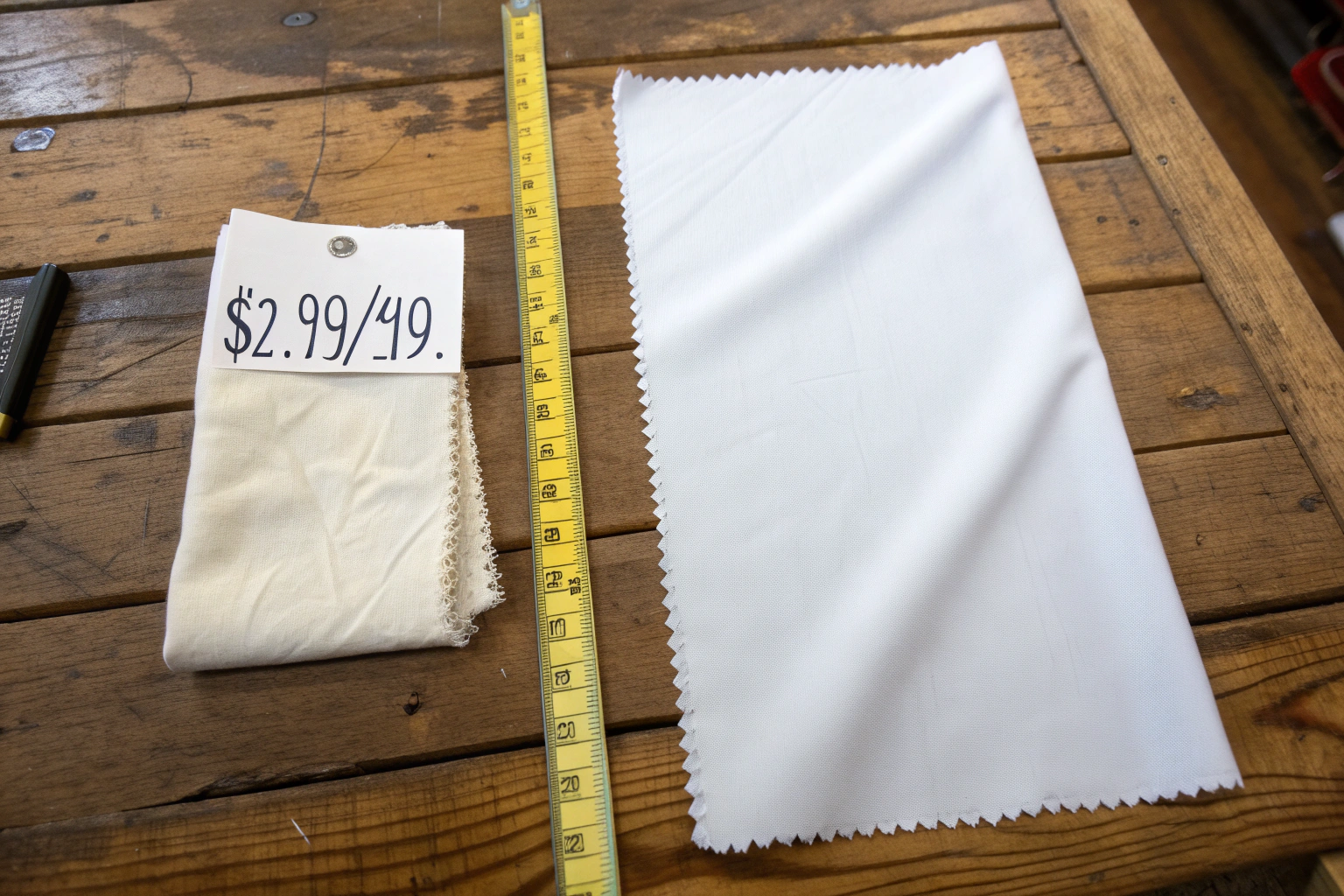
You’ve done the legwork. You requested quotes for 2,000 yards of "Cotton Twill, 7oz, Piece Dyed." Supplier A in one province quotes $3.85 per yard. Supplier B in another province quotes $2.95. Supplier C, a trading company you found on Alibaba, quotes $2.50. Your brain screams, "Take the cheap one! That’s a $2,700 savings on this order alone!" Then you receive the bulk shipment. The $2.50 fabric feels like sandpaper compared to the swatch. The width varies by two inches from roll to roll. And the color? It’s not even close to the lab dip. You didn’t save $2,700. You lit $5,000 on fire and lost six weeks of production time.
Fabric pricing is not a commodity market like gold or oil. It is an opaque, multi-variable equation that reflects Risk Allocation, Processing Integrity, and Supply Chain Leverage. The price per yard is a summary of hundreds of micro-decisions made from the cotton field to the finishing plant. A $1.00 difference in price isn’t just "profit margin" for the factory. It’s usually the cost of something being left out—whether it’s the third wash cycle, the proper yarn tension, or the honesty about the fiber content.
I’m Jack, and I’ve been pricing fabric for over two decades at Shanghai Fumao. I’ve had to explain to frustrated designers why my price is higher than a random listing on an app. And I’ve had to help clients who came to me after being burned by those low prices. I’m going to pull back the curtain on exactly where those price differences come from. By the end of this, you won’t just see a number on a quote. You’ll see the Invisible Variables that determine whether that fabric makes you money or costs you your reputation.
How Do Raw Material Sourcing and Yarn Quality Affect Cost?
The journey of your fabric starts in a field or a chemical plant, and the choices made there set the floor for the price. You can’t make a silk purse out of a sow’s ear, and you can’t make a premium, durable garment out of cheap, short-staple yarn. The raw material is the single biggest cost driver, often accounting for 50-70% of the total fabric cost. But it’s also the easiest place for unscrupulous suppliers to hide "savings."
At Shanghai Fumao, we see the impact of yarn quality every single day on our looms. Cheap yarn breaks. It breaks during warping. It breaks during weaving. It creates slubs, thin spots, and weak seams. Every time a loom stops because of a yarn break, we lose 3-5 minutes of production time. The weaver has to find the break, tie a knot (which leaves a defect), and restart the machine. A cheap yarn might save you $0.30 a yard on the yarn invoice, but it costs you $0.50 a yard in lost efficiency and quality downgrades.
You have to understand the difference between Combed vs. Carded and Ring-Spun vs. Open-End. These aren’t just fancy marketing terms. They are specific mechanical processes that dictate the strength, softness, and pilling resistance of the final fabric.
What Is the Real Difference Between Combed and Carded Cotton?
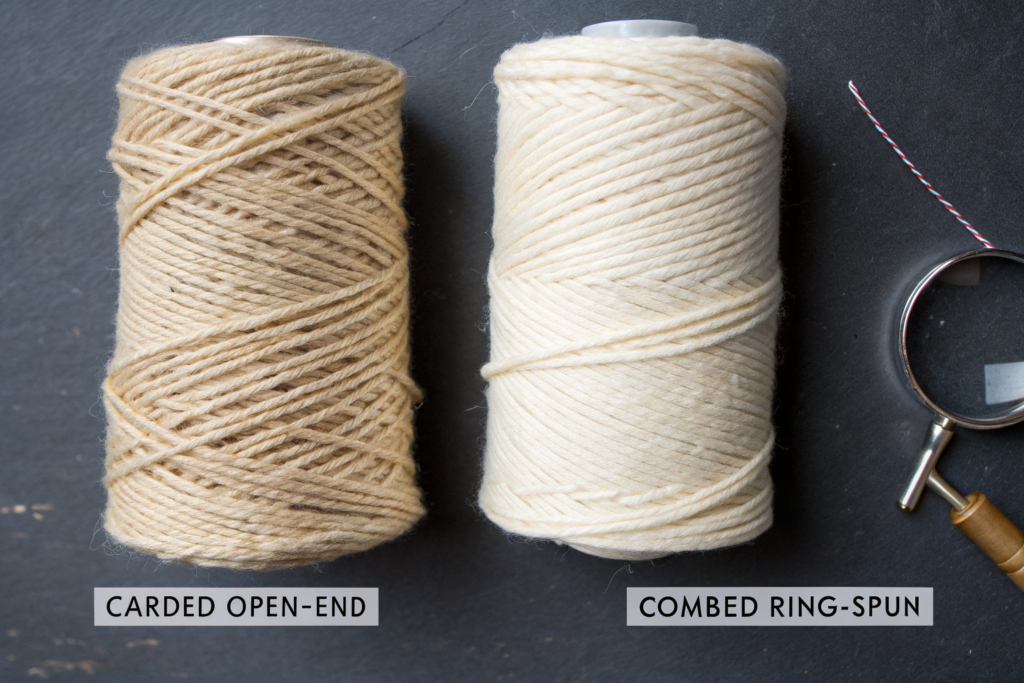
Carding is like brushing tangled hair with a wire brush. It aligns the fibers and removes some trash (leaves, seeds). But it leaves the Short Fibers in the yarn. These short fibers are the enemy. They work their way to the surface of the fabric over time, creating those annoying little fuzz balls called Pills.
Combing is an additional, expensive step. After carding, the cotton sliver is run through a machine with fine metal teeth that Removes the Short Fibers. Only the longest, strongest fibers remain. Combing removes about 15-20% of the fiber weight as waste. That waste is sold off for cheaper products (like mops or industrial wipes).
Therefore, Combed Cotton yarn is inherently 15-20% more expensive just on raw material waste alone, plus the extra machine cost. But the fabric? It’s smoother, stronger, and resists pilling for the life of the garment.
Here is a quick reference table we share with clients when they question the price of our "Premium Cotton" vs. "Market Cotton":
| Yarn Attribute | Market Standard (Cheap) | Fumao Standard (Premium) | Impact on Price |
|---|---|---|---|
| Processing | Carded | Combed | +12-18% |
| Spinning | Open-End (OE) | Ring-Spun (RS) | +10-15% |
| Staple Length | 26-28 mm (Upland) | 35+ mm (Supima/Egyptian) | +30-50% |
| Origin | Uncertified Mix | Xinjiang Long Staple / Imported | +5-10% |
This table isn’t to scare you. It’s to show you that a $2.50 fabric and a $4.00 fabric are literally made of different stuff. You can verify these technical specifications by reading up on the differences between carded and combed cotton yarn manufacturing processes and how fiber staple length affects yarn quality and fabric performance.
Why Does Yarn Count Consistency Matter for Your Bottom Line?
Yarn Count is the thickness of the yarn. A 40/1 (40 count) yarn is finer than a 20/1 yarn. You spec a fabric to be 40×40 / 133×72 (a standard poplin). That means you need exactly 40 count yarn in both warp and weft.
A cheap supplier might use 40 count yarn but source it from a mill with poor quality control. Their "40 count" yarn might actually fluctuate between 38 and 42 count throughout the batch. This variation is invisible to the naked eye in the greige state, but it creates Barré (streaky lines) in the fabric after dyeing because the dye absorbs differently on thicker vs. thinner yarn segments.
At Shanghai Fumao, we use a Uster Tester in our incoming yarn inspection. This machine measures the Coefficient of Variation (CV%) of the yarn mass. We reject yarn lots with a CV% above a certain threshold. This is a cost. It means we sometimes return yarn to our spinner and demand better. A low-cost supplier simply runs whatever yarn arrives on the truck. That’s one reason our price is higher. We are paying for Uniformity, which translates directly to Dyeing Consistency in your final product. You can explore the technical side of this through resources on understanding yarn evenness testing and its importance in fabric quality.
What Hidden Costs Exist in Dyeing and Finishing Processes?
This is the "Black Box" of fabric pricing. You can touch the yarn. You can see the loom. But you cannot see what happens inside the dye kettle or the finishing stenter. And yet, this is where 50% of the cost difference and 80% of the quality problems originate.
Dyeing and finishing are chemistry and energy. A cheap factory uses the Minimum Effective Dose of everything. They use the cheapest dyes, the least amount of water, the fastest oven speed, and the harshest chemicals. The fabric comes out looking okay on day one. But after three washes? The color fades to a sad pastel. The hand feel turns stiff and brittle. The fabric shrinks an extra 5% because it wasn’t properly heat-set.
At Shanghai Fumao, our CNAS-certified lab dictates the process. We don’t let the dye house cut corners because we test the Wash Fastness and Crocking of every single batch against the client’s spec. This adds cost. But it adds Durability.
Are You Paying for Water, Salt, and Steam Without Knowing It?
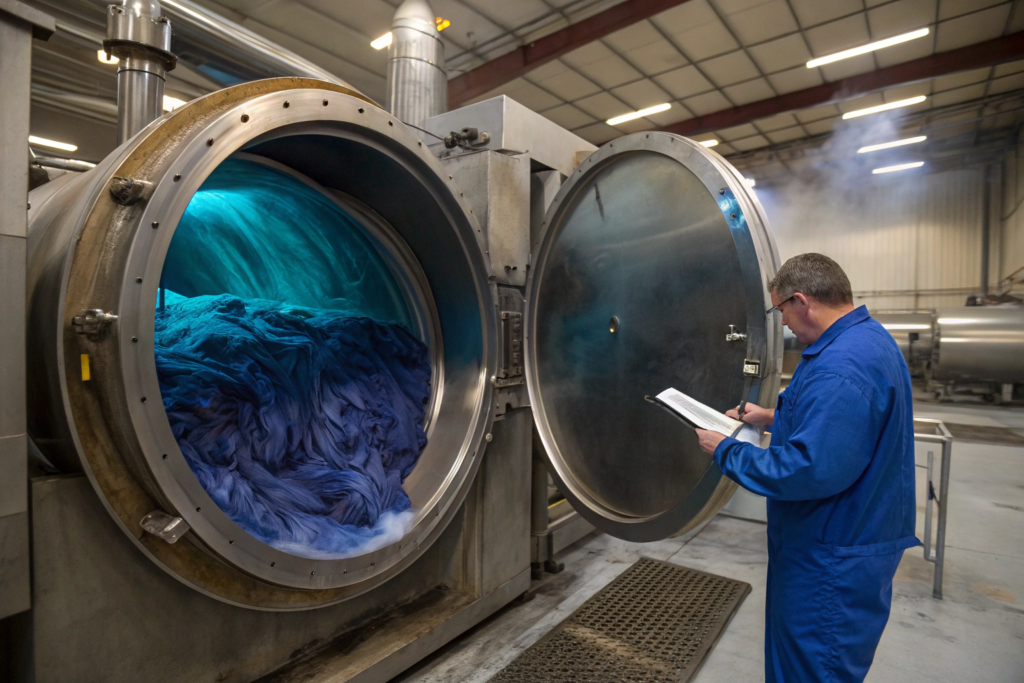
Let’s talk about Reactive Dyeing of Cotton. To get the dye molecule to bond with the cellulose fiber, you need Salt (Sodium Chloride or Sodium Sulfate) and Alkali (Soda Ash). A typical recipe for a dark shade like Navy or Black might require 80-100 grams of salt per liter of water. For a 500kg dye lot, that’s hundreds of kilos of salt.
That salt doesn’t disappear. It goes down the drain. And in China today, Wastewater Treatment is not free. The government strictly monitors Total Dissolved Solids (TDS) in the discharge. A factory that wants to run fast and cheap will use less water and dump high-salt, high-chemical effluent (risking fines or shutdown). A factory that wants to stay in business invests in Reverse Osmosis water treatment to clean that water before discharge.
We pay a premium to work with dye houses that have Closed-Loop Water Systems and proper effluent treatment. This is a direct cost that adds roughly $0.15 to $0.30 per yard for heavy shades. The cheap quote doesn’t include this because the cheap factory is either polluting (and will get shut down mid-order) or they are skimping on the Soaping-Off process. Soaping-off is the hot water rinse that removes the unfixed dye. If you skimp on soaping, the fabric looks bright but the color rubs off on your customer’s white sofa (Crocking). You can dive deeper into this by reading about the environmental impact and cost of textile wastewater treatment in China and the chemistry behind reactive dye hydrolysis and the importance of soaping-off.
Why Does "Hand Feel" Cost Extra?
You want a "Silky Soft" finish. Or a "Peach Skin" finish. These are not properties of the yarn. They are Chemical Finishes applied at the very end of the line. Specifically, Silicone Softeners (Macro or Micro emulsions).
There are $2/kg silicones and $20/kg silicones. The cheap one is a basic oil that coats the fiber. It feels great in the showroom. It washes out in two laundry cycles. The expensive one is a Reactive Amino Silicone that actually cross-links with the fiber and provides durable softness for 20+ washes.
When you ask a supplier, "Can you match this hand feel?" and they say "Yes," you need to ask the follow-up: "Is that a durable finish or a topical finish?"
At Shanghai Fumao, we use Micro-Silicone for most premium orders. It’s expensive. It requires a slower stenter speed (more time in the oven to cure) which uses more electricity. That’s another $0.10 a yard. But the garment still feels like the sample after the customer washes it. That’s the difference between a 5-star review and a return. (Here’s a tip: If a fabric feels too good and slippery right off the roll, it’s probably a heavy topical finish. It’s a red flag for longevity.) For a technical breakdown, looking into the chemistry of textile softeners and silicone finishing agents is quite revealing.
How Does Order Volume and Relationship Pricing Work in Textiles?
Textile manufacturing is a business of Batch Processing. Setting up a machine is the expensive part. Running the machine is the cheap part. Therefore, the Length of the Run is the single biggest determinant of price per yard. This is why you get a quote for 500 yards at $6.00 a yard and a quote for 5,000 yards at $4.50 a yard. The factory isn’t gouging you on the small order. They are applying the Setup Amortization math.
But there’s another layer to this: Relationship Pricing. This is the unspoken, "soft" side of sourcing. A factory will give a better price to a buyer who is easy to work with, pays on time, and doesn’t file frivolous claims. A buyer who is known for being difficult, slow to approve lab dips, or quick to demand discounts for minor issues will get a Hassle Premium built into their quotes.
At Shanghai Fumao, our pricing is transparent and tiered by volume. We publish our MOQ (Minimum Order Quantity) and our Volume Breakpoints. But we also value Long-Term Partnerships. A client who places four 5,000-yard orders a year will always get priority and better commercial terms than a one-time buyer.

Why Is There a "Small Order Surcharge" for 500 Yards?
Let’s break down the actual workflow for a 500-yard custom color order.
- Lab Dip Development: 3 hours of lab technician time. 5 gallons of water. Chemicals. Cost: $50 (we often absorb this, but it’s real).
- Yarn Sourcing: We have to find a spinner with 200kg of specific yarn count in stock. Often we have to buy a minimum cone quantity of 500kg just to get the 200kg we need for your 500 yards. The rest sits in inventory, tying up our cash.
- Dye Machine Preparation: The dye kettle has to be drained, cleaned, and filled. This takes 2 hours.
- Finishing Stenter Setup: The width and heat settings have to be adjusted from the previous run. Takes 30 minutes.
For a 500-yard order, that setup time is roughly 3 hours total. For a 5,000-yard order, the setup time is the exact same 3 hours. But in the first case, you amortize 3 hours over 500 yards (0.006 hours per yard). In the second case, you amortize 3 hours over 5,000 yards (0.0006 hours per yard). That’s a 10x difference in labor efficiency per yard.
This is why we have to charge a higher price for low minimums. We are essentially charging for the Time Slot on the machine. If you want the volume price, you need to commit to the volume that makes the math work. This is standard across every capital-intensive industry, not just textiles. For more context, you can read about how minimum order quantities are calculated in textile manufacturing and the economics of batch processing vs continuous manufacturing in fabric production.
Can You Negotiate Fabric Prices Without Sacrificing Quality?
Yes, but you have to negotiate the Right Variables. If you just say, "Can you do better on price?" the factory will say "Yes" and then silently downgrade the yarn or the finishing to protect their margin. That’s how you get the $2.50 fabric that doesn’t match the sample.
Here is the playbook for smart negotiation that preserves quality:
- Ask for "Mill Run" Allowance: Instead of demanding exact cut lengths (e.g., 50 yards per roll), accept "Mill Run" lengths (40-70 yards per roll). This reduces our repacking labor.
- Adjust the Delivery Window: If you can give us 7-10 days of flexibility on the ex-factory date, we can fit your order into a gap in the schedule where the machine would otherwise be idle. This saves us changeover costs.
- Consolidate Colors: If you need 500 yards of Navy, 500 yards of Red, and 500 yards of Green, you pay three separate setup fees. If you can order 1,500 yards of Navy, the price per yard drops significantly.
- Payment Terms: A deposit ensures we can buy the yarn without using our credit line. A buyer who pays 30% deposit, 70% against copy of documents gets a better price than one who demands 60-day open account terms. Cash flow is a cost.
At Shanghai Fumao, we are always open to these conversations. We want the business. We just need to structure it so we don’t lose money making it. Honest communication about these variables leads to a win-win.
What Are the Risks of Unbelievably Low Fabric Prices?
There is an old saying in the textile business: "The bitterness of poor quality remains long after the sweetness of low price is forgotten." When a price seems too good to be true, it isn’t magic. It’s Arbitrage of Risk. The supplier is transferring risk from their balance sheet to yours. They are betting you won’t notice the missing stitches, the weak yarn, or the toxic chemicals until it’s too late to do anything about it.
I have had clients come to me with horror stories that started with a "great deal." One client bought "Recycled Polyester" for a sustainable activewear line at a rock-bottom price. When they went to get the GRS (Global Recycled Standard) certificate to put the hangtag on the garment, the supplier ghosted them. The fabric was cheap because it wasn’t actually certified recycled. It was virgin polyester with a fake story. The brand had to recall the product or face a lawsuit for greenwashing.
At Shanghai Fumao, we have a saying: "The price is what you pay. Value is what you get." We’d rather lose a bid to a cheaper quote than win a bid by lying about the yarn content or the finishing durability.
Could Cheap Fabric Mean Fake Fiber Content or Toxic Chemicals?
Yes. This is the dirty underbelly of the industry. Fabric testing costs money. A cheap supplier assumes you won’t test the bulk. So they play the Bait and Switch game.
Common scams include:
- The Viscose Switch: You order "100% Linen." You get a blend of Linen and Viscose. Viscose is half the price of Linen. You can’t easily tell the difference in a quick hand feel, but Viscose wrinkles differently and loses all strength when wet.
- The Spandex Fade: You order 95% Cotton / 5% Spandex for stretch jeans. The supplier uses 3% Spandex and 2% Polyester filler. The jeans bag out at the knees after an hour of wear.
- The Azo Dye Time Bomb: To get a brilliant, cheap red or navy, some factories use Banned Azo Dyes that break down into carcinogenic amines. These dyes are illegal in the EU and US. If your shipment gets caught at customs, it’s seized and destroyed. You lose the goods and the freight.
At Shanghai Fumao, every single bulk shipment comes with a Mill Test Report and a Randomized 3rd Party Test Option. We encourage clients to test the bulk because we know what’s in it. We use OEKO-TEX Standard 100 certified dyes and auxiliaries. It costs more. But it clears customs. And it doesn’t give your customer a rash. You can learn more about these standards by reading the OEKO-TEX Standard 100 certification requirements and limits and the risks associated with azo dyes in textiles and leather products.
How Does the "Shrinkage Gamble" Affect the Real Price?
This is a subtle but brutal cost. You order 2,000 yards of fabric to cut 1,000 dresses. The pattern assumes 3% shrinkage in length and width. The cheap fabric arrives. You cut it. You sew it. You wash the finished garment to check quality. It shrinks 8%. The dress is now two inches too short and too tight. You can’t sell it.
The supplier met the price. The spec said "Width: 58/60 inches." But they didn’t control the Residual Shrinkage in finishing. They just stretched the fabric on the stenter to hit the width measurement while it was wet. As soon as it gets wet again (washing), it relaxes back to its natural state. You just lost 1,000 dresses worth of labor and trims.
At Shanghai Fumao, we test shrinkage Before Cutting. We cut a 50cm x 50cm square, wash it according to AATCC standards, and measure it. If the shrinkage is above the agreed tolerance (usually 3% max), we Re-Finish the fabric (run it through the stenter again with steam to pre-shrink it). This costs us time and energy. But it saves you from making 1,000 unwearable garments. That’s the hidden value in the price per yard. It’s an insurance policy against catastrophic yield loss. You can read more about this critical test by looking at the AATCC Test Method 135 for dimensional change of fabrics after home laundering.
Conclusion
The price of fabric is a language. It speaks to you about the soil the cotton grew in, the skill of the spinner, the integrity of the dye house, and the discipline of the finisher. A low price whispers, "We cut corners." A fair price states, "We controlled the process." An inflated price (from a middleman with no assets) shouts, "We add no value."
Your job as a buyer is to become fluent in this language. You need to understand that a $0.50 difference per yard is not just a number on a spreadsheet. It is Durability, Consistency, and Trust. When you find a supplier whose price reflects the true cost of making good fabric, you have found a partner, not just a vendor.
At Shanghai Fumao, we don’t try to be the cheapest fabric supplier in Keqiao. There are thousands of those. We try to be the Most Reliable Value. We price our fabric based on the actual cost of the raw materials, the energy, and the skilled labor required to meet your specifications. We want you to come back for the next season, and the one after that.
If you have a quote in hand that seems too good to be true, or if you’re struggling to understand why there’s such a wide gap between suppliers, let’s talk. We can walk through the specs together and identify where the risk is hiding. Reach out to our Business Director, Elaine. She can give you a realistic, line-by-line explanation of what goes into a fair price. You can email her at elaine@fumaoclothing.com. Let’s make sure the price you pay is for fabric you can actually use.