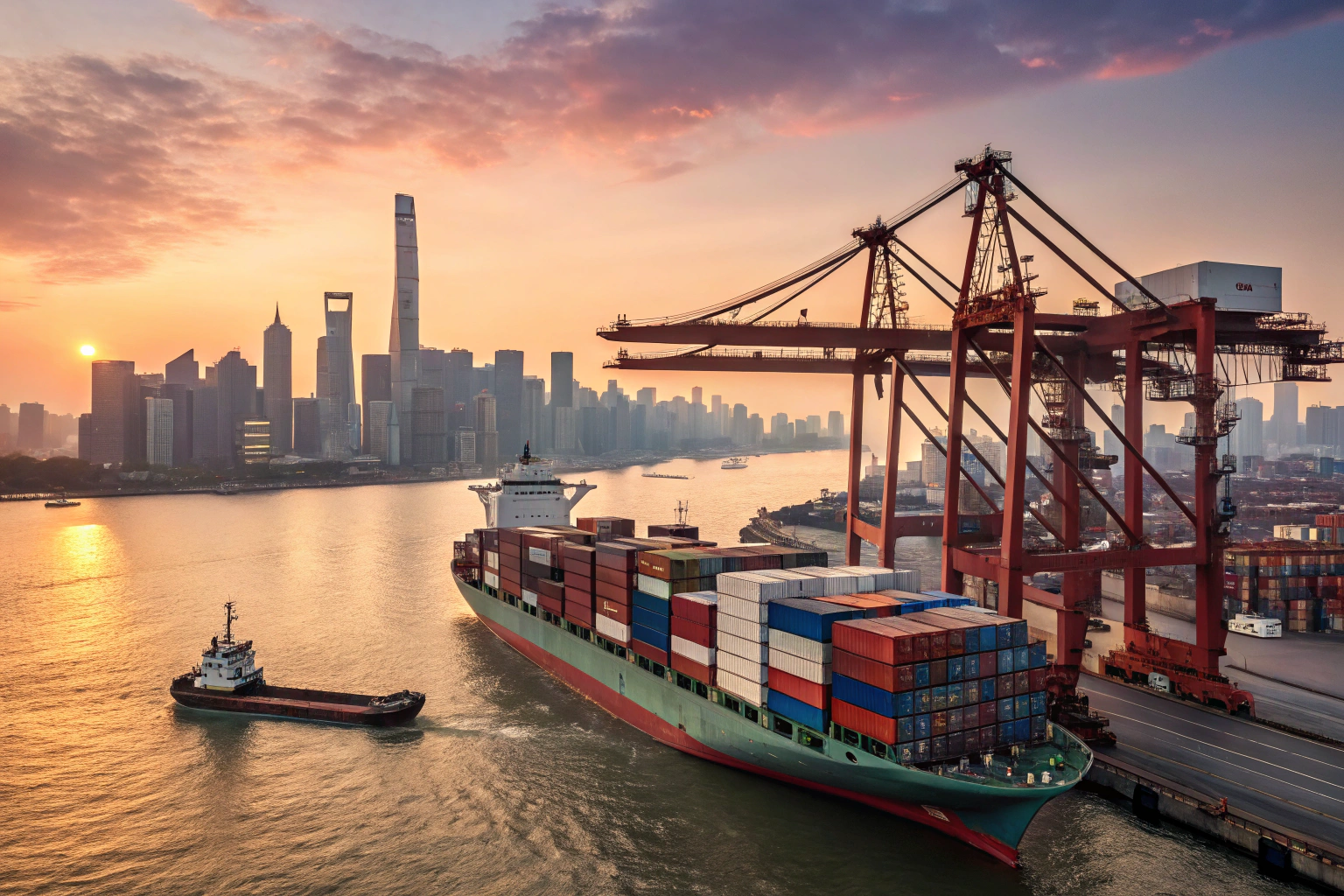
Here is the math problem that wakes every fabric buyer up at 3:00 AM. You have 2,500 yards of custom-printed viscose challis sitting in a warehouse in Keqiao. Your launch event is in 22 days in Los Angeles. Sea freight takes 18 days port-to-port, plus 4 days for customs and drayage. That’s 22 days. No margin for error. One day of bad weather in the Pacific, one day of port congestion in Long Beach, and you miss your launch. But air freight for 2,500 yards of fabric? That’s roughly 1,200 kilograms. At $5.50 per kilo, that’s a $6,600 freight bill. On an order where your fabric cost was maybe $9,000. You just erased your profit margin before you sold a single dress.
This is the eternal dilemma of textile logistics. You are not shipping iPhones or sneakers. You are shipping air. Fabric is volumetric. It’s light but it takes up a massive amount of space in a container or on a pallet. Choosing the wrong freight method doesn’t just delay your timeline. It fundamentally changes your Landed Cost Per Yard. And if you don’t calculate that cost before you price your garments, you are building a business on quicksand. The decision between sea and air freight isn’t just about speed versus cost. It’s about Cash Flow Timing, Inventory Holding Costs, and Quality Preservation.
My name is Jack, and I’ve been shipping containers of fabric out of China for two decades through Shanghai Fumao. I’ve seen buyers make the right call and cruise into port with a healthy margin. I’ve seen buyers panic, pay for air freight, and then have their fabric sit in customs for a week anyway, defeating the purpose. I’ve also seen fabric destroyed because someone tried to save $500 by stuffing delicate embroidered tulle into a humid ocean container without the right desiccant. Let’s break down the real numbers, the hidden risks, and the specific scenarios where each mode of transport actually makes sense for a textile professional like you.
Sea Freight vs. Air Freight: What Is the True Cost Per Yard?
Most buyers make the mistake of comparing Freight Cost vs. Freight Cost. They get a quote: $3,500 for a 20-foot container from Shanghai to LA, or $7,200 for air freight. They see air is double and instinctively say, "Sea freight. Done." But that’s only half the equation. You need to calculate the Landed Cost Per Yard, which includes the freight cost divided by the yards shipped, plus the Financial Carry Cost of your money being tied up in transit.
Let’s do some real math based on a typical order we handle at Shanghai Fumao. Let’s say you order 8,000 yards of medium-weight cotton twill. That’s roughly 2,800 kilos. It will fit nicely on 6 pallets.
Scenario A: Sea Freight (LCL – Less than Container Load)
- Freight Cost: $450 (per cubic meter, you use 5 CBM) = $2,250
- Transit Time: 18 days port-to-port + 5 days inland/pre-carriage = 23 days total.
- Customs/Brokerage: $250
- Total Logistics Cash Outlay: $2,500
- Cost Per Yard (Logistics): $0.31 per yard.
Scenario B: Air Freight
- Freight Cost: 2,800 kgs @ $5.20/kg = $14,560
- Transit Time: 2 days airport-to-airport + 2 days clearance = 4 days total.
- Customs/Brokerage: $350 (higher handling fees)
- Total Logistics Cash Outlay: $14,910
- Cost Per Yard (Logistics): $1.86 per yard.
The difference is $1.55 per yard. That seems huge. But if this is a premium fabric that sells for $12.00 per yard wholesale, and missing the season means you have to mark it down to $6.00 per yard in six months… suddenly that $1.55 insurance policy looks like a bargain. You have to factor in the Liquidation Risk. This is what we help our clients navigate at Shanghai Fumao—we don’t just give you a freight quote; we help you model the "Cost of Being Late."

How Do You Calculate the True Landed Cost of Fabric?
The Landed Cost is the total cost to get one yard of fabric onto your cutting table. The formula is simple but the inputs are often hidden.
Landed Cost = (Fabric Cost per Yard) + (Freight Cost per Yard) + (Duty per Yard) + (Insurance per Yard)
But here is where sea freight gets tricky for fabric: The Cubic Meter (CBM) Trap. Fabric rolls are round. Pallets are square. There is wasted space. If your factory packs the container poorly, you might use 12 CBM for 8,000 yards when a better packer uses 10 CBM. That extra 2 CBM at $90/CBM is $180 wasted. We call this the Packing Density Ratio.
At Shanghai Fumao, we have a specific packing protocol for export. For sea freight, we use Telescoping Prevention (hard cores) and we vacuum-pack or tightly roll woven fabrics to reduce volume. For knits, we use a specific roll tension to prevent "bagging" but still keep the roll diameter tight. This packing expertise can reduce your sea freight volume by up to 15% compared to a factory that just tosses rolls in a box. That’s real money.
Also, don’t forget Duty. The duty rate for woven cotton fabric (HTS 5208-5212) is different from knit synthetic fabric (HTS 6001-6006). If your supplier classifies it wrong to "save you money," U.S. Customs will catch it and you’ll get a bill for back duties plus penalties. We classify everything correctly based on the fiber content test report from our CNAS lab. It’s the only way to sleep at night. You can verify these rates yourself using the official USITC Harmonized Tariff Schedule lookup tool for textiles and apparel.
What Is the Hidden Cost of "Free on Board" Shipping?
FOB (Free on Board) is the most common Incoterm in this industry. The factory quotes you a price that includes getting the goods on the ship. You pay the ocean freight. This sounds fair, right? It’s a trap if you don’t control the freight forwarder.
Here is a scam we’ve seen a hundred times: A buyer agrees to FOB Shanghai. The factory recommends "their friend’s forwarding company." The buyer gets a freight bill for $4,500. The real cost was $3,800. The factory and the forwarder split the $700 difference as a kickback. You just paid a hidden surcharge.
At Shanghai Fumao, we actually prefer our clients to use their own freight forwarder under FOB terms, or we recommend using CIF (Cost, Insurance, Freight) where we control the shipping line. Here’s the difference:
- FOB with YOUR Forwarder: You have visibility. You control the routing. You know the real cost.
- CIF with Shanghai Fumao: We use our negotiated volume rates with carriers like Maersk and COSCO. Because we ship thousands of containers a year, we get rates that are often 20-30% cheaper than what a small forwarder can offer a single client. We pass that savings on transparently. We show you the bill of lading. We don’t play the kickback game.
The "hidden cost" isn’t just money. It’s Control. If you don’t control the forwarder, you don’t control the booking. Your "urgent" container gets rolled to next week’s vessel because the forwarder is prioritizing a bigger client. For more insight into this, reading up on how to avoid freight forwarder scams and hidden fees in China sourcing is essential.
When Does Air Freight Actually Save You Money on Fabric?
Yes, you read that right. Air freight is almost always more expensive in direct cash outlay. But there are specific, high-stakes scenarios where air freight actually preserves your profit margin more effectively than ocean freight. You have to think like a CFO, not just a logistics manager.
The financial principle here is Time Value of Money and Opportunity Cost. If your $30,000 fabric order is sitting on a boat for 30 days, that $30,000 is frozen. You can’t use it to buy more fabric. You can’t use it for marketing. More importantly, you can’t sell the fabric. If you air freight that same order, it arrives in 5 days. You sell it in 10 days. You get paid in 30 days. You have turned that cash around in 45 days instead of 90 days.
For a small to medium-sized brand, cash flow is oxygen. Running out of cash kills a brand faster than a bad review. Air freight, in this context, is an Accelerator. It’s the cost of accessing your inventory now.

Can Air Freight Save a Seasonal Launch?
This is the most common reason our clients at Shanghai Fumao switch to air. They have a Fall/Winter collection launch scheduled for September 1st. The fabric was supposed to ship July 15th. There was a delay at the dye house (it happens—usually a color rejection or a steam boiler issue). Now it’s August 5th. Sea freight won’t arrive until September 10th. You’ve missed the launch window. You’ve lost two weeks of peak selling season.
The cost of missing a season is Gross Margin Erosion. If you air freight 1,000 yards of premium wool coating, the air freight might cost $2,800 extra. But if you miss the season, you either cancel the production (losing your deposit and your relationship with the cut-and-sew factory) or you hold the fabric until next year. Holding inventory for a year costs roughly 25-30% of the value in warehousing fees, insurance, and capital costs. Plus, next year that color might be "so last season."
$2,800 extra freight vs. a $30,000 write-off? That’s a no-brainer. (Here’s a real tip from my desk: If you are a new brand, build a "Contingency Air Freight" line item into your initial budget. Assume 5% of your orders will need to fly. If you don’t use it, great—you have extra profit. If you need it, you don’t panic.)
How Does Fabric Weight and Volume Impact the Air Freight Equation?
Air freight is charged on Chargeable Weight, which is the greater of Actual Weight or Volumetric Weight. Volumetric Weight Formula: (Length x Width x Height in cm) / 6000.
Let’s go back to our 8,000 yards of cotton twill.
- Actual Weight: 2,800 kgs.
- Volume: 10 cubic meters = 10,000,000 cubic cm / 6000 = 1,666 kgs Volumetric.
- Chargeable Weight: 2,800 kgs (because actual weight is higher).
Now let’s look at a different fabric: Silk Chiffon. 8,000 yards of chiffon is incredibly light.
- Actual Weight: 400 kgs.
- Volume: 15 cubic meters (it’s fluffy and takes up space).
- Volumetric Weight: 15,000,000 / 6000 = 2,500 kgs.
- Chargeable Weight: 2,500 kgs.
See the difference? The chiffon is light as a feather, but you pay as if it weighs 2,500 kgs. That makes air freight for lightweight, high-volume fabrics like tulle, chiffon, or quilted down-proof fabric prohibitively expensive.
Here is a quick reference table we use at Shanghai Fumao to advise clients:
| Fabric Type | Typical Density | Air Freight Viability | Reason |
|---|---|---|---|
| Denim/Canvas | High Density (Heavy) | Poor | Actual weight is high. Cost is extreme. |
| Wool Coating | Medium Density | Situational | Good candidate if season is critical. |
| Silk Chiffon | Low Density (Fluffy) | Very Poor | Volumetric weight kills you. |
| Compressed Knits | Medium Density | Good | If vacuum packed, volume reduces. |
| Swimwear Lycra | High Density | Fair | Rolls small, weight high. |
Understanding this calculation prevents the shock when the forwarder sends you the air freight bill. You can learn more about this by reading how to calculate chargeable weight for air freight shipments.
What Are the Hidden Risks of Ocean Shipping for Textiles?
Ocean freight is cheap. But it’s also a 20-day torture test for your fabric inside a metal box floating on salt water. Most buyers only think about "Will it arrive on time?" But the real question for a textile professional is: "Will it arrive in the same condition it left the factory?"
I have seen entire containers of beautiful viscose linen arrive with Mildew because the factory didn’t put enough desiccant in the container. I’ve seen rolls of coated nylon arrive Blocked (fused together like a solid tube of plastic) because the container sat on the dock in Singapore in 120-degree heat. And I’ve seen Container Rain ruin the top layer of fabric rolls. This happens when warm, moist air inside the container condenses on the cold metal ceiling at night. It literally rains inside the box, dripping salty, rusty water onto your precious greige goods.
At Shanghai Fumao, we have a specific Container Loading Protocol that is non-negotiable. We don’t just throw rolls in a box. We treat that container like a temporary warehouse. Because for those three weeks, that’s exactly what it is.

How Do You Prevent Mildew and Moisture Damage in a Container?
Mildew is a fungus. It needs three things: Warmth, Moisture, and Food (the fabric itself). The ocean provides all three in abundance. Once mildew sets in, the fabric is trash. You can’t wash out the smell and you can’t bleach out the black spots without destroying the dye.
Our protocol at Shanghai Fumao is a three-layer defense:
- Moisture Content Check: Before packing, we use a handheld moisture meter on the fabric rolls. If the fabric’s moisture content is above 8% (especially for natural fibers like cotton and linen), we do NOT pack it. We let it acclimate in a climate-controlled room. Packing damp fabric is signing a death warrant.
- Desiccant Placement: We use Container Desiccants, not the little packets that come in shoe boxes. These are 1-kilo bags of calcium chloride that hang from the container ceiling lashing rings. They actively pull moisture out of the air. For a 40-foot container of cotton, we use 12 to 16 of these.
- Kraft Paper Lining: We line the container floor and walls with heavy Kraft paper. This acts as a buffer. If condensation forms on the wall, the paper absorbs it instead of the fabric roll.
I had a client in Florida in August 2024 who ignored this advice. He insisted his factory use "just the cheap packets" to save $50. He shipped 5,000 yards of linen. It arrived smelling like a wet basement. The insurance claim was denied because it was "inherent vice" (meaning linen naturally mildews if not packed right). That $50 saving cost him $15,000. Don’t be that guy. You can find detailed guides on how to prevent container rain and moisture damage in ocean freight and the specific best practices for shipping textiles in high humidity conditions.
Is Your Fabric at Risk of "Blocking" in Transit?
"Blocking" is the textile industry term for when layers of fabric stick together permanently. It’s most common with Coated Fabrics (PU coating, PVC, foil prints) and Fabrics with Heavy Softeners.
Here’s the physics: The container crosses the equator. The internal temperature hits 140°F (60°C). The plasticizers in the coating or the softeners on the fiber soften and become tacky. The pressure of the roll (tension from winding) presses the layers together. When the container cools down in a Northern port, the fabric fuses into a solid block. You cannot unroll it. It tears.
To prevent this, we adjust our Winding Tension for coated fabrics by reducing it 15-20% for export rolls. We also use Interleaving Tissue Paper for high-risk items like foil-printed spandex. Yes, the tissue paper costs extra and takes up space. But replacing 2,000 yards of ruined swimwear fabric costs a lot more. This is why you need a supplier who understands the difference between domestic Chinese shipping (short trip, no extreme temp swings) and global export shipping (long trip, brutal environment). This is the kind of institutional knowledge you get when you work with Shanghai Fumao.
How to Choose the Right Freight Forwarder for Fabric Imports?
You can have the best fabric in the world and the most careful packing job, but if your freight forwarder is a mess, you will suffer. The forwarder is your quarterback on the field of global logistics. They book the space on the vessel, they file the customs paperwork, they arrange the truck to pick it up at the port. A bad forwarder will give you a cheap quote, then hit you with "congestion surcharges" and "exam fees" after the goods are on the water. A good forwarder is worth their weight in gold-plated container seals.
I’ve worked with dozens of forwarders over the last 20 years at Shanghai Fumao. The ones who survive and keep our business are the ones who understand Textiles. They know that fabric is a Class 4.2 Spontaneously Combustible risk (oily rags, foam) and needs specific stowage on the vessel away from the engine room heat. They know that U.S. Customs has specific holds for Transshipment concerns (making sure the fabric is actually Made in China and not evading tariffs).

What Questions Should You Ask a Freight Forwarder Before Booking?
Most buyers ask: "What is your rate from Shanghai to Chicago?" That’s question number three. Question number one and two are about Transparency and Textile Experience.
Here is the exact script I use when vetting a new forwarder for our clients:
Question 1: "Do you charge a ‘Chassis Fee’ or ‘Congestion Fee’ separately, or is it included?"
This is a classic gotcha. They quote $2,500 for the ocean freight. Then, when the container hits Long Beach, there’s a $400 Chassis Usage Fee and a $200 Port Congestion Fee. They say, "Oh, that’s the terminal, not us." A good forwarder gives you an All-In Rate or at least warns you about these accessorials upfront.
Question 2: "Have you handled textile ISF filings before?"
Importer Security Filing (ISF) must be filed 24 hours before the vessel leaves the foreign port. It requires specific details about the manufacturer (us) and the seller (you). If the forwarder files it late or wrong, U.S. Customs can issue a $5,000 fine. We need a forwarder who knows that "Fabric Roll" is not an acceptable cargo description. It needs to be "100% Cotton Woven Twill Fabric."
Question 3: "What is your policy on ‘Rolled Cargo’?"
"Rolled" means the shipping line bumps your container off the vessel because they overbooked. It happens all the time from Shanghai to LA. A good forwarder has strong relationships with the carrier’s sales rep and can get you "Protected Status" or at least "Priority." A cheap forwarder just says, "Sorry, it’s on the next boat in two weeks." That two-week delay kills your production schedule.
For more guidance, you can read about essential questions to ask a freight forwarder before importing from China.
Should You Use an Express Courier for Fabric Samples?
Yes. Always. Do not cheap out on sample shipping. This is a false economy that drives me absolutely crazy. A buyer will negotiate for two weeks to save $0.10 a yard on bulk fabric, and then ask to ship the lab dip and handfeel sample via China Post Ordinary Mail to save $30. That sample takes 20 days to arrive, if it arrives at all. By the time the buyer touches the fabric, the production window has closed.
We use DHL or FedEx Priority for all sample shipments from Shanghai Fumao. Why?
- Speed: 2-3 days to the US/EU.
- Tracking: You know where it is.
- Accountability: If DHL loses it (rare), they pay the claim. If China Post loses it, you get a shrug.
The $50 you spend on fast sample shipping buys you Time. Time to make a decision. Time to request a strike-off change. Time to place the bulk order before the dye house fills up. That $50 is the best investment in your supply chain you will ever make. It’s the lubricant that keeps the development process moving. For small packages, understanding the difference between express courier services and standard postal service for international samples is key.
Conclusion
The best way to ship fabric isn’t a single answer. It’s a strategic decision that changes based on the fabric weight, the seasonal urgency, and the cash flow health of your brand. Sea freight is the workhorse—economical, reliable in its own slow way, but demanding respect for the physical risks of moisture and pressure. Air freight is the sprinter—expensive, fast, and absolutely necessary when a deadline is non-negotiable or a trend window is closing.
The real answer lies in Partnership. You need a fabric supplier who doesn’t disappear once the goods leave the loading dock. You need a partner who packs the container like they are shipping their own money. You need a partner who can advise you honestly whether the $1.55 per yard premium for air freight is worth it this specific time.
At Shanghai Fumao, we handle the logistics so you can handle the design. We’ve built the packing protocols, the forwarder relationships, and the freight modeling tools to take the guesswork out of this equation. We want your fabric to arrive in perfect condition, on time, and within the cost parameters we agreed upon. That’s how we build a business that lasts.
If you have a shipment coming up and you’re staring at two freight quotes trying to figure out which path leads to profit and which leads to a warehouse full of late inventory, let’s talk. Our Business Director, Elaine, works with our logistics team daily and can give you a realistic, no-nonsense assessment of your options. Reach out to her at elaine@fumaoclothing.com. We’ll help you get it there right.