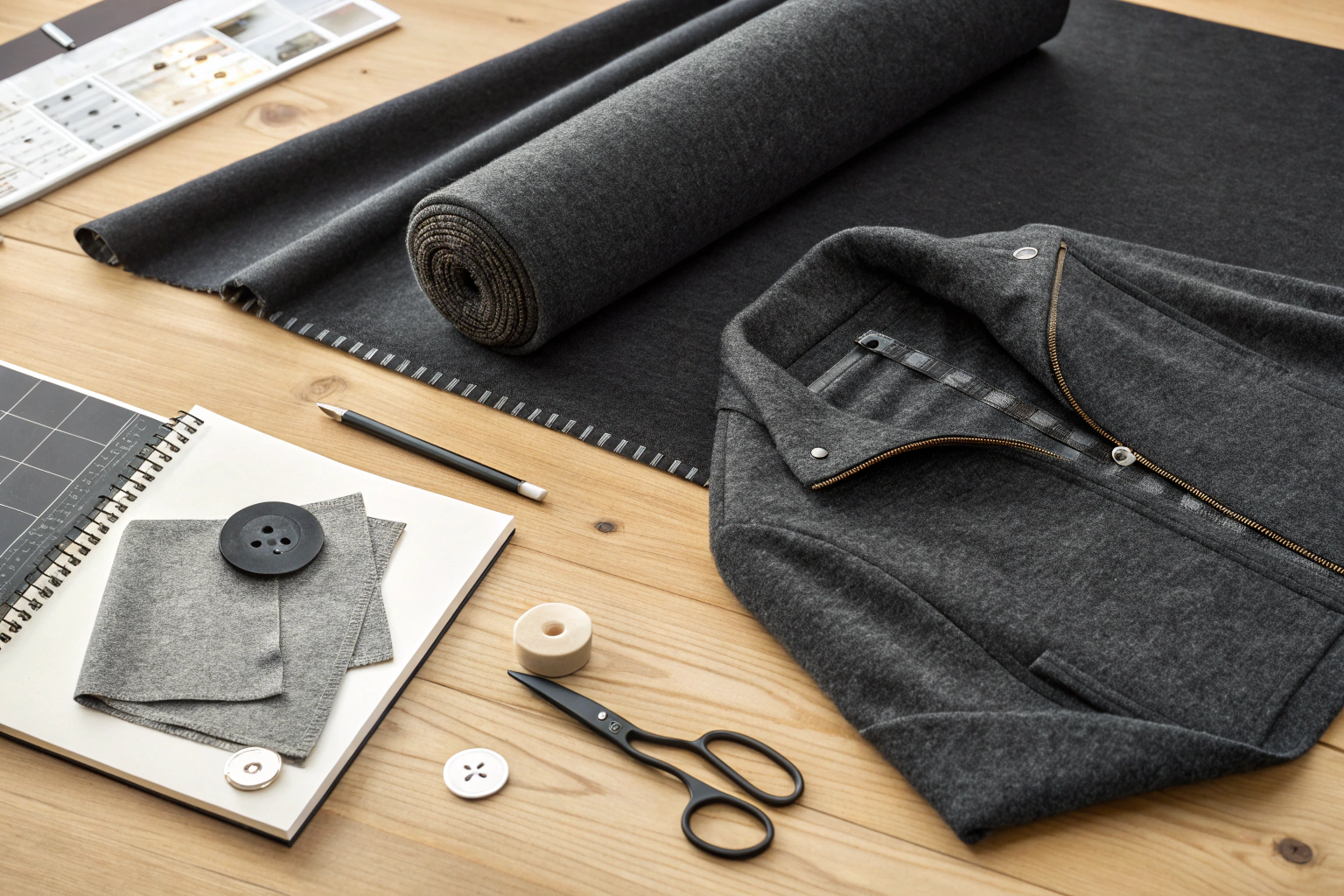
You just nailed the outer fabric for your new bomber jacket. It’s a custom-milled nylon twill with a subtle sheen and just the right amount of crispness. You’re feeling great. Then your pattern maker asks the question that stops you cold: "Okay, but what are we using for the rib knit collar? And what about the pocket lining? And did you order the matching zipper tape?" Suddenly, your "finished" fabric order is just the tip of the iceberg. You’re staring down the barrel of managing five different suppliers for one garment, and you know that if the shade of the rib trim is off by even 10%, the whole jacket looks like a cheap knockoff.
Sourcing matching fabric for accessories isn’t an afterthought. It’s a precision engineering exercise in color management and material compatibility. If you get it wrong, you end up with a beautiful shell and a collar that puckers in the wash or a sleeve lining that feels like sandpaper against the skin. The biggest challenge isn’t finding a rib knit or a lining. It’s finding the one that matches in both shade and performance. This requires a different sourcing strategy than ordering bulk yardage, and it’s where most new brands and even some established designers lose their margin and their minds.
At Shanghai Fumao, we’ve seen this movie a thousand times. A buyer places a container order for the main fabric and then panics when they realize they need 500 yards of custom-dyed rib and 1,000 yards of printed pocketing. This is where our integrated service model shines. We don’t just sell you the star of the show; we make sure the supporting cast is dressed correctly. I’m going to walk you through the specific hurdles of sourcing trim and accessories, and how to make sure the collar on that jacket looks like it was born with the body, not stitched on as an afterthought.
Why Is Color Matching Accessories So Difficult?
Here is the harsh reality: Dyeing different structures yields different colors, even with the exact same dye recipe. You can take the same pot of blue dye and pour it on a smooth woven satin and a fluffy knitted fleece. The satin will look bright, vibrant, almost electric. The fleece will look duller, maybe two shades darker, like a dusty navy. Why? Physics. Light hits the flat surface of the satin and bounces straight back to your eye. Light hits the fuzzy loops of the fleece and gets trapped in the shadows of the nap. This phenomenon drives designers absolutely crazy.
You cannot simply say, "Match this Pantone 19-4052 Classic Blue." You have to say, "Match this Pantone 19-4052 Classic Blue on this specific knit structure." And that requires a different level of technical skill from the dye house. Most small dye houses are "recipe followers." They look up a formula in a book. A great dye house—like the ones we partner with at Shanghai Fumao—understands Metamerism (when two colors match under store lights but not under sunlight) and Substrate Compensation (adjusting the formula for the texture of the material).

How Does Fiber Content Affect the Final Shade of Trim?
You found the perfect sustainable outer fabric: 100% Tencel. It has a beautiful, soft drape. Now you need rib trim for the cuffs. You find a supplier who has "matching Tencel rib." Great, right? Wrong. You put them together, and the body is a deep forest green, but the cuffs look like a washed-out sage. Why? Because the trim is a 95% Cotton / 5% Spandex blend "dyed to match" the Tencel.
Cotton and Tencel (Lyocell) take dye differently. They have different Affinity for the dye molecule. A reactive dye that bonds perfectly to cellulose (both are cellulose, which is why people think this is easy) will often look brighter on Tencel because Tencel fibers are smoother and reflect light more uniformly. Cotton has a rougher surface, fuzzier, which scatters light.
At Shanghai Fumao, our rule is simple: If the body fabric is a specific fiber, the trim must be either the exact same fiber or a pre-approved blend tested for visual compatibility. We don’t guess. We do a Pre-Production Compatibility Dip. We take a swatch of the body fabric and a small piece of the proposed trim fabric and dye them in the exact same bath at the exact same time. That’s the only way to see the true difference. If the difference is too great, we adjust the trim’s dye recipe (add more red, less blue, etc.) to compensate for the dulling effect of the texture. This is the kind of nuanced work that separates a commodity mill from a development partner. If you want to read more about the science behind this, resources like how fiber morphology affects color yield in reactive dyeing are essential, as well as understanding the principles of metamerism in textile color matching.
Can You Trust a Digital Swatch for Matching Rib and Shell?
Absolutely not. Never. Not even a little bit. (Here is where I get blunt with my clients: if a supplier sends you a photo of the rib next to the shell and says "Looks perfect, yes?" you should run.) Digital cameras and computer screens are liars when it comes to textile color. They use RGB color space (Red, Green, Blue light). Fabric is viewed in reflected light. The camera’s auto-white balance will "correct" the color based on what it thinks is white in the room, which is often the paper or the table.
I had a client from the UK in February 2025 who insisted on approving trim via WeChat photos. "It looks fine on my phone," she said. We shipped the bulk. The rib trim was a full shade too yellow. The phone screen’s "Night Shift" mode had warmed the entire image, masking the yellow cast. She was furious—not at us, but at herself for trusting the screen.
At Shanghai Fumao, we only approve trim matches via Physical Lab Dip Submissions sent via courier. It’s old school, but it’s the only way. You need to see the trim laid on top of the shell fabric in a light box. And you need to view it under at least two light sources: D65 (Artificial Daylight) and A (Incandescent Home Light). If it matches under D65 but not under A, you have metamerism. You then have to decide which light source is more important for your brand’s retail environment. This is why we say we have a "professional customer energy"—we force you to do the hard work upfront so you don’t have a crisis later. You can read more about industry standards by checking the ASTM D1729 standard for visual evaluation of color differences.
Where Can You Find Low MOQ Trim and Lining Suppliers?
This is the paradox of trim sourcing. You need 300 yards of a specific 2×2 rib with a hint of spandex recovery. The big trim mills in China want a minimum of 3,000 yards per color. They won’t even answer your email for 300 yards. So you’re stuck either buying generic stock trim that "sort of" matches, or you’re paying a huge surcharge for a small custom run that kills your garment’s cost sheet.
This is precisely where a full-service fabric supplier like Shanghai Fumao becomes invaluable. We act as an aggregator. We combine the accessory needs of multiple clients who are using similar base colors (say, Navy, Black, Ivory) to meet the factory minimums. We take the risk of stocking the inventory and then sell it to you in smaller, manageable quantities. This is a behind-the-scenes advantage of working with a company that has a large-scale operation and a diverse client base. We can absorb the MOQ pressure so you don’t have to.

Is It Possible to Dye 200 Yards of Custom Rib Without Breaking the Bank?
Yes, but only if you understand Sample Dyeing vs. Bulk Dyeing economics. Dyeing a small lot (under 500 yards) in a specific custom color is expensive because you are still paying for the entire machine setup. The dye kettle has a fixed cost to fill with water, heat up, and clean out. That cost is the same whether you put 100 yards of fabric in it or 1,000 yards.
So, how do we make it affordable for you? We use Pilot-Scale Dyeing Machines. At Shanghai Fumao, we maintain smaller, dedicated sample dye pots precisely for this purpose. These machines are designed for runs of 50kg to 100kg (roughly 150 to 300 yards). The cost per yard is higher than a bulk run, but the total outlay is manageable for a designer who only needs trim for 500 jackets.
Here is the internal workflow we use that saves clients from the MOQ trap:
| Scenario | Standard Industry Approach | Shanghai Fumao Approach |
|---|---|---|
| Need 200yds Custom Rib | Refuse order or charge $500 setup fee + $8/yd. | Use Pilot Dye Pot. Charge $3.50/yd + $50 lab fee. |
| Color Matching | "Send us a Pantone; we’ll try." | Send us the shell fabric. We dye the rib against the shell. |
| Lead Time | 4-5 weeks (waiting for machine slot). | 2-3 weeks (dedicated sample line). |
This is the kind of flexibility that lets a startup brand compete with ZARA on quality without ordering ZARA-sized quantities. If you’re navigating this, reading up on strategies for managing low minimum order quantities in textile manufacturing can give you more context on why this is such a pain point, and learning about the difference between sample dyeing machines and bulk production dyeing helps set realistic expectations.
What Is the Secret to Finding Consistent Lining Fabric?
Lining is the unsung hero of a well-made garment. It’s the first thing the customer touches when they put the jacket on. A bad lining is clingy with static, or it’s so stiff it ruins the drape of the outer fabric. A good lining glides. It breathes. It feels expensive.
But lining consistency is a nightmare. The market is flooded with cheap polyester taffeta that is finished with a temporary silicone coating to feel "silky." That coating washes off after three dry cleans, leaving the lining feeling like a plastic trash bag. Or worse, the color of the lining bleeds onto the wearer’s white shirt when they sweat.
At Shanghai Fumao, we have a shortlist of Vetted Lining Partners. We don’t just buy lining from the spot market. We use specific mills that specialize in Bemberg (Cupro) and high-end Viscose Twill. Why?
- Cupro: Made from cotton linter (a waste product). It breathes like cotton, drapes like silk, and doesn’t build static. It’s the gold standard for premium jackets.
- Viscose Twill: We use a specific weave that prevents seam slippage. Seam slippage is when the yarns slide apart at the shoulder seam, creating a gaping hole.
We test every lot of lining for Colorfastness to Perspiration and Seam Slippage. We do this so you don’t get an angry email from a customer six months later. For a deeper dive into why this matters, you can explore the properties and benefits of Bemberg cupro lining in apparel manufacturing and how to test for seam slippage in woven fabrics.
When Should You Use Knit Trim vs. Self-Fabric Trim?
This is a design decision that has massive production consequences. Using Self-Fabric Trim—cutting the collar or hem facing from the exact same fabric as the body—seems elegant. It guarantees a perfect color match. No dye lot issues. No separate supplier. But it’s also a trap for certain silhouettes and body parts.
The decision comes down to Recovery vs. Structure. Knit trim (like a rib collar on a bomber jacket or a jersey binding on a tank top) has natural stretch and memory. It snaps back to shape after being pulled over a head or pushed up an arm. Woven self-fabric trim has zero stretch (unless it contains spandex, and even then, minimal). If you use a woven self-fabric collar on a pullover sweatshirt, the customer will either tear the seam trying to get it over their head, or the collar will stretch out permanently and look like a sad, wavy lettuce leaf after one wear.

Can You Achieve a Perfect Match with Self-Fabric Binding?
Yes, you can achieve a perfect color match. That’s the easy part. The hard part is the Bulk and the Drape. When you fold over a medium-weight woven fabric to create a cuff or a neck binding, you are creating three layers of fabric (the body, the facing, the under-facing). That’s thick. That’s stiff. On a delicate blouse, it looks clunky.
The alternative is Self-Fabric Bias Binding. You cut the fabric on the 45-degree angle (the bias). This introduces a tiny bit of mechanical stretch into an otherwise rigid woven fabric. It allows the binding to ease around a curved neckline without puckering. But bias binding is wasteful. Cutting on the bias requires more fabric yardage and creates odd-shaped scraps. It increases your fabric consumption by 10-15%.
At Shanghai Fumao, when a client wants self-trim, we run a Consumption Simulation. We lay out the pattern pieces in our CAD software to see exactly how much extra yardage the bias strips will consume. We then present the client with a choice:
- Option A: Bias self-fabric. Cost: $X per garment. Look: Premium, couture.
- Option B: Matching stock rib. Cost: $Y per garment (cheaper). Look: Sporty, commercial.
This data-driven approach prevents the "sticker shock" that happens when the cutting ticket comes back and you’ve used 20% more fabric than you planned. For a deeper technical explanation, looking into the geometry of bias cut fabric and its applications in garment construction is extremely helpful.
Why Does Rib Trim Sometimes "Bacon Neck" After Washing?
"Bacon Neck." It’s the industry slang for a rib collar that has lost its will to live. It’s wavy. It’s stretched out. It looks like a piece of fried bacon draped around the neck. This happens for two reasons: Poor Yarn Quality and Incorrect Tensioning During Sewing.
First, the yarn. A good rib trim needs a strong core. We use Core-Spun Spandex. This means the elastic spandex filament is wrapped tightly in cotton or poly fibers. When you stretch it, the cotton blooms, but the spandex core snaps it back. Cheap rib uses bare spandex plied with cotton. Once that spandex breaks (and it will break from the heat of the dryer), there’s nothing left to pull it back. It’s game over.
Second, the sewing. If the sewing machine operator stretches the rib trim as they feed it into the machine, they are sewing it in a pre-stretched state. The moment you let go, the rib wants to relax, but the seam won’t let it. Result: Waves.
At Shanghai Fumao, we provide our clients with a Trim Spec Sheet that includes:
- Stretch Ratio: e.g., 2:1 (meaning the trim should be cut at 50% of the body opening length).
- Recovery Test: We stretch it 100% for 30 minutes. It must return to within 5% of its original length.
We test this before it leaves the factory. If the rib fails the recovery test in our lab, it fails for your customer in the real world. You can find more data on this by reading about ASTM D2594 standard test method for stretch properties of knitted fabrics.
How to Manage Zippers and Hardware to Match Fabric Quality?
This is the final frontier of matching. You have the perfect shell. You have the perfect rib. Now you need the zipper. And this is where you find out that the "Black" zipper tape from YKK’s stock range doesn’t match your custom "Jet Black" fabric. Or the "Antique Brass" finish on the slider clashes with the warm gold tone of your custom buttons.
Hardware and zippers are often treated as generic commodities by buyers. "Just get a YKK #5." But YKK makes hundreds of shades of black tape. There is Jet Black, Blue-Black, Grey-Black, and Recycle Black. If you don’t specify the exact tape color code, you will get whatever the zipper factory had on the shelf that day. And when that zipper is sewn into the center front of a $200 dress, a mismatched tape screams "low budget" louder than a crooked hem.

Can You Dye Zipper Tape to Match Custom Fabric?
Yes, you can. But it’s a specialized process that requires High-Temperature Disperse Dyeing because zipper tape is almost always 100% Polyester (for strength) and the teeth are often nylon or metal which can’t take the dye. This is not a job for a regular garment dye house. It requires a zipper manufacturer with in-house dyeing capabilities or a very specialized trim finisher.
At Shanghai Fumao, we have a partner who does exactly this. Here is the workflow:
- We send them a cutting of your exact approved bulk shell fabric.
- They use a spectrophotometer to read the color.
- They run a Sample Dye Lot on a small batch of polyester tape (without the teeth or slider).
- We send that dyed tape sample back to you for approval against the fabric.
This process adds about 7-10 days to the trim lead time, but it elevates the garment from "good" to "bespoke." It’s what high-end designers do, and it’s a service we offer specifically because our clients in the US and Europe demand this level of detail.
The alternative—which is faster and cheaper—is to Match the Tape from Stock. YKK and SBS have extensive color cards. We can often find a stock color that is "commercially acceptable" (Delta E under 0.8). The key is to order a Zipper Tape Color Card (a physical ring of fabric tape swatches) and match it in person to your fabric. Never match it to a photo.
Here is a quick guide to zipper tape matching:
| Zipper Element | Matching Consideration | Common Mistake |
|---|---|---|
| Tape Color | Must match shell fabric or contrast intentionally. | Assuming "Black" is universal. |
| Slider Finish | Match to other hardware (snaps, D-rings). | Mixing Antique Brass with Shiny Gold. |
| Tape Material | Polyester for durability; Cotton for vintage dyeability. | Using cotton tape on a garment that will be heavily washed (shrinks). |
| Teeth Size | #3 for lightweight blouses; #5 for jackets; #8 for heavy coats. | Using a #3 on a heavy denim jacket (it will fail). |
For more information on this, reading YKK’s technical guide to zipper tape color matching and dyeing is a great start, and understanding how to select the correct zipper size and type for different apparel applications is crucial for any designer.
What Happens When Metal Finishes Don’t Match?
This drives me crazier than a crooked seam. You spec "Gunmetal" snaps from one supplier and a "Gunmetal" zipper from another. They arrive, and the snap looks blue-grey while the zipper looks brown-grey. They clash. It looks accidental.
Metal finishing is a chemical process. Electroplating. The exact shade of "Gunmetal" or "Antique Brass" depends on the voltage, the bath temperature, and the specific alloy of the base metal. There is no Pantone for plating.
The only way to guarantee a match is to Source All Hardware from a Single Trim Supplier who can plate all the pieces in the same batch. Or, you order Finish Samples—actual plated pieces—from each supplier and compare them physically in a lightbox before placing the bulk order.
At Shanghai Fumao, when we manage a full-package project, we consolidate the hardware sourcing. We don’t let the garment factory buy the zipper and the button factory buy the snaps. We buy them together, inspect the finish consistency, and then issue them to production. This is a small detail that requires a lot of coordination, but it’s the difference between a garment that looks "designed" and one that looks "assembled." It’s part of the value of having a partner who sees the whole picture, not just the yardage of the main fabric.
Conclusion
Matching accessories is where great fabric becomes a great garment. It’s the difference between a sample that photographs well and a product that lasts 50 washes. We’ve walked through the minefield of color metamerism, the headache of low MOQ rib sourcing, the physics of trim stretch, and the chemistry of zipper finishes. It’s a lot. And honestly, it’s why many designers just give up and use a generic contrast trim—not because it’s better design, but because it’s easier sourcing.
But you don’t have to settle. The secret isn’t finding ten different suppliers who can each do one thing perfectly. The secret is finding one partner who understands how all the pieces fit together. At Shanghai Fumao, we’ve spent twenty years building the relationships and the technical knowledge to manage this entire ecosystem for you. We know which dye house can nail the rib match. We know which zipper vendor actually checks the plating. We know how to test for bacon neck before it leaves the country.
If you’re tired of playing detective with a dozen different trim suppliers and you want a single point of contact who can make sure the collar matches the cuff and the zipper matches the button, let’s talk. Reach out to our Business Director, Elaine. She can walk you through how our accessory matching service works and give you a real timeline for getting those finishing touches just right. You can email her at elaine@fumaoclothing.com. Let’s make sure your next collection is stitched together as perfectly on the inside as it looks on the outside.