Let’s be honest. You’ve been burned before. You found a supplier with a slick website and a low price, you placed a 20,000-yard order for a spring collection, and then the emails start. "Small delay." "Machine maintenance." "Holiday backlog." Suddenly, you’re paying for air freight just to save your launch date, or worse, your shelves are empty. The root of this nightmare? You didn’t verify the actual production capacity against their sales pitch. When you are sourcing fabric from China, you are not just buying yarn; you are buying time on a machine and a spot in the queue. If that queue is clogged or the machines are relics, your timeline doesn’t stand a chance.
Verifying a factory’s production lines isn’t just about counting how many machines are on the floor. You need to understand the five critical workflow checkpoints that dictate whether your fabric actually ships on time. I break this process down into: Weaving/Knitting capacity, Dyeing allocation, Finishing capabilities, Quality Control bandwidth, and Packing/Logistics efficiency. If you can’t get straight answers on these five lines—or worse, if the factory won’t show you all five—you’re taking a massive risk with your cash flow and brand reputation.
As the owner of Shanghai Fumao, I have spent two decades in the trenches of Keqiao, the epicenter of global textile production. I’ve seen buyers make costly mistakes by just peeking at the weaving shed and ignoring the bottleneck in the dye house. This guide isn’t theory. It’s the exact walkthrough I give to my own clients—whether they’re a startup founder buying 500 yards of modal or a European brand placing a container order for recycled poly—to give them the confidence that the delivery date is real, not just a hope. Let’s walk the floor together and look at what actually matters.
Weaving & Knitting Lines: Loom Density vs. Efficiency
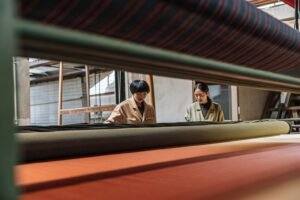
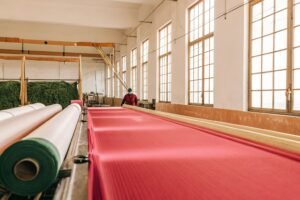
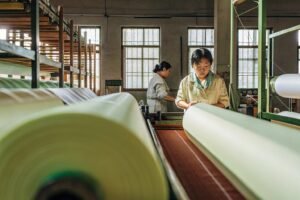
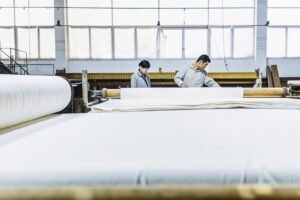
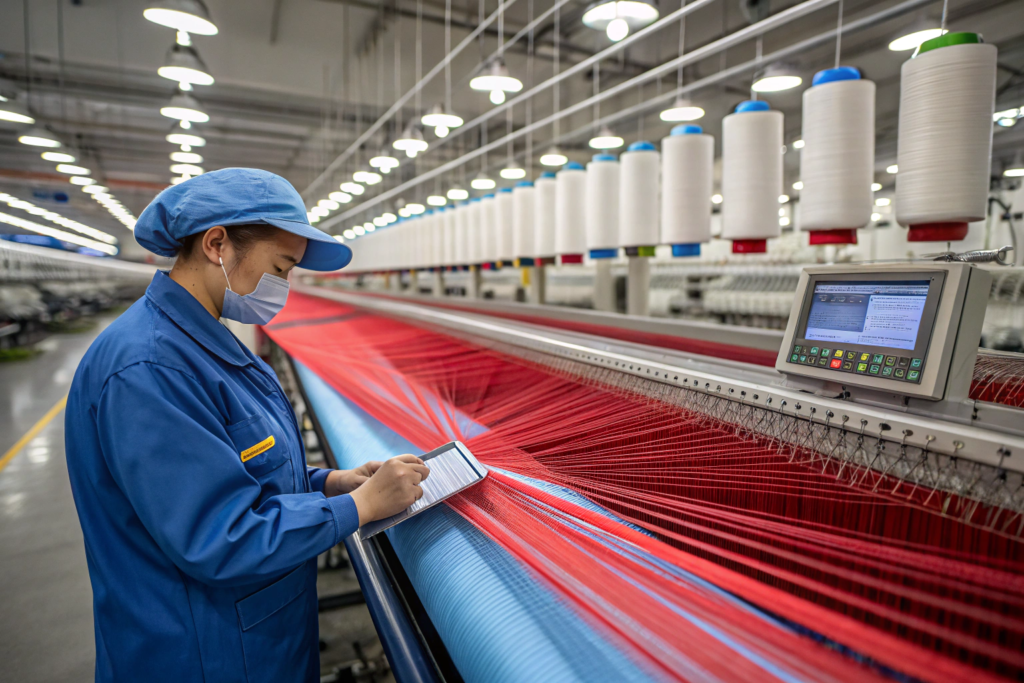
You walk into a weaving shed and it’s deafening. Good. Silence means no capacity. But noise alone is a trap. I’ve seen buyers get wowed by 200 looms clanking away, only to find out later that 60% of them are running 600 RPM while the specific high-density satin they ordered needs 350 RPM to keep the selvage clean. You have to dig into the type of iron on the floor, not just the count. This is where most generic factory audits fall flat. They count machines. I count capability per square foot.
Vetting a weaving line comes down to two questions: What is the real utilization rate of the looms that match your specific yarn count? And What is the changeover time for a new warp beam? If a factory is running commodity greige goods at 90% capacity, your custom order for Tencel twill is going to the back of the line or being outsourced to a village workshop that might not have the same tension control. We keep our loom allocation flexible precisely because we know buyers hate surprises.
Can That Weaving Floor Handle Your Specific Yarn Count and Width?
You can’t put a heavy denim warp on a machine built for chiffon. It sounds obvious, but I get at least three RFQs a week where the buyer doesn’t understand why their 2/1 twill lead time is so long. It’s usually because the factory they are talking to has water-jet looms optimized for high-speed filament polyester. If you throw a spun yarn or a delicate filament on those, you get warp breaks every five minutes. Efficiency drops from 92% to maybe 65%. The factory will still take the order—they just won’t tell you that your fabric is the one slowing the floor down.
Here is the internal check we run every single day at Shanghai Fumao:
- Rapier Looms: Best for cotton, linen, wool blends, and small batch fashion. Flexible but slower.
- Water-Jet Looms: Lightning fast for Nylon and Polyester. Horrible for natural fibers (they absorb water and swell).
- Air-Jet Looms: Middle ground. Great for high-volume sheeting but energy hogs.
When you vet a factory, ask them: "What percentage of your floor is dedicated to the specific loom type my fabric requires?" If you need a heavy linen blend and they only run air-jet, you’re looking at a bottleneck before you even start. (Here I have to jump in—we run a mixed floor of 150+ looms specifically to avoid this issue. We can shift capacity without shutting down your project.) For more details on fabric construction specifics, you might find it helpful to cross-reference industry forums where technicians discuss real-world machine limitations on sites like how to troubleshoot warp yarn breakage on rapier looms and understanding weaving machine classifications and applications.
How Long Does a Warp Change Actually Take and What Does It Cost You?
This is the dirty little secret of custom fabric sourcing. The weaving itself is fast. The setup is slow. A warp change—unloading the empty beam from the last run and tying in 8,000 to 20,000 new yarn ends to the harness—is the single biggest downtime event in the mill. A factory with a seasoned team and modern auto-drawing-in equipment might do this in 4 to 6 hours. A factory with manual knotting and less skilled labor? That’s a 2-day shutdown.
Why does this matter to you? Because if you order 1,000 yards of a custom stripe pattern, you are paying for that setup time somewhere. If the factory’s minimum order quantity (MOQ) is low but the setup time is high, they are either losing money on you (unlikely) or they are batching your order with three other customers and waiting for the machine to clear. That "4-week lead time" becomes 8 weeks because you are in a queue for a specific reed width.
At Shanghai Fumao, we mitigate this with a two-pronged approach. First, we stock over 50 standard warp beams in greige state (especially for cottons and poly blends). This is huge. It means we can often bypass the warping step entirely for repeat colors. Second, we use a variable pricing model for development. We are upfront: "The first 1,000 yards cost X because of the setup. The next 10,000 yards cost Y." We don’t hide the engineering cost in the yarn price. That’s how you build trust with designers who need small runs but value speed.
Dyeing & Finishing: The Hidden Bottleneck in Wet Processing
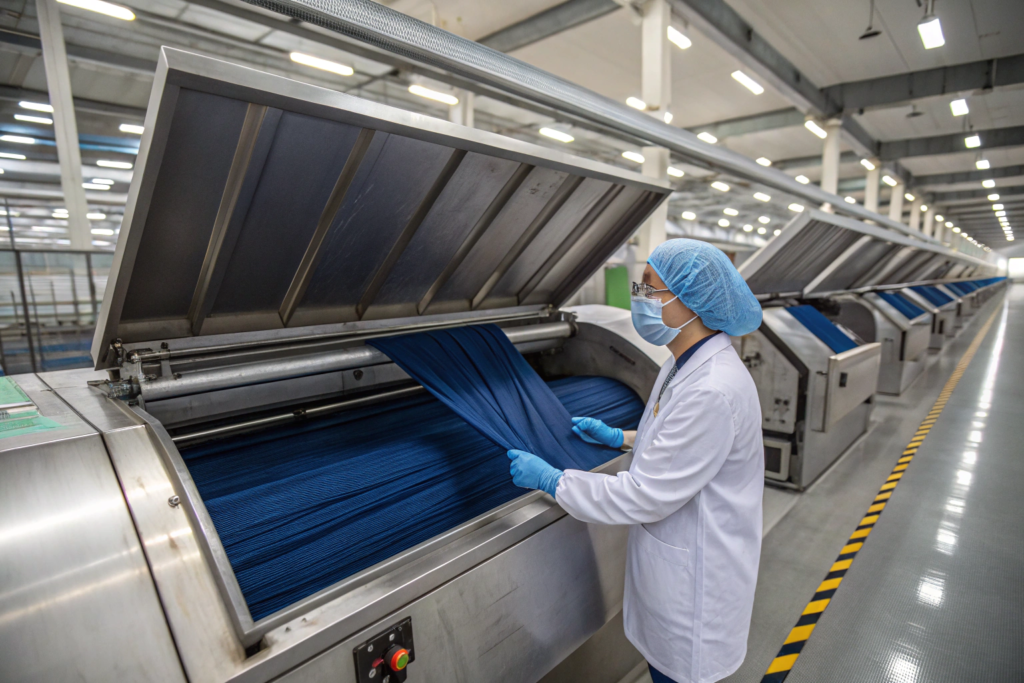
If the weaving floor is the heart, the dye house is the unpredictable stomach of the operation. This is where timelines go to die, and it’s the area most overseas buyers are least equipped to evaluate. You can have a perfect greige fabric roll, but if the dye house is backed up with 50 tons of black polyester for a fast-fashion giant, your specialty 200-kg lot of terracotta linen is just sitting on a pallet collecting dust. More importantly, this is where the environmental and performance variables intersect. You can’t just look at a dye machine; you have to understand water chemistry.
When I walk a client through our partner dye houses (and yes, we use a cooperative model here because owning a standalone dye house in Zhejiang requires an environmental compliance budget that most weaving mills can’t handle), I focus on three things: Water Source & Recycling Rate, Liquor Ratio of the Machines, and Lab Dip Turnaround. Ignore these three, and you will get a fabric that is either off-shade, damaged in hand feel, or delayed by government environmental inspections.
Why Do Dyeing Lead Times Fluctuate So Drastically in China?
The dyeing process is a chemical reaction, but the schedule is a political and environmental one. In the Yangtze River Delta, where we operate, the government has a strict quota on wastewater discharge. During the rainy season or specific environmental crackdowns (which happen regularly), the daily discharge limit for a dye house might drop by 30%. When that happens, production doesn’t stop—it just slows to a crawl. A 7-day dye cycle becomes a 14-day cycle.
Furthermore, the exhaustion rate of the dye matters. Reactive dyes for cotton require massive amounts of salt and water to push the color onto the fiber. Disperse dyes for polyester use high heat and pressure. Most large dye houses want to run Polyester all day long. It’s faster and the re-dye rate (do-overs) is lower than with natural fibers. If your order is for 100% Supima Cotton, you are a "difficult" customer to the dye house manager unless you have volume or a strong relationship.
That’s where our leverage comes in. Because Shanghai Fumao is a comprehensive provider with a high volume of weaving orders, we command priority in the dye queue. We don’t just send a roll over with a note; we send it with a tech pack and a relationship manager who checks the pH balance of the bath. We also invest heavily in recycled polyester and eco-friendly dye methods, which often get preferential treatment in the new environmental regulatory scheme. To understand the global shift in this space, reading up on how China’s environmental regulations are impacting textile dyeing lead times and the technical aspects of reactive dyeing process parameters for cotton knit fabric will give you a much clearer picture of why that terracotta linen takes longer than the black poly.
How Can You Tell If the Hand Feel Was Ruined in Finishing?
Here’s a scenario: I had a client from Australia in March 2024. She sent me a swatch of a beautiful peach skin finish she loved. She had bought it from a competitor the year before. When she placed a re-order, the new shipment felt like sandpaper. Same specs. Same mill. What happened? Over-stenting. The factory was running behind, so they cranked up the heat on the stenter frame (the giant oven that dries and sets the width) to speed up the line. They cooked the softener right off the fiber and locked the fabric width at a brittle tension.
You can’t test for this with just a lab report on shrinkage. You have to feel it and stretch it. Ask the factory these two questions:
- What is your stenter speed in meters per minute for this specific finish? (If they don’t know or say "it depends," they aren’t tracking it.)
- Do you use a continuous softener application or a batch process?
At Shanghai Fumao, we use a separate finishing line for delicate fabrics like Modal and BAMSILK (bamboo). We run it slower and cooler. It costs more in electricity per yard, but it preserves the drape—which for a fashion brand is the whole point of buying the premium fabric in the first place. We also use automated inspection on the exit of the stenter to catch any width deviation before it gets rolled up. That’s the kind of proactive control that stops a container from arriving DOA.
Printing & Embroidery: Assessing Specialty Value-Add Lines
This is where you separate the commodity suppliers from the development partners. Any factory can weave a basic twill. Adding surface interest—whether it’s a digital placement print, a heavy schiffli embroidery, or a foil transfer—requires a different management mindset. I view our printing and embroidery departments as the "surgical units" of our operation. They require extreme cleanliness, precise calibration, and a high tolerance for design file management. If the weaving floor is loud and hot, the digital print room is climate-controlled and quiet. If it’s not quiet in there, they’re probably running the wrong kind of equipment for the job.
The capacity calculation here isn’t just meters per hour. It’s how many design revisions can they handle in a week without charging you a fortune? And how do they manage registration on stretch fabrics? These are the questions that determine whether your placement print hoodie looks like a high-end boutique item or a cheap carnival souvenir.
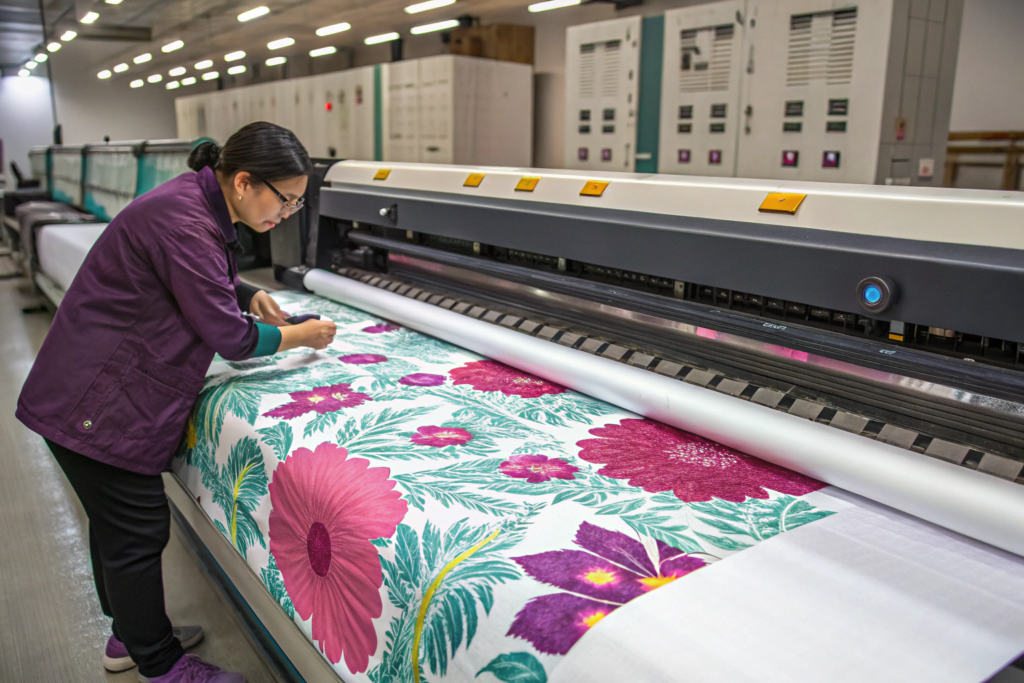
Why Does Your Digital Print Look Blurry on the Fabric Edge?
This is a classic fail in the digital textile world, and it’s almost always due to two things: Print Head Height and Fabric Pretreatment.
First, the heads. Industrial printers like the MS or Reggiani machines we use have a very specific "throw distance" between the nozzle and the fabric. If the fabric is wavy or the tension is uneven as it passes under the heads, the ink droplets scatter. You lose definition. You get that fuzzy, "ghost" effect around the edges of petals or geometric lines. A top-tier operator is constantly micro-adjusting the vacuum belt and the spreader rollers. We have a rule on our floor: if the fabric edge lifts more than 1.5mm off the belt, we stop the run and fix the entry tension. It costs us 5 minutes but saves the whole lot from being second quality.
Second, pretreatment. Digital pigment inks sit on top of the fiber. Reactive or acid inks penetrate. If you’re printing on a knit and you don’t apply the right coating, the ink sits on the surface and gets smashed when you heat-press it to cure. It bleeds laterally. We test the coating viscosity every four hours with a simple flow cup. It’s a $2 tool that prevents a $2,000 mistake. I remember a conversation on a sourcing forum where someone asked how to fix blurry edges on digital textile printing for cotton jersey, and the top answer was always about tension and pre-coat. It’s the basics that kill you. For more technical deep dives on machine maintenance, understanding print head alignment and maintenance for industrial textile printers is essential reading.
How Do You Vet Embroidery Capacity Without Seeing 100 Heads?
Embroidery is deceptive. If a factory shows you 50 Tajima heads running the same logo patch over and over, that’s great for caps, but that’s not your project. You want a sample yardage of intricate guipure lace or a heavy chenille patch on a sweatshirt. That requires not just heads, but brains in the digitizing department.
Here is the single best vetting question for an embroidery line: "What is your maximum stitch count per design, and do you punch your own tapes in-house?"
- If they say they outsource digitizing to a third party in town, you will wait an extra 24-48 hours for every single revision. Plus, the communication lag between you, the factory, and the invisible digitizer is where details get lost.
- If they can’t run a design over 20,000 stitches without the thread snapping or the backing puckering, they are a production house for simple logos, not fashion fabrics.
At Shanghai Fumao, we keep our digitizing in-house. This is a non-negotiable for us. We have a team of four specialists who only do this. They know that if they use a .75mm underlay stitch on a stretch mesh, it will pucker. If they use a 1.0mm, it lays flat. This expertise allows us to develop complex repeats that you simply cannot get from a factory that just bought the machines last year and hired operators last month. This is the difference between a garment that looks like it came from a department store and one that looks like it came from a designer atelier.
Quality Control Lines: Beyond the 4-Point Inspection
The 4-Point System is the standard everyone quotes, but it’s just math. It doesn’t protect you from a roll that is 60 yards instead of 62, or a shade that is only visible under the lights in your New York showroom, not the LED lights in a Keqiao warehouse. Real quality control capacity is about how the factory reacts to a defect, not just how they count it. I train my QC team to think like a brand owner, not just a meter checker. If this fabric was on a rack at retail, would you buy it? That’s the standard.
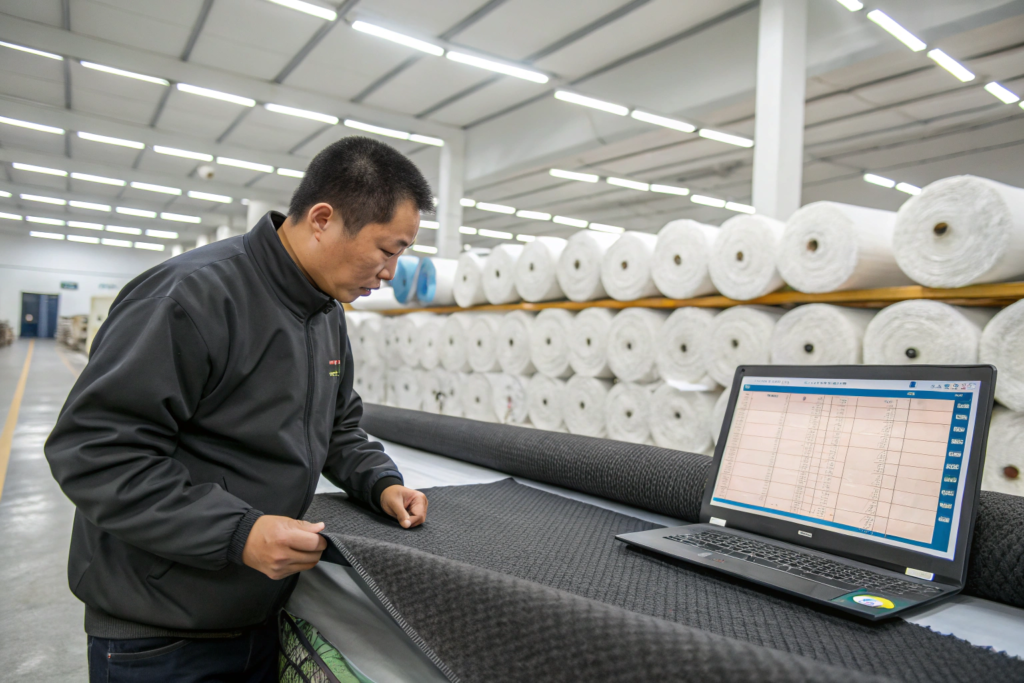
The limiting factor in any QC line is Inspection Table Space and Light Source Calibration. You can only inspect as fast as a human eye can see the fabric pass by. If the factory has one table and a dim bulb, and they just promised you they’d ship 20,000 yards next week, they are either lying about the shipment date or lying about the inspection quality. You can’t have both.
What’s the Difference Between Factory Grade A and Your Grade A?
I had a confrontation with a buyer from Los Angeles in late 2023. He was furious. "The lab report says A Grade, but I see needle lines running every three inches!" He was right. The factory’s definition of "Grade A" allowed for a certain level of knitting barre (those horizontal lines) because they sell that same fabric to the local domestic market where it’s used for cheap linings. But for his premium activewear brand, it was unsellable.
This is why we maintain a Customer-Specific Defect Code Library. When we onboard a new client at Shanghai Fumao, we don’t just say "4-Point System." We send them a physical swatch card with 10 common defects (Slubs, Knots, Needle Lines, Mis-Print Registration, Dye Spots) and ask them to circle their Acceptable Limit. Some brands want zero slubs in cotton. That’s unrealistic for a natural fiber, but we can meet a stricter tolerance—we just need to know it upfront so we price in the extra labor to pick them out by hand.
Here’s the internal standard we use that saves a lot of headaches:
| Defect Type | Standard Tolerance (Internal) | Premium Brand Tolerance (Custom) |
|---|---|---|
| Slub/Knot | 1 per 10 yards (Max 3mm) | 0 per 10 yards (Hand Trimming) |
| Barre (Knitting) | Visible under lab light only | Invisible under retail spot light |
| Shade Variation | Within 0.6 Delta E | Within 0.3 Delta E (Continuity Match) |
| Width Variance | +/- 1.5 inch | +/- 0.5 inch |
This table isn’t just for show. It’s the law on our floor. Before a roll hits the packing table, it’s been cross-referenced against this specific client’s profile. That is capacity. Not how many tables we have, but how many custom profiles we can manage without mixing them up.
How Does Real-Time Data Tracking Prevent Shipping Delays?
The old way: Inspector finds a hole. Marks it with a red sticker. Roll goes back to mending pile. Mending pile is 6 feet high. Nobody knows which order that roll belongs to or if mending will take 1 hour or 3 days. This is the "Black Hole of QC."
We tore that system down. Every inspection table at Shanghai Fumao is linked to our internal ERP via a simple QR code scan. As soon as an inspector logs a "Hole" or "Dye Stain" on the tablet, the system checks the available yardage against the open order. If the remaining good yardage drops below the packing tolerance, the system sends an instant alert to the Weaving or Knitting Department: "Run 50 yards more of PO #4567 to cover QC loss."
This is a game-changer for buyers like you because it eliminates the "Friday Afternoon Surprise." You know how it goes—you call on Friday to confirm the Monday truck, and they say, "Uh, we had a quality issue. We’re short 200 yards. We’ll ship next week." With our system, we know about that 200-yard shortage on Tuesday. The replacement fabric is on the loom by Wednesday. By Friday, it’s dyed and ready. That is what we mean when we say we have high yield in our control process. It’s not just about good fabric; it’s about good data flowing alongside the fabric. You can learn more about the technical side of how to implement a digital quality management system in textile manufacturing or the specific grading methods from ASTM D5430 standard for visual inspection of fabrics.
Packing & Logistics: The Final Mile That Breaks Margins
This is the part where the factory says, "Your fabric is ready, please arrange shipping." And you think, Great, I’m done. You are not done. Packing and logistics are the final production line, and it’s the one where the cost variance between "doing it right" and "just throwing it in a box" can be 15-20% of the landed cost. I’ve seen beautifully woven and printed fabric destroyed by a leaky container, or a pallet that collapsed because the factory used the cheapest shrink wrap available.
At Shanghai Fumao, we treat packing with the same seriousness as weaving. We know that our performance is judged not when the fabric leaves our door, but when it arrives at yours. And in the post-pandemic world of volatile freight rates and congested ports, the packing line is where you either protect your margin or lose it to demurrage fees and damaged goods claims. We don’t outsource this to a third-party forwarder we don’t know; we control it in-house.
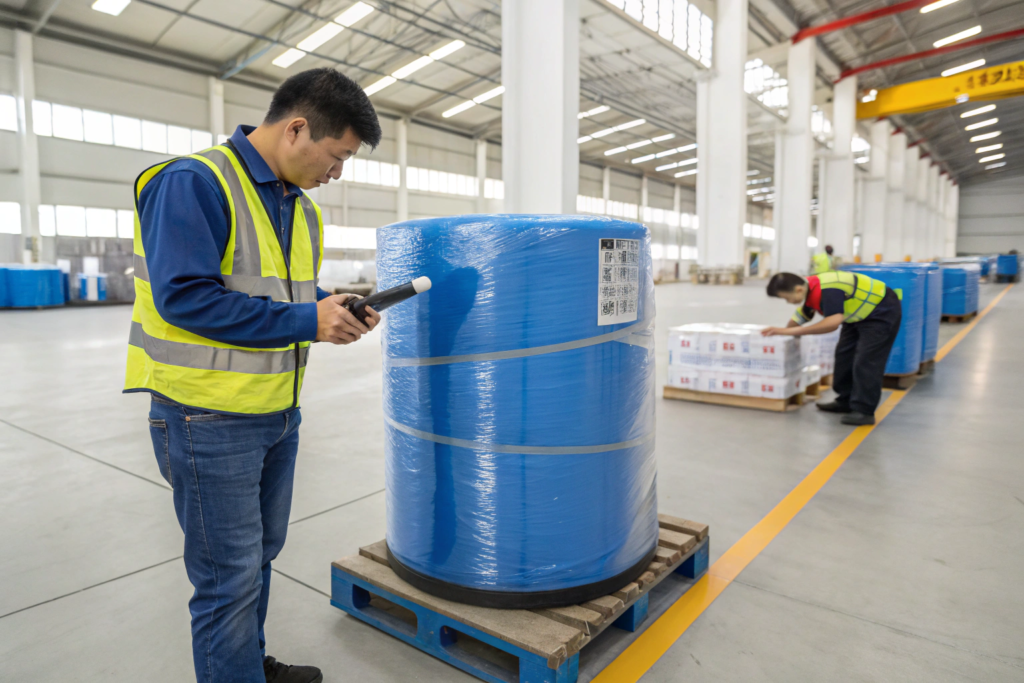
Why Does Roll Diameter Matter for Container Cube?
This sounds like a minor detail. It is not. It is geometry and economics. Most containers are limited by weight (for dense fabrics like heavy denim or coating) or volume/cube (for fluffy fabrics like fleece or chiffon). If your supplier is packing rolls on a 1.5-inch inner core, you are wasting about 8% of your container space compared to a 1.0-inch core. Multiply that over a 40-foot container, and you’re shipping air across the ocean at $4,000 a pop.
Even worse: Telescoping. That’s when the roll is wound so loosely that the inner layers slide out during transit, creating a "telescope" shape. That fabric is ruined. It can’t be unrolled on a spreading machine. We prevent this with two steps: Taper Tension Control during winding and Hard Paper Core Standards. We use a heavier core for export than for domestic. It costs us an extra $0.20 per roll, but it saves you from having to file an insurance claim for $2,000 worth of viscose that looks like an accordion.
Here’s a quick cheat sheet we use internally that guides how we pack based on fabric type:
| Fabric Type | Risk Factor | Packing Protocol at Shanghai Fumao |
|---|---|---|
| Velvet/Pile | Crush Marks | Hanging fold or jumbo roll on pallet; Never folded. |
| Lycra/Spandex | Bagging/Relaxation | Double-layer poly bag with desiccant; Core tension reduced 15%. |
| Coated Nylon | Blocking (Sticking) | Interleaved with tissue paper; Rolled loose. |
| Linen/Ramie | Mildew | Breathable woven poly bag; Silica gel packs mandatory. |
How Do You Avoid Customs Clearance Nightmares?
The fabric is perfect. The ship arrived on time. And then… U.S. Customs puts a hold on it. Why? Because the commercial invoice says "Woven Fabric" and the packing list says "Knit Fabric." Or because the HTS code doesn’t match the fiber content breakdown on the label. This is a paperwork error that costs hundreds of dollars in exam fees and weeks of delay.
We have a dedicated documentation specialist whose only job is to align the packing list, the commercial invoice, and the Mill Test Report with the specific HTS code for your product. For our U.S. clients, this is where the tariff issue comes up. Because we manufacture the greige fabric, dye it, and finish it all within our Keqiao network, the Country of Origin is clearly China. This is straightforward. Where buyers get into trouble is when they use a fabric that was woven in China, dyed in Vietnam, and finished in Cambodia. That’s a customs red flag for tariff evasion.
We are not affected by the US tariffs on specific product categories because our clients are usually buying under HTS headings for raw textiles which have different duty rates than finished apparel. But we provide full transparency on the mill cost and the processing cost. If you need us to split the invoice for your own internal costing (showing yarn cost vs. dye cost), we can do that. We don’t play games with customs declarations because the penalty for getting caught is losing the privilege of shipping to the U.S. entirely. For further reading on the current complexities, I often point people to resources that explain how to correctly classify textile products for US import HTS codes and the specific nuances of understanding de minimis value and Section 321 entry for fabric samples. It’s dense, but knowing it keeps your goods moving.
Conclusion
Vetting a factory’s production capacity isn’t a single snapshot. It’s a movie. It’s understanding the sequence of events from the creel of yarn on the warping beam to the pallet being wrapped in the warehouse. You have to look at the five lines we just walked through: the Weaving floor’s flexibility, the Dyeing house’s chemistry and environmental constraints, the Print/Embroidery unit’s digital precision, the Quality Control team’s definition of "Good," and the Packing team’s logistics IQ. If you skip any one of these five steps, you are gambling with your lead time.
The real capacity of a mill isn’t the number of machines bolted to the floor. It’s the management bandwidth to handle the specific, picky, and sometimes complicated requirements of a brand that cares about quality. At Shanghai Fumao, we built our entire operation around being that management layer for you. We know that if we manage the process correctly, the fabric takes care of itself. And we know that when you ask for a delivery date, you need to know if it’s a real date or just a guess.
If you are tired of guessing, and you want to partner with a team that actually understands the five production lines that impact your business, let’s talk about your next collection. Reach out to our Business Director, Elaine, directly. She can walk you through our current capacity for Spring/Summer development and give you a real, honest timeline for your specific fabric specs. You can email her at elaine@fumaoclothing.com. We look forward to weaving something great together.