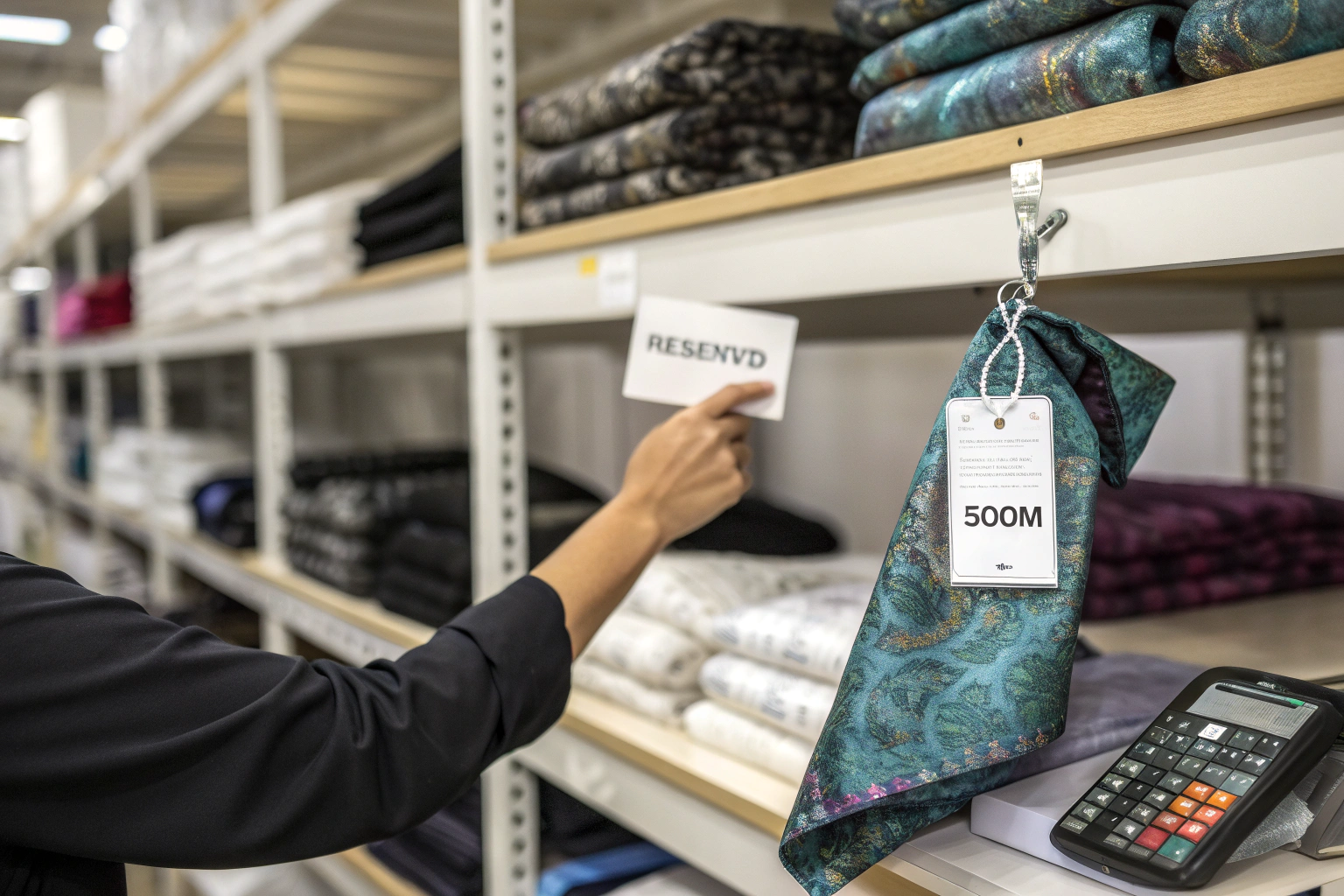
I get this email at least three times a week. It’s usually from a young designer or a boutique brand owner. The subject line is something like: "Question about your Metallic Linen Brocade." And the body reads: "Hi Elaine, I am absolutely in love with this fabric. But I only need 50 meters for a capsule collection. Is that possible? What’s the MOQ?"
And my heart sinks a little bit. Because I know I’m about to deliver the news that feels like a door slamming in their face. The standard Minimum Order Quantity (MOQ) for a custom or rare woven fabric is 1,000 to 2,000 meters. And I know that number sounds arbitrary, punishing, and designed to crush small business dreams. But it’s not. It’s physics. It’s economics. It’s the reality of how a massive loom works.
But here’s the part of the email they don’t expect. After I explain the why behind the 1,000-meter number, I usually type: "However, for that specific Metallic Linen, we have 75 meters left on a stock shelf from a previous production run. I can sell you that at a 20% premium. Or, if you can wait 8 weeks, I can group your 50-meter request with another client’s order for a similar base cloth and we can share the setup cost."
There is almost always a Pathway. It might be narrow, it might require patience, and it might cost more per meter. But the door isn’t completely locked. You just need to understand why the door is heavy in the first place, and where the side doors and windows are located. Let me explain the real economics of rare fabric production and how you, as a small or mid-size buyer, can navigate the MOQ labyrinth.
Why Do Rare Fabrics Have Higher Minimum Order Quantities?
Let’s start with the brutal math of the Warp Beam. This is the single biggest reason you can’t just order 50 meters of a custom jacquard or a rare yarn-dyed stripe.
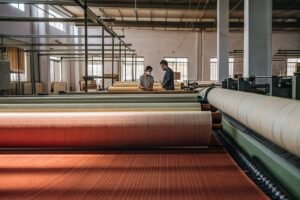
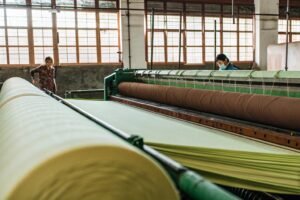
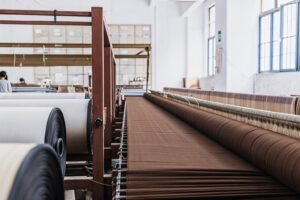
Imagine a loom. It’s 10 feet wide. To weave anything, you need to fill the back of the loom with Warp Yarns. These are the long, lengthwise threads that run the entire length of the fabric roll. You don’t just tie on a few threads. You need Thousands of them, all perfectly parallel, all under the exact same tension.
The Setup Cost (in Time and Yarn):
- Warping: It takes a specialized machine (a warper) to wind the yarn from hundreds of individual cones onto a single massive Warp Beam. This process takes 6-8 Hours for a complex stripe pattern. The labor cost is fixed. It costs the same whether you want 10 meters of fabric or 2,000 meters.
- Drawing-In: Each of those thousands of warp yarns must be threaded by hand through the Heddles (the little wires that lift the yarn) and the Reed (the comb that packs the weft). This is tedious, skilled work. It takes 1-2 Days depending on the complexity.
- Loom Waste: When the loom starts, the first 5-10 Meters of fabric are usually garbage. The tension isn’t stable yet. The pattern hasn’t "settled." That’s Dead Loss. If you only order 50 meters, that 10-meter waste represents 20% of your total order. If you order 2,000 meters, that waste is 0.5% .
That’s why the price per meter for a 50-meter run would be astronomical. You’re not paying for the yarn in those 50 meters. You’re paying for the 8 hours of warping time and the 2 days of drawing-in. The only way to amortize that fixed setup cost is to Run the Loom Long Enough.

How Does Warping and Loom Setup Dictate Fabric MOQs?
Let’s put real numbers on this from our Shanghai Fumao weaving shed. Let’s look at a Yarn-Dyed Cotton Stripe Shirting.
The Fixed Costs (The "Setup"):
- Warping Labor & Machine Time: $200
- Drawing-In Labor: $150
- Loom Threading Waste (Yarn Cost): $80
- Total Fixed Setup Cost: $430
Scenario 1: The 50-Meter Order.
- Fixed Setup Cost per Meter: $430 / 50m = $8.60 per meter.
- Yarn Cost: $1.50/m
- Weaving Cost: $0.80/m
- Total Cost to Produce: $10.90 per meter.
- Market Price: No one will pay $10.90 for cotton shirting. You’d have to charge the client $15/m. They can buy Italian shirting for that price.
Scenario 2: The 2,000-Meter Order.
- Fixed Setup Cost per Meter: $430 / 2,000m = $0.22 per meter.
- Yarn Cost: $1.50/m
- Weaving Cost: $0.80/m
- Total Cost to Produce: $2.52 per meter.
- Market Price: We sell it for $3.80/m. We make a profit. You get a fair price.
This is the Economy of Scale in action. The loom doesn’t care about your brand story. It cares about running continuously. When we set a 1,000-meter MOQ for a custom stripe, we’re not being greedy. We’re saying: "This is the minimum length where the setup cost per meter drops to a level that makes the fabric commercially viable."
For fabrics using Rare Yarns (like Cashmere, Alpaca, or Metallic Lurex), the MOQ is even higher. Why? Because the yarn supplier has their own MOQ. I can’t buy 5 kilos of cashmere yarn. The spinner demands I buy 50 Kilos minimum. That 50 kilos of yarn will make roughly 600 Meters of fabric. If you only want 100 meters of cashmere fabric, I’m stuck with 500 meters of expensive deadstock. That risk has to be priced into your 100 meters. This is a great technical explanation of the process: how warping and loom setup costs determine woven fabric minimums. And for the yarn side, this explanation of yarn spinning minimums and their impact on fabric production is very clear.
Why Do Yarn Suppliers Have Their Own MOQs for Specialty Fibers?
This is the second layer of the MOQ onion. It’s not just our loom that has a minimum. It’s Their Spinning Frame. The mill that makes the yarn has the exact same economic problem we do, only upstream.
Let’s say you want a fabric made of 100% Yak Wool. It’s rare. It’s luxurious.
- The Scouring Plant: The place that washes the raw yak hair has a minimum batch size. Maybe 100 kilos of raw fiber.
- The Spinner: They need to run that 100 kilos of clean fiber through their carding machine. The machine is 5 feet wide. You can’t put 2 kilos in it. You need enough fiber to form a continuous Sliver (a rope of fibers). That takes at least 30-50 Kilos just to get the machine running smoothly.
- The Dyer (Yarn Dye): If the yarn needs to be a specific color, the dye house has a minimum bath size. They won’t heat up a 500-gallon pressure dye vat for 3 kilos of yarn. The minimum is usually 20-50 Kilos per color.
The Cascade Effect:
- Client wants: 100 meters of Yak Wool fabric.
- Fabric Mill needs: 50 kilos of Yak yarn.
- Spinner says: "MOQ is 150 kilos of Yak fiber."
- Result: Either the client pays for the 150 kilos of yarn (and gets 600 meters of fabric they didn’t want), or the project dies.
This is why you see so many "Wool Blend" fabrics in the market. Mills substitute 50% of the rare Yak wool with 50% standard Merino wool. Why? Because the spinner can make the Merino base in huge volumes, and they only need a small amount of Yak to blend in. This drops the specialty fiber MOQ significantly.
At Shanghai Fumao, we navigate this by pooling our specialty yarn inventory. We don’t just buy yak yarn for your order. We look at our forecast and think: "We have three clients interested in yak blends this fall. We’ll buy 150 kilos of yak yarn for stock." This allows us to offer Smaller Cut Lengths of the finished fabric. You can buy 200 meters of our stock-supported Yak blend. The MOQ for a custom color in that blend is still high, but for the stock color, it’s accessible. This is a great overview of the supply chain: understanding minimums in the specialty fiber and yarn spinning industry. And this explanation of how cashmere and luxury fiber MOQs are set (from a brand perspective) is interesting.
How Can Small Brands Access Small Batch Rare Fabrics?
Okay, so the economics of custom production of rare fabrics are stacked against the small brand. But that doesn’t mean you can’t access rare fabrics. It means you need to change your strategy from "Make to Order" to "Buy from Stock."
This is the secret door that most new designers don’t know exists. Every single mill in the world, including Shanghai Fumao, produces Overstock. We run 2,200 meters for a client who ordered 2,000 meters (the extra 200m covers potential defects and shade matching). After we ship the 2,000m, we have 200 Meters of Prime Quality, Rare Fabric sitting on our shelf with nowhere to go.
We also produce Sample Blankets. These are 20-50 meter runs of new developments that we take to trade shows. If the style doesn’t sell to a big brand, it sits in our sample room.
This "Deadstock" or "Stock Lot" inventory is the Goldmine for Small Brands. It’s already woven. It’s already dyed. The setup cost is sunk. The mill’s only goal is to Recover Cash and Clear Shelf Space.

What Are Stock Lots and How Do They Offer Lower MOQs?
A Stock Lot is a batch of fabric that is surplus to requirements. It’s first quality, but it’s a Finite Quantity. When it’s gone, it’s gone forever.
The Economics of Stock Lots (The Shanghai Fumao Outlet Model):
- MOQ: 1 Roll (Usually 50-80 meters).
- Price: Usually 10-20% Higher than the bulk custom price, but 40-50% Lower than the "50-meter custom setup" price.
- Availability: What you see is what you get. No custom colors. No repeats.
Where to Find These Deals:
- Direct Inquiry: You must ask the supplier: "Do you have any stock lots or overstock available in [Fiber Type/Weave]?" This is a different conversation than "Can you custom make this for me?"
- In-Person Visits: At trade shows, the "Specials" table or the back room of the booth is often where the stock lots hide. The front display is for custom orders.
- Online Platforms: Some mills (including us) list stock lots on Alibaba or dedicated B2B clearance sites.
I had a client—a bridal designer in Atlanta. She needed 60 meters of a specific Gunmetal Lurex Chiffon. Custom MOQ was 1,200 meters. She was heartbroken. I checked our Stock Lot database. We had 85 Meters of that exact fabric leftover from a European order 8 months prior. It was sitting in the back of the warehouse, gathering dust. I sold it to her for $6.50/m (custom price would have been $5.20/m, but she avoided the $5,000 setup fee). She made 15 stunning dresses. She came back next season looking for more "treasures" in the stock room. This is a great strategy guide: how to source small batch fabrics through stock lots and deadstock programs. And this directory of deadstock fabric suppliers and how to navigate them is a useful resource.
Can You "Piggyback" on a Larger Brand’s Production Run?
This is a more advanced, relationship-based strategy. It requires patience and a bit of luck. But it’s how some of the most innovative small brands get access to world-class fabrics.
The Concept:
A large brand (e.g., a major outdoor company) has placed an order with Shanghai Fumao for 5,000 Meters of Custom Recycled Polyester Ripstop in a specific "Olive Green." The warping is done. The loom is running.
The Opportunity:
While the loom is running for them, we can Add Your 200 Meters to the End of the Run. We simply let the loom run a little longer. We use the exact same warp setup, the exact same yarn, the exact same dye formula.
The Benefits for You:
- Zero Setup Fee: The large brand paid for the warping and drawing-in.
- Low MOQ: You can order as little as 100-200 Meters (or whatever the minimum dye batch addition is).
- Access to Premium Tech: You get a high-performance fabric that would normally be locked behind a 2,000m MOQ.
The Limitations:
- Color is Fixed: You must accept the Exact Color of the main production run. You can’t tweak the Pantone.
- Timeline is Fixed: You must accept delivery on Their Schedule. You can’t rush it.
- Confidentiality: The brand paying for the setup usually has exclusivity on that color for a season. We cannot sell the exact same fabric to their direct competitor. But we can sell it to a brand in a different market segment (e.g., a bag maker vs. a jacket maker).
I facilitated this recently. A large corporate uniform brand was running 3,000 meters of a Navy Twill. A small indie bag maker wanted a durable, premium twill but couldn’t meet the MOQ. We got permission from the uniform brand (they didn’t see the bag maker as a competitor). We added 150 meters to the dye lot. The bag maker got premium fabric at a fair price. The uniform brand’s price per meter dropped slightly because the total run was longer, spreading the setup cost even thinner. Win-win. This is a strategy discussed in sourcing circles: how to leverage open production capacity and piggyback on existing textile orders. And this forum discussion on sharing minimums with other small brands has some real-world examples.
What Are the Alternatives to Custom Weaving for Unique Looks?
Maybe the 1,000-meter woven jacquard MOQ is truly impossible for your business model. Does that mean you’re stuck with boring solid fabrics? Absolutely not. You just need to separate the Visual Effect from the Weaving Structure.
Ask yourself this question: "Do I need the texture of the weave, or do I just need the Look of the pattern?"
- If you need the Texture (the raised, sculptural feel of a brocade), you need to weave it. MOQ applies.
- If you just need the Look (a complex floral pattern, a photographic image, an ombre effect), you have Low-MOQ Alternatives.
The two most powerful tools in the "Faking a Jacquard" toolkit are Digital Printing and Embossing. Both can be applied to Greige Stock Fabric, which completely bypasses the weaving MOQ problem. You buy 200 meters of plain white fabric off the shelf, and you transform it.

How Does Digital Printing Bypass Weaving MOQs for Patterns?
Digital textile printing is a game-changer for small brands. It’s like your home inkjet printer, but for fabric.
The MOQ Difference:
- Custom Woven Jacquard: MOQ 1,000m. Setup Fee $500 – $1,500.
- Digital Print on Stock Base: MOQ 50-100 Meters. Setup Fee $50 – $100.
Why Is the MOQ So Low?
Because there is No Loom Setup. You don’t need to warp a beam. You just upload a TIFF or PSD file. The printer lays down microscopic droplets of pigment or reactive dye onto the surface of the pre-woven white fabric.
The Visual Result:
A digital print can Mimic a Jacquard incredibly well. You can scan an antique tapestry, and the printer will reproduce all the shadows, highlights, and color variations. From 5 feet away, it looks like a rich, textured weave. Up close, you can tell it’s printed because it’s Flat—there is no physical relief.
The Shanghai Fumao Digital Print Offering:
We stock Greige Bases specifically for this purpose. We have 180 GSM Cotton Jersey, 200 GSM Cotton Twill, and 100 GSM Poly Chiffon ready to print. You can order 100 Meters of a custom-designed "Faux Jacquard Floral" on our Cotton Twill.
- Cost: $6.00 – $9.00 per meter.
- Time: 7-10 Days.
This is how many emerging streetwear and contemporary brands achieve that "custom fabric" look without the inventory risk of 2,000 meters. They print 100 meters, test the market, and if it sells, they then consider investing in a true woven jacquard for the next run. This is a great comparison of the technologies: digital printing vs jacquard weaving for small batch custom fabric designs. And this guide to minimum order quantities for digital fabric printing is very clear.
What Is Embossing and How Does It Create Texture on a Budget?
What if you do need texture? What if the flatness of a print just won’t cut it for your luxury branding? Embossing is the bridge between Print and Jacquard.
The Process:
- Base Fabric: We take a stock fabric (usually a Synthetic like Polyester or Nylon, or a blend). Synthetics hold an emboss because they have Thermoplastic Memory. You heat them, squish them, cool them, and they stay squished. Cotton does not hold an emboss well (it washes out).
- The Roller: We engrave a Pattern onto a heavy, heated steel roller. This is the Setup Cost.
- Custom Roller: MOQ is high (1,000m+) and cost is $800+.
- Stock Roller: We have a library of Pre-Existing Rollers (Crocodile, Lizard, Geometric, Floral). Using a stock roller has ZERO Setup Fee.
- The Squish: We run the fabric between the hot patterned roller and a soft backing roller. The heat and pressure Melt and Reform the surface of the fabric.
The Result:
You get a Permanent, Raised Texture. You can emboss a Solid Color fabric for a Tone-on-Tone Damask effect. Or, you can emboss a Digitally Printed fabric to give the print a 3D Feel.
The MOQ Advantage:
If you use one of our Stock Embossing Rollers, the MOQ is simply the Finishing Minimum—which is 300-500 Meters. You buy 300 meters of white poly satin, we emboss it with a "Crocodile" pattern, and then we piece-dye it to your chosen "Burgundy." You have a textured, luxurious fabric for the cost of stock satin + $0.80/yd finishing.
I had a client making high-end tech accessories (laptop sleeves). They wanted a "Carbon Fiber" look but couldn’t afford custom weaving. We took a heavy Ballistic Nylon base, embossed it with a Geometric Hex Roller we had in stock, and piece-dyed it black. It looked incredibly technical and premium. MOQ was 400 meters. It cost them $5.50/m instead of $18/m for custom jacquard. This is a great explanation of the process: how fabric embossing works and its applications for textured effects. And this overview of surface finishing techniques for synthetic fabrics covers the technical requirements.
How to Negotiate Rare Fabric MOQs with a Supplier?
You’ve found the perfect rare fabric. The standard MOQ is 1,500 meters. You need 400 meters. Before you walk away, you need to have a Grown-Up Conversation with the supplier. This isn’t about begging. It’s about Structuring a Deal that makes economic sense for both sides.
Remember the math from Section 1? The MOQ exists to cover the Fixed Setup Cost. If you want a lower MOQ, you have to offer something that offsets that fixed cost. Money is the most obvious offset, but Time and Flexibility are also valuable currencies.
Here are the three levers you can pull in a negotiation with a mill like Shanghai Fumao. Don’t just ask for a "lower MOQ." Offer a specific Alternative Deal Structure.

Should You Offer to Pay a Surcharge for a Smaller Cut?
This is the most straightforward and most common negotiation. You say: "I understand the 1,500m MOQ covers your setup costs. If I only take 400m, that setup cost doesn’t get fully covered. What if I pay a Setup Fee or a Per-Meter Surcharge to make you whole?"
The Surcharge Model (Shanghai Fumao Example):
- Fabric: Custom Dyed Linen Blend.
- Standard MOQ: 1,000 meters at $5.20/m.
- Your Request: 300 meters.
- The Math: The fixed setup cost is $600.
- In a 1,000m order: Setup cost per meter = $0.60. Total cost = $4.60 (variable) + $0.60 = $5.20.
- In a 300m order: Setup cost per meter = $2.00. Total cost = $4.60 + $2.00 = $6.60/m.
- The Offer: "I can sell you 300 meters at $7.00/m." (This gives the mill a slightly higher margin to compensate for the small batch disruption to their workflow).
When This Works:
- When the mill has the yarn in stock. If they have to order new yarn, the yarn MOQ kills the deal.
- When you are a promising new brand. I often accept a lower margin on a first order if I believe the brand will grow into larger volumes.
I did this last month for a client who wanted 250 meters of a specific Copper Tencel Twill. We had the yarn. We had a dye slot. I charged him a 20% Surcharge over the 1,000m price. He got his fabric. He launched his collection. He’s already talking about a 600m re-order (at the lower price). It’s an investment in the relationship. This is a practical guide: how to negotiate lower minimum order quantities by offering to pay setup fees. And this discussion on the economics of small batch surcharges in textile manufacturing is very insightful.
Why Does Offering a Longer Lead Time Reduce MOQ?
(This is the secret weapon of the smart, organized buyer.) Factories hate Rush Orders. They disrupt the smooth flow of production. They cause the planner to stop a machine mid-run, change the setup, and lose an hour of production.
But a Fill-In Order? That’s gold. If you say: "I don’t need this fabric for 12 weeks. Just fit it in whenever you have a gap in the schedule." Suddenly, the 300-meter order becomes Easy.
The Value of a Fill-In Order:
- Utilizes Idle Capacity: The dye house might have a 4-hour window on a Wednesday afternoon between two large runs. Your 300 meters fits perfectly in that window. They were going to pay the workers for that time anyway. Now that time generates revenue.
- Reduces Setup Disruption: They can schedule your small batch when the machine is already set up for a Similar Color or Fiber. If the machine is running "Navy" all week, and you want "Navy," your 300 meters just slides right in with Zero Extra Cleaning Time.
I have a client who runs a slow-fashion brand. They plan their collections 9 months out. They give me a 12-Week Lead Time on their small batch orders. Because of this, I can offer them MOQs of 200-300 Meters on fabrics that normally require 1,000 meters. I just use their orders to fill the "valleys" in my production schedule. It’s a perfect symbiotic relationship. They get low MOQs; I get 100% machine utilization. This is a great resource on production planning: how offering flexible lead times can help negotiate better terms with manufacturers. And this explanation of production scheduling and capacity utilization in textile mills provides the factory perspective.
Conclusion
The Minimum Order Quantity for rare style fabrics is a hard number rooted in the physics of warping beams and the economics of yarn spinning. A custom jacquard, a unique metallic brocade, or a specialty yak wool blend will almost always require a commitment of 500 to 2,000 meters if you want to start from scratch. That’s just the reality of the supply chain.
But "rare" doesn’t have to mean "impossible." The pathways are there, hidden in the stock room shelves and the digital print queues. You can hunt for Stock Lots—the forgotten treasures of past production runs. You can Piggyback on a larger brand’s dye lot. You can use Digital Printing and Embossing to create the illusion of a complex weave on a stock base fabric. And when you do find that perfect fabric that requires a custom run, you can negotiate with Surcharges and Flexible Lead Times to bridge the gap between their MOQ and your budget.
The key is to approach the conversation with understanding, not entitlement. When you email me at Shanghai Fumao asking about that Metallic Linen Brocade, don’t just say "What’s your MOQ?" Say: "I understand the standard MOQ is likely high. I’m looking for 100 meters. Do you have any stock lots available? Or is there a way to work this into a future production slot with a surcharge?"
That kind of question gets a real answer. It starts a partnership. If you’re looking for that kind of collaborative, problem-solving relationship for your fabric sourcing, let’s talk specifics. Reach out to our Business Director, Elaine, at elaine@fumaoclothing.com. Tell me what you’re dreaming of, and let’s see which door we can open.